Hubbry Logo
Republican Guard (France)Republican Guard (France)Main
Open search
Republican Guard (France)
Community hub
Republican Guard (France)
logo
8 pages, 0 posts
0 subscribers
Be the first to start a discussion here.
Republican Guard (France)
from Wikipedia
Republican Guard
Garde républicaine
Emblem of the Republican Guard[1]
Active1848–present
Country France
BranchNational Gendarmerie
TypeInfantry
Cavalry
RoleHonour Guard
Security
Size3,300
(Brigade of three regiments)
Garrison/HQParis
Decorations Légion d'honneur
Croix de Guerre TOE
WebsiteOfficial website (in French)

The Republican Guard (French: Garde républicaine, [ɡaʁd ʁepyblikɛn]) is part of the French National Gendarmerie. It is responsible for special security duties in the Paris area and for providing guards of honour at official ceremonies of the French Republic.

Its missions include guarding important public buildings in Paris, such as the Élysée Palace (the residence of the President of the French Republic), the Hôtel Matignon (the residence of the Prime Minister of France), the Luxembourg Palace (the Senate), the Palais Bourbon (the National Assembly) and the Palais de Justice, as well as keeping public order in Paris. Ceremonial and security services for the highest national personalities and important foreign guests, military ceremonies and guards of honour for fallen soldiers, support of other law enforcement forces with intervention teams, as well as staffing horseback patrol stations (particularly for the forests of the Île-de-France region) are also part of its duties.

The close physical protection of the President of the Republic is entrusted to the Security Group for the Presidency of the Republic (GSP), a mixed police–gendarmerie unit that is not part of the Republican Guard. However, the Republican Guard does provide counter-sniper teams (Tireurs d'élite Gendarmerie or TEG) and intervention platoons (pelotons d'intervention). The Republican Guard also represents France at international events at home and abroad.

History

[edit]
Early uniforms of the Republican Guard (1848)

The Republican Guard is the heir of the various bodies that preceded it in the course of French and Parisian history and whose task was to honor and protect the high authorities of the State and the capital city – Gardes Françaises of the French kings, Consular and Imperial Guard of Napoleon, etc. Its name derives from the Municipal Guard of Paris, established on 12 Vendémiaire XI (October 4, 1802) by Napoleon Bonaparte. This unit distinguished itself in battles of historical significance, including Danzig and Friedland in 1807, Alcolea in 1808 and Burgos in 1812.

In 1813, the Municipal Guard was dissolved following the attempted coup of General Malet and replaced by the Imperial Gendarmerie of Paris and then, under the Restoration, the Royal Guard of Paris and the Royal Mounted Police of Paris. In 1830, it was recreated, but after the Revolution of 1848, it was removed in favor of the Civic Guard (which proved to be a transient institution).

In June 1848, under the Second Republic, the Republican Guard of Paris was created, including an infantry regiment and a regiment of cavalry. On February 1, 1849, president Louis-Napoléon Bonaparte made the Guard a part of the National Gendarmerie. It received its insignia on July 14, 1880.

The Republican Guard did not take part in World War I as a unit, but more than one third of its personnel were seconded to Army regiments for the duration of the conflict. As a consequence, its flag and banner are decorated with the Knight's Cross of the Legion of Honour. During World War II, it reported to the police headquarters and took the name of Guard of Paris. Part of its staff rallied to General de Gaulle, and the Guard was involved in fighting alongside the FFI during the liberation of Paris.

From 1947 to 1954, the Republican Guard took part in the Indochina War by sending three "Legions of March", which were mainly assigned to the training of allied indigenous troops and to the defense of certain places. The three legions, comprising a constant workforce of nearly 3,000 men, suffered heavy losses (more than 600 dead and 1,500 wounded during the conflict), which earned it the Croix de Guerre TOE. In 1954, the Republican Guard was renamed as the Mobile Gendarmerie and the Republican Guard of Paris became the Republican Guard. Both organizations were then and still remain part of the same branch in the French Gendarmerie.

In 1978, President Valéry Giscard d'Estaing gave the Guard it new insignias on 11 November 1979 when the infantry regiment was split into the current two separate regiments. Michèle Alliot-Marie, Minister of Defence, said in October 2002: "The Republican Guard has a popularity that transcends borders", and it contributes "to the splendour of the French military and France."[2]

Missions

[edit]

Ceremonial duties

[edit]
John Kerry and Jean-Marc Ayrault leaving the Ministry of Foreign Affairs, surrounded by the Republican Guard

These ceremonial functions are performed mainly by the first infantry regiment, the cavalry regiment and occasionally by the second infantry regiment.

Detachments from the cavalry regiment reinforce the two infantry regiments in carrying out ceremonial and security duties in and around state buildings. These include the lining of both sides of the entry stairs of the Elysée or Matignon Palaces (and other buildings) by dismounted cavalry on special occasions. These Republican Guards belong to the Cavalry Regiment and not to the infantry units whose mission is to ensure the security of these palaces and of senior government figures. Certain ceremonial duties in the form of honour guards are performed during state visits to the Paris museums or the Opera, as well as during other ceremonies (for example at the French Academy).[3]

Security missions

[edit]

Although the ceremonial duties attract more public attention, more than 80% of the missions assigned to the Garde are security missions. These include missions performed for the state such as protection of state buildings but also missions performed for the benefit of the population (for example patrols in the parks and streets).

Other missions

[edit]
Presidential escort, 8 May 2018

Some guards are assigned to more specific missions:

Organization

[edit]

The Republican Guard belongs to the French National Gendarmerie. It is made up of approximately 2,800 men and women (drawn from an overall body of 100,000 gendarmes). As a historically Parisian organization, the guards wear the armorial bearings of the city on their uniforms.

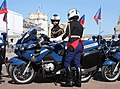
It consists of two infantry regiments (one includes a motorcycle squadron) and a horse cavalry regiment. It also has four musical formations, as well as display teams demonstrating prowess in horseback or motorcycle maneuvers. The Guard is commanded by a general de division (major general). It is headquartered in the Quartier des Célestins,[4] Paris, built in 1895–1901, designed by the renowned French architect Jacques Hermant.

Cavalry regiment

[edit]
Cavalry
Cavalry officer
Mounted band

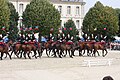
Headquartered in the Quartier des Célestins, and Quartier Carnot barracks the cavalry regiment is made up of approximately 480 gendarmes and civilians of whom a little more than 10% are women. It has approximately 550 horses (11% mares) and, following the disbanding of the Algerian Spahis in 1962, remain the last mounted regiment in the French armed forces.

The regiment is composed of:

  • Three squadrons[5] of cavalry (the first is based at Quartier des Célestins, in Paris, and two others based at Quartier Carnot, also in Paris at the fringe of Bois de Vincennes),
  • Reserve squadron
  • A squadron hors rang (based at Les Célestins) and composed of:
  • The training centre (centre d'instruction) at Quartier Goupil Saint-Germain-en-Laye
  • Hunting Horns Platoon (Trompes de Chasse de la Garde)

This unit has a section of high level sportsmen, in particular Hubert Perring, dressage champion of France in 2005, and member of the French team for the World Equestrian Games of 2006.

The Guard Cavalry Regiment is twinned with the British Household Cavalry Mounted Regiment, the Italian Carabinieri Cavalry Regiment and the Senegalese Red Guard.

Special displays of the cavalry regiment

[edit]

Exhibition drill squads present five shows and reenactments:

  • le carrousel des lances (the lancer's carrousel);
  • la maison du Roy (the King's household cavalry);
  • la reprise des tandems (the tandem riders);
  • la reprise des douze (demonstration/lesson with 12 riders);
  • l’équipe de démonstration de sécurité publique (modern mounted police demonstration)

Infantry regiments

[edit]
Republican Guard Infantry in ceremonial uniform.

The Republican Guard has two regiments of infantry:

  • The first infantry regiment is composed of :
  • the second infantry regiment is composed of :
    • Regimental HQ
    • Compagnie de sécurité de l'Hôtel Matignon (prime minister security company)
    • Compagnie de sécurité des palais nationaux (CSPN) (national palaces security company; i.e., national assembly and senate)
    • Four compagnies de sécurité et d'honneur (CSH)
    • Auxiliary platoon

Each of the seven security and honor companies is composed of three regular sections (i.e., platoons) and one peloton d'intervention (intervention platoon). The regular sections perform ceremonial duties and guards. The intervention platoons provide special security in the government buildings and palaces protected by the Guard. They are also tasked with police missions in support of the Gendarmerie in the Paris area (home arrests, escorts etc.). One of the seven intervention platoons is permanently deployed on a rotational basis to either French Guiana in support of forces combating illegal gold mining or to another French oversea territory (typically Guadeloupe or Saint Martin).

Special displays of the infantry regiments

[edit]
  • Bayonet drill team (quadrille des baïllonnettes; 1st régiment)
  • The battery fanfare band
  • The Napoleonic Drumline, made up of drummers wearing uniforms of the Napoleonic Wars
  • Emperor's grenadiers company, serving as a reenacting unit (2nd régiment)
  • Motorcycle display teams
Orchestra of the Republican Guard

Depending on needs, the orchestra performs in three configurations:

  • the concert band (80 musicians)
  • the string orchestra (40 musicians), likely to be presented in configurations of 24 or 12 bows, or in string quartets
  • Symphony orchestra (80 musicians)

It was founded in 1848 by Jean-Georges Paulus.

Armed Forces Choir

This men's choir is composed of 46 professional singers. In spite of its name (Choir of the French army), it is part of the Guard and thus reports to the Gendarmerie and through the Ministers of the Armed Forces and Interior (owing to the military character of the service). The choir performs mainly during official ceremonies and commemorations but also during festivals and sport events of national and international importance. Since 2007, it has been led by a woman, Major Aurore Tillac, who serves as choir master and director.

Commanders of the Republican Guard

[edit]
  • 1813–1815: Colonel Bourgeois
  • 1815–1815: Colonel Colin
  • 1815–1819: Colonel Tassin
  • 1819–1820: Colonel Christophe de la Motte Guerry
  • 1820–1822: Colonel Tassin
  • 1822–1830: Colonel Foucaud de Malembert
  • 1830–1831: Colonel Girard
  • 1831–1839: Colonel Feisthamel
  • 1839–1843: Colonel Carrelet
  • 1843–1848: Colonel Lardenois
  • 1848–1849: Colonel Raymond
  • 1849–1849: Colonel Lanneau
  • 1849–1852: Colonel Gastu
  • 1852–1855: Colonel Tisserand
  • 1856–1858: Colonel Texier of the Pommeraye
  • 1859–1862: Colonel Faye
  • 1862–1868: Colonel Letellier-Blanchard
  • 1868–1870: Colonel Valentin
  • 1870–1873: General Valentin
  • 1873–1875: Colonel Allavene
  • 1875–1875: Colonel Grémelin
  • 1875–1877: Colonel Lambert
  • 1877–1881: Colonel Guillemois
  • 1881–1886: Colonel Azaïs
  • 1886–1889: Colonel Massol
  • 1889–1894: Colonel Mercier
  • 1894–1895: Colonel Risbourg
  • 1895–1897: Colonel De Christen
  • 1897–1899: Colonel Quincy
  • 1899–1902: Colonel Prevot
  • 1902–1903: Colonel Doutrelot
  • 1903–1904: Colonel Weick
  • 1904–1909: Colonel Bouchez
  • 1909–1910: Colonel Vayssière
  • 1910–1914: Colonel Klein
  • 1914–1917: Colonel Brody
  • 1917–1917: Colonel Lanty
  • 1917–1918: Colonel Brione
  • 1918–1922: Colonel Somprou
  • 1922–1924: Colonel Pacault
  • 1924–1926: Colonel Verstraete
  • 1926–1928: Colonel Miquel
  • 1928–1930: Colonel Moinier
  • 1930–1935: Colonel Gibaux
  • 1935–1936: Colonel Maze
  • 1936–1938: Colonel Durieux
  • 1938–1941: Colonel Ruel
  • 1941–1943: Colonel Martin
  • 1943–1944: Colonel Pellegrin
  • 1944–1944: Colonel Charollais
  • 1944–1944: Lt-Colonel FFI Chapoton
  • 1944–1944: Colonel Houllier
  • 1944–1945: Lt-Colonel Heurtel
  • 1945–1948: Colonel Gauduchon
  • 1948–1953: Colonel Nicolini
  • 1953–1957: Colonel Pelabon
  • 1957–1959: Colonel Dorin
  • 1959–1961: Colonel Bouchardon
  • 1961–1964: Colonel Gérard
  • 1964–1969: Brigadier general Dumont
  • 1969–1970: Colonel Chevrot
  • 1970–1976: Brigadier general Herlem
  • 1976–1980: Brigadier general Personnier
  • 1980–1984: Brigadier general de la Rochelambert
  • 1984–1986: Brigadier general Depardon
  • 1986–1988: Brigadier general Hérisson
  • 1988–1991: Brigadier general Kretz
  • 1991–1995: Brigadier general Lorant
  • 1995–1998: Brigadier general Villermain-Lecolier
  • 1998–2000: Brigadier general Puyou
  • 2000–2002: Brigadier general Prigent
  • 2002–2004: Brigadier general Schott
  • 2004–2007: Brigadier general Poupeau
  • 2007–2010: Divisional general Moulinié
  • 2010–2014: Divisional general Schneider
  • 2014-2019: Divisional general Striebig
  • 2019-2023: Divisional general Bio-Farina[6]
  • 2023 onwards: Divisional general Thomas[7]

Alliances

[edit]
[edit]

See also

[edit]

References

[edit]
[edit]
Revisions and contributorsEdit on WikipediaRead on Wikipedia
from Grokipedia
The Garde républicaine is an elite branch of the French dedicated to securing national palaces and institutions in , executing protocol for state ceremonies and dignitary escorts, and supporting public order via intervention platoons, motorcycle convoys, and mounted units. Commanded by a général de division, it encompasses nearly 3,500 and civilian personnel organized into two regiments, one with around 450 riders, an état-major, specialized formations including counter-sniper teams trained by the , and musical ensembles such as the Orchestre symphonique and Chœur de l'Armée française. As successor to the ancient Garde de Paris tracing origins to the Frankish kings, it maintains ceremonial traditions like those seen in parades on the Champs-Élysées while deploying daily for high-risk operations, such as prisoner transports and event security including the since 1953. Its multifaceted role underscores a commitment to institutional protection, national prestige, and operational versatility without notable public controversies, embodying continuity in France's heritage amid evolving security demands.

History

Origins and Early Formation

The Garde municipale de Paris, the direct institutional predecessor to the modern Garde républicaine, was established on , 1802 (12 Vendémiaire An XI), by decree of First Consul Napoleon Bonaparte to maintain public order in the capital following the suppression of royalist unrest. This force comprised approximately 1,000 men organized into and components, tasked with policing duties, escorting dignitaries, and ceremonial functions, drawing personnel from veteran soldiers to ensure loyalty and discipline. The unit faced repeated political disruptions tied to regime changes. Reformed after the of 1830 under the , it was again dissolved amid the of 1848, which overthrew King Louis-Philippe and established the Second Republic, as revolutionaries viewed it as a symbol of monarchical authority. In response to ongoing instability, including the , the provisional government created the Garde républicaine de Paris in June 1848, explicitly republican in name and orientation, to safeguard republican institutions and suppress counter-revolutionary threats. This new formation included one infantry regiment and one cavalry regiment, totaling around 2,500 personnel, with recruitment prioritizing ideological reliability and military experience to counter the earlier Garde mobile's volatility. On February 1, 1849, it was formally integrated into the , marking its transition from a municipal to a national entity while retaining elite status for Paris security and honors. Early operations emphasized rapid response to riots and protection of assemblies, establishing precedents for dual ceremonial and operational roles that persisted through subsequent regimes.

Evolution Through Republics and Wars

The Garde républicaine de Paris was established in June 1848 during the Second Republic, following the dissolution of the Garde municipale de Paris amid the February Revolution; it consisted of one infantry regiment of approximately 2,000 men and one cavalry regiment of 600 men tasked with special police duties in the capital. On 1 February 1849, by decree of President Louis-Napoléon Bonaparte, the unit was integrated into the Gendarmerie nationale, marking its formal militarization and alignment with republican institutions while retaining elite status for Paris security. Under the Second Empire (1852–1870), the Garde operated as the Garde de Paris, focusing on urban order amid political consolidation, but regained its republican designation on 10 September 1870 via decree during the Franco-Prussian War's siege of Paris, as imperial authority collapsed. In the ensuing Third Republic, proclaimed in 1870, the unit supported government forces against the uprising (March–May 1871), conducting patrols and suppressions that reinforced its role as a bulwark for nascent republican stability. On 14 July 1880, President presented the Garde with its flag and standard, symbolizing institutional entrenchment. During the (1870–1871), the Garde maintained internal security in besieged , organizing defenses alongside hastily formed regiments amid resource shortages and urban unrest. In (1914–1918), while primarily assigned to surveillance, approximately one-third of its personnel volunteered for frontline service in a dedicated legion; of 1,125 deployed, 218 were killed, reflecting significant contributions to combat despite its ceremonial mandate. (1939–1945) saw the Garde fragmented by occupation; elements formed the "Saint-Jacques" Resistance network, with members like Jean Vérines executed in 1943 for sabotage and intelligence activities against and German forces. In November 1940, the related Mobile Republican Guard was dissolved under , but -based units persisted in limited protective roles until liberation.

Postwar Reorganization and Contemporary Role

Following the in , the Garde républicaine was reconstituted as a subdivision of the Gendarmerie nationale under the Provisional Government of the French Republic. Between 1945 and 1946, its structure underwent reorganization, including the reconfiguration of its légions to align with postwar security and ceremonial needs. A significant restructuring occurred in , when the existing was divided into two distinct units—the 1st and 2nd Regiments of the —each assigned specialized missions, while the retained its role in mounted duties. This reform clarified operational boundaries, enhancing efficiency in both honor guard functions and protective services. In its contemporary role, the Garde républicaine maintains a dual mandate within the nationale, encompassing ceremonial protocols for state events such as parades and foreign dignitary visits, alongside security operations protecting key institutions like the Élysée Palace, , and . It contributes to public order in through patrols, event security, and rapid intervention teams equipped for urban threats, including counter-sniper units and pelotons d'intervention. Recent adaptations include the establishment of a judicial support cell and designation of select personnel as officiers de police judiciaire to bolster investigative capabilities. As of June 1, 2024, the unit resumed full responsibility for securing the Palais de Justice in , integrating advanced surveillance and response protocols amid heightened urban security demands. These evolutions reflect a balance between tradition—such as equestrian displays and musical ensembles—and modern imperatives like intelligence gathering and counter-terrorism support, ensuring the Guard's adaptability to evolving threats without compromising its symbolic representation of the Republic.

Missions and Responsibilities

Ceremonial and Symbolic Duties

The Garde républicaine ensures the military protocol of the French state, rendering honors and providing guards of honor at official ceremonies for the President, foreign heads of state, and parliamentary leaders. This includes foot services, mounted or motorcycle escorts during events on the Esplanade des Invalides and Champs-Élysées, and salutes to presidents of the and at session openings. In the annual Bastille Day military parade on July 14, the unit's infantry and cavalry components participate prominently, with the 2nd Infantry Regiment marching in the foot parade and cavalry squadrons providing mounted displays and escorting the presidential convoy from the Arc de Triomphe. These elements symbolize national unity and military tradition, drawing on the unit's historical role in public ceremonies since the Second Republic. At the , the Garde républicaine maintains a permanent guard of honor, comprising over 210 personnel including sections, dismounted , and musicians in full dress uniforms, who render honors to high-ranking visitors per protocol guidelines. The public "Grande Relève" changing of the guard occurs on the first Tuesday of each month, featuring two sections of 16 infantrymen marching from avenue de Marigny to rue de l’Élysée for a 24-hour posting in the Cour d’honneur, accompanied by salutes and musical fanfares. Symbolic duties extend to cultural representations through the Musique de la Garde, including its symphonic orchestra and affiliated with the Armée française, which perform classical repertoires at state events, and the de Cavalerie for mounted parades. Equestrian units conduct precision displays such as carrousels and quadrilles, reinforcing France's equestrian heritage and supporting international training exchanges with foreign . These elements collectively embody the republic's institutional prestige and continuity.

Security and Protective Operations

The Garde républicaine maintains permanent security for six principal national palaces in Paris, including the , Matignon, the , Hôtel Beauvau, Hôtel de Brienne, , , and the Conseil Constitutionnel, with the 1st Infantry Regiment primarily responsible for the Élysée and the 2nd Infantry Regiment covering parliamentary institutions and other sites. Approximately 900 gendarmes are deployed daily for these duties, incorporating surveillance, access control, and rapid response measures. Additional protection extends to the Palais de Justice and temporary reinforcements for French embassies during crises abroad. Specialized protective operations rely on elite units such as seven Pelotons d'Intervention de la Garde Républicaine (PIGR), operational 24 hours a day, 7 days a week, which execute high-risk arrests, prisoner escorts, and support for in searches and interventions. These platoons, each comprising about 15 selected personnel, augment departmental efforts in maintaining order, securing sites, and conducting reinforcements beyond standard public order tasks. Counter-sniper teams, trained annually by the using precision rifles, provide overwatch and neutralization capabilities for site defense. Cavalry components enhance protective mobility with three mounted surveillance and intervention platoons, two groups in and , and nine horse posts dedicated to public safety patrols in challenging urban and terrain conditions. Motorcycle escadrons secure sensitive convoys and have provided escort for the since 1953. Personnel undergo specialized training in marksmanship, crowd management, and operational tactics to support territorial units and contribute to the defense opérationnelle du territoire (DOT). These efforts represent the majority of the unit's activities, emphasizing institutional safeguarding over ceremonial functions.

Auxiliary and Support Missions

The Garde républicaine performs auxiliary missions that supplement its core ceremonial and protective functions, including rapid intervention and operational support to broader activities. Specialized units such as the Sections de Réaction Rapide (SRR) in the 1st and 2nd Regiments enable quick deployment of heavily armed personnel for events requiring heightened , including legislative elections and international summits like the Francophonie Summit. The 1er Régiment d'Infanterie maintains a d'appui tactique equipped with elite snipers from the , which provides overwatch for national palace security, aids departmental units in operations, and supports rapid interventions in overseas territories. These capabilities extend to territorial defense under the Défense Opérationnelle du Territoire (DOT) framework, incorporating anti-drone systems and explosive-detection dogs for nationwide or expeditionary projection. Cavalry elements contribute to public security through 5,000 annual patrols in , accumulating 30,000 hours of operational time, during which personnel exercise Officier de Police Judiciaire (OPJ) authority to conduct identity checks and issue fines. Groupements tactiques formed from Garde units deliver logistical and tactical assistance to national police in judicial inquiries, as evidenced in operations at . During major national events, such as the 2024 Olympic and Paralympic Games, the Garde républicaine augments its standard duties with logistical support, including automotive resources and civilian services, to bolster overall operations. initiatives, like the OPSIS program for protection operators and commando instruction at dedicated centers, further enable these support roles by enhancing with partner forces.

Organization and Structure

Cavalry Components

The cavalry component of the Garde républicaine is organized as the Régiment de Cavalerie, the sole mounted unit remaining in the , comprising approximately 500 personnel and an equivalent number of horses. This regiment handles ceremonial duties, public security patrols, and protocol services for state authorities, with detachments supporting infantry elements in and surrounding areas. The regiment's structure includes four escadrons de cavalerie, a de cavalerie, a veterinary group, and a training center. The three primary escadrons de marche each maintain an effective strength of about three officers and 115 subordinates, focusing on mounted operations for honor guards, , and public order maintenance.) These squadrons deploy for events such as the parade and daily patrols, with horses selected for uniformity: the first escadron uses (alezan) mounts, the second horses, and the third bay-brun varieties, totaling around 460 to 500 animals stabled at the barracks. The fourth escadron specializes in public security missions, including crowd control and intervention support, while also contributing to ceremonial roles; it operates both mounted and dismounted, integrating with the regiment's broader capabilities. The fanfare provides musical accompaniment for parades, the veterinary group ensures equine health, and the instruction center handles recruitment, training, and maintenance of riding proficiency among gendarmes selected for their equestrian skills. Recent enhancements include mounted combat training to bolster operational versatility beyond traditional roles.

Infantry Components

The infantry components of the French Republican Guard consist of two dedicated regiments: the 1st Regiment (1er Régiment d'Infanterie de la Garde républicaine) and the 2nd Regiment (2e Régiment d'Infanterie de la Garde républicaine). These units, part of the , focus on security, protection of key institutions, and ceremonial duties on foot, complementing the elements. The 1st Infantry Regiment, headquartered in , is primarily responsible for security operations linked to the and the Presidency of the Republic. It provides close protection details, , and defensive measures for the presidential residence, rendering honors exclusively to the President. This maintains intervention platoons (pelotons d'intervention) capable of rapid response to threats, alongside routine guard posts and patrols. The 2nd Infantry Regiment handles protection missions for parliamentary institutions, including the and , as well as several national palaces such as the . As the only armed force authorized to enter parliamentary enclosures, it conducts internal security sweeps, escort duties, and maintains order during sessions. The regiment also supports public order maintenance and ceremonial escorts in , with specialized teams for counter-sniper roles and demonstrations. Both regiments undergo rigorous training in urban combat, marksmanship, and drill formations, enabling them to alternate between operational security shifts and public honor services, such as Bastille Day parades. Personnel are selected from experienced gendarmes, ensuring high readiness for dual ceremonial and protective roles.

Specialized Support Units

The specialized support units of the Garde républicaine include musical formations and the escadron motocycliste, which provide ceremonial enhancement and motorized operational assistance distinct from the primary cavalry and infantry components. These units total several hundred personnel integrated into the overall force of approximately 3,000 guards, supporting missions through technical and artistic expertise. The formations musicales consist of the Orchestre de la Garde républicaine and the Chœur de l'Armée française, both stationed under the Garde républicaine's command. The orchestra, comprising around 60 professional musicians selected from military and civilian backgrounds, performs at national ceremonies such as parades, state funerals, and diplomatic receptions, maintaining a repertoire of classical, , and contemporary French music. The choir, with about 40 singers, specializes in vocal ensembles for official events, including the annual commemorations on November 11, and collaborates with the orchestra for large-scale performances that symbolize republican traditions. These units undergo rigorous training in musical proficiency and , ensuring synchronization with ceremonial protocols established since the Garde's postwar reorganization in 1945. The escadron motocycliste, operational since the early but formalized in its current structure post-World War II, fields approximately 100 riders equipped with motorcycles for high-speed escorts, urban patrols, and rapid response in the region. This unit supports VIP convoys, such as those for the , and participates in public order maintenance during major events, leveraging specialized training in defensive driving and tactical maneuvering conducted annually at facilities. Its role extends to ceremonial displays, including carrousels and precision riding demonstrations that highlight technical skill and unit cohesion. These support units integrate with the Garde's broader operational framework, providing logistical and representational capabilities that amplify the prestige of French institutions without direct combat engagement. Their effectiveness is evidenced by consistent participation in over 1,000 annual events, from security perimeters to cultural outreach, as audited in recent governmental reviews.

, , and Capabilities

Armament and Vehicles

The Garde républicaine employs standard-issue weaponry for security and protective operations, including the F1 5.56 mm utilized in training exercises such as mounted combat and ceremonial parades. Non-lethal options complement lethal arms, consistent with broader protocols for and intervention. Edged weapons consist primarily of ceremonial sabres, with approximately 1,300 units in models , , and maintained by specialized armuriers who perform soldering, burnishing, , and handle fabrication using beech wood cores wrapped in and brass. These sabres serve in honor guards and equestrian displays, emphasizing tradition over modern combat utility. Vehicles encompass motorcycles for escort and rapid response, notably the R 1250 RT adopted since for the escadron motocycliste's daily missions, supplemented by models like the R 1200 RT and for interception duties. Automobiles and specialized intervention vehicles support pelotons d'intervention, while equestrian units rely on horses for patrols and ceremonial formations near key sites like the . No heavy armored platforms are standard, aligning with the unit's focus on urban security rather than frontline combat.

Selection and Training Processes

Selection for the Garde républicaine occurs primarily among serving members of the French National , with recruitment focused on sous-officiers (non-commissioned officers) through competitive concours processes, either internal or external. Candidates must hold a diploma and meet general eligibility criteria, including being between 18 and 35 years old, having completed the Journée Défense et Citoyenneté (mandatory civic service orientation), and demonstrating physical aptitude via medical and fitness evaluations. Assignment to the Garde républicaine depends on performance ranking during initial gendarmerie training, prioritizing those with interest in security, intervention, and ceremonial duties. For cavalry positions, additional specialized criteria apply: candidates require a minimum Galop 5 equestrian validated by the Fédération Française d'Équitation, along with at least two years of operational experience as a gendarmerie sous-officier in units such as territorial brigades or mobile squadrons. No formal is strictly mandated beyond preferences for baccalauréat-level education, but strong physical conditioning and prior horse-handling knowledge are emphasized to handle the unit's mounted operations. roles prioritize for prolonged static guards and equipment carriage, with selection favoring those excelling in concours physical and technical tests. Training commences with standard gendarmerie sous-officier formation, which includes academic, physical, and tactical instruction at designated schools, followed by unit-specific adaptation. Upon selection for the Garde républicaine, personnel undergo targeted specialization: cavalry recruits complete a 15-week course at the Centre d'Instruction de Cavalerie in , covering mounted shooting, without dismounting, and refinement. Infantry training emphasizes parade-ground , protective tactics, and endurance for extended patrols or posts, integrated into ongoing operational readiness. All training is remunerated and culminates in evaluation for full integration into the regiment's dual ceremonial and mandates.

Operational Readiness and Effectiveness

The French maintains high operational readiness through rigorous selection processes, programs, and specialized units tailored for rapid response and protection duties. Since its full integration into the in January 2023, the Guard has adhered to elevated operational standards, enabling permanent projection capabilities both domestically and abroad. Specialized teams, including snipers, anti-drone sections, and explosive detection dogs, ensure immediate availability for threat neutralization. Two intervention platoons are continuously deployed overseas, demonstrating sustained deployability. Training emphasizes combat proficiency and , with the OPSIS program providing three levels of instruction for individual defense against attacks lasting up to 45 minutes. A three-week commando course at the dedicated training center incorporates close-quarters battle (CQB) techniques, often conducted jointly with units such as U.S. , and equips personnel with G3 rifles, auditory protection, and communication systems. Intervention platoons undergo stringent initial selection tests followed by specialized formation, focusing on high-threat scenarios like VIP protection and airspace security during major events. Effectiveness is evidenced by operational deployments, such as deploying 200 horses daily during the 2024 Paris Olympics for enhanced coverage and conducting 30,000 hours of patrols annually across 5,000 missions in . Restructuring initiatives have boosted efficiency, with 120 cavalry personnel replacing the equivalent of seven infantry squadrons during the 2022 Francophonie Summit, and overall effectives increasing from 3,100 to 3,500 while doubling infantry capacity through new rapid reaction sections. These Sections de Réaction Rapide (SRR) have been activated for events like legislative elections, underscoring adaptable response capabilities. However, a 2024 review by the Cour des comptes highlighted imbalances, noting that security companies often exceed standard mobilization hours, potentially limiting training time, while intervention platoons see limited palace duty (under 5% of assignments). The audit, covering 2022 expenditures of €230 million, recommended uniform training protocols, intensified operational roles for underutilized , and evaluations before expanding intervention units to optimize readiness without inflating costs. Despite these concerns, the Guard's 2023-2026 action plan targets enhanced competencies and process renovations to sustain core security functions.

Notable Operations and Achievements

Key Historical Engagements

The Garde républicaine, formed in June 1848 amid the Second Republic, immediately participated in suppressing the in from 22 to 26 June, where approximately 50,000 workers erected barricades in response to the government's closure of national workshops. Deploying its newly organized and regiments alongside units, the Guard conducted urban assaults and policing actions that helped crush the revolt, resulting in over 4,000 insurgent deaths and the arrest of 11,000 participants, thereby securing the provisional government's authority. During , following the mobilization order of 2 August 1914, the Garde fulfilled dual roles: securing critical Paris sites including the , the , and government ministries against potential threats, while contributing personnel to frontline combat units. It dispatched all 76 career officers and 1,500 enlisted men—over one-third of its strength—to army formations, where they served in and roles until the on 11 November 1918. In the , the Garde maintained mobile squadrons equipped with armored vehicles, exemplified by the Groupe spécial de garde républicaine mobile established in at Versailles-Satory, which operated light tanks and participated in defensive maneuvers until the German invasion in led to its dissolution. These units focused on rapid response for internal security rather than extended field campaigns. The Garde's most significant overseas deployment occurred during the from 1947 to 1954, when it formed and dispatched three Légions de Marche (1re, 2e, and 3e LGRM), totaling around 3,000 personnel initially, with additional rotations bringing the figure to over 17 officers and 974 guards by war's end. These legions conducted pacification operations, convoy escorts, and gendarme training for Vietnamese forces, earning a collective citation in army orders on 5 February 1949 and the des Théâtres d'Opérations Extérieures with palms for their contributions to efforts.

Modern Security Contributions

The Garde républicaine maintains a core mission of securing national palaces and institutions in , including the , where over 210 gendarmes from the 1st Infantry Regiment provide continuous protection for the presidency and close-quarters defense for the president and first lady. This role extends to year-round defense of government members and parliamentary sites, ensuring operational readiness against threats through specialized detachments. In response to heightened terrorism risks following attacks like those in , the unit has bolstered its intervention capabilities, with seven Pelotons d'Intervention de la Garde Républicaine (PIGR) available 24/7 for rapid response, hostage situations, and support to operations in the Paris area. Each PIGR consists of 15 selected sous-officiers trained for high-risk scenarios, including anti-terrorism exercises involving equipment and ballistic helmets. The cavalry regiment contributes to security through mounted patrols and reconnaissance, with recent developments emphasizing combat-mounted operations for urban and rural threat mitigation, deployable in support of broader armed forces needs. During the 2024 Paris Olympics, the Garde républicaine served as an operational security actor, deploying patrols—including horseback units—for site protection and public order maintenance amid unprecedented threat levels, integrating snipers, anti-drone sections, and intervention teams into the multi-agency framework. These efforts align with the unit's dual mandate of institutional safeguarding and public security reinforcement, as evaluated in a 2024 audit confirming its effectiveness in palace defense while noting resource strains from concurrent ceremonial duties. Overall, the Garde républicaine's modern contributions emphasize proactive threat neutralization in high-profile urban environments, leveraging elite training to complement national gendarmerie operations without direct involvement in deployments like Operation Sentinelle, which primarily utilize army and mobile gendarmerie assets.

Ceremonial and Public Engagements

The Garde républicaine undertakes ceremonial duties encompassing honour guards, escorts, and protocol services for high-level state functions, ensuring the military representation of the French Republic. These include foot, mounted, and motorized escorts during official commemorations such as those on 8 May and 11 November at the esplanade des Invalides, as well as state visits and presidential events. The unit's infantry regiment specifically renders honours to senior state figures and animates key military ceremonies and arms presentations. A prominent annual engagement is the Bastille Day military parade on 14 July, where the Garde républicaine provides the grande escorte for the President of the Republic during the troop review along the Champs-Élysées. In 2024, this escort accompanied President Emmanuel Macron in the parade sequence following the aerial flyover. The cavalry regiment contributed 157 horses and riders to the mounted segment in the 2025 parade, highlighting their equestrian precision. Over 700 gendarmes from the unit, including presidential motorcycle escorts, participated in that event. Public demonstrations form another facet, promoting the unit's heritage through specialized performances. The cavalry's carrousel des lances exemplifies tight-order horsemanship, emphasizing panache, rigor, and historical drill traditions. The acrobatics escadron conducts public shows featuring precision maneuvers, while the provides musical accompaniment to these events. Internationally, the Garde has engaged in joint ceremonies, such as participation in Monaco's festivities on 19 November 2024. These engagements underscore the of ceremonial prestige and public outreach, with the unit embodying republican traditions during official protocol and cultural displays.

Criticisms and Controversies

Financial and Efficiency Critiques

The Garde républicaine's total annual cost reached approximately €230 million in 2022, encompassing personnel, operations, and support functions, with a net expenditure of €195 million after reimbursements from state authorities and service revenues. This figure reflects chronic budget shortfalls, where initial allocations covered only about 50% of planned expenditures from 2018 to 2022, leading to over-execution and reliance on variable third-party funding. Personnel costs dominate, averaging €80,000 per operational gendarme and €90,000 including support staff annually, plus €18,000 per guard for housing. Specific expenditures have drawn scrutiny, particularly the cavalry regiment, which incurred over €44 million yearly, equating to roughly €131,000 per horse for 340 animals, with 38% of the unit's budget dedicated to equine maintenance, feed, veterinary care, and stabling. A 2013 audit by the Cour des comptes pegged overall costs at €280 million annually, criticizing inadequate billing for services provided to state entities and recommending better cost recovery to offset public funding. Efficiency concerns center on overburdened core units, such as security and honor companies, where gendarmes averaged 12-hour shifts daily, resulting in a 25% reduction in hours from 145 to 115 per gendarme between 2019 and 2023, alongside gaps in public order training limited to 10-15% of time. Underutilization affects specialized elements: the devoted 72% of time to horse maintenance and only 5.6% to honors or 6% to public order, while intervention platoons spent less than 5% of shifts on protection despite high focus. Redundancies exist in musical formations, overlapping with units and offering potential for 30 position savings through merger. The Cour des comptes has recommended rationalization measures, including reducing horse numbers and redeploying personnel, merging musical units, increasing intervention platoons' roles, rotating missions to enhance cohesion, delegating minor event to departmental , and revising tariffs to minimize discounts and improve revenue predictability. Earlier evaluations questioned the unit's capacity to counter terrorist threats, asserting it prioritized prestige over robust needs and lacked resilience against attacks in . High turnover rates—34% for administrative staff and 13% for gendarmes from 2018-2022—further strain operational readiness.

Debates on Role and Modern Relevance

The French Court of Auditors, in its July 2024 report, highlighted the Garde républicaine's annual operating costs exceeding €200 million, with a full cost per horse approaching €130,000, prompting questions about the unit's efficiency in fulfilling security and ceremonial missions amid fiscal constraints. The report recommended a comprehensive review of the organizational model, including optimizing the cavalry regiment's size and repurposing equestrian assets for broader operational roles beyond tradition, as static palace protection and honor services consume disproportionate resources relative to output. Critics, including taxpayer advocacy groups, have echoed these concerns, arguing that the unit's prestige-driven structure duplicates functions better handled by standard or police units at lower cost, with 2013 audits estimating total expenses at €280 million annually, including under-billed ceremonial services to other entities. Proponents of the Garde's current form counter that its enhances national cohesion and deterrence, with mounted units providing unique capabilities for crowd management and rapid response in urban settings, as evidenced by ongoing adaptations toward mounted proficiency reported in . These defenders emphasize empirical value in high-profile , such as protecting Parisian palaces housing institutions, where the unit's specialized —drawing from standards—yields higher readiness than ad-hoc deployments, despite higher per-personnel expenses driven by equine maintenance. However, the absence of quantified metrics for threat mitigation efficacy in official evaluations fuels ongoing skepticism, with the 2024 audit noting insufficient data to justify expansions in honor detachments amid evolving risks like . In broader discourse, the unit's relevance ties to France's republican traditions, where ceremonial permanence symbolizes institutional stability, yet fiscal realists question this in a post-2015 landscape favoring agile, tech-integrated forces over legacy formations. No major proposals for dissolution have gained traction, but iterative reforms—such as the push for inter-unit resource sharing—reflect a pragmatic balance, prioritizing verifiable outputs over unmeasured symbolic benefits.

Responses to Security Challenges

The Garde républicaine addresses security challenges through its specialized Pelotons d'Intervention de la Garde Républicaine (PIGR), seven infantry platoons dedicated to rapid response operations in the Paris region. These units support territorial detachments and judicial authorities in high-risk interventions, including arrests, searches, and neutralization of armed threats. Equipped with tactical gear, firearms, and vehicles suited for urban environments, the PIGRs undergo rigorous training in close-quarters combat, , and to maintain order during civil disturbances or targeted incidents. In response to elevated threat levels, such as those under the plan, the Guard deploys these platoons to secure institutional sites, including the and presidential residences, while coordinating with national police and other forces. Their role extends to providing counter- support via specialized tireurs d'élite units, enhancing protection against potential or elevated-position threats in the capital. This operational framework allows the Guard to transition from ceremonial duties to active measures, ensuring continuity in protecting key republican institutions amid urban pressures like protests or isolated attacks. The effectiveness of these responses is evidenced by frequent deployments for delinquency suppression and public order maintenance, as seen in coordinated operations against in . While primarily focused on the Paris area, PIGR detachments have also supported overseas security missions, demonstrating adaptability to diverse challenges such as riots or counter-narcotics actions. These capabilities underscore the Guard's dual role in ceremonial prestige and practical security, though their limited national footprint relies on integration with broader and military structures for large-scale threats.

Leadership and Alliances

Command Structure and Notable Leaders

The Garde républicaine is commanded by a of the nationale, typically a général de division, who oversees operational, ceremonial, and security missions from the Paris region headquarters. As of 2025, the current commandant is Général de brigade François-Xavier Lesueur, appointed to lead the unit's approximately 3,000 personnel across its specialized formations. The organizational hierarchy includes an état-major for administrative and strategic coordination, two infantry regiments—the 1er and 2e Régiments d'infanterie de la Garde républicaine—focused on public order, VIP protection, and rapid intervention; the Régiment de cavalerie de la Garde républicaine, the French military's sole mounted unit with over 500 horses for ceremonial and patrol duties; and dedicated musical units such as the Orchestre de la Garde républicaine and the Chœur de l'Armée française. The commandant is supported by a second-in-command, currently Colonel Vincent Lamballe, who assumed the role on September 1, 2024, and subordinate commanders for each regiment and specialized pelotons d'intervention (PIGR) equipped for counter-terrorism and high-risk security. Since , 2021, the Commandement des Maisons militaires (C2M) has integrated the Garde républicaine's presidential security elements with those of the Élysée's military household, enhancing coordination for protection of national institutions under the Ministry of the Interior's oversight via the nationale's . Notable leaders include historical officers recognized for valor in engagements, such as Capitaine Louis Artous, Chef d'escadron Jean Verines, Capitaine Paul Fontan, Lieutenant Jean-Georges Paulus, and Capitaine François Paoli, whose contributions to the unit's operational legacy are commemorated in official records. Modern commanders like Lesueur have emphasized modernization, including enhanced intervention capabilities amid evolving threats, as evidenced by the unit's integration into broader gendarmerie reforms.

International Partnerships and Exchanges

The Garde républicaine engages in select international partnerships and exchanges, emphasizing training , equestrian expertise, and ceremonial reciprocity with foreign counterparts. These initiatives, often coordinated through the broader nationale, aim to enhance tactical skills, diplomatic ties, and shared military traditions. A key collaboration involves the ' Security Force Regiment, building on Gendarmerie-wide ties established in 2014, with the Garde républicaine's active participation commencing in 2024. This partnership includes reciprocal training: two Garde républicaine personnel underwent tactical skills instruction in the United States, while three U.S. Marines completed a three-week course at the Garde républicaine's National Commando Training Center, focusing on site protection and embassy security detachment operations. The exchange culminated in a awarding insignias, presided over by General Charles-Antoine Thomas. Ceremonial exchanges feature prominently with the , exemplified by the April 8, 2024, reciprocal guard duties marking the 120th anniversary of the . Thirty-two Garde républicaine members performed guard duties at in , while 16 from the Number 7 Company of the joined the changing of the guard at the Élysée Palace in , integrating bilateral elements into standard protocols. This event underscored enduring Franco-British military camaraderie originating from the 1904 agreement. In the equestrian domain, a 2018 partnership with Chinese authorities, formalized during President Emmanuel Macron's , facilitated expertise transfer. It encompassed a French mission to provide training in and reciprocal formation programs in , including breaking, , and mounted honor services for Chinese riders, alongside the diplomatic gift of the Garde républicaine's Vésuve de Brekka to President Xi Jinping. This accord highlights the unit's role in promoting French equestrian excellence abroad.

References

Add your contribution
Related Hubs
User Avatar
No comments yet.