Hubbry Logo
Fugio centFugio centMain
Open search
Fugio cent
Community hub
Fugio cent
logo
8 pages, 0 posts
0 subscribers
Be the first to start a discussion here.
Fugio cent
Fugio cent
from Wikipedia

One cent
United States
Value0.01 U.S. dollar
Mass10.2 g
CompositionCopper
Obverse
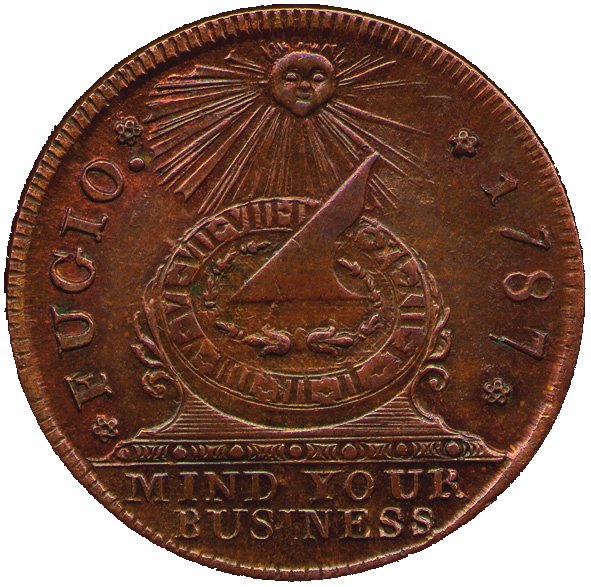
"New Haven Restrike", probably produced at the Scovill Mint in Waterbury, Connecticut
Design"Mind Your Business", Sun, and sundial
DesignerUnknown, reputedly Benjamin Franklin
Design date1787
Reverse
Design"We Are One" surrounded by the words "United States" and 13 state chain links
DesignerUnknown, reputedly Benjamin Franklin
Design date1787

The Fugio cent, also known as the Franklin cent,[1][2] is the first official circulation coin of the United States. Consisting of 0.36 oz (10 g) of copper and minted dated 1787, by some accounts it was designed by Benjamin Franklin. Its design is very similar to Franklin's 1776 Continental Currency dollar coin that was produced in pattern pieces as potential Continental currency but was never circulated.

History

[edit]
Continental currency 1/3-dollar note (obverse), with the inscriptions "Fugio" and "Mind your business".

On April 21, 1787, the Congress of the Confederation of the United States authorized a design for an official copper penny,[3] later referred to as the Fugio cent because of its image of the Sun and its light shining down on a sundial with the caption, "Fugio" (Latin: I flee/fly, referring to time flying by). By some accounts, this coin was designed by Benjamin Franklin; as a reminder to its holders, he put at its bottom the message, "Mind your business". This design was based on the 1776 "Continental dollar" coin, which was produced in pattern pieces but was never circulated.[4]

The reverse side of both the 1776 Continental dollar coins and paper notes, and the 1787 coins, bore the third motto "We Are One" (in English) surrounded by thirteen chain links, representing the original thirteen colonial states. Following the reform of the central government with the 1788 ratification of the 1787 Constitution, gold and silver coins transitioned to the motto "E pluribus unum" from the Great Seal of the United States.[5]

The Bank of New York Hoard

[edit]

In 1788, the Bank of New York stored several thousand Fugio cents in a keg in its basement. In 1856, the coins were put into cotton bags and stored away again. The trove was rediscovered in 1926.[2] The coins were then given out as souvenirs and keepsakes to clients until 1948 when the American Numismatic Society examined the remaining 1,641 coins. The cache became known as the Bank of New York Hoard. Several of the coins were donated to the Society, others were sold to collectors.[2][6] All of the coins found were in mint state condition, most with brown toning and some with water damage.[6][7] The bank retained 819 of the coins.[6][8]

Collecting

[edit]

The coin has been a long-time favorite of collectors, especially specialists in colonial American or early Federal coinage. In January 2022, the Fugio Cent was re-classified by major coin grading services as a "regular-issue United States coin".[9][10]

See also

[edit]

References

[edit]
[edit]
Revisions and contributorsEdit on WikipediaRead on Wikipedia
from Grokipedia
The Fugio cent, also known as the Franklin cent, is a minted in 1787 that represents the first official circulation coin authorized by the , the governing body of the prior to the ratification of the . Struck in response to shortages of small-denomination currency following the Revolutionary War, it addressed the need for a domestic coinage independent of foreign dependencies like British or Spanish coins then in common use. The obverse features a encircled by the Latin word "Fugio," meaning "I flee" and evoking the passage of time, paired with the English phrase "Mind Your Business," a design element inspired by to emphasize diligence and self-reliance. The reverse displays "We Are One" surrounding thirteen interlinked rings, symbolizing the unity of the original thirteen states under the . Dies for the coin were created by engraver Abel Buel in , with minting likely handled by local coppersmiths under congressional contract, though production was limited and ceased after a brief period due to the impending adoption of the and establishment of a federal minting authority. Its historical significance lies in marking the initial federal effort toward a national monetary standard, reflecting Enlightenment ideals of unity and productivity amid post-war economic challenges, and it remains a key artifact in American for collectors due to its rarity and symbolic motifs.

Design and Symbolism

Obverse Features

The obverse of the Fugio cent depicts a positioned beneath a sun with radiating rays, symbolizing the measurement and rapid passage of time. To the left of the appears the Latin word FUGIO, translating to "I fly" or "I flee," which underscores the fleeting nature of time as conceptualized by , the coin's attributed designer. Beneath , the motto MIND YOUR BUSINESS is inscribed in English, intended to convey a pragmatic exhortation for individuals to focus diligently on their personal endeavors amid life's brevity. This phrase, drawn from Franklin's philosophical influences, promotes and productivity rather than idleness. The overall layout balances these elements within a simple, uncluttered field, with the date "" typically positioned above the sun in surviving specimens, though variations exist due to minting inconsistencies. The design elements were struck using copper planchets, resulting in a low-relief profile that facilitated mass production at Abel Buell's private mint in New Haven, Connecticut, under congressional authorization. No portraits or national emblems adorn the obverse, distinguishing it from later federal coinage and reflecting the era's emphasis on symbolic utility over personalization.

Reverse Features

The reverse of the Fugio cent features a circular chain composed of thirteen interlinked rings, each representing one of the original thirteen states, to symbolize their interconnected unity under the Confederation. At the center of this chain is the inscription "WE ARE ONE," underscoring the importance of collective cohesion for the young nation's stability. The outer periphery bears the legend "," affirming federal authority over the currency. This design echoed motifs from Continental paper money, such as the 1776 $40 bills that displayed a similar chain of thirteen links with "We Are One," promoting economic and political interdependence amid wartime fragmentation. The absence of individual state names on the rings in the standard issue avoided favoritism, focusing instead on indivisible linkage, though some non-circulating patterns included state identifiers. The chain's unbroken form contrasted with potential disunion, aligning with Benjamin Franklin's advocacy for strong interstate bonds as expressed in his correspondence and currency proposals.

Mottos and Intended Meanings

The obverse of the Fugio cent bears two key inscriptions derived from Benjamin Franklin's earlier designs for Continental currency: "Fugio" positioned adjacent to a sundial beneath sun rays, and "Mind Your Business" at the base. "Fugio," translating from Latin as "I fly" or "I flee," combines with the sundial imagery to convey "time flies," serving as a reminder of time's transience and the urgency of productive action. "Mind Your Business" functions as an to focus on personal enterprise and , aligning with Franklin's of and self-sufficiency, as evidenced by his writings promoting industry over . Some interpretations extend this to caution users regarding the coin's value and circulation, though primary intent emphasizes individual responsibility in economic matters. The reverse inscription "We Are One," encircled by 13 interlinked chains representing the original states, underscores the imperative of national unity under the , symbolizing collective strength amid post-Revolutionary fragmentation. This motto reflects contemporaneous efforts to forge cohesion in the confederation's loose structure, predating the stronger federal bonds established by the 1787 Constitution.

Technical Specifications

Composition and Weight

The Fugio cent was composed of pure , with no specified alloying metals, reflecting the Continental Congress's resolution for simple copper coinage to facilitate small transactions under the . The authorized weight was 157.5 grains of , equivalent to 10.2 grams, aligning with contemporary standards for a one-cent piece intended to contain intrinsic value comparable to its face denomination. In practice, weights varied due to inconsistencies in preparation and striking by contractor Abel Buell; numismatic of surviving specimens shows averages of approximately 149.73 grains (9.7 grams) for uncirculated examples from original distribution bags, with broader ranges from 140 to 160 grains attributable to irregularities and quality control limitations.

Dimensions and Minting Process

The Fugio cent has a of approximately 28 , though individual specimens vary slightly due to the manual nature of early minting techniques. The coins feature a plain edge without , consistent with contemporaneous coinage practices. Minting occurred at Abel Buell's facility in , under a federal contract awarded to merchant James F. Jarvis on September 1, 1787, for the production of up to 300 short tons of cents. Buell, who had invented improved coinage presses and machinery, engraved the dies based on designs and mottos provided by . planchets were prepared by rolling imported French copper sheets to the desired thickness, annealing them for malleability, and cutting blanks of roughly 10 grams each before striking between the dies using Buell's screw-press technology. This process yielded an estimated 398,000 to 500,000 coins, all dated 1787 despite some production extending into 1788. The operation faced challenges including inconsistent planchet quality and die wear, contributing to varieties in strike quality and alignment.

Production and Key Figures

Congressional Authorization

On April 21, 1787, the resolved to authorize the striking of coins as the first official federal mintage, adopting a design submitted by through the Board of Treasury. The resolution specified a denomination of 100 coins per pound of , valued at one-hundredth of a Spanish milled dollar, to address the acute shortage of small change in circulation amid the depreciation of Continental paper currency. This action fell under Article IX of the , which granted Congress authority to regulate the alloy and value of coin struck with the assayer's mark, though lacking explicit power to compel states to accept the coins as . The Board of Treasury was directed to contract for up to 300 tons of such coins, with production allocated to private contractors including James Jarvis, who secured the primary deal despite limited prior minting experience. A follow-up resolution on May 8, 1787, empowered the Board to utilize existing public copper stockpiles for the effort. The authorization reflected pragmatic efforts to stabilize commerce without a centralized mint, predating the Constitution's , yet production yielded only a fraction of the intended volume due to contractor shortfalls and quality issues.

Minting by Abel Buell

Abel Buell, a Connecticut-based engraver, , and inventor, engraved the dies for the Fugio cents, adapting designs attributed to that featured a with "FUGIO" and "Mind Your Business" on the obverse, and 13 linked chain circles with "We Are One" and "" on the reverse. As owner and superintendent of the mint operation, Buell designed the coining equipment, including machinery for striking planchets into coins, at the facility on Chapel Street in , operated under the Company for Coining Coppers. The minting took place in 1788, with coins backdated to to align with congressional resolutions on the design issued in of that year, following an initial contract awarded to James Jarvis on , 1787, for up to 300 tons of coinage. Buell oversaw the striking , which produced approximately 11,910 pounds of Fugio cents, equivalent to about 554,741 pieces based on standard weight specifications, though this fell far short of the contracted volume due to financial and logistical constraints that led to the agreement's cancellation. The operation involved a workforce of around 34 individuals engaged in preparing blanks and operating the presses Buell had engineered. Buell's technical contributions marked an early American effort in mechanized coin production, drawing on his prior experience with Connecticut coppers, though the resulting Fugio cents exhibited variations in strike quality attributable to the nascent machinery and manual elements of the process.

Role of Slave Labor and Workforce

The production of the Fugio cent at Abel Buell's private mint in , relied on a diverse of 34 individuals, encompassing children, indentured apprentices, white unskilled laborers, skilled white craftsmen, one free Black man named Stevens, and one enslaved Black man named . This labor force operated under Buell's supervision from 1785 to 1788, with the Fugio cents—America's first federally authorized coinage—being struck primarily between 1787 and 1788 using Buell's hand-operated and engraved dies. Enslaved labor played a direct role through Aaron, owned by Levi Hubbard of New Haven, who was employed specifically to operate the press and stamp the sundial obverse and chain reverse designs onto copper planchets. Aaron's involvement is documented in Buell's wage ledgers from the New Haven Museum archives, with his first entry dated February 29, 1788, and last on June 25, 1788; he received four shillings per day, paid not to him but to Hubbard, though Aaron retained overtime earnings for additional hours worked. This arrangement reflected common Northern practices where enslaved individuals performed skilled manual tasks in workshops, supplementing free and indentured labor amid Connecticut's gradual emancipation laws that did not fully abolish slavery until 1848. While Aaron's stamping duties were essential to the mint's output—estimated at around 400,000 Fugio cents before quality issues and contractual disputes halted operations—his role represented a minority within the , highlighting the hybrid labor system in post-Revolutionary manufacturing. Stevens, the free Black worker, received wages directly, underscoring distinctions in compensation and status even among non-white laborers. Buell's reliance on such coerced labor aligned with economic necessities for low-cost production under the cash-strapped government, which contracted Buell despite his prior counterfeiting conviction.

Historical Context and Circulation

Development Under the Articles of Confederation

The Congress of the Confederation, operating under the Articles of Confederation from 1781 to 1789, sought to establish a unified national currency amid post-Revolutionary War economic instability, including hyperinflation from Continental paper money and a dearth of reliable small-change coins, which forced reliance on foreign coppers, bartered goods, and state-issued tokens. Article IX of the Articles empowered Congress to "regulate the alloy and value of coin struck by their own authority," providing a basis for federal coinage despite the government's limited enforcement mechanisms and lack of taxation powers. This initiative represented an early assertion of central monetary authority in a confederation where states retained significant sovereignty over commerce and fiscal policy. On April 21, 1787, following debates on national versus state coinage, Congress resolved to authorize the striking of copper cents at a federal standard, aiming to inject standardized small-denomination coins into circulation to facilitate everyday transactions and restore public confidence in federal monetary efforts. The resolution directed the Board of Treasury to oversee procurement, specifying coins of pure copper weighing approximately 157 grains each, with designs to include emblems promoting unity and time's passage. Benjamin Franklin contributed mottos such as "Mind Your Business" and "We Are One," drawing from his earlier colonial currency designs, while the sundial motif symbolized urgency in economic productivity. In July 1787, further instructed the Treasury to ensure stamping of "" on the coins, reinforcing federal identity, though implementation faced delays due to the need for suitable minting equipment and reliable contractors. The Board awarded a contract to merchant James Jarvis of , who partnered with local artisan Abel Buell to engrave dies and adapt machinery from Buell's prior colonial minting experiments, marking the transition from authorization to practical production in New Haven by late 1787. This development highlighted the Articles-era government's aspirations for economic cohesion but underscored its constraints, as the absence of coercive powers limited widespread adoption and enforcement against counterfeiting or state preferences for their own issues.

Issuance and Initial Use

The authorized the issuance of cents on April 21, 1787, establishing the Fugio cent as the first official federal coinage denominated at 1/100 of a silver . Specifications for the coin's weight (280 grains) and composition (pure ) were refined on July 6, 1787, with production contracted to Abel Buell in , who engraved the dies and oversaw striking. Although dated 1787, the majority of coins were minted in 1788 and backdated to align with the congressional resolution. Buell's operation produced an estimated 400,000 to 500,000 Fugio cents, though records indicate approximately 554,000 were struck before the contract faced complications, with not all delivered to the federal government. The coins were transported to the Board of Treasury in New York, where they were inspected, accepted per the authorized standards, and prepared for release. Intended to address the acute shortage of small-denomination following the Revolutionary War, the Fugio cents were distributed into circulation primarily in the starting in late 1787 and 1788. They facilitated minor transactions in , such as local and retail exchanges, under the loose monetary framework of the , representing the initial federal effort to standardize low-value payments amid reliance on foreign and colonial coins.

Factors Leading to Limited Circulation

The Copper Panic of 1789 severely undermined confidence in coinage across the early , directly contributing to the Fugio cent's restricted use. This crisis stemmed from an influx of lightweight, debased coins imported primarily from Britain and , which flooded the market and drove down the value of all coppers by approximately 75 percent. Despite the Fugio cent's status and higher quality—struck from pure planchets weighing about 157 grains each—these coins suffered from the generalized distrust, trading at depressed rates far below their intended one-cent denomination. Production constraints further hampered circulation, as contractor James failed to fully execute his obligations under the April 2, 1787, congressional resolution. Although ordered 300 tons of copper planchets from , only an estimated 398,577 Fugio cents were ultimately struck, based on records of 8,968 pounds delivered to the at a rate of 2.25 pounds per 100 pieces. Jarvis diverted much of the remaining copper to mint underweight Connecticut coppers for higher profit margins, leading to early termination of Fugio production and incomplete distribution. Significant prevented broader release into . In 1788, the Bank of New York purchased a substantial quantity—potentially thousands of pieces—in uncirculated condition, storing them in its vaults rather than circulating them, which kept a large portion out of everyday use until rediscovery in the . Other private acquisitions and limited government dispersal compounded this, with many coins remaining in mint state and showing minimal early wear, indicative of over active exchange. Under the , the absence of a centralized mint and enforcement exacerbated these issues, as states lacked unified mechanisms to compel acceptance of the Fugio cent amid preferences for established foreign silver coins like the . The lack of a firmly established valuation system for small change also meant coppers, including Fugios, circulated at variable local rates rather than a standardized cent, further diminishing their utility until federal coinage reforms post-Constitution.

Varieties and Numismatic Details

Die Varieties and Differences

The Fugio cents, struck from hand-engraved dies prepared by Abel Buell in 1787 (though minted primarily in 1788), exhibit extensive die varieties resulting from manual craftsmanship and multiple die pairings, with numismatists identifying up to 55 combinations from 24 obverse dies and 33 reverse dies. These variations arise primarily from differences in ornamental elements, lettering styles, ray configurations, and occasional misspellings, reflecting the rudimentary production process without standardized tooling. Eric P. Newman's comprehensive study serves as the standard reference for classifying these, emphasizing diagnostic features like die pairings rather than treating all as identical "Fugio cents." Obverse dies feature a central encircled by "FUGIO" (Latin for "I fly") above and "MIND YOUR BUSINESS" below, flanked by the date "," with variations centered on the number and placement of cinquefoils—five-petaled floral ornaments—positioned between "FUGIO" and the date or around the rim. Major categories include the 4-cinquefoil obverses, which display four such ornaments symmetrically arranged, and no-cinquefoil obverses lacking them entirely, leading to cleaner but less ornate fields. Subtle differences within these groups involve , such as tighter or looser alignment of "MIND YOUR BUSINESS," or minor engraving errors like a reversed "N" in rare instances, each constituting unique dies when paired differently. Reverse dies depict a chain of 13 interlocking rings symbolizing the states, inscribed "WE ARE ONE" in the center, surrounded by radial rays emanating from the hub and an outer legend. Key distinctions include the legend text—"UNITED STATES" (most common) versus the scarcer "AMERICAN CONGRESS"—and ray types: club rays with concave, rounded ends versus pointed rays with tapered tips, the latter often paired with "AMERICAN CONGRESS" for rarer combinations. Additional markers encompass the presence or absence of inner concentric rings around the rays, ray thickness (e.g., 13 thick rays in some "AMERICAN CONGRESS" dies), and anomalies like reversed "STATES UNITED" phrasing or misspellings such as "FUCIO" on select obverse-reverse pairings. Die states further differentiate progressive wear, such as cracks developing from the sundial spokes or chain links, but primary variety attribution relies on initial design divergences traceable to Buell's iterative engraving. These die-linked varieties, documented through comparative die analysis in numismatic references, underscore the coins' artisanal origins and enable precise attribution in collections, with over 30 pairings under the 4-cinquefoil "" group alone.

Rarity and Condition Factors

Fugio cents exhibit considerable variation in rarity depending on the specific die variety, as cataloged by numismatist Eric P. Newman, with estimates ranging from common types (rarity 1-3, hundreds known) to extreme rarities (rarity 7-8+, fewer than 10 survivors). For instance, the Newman 10-OO variety is rated rarity 8+, while others like 7-T are rarity 4, reflecting differences in die usage and survival rates influenced by production quality and historical hoarding patterns. Overall, approximately 3,800 to 4,000 examples across all varieties have been certified by PCGS and NGC combined, underscoring their scarcity relative to later U.S. copper coinage, though ungraded pieces likely exist in private holdings and institutions. Condition preservation is challenged by the coins' pure composition, which promotes , verdigris formation, and toning over 235 years, exacerbated by exposure to moisture, air pollutants, and acidic storage environments common in early American households. Most certified specimens grade Very Good to Fine (VG-8 to F-12), reflecting wear from limited but actual circulation and subsequent handling, with flaws from impure metal and weak striking further degrading apparent quality. About Uncirculated (AU) and Mint State (MS) examples are markedly rarer, comprising less than 10% of populations; for example, PCGS has graded only around 100 in AU-55, while MS-66 represents a pinnacle with perhaps one or two known, often featuring retained luster from provenance. Key enhancing factors include derivation from sealed hoards minimizing abrasion and oxidation, original red or reddish-brown color over brown toning, and absence of post-minting cleans or digs, which can drastically reduce value in numismatic assessment.

Significant Hoards and Rediscoveries

The Bank of New York Hoard

The Bank of New York, founded in 1784, acquired a keg of approximately 5,000 original 1787-dated Fugio cents around the time of their minting, likely in 1788, and stored it in its vault where the coins remained undisturbed for decades. This hoard comprised primarily uncirculated examples, preserving them in high grades with minimal wear and original toning. In 1856, during the bank's relocation to new premises, employees unearthed , marking the 's initial discovery and introducing thousands of mint-state specimens into circulation among collectors. Subsequent smaller finds occurred over the following years as additional stashes were identified in the bank's holdings, further augmenting the supply of high-quality Fugio cents. The originated from institutional storage rather than private accumulation, reflecting the coin's limited contemporary use and the bank's role in early American finance. This discovery served as the predominant for surviving mint-state Fugio cents, significantly influencing numismatic and grading populations for varieties such as those with four cinquefoils. Coins from the typically command premiums in auctions due to their verified pedigree and superior preservation, with examples grading MS-64 or higher often realizing values exceeding $10,000 depending on variety and eye appeal. The event also renewed historical interest in the Fugio cent, which had faded from prominence post-Revolution until this pre-Civil War rediscovery.

Other Known Discoveries

Beyond the Bank of New York Hoard, no other large-scale hoards of Fugio cents have been documented in numismatic literature, with surviving uncirculated or high-grade specimens predominantly traceable to that 1788 deposit. Circulated examples occasionally surface through private collections, estate sales, and metal detecting recoveries, often representing rarer die varieties known from only a handful of specimens. For instance, varieties classified as R7 or R8 on the Sheldon rarity scale—indicating fewer than five or three known examples, respectively—have entered the market sporadically, typically authenticated via detailed die analysis matching Newman's cataloging system. These discoveries contribute to ongoing refinements in variety attribution but do not indicate organized akin to institutional storage. Archaeological contexts, such as War-era sites, have yielded isolated worn pieces, underscoring limited circulation rather than widespread use or deliberate accumulation.

Collecting, Valuation, and Modern Recognition

The Fugio cent commands strong collector interest as the first coin officially minted for circulation by the United States, appealing to numismatists focused on early American coppers and colonial-era issues. Demand is driven by its historical ties to Benjamin Franklin's design influence and the inscription "Mind Your Business," with enthusiasts pursuing die varieties, high-grade survivors, and pieces from notable hoards. Rarity across grades sustains appeal, as fewer than 500 examples are certified by major services like PCGS and NGC, fostering competition at auctions. Market values vary widely by condition, variety, and , with low-grade circulated pieces starting around $200–$500, while Very Fine to Extremely Fine examples fetch $2,000–$10,000. Mint State survivors, scarce due to the coin's age and composition, command premiums up to $14,500 or more for brown uncirculated specimens. Auction realizations underscore this tiering: a club rays variety graded AU53 by NGC sold for an undisclosed high sum in recent sales, and top-tier pieces have exceeded $50,000, including a $55,812.50 result for an NGC-graded example. Trends indicate stable to increasing demand amid broader interest in foundational U.S. , with consistent appearances in major auctions from houses like Heritage and Stack's Bowers. Post-2020 market strength in early coppers has bolstered Fugio cent prices, though sensitivity to economic factors and collector preferences for scarcer varieties persists. Greysheet and PCGS guides reflect upward trajectories for mid-to-high grades since 2020, attributing gains to limited supply and historical allure rather than speculative bubbles.

Recent Reclassifications

In January 2022, the Professional Coin Grading Service (PCGS) reclassified the as the first regular-issue of the , elevating its status from a or colonial issue to one authorized for general circulation under federal . This decision followed an exhaustive review by a panel of numismatic experts, who determined that the met congressional standards for commerce, including specifications for , , and approved by the Board of on May 22, 1787. The reclassification hinged on historical evidence of intent and execution: Congress, operating under the , resolved on April 23, 1787, to contract for copper coins bearing the mottoes "Mind Your Business" and "We Are One," with production commencing that summer at James Jarvis's facility in , yielding an estimated 100,000 to 400,000 pieces at face value for public use. Unlike contemporaneous state-issued coppers, such as coppers, the Fugio cent's federal mandate distinguished it as a precursor to the , despite limited circulation due to Jarvis's financial mismanagement and public skepticism toward paper money. This shift has implications for numismatic categorization, prompting debates on whether it supplants earlier patterns like the 1776 Continental dollar or aligns more closely with subsequent federal issues, such as the 1792 half dimes. While some collectors and historians, citing P. Newman's prior analyses, had advocated for this view since the , the PCGS endorsement formalized it, influencing grading protocols and market perceptions without altering die variety classifications, which remain based on Newman's 55 identified combinations from 24 obverse and 33 reverse dies.

Authentication Challenges

The of Fugio cents presents significant challenges due to their historical rarity, with fewer than 500 genuine examples believed to survive, combined with the prevalence of both contemporary counterfeits produced during the and modern reproductions aimed at collectors. Contemporary fakes, often struck on similar planchets to circulate alongside originals, mimic the design but exhibit inconsistencies in die alignment, spacing, and details on the reverse. These early imitations complicate verification, as they share the same era's and wear patterns, requiring expert analysis of subtle die states and edge characteristics not easily replicated today. Modern counterfeits and restrikes further exacerbate difficulties, with unauthorized 19th-century novodels from the New Haven mint—struck using original dies but on later s—often lacking the authentic flow lines and planchet cracks of 1787 emissions. Recent Chinese-made fakes, produced in large quantities for the numismatic market, frequently use alloys that approximate tone but fail under metallurgical testing, revealing higher content or uniform casting flaws absent in hand-struck originals. Visual cues, such as thinner chain rings on the reverse or overly sharp strikes without circulation wear, serve as initial red flags, but low-grade specimens corroded by or environmental damage can obscure these traits. Professional grading services like PCGS and NGC address these issues through multi-step , including die variety attribution (e.g., distinguishing New Haven vs. issues via wreath vine counts), specific gravity tests for composition (pure vs. adulterated alloys), and high-magnification imaging for micro-details like pits from original planchets. However, even slabbed coins occasionally receive "genuine" qualifiers for questionable pieces, underscoring the need for cross-verification against pedigrees or provenances, such as those from the Bank of New York discovery. Collectors are cautioned against unverified purchases, as market values for authenticated fine-grade examples exceed $10,000, incentivizing sophisticated forgeries that demand interdisciplinary expertise beyond casual inspection.

Legacy and Interpretations

Symbolic and Philosophical Impact

The obverse design of the Fugio cent, featuring a sundial under a rising sun with the inscription "Fugio" (Latin for "I flee"), symbolizes the rapid passage of time and the urgency of productivity. This imagery, attributed to Benjamin Franklin, draws from his aphorisms in Poor Richard's Almanack, such as "time is money," reinforcing a philosophy of diligence and efficient use of fleeting opportunities to foster personal and economic self-sufficiency. The accompanying motto "Mind Your Business" encapsulates Franklin's advocacy for individual responsibility, interpreting it as a call to focus on one's own affairs and commerce rather than interference in others, aligning with Enlightenment-era emphasis on rational self-interest and limited government meddling. On the reverse, thirteen interlinked rings, each representing a state, surround the phrase "We Are One," philosophically balancing individualism with national cohesion under the . This design promotes a ideal where states retain autonomy yet form an unbroken chain of unity, reflecting Franklin's earlier use of similar motifs in Continental currency to urge collective resolve against division. The symbolism underscores causal realism in : unity as a pragmatic necessity for survival, not mere sentiment, while "mind your business" counters potential over-centralization by prioritizing local enterprise. Overall, the Fugio cent's philosophically embeds early republican virtues—time-conscious industriousness, non-interference, and voluntary union—into circulating , influencing perceptions of as a tool for moral and civic education in the nascent . Its design, minted in 1787 amid economic instability, served as a didactic artifact promoting over dependency, with lasting resonance in American libertarian thought despite the coin's short circulation.

Debates on Classification and Significance

The classification of the Fugio cent as the inaugural regular-issue coin of the United States has sparked ongoing debate within numismatic circles, centered on its authorization under the Articles of Confederation and its practical role in circulation. Produced in 1787 at the direction of the Continental Congress via a contract with private mints in New York and New Jersey, approximately 400,000 pieces were struck in copper, each weighing about 157 grains as specified by congressional resolution on August 8, 1786. Proponents of its status as the first official federal coin emphasize the congressional mandate and Benjamin Franklin's involvement in the design, which included explicit references to the "United States of America," distinguishing it from prior colonial or private issues like the 1787 Brasher doubloon. However, skeptics historically argued it functioned more as a pattern or token, given the absence of a centralized mint and its overlap with the Confederation period, prior to the 1789 Constitution establishing firmer monetary powers. A pivotal development occurred in January 2022, when the Professional Coin Grading Service (PCGS) reclassified the Fugio cent from a colonial or to a regular-issue product, based on archival evidence of , distribution intent, and limited but documented use in commerce. This shift, endorsed by numismatic experts citing congressional records and production scales, elevated its standing in catalogs, aligning it with subsequent federal coinage under the Coinage Act of 1792. Contrasting views persist, particularly from the Numismatic Guaranty Corporation (NGC), which maintains its designation as a "special issue" rather than core federal currency, reflecting caution over the decentralized minting process involving contractors like James Jarvis and potential overlaps with state-level emissions. Such discrepancies influence auction attributions and collector valuations, with PCGS-graded examples commanding premiums reflective of enhanced . Regarding significance, the Fugio cent's symbolic value—embodying Enlightenment ideals through Franklin's sundial ("Fugio," Latin for "I fly," denoting time's passage), "Mind Your Business" exhortation for , and 13 interlinked chains inscribed "We Are One"—is widely acknowledged as a foundational expression of nascent American unity and productivity amid post-Revolutionary shortages. Yet, debates question its practical historical impact, noting minimal widespread circulation due to a 1789 copper market panic that halved metal values, rampant counterfeits mimicking British halfpence, and Jarvis's financial mismanagement leading to contract termination after just months. Historians argue it failed to stabilize the , serving more as a transitional artifact than a transformative medium, with its motifs (e.g., ) briefly echoed but altered in later federal designs to avoid misinterpretations. Numismatists counter that its rarity today—exacerbated by hoards like the 1927 Bank of New York discovery—and role in bridging colonial fiat experiments to constitutional coinage underscore enduring cultural weight, despite economic limitations. These tensions highlight a divide between viewing it as a philosophical precursor to enduring U.S. monetary symbolism versus a short-lived experiment undermined by Confederation-era frailties.

Criticisms and Limitations

The Fugio cent suffered from significant production limitations inherent to the rudimentary minting processes of , including the use of low-grade sourced from recycled powder keg bands, which resulted in irregular planchets prone to cracks, , and other defects. Striking quality was inconsistent, with many examples exhibiting weak details, off-center impressions, and surface issues exacerbated by the era's manual techniques and lack of standardized equipment. Critics have questioned its status as a true federal coin, arguing that issuance under the rendered it non-federal, as the central government lacked the authority to establish a uniform currency, distinguishing it from later Constitutional-era mint products. This view persists despite a reclassification by numismatic authorities affirming its regular-issue intent, highlighting ongoing debates over its legal and historical boundaries. Further contention surrounds its denomination, with evidence suggesting Fugio coppers were not strictly one-cent pieces but rather undervalued coppers intended for fractional use, challenging traditional attributions in numismatic catalogs. Economically, the coin had limited circulation and impact, as wartime shortages persisted, public distrust of lingered, and many specimens were melted for their metal value soon after production, with only an estimated fraction surviving today.

References

Add your contribution
Related Hubs
User Avatar
No comments yet.