Hubbry Logo
GerminomaGerminomaMain
Open search
Germinoma
Community hub
Germinoma
logo
8 pages, 0 posts
0 subscribers
Be the first to start a discussion here.
Germinoma
Germinoma
from Wikipedia
Germinoma
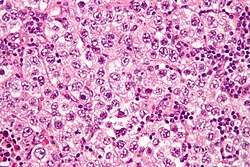
Micrograph of a germinoma, H&E stain
SpecialtyOncology Edit this on Wikidata

A germinoma is a type of germ-cell tumor,[1] which is not differentiated upon examination.[2] It may be benign or malignant.

Cause

[edit]

Germinomas are thought to originate from an error of development, when certain primordial germ cells fail to migrate properly. Germinomas lack histologic differentiation, whereas nongerminomatous germ-cell tumors display a variety of differentiation. Like other germ-cell tumors, germinomas can undergo malignant transformation.[citation needed]

Histology

[edit]

The tumor is uniform in appearance, consisting of large, round cells with vesicular nuclei and clear or finely granular cytoplasm that is eosinophilic. On gross examination, the external surface is smooth and bosselated (knobby), and the interior is soft, fleshy, and either cream-coloured, gray, pink, or tan. Microscopic examination typically reveals uniform cells that resemble primordial germ cells. Typically, the stroma contains lymphocytes, and about 20% of patients have sarcoid-like granulomas.[citation needed]

Diagnosis

[edit]

Metastasis has been noted in about 22% of cases at time of diagnosis. Males are roughly twice as commonly affected in developing germinomas. They are most commonly diagnosed between the ages of 10 and 21.[citation needed]

Often, serum and spinal fluid tumor markers of alpha-fetoprotein and beta-HCG are tested. Pure germinomas are not associated with these markers. Nongerminomatous germ-cell tumors may be associated with increased markers such as alpha-fetoprotein with yolk sac tumors, as well as embryonic cell carcinomas and immature teratomas and beta-HCG, which occur in choriocarcinomas. In one to 15% of germinomas, a low level of beta-HCG may be produced. Although controversial, HCG-secreting germinomas may be more aggressive than nonsecreting ones.[citation needed]

Classification

[edit]

The term "germinoma" most often refers to a tumor in the brain that has a histology identical to two other tumors, dysgerminoma in the ovary and seminoma in the testis.[3] Since 1994, MeSH has defined germinoma as "a malignant neoplasm of the germinal tissue of the gonads, mediastinum, or pineal region"[4] and within its scope included both dysgerminoma and seminoma. Collectively, these are the seminomatous or germinomatous tumors.[citation needed]

Locations

[edit]

Ovary (dysgerminoma) and testis (seminoma)

[edit]

Dysgerminoma is the most common type of malignant germ-cell ovarian cancer. Dysgerminoma usually occurs in adolescence and early adult life; about 5% occur in prepubertal children. Dysgerminoma is extremely rare after age 50. It occurs in both ovaries in 10% of patients and, in a further 10%, a microscopic tumor is in the other ovary.[citation needed]

A 7.4 x 5.5-cm seminoma in a radical orchiectomy specimen from a 27-year-old man

Seminoma is the second-most common testicular cancer; the most common is mixed, which may contain seminoma.[citation needed]

Abnormal gonads (due to gonadal dysgenesis and androgen insensitivity syndrome) have a high risk of developing a dysgerminoma.[5] Most dysgerminomas are associated with elevated serum lactic dehydrogenase, which is sometimes used as a tumor marker. Metastases are most often present in the lymph nodes.[citation needed]

Intracranial germinoma

[edit]

Intracranial germinoma occurs in 0.7 per million children.[6] As with other germ-cell tumors (GCTs) occurring outside the gonads, the most common location of intracranial germinoma is on or near the midline, often in the pineal or suprasellar areas; in 5-10% of patients with germinoma in either area, the tumor is in both areas. Like other GCTs, germinomas can occur in other parts of the brain. Within the brain, this tumor is most common in the hypothalamic or hypophyseal regions. In the thalamus and basal ganglia, germinoma is the most common GCT.[citation needed]

The diagnosis of an intracranial germinoma usually is based on biopsy, as the features on neuroimaging appear similar to other tumors.[citation needed]

Cytology of the cerebrospinal fluid often is studied to detect metastasis into the spine. This is important for staging and radiotherapy planning.

Intracranial germinomas have a reported 90% survival to five years after diagnosis.[7] Near total resection does not seem to influence the cure rate, so gross total resection is not necessary and can increase the risk of complications from surgery. The best results have been reported[citation needed] from craniospinal radiation with local tumor boost of greater than 4,000 centigray (cGy).

Treatment

[edit]

Germinomas, like several other types of GCTs, are sensitive to both chemotherapy[8] and radiotherapy. For this reason, treatment with these methods can offer excellent chances of long-term survival, even cure.[citation needed]

Prognosis

[edit]

Although chemotherapy can shrink germinomas, it is not generally recommended alone unless radiation has contraindications. In a study in the early 1990s, carboplatinum, etoposide, and bleomycin were given to 45 germinoma patients, and about half the patients relapsed. Most of these relapsed patients were then recovered with radiation or additional chemotherapy.[9]

See also

[edit]

References

[edit]
[edit]
Revisions and contributorsEdit on WikipediaRead on Wikipedia
from Grokipedia
A germinoma is a rare type of malignant that primarily arises in the (CNS), most commonly in the or suprasellar region, and is the most prevalent form of CNS , comprising about two-thirds of such tumors. Originating from primordial s that aberrantly migrate to the brain during fetal development, germinomas are typically slow-growing despite their and are highly curable with appropriate therapy. These tumors predominantly affect children, adolescents, and young adults, with a peak incidence between ages 10 and 19, and show a marked male predominance (male-to-female ratio of approximately 3.7:1). , the annual incidence is about 0.07 per 100,000 individuals, representing 3-4% of primary intracranial tumors in patients under 20 years old, with higher rates observed among Asian and populations compared to other ethnic groups. The exact remains unknown, but it involves molecular abnormalities such as 12p and gains in chromosome regions 1p and 12q. Clinical manifestations depend on tumor location: pineal germinomas often cause obstructive leading to headaches, , , and Parinaud (upward gaze palsy), while suprasellar tumors may present with endocrine disturbances such as , growth delays, or precocious/ due to hypothalamic-pituitary involvement. Diagnosis typically involves (MRI) of the brain and spine, analysis for tumor markers like beta-human chorionic gonadotropin (beta-hCG), and histopathological confirmation via . Treatment is multimodal, with radiation therapy as the cornerstone—often following neoadjuvant chemotherapy to minimize radiation exposure in young patients—and yields excellent outcomes, including 10-year survival rates over 90% for localized disease. Recurrences are uncommon but can be managed with additional radiation or chemotherapy.

Introduction

Definition and Classification

A germinoma is a malignant arising from primordial germ cells, representing the malignant counterpart to an early embryonic developmental stage. It is histologically identical to in the testis and in the , characterized by undifferentiated germ cells that mimic these gonadal counterparts. These tumors primarily occur in extragonadal sites, with the (CNS) being the most common location for intracranial manifestations. Within the broader category of germ cell tumors, germinomas are classified as pure forms when they lack components of other elements, in contrast to mixed or non-germinomatous germ cell tumors that incorporate tumors, choriocarcinomas, embryonal carcinomas, or teratomas. The 2021 (WHO) Classification of Tumors of the Central Nervous System designates germinoma as a distinct entity under germ cell tumors, emphasizing its unique clinicopathological profile separate from nongerminomatous subtypes. This classification facilitates targeted diagnostic and therapeutic approaches, highlighting germinoma's relatively favorable compared to mixed forms. The nomenclature of germinoma has evolved historically to unify descriptions across sites. Originally, similar tumors in gonadal locations were termed "" (testis) or "" (), but the term "germinoma" was introduced by and Moore in 1946 for testicular neoplasms and later extended to extragonadal, especially intracranial, occurrences following Gunnar Teilum's proposal of the germ cell theory in the mid-20th century. This unification, gaining prominence since the , reflects the shared embryological origin from primordial germ cells and avoids site-specific terminology for CNS tumors. Diagnosis of pure germinoma relies on specific histological criteria, including sheets of uniform, large polygonal cells with clear, glycogen-rich , distinct cell borders, and round to oval nuclei containing finely granular . A hallmark feature is the prominent lymphocytic infiltrate, often forming a "two-cell pattern" with tumor cells, alongside high mitotic activity and absence of teratomatous or syncytiotrophoblastic elements that would indicate a mixed tumor. These features, confirmed via , distinguish pure germinoma from other tumors.

Epidemiology

Germinoma is a rare intracranial tumor, comprising approximately 1-2% of all primary brain tumors in children and adolescents in Western countries. In contrast, its incidence is substantially higher in , where germ cell tumors (of which germinomas represent 50-70%) account for 10-15% of pediatric tumors in regions such as and . The overall annual incidence of intracranial germ cell tumors is estimated at 0.6–2.5 cases per million children under 15 years worldwide, with variations by region (e.g., lower in Western countries and higher in ). The tumor exhibits a peak incidence in the second decade of life (ages 10-21 years), with a diagnosis age of 10-12 years, and displays a bimodal distribution including rare cases in early childhood and adulthood. Intracranial germinomas show a marked male predominance, with a male-to-female ratio of approximately 2:1 overall, though this can reach 3-4:1 in certain populations like the or Korea; in contrast, gonadal germinomas occur equally between sexes. Geographic and ethnic variations are pronounced, with elevated rates observed in Asian populations, potentially linked to genetic predispositions, compared to lower incidences in Western cohorts. Incidence trends have remained largely stable over recent decades, attributed to consistent epidemiological patterns despite enhanced detection through advanced imaging modalities.

Etiology and Pathogenesis

Causes and Risk Factors

Germinomas are believed to originate from the aberrant migration of primordial (PGCs) during early embryogenesis, where these cells fail to properly migrate from the to the gonadal ridge, instead forming extragonadal rests in midline structures such as the pineal or suprasellar regions. This germ cell theory is supported by the histological and molecular resemblance of germinomas to PGCs, including the expression of pluripotency markers like OCT4 and the retention of an immature epigenetic profile. The resulting ectopic cell clusters may undergo neoplastic transformation later in life, though the precise triggers remain unclear. Genetic predispositions play a notable role in germinoma development, particularly through associations with chromosomal aneuploidies and specific mutations. Individuals with (47,XXY) exhibit an elevated risk of extragonadal tumors, including intracranial germinomas, due to altered maturation and increased susceptibility to in extragonadal sites. Similarly, (trisomy 21) is linked to a higher incidence of intracranial tumors, potentially stemming from genomic instability and disrupted migration pathways. Isochromosome 12p [i(12p)] is a characteristic cytogenetic abnormality in tumors, observed in 10-30% of CNS germinomas and more commonly in gonadal counterparts, often contributing to 12p amplification that drives oncogenesis. Additionally, activating mutations in KIT occur in approximately 20-40% of germinomas, while mutations are found in about 20%, with these alterations in the KIT/RAS signaling pathway being mutually exclusive and promoting uncontrolled cell proliferation. Environmental risk factors for germinoma remain poorly defined, with no robust evidence linking exposure to radiation, chemicals, or other agents to disease onset. Rare instances of familial clustering suggest possible heritable components, as seen in sibling cases without identifiable shared environmental exposures. In the majority of cases—over 90%—the etiology is idiopathic, lacking clear genetic or environmental precipitants. Emerging research as of 2025 underscores the role of epigenetic dysregulation in pathogenesis, including global DNA hypomethylation akin to PGCs and overexpression of KIT ligand (SCF), which sustains autocrine signaling in KIT-mutated tumors and contributes to their immature phenotype.

Histology and Molecular Features

Germinomas exhibit a characteristic histology consisting of sheets or nests of uniform, large polygonal tumor cells with clear or pale cytoplasm, distinct cell borders, and centrally located vesicular nuclei containing prominent nucleoli. These cells are arranged in a lobular or nested pattern separated by thin fibrovascular infiltrated by lymphocytes, forming a distinctive "two-cell pattern" of neoplastic cells interspersed with a prominent lymphocytic stroma. High mitotic activity is often observed, but and hemorrhage are typically absent. Unlike yolk sac tumors, Schiller-Duval bodies are not present, aiding in histological differentiation. Immunohistochemically, germinomas show strong positivity for (PLAP) in approximately 80-100% of cases, c-KIT (CD117) in nearly all cases, and OCT3/4 in 100% of cases, reflecting their origin. These markers are particularly useful for confirming in lesions. Tumor cells are negative for (AFP) and beta-human chorionic gonadotropin (beta-hCG), which helps distinguish them from tumors and choriocarcinomas, respectively. At the molecular level, germinomas demonstrate gain of chromosome 12p, including isochromosome 12p [i(12p)], in approximately 30-80% of cases, depending on the study cohort and detection method—a lower than in non-germinomatous tumors but still indicative of lineage. Common chromosomal gains include 12p (30-80%), 1q (∼65%), 21q (∼76%), and others, contributing to genomic instability. Recent studies (as of 2025) have identified molecular subtypes such as immune-hot and / based on transcriptional profiles. KIT amplifications and mutations are also common, occurring in up to 20-30% of tumors and correlating with c-KIT protein overexpression. Recent single-cell sequencing studies have revealed intratumoral heterogeneity in germ cell tumors, with germinoma cells displaying transcriptional profiles resembling primordial germ cells, including upregulation of pluripotency and germ cell-specific genes. Germinomas are classified into pure and syncytiotrophoblastic variants. The pure form lacks syncytiotrophoblastic giant cells and shows no beta-hCG production. In contrast, the syncytiotrophoblastic variant contains scattered syncytiotrophoblastic giant cells that produce beta-hCG, leading to mildly elevated serum or levels in 10-20% of pure germinoma cases overall, though these do not constitute elements.

Clinical Manifestations

Signs and Symptoms

Germinomas often present with symptoms related to , , or endocrine disruption, depending on the tumor's location. Common general symptoms include , , and , which arise from increased due to obstructive in (CNS) cases. In the pineal region, patients frequently exhibit Parinaud syndrome, characterized by upward gaze palsy, convergence-retraction nystagmus, and pupillary light-near dissociation, occurring in approximately 75% of cases; additional features may include and seizures. For suprasellar tumors, visual field defects such as and growth delay are prominent due to compression of the and hypothalamic-pituitary axis. Extracranial gonadal germinomas, particularly testicular, may cause or a palpable mass, with in cases of (hCG) secretion. Endocrine dysfunction is a hallmark, especially in suprasellar or sellar locations, with as the most common initial manifestation, affecting 70-90% of patients and presenting as excessive thirst and . () is common in suprasellar germinomas due to compression of the hypothalamic-pituitary axis, while is rare and may occur in hCG-secreting cases. The onset of intracranial germinomas is typically insidious, progressing over weeks to months in pineal cases or months to years in suprasellar ones, often delaying due to nonspecific complaints like or behavioral changes. In contrast, gonadal germinomas may present more acutely with pain or a . Rare systemic signs in advanced disease include fever and , while recent pediatric reports highlight subtle pre-diagnostic neurocognitive changes such as , scholastic difficulties, and altered sleep patterns. In or thalamic germinomas, symptoms may include , , or cognitive decline due to local .

Anatomical Locations

Germinomas primarily arise in midline structures, with the majority occurring intracranially in the (CNS). The represents the most frequent intracranial site, accounting for 50-70% of cases, where tumors often originate from germ cell remnants along the migratory path of primordial . The suprasellar and hypothalamic regions constitute the second most common location, comprising 20-30% of intracranial germinomas, typically involving the or floor of the third ventricle. Less frequently, germinomas develop in the or , representing under 10% of cases, and recent advancements have highlighted off-midline presentations in these areas as an emerging diagnostic consideration. Approximately 10-15% of intracranial germinomas are multifocal, involving multiple midline sites such as synchronous pineal and suprasellar lesions. In the gonadal sites, germinomas manifest as seminomas in the testis, which account for about 50% of all testicular tumors (GCTs), predominantly affecting the seminiferous tubules. In the , they present as , comprising 1-2% of ovarian malignancies and typically arising from ovarian stroma. Bilateral involvement occurs in 1-5% of testicular seminoma cases and 10-15% of ovarian cases, often necessitating comprehensive gonadal evaluation. Extragonadal non-CNS germinomas are uncommon, representing less than 5% of all cases, and primarily occur in midline extragonadal locations such as the anterior or retroperitoneum. Mediastinal germinomas, the most frequent in this category, often arise from thymic or residual tissue, while retroperitoneal sites are even rarer and associated with lymphatic drainage patterns. The anatomical distribution of germinomas varies by age, with intracranial sites predominating in adolescents (peak incidence 10-19 years) and gonadal sites more common in young adults (20-40 years).

Diagnosis

Imaging and Laboratory Tests

(MRI) is the cornerstone for detecting and characterizing germinoma, providing detailed anatomical information and aiding in differentiation from other pineal or suprasellar lesions. On T1-weighted images, germinomas typically appear isointense to gray matter, while on T2-weighted sequences, they are iso- to hypointense, reflecting their high cellularity. Following administration, these tumors exhibit homogeneous, vivid enhancement, which helps distinguish them from more heterogeneous non-germinomatous tumors. Diffusion-weighted imaging (DWI) often reveals restricted diffusion in the solid components due to dense cellular packing, with corresponding low apparent diffusion coefficient (ADC) values. Pineal cysts are a common imaging mimic, appearing as well-defined, non-enhancing lesions that can simulate small germinomas, necessitating careful evaluation of enhancement patterns and clinical correlation. Computed tomography (CT) serves as an initial imaging modality, particularly useful for assessing secondary to in the pineal or suprasellar regions. Germinomas appear hyperdense relative to surrounding on non-contrast CT, attributed to their compact cellular architecture. Enhancement is homogeneous and intense post-contrast, mirroring MRI findings. Calcifications are observed in 30-70% of cases, often representing engulfed calcifications rather than intrinsic tumor mineralization, and their presence can help localize the lesion but is not diagnostic. CT is particularly valuable in emergency settings for rapid evaluation of ventricular obstruction and . Laboratory evaluation focuses on tumor markers in serum and (CSF) to support findings and guide without immediate in select cases. In pure germinomas, (AFP) levels are negative or within normal limits (typically <10 IU/L in CSF), while beta-human chorionic gonadotropin (beta-hCG) may be mildly elevated but remains below 50 IU/L, distinguishing them from mixed or non-germinomatous tumors where levels exceed this threshold. CSF cytology demonstrates malignant cells in approximately 38% of germinoma cases, offering moderate sensitivity for detecting but requiring with markers and . Elevated markers in CSF are generally more pronounced than in serum, enhancing diagnostic yield when is safely performed post- to rule out increased . Advanced imaging techniques provide additional characterization for staging and metabolic assessment. Positron emission tomography-computed tomography (PET-CT) using 18F-fluorodeoxyglucose (FDG) shows avid uptake in germinomas due to their high glucose metabolism, aiding in detecting multifocal disease or leptomeningeal spread with sensitivity comparable to MRI. MR spectroscopy reveals elevated choline peaks, indicative of increased membrane turnover and cellular proliferation, alongside reduced N-acetylaspartate (NAA) and occasional lipid signals. These modalities complement standard MRI and CT, particularly in atypical presentations, though ultimate confirmation often requires pathological correlation.

Pathological Confirmation

Pathological confirmation of germinoma requires tissue sampling to establish the definitive through histopathological examination, (IHC), and molecular testing, as non-invasive methods alone are insufficient for classification. For intracranial lesions, stereotactic is commonly employed to obtain tissue samples, particularly for pineal region tumors, while endoscopic offers a minimally invasive alternative that can be combined with cerebrospinal fluid diversion procedures. In suprasellar germinomas, endoscopic third ventriculostomy with simultaneous tumor sampling allows for both management and diagnostic yield, minimizing procedural risks. The diagnostic workflow integrates multiple modalities to confirm germinoma while avoiding aggressive resection, given its high . Histologically, germinomas exhibit uniform sheets of large, round cells with clear and prominent nucleoli, often with lymphocytic infiltration. IHC plays a crucial role, with strong nuclear positivity for SALL4 observed in nearly all cases, serving as a sensitive marker for origin. Additional supportive markers include placental (PLAP) and c-KIT (CD117) positivity, while OCT4 and D2-40 are also frequently expressed. Molecular analysis, such as (FISH) for 12p [i(12p)], detects 12p gain in the majority of germinomas, further corroborating the diagnosis when integrated with histological and IHC findings. Challenges in pathological confirmation arise primarily from sampling errors in heterogeneous tumors, such as mixed germ cell tumors (GCTs), where may miss non-germinomatous components, leading to underdiagnosis or inappropriate treatment. The 2025 Chinese Anti-Cancer Association (CACA) guidelines emphasize multidisciplinary review involving pathologists, neurosurgeons, and oncologists to evaluate adequacy and integrate findings for accurate classification of mixed GCTs, reducing diagnostic discrepancies. Differential diagnosis requires exclusion of mimics through targeted markers; for instance, germinomas are typically negative for lymphoid markers like CD45 to rule out , and lack synaptophysin expression, which distinguishes them from pineal parenchymal tumors that show synaptophysin positivity. c-KIT positivity in germinomas further aids in differentiating from synaptophysin-positive pineal tumors.

Management

Treatment Modalities

The primary treatment for germinoma, particularly intracranial forms, involves multimodal approaches combining and , which have demonstrated high efficacy in achieving cure rates exceeding 90%. These therapies exploit the tumor's high sensitivity to both and platinum-based agents, allowing for tailored strategies that minimize long-term morbidity, especially in pediatric patients. Radiotherapy remains a cornerstone, with craniospinal typically administered at doses of 24-36 Gy for intracranial germinoma to cover potential sites of , followed by a whole-ventricle boost and focal tumor bed up to 45-50 Gy total. For localized pure germinoma, reduced-dose whole-ventricular radiotherapy (21-24 Gy) with a tumor boost is often sufficient, achieving response rates of approximately 90%. In gonadal cases, such as localized , focal radiotherapy is reserved for residual disease after , rather than as initial . Chemotherapy employs platinum-based regimens, such as combined with or , administered in 3-4 cycles as to shrink tumors and reduce subsequent radiotherapy fields, particularly in children to limit neurocognitive risks. These regimens induce complete responses in over 80% of cases, enabling de-escalation of radiation exposure. Combined chemoradiotherapy is the standard for intracranial germinoma, yielding event-free survival rates greater than 95% at 5 years. Ongoing trials, such as the COG ACNS2321 phase II study initiated in 2024, are evaluating response-adapted reduced-dose radiotherapy (e.g., 21 Gy) following -etoposide chemotherapy for pure germinomas. Site-specific management for gonadal germinoma emphasizes fertility preservation; in stage I testicular , orchiectomy followed by active surveillance or single-agent is preferred, with radiotherapy (20-30 Gy) for . For ovarian , unilateral salpingo-oophorectomy preserves fertility, supplemented by adjuvant (e.g., bleomycin-etoposide-cisplatin) for higher-risk stages, achieving cure rates over 90%.

Surgical and Supportive Interventions

Surgical interventions for germinoma primarily serve diagnostic purposes rather than curative resection, particularly for intracranial tumors, where gross total resection is rarely indicated due to the tumor's high radiosensitivity and the risk of neurological or endocrinological deterioration from aggressive surgery. Stereotactic or endoscopic biopsy is the standard approach to obtain tissue for pathological confirmation, often combined with cerebrospinal fluid diversion procedures when hydrocephalus is present. For gonadal primary germinomas, such as those in the testes or ovaries, surgical gonadectomy remains the cornerstone of initial management to remove the tumor and prevent local recurrence, typically followed by adjuvant therapies. Hydrocephalus complicates approximately 50-70% of pineal region germinomas due to obstruction of pathways, necessitating prompt intervention to alleviate . Ventriculoperitoneal shunting is commonly employed in these cases to divert excess fluid, with preferred as a minimally invasive alternative that avoids shunt-related complications like or malfunction, achieving success rates exceeding 70% in select patients. These endoscopic procedures not only manage but can simultaneously facilitate , reducing overall morbidity compared to open approaches. Supportive care plays a vital role in addressing the endocrine disruptions frequently associated with germinoma, particularly in suprasellar or pineal locations affecting the hypothalamic-pituitary axis. is essential for managing deficits such as , where acetate effectively replaces deficient antidiuretic hormone to control and , often administered intranasally, orally, or sublingually. Broader may require additional replacements like for or for , tailored to individual needs through regular endocrine monitoring. Prior to initiating or —therapies known to impair gonadal function—patients should receive fertility counseling and, where feasible, undergo preservation techniques such as or to safeguard reproductive potential. As of 2025, advancements in minimally invasive have enhanced the precision and safety of deep brain biopsies for germinoma , with systems like the ROSA or Remebot enabling frameless stereotactic procedures that achieve diagnostic yields over 98% and reduce clinical complication rates to approximately 4%. These robotic platforms minimize trajectory errors to under 1.5 mm and lower risks of hemorrhage or neurological deficits compared to traditional methods, supporting earlier and safer tissue sampling in challenging locations like the pineal region.

Prognosis and Outcomes

Survival and Recurrence Rates

Germinomas exhibit excellent outcomes, with 5-year overall (OS) rates exceeding 90% for pure cases, primarily due to their high sensitivity to and . For instance, a large reported 5-year OS of 92.6% and 10-year OS of 87.9% across intracranial germinomas treated with combined modalities. Long-term data further indicate 10-year OS ranging from 86% to 92% in pure germinomas, reflecting sustained efficacy of standard therapies. Localized gonadal germinomas, particularly stage I, achieve near 100% 5-year OS with or minimal adjuvant treatment following or salpingo-oophorectomy. Recurrence rates for germinomas are relatively low at 10-15%, with most events occurring within the first 2 years post-treatment. Spinal seeding is observed in 5-10% of untreated cases, often manifesting as leptomeningeal dissemination, though prophylactic craniospinal significantly reduces this risk. Salvage therapies, including re- and , prove effective in approximately 70% of recurrent cases, enabling durable remission in the majority of patients. Historical advancements have markedly improved ; pre-1990s survival rates hovered around 70% with radiation alone, but combined chemoradiotherapy has elevated modern 5-year OS to over 90%. Recent 2025 meta-analyses affirm no decline in these outcomes, underscoring the stability of current protocols. Site-specific differences show 5-year (PFS) of approximately 90% for intracranial germinomas versus 95% for gonadal counterparts, attributable to earlier detection and less invasive treatment needs in gonadal sites.

Prognostic Factors and Long-term Effects

Prognostic factors for germinoma significantly influence (PFS) and overall outcomes, with pure representing a key favorable indicator. Patients with pure germinoma exhibit markedly better 10-year PFS rates of approximately 88% compared to those with non-germinomatous components, which drop to around 33%. Low levels of beta-human chorionic gonadotropin (beta-hCG, typically <50-100 IU/L) further support excellent prognosis in pure cases, as elevated markers often signal mixed or non-germinomatous tumors with poorer responses. Complete response to upfront also correlates with sustained remission, enabling reduced doses and improved long-term control. Younger age at , particularly under 20 years, and localized ( stage) are additional favorable predictors, enhancing PFS by facilitating targeted therapies and minimizing risks. In contrast, adverse factors include metastatic spread at , which substantially worsens outcomes due to the need for more intensive craniospinal . Non-germinomatous elements, such as yolk sac or components, confer aggressive behavior and lower survival rates. Delayed beyond six months from symptom onset independently predicts reduced overall survival, often due to advanced tumor burden at treatment initiation. Genetic markers, including high KIT load or associated chromosomal instability, may indicate poorer in select germinoma cases by promoting tumor aggressiveness. Long-term effects of germinoma treatment, primarily from (RT) and , pose significant challenges despite high cure rates. Cranial RT frequently leads to neurocognitive deficits, including declines in processing speed, , and overall IQ by approximately 8-10 points on average, with some patients experiencing more pronounced drops of 10-15 points and learning disabilities. Secondary malignancies arise in 5-6% of survivors, often manifesting 10-20 years post-treatment as meningiomas, gliomas, or cavernomas due to RT exposure. affects roughly 20-50% of patients following multi-agent , compounded by gonadal toxicity and hypothalamic-pituitary disruption. Endocrine dysfunction occurs in 50-80% of cases long-term, with panhypopituitarism, , and necessitating lifelong hormone replacement. Recent advancements as of 2025 emphasize mitigating these effects through refined modalities like , which spares normal tissue and reduces neurocognitive and endocrine risks compared to conventional RT, while maintaining 10-year local control rates near 100%. Surveillance guidelines recommend at least 10 years of post-treatment monitoring, including annual MRI of the and spine, serial assessments, and multidisciplinary evaluations for endocrine and cognitive sequelae to detect late recurrences or toxicities early.

References

Add your contribution
Related Hubs
User Avatar
No comments yet.