Hubbry Logo
J. Paul Getty MuseumJ. Paul Getty MuseumMain
Open search
J. Paul Getty Museum
Community hub
J. Paul Getty Museum
logo
8 pages, 0 posts
0 subscribers
Be the first to start a discussion here.
J. Paul Getty Museum
from Wikipedia

The J. Paul Getty Museum, commonly referred to as the Getty, is an American art museum in Los Angeles, California, housed on two campuses: the Getty Center and Getty Villa.[1] It is operated by the J. Paul Getty Trust, the world's wealthiest art institution.[2]

Key Information

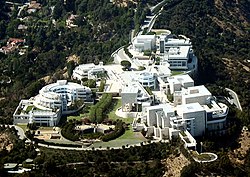
The Getty Center is located in the Brentwood neighborhood of Los Angeles and features pre-20th-century European paintings, drawings, illuminated manuscripts, sculpture, decorative arts, and photographs from the inception of photography through present day from all over the world.[3][4] The original Getty museum, the Getty Villa, is located in the Pacific Palisades neighborhood of Los Angeles and displays art from Ancient Greece, Rome, and Etruria.[5]

History

[edit]

In 1974, Jean Paul Getty opened a museum in a re-creation of the Villa of the Papyri at Herculaneum on his property in Malibu, California.[6] In 1982, the museum became the richest in the world when it inherited US$1.2 billion.[7] In 1983, after an economic downturn in West Germany, the Getty Museum acquired 144 illuminated medieval manuscripts from the financially struggling Ludwig Collection in Aachen.[8]

In 1996, John Russell, writing in The New York Times, said of the collection, "One of the finest holdings of its kind ever assembled, it is quite certainly the most important that was in private hands."[9] In 1997, the museum moved to its current location in the Brentwood neighborhood of Los Angeles. The Malibu museum, renamed the "Getty Villa", was renovated and reopened in 2006.

Many museums turned to their existing social media presences to engage their audience online during the COVID-19 pandemic. Inspired by the Rijksmuseum in Amsterdam and Instagram accounts such as the Dutch Tussen Kunst & Quarantaine ("between art and quarantine") and Covid Classics, the Getty sponsored the Getty Museum Challenge, inviting people to use everyday objects to recreate works of art and share their creations on social media, prompting thousands of submissions.[10][11] The museum was among those singled out for particular praise by industry analysts for their successful social media content strategy during the shutdown, both for the challenge[12][13] and for incorporating its works into the popular video game Animal Crossing.[14] Following the 2025 Southern California wildfires, in April 2025, the Getty sold $500 million in bonds to raise money to protect its collection from fire.[15][16]

Controversies with Italy and Greece

[edit]
The Getty attracts approximately 1.8 million visitors a year.[17]
Architect Richard Meier chose beige-colored Italian travertine panels to cover the retaining walls and to serve as paving stones for the arrival plaza and museum courtyard.[18]

In the 1970s and 1980s, the curator, Jiří Frel, designed a tax manipulation scheme which expanded the museum collection of antiquities, essentially buying artifacts of dubious provenance, as well as a number of artifacts generally considered fakes, such as the Getty kouros. In 1984, Frel was demoted, and in 1986, he resigned.[19]

The Getty is involved in a controversy regarding proper title to some of the artwork in its collection. The museum's previous curator of antiquities, Marion True, hired by Frel, was indicted in Italy in 2005, along with famed dealer Robert E. Hecht, on criminal charges relating to trafficking in stolen antiquities. Similar charges have been addressed by the Greek authorities. The primary evidence in the case came from the 1995 raid of a Geneva, Switzerland, warehouse which had contained a fortune in stolen artifacts.[20]

Italian art dealer Giacomo Medici was arrested in 1997. His operation was thought to be "one of the largest and most sophisticated antiquities networks in the world, responsible for illegally digging up and spiriting away thousands of top-drawer pieces and passing them on to the most elite end of the international art market".[21] In 2005 True was forced to tender her resignation by the Board of Trustees, which announced her early retirement. Italy allowed the statute of limitations of the charges filed against her to expire in October 2010.[22]

In a letter to the J. Paul Getty Trust in December 2006, True stated that she was being made to "carry the burden" for practices which were known, approved, and condoned by the Getty's board of directors.[23] True is currently under investigation by Greek authorities over the acquisition of a 2,500-year-old funerary wreath, that was illegally excavated and smuggled out of Greece. The wreath, along with a 6th-century BC statue of a kore, have been returned to Greece and are currently exhibited at the Archaeological Museum of Thessaloniki.[24] A 2,400-year-old, black limestone stele and a marble votive relief dating from about 490 BC were also returned.

The succulent garden at the Getty Center

In November 2006, the director of the museum, Michael Brand, announced that 26 disputed pieces were to be returned to Italy, but not the Victorious Youth, which is still claimed by the Italian authorities. In 2007, the Los Angeles J. Paul Getty Museum was forced to return 40 artifacts, including a 5th-century BC statue of the goddess Aphrodite, which was looted from Morgantina, an ancient Greek settlement in Sicily.[25] The Getty Museum resisted the requests of the Italian government for nearly two decades, only to admit later that "there might be 'problems'" attached to the acquisition."[26] In 2006, Italian senior cultural official Giuseppe Proietti said: "The negotiations haven't made a single step forward." Only after he suggested that the Italian government should "take cultural sanctions against the Getty, suspending all cultural cooperation,"[27] did the J. Paul Getty Museum return the antiquities.

In another unrelated case in 1999, the Getty Museum had to hand over three antiquities to Italy after determining they were stolen. The objects included a Greek red-figure kylix from the 5th-century BC, signed by the painter Onesimos and the potter Euphronios as potter, looted from the Etruscan site of Cerveteri; a torso of the god Mithra from the 2nd-century AD, and the head of a youth by the Greek sculptor Polykleitos.[28]

In 2016, the terracotta head of the Greek god Hades was returned to Sicily (Italy). The archaeological artifact was looted from Morgantina in the 1970s. The Getty museum purchased the terracotta head of Hades in 1985 from the New York collector Maurice Tempelsman, who had purchased it from the London dealer Robin Symes. Getty records show the museum paid $530,000 for it.[29][30] In December 2016, the head of Hades was added to the collection of the archaeological museum of Aidone, where it joined the statue of Demeter, the mother of his consort Persephone. Sicilian archaeologists found a blue curl that was missing from Hades' beard, and so it proved the origin of the terracotta head.[citation needed]

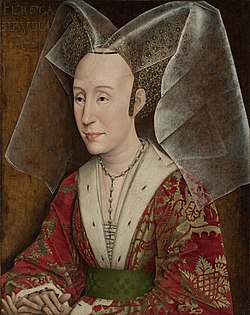
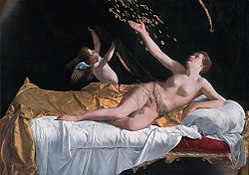
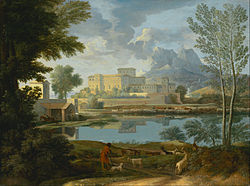
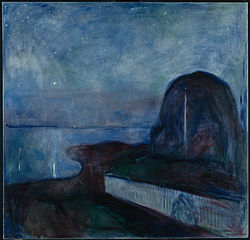
Selected paintings at the Getty Center

[edit]

Selected objects at the Getty Center

[edit]

See also

[edit]

References

[edit]
[edit]
Revisions and contributorsEdit on WikipediaRead on Wikipedia
from Grokipedia
The J. Paul Getty Museum is an art museum in , , operated by the and comprising two campuses: the in Brentwood, which focuses on European art, and the in Pacific Palisades, dedicated to ancient , Roman, and Etruscan . Established by oil industrialist to display his personal collection, it features architecture inspired by a Roman country house at the Villa and modern design by at the Center. The museum's collections encompass over a hundred thousand objects, including pre-20th-century European paintings, sculptures, drawings, illuminated manuscripts, and , alongside significant holdings in antiquities from the period to and extensive photograph archives. Opened initially in 1954 within Getty's Pacific Palisades ranch house to exhibit his antiquities and paintings, it expanded with the purpose-built in 1974 and relocated major holdings to the upon its 1997 opening, drawing millions of visitors for its scholarly exhibitions and programs. Notable for its role in art conservation and research through the affiliated Getty Conservation Institute and Getty Research Institute, the museum has also encountered scrutiny over acquisitions of with questionable , resulting in voluntary repatriations of artifacts to and other nations amid claims of and illicit trade, though such disputes highlight tensions between preservation and international collecting practices.

Founding and Early History

Establishment by J. Paul Getty

In 1953, oil magnate established the as a , formally named the J. Paul Getty Museum Trust, to institutionalize the public display of his burgeoning art collection, which emphasized European paintings, drawings, sculptures, and antiquities acquired since the 1930s. This move formalized Getty's longstanding interest in art as a cultural asset, driven by his belief in its civilizing influence on society, amid his personal residence at the Ranch House property in Pacific Palisades, near . The museum opened to the public in within a converted portion of the Ranch House, initially limited to two rooms and operating with restricted hours to accommodate visitors by appointment or scheduled access. Admission was provided of charge, underscoring Getty's commitment to broad without financial barriers, though early was minimal and attendance grew gradually as word spread. The initial holdings featured select pieces from Getty's personal holdings, including and works, displayed in a modest setup that reflected the transitional nature of the institution before further expansions. This ranch house phase marked the museum's origins as a private collection turned public resource, with Getty overseeing operations remotely from his international residences, setting the stage for subsequent growth as acquisition continued apace. By late 1955, gallery space had expanded to six areas to house additional acquisitions, signaling the limitations of the original site and foreshadowing larger facilities.

Initial Collections and Public Access

J. Paul Getty initiated his art collecting in earnest during , acquiring pieces that formed the nucleus of what would become the museum's holdings. His first documented antiquity purchase occurred in 1939, a terracotta statuette of a woman reclining on a couch with , known as the Tanagra Group, marking the beginning of his focused pursuit of and Roman artifacts. By the early , Getty had expanded into European paintings, particularly and works, alongside 18th-century French such as furniture and decorative objects, reflecting his preference for items embodying classical aesthetics and historical craftsmanship. These acquisitions were housed initially in his personal residences, including the Pacific Palisades ranch property purchased in the , where select pieces were periodically displayed for private viewings. The initial collections emphasized quality over quantity, comprising approximately a few dozen significant works by the time of public opening, including old master paintings by artists such as and , alongside Greek and Roman and ornate French furnishings that Getty viewed as exemplars of enduring beauty. These holdings were not amassed through systematic institutional acquisition but through Getty's personal dealings at auctions and dealers in and the , often prioritizing and aesthetic appeal over comprehensive coverage of art historical periods. The ranch house served as an informal gallery space, with artworks integrated into domestic settings to evoke a sense of lived akin to historical collectors. In 1953, Getty formalized the institution by establishing the J. Paul Getty Museum Trust as a charitable entity to manage and perpetuate his collections. The opened to the public on July 8, 1954, utilizing two dedicated gallery rooms at the eastern end of the ranch house, with access limited to one day per week and by appointment to control crowds and preserve the intimate scale. This restricted model prioritized scholarly and appreciative visitation over mass tourism, admitting around 100 visitors daily initially, and required no admission fee, aligning with Getty's intent for educational benefit without commercialism. Expansion followed swiftly, with a new completed and opened in December 1957, enhancing display capacity for the growing corpus of classical sculptures and vessels.

Institutional Development

Formation of the Getty Trust

The J. Paul Getty Museum Trust was established on December 2, 1953, by oil magnate as a dedicated to housing and exhibiting his personal art collection, with the aim of promoting the "diffusion of artistic and general knowledge" and viewing art as a civilizing force in society. Initially capitalized with Getty's contributions from his burgeoning collection of European paintings, Greek and Roman antiquities, and , the Trust operated on a modest scale, reflecting Getty's intent to create a private institution rather than a large public entity. In 1954, the Trust opened the J. Paul Getty Museum to limited public access within Getty's ranch house in Pacific Palisades, California (now part of Malibu), marking the Trust's first operational phase as a small gallery displaying select works from Getty's holdings. This setup underscored the Trust's early focus on controlled visitation—initially by appointment only—to preserve the intimate scale of the collection while fulfilling Getty's philanthropic vision. By the late , as the collection expanded, the Trust initiated plans for a dedicated facility, leading to construction of the Getty Villa in 1968, though the core governance structure remained rooted in the 1953 founding documents. The Trust's endowment began to solidify in the mid-1970s when Getty transferred substantial shares of Company to it, providing a revenue stream from oil royalties that ensured long-term financial independence. Following Getty's death on June 6, 1976, his will directed nearly $700 million—primarily from remaining estate assets—to the Trust, transforming it into one of the wealthiest cultural institutions globally, though this inheritance built upon rather than initiated the 1953 framework. In 1983, the entity was renamed the to encompass broader programs in conservation, , and beyond the museum's operations.

Expansion of Facilities and Collections

The opening of the Getty Villa in 1974 represented a substantial expansion of the museum's physical facilities, transitioning from the limited exhibition spaces within J. Paul Getty's Malibu ranch house, which had housed the collections since 1954, to a purpose-built structure modeled on the ancient Roman Villa dei Papiri. Construction had commenced in 1970 to accommodate the burgeoning art holdings, primarily antiquities, 18th-century French decorative arts, and European paintings, thereby enabling greater public access and improved display capabilities. Following J. Paul Getty's death in 1976, his bequest of $660 million in Getty Oil stock to the museum trust provided the financial foundation for accelerated collection growth. By 1982, the institution received an additional $1.2 billion endowment, the largest at the time, which fueled extensive acquisitions across categories including Renaissance and Baroque paintings, drawings, and emerging areas such as photographs and illuminated manuscripts established in the early 1980s. This period saw the collections expand from Getty's personal holdings to a more comprehensive assembly, with particular emphasis on strengthening antiquities and Old Master works to fill gaps in the original focus. These developments strained the Villa's capacity, prompting internal renovations and programmatic enhancements, such as improved conservation facilities, while laying the groundwork for further institutional scaling. The trust's resources enabled curatorial initiatives that not only increased object counts but also diversified scholarly expertise, transforming the museum into a leading repository for Western art from antiquity to the .

Transition to the Getty Center

The transition to the was driven by the need to accommodate the Museum's expanding collections and the Trust's growing programs, which had outgrown the facilities at the Malibu Villa opened in 1974. Following 's death in 1976, the Trust's endowment enabled ambitious expansion; by 1982, trustees decided to construct a new centralized campus to consolidate scattered operations across . In September 1983, the Trust announced plans for a and fine arts center in Brentwood, with site acquisition in the completed by 1984, encompassing 110 acres for development within a larger 742-acre holding. Architect was selected in 1984 through a competitive process, bringing his modernist design expertise to create a complex of travertine-clad buildings integrated with gardens and terraces. Construction began with groundbreaking in August 1989, spanning eight years and involving adjustments for seismic safety after the , ultimately costing over $1 billion and generating significant economic impact through 12,900 jobs. The project aimed to separate functions: non-antiquities collections—such as European paintings, drawings, sculptures, manuscripts, decorative arts, and photographs—would relocate to , while antiquities remained designated for the renovated . On July 6, 1997, the Malibu museum closed for a four-year renovation, with its collections transferred to the Getty Center site in preparation for the opening. The Center debuted to the public on December 16, 1997, marking the museum's primary operational shift to Brentwood and enabling enhanced exhibition, research, and conservation capabilities on a larger scale. Reservations were required for initial visits due to overwhelming demand, reflecting the facility's immediate prominence as a cultural landmark. Post-transition, the Villa reopened in 2006 focused exclusively on antiquities and classical studies, completing the division of the museum's sites.

Physical Sites

Getty Villa

The , situated at 17985 Pacific Coast Highway in Pacific Palisades, , functions as the Museum's dedicated venue for , Roman, and Etruscan . Its architecture replicates the Villa dei Papiri, a first-century Roman seaside villa in buried by the eruption of in , featuring elements like an atrium, gardens with colonnades and fountains, and a with columns dividing the space into a and aisles. Construction commenced on December 21, 1970, and the facility opened to the public on January 16, 1974, housing Getty's expanding collection in a setting meant to evoke ancient luxury. J. Paul Getty, who initiated the project, never visited the completed Villa, as he had moved to England for health reasons and died on June 6, 1976. The site initially served as the museum's primary location until the Getty Center opened in 1997, after which the Villa closed for renovation to address structural issues, improve accessibility, and align displays more closely with its Roman-inspired layout. Reopening occurred on January 28, 2006, under a redesign by architects Rodolfo Machado and Jorge Silvetti, which included expanded gardens, enhanced seismic resilience, and galleries reinstalled to highlight both ancient artifacts and their modern interpretive contexts. Today, the Villa exclusively displays the museum's , comprising sculptures, vases, mosaics, and jewelry from the period through , arranged thematically across rooms mimicking Roman domestic spaces. The outer features bronze and marble statues overlooking the , while interior areas showcase frescoed walls and mosaic floors recreated from archaeological evidence. Admission requires advance reservations, with free entry funded by the , emphasizing public access to classical heritage without charge.

Getty Center

The Getty Center, situated at 1200 Getty Center Drive in the Brentwood neighborhood of , , occupies a 110-acre hilltop site overlooking the city and . Designed by architect and completed in 1997 after a five-year period, it represents the largest single-phase construction project in Los Angeles history, with total costs reaching approximately $1.3 billion. The complex integrates modernist architecture with the natural landscape, featuring six primary buildings clad in white stone and aluminum panels, connected by travertine walkways and plazas that emphasize geometric forms and natural light. Construction began following Meier's selection in , with planning emphasizing harmony between , , and the rugged terrain; the design draws partial inspiration from ancient sites like while adapting Meier's signature style of clean lines and reflective surfaces. Key structural elements include earthquake-resistant reinforcements and a three-quarter-mile electric system that transports visitors from remote lots to the elevated campus, minimizing vehicular traffic on the grounds. The campus also incorporates extensive landscaping, including the Central Garden designed by artist Robert Irwin, featuring winding paths, a , and an azalea-hedged that serves as a living sculpture. As the operational headquarters of the , the consolidates administrative functions alongside exhibition spaces for paintings, drawings, sculptures, manuscripts, , and photographs from the museum's holdings, distinct from the antiquities collection displayed at the . Public access is free, with timed reservations required; facilities include five pavilions for galleries, a , cafes, and outdoor terraces offering panoramic views. The architecture's stark white palette and terraced layout have drawn both acclaim for their sculptural quality and critique for potentially overpowering the they house, though Meier intended the buildings to frame and elevate the viewing experience.

Collections

Antiquities

The Department of Antiquities at the J. Paul Getty Museum maintains a collection of approximately 44,000 Greek, Roman, and Etruscan objects dating from around 6500 BCE to 400 CE, encompassing sculptures, ceramics, mosaics, bronzes, terracottas, jewelry, coins, and luxury items such as and ivories. Primarily displayed at the , which replicates an ancient Roman country house to evoke the context of , the holdings emphasize large-scale alongside functional and decorative artifacts that illuminate ancient religious, domestic, and funerary practices. The scope extends beyond core Mediterranean civilizations to include Cypriot, Near Eastern, and Egyptian influences, with strengths in vases, Etruscan bronzes, and . J. Paul Getty initiated acquisitions of in the 1930s and 1950s, predating the formal museum, with systematic expansion occurring from the onward through purchases from European dealers and private collections. Under early curators, the focus shifted to high-quality marbles and bronzes, including imports that filled gaps in earlier periods like the and extended into . By the 1980s, the collection had grown to include over 10,000 vases alone, many featuring black- and red-figure techniques depicting mythological narratives, athletic contests, and daily scenes from the 8th to 4th centuries BCE. Among the most prominent sculptures is the Lansdowne Herakles, a 2nd-century CE Roman copy of a Greek original, depicting the hero at rest with his club and apples from the , acquired by Getty as a centerpiece for the Villa's display. The Getty Bronze (c. 300–100 BCE), a life-sized Hellenistic figure of a victorious athlete pouring water over his head, recovered from the in 1963, represents rare surviving ancient bronze casting techniques and anatomical precision. The Statue of (1st century BCE), a adapting Hellenistic prototypes, exemplifies idealized female divinity with draped garments and poised stance. Additional highlights include the Greek Vase Painter's (c. 520–500 BCE), an red-figure showcasing Dionysiac revelry, and Roman mosaics from the 2nd–4th centuries CE illustrating and geometric patterns sourced from imperial villas. Smaller-scale items, such as gold jewelry from Etruscan tombs (7th–4th centuries BCE) and engraved gems from the Roman era, highlight artisanal craftsmanship and elite patronage, while coins from Greek city-states to imperial mints provide numismatic evidence of economic and across the ancient world. The collection's curatorial approach prioritizes contextual reinstallation at the , grouping objects by theme—such as banquets, sanctuaries, and heroism—to reconstruct ancient environments rather than chronological .

European Paintings, Drawings, and Sculpture

The J. Paul Getty Museum's collection of European paintings encompasses works from the Middle Ages through the 19th century, with particular strengths in Renaissance, Baroque, and Impressionist examples. J. Paul Getty himself acquired a modest number of paintings during his lifetime, primarily through purchases in the mid-20th century, but the bulk of the holdings—172 paintings added since 1982—resulted from the Getty Trust's systematic expansion following the museum's institutionalization. This growth reflects a deliberate curatorial strategy prioritizing high-quality, provenance-documented pieces to complement the museum's antiquities focus, enabling comprehensive displays of European artistic traditions. Key holdings include Renaissance masterpieces such as Titian's Portrait of Alfonso d'Avalos, Marchese del Vasto (1533), Pontormo's Portrait of a Halberdier (1528), and Parmigianino's Virgin and Child with St. and (c. 1530), which exemplify the period's emphasis on portraiture and religious with refined technique and psychological depth. Baroque representations feature Peter Paul Rubens's The Entombment (1612), Orazio Gentileschi's (1621), and multiple , including Rembrandt Laughing (1628), An Old Man in Military Costume (1630), and The Abduction of Europa (1632), acquired to showcase dramatic lighting, emotional intensity, and mythological narratives central to 17th-century Dutch and Italian schools. Later periods are anchored by Nicolas Poussin's in Calm Weather (1651), Jean-Antoine Watteau's The Italian Comedians (1720), Canaletto's The Grand Canal in from Palazzo Flangini to Campo San Marcuola (c. 1738), and 19th-century works like J.M.W. Turner's Modern Rome - Campo Vaccino (1839), Francisco de Goya's Bullfight (1824), and Impressionist pieces such as Claude Monet's Sunrise (Marine) (1873), Pierre-Auguste Renoir's La Promenade (1870), and Gustave Caillebotte's Young Man at His Window (1876). The drawings collection, catalogued in multiple volumes covering Italian, , Dutch, and other schools from the to the , includes over 1,000 sheets acquired progressively since the museum's early years, with significant additions from 1995 to 1998 alone. Recent acquisitions bolster this area, such as a 2017 group of 16 drawings—including works by , Parmigianino, and Watteau—purchased from a British for over $100 million, and 17 drawings from the 16th to early 20th centuries acquired in 2024, enhancing studies of preparatory techniques and artistic processes. European sculpture holdings, initiated in 1984, span the late 15th to early 20th centuries, emphasizing independent works appreciated for their material innovation and form rather than as models, with curatorial selections prioritizing visual power and historical significance. Notable examples include pieces by and other 19th-century sculptors, integrated into broader 19th-century European displays alongside paintings by Van Gogh and Monet. The department's ongoing acquisitions, such as three paintings by European masters in 2023 and a rediscovered self-portrait in 2013, continue to refine the collection's depth while adhering to rigorous standards amid evolving ethical considerations in markets.

Manuscripts, Decorative Arts, and Photographs

The J. Paul Getty Museum maintains distinct curatorial departments for manuscripts, decorative arts, and photographs, each housing significant holdings that complement its broader European art focus. The Department of Manuscripts specializes in illuminated works from the Middle Ages and Renaissance, encompassing nearly 60 Italian examples alone, including whole manuscripts, leaves, and cuttings produced between the 13th and 16th centuries. These feature intricate miniatures, historiated initials, and borders by artists such as Jean Fouquet and Girolamo da Cremona, alongside Ottonian, Romanesque, and English Gothic pieces like an Apocalypse manuscript. The collection supports scholarly access through digitization of hundreds of medieval manuscripts, enabling global study of their artistic techniques and historical contexts. In decorative arts, the museum's holdings emphasize European objects from approximately 1660 to 1800, with over 450 cataloged items in furniture, , and silver. Strengths include 18th-century French furnishings such as Boulle cabinets, services, and gilt-bronze mounts, alongside Italian ceramics and East Asian porcelains acquired for their technical refinement and period aesthetics. These pieces, often from aristocratic commissions, illustrate advancements in craftsmanship like veneer inlays and firing, documented in summary catalogues that detail and conservation. The Department of Photographs, established in 1984 through the acquisition of renowned private collections, comprises over 100,000 prints spanning the medium's invention in the to the late . It prioritizes rare early works by pioneers like and gelatin silver prints by masters including and , with emphases on French photography from 1847–1860 and diverse genres from portraiture to landscapes. The department's growth reflects strategic purchases and gifts, such as those enhancing representations of modernist photographers, fostering research into photographic processes like daguerreotypes and their evolution.

Exhibitions, Programs, and Recent Initiatives

Permanent Displays and Rotating Exhibitions

The permanent displays at the J. Paul Getty Museum feature the institution's core collections in fixed gallery installations at both the and , organized chronologically and thematically to contextualize artistic and cultural developments. At the , 27 galleries present over 1,300 Greek, Roman, and Etruscan dating from 2500 B.C. to the A.D., with layouts evoking ancient domestic and public spaces, such as the gallery adorned with frescoes and mosaics to illustrate elite residential decoration. These displays emphasize , including ceramics, sculptures, and jewelry, arranged to highlight technological and stylistic evolutions across Mediterranean civilizations. ![Rembrandt, An Old Man in Military Costume, 1630](./assets/Rembrandt_Harmensz.van_Rijn(Dutch_-An_Old_Man_in_Military_Costume-_Google_Art_Project.jpg) At the Getty Center, permanent displays span multiple pavilions housing pre-20th-century European paintings, drawings, sculptures, illuminated manuscripts, , and 19th- to 20th-century photographs, with galleries dedicated to specific media or eras—such as panel paintings or altarpieces—to trace influences from antiquity through the Enlightenment. Certain spaces, like those in the West Pavilion, integrate semi-permanent rotations from the collection to protect light-sensitive items like drawings and pastels, ensuring ongoing access while adhering to conservation standards that limit exposure durations. Rotating exhibitions augment these displays with temporary installations, typically numbering around 25 annually across sites, that draw from the permanent holdings, incorporate international loans, or focus on niche themes to provide fresh scholarly interpretations and accommodate preservation needs. These shows often spotlight underrepresented aspects of the collection, such as focused surveys of works for historical commemorations or rotations of fragile sketches to prevent fading, thereby balancing public engagement with artifact longevity. The museum maintains an annual program for refining permanent gallery presentations, incorporating updated , mounts, and interpretations based on curatorial research.

Educational Outreach and Public Engagement

The Education Department at the J. Paul Getty Museum delivers programs across the Getty Center and Getty Villa sites to foster engagement with art for students, teachers, families, and the general public. These initiatives include in-person tours, workshops, and digital resources aimed at building and skills. Annually, the department supports experiences for over 800,000 visitors, encompassing 350,000 family visitors and 162,000 from school communities. School outreach emphasizes accessibility for underserved students, with the museum funding bus transportation for 101,000 pupils from Title I schools each year—71,000 to and 30,000 to the . A corps of 500 docents logs 70,000 volunteer hours annually, including 174 dedicated to guiding student tours. Specialized curricula, such as Art & Language Arts, provide for educators to integrate with language skills, while Exploring Photographs equips teachers and students with tools for analyzing photography through adaptable lesson plans. Partnerships extend reach, including collaborations with for online modules and events like College Night, which drew over 4,000 students. Youth programs target Los Angeles-area teens with initiatives like an intensive photography workshop and an open call for original works, supplemented by high school lesson plans. For broader public engagement, the department offers interactive online sessions via Zoom, bringing educators into classrooms for hour-long explorations involving discussion, movement, and . In , amid restrictions, the Getty Challenge invited global participants to recreate artworks using household items, yielding over 100,000 submissions and amplifying virtual interaction with the collection. Additional efforts include the Open Content Program, which since 2013 has provided free, high-resolution access to images from the collections to encourage creative reuse and study. Community-focused projects, such as the Participation Project, link artmaking with through multi-year models involving local groups. In November 2020, Elizabeth Escamilla was appointed assistant director for education and public programming to oversee these expansions.

Acquisitions and Collaborations Post-2020

In response to the challenges of the , the J. Paul Getty Museum continued its acquisition efforts, focusing on enhancing its holdings in European paintings, drawings, sculptures, photographs, and , with an emphasis on works that fill historical gaps or represent underrepresented artists. In 2021, the museum acquired twenty works across its collecting areas, including from and pieces reflecting diverse media, as showcased in the "Recent Acquisitions 2021: Collecting for the Museum," which highlighted director-selected items acquired during restricted travel periods. These purchases prioritized quality and strategic completeness over volume, drawing from auctions and private sales. By 2022, the museum expanded its photographic and sculptural collections through targeted acquisitions, including groups of photographs by 19th-century practitioners, underscoring a commitment to documenting in . In 2023, notable additions included Gerard David's "The " (c. 1515–1520), a Netherlandish depicting the in a detailed interior with views, acquired to strengthen early holdings; Ludger tom Ring the Younger's works; and an early , enhancing the museum's survey of Northern European art. The museum also jointly acquired Joshua Reynolds's " of Mai (Omai)" (c. 1776) with the National Gallery in , a collaborative effort to share the Polynesian visitor's depiction between institutions, reflecting shared custodial responsibilities for transatlantic cultural artifacts. Acquisitions accelerated in 2024, with the purchase of Quentin Metsys's "Madonna of the Cherries" (c. 1529), a rediscovered Flemish panel long presumed lost, obtained at a auction for its exquisite detail and iconographic significance in early Netherlandish devotion. Sophie Frémiet's "Portrait of a " (1818), a Neo-Classical oil enhancing female artist representation, and two eclipse photographs by Chris McCaw (2023), capturing solar phenomena in , further diversified the collections in paintings and contemporary photography. Into 2025, the museum secured Luis de Morales's "Christ Crucified" (c. 1565–1566), a work noted for its emotive realism and requiring conservation, and Giovanni Domenico Tiepolo's fantasy portrait, bolstering and Mannerist strengths. Collaborations post-2020 emphasized institutional partnerships for shared expertise and resources, including the joint Reynolds acquisition with the National Portrait Gallery, which involved coordinated conservation and display agreements to maximize public access. The museum engaged in dialogues on museum futures with the through the Getty Trust, fostering cross-institutional exchanges on conservation and exhibition strategies. Additionally, partnerships with entities like the USC facilitated the acquisition and digitization of Williams's architectural archives, integrating architectural history into broader cultural preservation efforts. These initiatives, often leveraging digital platforms amid physical closures, prioritized verifiable and ethical sourcing to mitigate risks.

Controversies and Ethical Debates

Historical Acquisition Practices

The J. Paul Getty Museum's collection of antiquities began forming in the mid-20th century under founder , who prioritized rapid expansion through purchases on the international art market, often via intermediaries in and to facilitate discreet transactions. Between 1954 and 1976, Getty personally acquired over 200 , including high-profile items like the Lansdowne and the Getty Bronze, sourced primarily from dealers such as Jean Lauffenburger and Swiss firms that handled documentation minimally, reflecting the era's lax regulatory environment prior to the 1970 Convention on . Following Getty's death in 1976, curators including Jirí Frel and Marion True continued aggressive acquisition strategies, amassing hundreds of objects through auctions, private sales, and dealers linked to networks later implicated in , such as Giacomo Medici and Robert Hecht, with internal memos revealing awareness of incomplete ownership histories but prioritization of aesthetic and market value over exhaustive verification. This approach involved accepting warranties from sellers instead of independent provenance research, enabling the purchase of items like the Statue of Aphrodite (acquired 1988) despite fragmented records post-World War II, a practice common among major museums but amplified at the Getty by its endowment exceeding $4 billion by the , which fueled competition for rare pieces. Historical practices often disregarded early signs of illicit excavation, such as rapid surface appearances on the market without prior records, as documented in Getty files showing half of its acquired from dealers with ties to Mediterranean routes, though museum officials maintained these aligned with prevailing legal norms before 1970 export restrictions. By the late , amid emerging scandals—including Frel's 1986 amid tax fraud allegations tied to inflated appraisals—internal reviews prompted a 1995 policy shift requiring documented export before November 1970 or equivalent evidence, yet retrospective audits revealed over 350 objects potentially looted, underscoring systemic reliance on opaque dealer networks rather than forensic scrutiny.

Repatriation Disputes with Italy

The J. Paul Getty Museum has engaged in prolonged repatriation disputes with primarily over ancient alleged to have been looted from archaeological sites, clandestinely excavated, and illegally exported before entering the international in the mid- to late . These conflicts intensified in the 1990s following investigations by 's Tutela Patrimonio Culturale (TPC), which uncovered networks of traffickers, including dealers like Giacomo Medici and Robert Hecht, who supplied museums including the Getty with objects lacking verifiable . Many acquisitions occurred prior to stricter international norms under the 1970 Convention, but Italian authorities have successfully demonstrated through photographic evidence, witness testimonies, and soil analysis that pieces were recently disturbed from Italian territories, such as and . Key returns include 26 repatriated in November 2006, encompassing vases, statues, and reliefs tied to looted sites, followed by a landmark 2007 agreement surrendering 40 additional objects—valued collectively at over $50 million—including a 5th-century B.C. griffin protome and a 4th-century B.C. Greek vase, in exchange for long-term loans of comparable Italian treasures. In 2005, the Getty proactively returned three items, such as a Calenian flask linked to dealings. More recently, in August 2022, the museum repatriated four artifacts based on new research, prominently featuring the life-size terracotta group and the Sirens (circa 350–300 B.C.), illegally excavated near , along with a fragment and two grave reliefs, all destined for display in Italian museums after authentication. The most protracted case involves the (Greek Bronze, circa 300–100 B.C.), purchased by the Getty in 1977 for $4 million after its recovery by Italian fishermen in 1961. contends the statue was smuggled through without declaration, violating export laws, and obtained a 2018 confiscation order from court, affirmed by Italy's in 2019. The Getty, asserting good-faith acquisition from a Swiss gallery with no initial Italian ownership evidence, appealed to the , which in May 2024 rejected claims of property rights violations, upholding 's forfeiture as proportionate to protection under the . The bronze remains at the pending potential U.S. enforcement of the ruling, highlighting tensions between municipal immunity and foreign judgments. Not all Italian claims have prevailed; in January 2024, Italy's dismissed repatriation efforts for Jacopo Bassano's Madonna and Child with Saint John the Baptist and Saint Elizabeth (circa 1540s), ruling the export occurred legally in the with sufficient documentation, rejecting ministry arguments of national patrimony retention. These disputes culminated in a 2010 bilateral accord fostering cooperation, including joint exhibitions and restoration funding, though critics argue it tacitly legitimized past acquisitions while enabling further scrutiny. Overall, the Getty has repatriated over 100 Italian objects since 2005, reflecting evolving ethical standards amid of illicit origins, yet underscoring challenges in tracing pre-1970 provenance without presuming forfeiture.

Repatriation Disputes with Greece

The J. Paul Getty Museum's repatriation disputes with primarily concerned several acquired in the 1990s, which Greek authorities alleged were looted from archaeological sites and illegally exported, lacking documented provenance prior to 1970 as per the Convention. initiated formal claims around 1996, presenting evidence such as photographs from Swiss dealer catalogs showing the objects in poor condition without ownership , suggesting recent illicit excavation. The museum, which purchased items like a fourth-century BCE gold funerary wreath for approximately $1.1 million in 1993, a fifth-century BCE gravestele depicting a youth, and a second-century BCE of , defended acquisitions based on available export documents from the time but faced mounting international pressure amid broader scrutiny of the market. In July 2006, the Getty agreed to repatriate two marble sculptures—a funerary and a statue fragment—after demonstrated their origins in looted tombs near Thebes, marking an initial resolution in ongoing negotiations. By August , following further talks, the museum returned four contested objects to , including the gold myrtle wreath from a Macedonian royal tomb, effectively ending the 11-year dispute; Greek officials hailed the returns as a victory for protection, while the Getty emphasized the voluntary action to build collaborative ties rather than concede illegality. These repatriations, totaling artifacts valued in the millions, aligned with the museum's policy shift to require evidence dating to 1970 or earlier for new acquisitions, a response to scandals involving former antiquities Marion True's trials in over similar practices. Subsequent agreements reinforced cooperation: in September 2011, the Getty repatriated three fragments—a votive , a grave , and a base—from the fourth to second centuries BCE, in exchange for long-term loans of other Greek works and joint research initiatives. Overall, between 2005 and 2011, the museum returned at least six objects to , contributing to a broader trend of over 100 repatriations from U.S. institutions amid source-country campaigns. Critics, including some historians, argue such returns prioritize nationalistic claims over global access to cultural artifacts in encyclopedic museums, though empirical evidence of —such as soil encrustations and tool marks on returned items—supported Greece's assertions in these cases. No major new disputes have emerged since, with relations focusing on loans and exhibitions. In December 2018, Italy's , the country's highest court, issued a final ruling ordering the J. Paul Getty Museum to return the of a , a fourth-century BCE Greek bronze acquired by the in 1977 for approximately $3.95 million, on grounds that it had been illegally exported after discovery by Italian fishermen in off Italy's Adriatic coast in 1961. The court determined the statue fell under Italian cultural heritage protections despite its Greek origins, citing evidence of and falsified export documents, and rejected the Getty's good-faith purchase defense from a Swiss dealer. The Getty Trust challenged the order before the (ECtHR), alleging violations of property rights and fair trial standards under the . On May 2, 2024, the ECtHR unanimously dismissed the claims in The J. Paul Getty Trust and Others v. Italy, affirming 's jurisdiction and the legality of its forfeiture proceedings, as the statue's presence on Italian territory at the time of seizure triggered national export laws. As of October 2025, the statue remains on display at the , with Italy authorized to seek its physical repatriation through diplomatic or enforcement channels, though no transfer has occurred. In response to the broader antiquities trafficking investigations culminating in the 2005 indictment of former Getty antiquities curator Marion True on conspiracy charges in Rome—charges that expired under statute of limitations in 2010 without conviction—the museum adopted stricter acquisition guidelines in 2007, requiring documented ownership histories dating back to 1970 or earlier, or alternative evidence of lawful export. These policies built on a 1995 provenance framework and facilitated voluntary returns, including 46 objects to Italy between 1999 and 2007 via negotiated agreements that included long-term loans of Italian-approved artifacts to the Getty in exchange for cooperation. For , no equivalent appellate rulings have materialized, with repatriations such as a fourth-century BCE golden wreath in 2010 proceeding through diplomatic settlements rather than litigation, reflecting the Getty's shift toward collaborative resolutions to mitigate ongoing export restriction risks under the 1970 Convention. Museum leadership, including director Timothy Potts, has publicly defended encyclopedic collections' universal value while acknowledging gaps in pre-1970 acquisitions, proposing models like shared custody or digital access to balance retention with source-country claims.

Governance, Funding, and Broader Impact

Leadership Structure and Financial Model

The , the parent organization of the J. Paul Getty Museum, is governed by a Board of Trustees that sets strategic direction and oversees operations across its institutions, including the museum, conservation programs, and research entities. The board appoints the president and chief executive officer, who manages day-to-day leadership and reports to the trustees. Katherine E. Fleming has served as president and CEO since August 1, 2022, succeeding James Cuno and focusing on integrating the Trust's programs amid evolving cultural priorities. The Getty Museum itself operates under the Trust's umbrella with dedicated leadership for its curatorial, collections, and public-facing activities. Timothy Potts has been the Maria Hummer-Tuttle and Robert Tuttle Director since September 1, 2012, overseeing the museum's two sites in —the and —and directing acquisitions, exhibitions, and scholarly initiatives. Key supporting roles include executive vice presidents for finance and operations, such as Pierre Ouillet, who handles budgeting and administrative functions aligned with the Trust's broader governance. The Trust's financial model relies predominantly on its endowment, which stood at $8.6 billion as of June 30, 2023, growing to approximately $9.45 billion by October through returns. Annual operating budgets are derived from a spending policy appropriating roughly 5% of the endowment's , calculated as a 12-quarter moving average to mitigate market volatility, supplemented minimally by contributions, admissions (where applicable), and other revenues. This structure enables free general admission to the sites, with 2023 revenues of $395.5 million primarily from endowment distributions covering expenses of $363.2 million. The model emphasizes long-term over short-term fluctuations, as evidenced by total assets exceeding $12.5 billion in 2023, though it exposes operations to risks.

Philanthropic Legacy and Economic Contributions

The , established by in 1953 and expanded after his death in 1976 when his fortune was transferred to it, forms the core of his philanthropic legacy in the , funding conservation, research, and access initiatives worldwide through its endowment and grant programs. The Trust's endowment stood at $9.45 billion as of October 2025, enabling sustained support for arts preservation without reliance on public funding. The , the Trust's philanthropic arm, has awarded over 7,000 grants across more than 180 countries, focusing on advancing conservation practices, as a global discipline, and equitable access to collections. Key initiatives include the Getty Scholars Program for residential research, Library Research Grants for archival studies, and professional development for arts leaders, with recent allocations such as $1.5 million in 2025 to seven U.S. institutions for preserving Black visual arts archives and $1.55 million for conserving modernist architecture by Black designers, bringing total investment in that program to $4.65 million. These efforts prioritize empirical preservation techniques and interdisciplinary scholarship, supporting over 500 grants annually in areas like museum digitization and conservation training. Economically, the Getty Museum and Trust have generated substantial regional impact in Los Angeles, including through major initiatives like Pacific Standard Time: LA/LA (2017–2018), which drew nearly 2.8 million participants and produced $430.3 million in economic output across , with $192.6 million from visitor spending on and retail, bolstered by $16.3 million in grants to over 70 institutions. The construction of the in the 1990s alone contributed $1.4 billion to the local economy and created 12,900 jobs, while ongoing operations sustain hundreds of positions in curation, conservation, and visitor services, enhancing in a city where drives significant GDP. These contributions stem from the Trust's model of endowment-driven investment, yielding multiplier effects in employment and without taxpayer subsidies.

Criticisms of Operations and Influence

The has faced scrutiny over its financial operations, particularly during periods of market downturns. In March , following significant investment losses, the Trust reduced its operating budget by nearly 25% for the , affecting programs and staffing across its institutions, including the museum. This decision highlighted vulnerabilities in relying heavily on endowment returns, with critics arguing that the Trust's conservative investment strategy exposed it to amplified risks despite its vast resources. Leadership transitions have also drawn criticism for governance lapses. In February 2006, President and CEO Barry Munitz resigned amid allegations of misusing Trust funds for personal and unrelated purposes, including loans to associates and improper expense reimbursements totaling over $1 million; an internal investigation confirmed ethical breaches, though no criminal charges resulted. Similarly, in 2012, under Director Timothy Potts (later president), the museum eliminated 34 positions, primarily in education and public programs, to streamline operations and redirect resources toward acquisitions and conservation, prompting concerns from educators about diminished . Employee relations have been a point of contention, including disputes over benefits and workplace equity. In February 2022, the Trust's decision to terminate its defined-benefit pension plan for retirees and transfer assets to an provider was condemned by former employees as a "" that eroded long-term security for those who built the , despite the Trust citing actuarial solvency. In July 2020, an signed by over 900 current and former staff, affiliates, and visitors accused the Getty of systemic racial bias, including unequal promotion opportunities for non-white employees and insensitive handling of diversity initiatives; the Trust responded by acknowledging shortcomings and committing to reforms, but critics viewed the reply as insufficiently accountable. The Trust's outsized endowment—valued at $6.6 billion as of —has been criticized for exerting distortive influence on the global art market. By consistently acquiring high-value works, such as drawings at premium prices, the Getty has been accused of inflating costs and crowding out smaller institutions, with experts noting its year-round spending patterns exacerbate market volatility. reforms have targeted such entities for limited public accessibility, citing remote locations like the Brentwood and restrictive hours that prioritize visitors over broader demographics, despite free admission. This influence extends to , where the Trust's resources enable dominance in conservation grants and , but detractors argue it fosters dependency among peers rather than equitable advancement.

References

Add your contribution
Related Hubs
User Avatar
No comments yet.