Hubbry Logo
Pointed archPointed archMain
Open search
Pointed arch
Community hub
Pointed arch
logo
8 pages, 0 posts
0 subscribers
Be the first to start a discussion here.
Pointed arch
Pointed arch
from Wikipedia
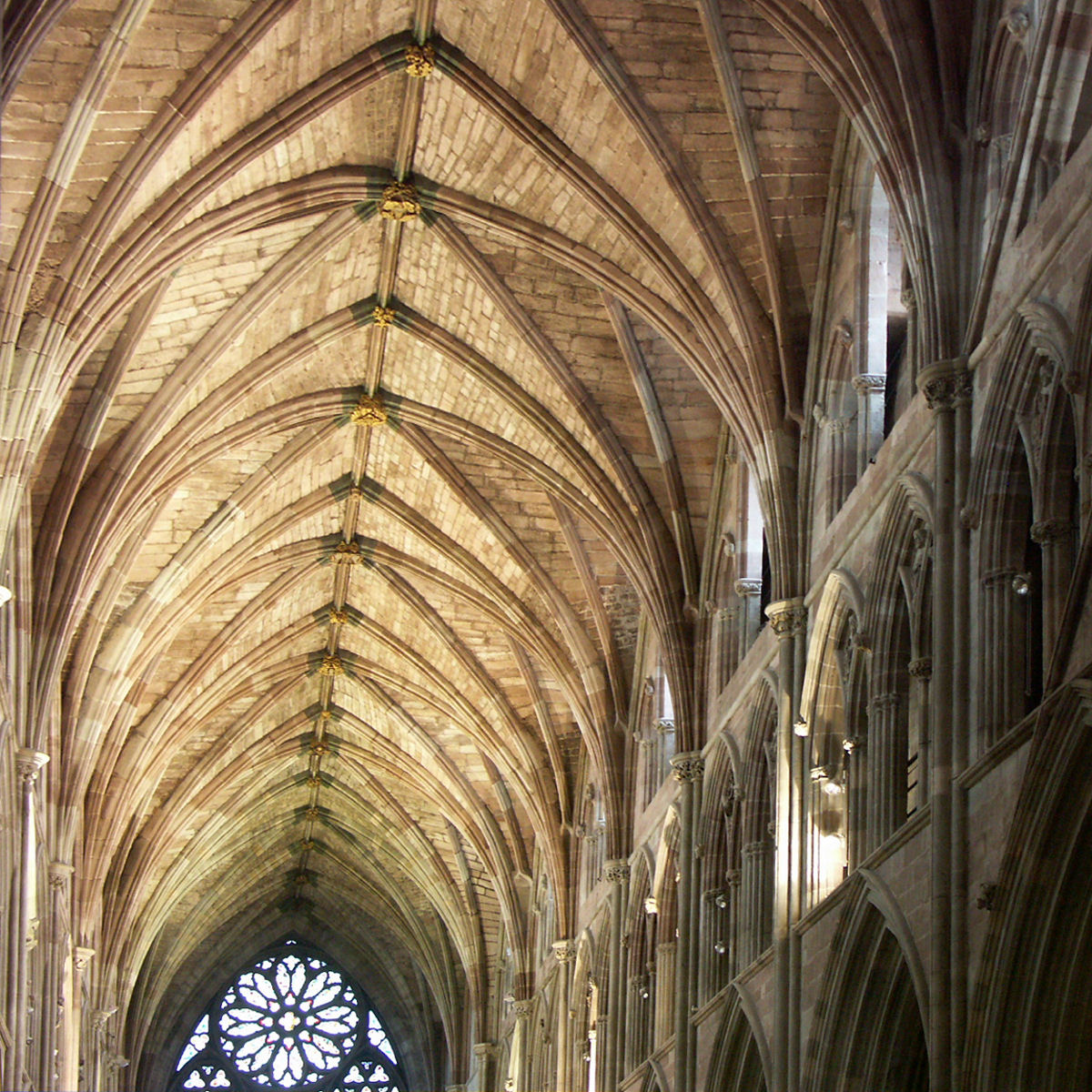
Pointed arches form the rib vaults of Worcester Cathedral (1084–1504)

A pointed arch, ogival arch, or Gothic arch is an arch with a pointed crown, whose two curving sides meet at a relatively sharp angle at the top of the arch.[1] Also known as a two-centred arch, its form is derived from the intersection of two circles.[2] This architectural element was particularly important in Gothic architecture. The earliest use of a pointed arch dates back to bronze-age Nippur. As a structural feature, it was first used in eastern Christian architecture, Byzantine architecture and Sasanian architecture, but in the 12th century it came into use in France and England as an important structural element, in combination with other elements, such as the rib vault and later the flying buttress. These allowed the construction of cathedrals, palaces and other buildings with dramatically greater height and larger windows which filled them with light.[3]

Early arches

[edit]
7th-century Byzantine pointed arches from Chytroi-Constantia Aqueduct, Cyprus

Crude arches pointed in shape have been discovered from the Bronze Age site of Nippur dated earlier than 2700 BC. The palace of Nineveh also has pointed arched drains but they have no true keystone.[4] There are many other Greek examples, late Roman and Sassanian examples, mostly evidenced in early church building in Syria and Mesopotamia, but also in engineering works such as the Byzantine Karamagara Bridge, with a pointed arch of 17 m (56 ft) span, making "the pre-Muslim origins of pointed architecture an unassailable contention".[5]

The clearest surviving example of pre-islamic pointed arches are the two pointed arches of Chytroi-Constantia Aqueduct in Cyprus dating back to the 7th century CE.[6]

Pointed arches – Islamic architecture

[edit]

The pointed arch became an early feature of architecture in the Islamic world. It appeared in early Islamic architecture, including in both Umayyad architecture and Abbasid architecture (late 7th to 9th centuries).[7][8] The most advanced form of pointed arch in Islamic architecture was the four-centred arch, which appeared in the architecture of the Abbasids. Early examples include the portals of the Qubbat al-Sulaiybiyya, an octagonal pavilion, and the Qasr al-'Ashiq palace, both at Samarra, built by the Abbasid caliphs in the 9th century for their new capital.[8] It later appeared in Fatimid architecture in Egypt[9] and became characteristic of the architecture of Persianate cultures, including Persian architecture,[10] the architecture of the Timurid Empire,[11] and Indo-Islamic architecture.[12][13][14]

The evolution of the pointed arch in Islamic architecture was associated with increases between the centers of the circles forming the two sides of the arch (making the arch less "blunt" and more "sharp"), from 110 of the span in Qusayr 'Amra (712-715 AD), to 16 in Hammam as-Sarah (725-730), to 15 in Qasr Al-Mshatta (744), and finally to 13 in Fustat (861-862).[15]

The appearance of the pointed arch in European Romanesque architecture during the second half of the 11th century, for example at Cluny Abbey, is ascribed to the Islamic influence.[16] Some researchers follow Viollet-le-Duc in acknowledging the spread of Arabic architecture forms through Italy, Spain and France, yet suggesting an independent invention of the pointed shape in some cases. The change was supposedly driven by the observations of the collapses of semicircular arches, with the crown moving down and haunches out. In this interpretation, the pointed arch was an attempt to strengthen the semicircular arch against a collapse by moving the crown up and haunches in.[15]

Gothic architecture – pointed arches and rib vaulting

[edit]

The reduction of thrust on supports that a pointed arch provided, as compared to a semicircular one with the same load and span, was quickly recognized by medieval European builders. They achieved this at first through experimentation, but technical literature dating to the Renaissance indicates that formulas for determining thrust may have been in use during the medieval period.[15]

Rib vaults

[edit]

In the 12th century, architects in Sicily, England and France discovered a new use for the pointed arch. They began using the pointed arch to create the rib vault, which they used to cover the naves of abbeys and cathedrals. One of the first Gothic rib vaults was built at Durham Cathedral in England (1135–1490).[3] Others appeared in the deambulatory of the Abbey of Saint Denis in Paris (1140–1144), Lessay Abbey in Normandy (1064–1178), Cefalù Cathedral in Sicily, (1131–1240). and the Cathedral of Notre-Dame de Paris.

The rib vault quickly replaced the Romanesque barrel vault in the construction of cathedrals, palaces, and other large structures. In a barrel vault, the round arch over the nave pressed down directly onto the walls, which had to be very thick, with few windows, to support the weight. In the rib vault, the thin stone ribs of the pointed arches distributed the weight outwards and downwards to the rows of pillars below. The result was that the walls could be thinner and higher, and they could have large windows between the columns. With the addition of the flying buttress, the weight could be supported by curving columns outside the building, which meant that the Cathedrals could be even taller, with immense stained glass windows.[17]

In the earliest type of Gothic rib vault, the sexpartite vault, the vault had a transversal pointed arch, and was divided by the ribs into six compartments. It could only cross a limited amount of space, and required a system of alternating columns and pillars. This type was used in Sens Cathedral and Notre-Dame de Paris. A new version was soon introduced, which reduced the number of compartments from six to four, distributed the weight equally to four pillars, eliminating the need for alternating columns and pillars, and allowed the vault to span a wider space. This quadripartite vault was used at Amiens Cathedral, Chartres Cathedral, and Reims Cathedral, and gave these structures unprecedented height.[18]

Portals

[edit]

Portals of Cathedrals in the Gothic period were usually in the form of a pointed arch, surrounded by sculpture, often symbolizing the entrance to heaven.

Windows

[edit]

The window in the form of a pointed arch is a common characteristic of the Gothic style. Windows sometimes were constructed in the classical form of a pointed arch, which is denominated an "equilateral arch", while others had more imaginative forms that combined various geometric forms (see #Forms). One common form was the lancet window, a tall and slender window with a pointed arch, which took its name from the lance. Lancet windows were often grouped into sets, with two, three or four adjacent windows.

The late Gothic, also known as the Flamboyant Gothic, had windows with pointed arches that occupied nearly all the space of the walls. Notable examples are the windows of Sainte-Chapelle de Vincennes (1379–1480)

Forms

[edit]
Varieties of Gothic pointed arches: 1 - equilateral (with trefoil treatment), 2 - blunt, 3 - lancet, 4 - ogee, 5 - four-centred, 6 - curtain (inflexed), 7 - pointed horseshoe

The most common form of the Gothic pointed arch in windows and arches was based upon an equilateral triangle, in which the three sides have an equal length (the span of the arch is equal to the arc radii). This so called equilateral arch had the great advantage of simplicity. Stone cutters, or hewers, could precisely draw the arc on the stone with a cord and a marker. This allowed arch stones to be cut at the quarry in quantity with great precision, then delivered and assembled at the site, where the layers put them together, with the assurance that they would fit. The use of the equilateral triangle was given a theological explanation – the three sides represented the Holy Trinity.[19]

In the later years of the flamboyant Gothic the arches and windows often took on more elaborate forms, with tracery circles and multiple forms within forms. Some used a modification of the horseshoe arch, borrowed from Islamic architecture.

The Tudor Arch of the Late Gothic style was a variation of the Islamic four-centred arch. A four-centred arch is a low, wide type of arch with a pointed apex. Its structure is achieved by drafting two arcs that rise steeply from each springing point on a small radius, and then turning into two arches with a wide radius and much lower springing point. It is a pointed sub-type of the general flattened depressed arch. Two of the most notable types are known as the Persian arch, which is moderately "depressed",[8] and the Tudor arch, which is flatter than the Persian arch, was widely used in English architecture, particularly during the Tudor dynasty (1485–1603).[20]

Revival of pointed arch

[edit]

Though the Gothic pointed arch was largely abandoned during the Renaissance, replaced by more classical forms, it reappeared in the 18th and 19th century, Gothic Revival architecture. It was used in Strawberry Hill House, the residence in Twickenham, London built by Horace Walpole (1717–1797) from 1749 onward. It was usually used in churches and chapels, and later in the British Houses of Parliament in London, (1840–1876) rebuilt after the earlier building was destroyed by a fire. In the 19th century, pointed arches appeared in varied structures, including the Gothic train station in Peterhof, Russia (1857).

Notes and citations

[edit]

Bibliography

[edit]
Revisions and contributorsEdit on WikipediaRead on Wikipedia
from Grokipedia
A pointed arch is an architectural element consisting of two curved segments that meet at a sharp apex, forming a pointed crown rather than a rounded one, which enables more efficient load distribution by directing forces downward onto supports at a steeper angle. This contrasts with the semicircular Roman arches used in earlier and allows for reduced lateral thrust, facilitating taller vaults and thinner walls. Originating in as early as the , the pointed arch was adapted in during the mid-12th century, marking a key innovation in the Gothic style. The pointed arch played a pivotal role in the Gothic architectural revolution, emerging prominently at the near around 1144, where it supported ribbed vaults and expansive stained-glass windows to create brighter, more vertical interiors symbolizing spiritual aspiration. By channeling weight more effectively to slender columns and flying buttresses, it permitted unprecedented heights in cathedrals, such as those in and from the late 12th to 16th centuries, while minimizing the need for massive supporting walls. Variations like the , equilateral, and arches evolved over time, influencing decorative elements in doorways, windows, and arcades across medieval . Beyond its structural advantages, the pointed arch contributed to the aesthetic emphasis on height and light in Gothic buildings, fostering a sense of divine elevation and openness that distinguished the style from preceding Romanesque forms. Its adoption spread through trade and cultural exchanges, particularly via Islamic influences in , and later inspired revivals in the , though its primary legacy remains in enduring cathedrals like and .

Definition and Structural Principles

Definition and Geometry

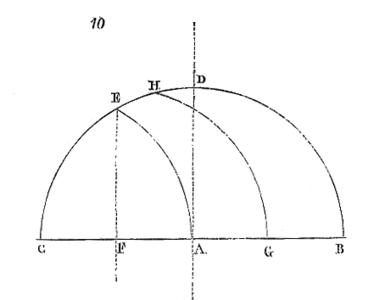
A pointed arch is an arch form composed of two or more circular arcs that converge to form a sharp at the apex, distinguishing it from the semicircular profile of a round arch. This configuration allows for varied proportions, enabling greater height relative to span compared to round arches. Geometrically, a pointed arch is typically constructed as a two-centered arch, where each side consists of a drawn from separate centers located outside the arch's span, usually below the springing line. The centers are positioned symmetrically such that the arcs originate at the springing points on either side of the span and intersect precisely at the apex, forming the pointed ; the distance between the centers and the of each arc are determined by the desired span (horizontal width) and rise (vertical height to the apex). For equilateral (isosceles) forms, the two arcs have equal and the apex lies directly above the of the span, while non-equilateral variants may feature unequal for asymmetrical profiles. Key terminology includes the intrados, the inner curved surface of the arch; the extrados, the outer curved surface; the springing line, the horizontal baseline from which the arch rises; and the apex, the highest point where the arcs meet. The mathematical basis for the arc radius RR in a symmetric two-centered pointed arch, with centers on the springing line, derives from circle geometry. To arrive at the solution, consider one side of the arch: the center of the arc is located on the springing line at a horizontal distance RR from the springing point. The apex is at a horizontal distance s/2s/2 from the springing point and hh above the springing line, so the horizontal distance from the center to the vertical line through the apex is Rs/2R - s/2, the vertical distance is hh, and the hypotenuse to the apex is RR. By the applied to this , the equation is (Rs/2)2+h2=R2(R - s/2)^2 + h^2 = R^2. Expanding yields R2Rs+s2/4+h2=R2R^2 - R s + s^2/4 + h^2 = R^2, simplifying to Rs=s2/4+h2R s = s^2/4 + h^2, so R=s2/4+h2s=s4+h2sR = \frac{s^2/4 + h^2}{s} = \frac{s}{4} + \frac{h^2}{s}. This formula provides the common radius for both arcs in the equilateral case.

Structural Advantages

The pointed arch directs vertical loads more efficiently downward along its legs compared to a round arch, minimizing the outward horizontal thrust on supporting abutments. This occurs because the converging curves meet at a sharp apex, where the angle between the legs is acute, allowing the compressive forces to align more closely with the vertical direction. Vector analysis of forces at the apex reveals that the horizontal components partially cancel, reducing the net lateral force transmitted to the supports. In contrast, a round arch's semicircular profile distributes forces more evenly around the curve, leading to greater horizontal spread that requires stronger abutments to contain. This efficient load distribution enhances height and stability, enabling taller structures with thinner walls and larger spans while keeping the thrust line—the locus of resultant compressive forces—confined within the arch's profile. By concentrating stress at the pointed crown, the arch avoids excessive eccentricity that could cause tensile stresses or instability in masonry materials, which perform poorly in tension. The thrust line remains safely within the kern (the middle third of the cross-section) for a wider range of geometries, allowing minimal material thickness without risk of hinging or collapse. For instance, analysis of pointed masonry arches under self-weight shows that limit equilibrium eccentricity correlates with embrace angle and rise, permitting optimized profiles that maximize stability for given heights. Mechanically, the horizontal thrust HH in a pointed arch (approximated as parabolic for uniform loading) is lower than in a round arch for equivalent span and rise, derived from moment equilibrium. For a three-hinged arch under uniform vertical load ww per unit length over span LL and rise hh, H=wL28hH = \frac{w L^2}{8 h}, or equivalently H=WL8hH = \frac{W L}{8 h} where W=wLW = w L is the total load; this decreases as the apex angle sharpens (higher h/Lh/L ratio), unlike round arches where the fixed curvature yields higher HH (up to 20-50% more in comparable models) due to poorer force alignment. This reduction in thrust—stemming from the geometry's ability to follow a nearer-funicular shape—lowers bending moments and shear, supporting slender designs. The varying of the pointed arch also facilitates its use as a prerequisite for complex vaulting systems, as the non-uniform allows intersecting arches of different spans to converge at a common keystone without geometric distortion. In ribbed vaults, this adaptability ensures that transverse and diagonal ribs meet precisely, distributing loads axially while avoiding the warping or mismatched joints common in circular arches under varying sizes. Such configurations enhance overall structural integrity.

Historical Origins

Pre-Islamic and Early Examples

The earliest known examples of pointed arches trace back to the in the ancient Sumerian city of , dating to approximately 2100 BCE, where they appeared in drain covers and minor drainage structures primarily for practical engineering purposes rather than aesthetic or structural innovation. Archaeological excavations conducted by the at uncovered a pointed arch formed of unbaked , measuring 60 cm high and 48 cm wide at the base, situated in a low-stress context within mound X on the southwest side of the site; this feature, associated with the Old Babylonian period, highlights early experimentation with curved forms to manage water flow in utilitarian settings. Such applications underscore the functional origins of the pointed arch in Mesopotamian architecture, where it facilitated simple spanning without the need for advanced load-bearing capabilities. In the broader , pointed arches evolved through corbelled approximations in Mesopotamian and Egyptian constructions, with more defined curved pointed forms emerging in Assyrian drainage systems by the 8th century BCE. These Assyrian examples, such as those in the drains under at Khorsabad, represented a step toward true construction in low-stress utilitarian contexts to manage water flow without full vaulting systems. Earlier corbelled variants, built by stepping stones inward to approximate a pointed shape, appeared in Egyptian mastaba tombs and Mesopotamian approaches as early as the third millennium BCE, serving to bridge small openings in low-tensile materials like . Byzantine architecture provided further precursors to the pointed arch in eastern Christian contexts, as evidenced by its use in innovative structures for functional and symbolic purposes. A clearer surviving pre-Islamic instance appears in the two pointed arches of the Chytroi-Constantia Aqueduct in Cyprus, dating to the 5th-6th century CE, where they supported innovative water management structures alongside flying buttresses, demonstrating early Byzantine adaptation for hydraulic efficiency. Throughout these periods, pointed arches predominantly served non-structural roles, appearing in decorative elements or low-stress applications like drainage and water management. This limited scope reflects the pointed arch's gradual emergence as a versatile element before its refinement in later traditions.

Development in Islamic Architecture

The pointed arch emerged as a significant architectural element during the Umayyad period, marking its first systematic use in monumental Islamic structures. In the Dome of the Rock in Jerusalem, completed in 691 CE under Caliph Abd al-Malik, the outer octagonal arcade features slightly pointed arches that support the elevated drum and dome, creating a rhythmic elevation and allowing for greater height while distributing structural loads more efficiently than semicircular forms. This innovation, influenced by regional Syrian and Byzantine traditions, represented an early refinement of arch geometry by adjusting the centers of the curving segments to form a tapered apex, which reduced lateral thrust and enabled lighter walls. In the subsequent Abbasid era, the pointed arch gained further prominence, as seen in the Palace of Ukhaidir in (late 8th century), where it was employed structurally in vaulted spaces for the first time in a comprehensive manner, facilitating complex interior designs without excessive material use. By the Fatimid period in , the form evolved with stilted pointed arches, particularly in designs, as exemplified in the founded in 970 CE in . Here, the original prayer hall's arcades incorporate pointed arches on coupled columns, enhancing verticality and integrating with the mosque's T-plan layout to emphasize spatial hierarchy and light penetration through elevated openings. These adaptations not only served structural purposes but also harmonized with Fatimid aesthetic principles, often adorned with vegetal motifs and in the spandrels. The Seljuk period in introduced decorative variations, such as multifoil pointed arches, which added ornamental complexity while maintaining structural integrity. The Alaeddin Mosque in , completed around 1155 CE, showcases these in its portal and interior arcades, where multifoil designs transition into that support domes, bridging square bases to circular drums with geometric precision. This integration of pointed arches with squinch systems was a key innovation, allowing seamless plan transitions in domed architecture and emphasizing rhythmic patterns that complemented intricate tilework and . As Islamic architectural traditions spread westward, the pointed arch influenced the style in during the 12th century, blending with local Visigothic and Romanesque elements. In the , rebuilt and expanded in the Mudéjar idiom around 1160–1200 CE under Almohad rule, pointed arches appear in courtyard arcades and vaults, facilitating open, light-filled spaces that fused Islamic geometric harmony with emerging Christian patronage. This regional evolution underscored the arch's versatility, prioritizing both aesthetic unity—through motifs like intersecting foils and arabesques—and functional advancements in load-bearing for expansive palaces and mosques.

Applications in Medieval European Architecture

Transition to Romanesque and Early Gothic

The pointed arch entered European architecture through cultural exchanges facilitated by the and interactions with , where Islamic builders had refined the form centuries earlier. These transmissions are evident in the sporadic adoption during the late 11th century, particularly in regions like and , marking an experimental phase in Romanesque design. In Aquitanian , early experiments with pointed arches appeared in vaulting systems amid the region's pilgrimage routes. This adoption reflected broader influences from Islamic motifs transmitted via trade and conquest in Iberia, allowing Romanesque builders to deviate from traditional rounded arches for more varied spatial effects. Further north, the pointed arch gained traction in during the Norman period, notably at , begun in 1093, where it was employed in the ribbed vaults of the to transition from semicircular forms, enabling taller elevations and distributing loads more efficiently. This use signified a shift toward verticality in Romanesque designs, influenced by continental exchanges during the , though it remained experimental and not yet systematized. The emergence of crystallized these innovations at the Abbey of Saint-Denis near , rebuilt under Abbot starting in 1140, where pointed arches in the and allowed for expansive windows that flooded the interior with light, symbolizing divine illumination as described in Suger's own writings. , in his treatise De administratione, articulated this symbolism, arguing that radiant light elevated the soul toward the divine, driving the structural choices that conceptually paved the way for flying buttresses in later Gothic works. This rebuild thus bridged Romanesque solidity with Gothic aspiration, prioritizing aesthetic and spiritual height over mere mass.

Role in Gothic Vaulting and Ribs

In , rib vaults represented a significant evolution from earlier Romanesque forms, incorporating pointed arches as the primary structural elements for diagonals and transverse ribs to create compartmentalized ceiling systems. These vaults typically divided into sexpartite configurations, with six curved panels per bay formed by two diagonal ribs, two transverse ribs, and intermediate ridge ribs, all employing pointed arches to span varying widths while achieving uniform height. A prime example is the choir of , rebuilt after 1194 CE, where such sexpartite vaults allowed for modular construction that facilitated the erection of taller interiors without excessive lateral thrust. Similarly, , dating from circa 1150 CE, featured early sexpartite rib vaults with pointed arches that marked a transitional innovation, enabling builders to experiment with height and complexity in nave ceilings. The construction of these ribbed vaults relied on a methodical process that leveraged the geometric properties of pointed arches. Builders first erected temporary wooden centering—a scaffold-like framework—to support the vault's form, positioning it by bay to allow sequential assembly. The were laid next, starting with the transverse and diagonal pointed arches, which were assembled from precisely cut voussoirs (wedge-shaped stones) locked at the keystone; the pointed profile ensured that ribs spanning different distances, such as shorter diagonals versus longer transverses, converged at the same crown height, simplifying the centering's design and reducing material needs. Once the were in place and self-supporting, the infill panels, or webbing, were added using thinner stone slabs or lightweight fillers, often in radiating courses that followed the ribs' curvature. This approach, evident in the choir vaults of (completed by 1177 CE), minimized construction time and scaffolding while distributing loads evenly during assembly. Over time, the use of pointed arches in rib vaults advanced toward greater intricacy, evolving from sexpartite designs to quadripartite vaults with four panels per bay, which became standard in structures for their efficiency. Further developments included tierceron vaults, adding intermediate ribs from capitals to the ridge for enhanced support and decoration, as seen in the presbytery of in the 1320s. By the late Gothic period, lierne vaults emerged, incorporating short connecting ribs between main ribs to form intricate, fan-like networks without altering the primary load paths; the at exemplifies this, with its lierne ribs creating a complex geometric web spanning 13 meters. These progressions were enabled by the pointed arch's versatility, allowing ribs of varied lengths and curvatures to intersect harmoniously while maintaining structural integrity. The engineering synergy of pointed arches in these vaults lay in their ability to channel vault weight more directly downward, minimizing horizontal thrust compared to semicircular arches. By concentrating forces along the toward vertical piers and abutments, pointed arches reduced lateral pressures on enclosing walls, permitting thinner and the integration of expansive windows; this was crucial in structures like , where vaults rose to over 30 meters without compromising stability. Complementing flying buttresses, the ribs served as secondary guides for load paths, with the vault's thin shell (often 12-20 cm thick) bearing primary compression, thus optimizing material use and enabling the soaring, luminous interiors characteristic of Gothic cathedrals.

Use in Portals and Openings

In , pointed arches were extensively employed in portals, or doorways, to create imposing entrances that emphasized verticality and grandeur. These arches allowed for taller openings compared to the semicircular Romanesque arches, distributing structural loads more efficiently downward onto supports rather than outward, which minimized the need for thick surrounding walls. This innovation enabled the construction of expansive, elaborately decorated portals that served both functional and symbolic purposes, framing sculptural programs depicting biblical scenes and saints. For instance, at (begun 1220), the three west façade portals feature tall pointed arches adorned with motifs and statue-columns, enhancing the dramatic height of the entrance while supporting the weight of the above. Similarly, Chartres Cathedral's Royal Portal on the west façade (mid-12th century) utilizes pointed arches to integrate intricate sculptural tympana and archivolts, marking an early transition to forms. The structural advantages of pointed arches in portals also facilitated the integration of narrative sculpture without compromising stability. By concentrating thrust vertically, architects could employ slender jambs and colonnettes, allowing for deeper recesses and multi-layered archivolts that housed profuse figural decoration. This is evident in the north portals of (c. 1210), where pointed arches frame recessed doorways with elaborate moldings and statues, creating a sense of depth and movement that draws worshippers inward. At (begun 1163), the central portal's pointed arch supports a with the tympanum, demonstrating how the form's permitted heavier sculptural loads while maintaining proportional harmony. These portals not only provided access but also acted as theological gateways, with the arch's upward taper symbolizing ascension toward the divine. Beyond doorways, pointed arches revolutionized openings such as windows, enabling vast glazed surfaces that flooded interiors with light—a key aspiration of Gothic design. The arch's ability to adjust height independently of width allowed for elongated lancet windows and complex patterns, reducing wall mass and maximizing illumination. In the clerestory windows of (begun 1220), pointed arches form tall, narrow lancets grouped under gables, pierced by intricate bar that divides the glazing into geometric motifs like trefoils and mouchettes. At (c. 1190–1420), the level employs multifoil pointed arches for secondary openings, creating rhythmic patterns that unify the elevation and enhance the perception of height. This application extended to rose windows, where radiating pointed arches in the , as seen in the south of Notre-Dame (c. 1260), formed circular compositions that symbolized divine light piercing the earthly realm. Overall, these uses in openings underscored the pointed arch's role in achieving luminous, ethereal spaces that elevated the spiritual experience.

Variations in Gothic Forms

Within Gothic architecture, pointed arches evolved into several distinct subtypes, each adapted to regional preferences, structural needs, and stylistic developments from the 12th to 16th centuries. These variations maintained the basic two-centered of the pointed form but altered the , rise, and to achieve different visual and functional effects, such as emphasizing verticality or spanning wider openings. The equilateral pointed arch, a symmetrical two-centered form where the sides equal the radius, became prominent in structures around 1220 CE. This balanced design distributed loads efficiently while creating a harmonious, upward thrust, as seen in the arcades and windows of in . In contrast, the lancet arch features a slender, steeply pointed profile with a rise exceeding half the span, producing a narrow, lance-like shape that heightened the sense of verticality in Early English Gothic buildings from the 1220s. Exemplified by the clustered lancet windows and nave arcades at , this form allowed for taller interiors and grouped openings that flooded spaces with light. Later developments introduced lower-rise variations for flatter profiles, distinguishing the equilateral from the drop arch, which depresses the apex to create a wider, more horizontal emphasis in the style of the 15th century. At King's College Chapel in , begun in 1446 CE, drop arches appear in the expansive window and fan vaults, facilitating broader spans and intricate decorative panels. The four-centered arch, characteristic of the Tudor and phases, employs two smaller arcs for the rise and two larger ones for the base, forming an S-curve that enables even wider spans with a graceful, undulating outline. Constructed from 1514 CE at in , this subtype marked a transition toward influences while retaining Gothic pointedness, often used in grand doorways and cloisters. Regionally, French Gothic arches tended to be steeper, as in the equilateral forms of cathedrals, to accentuate soaring heights, whereas English examples progressively flattened in the period to prioritize length and expansive interiors.

Revival and Later Developments

Gothic Revival in the 19th Century

The Gothic Revival of the 19th century marked a romantic resurgence of pointed arches as a symbol of moral and nationalistic ideals in architecture, largely propelled by the advocacy of Augustus Welby Northmore Pugin and John Ruskin. Pugin, in his 1836 treatise Contrasts, argued that the pointed arch exemplified true Christian architecture, contrasting it with the perceived corruption of classical styles and positioning Gothic forms as embodiments of spiritual authenticity and social virtue. Ruskin further elevated this ideology in works like The Seven Lamps of Architecture (1849), where he praised the pointed arch for its organic beauty and structural honesty, viewing it as a moral imperative against the mechanized excesses of industrial production. Their combined influence framed the pointed arch not merely as a stylistic element but as a ethical response to Victorian modernity, inspiring a wave of neoclassical revival projects across Europe and North America. A prominent secular application emerged in the reconstruction of the Palace of Westminster, known as the Houses of Parliament, following the 1834 fire; completed in phases from 1840 onward under architects and A.W.N. Pugin, the design incorporated extensive pointed arches in windows, doorways, and to evoke medieval English heritage. The building's detailing, including tall lancet windows with pointed arches, symbolized parliamentary tradition and , becoming a benchmark for Gothic Revival civic architecture. In contexts, the pointed arch facilitated the completion of longstanding medieval projects and the erection of new neo-Gothic cathedrals, blending historical continuity with 19th-century engineering. The in , initiated in 1248 but stalled for centuries, was resumed in 1842 under Prussian initiative and fully completed in 1880, with its towering spires and intricate pointed arches in vaults and facades representing a nationalist triumph of Gothic purity. Similarly, the Washington National Cathedral's design, conceptualized in the 1890s by British architect George Frederick Bodley, drew on English Gothic precedents with prominent pointed arches in its and transepts, though construction began in 1907; this project underscored transatlantic adoption of the style for institutional worship. Secular buildings, particularly in educational and civic spheres, adapted pointed arches to modern materials like iron framing, allowing for expansive interiors while retaining ornamental flair. At the , the New Examination Schools, constructed between 1876 and 1882 by architect Thomas G. Jackson, featured robust pointed arch windows and arcades in a High Victorian Gothic manner, integrating cast-iron supports to accommodate large lecture halls. Comparable civic structures, such as town halls and museums, employed these arches to convey cultural prestige, often combining them with for visual dynamism. The movement faced critiques regarding authenticity and perceived Victorian excess, with Ruskin himself decrying later interpretations as overly ornate and divorced from medieval craftsmanship's sincerity, as outlined in The Stones of Venice (1851-1853). This debate prompted a shift toward more restrained forms by the late , emphasizing structural clarity over decorative proliferation while preserving the pointed arch as a core element of revivalist identity.

Modern and Contemporary Uses

In the , pointed arches found stylized applications in transitional styles like , where they blended with organic curves to create dynamic forms. A notable example is the Saint-Jean de Montmartre Church in , completed in 1904 and designed by Anatole de Baudot, which incorporates pointed arches in its structure to evoke Gothic height while integrating flowing motifs for doorways and windows. This fusion marked an early modern adaptation, using the arch's vertical emphasis to enhance spatial drama in urban religious . During the mid-20th century, pointed arches appeared in educational and civic buildings influenced by Gothic elements, often constructed with and for greater spans. The at the , finished in 1937 and designed by Charles Z. Klauder, employs pointed arches in its fenestration and interior vaults to symbolize intellectual aspiration, distributing loads efficiently in a 42-story tower that combines massing with Gothic detailing. This structure demonstrates the arch's role in modern high-rise design, where its form accentuates verticality without compromising structural integrity. In , pointed arches contribute to sustainable practices by enabling expansive openings that maximize natural daylight and ventilation, thereby minimizing energy use for lighting and climate control. Modern materials like allow these arches to support lightweight frames over wide spans, as seen in eco-oriented public buildings where the form optimizes and airflow; for instance, pointed arch-inspired clerestories in green campuses reduce electricity consumption through passive solar strategies. Restoration projects highlight the pointed arch's enduring engineering value in the . Following the April 2019 fire that damaged Notre-Dame Cathedral in , the five-year reconstruction effort, overseen by the French government and completed in December 2024, meticulously rebuilt the nave's pointed arches using original 13th-century techniques augmented with digital scanning and carbon-fiber reinforcements for seismic resilience. This work preserved the arches' load-bearing role in the ribbed vaults while adapting them to contemporary safety standards. Symbolically, pointed arches evoke aspiration and resilience in modern memorials, their upward thrust representing amid . Though not always literal, the form influences designs like those in commemorative spaces where vertical elements draw the eye heavenward, reinforcing themes of elevation and remembrance in 21st-century .

References

Add your contribution
Related Hubs
User Avatar
No comments yet.