


Community hub
Recent from talks
Contribute something
Nothing was collected or created yet.
Grimaldi Group
View on Wikipedia

Key Information


The Grimaldi Group is a private shipping company owned by the Grimaldi family (Emanuele Grimaldi) and based in Naples, Italy. Grimaldi operates a large fleet of ro-ro, ro-ro/multipurpose, con-ro multipurpose, PCTC (Pure Car and Truck Carrier), ro-pax and cruise ferries vessels.[2]
Shipping
[edit]The Grimaldi Group is a conglomerate of companies linked to the logistics business with a main focus on shipping. The main brands of the company are:[3]
- Grimaldi Lines – covering the activities of two companies, Grimaldi Euromed and Grimaldi Deepsea, including maritime transport of cargo and passengers in the Mediterranean as well as freight only services between the Mediterranean, Northern Europe, West Africa, North and South America
- Atlantic Container Line (ACL) – Roll-on roll-off and container-based cargo services in the North Atlantic
- Minoan Lines – a ferry company sailing between Italy and Greece and within Greece
- Finnlines – a ferry company operating in Northern Europe and in the Baltic Sea
- Malta Motorways of the Sea – a ferry company operating between Malta and other Mediterranean countries
History
[edit]
The Grimaldi family has had links to shipping for many generations. According to their own records, the oldest written records linking the Grimaldi family to shipping dates back to 1348, when three Grimaldi brothers received a precious relic as a guarantee for the chartering of three ships, and the newest member inherited the company (Emanuele Grimaldi the first).
The current Grimaldi companies can be traced back to the middle of the 19th century when Italian shipowner Gioacchino Lauro started a steamboat company. His son Achille expanded that shipping company and, in the middle of the 20th century, it became one of the largest shipping companies in the world. At that time, Giovanni Grimaldi was a lawyer who was married to the sister of above Achille Lauro. Amelia Grimaldi-Lauro asked her brother Achille to take her son Guido under his wings, and this brought the Grimaldi family back into the shipping business. It was this son, Guido, who founded the group in 1947 with his brothers Luigi, Mario, Aldo, and Ugo by buying a Liberty ship. In those years, passenger transatlantic travelling reached its peak. The Grimaldi brothers realized the needs of the market and promptly started to transport passengers, focusing on Mediterranean- South America routes, with comfortable ships that regularly connected Italy to Buenos Aires, Caracas and other ports.[4]
Since the early 1960s, coinciding with Italy's economic boom, the Liberty ships were replaced with modern bulk carrier and tankers units, which enhanced the group in the transport of goods. For the Grimaldis, however, the turning point came in 1969, when the brothers inaugurated a new regular service between Italy and the United Kingdom, specifically dedicated to the transport of brand new vehicles. In a few years, all the major international car manufacturers knew Grimaldi and chose the company for the transport of their vehicles between Europe and the Mediterranean. Since then rolling freight has been the driving force of the growth of the group.
Over the last decades, the group proceeded with an expansion policy of its maritime network, of its fleet and shore services. The group's fleet increased from 36 units to over 130 ships and the brand became a landmark for the biggest vehicle manufacturers worldwide.
At the same time the group evolved to an integrated logistics operator, running a network of 22 owned port terminals located in the Mediterranean, Northern Europe and West Africa (with a total surface of about 6.2 million m2) and managing various land transport companies for door-to-door distribution of brand new vehicles. In the last decades, the group has also strongly invested in the development of the Motorways of the Sea in the Mediterranean and Baltic Seas, thus promoting EU's policy of shifting goods from the road to more environmentally friendly transport solutions. The Motorways of the Sea network was further extended between 2006 and 2008 with the acquisition of Finnlines, leader in the Baltic region, and Minoan Lines, leader in the Adriatic Sea, totalling today more than 120 routes.[citation needed]
Tonnage
[edit]The Grimaldi Group fleet includes over 130 ships, of which about 120 are owned, with an average age significantly below the industry average as well as the useful life of the ships. These young and modern units are deployed on regular services in a network that connects over 140 ports in 50 countries and 4 continents.[5] In recent years, the group has invested heavily in the renewal and strengthening of its fleet, firstly by designing and commissioning the construction of new high-performance units with a reduced environmental impact. At the same time, numerous ships already in operation have undergone important green conversion works. About 80% of the group's ships are dedicated to freight-only transport between Europe, the Near East, Africa, North and South America. The remaining units are deployed for the mixed transport of freight and passengers in Europe (Mediterranean Sea, Baltic Sea and North Sea).
Freight-only transport
[edit]- Ro-ro ships for short sea connections, mainly dedicated to the transport of rolling freight and cars and regularly operating in the Mediterranean, the Baltic Sea and the North Sea. Finnlines’ ice class vessels, which are specially designed to navigate through sea ice, also belong to this category.[6] The Grimaldi Group has recently made important investments for the strengthening of its ro-ro fleet. Between November 2020 and January 2021, the first three GG5G-class (Grimaldi Green 5th Generation) hybrid ro-ro vessels entered service in the Mediterranean. These ships use fossil fuel in navigation and electricity during the stop in port, guaranteeing Zero emission in Port thanks to the presence onboard of mega lithium-ion batteries. Nine of the twelve GG5G-class vessels will be operated under the Grimaldi Lines brand in the Mediterranean, while the other three will be delivered to Finnlines, which will use them to enhance freight connections in Northern Europe. All GG5G-class units will be delivered in 2021–2022.
- PCTC (Pure Car & Truck Carrier) and ro-ro multipurpose ships: extremely flexible vessels which can transport any type of rolling freight (trucks, tractors, buses, excavators, etc.) and special cargo (railway waggons, helicopters, etc.). These ships are mainly used in the Mediterranean Sea as part of the Euromed network as well as in trade between Europe and North America. A recent order from the Grimaldi Group covered seven new highly innovative PCTC vessels that stand out for their size, flexibility and efficiency. Six of these units are already operational, while the last one will be delivered in the first half of 2021.[7]
- Con-ro ships for the transport of containers and rolling freight on deep sea routes. Thanks to the combination of the stern ramps and the cranes on the deck, they are able to load different types of goods independently and simultaneously. All ACL ships, operating between North America and Northern Europe, and other group ships used on routes connecting Europe, the East coast of America and West Africa, belong to this category.[8]
- The group has recently made an order to a Korean shipyard for the construction of 6 con/ro vessels of the G5 class with delivery by 2023.[9]
Ferry operations
[edit]The Grimaldi Group deploys around 30 ro-pax vessels for the mixed transport of goods and passengers in the Mediterranean Sea, the Baltic Sea and the North Sea. With a fleet consisting mostly of modern and comfortable ferries, cruise ferries and a luxury catamaran, the group transports rolling freight, cars and passengers between the main European ports under the Grimaldi Lines, Minoan Lines and Finnlines brands.[10] Fleet improvement initiatives have recently involved the two flagships of the group's ro-pax fleet. The two state-of-the-art cruise ferries Cruise Roma and Cruise Barcelona – both operating since 2008 – underwent major lengthening and refurbishment works at the beginning of 2019 which further increased their energy efficiency and made them the first ships in the Mediterranean with Zero Emission in Port technology. In fact, thanks to the installation of mega lithium-ion batteries that are recharged during navigation, the vessel is capable of cutting emissions to zero during port stays. Each of the sister vessels can currently carry up to 3,500 passengers, 3,700 linear meters of rolling cargo and 271 cars.[11] In December 2019, Finnlines finalized a new order for the construction of two ro-pax units, which will be delivered by 2023. These new ships, which will inaugurate the innovative Superstar class, will be larger and more technologically advanced than the existing units belonging to the Star class.[12] In particular, this investment is aimed at increasing energy efficiency and further reducing the emissions generated by transport activities in the Baltic Sea, while at the same time raising the quality of the services offered to the company's passengers.
Cargo
[edit]The company specializes in the maritime transport and distribution of shipping containers, automobiles, trucks, trailers, Mafi roll trailers, heavy construction machinery and other types of rolling cargo.[13] The core business of the Grimaldi Group is the transport of rolling and containerized goods on a global scale. The dense network of maritime connections operated links the main ports in the Mediterranean, Northern Europe, West Africa, North and South America, and is conventionally divided into Atlantic Network and Euro-Med Network. The Atlantic Network includes all lines operated between the various shores of the Atlantic Ocean and is mainly dedicated to transport of rolling freight, containers, project cargo and special cargo. The group has been operating on these lines for over 40 years, taking on the role of market leader and guaranteeing weekly departures from the main ports in North and South America, West Africa and Northern Europe. The Euro-Med Network was born in the mid-nineties. It includes frequent and regular services calling at over 50 ports in the Mediterranean (including Turkey and the Near East) and in the Baltic Region (including Russia). The Euro-Med connections are mostly dedicated to the automotive sector. The Grimaldi Group has also been the pioneer in the development of the Motorways of the Sea in Europe. The wide network of over 120 short sea routes extends in all the Mediterranean Sea, the Baltic Sea and Northern Europe. For its short sea and deep sea services, the company deploys over 130 vessels, including ro-pax ships, ro-ro vessels, pure car and truck carriers, ro-ro multipurpose and container/ro-ro ships.[14]
Notable incidents
[edit]- On 21 February 2025, a fire broke out on Grand Congo while sailing in the Atlantic ocean, in proximity with Bahamas. The crew was able to contain the fire.[15]
- On 18 February 2025, a fire started on board of Grand Brasile while sailing in the English Channel. Crew evacuated by life boat, while the coast guard responded with a rescue operation for vessel and crew.[16] Consequently the vessel was declared a total loss and sold for scrap in Turkey.[17]
- On 6 July 2023, a fire started on Grand Costa D’Avorio while alongside Newark pier. Two fire fighters lost their lives while attempting to placate the flames.[18]
- On 20 February 2023, a fire was extinguished by the crew on Grand California while sailing between from Antwerp to Italy, opposite Spanish coast.[19]
- On 18 February 2022, a major fire broke out on Euroferry Olympia while it was in international waters near Diapontia Islands, northwest of Corfu, en route from Igoumenitsa to Brindisi, causing 11 casualties. According to the authorities, there were at least 292 people on board: 239 registered passengers and two refugees who were not officially checked in, as well as 51 crew members. Grimaldi confirmed that there were 153 vehicles on board.[20] The fire broke out in the car deck, probably in a truck. The ship was brought closer to the north Corfu coast to offer better protection from the wind,[20] and it was later towed to Astakos in hopes of making the fire-fighting effort easier. By 23 March the bodies of the eleven missing passengers had been recovered.[21][22] The Greek Union of Lorry Drivers (SEOFAE) accused Grimaldi of overloading the ship; the company denied this, stating that passenger numbers were at only 42 per cent of capacity, all 159 lorry drivers had cabins, and overbooking of freight vehicles was prevented. The company also said that it complied with international rules forbidding passengers entering the garage decks while the ship is moving, though an Italian truck driver told RAI that he and many other truck drivers had previously camped in the ship's car deck.[23]
- On 4 June 2020, a serious fire started on MV Höegh Xiamen while alongside Jacksonville Blount Island port, and lasted for three full days, before having been successfully extinguished by Jacksonville fire brigades.[24] The vessel, before being finally declared a total loss, was under Grimaldi Group's time chartering and operation from Höegh Autoliners, for discharging and loading cars and used high and heavy machineries, on a regular monthly service in between Europe and US.[25]
- On 21 November 2019 early morning, ro-pax MV Eurocargo Trieste faced a fire in her engine room. The ship departed Livorno just an hour before with over 200 vehicles on board and passengers, and was only 4 miles away from the port, when tugboats were re-deployed to berth her again, while fire brigades helped in extinguishing the fire. The reason of the accident remains unknown.[26]
- On 7 October 2019, Euroferry Malta faced a severe storm after departing Cagliari port. Four crew members were injured while attempting to secure the cargo with lashing, and one died.[27]
- On 15 May 2019, Grande Europa caught fire en route from Naples to Valencia close to the Balearic islands.[28] The vessel was carrying over 1800 motor vehicles including a 1960s Bedford SLCO bus once used for public transport in Malta and owned by comedian Johnny Vegas.[29] Two separate fires were started hours apart in different parts of the ship. The first broke out on deck 3 at 00:45am and was extinguished by the crew within 45 minutes. Some 2.5 hours later at 4am, another fire broke out on deck 8, spread to deck 9, and required ten hours to extinguish. Half of the crew had to be evacuated by helicopter, while the other half remained on board to help the immediately deployed rescuing vessels in extinguishing the fire.[30] The ship had to be towed to Palma de Mallorca port, and the ship's third officer was later arrested along with two other crewmembers, charged with intentionally setting both fires.[31]
- On 10 March 2019, a fire started on the ro-ro ship Grande America off the coast of the Finistère. Travelling from Hamburg to Casablanca, it was carrying around two thousand cars including four Porsche 911 GT2 RS vehicles originally intended to be the last ever made,[32][33] as well as 365 containers (some of which contained hazardous materials). Efforts to extinguish it were unsuccessful and the ship started leaning to starboard. Early on 11 March, the twenty-six crew members and the only passenger were evacuated; they were then rescued by the British frigate HMS Argyll. The Grande America sank soon afterward, causing an oil spill.[34] The Grimaldi Group immediately dispatched in the place of sinking the Anchor Handling Supply (AHTS) vessel Union Lynx to monitor any ship's fuel spill, and organised the recovery of any floating container. Later on, the group sent there the vessel Island Pride, equipped with a modern ROV (Remotely Operated Underwater Vehicle) that reached the wreck at 4,600 metres sea depth, completed the patches on every holes and confirmed that there was no oil leakage.[35]
- On 21 December 2018, four stowaways armed with metal bars threatened crew members on board Grande Tema travelling from Nigeria, demanding to be taken closer to the British coast.[36] The following day, despite Essex Police stating this was not being treated as a hostage, terror or piracy-related incident, British special forces seized control of the vessel and detained all four perpetrators without casualties.[37]
- On 8 August 2017, a seizure warrant was issued by the Dakar Port Authority for Grande Nigeria until damage repayment was arranged. The vessel had broken her moorings and accidentally collided with a ferry docked close by. Diambogne vessel suffered severe damage to her hull that caused seawater to enter the engine room.[38]
- On 27 November 2016, while en route from Valencia to Autoport-Izmit, MV Grande Anversa collided with general cargo Sider Capri in the Çanakkale Boğazı (Strait of Çanakkale) in Turkey. Both vessels reported minor damage but had to interrupt their commercial voyages, proceeding to the anchorage to undertake investigations and surveys.[39]
- On 22 October 2014, Grande Francia encountered extreme bad weather conditions on the way from Tilbury to Hamburg. The vessel faced severe rolling and strong gust winds that caused ten 40-foot containers to break their lashings and fall overboard.[40]
- On 7 October 2011, Repubblica Argentina ran aground in the Western Scheldt between the North Sea and the port of Antwerp and was pulled back afloat at the next high tide.[41]
- On 8 March 2007, Repubblica di Genova capsized during an Antwerp port stay due to possible incorrect stowage and ballast. The vessel was loading containers and vehicles. A large portion of the cargo fell overboard, however, the vessel was rescued and towed to dry dock.[42]
Drug smuggling episodes
[edit]- On 28 January 2020, in Dakar Senegal, onboard of the MV Grande Nigeria 120 kilograms of cocaine packed in 4 bags were found by the crew in the ship's ventilation system.[43][44][45]
- Between 14 and 16 July 2019 German customs officials confiscated 4.5 tons of cocaine hidden in 211 sports bags on the MV Grande Benin while the ship was in Hamburg. 4,200 packages of pressed cocaine had arrived aboard the ship on the route Montevideo – Antwerp. According to the ship's documentation, the container was loaded with soybeans. It was the largest seizure of drugs in the history of Germany, the approximate value of which was 1,000 million dollars, which was a sensitive blow to drug trafficking. The drugs were destroyed under strict security measures. The national director of Customs of Uruguay, Enrique Canon, resigned on 1 Aug after knowing the case of the ship which added another seizure of the drug that had left on a private flight from Carrasco International Airport in Uruguay, carrying about 600 kilos of cocaine. In both cases, the controls of the loads at the exit were not adequate. The ship had berthed in Montevideo between 12 and 19 June where the drug was probably loaded.[46]
- On 29 June 2019, in the port of Dakar, the Senegalese customs inspected the vehicles transported by the MV Grande Nigeria, coming from South America and headed for Northern Europe, and found in some of them a hidden bust of 798 kilos cocaine. For this reason, the vessel was seized, while the Master and the Chief mate Commander – both Italians – as well as two German passengers were arrested.[47] The release has been described as an "embarrassing affair" in the Senegalese media. It was noted that some crew members were on board the ship after the seizure in order to run the engines and that the people who held responsibility of the vessel were released and allowed to return to Italy.[48]
- In June 2019, 3.36 tonnes of cocaine were found hidden in a load of rice on board of the Grimalid ro-ro ship Grande Francia at the port of Antwerp. This was the largest seizure of cocaine at the port of Antwerp in 2019 [49]
- On 30 November 2018, Italian authorities seized 82 kg of cocaine hidden in a Land Rover car shipped from Argentina on the MV Grande Argentina.[50]
- In August 2018, in short succession, two Grimaldi vessels were stopped by the Brazilian authorities at Santos. On 7 August, 1.2 tons of cocaine drug was found hidden inside a container on MV Grande Nigeria.[51] On MV Grande Francia two containers were noted with broken seals by the crew, and intruders were spotted fleeing the ship anchored at Santos roads. Consequently, 1.3 tons of cocaine was found inside the containers by local authorities on 12 August.[52]
- On 22 February 2018, Dutch police seized 55 kilos of cocaine in Antwerp port, that was brought to the Netherlands onboard the MV Grande Amburgo.[53]
- In April 2016 German police found 26 kilos of cocaine hidden in building machines on board of MV Grande Atlantico during a raid in Hamburg.[54]
- On 26 March 2016, during a raid in Emden harbour, German police seized 60 kg of cocaine hidden in building machines on board of MV Grande Amburgo.[55]
- On 19 March 2016, 20 kg of cocaine were found on board of the MV Grand Brasile during a raid by German police, when the ship was approaching Hamburg.[56]
- On 18 January 2016, 3 kg of cocaine were intercepted by State police in Palermo, Italy, on board the MV Eurocargo Rome.[57]
- In December 2015, 13 kg of cocaine were found to be transported by a Grimaldi ferry to Sardinia.[58]
- On 12 May 2015, 13 kg of cocaine were seized by Italian police in "Operazione Paprika". The ro-pax ferries travelling between Civitavecchia and Barcelona were used for the transport of cocaine, hidden in passenger cars.[59]
Current fleet
[edit]| Ship name | Flag | Built | Route | IMO | Tonnage | Length | Width | Passengers | Cars | Knots | Photo |
|---|---|---|---|---|---|---|---|---|---|---|---|
| Cruise Bonaria |  |
2000 | Livorno-Palermo | 9204063 | 37,551 | 214 m | 26.4 m | 2,500 | 665 | 31.5 | |
| Zeus Palace | |
2001 | Livorno-Olbia | 9208071 | 31,730 | 212 m | 25 m | 1,706 | 580 | 31.5 | |
| Europa Palace | |
2001 | Cagliari-Napoli Cagliari-Palermo |
9198939 | 32,728 | 203.9 m | 25 m | 1,800 | 712 | 28.9 | |
| Cruise Ausonia | |
2002 | Napoli-Palermo | 9227429 | 30,902 | 199.9 m | 25 m | 1,821 | 649 | 31.2 | |
| Catania | |
2003 | Salerno-Palermo |
9261554 | 25,955 | 186.5 m | 25.6 m | 934 | 480 | 22.5 | |
| Venezia | |
2004 | Igoumenitsa-Ancona | 9304631 | 26,400 | 186 m | 25.6 m | 946 | 400 | 23 | |
| Florencia | |
2004 | Igoumenitsa-Ancona | 9287584 | 26,302 | 186 m | 25.6 m | 946 | 400 | 24 | |
| Corfu | |
2006 | Civitavecchia-Cagliari Civitavecchia-Arbatax | 9349758 | 27,522 | 186.5 m | 25.6 m | 950 | 400 | 24 | |
| Europalink | |
2007 | Igoumenitsa-Brindisi | 9319454 | 46,124 | 218.8 m | 30.5 m | 925 | 366 | 25 | |
| Cruise Roma | |
2008 | Civitavecchia-Porto Torres- Barcelona |
9351476 | 63,742 | 254 m | 30.4 m | 3,500 | 963 | 27.5 | |
| Cruise Barcelona | |
2008 | Civitavecchia-Porto Torres- Barcelona |
9351488 | 63,742 | 254 m | 30.4 m | 3,500 | 963 | 27.5 | |
| Cruise Europa | |
2009 | Livorno-Olbia | 9351490 | 54,310 | 225 m | 30.4 m | 2,850 | 963 | 27.5 | |
| Cruise Sardegna | |
2010 | Livorno-Olbia | 9351505 | 54,310 | 225 m | 30.4 m | 2,850 | 963 | 27.5 |
Image gallery
[edit]-
 Grande Colonia
 -
 Grande Scandinavia
 -
 Grande Maditerraneo
 -
 Grande Gabon
 -
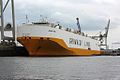 Grande Roma
 -
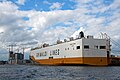 Grande Spagna
 -
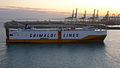 Grande Sicilia
 -
 Gran Bretagna


.jpg)


.jpg)

See also
[edit]
References
[edit]- ^ "About Us".
- ^ grimaldi.napoli.it (ed.). "Grimaldi Group".
- ^ grimaldi.napoli.it (ed.). "Grimaldi Group" (in Italian).
- ^ D’Antonio B. & Stares J. (2016), Grimaldi Armatori: The Story of a Family and a Company Grimaldi & C.
- ^ Sustainability report 2019: https://www.grimaldi.napoli.it/pdf/REPORT2019_ENG.pdf/
- ^ Grimaldi Group Corporate Brochure: https://www.grimaldi.napoli.it/en/publications.html#dflip-brochure-118/
- ^ Grimaldi News 79, p.8, https://www.grimaldi.napoli.it/pdf/gnews79_web_1504777680.pdf
- ^ "The Grimaldi Group recognized by General Motors as a 2016 Supplier of the Year Winner. This is the 16th time that the Group has received the award in the last 17 years".
- ^ Grimaldi News 48, pp.6–7, https://www.grimaldi.napoli.it/pdf/gnews48_1254413340.pdf
- ^ "The Grimaldi Group recognised by Renault-Nissan Alliance as the 2014 most innovative outbound logistics supplier". Portnet. 19 June 2015. Retrieved 20 May 2023.
- ^ Costanza, Luigi. "Grimaldi Group". Grimaldi Group. Retrieved 20 May 2023.
- ^ "Grimaldi Lines si aggiudica il World Travel Leaders Award 2016". Pressmare (in Italian). 9 November 2016. Retrieved 20 May 2023.
- ^ Grimaldi News 76, p.8, https://www.grimaldi.napoli.it/pdf/gnews_76_web_1477660740.pdf
- ^ Grimaldi Group website: Fleet overview grimaldi.napoli.it
- ^ "Grand Congo catches fire". marinetraffic.com -date=26 February 2025. 21 February 2025.
- ^ "Crew evacuated from burning vessel". maritime-executive.com -date=26 February 2025. 18 February 2025.
- ^ "Grande Brasile departs for Turkey". World Cargo News. Retrieved 29 October 2025.
- ^ "What we know about the fire". Cbsnews.com -date=26 February 2025. 6 July 2023.
- ^ "Fire on Car Carrier". Informare.it -date=26 February 2025. 20 February 2023.
- ^ a b Papadimas, Lefteris; Amante, Angelo (19 February 2022). "Twelve still missing after blaze engulfs Greece-Italy ferry". Reuters. Archived from the original on 22 March 2022. Retrieved 13 April 2022.
- ^ "Ninth body recovered from smoldering Euroferry Olympia | eKathimerini.com". Archived from the original on 14 March 2022. Retrieved 14 March 2022.
- ^ "Euroferry Olympia: Εντοπίστηκαν δύο σοροί εντός του πλοίου (Euroferry Olympia: Two bodies found inside the ship)". huffingtonpost.gr (in Greek). 23 March 2022. Retrieved 6 April 2022.
- ^ "Passagier nach Brand auf Mittelmeer-Fähre lebend gefunden (Passenger found alive after fire on Mediterranean ferry)". Der Standard (in Austrian German). Archived from the original on 16 March 2022. Retrieved 20 February 2022.
- ^ "Fire breaks out on Hoegh Xiamen". Automotive Logistics. 8 June 2020. Retrieved 11 June 2020.
- ^ "Hoegh Xiamen in Jacksonville". Hoegh Autoliners. 5 June 2020. Retrieved 11 June 2020.
- ^ "Ro-ro EUROCARGO TRIESTE fire, Livorno UPDATE – Maritime Bulletin". 21 November 2019.
- ^ "One killed, three injured in accident". Maritime Executive. 7 October 2019.
- ^ "Car Carrier Grande Europa Catches Fire off Spain". 15 May 2019. Archived from the original on 16 May 2019.
- ^ ""Episode 1"". Johnny Vegas: Carry on Glamping. Season 1. Episode 1. 5 May 2021. Channel 4.
- ^ "Grimaldi's car carrier on fire, Mediterranean UPDATE VIDEO – Maritime Bulletin". 15 May 2019.
- ^ Galli, Andrea (15 June 2019). "Navi Grimaldi, svolta sui roghi: in cella ufficiale della compagnia". Corriere della Sera (in Italian). Retrieved 24 October 2021.
- ^ Fiorentino, Michael-Ross (19 March 2019). "Porsche sports cars among destroyed cargo of sunken Grande America". euronews. Retrieved 24 October 2021.
- ^ Cheromcha, Kyle (19 March 2019). "Porsche to Restart 911 GT2 RS Production After Cargo Ship Sinks With Cars On Board". The Drive. Retrieved 24 October 2021.
- ^ "Ce que l'on sait du naufrage du navire "Grande America", qui a coulé au large de la Bretagne". Franceinfo (in French). 12 March 2019. Retrieved 14 March 2019.
- ^ "Aggiornamento circa l'incidente della Grande America – il piano anti-inquinamento continua" (in Italian).
- ^ "Stowaways threaten crew on cargo ship". BBC News. 21 December 2018. Retrieved 21 December 2018.
- ^ "Special forces retake cargo ship after migrants threatened staff". Sky News. 22 December 2018. Retrieved 23 December 2018.
- ^ "Senegal seized Italian Grimaldi's ro-ro ship".
- ^ "Grimaldi's Grande Anversa collided with Polish cargo ship Sider Capri, Dardanelles". 28 November 2016.
- ^ "Grande Francia Loses Part of Its Cargo in Storm". 24 October 2014. Archived from the original on 7 November 2014.
- ^ NU.NL newssite: Cargo vessel Wester Scheld refloated, 8 October 2011
- ^ "Repubblica di Genova towed to dry dock". 19 November 2007.
- ^ "Cocaine, GRIMALDI's ro-ro, Dakar – routine scheme".
- ^ "Drogue saisie sur Grande Nigeria : "Libéré", un autre membre de l'équipage est rentré en Italie".
- ^ "Il Gruppo Grimaldi Sulle Vicende Legate Alla Grande Nigeria, Ferma a Dakar".
- ^ "Grande Benin - Cargo Ship, IMO 9343170, MMSI 247275400, Callsign ICEX, Flag Italy - vesseltracker.com". www.vesseltracker.com. Retrieved 20 May 2023.
- ^ "Grimaldi's ro-ro in record cocaine bust. What's going on?".
- ^ "SAISIE DE DROGUE AU PORT DE DAKAR : Révélations sur une affaire embarrassante". 31 January 2020.
- ^ "Bananen uit Ecuador". 9 December 2020.
- ^ "Nettuno, operazione antidroga. Sequestrati 82 kg di cocaina proveniente dall'Argentina - InLiberaUscita". 30 November 2018.
- ^ "1.2 ton of cocaine smuggled on board of GRIMALDI ro-ro ship at Santos – Maritime Bulletin". 10 August 2018.
- ^ "One more Grimaldi's ship in cocaine bust, again Santos, again 1.3 ton".
- ^ "ATV". Gazet van Antwerpen. Retrieved 20 May 2023.
- ^ "Koks im Bagger geschmuggelt". 9 April 2016.
- ^ https://www.emderzeitung.de/lokales_artikel,-kokain-auf-schiff-im-emder-hafen-gefunden-_arid,279686.html [dead link]
- ^ Tripmaker, Marco (19 March 2016). "Schlag gegen Kokain-Schmuggler". Die Welt.
- ^ "Palermo, da Genova con 3 chili di cocaina, arrestato dalla polizia". 17 January 2016.
- ^ "Nel camion 13 chili di cocaina". 9 December 2015.
- ^ Operazione paprika centumcellae.it [dead link]
External links
[edit]

Grimaldi Group
View on GrokipediaHistory
Founding and Early Development
The Grimaldi Group was established in 1947 in Naples, Italy, by the brothers Luigi, Mario, Ugo, Aldo, and Guido Grimaldi, who formed Fratelli Grimaldi SpA as a shipowning company.[4][3] The founders, grandchildren of 19th-century steamship pioneer Gioacchino Lauro, drew on familial maritime ties—including their aunt Amelia Lauro Grimaldi and the influence of prominent shipowner Achille Lauro—but initiated independent operations amid Italy's post-World War II economic recovery.[4] Initial activities centered on cargo transport, beginning with the acquisition of the Liberty ship Orione, a surplus U.S. wartime vessel repurposed for freight services.[4][3] This marked the group's entry into maritime logistics, capitalizing on Mediterranean trade routes and the era's demand for reliable shipping amid reconstruction efforts. Early expansion incorporated passenger services, particularly on routes connecting Italy to South America, which facilitated post-war emigration waves and supported growing transatlantic commerce.[4][3] By the 1950s and into the 1960s, during Italy's industrial boom, the Grimaldi brothers upgraded their fleet, phasing out aging Liberty ships in favor of modern bulk carriers to handle increased volumes of goods.[4] This period solidified the company's focus on versatile maritime transport, laying groundwork for specialized services while maintaining family ownership and operational control in Naples.[3] A pivotal early innovation came in 1969 with the launch of the first roll-on/roll-off (ro-ro) vehicle service between Italy and the United Kingdom, using the Warrington car carrier to transport Fiat automobiles, which anticipated the group's future emphasis on wheeled cargo logistics.[3]Expansion into Global Logistics
The Grimaldi Group's initial foray into international operations occurred in 1969 with the launch of a scheduled ferry service connecting Italy to the United Kingdom, marking its first regular route beyond the Mediterranean.[4] This was followed in 1970 by a specialized ro-ro service transporting Fiat automobiles to the UK aboard the vessel Warrington, leveraging the growing demand for vehicle exports.[3] By the early 2000s, Grimaldi accelerated its expansion through targeted acquisitions of shipping companies, establishing leadership in the ro-ro sector and diversifying routes to Northern Europe, the Baltic region, West Africa, and South America.[3] This era introduced integrated logistics capabilities, merging sea freight with inland distribution networks operated by subsidiary land transport entities, supported by a portfolio exceeding 20 owned or managed terminals spanning the Mediterranean, Northern Europe, and West Africa.[3] Routes such as North Europe to West Africa, linking ports including Antwerp, Le Havre, and Lagos, exemplify this operational scope, facilitating efficient cargo flows for vehicles and containers.[5] Strategic investments in port infrastructure further entrenched global logistics control, including a 67% stake in Greece's Igoumenitsa Port acquired in 2022 for €81.47 million and a similar majority holding in Heraklion Port Authority finalized in September 2024 for €80 million.[6] [7] The 2008 acquisition of a controlling interest in Minoan Lines enhanced Adriatic and Greek island connectivity, integrating additional ferry assets into Grimaldi's fleet.[8] Recent initiatives have pushed into Asian markets, with direct services to India commencing in February 2025 and a October 2025 cooperation pact with China Merchants Shenzhen RoRo Shipping to support vehicle shipments from East Asia to Europe.[9] [10] These expansions, coupled with fleet enhancements like the deployment of next-generation pure car and truck carriers such as Grande Shanghai on Asia-Mediterranean lanes, reflect Grimaldi's commitment to a comprehensive global logistics network.[11]Fleet Modernization and Recent Milestones
In recent years, the Grimaldi Group has pursued aggressive fleet renewal to enhance capacity, efficiency, and adaptability to future fuels, including the delivery of multiple ammonia-ready pure car and truck carriers (P PCTCs) designed for reduced emissions and larger cargo volumes. These vessels incorporate advanced naval architecture for up to 50% fuel efficiency gains compared to predecessors, supporting decarbonization goals while expanding routes like East Asia to Europe and Africa.[12][13] Key milestones in 2025 include the August delivery of the Grande Tianjin, the inaugural vessel in a series of seven PCTCs built by Shanghai Waigaoqiao Shipbuilding, with a capacity of 9,241 car equivalent units (CEU) and immediate deployment on East Asia-Northern Europe services carrying vehicles and rolling cargo.[14][15] This was followed by the Grande Shanghai handover on August 27, the first of ten next-generation PCTCs measuring 220 meters in length and 93,145 gross tons, which commenced its maiden voyage in early September from Chinese ports, loaded with 7,000 linear meters of rolling stock to bolster East Asia-East Africa trade links.[16][11] Subsequent additions encompassed the Grande Auckland on September 11, enhancing project cargo capabilities for heavy and out-of-gauge shipments, and the Grande Svezia on September 24, each integrating ammonia-readiness for potential dual-fuel operations.[17][18][19] Supporting this expansion, the group placed a €1.3 billion order in April 2025 for nine pioneering Ro-Pax vessels from China Merchants Jinling Shipyard (Weihai), slated for delivery between 2028 and 2030, with four under the Italian flag for Grimaldi Lines operations; these units emphasize hybrid propulsion and increased passenger-cargo integration.[20][21] Overall, Grimaldi has 14 additional ammonia-ready PCTCs pending delivery through 2027, alongside the phase-out of older tonnage—such as five vessels sold in 2024—to streamline the fleet toward higher-capacity, lower-emission profiles exceeding 9,800 CEU in later builds.[22][23][24]Operations
Passenger Ferry Services
The Grimaldi Group provides passenger ferry services primarily through its subsidiary Grimaldi Lines in the Western Mediterranean, connecting Italian mainland ports including Civitavecchia, Livorno, Salerno, Naples, and Brindisi to destinations such as Sardinia (14 routes, e.g., to Olbia, Porto Torres, Cagliari), Sicily (8 routes, e.g., to Palermo), Greece (8 routes, e.g., to Igoumenitsa and Corfu), Spain (e.g., Barcelona, Valencia), Tunisia (6 routes, e.g., to Tunis), and the Balearic Islands (18 routes, e.g., to Minorca, Majorca, Ibiza).[25] [26] These services utilize ro-pax and cruise ferries designed for both passengers and vehicles, emphasizing regular, punctual operations across the region.[26] Grimaldi Lines maintains a fleet of 14 vessels for these routes, including large cruise ferries like the Cruise Roma, which serves the Civitavecchia-Barcelona line and accommodates over 2,500 passengers with high-standard services.[27] [28] Other notable ships include the MV Cruise Europa with a passenger capacity of 2,850 and the Europalink with 925 passengers, offering amenities such as cabins, dining options, and entertainment facilities.[29] [30] Certain routes, such as Civitavecchia to Olbia in Sardinia, operate seasonally from June 1 to September 30.[25] The group's broader passenger operations extend via subsidiaries: Minoan Lines handles connections from Italy to mainland Greece, Crete, and the Cyclades; Finnlines serves Northern Europe with routes between Germany, Finland, and Sweden in the Baltic Sea; and Trasmed GLE links mainland Spain to the Balearic Islands.[26] These services integrate passenger transport with vehicle and cargo capacity, supporting tourism and regional mobility while prioritizing efficiency and reliability.[26]Roll-on/Roll-off and Containerized Cargo
The Grimaldi Group's roll-on/roll-off (RoRo) and containerized cargo operations form the backbone of its freight division, focusing on multipurpose ConRo vessels that transport wheeled goods such as trucks, semi-trailers, and vehicles alongside standard ISO containers and unitized cargo.[31][32] These services handle diverse loads including project cargo, refrigerated units, and dangerous goods, emphasizing efficient global logistics for industrial and commercial clients.[32] A flagship component is the Atlantic Container Line (ACL), a Grimaldi-owned entity operating ConRo ships on transatlantic routes between North Europe and North America, with each of its five G4-class vessels providing 3,800 TEU container capacity, 28,900 square meters of RoRo deck space, and accommodation for over 1,300 vehicles.[33][34][35] ACL services extend to West Africa via transshipment, supporting ports like Abidjan, Dakar, and Douala with transit times ranging from 21 to 34 days from Halifax.[36][35] Direct West Africa routes from Europe and North America utilize Grande-class RoRo ships, serving key ports including Dakar, Conakry, Lagos, Lome, and Luanda for rolling stock and containers, with schedules featuring vessels like Grande Benin and Grande Togo.[37][38] In October 2024, Grimaldi announced a new China-West Africa service, routing containers and cargo through Lagos for regional distribution using existing Northern Europe vessels.[39] Fleet assets for these operations include the GG5G-class RoRo ships, the world's largest by capacity with up to 4,700 linear meters of rolling space, and newer G5 multipurpose vessels offering 4,700 linear meters of RoRo, 2,500 CEU for vehicles, and 2,000 TEU slots, enabling hybrid loads with reduced emissions through hybrid propulsion.[40][41] Recent fleet upgrades, including six G5 ships ordered in 2024, double container capacity compared to predecessors while incorporating ammonia-ready designs for future sustainability.[42][24] Grimaldi remains one of few operators committed to deep-sea ConRo concepts, contrasting with the industry's shift toward pure container newbuilds adding over 6 million TEU since 2023.[43]Terminal and Logistics Integration
The Grimaldi Group integrates its maritime transport with a network of owned port terminals and associated logistics services to enable seamless end-to-end supply chain operations, particularly for roll-on/roll-off (Ro-Ro) cargo, vehicles, and containers. This vertical integration allows for coordinated handling from vessel berthing through inland distribution, minimizing delays and optimizing efficiency across regions.[2][1] The group operates over 20 such terminals, primarily in the Mediterranean, Northern Europe, the Baltic Sea, and West Africa, supporting operations in 150 ports across 50 countries and five continents. Key facilities include Antwerp Euroterminal in Belgium, Europe's largest multipurpose terminal, which handles diverse cargo types and is set to implement onshore power supply for vessels starting in 2024. Other notable sites encompass Palermo Euroterminal in Italy for Ro-Ro and container traffic integration, and Grimaldi Terminal Barcelona in Spain, equipped for ferry and cargo operations with recent enhancements like shore power infrastructure activated on April 1, 2025.[2][44][45] Logistics integration extends beyond terminals to overland transport coordination, forming a closed-loop chain that links sea freight with multimodal distribution. In the automotive sector, the group provides finished vehicle services at 24 European ports, leveraging terminal investments for streamlined deliveries to original equipment manufacturers. Recent developments include the acquisition of Terminal Darsena Toscana in Livorno, Italy, in 2024, and a new terminal in the Port of Amsterdam announced in 2025, bolstering intra-European and global connectivity.[46][47][48]Fleet and Technology
Current Fleet Overview
The Grimaldi Group's fleet, as of October 2025, comprises over 140 vessels dedicated to short-sea shipping, vehicle transport, and passenger services across the Mediterranean, Northern Europe, and global routes.[47] These include roll-on/roll-off (Ro/Ro) ships, pure car and truck carriers (PCTC), ro-pax ferries, cruise ferries, and multipurpose con-ro vessels, with a collective deadweight tonnage surpassing 2.1 million metric tons.[49] The fleet emphasizes modern, high-capacity designs optimized for efficiency in rolling cargo and passenger transport.[35] Key segments feature the Grimaldi Green 5th Generation (GG5G) class of 14 hybrid Ro/Ro vessels, completed with the delivery of Eco Napoli in March 2025; each measures 238 meters in length, 34 meters in beam, with 67,311 gross tons and capacity for 7,800 lane meters of rolling stock.[50] For vehicle export, the group operates ammonia-ready PCTCs such as Grande Shanghai, delivered August 27, 2025, with 9,241 car equivalent units (CEU) capacity, and Grande Svezia, added September 28, 2025, at 220 meters long, 38 meters wide, 91,611 gross tons, and 18-knot service speed.[16][51] Additional orders include 14 more such PCTCs for delivery between 2025 and 2027.[17] Ro/pax and cruise ferries support passenger routes, exemplified by vessels like those in the Catania class for intra-Mediterranean services.[52] The Atlantic Container Line (ACL) G4 class enhances transatlantic capabilities within the group's operations.[52] Four Ro/Ro ships currently serve Italy-Greece-Turkey lanes, underscoring regional focus.[53]| Vessel Type | Approximate Number | Key Features |
|---|---|---|
| Ro/Ro (including GG5G hybrid) | ~50+ (including owned and operated) | High lane-meter capacity, hybrid propulsion for emissions reduction; largest Ro/Ro ships globally in GG5G class.[47][50] |
| PCTC (Pure Car/Truck Carriers) | Expanding series (10+ recent/newbuilds) | Ammonia-ready, 9,000+ CEU, for East Asia-Northern Europe routes.[54][17] |
| Ro/Pax & Cruise Ferries | Dozens for passenger ops | Combined freight/passenger, serving Mediterranean and short-sea links.[55][35] |
| Multipurpose/Con-Ro | Supporting global logistics | Versatile for containers and rolling cargo. Wait, no wiki, but from [web:33] but avoid, use [web:36] |
Ship Classes and Innovations
The Grimaldi Group's ship classes encompass Ro-Pax ferries, multipurpose Ro-Ro vessels, and pure car and truck carriers (PCTC), with prominent examples including the Grimaldi Green 5th Generation (GG5G) hybrid Ro-Ro series and the G5 multipurpose class. These classes prioritize enhanced capacity and environmental efficiency for short-sea and deep-sea routes.[52] The GG5G class consists of 14 hybrid-powered Ro-Ro vessels, each 238 meters long with a 34-meter beam, 67,311 gross tons, and a service speed of 20.8 knots. Equipped with electronically controlled engines, battery systems for zero-emission port operations, shore power connectivity, and exhaust gas cleaning systems, these ships achieve double the cargo capacity of prior generations at equivalent fuel use. Nine units serve Mediterranean routes under Grimaldi Lines, with the series completed by Eco Napoli's delivery in March 2025.[56][50][57] The G5 class features six multipurpose Ro-Ro ships for Northern Europe to West Africa services, measuring 250 meters in length and 38 meters in beam, with a deadweight of 45,684 tonnes. Each accommodates 4,700 linear meters of rolling freight, 2,500 car equivalent units (CEU), and 2,000 twenty-foot equivalent units (TEU) of containers—doubling container capacity over the G4 class while matching rolling cargo space. Innovations include advanced propulsion for lower emissions, with the fleet finalized by Great Cotonou's delivery in December 2024.[58][42][59] PCTC vessels represent another focus, with ammonia-ready models like Grande Shanghai, delivered August 2025, offering 9,000 CEU capacity and 50% reduced fuel consumption versus predecessors. Grimaldi ordered ten such large PCTCs for ammonia compatibility. Ro-Pax innovations include the Next Generation Med class, with six methanol dual-fuel units ordered in April 2025 for Mediterranean routes, emphasizing green corridor compliance.[54][60] Fleet-wide innovations integrate air lubrication, hull optimization, and scrubbers to cut CO2 and pollutants, alongside alternative fuel readiness for ammonia and methanol, supporting emission regulations without sacrificing operational versatility.[61][62]Capacity and Tonnage Metrics
The Grimaldi Group's fleet, comprising over 140 vessels as of May 2025 with 133 owned, features a range of tonnage and capacity metrics tailored to roll-on/roll-off (Ro-Ro), pure car and truck carrier (PCTC), and ferry operations.[47] Gross tonnage (GT) across the fleet varies by vessel class, with newer builds emphasizing larger displacements and optimized cargo volumes for efficiency. Deadweight tonnage (DWT) for advanced designs reaches up to 45,684 tonnes per vessel, supporting substantial wheeled cargo loads.[42] Key ship classes illustrate these metrics. The Grimaldi Green 5th Generation (GG5G) Ro-Ro series, completed with 14 units by March 2025, standardizes at 67,311 GT per vessel, with lengths of 238 meters and beams of 34 meters, enabling hybrid propulsion and increased cargo space over prior generations—up to 50% greater volume efficiency in some configurations.[63] [64] These vessels prioritize short-sea and Mediterranean routes, with service speeds of 20.8 knots facilitating high throughput. Ammonia-ready PCTCs represent the upper end of capacity, designed for deep-sea vehicle transport. Vessels like the Grande Shanghai and Grande Svezia, delivered in August and September 2025 respectively, measure 220 meters in length and 38 meters in beam, with 91,611 GT each and capacities of approximately 9,000 car equivalent units (CEUs) distributed across 14 decks at 18-knot speeds.[16] [65] Larger variants, such as the initial naming in the 10-unit series, achieve 93,145 GT.[24] Smaller PCTCs like the Grande Tianjin, delivered August 2025, register about 77,500 GT and 9,241 CEUs on comparable dimensions.[14]| Ship Class | Approximate Number | Gross Tonnage (GT) per Vessel | Key Capacity Metric |
|---|---|---|---|
| GG5G Ro-Ro | 14 | 67,311 tonnes | Enhanced Ro-Ro volume (specific lane meters not uniformly reported; hybrid efficiency focus)[63] |
| Ammonia-Ready PCTC (220m series) | Multiple (part of 10-unit program) | 91,611–93,145 tonnes | 9,000+ CEUs[16] [65] |
| Ammonia-Ready PCTC (200m series) | Ongoing deliveries | ~77,500 tonnes | 9,241 CEUs[14] |
Sustainability and Environmental Practices
Emission Reduction Initiatives
The Grimaldi Group has pursued emission reductions through fleet retrofits, adoption of hybrid propulsion systems, and investments in newbuild vessels incorporating energy-efficient technologies. In 2019, the company retrofitted 10 passenger/vehicle ferries with sulphur oxide (SOx) exhaust gas cleaning systems (scrubbers) to comply with stricter emission standards and lower atmospheric pollutants.[66] By 2025, Grimaldi expanded its hybrid-powered fleet to 14 vessels, including the Eco Napoli, enabling zero-emission operations in port via shore-to-ship power connections and battery packs that store energy from main engines or renewables.[56] New ship constructions emphasize substantial CO2 cuts, with a program launched in the late 2010s targeting 20 vessels by 2024 that emit 50% less CO2 per unit transported compared to prior generations.[67] Advanced designs, such as the GG5G-class ro-ro ships introduced in 2023, incorporate hull optimizations, waste heat recovery, and propulsion efficiencies, positioning them as among the lowest-emission vessels in their category for short-sea routes.[68] Recent deliveries like the ammonia-ready Grande Shanghai in 2025 feature 2,500 square meters of solar panels, silicon-based anti-fouling hull coatings to minimize drag, smart energy management systems, and readiness for carbon-free fuels, allowing zero port emissions and overall energy optimization.[16] The group secured European Commission funding in 2025 for two Zero Emission Waterborne Transport (ZEWT) projects focused on developing battery-electric and hydrogen technologies for ferries and ro-pax vessels.[69] These align with Grimaldi's stated target of net-zero emissions by 2050, supported by ongoing R&D into alternative fuels like ammonia, as seen in vessels such as the Grande Svezia.[70] [65] Compliance with the EU Emissions Trading System (ETS) involves purchasing allowances for CO2 emissions since 2024, with quarterly adjustments based on verified data.[71] Trasmed, a Grimaldi Lines brand, reported a 16,600-tonne CO2 equivalent reduction in 2024 through efficiency measures and route optimizations, projecting further cuts of 15,700 tonnes in 2025.[72]Green Fleet Developments
The Grimaldi Group has developed the Grimaldi Green 5th Generation (GG5G) class, comprising 14 hybrid roll-on/roll-off (Ro-Ro) vessels designed for reduced emissions through battery-hybrid propulsion systems. These ships, such as the Eco Napoli delivered on March 14, 2025, feature lithium-ion batteries with a total capacity of 5 MWh, enabling zero-emission electric operation during port stays and maneuvers, while relying on diesel engines at sea.[63][73] The class includes vessels like the Eco Salerno, the 13th unit added on December 3, 2024, each with dimensions of approximately 238 meters in length, 34 meters in beam, and a gross tonnage of 67,311 GT, supporting hybrid mode to cut fuel use and emissions in coastal operations.[74][40] In parallel, the group has introduced ammonia-ready pure car and truck carriers (PCTCs) to prepare for future zero-carbon fuels. The Grande Shanghai, delivered on August 27, 2025, from China Merchants Heavy Industries Jiangsu, offers 9,000 car equivalent units (CEU) capacity with halved fuel consumption compared to prior generations and an Ammonia Ready class notation for potential retrofits.[16][54] Similarly, the Grande Svezia, added in September 2025, incorporates advanced green technologies as the fourth such vessel, enhancing the fleet's adaptability to low-emission ammonia propulsion.[62] The Grande Auckland, delivered on September 10, 2025, follows as the second in a series of seven ammonia-ready PCTCs, with reinforced decks for heavy cargo alongside emission-reduction features.[19] Looking ahead, in April 2025, Grimaldi signed contracts for nine ro-pax vessels from China Merchants Jinling Shipyard (Weihai), projected to reduce CO2 emissions per cargo unit by over 50% versus existing ships through enhanced efficiency and hybrid systems.[21][75] These developments reflect targeted investments in hybrid electrification and fuel-ready notations, prioritizing verifiable reductions in operational emissions over unproven alternatives, though full lifecycle impacts depend on battery sourcing and future fuel availability.[56]Regulatory Compliance and Challenges
The Grimaldi Group adheres to key international environmental regulations, including the International Maritime Organization's (IMO) sulfur oxide (SOx) emission limits under the MARPOL Annex VI convention, by retrofitting vessels with exhaust gas cleaning systems (scrubbers) beginning in 2014.[76] This initiative covered at least 10 roll-on/roll-off passenger (RoPax) ferries, supported by European Investment Bank financing to ensure compliance ahead of the 2020 global sulfur cap of 0.5%.[66] The company also operates under ISO 14001 environmental management systems, a certification it pioneered among Italian shipping firms in the 1990s, encompassing monitoring of energy use, waste, and emissions across its fleet.[77][78] Compliance with the European Union's Emissions Trading System (EU ETS), extended to maritime transport on January 1, 2024, requires Grimaldi to monitor, report, and verify CO2 emissions for ships over 5,000 gross tons on voyages to, from, or within EU/EEA ports, surrendering allowances for 40% of emissions in 2024 rising to 100% by 2026.[79] To address the resulting costs—driven by fluctuating carbon allowance prices—Grimaldi imposes quarterly surcharges on freight and passengers, calculated based on actual emissions and market rates, as seen in adjustments for Q2 and Q3 2025.[71][80] The FuelEU Maritime regulation, implemented from January 1, 2025, presents further challenges by mandating annual reductions in the greenhouse gas intensity of onboard energy use—starting at 2% and escalating to 80% by 2050—penalizing non-compliance with penalties up to €2,400 per ton of excess emissions.[80] Grimaldi mitigates this through hybrid-electric vessels and shore power connections for zero-emission port stays, but the directive's emphasis on biofuels and e-fuels raises fuel procurement costs and supply chain risks, particularly for short-sea routes comprising much of its operations.[78] No significant fines or violations specific to Grimaldi's environmental practices have been documented in public records, though the group has highlighted competitive distortions from uneven global adoption of standards, urging IMO alignment to avoid regulatory fragmentation.[81]Controversies and Incidents
Drug Smuggling Investigations
In multiple instances, authorities have uncovered cocaine shipments concealed in legitimate cargo aboard Grimaldi Group ro-ro vessels, prompting investigations into international drug trafficking networks exploiting maritime routes from South America to Europe. These cases typically involved drugs hidden in vehicles, containers, or ship compartments, with no public evidence of company complicity but highlighting vulnerabilities in cargo screening at high-volume ports.[82][83] On August 7, 2018, Brazilian authorities seized 1.2 tonnes of cocaine from the Grimaldi ro-ro Grande Nigeria at the port of Santos, marking an early major incident involving the vessel. The drugs were hidden within cargo destined for Europe, leading to probes into shippers and handlers. This preceded further seizures on the same ship. In late June 2019, Senegalese customs at Dakar port intercepted 798 kg of cocaine concealed in 15 new Renault vehicles aboard the Grande Nigeria, en route from Brazil to Europe via transshipment. This seizure was part of a broader operation yielding 1.3 tonnes across two Italian-flagged ships in the port over five days, underscoring West Africa's role as a transit hub for South American cocaine. The Grande Nigeria faced additional scrutiny later that year.[84][83][85] By January 2020, another 120 kg of cocaine was discovered in the ventilation system of the detained Grande Nigeria at Dakar, valued at approximately 9.6 billion CFA francs, further implicating the vessel in repeated trafficking attempts and intensifying local enforcement efforts.[86] On November 5, 2023, Brazilian Federal Police raided the Grimaldi con/ro Grande Amburgo at Vitoria port, seizing 1.5 tonnes of cocaine in 52 bales hidden in two onboard locations. The operation involved 50 officers and 14 drug-sniffing dogs; all 28 crew members were interviewed and fingerprinted, with suspicions of potential crew involvement in offloading plans near Europe. Investigations targeted unidentified shippers, consignees, and logistics facilitators, while the vessel proceeded to Rio de Janeiro and then Tenerife.[82] These episodes reflect broader patterns in containerized shipping, where traffickers embed narcotics in high-legitimacy cargoes like automobiles to evade detection, though repeated findings on specific Grimaldi vessels have drawn attention to port-level security protocols without resulting in corporate charges.[83][82]Competitive and Regulatory Disputes
In 2016, Brazil's Administrative Council for Economic Defense (CADE) initiated an investigation into an alleged international cartel in the maritime transportation of automobiles, targeting Grimaldi Group alongside companies including Hoegh Autoliners, Eukor Car Carriers, and Compañia Sud Americana de Vapores.[87] The probe focused on potential anticompetitive practices such as price-fixing and market allocation with effects in Brazil, stemming from ro-ro shipping activities.[88] By March 2021, CADE investigators recommended fines against Grimaldi Group and four individuals for participation in the global cartel, though no final penalties had been imposed as of the latest updates.[89] In August 2025, competitive tensions escalated between Grimaldi Group and DFDS at Italy's Port of Trieste over routes connecting Turkey and northern Italian ports. Grimaldi's entry into the market with efficient ro-ro vessels captured approximately 45% of the traffic share within a year, prompting DFDS to accuse Grimaldi of predatory pricing and unfair practices.[90] [91] Grimaldi countered by alleging DFDS engaged in obstructive tactics, including delays in terminal access, leading Italian authorities to scrutinize DFDS for potential anticompetitive behavior in terminal operations.[92] [93] DFDS subsequently withdrew from aggressive price competition on the route, shifting focus to service differentiation.[94] Grimaldi Group's 2023 acquisition of terminal assets in Barcelona's port raised merger control concerns under Spanish competition law, as it resulted in control over the only two public ro-ro and passenger terminals, potentially enabling input foreclosure for rivals.[95] The transaction underwent review by Spain's National Markets and Competition Commission, with remedies likely imposed to mitigate dominance risks, though specific conditions remain undisclosed in public records. Grimaldi executives have repeatedly criticized state aid to distressed competitors as distorting market competition, arguing in 2020 that selective bailouts for financially weak operators undermine fair play without addressing underlying inefficiencies.[96] In EU proceedings, Grimaldi subsidiaries have participated as interested parties challenging aid to rivals, such as in a 2022 Court of Justice case assessing compatibility of support measures affecting Mediterranean ferry markets.[97] No findings of unlawful state aid receipt by Grimaldi itself have been reported.Operational and Safety Criticisms
The Grimaldi Group has faced scrutiny over recurrent fire incidents on its roll-on/roll-off (Ro-Ro) and con-ro vessels, with at least five major fires reported between 2019 and 2025, raising questions about cargo handling protocols and fire suppression systems.[98] In July 2023, a fire aboard the Grande Costa D'Avorio in Newark, New Jersey, originated from a pusher vehicle in the cargo hold, resulting in the deaths of two firefighters and injuries to six others; the vessel's CO2 suppression system failed to fully activate due to procedural lapses, as detailed in a National Transportation Safety Board (NTSB) investigation.[99] Similarly, the Grande America caught fire and sank in the Bay of Biscay in March 2019, spilling oil and prompting environmental cleanup efforts while highlighting vulnerabilities in fire detection on similar vessel classes.[100] Operational safety concerns extended to crew welfare and equipment maintenance. In June 2024, a crewmember died in an onboard accident on the Grande Baltimora while docked in Melbourne, Australia, amid reports of inadequate safety measures during cargo operations.[101] A U.S. Department of Labor investigation into Grimaldi operations revealed deficiencies including unrepaired lifeboat equipment and crew members possessing alcohol aboard, leading to policy changes for injury reporting but underscoring prior non-compliance with maritime safety standards.[102] Pre-fire inspections have occasionally flagged issues, such as a 2022 Paris MoU inspection on a Grimaldi vessel identifying deficiencies in the operational fire safety manual, which correlated with subsequent incidents.[103] More recent events include dual deck fires on the Grande Brasile in the English Channel in February 2025, leaving the 56,000-gt vessel adrift and necessitating crew evacuation, though no injuries were reported; the fires were contained after a mayday call, but the incident immobilized the ship and required tug assistance.[104] A smaller fire on the Grande Argentina in Hamburg in September 2025 was quickly extinguished with no casualties, yet it contributed to perceptions of systemic fire risks in Grimaldi's fleet, particularly with mixed cargo including vehicles.[105] Critics, including maritime safety analysts, attribute these patterns to challenges in managing high-density vehicle cargoes on con-ro ships, though Grimaldi maintains compliance with international standards like SOLAS.[106] Passenger reports have also cited overcrowding and blocked fire exits on ferries, potentially exacerbating evacuation risks, as noted in operational reviews.[107]Economic Impact and Market Position
Global Market Role
The Grimaldi Group occupies a leading position in the global roll-on/roll-off (Ro-Ro) shipping market, recognized as the world's largest Ro-Ro operator in the ferry sector and a primary facilitator of vehicle and rolling stock transport.[108][47] It specializes in maritime logistics for the automotive industry, handling finished vehicles, including electric models, via specialized pure car and truck carriers (PCTC) with capacities up to 9,241 car equivalent units (CEU).[14][46] The company's fleet comprises over 140 vessels, of which 133 are owned, enabling operations across a network linking more than 150 ports in 60 countries spanning five continents.[47] This infrastructure supports diverse routes, including Mediterranean crossings, Northern European services, West African links, transatlantic voyages, and expanding East Asia-Europe corridors for vehicle exports.[47][14] As Italy's largest shipowner, Grimaldi also integrates containerized and passenger (Ro-Pax) transport, contributing to short-sea and deep-sea efficiency in global trade.[64] Strategic alliances, such as the October 2025 cooperation framework with China Merchants Shenzhen RoRo Shipping, strengthen its role in Euro-Asian vehicle carrier networks, enhancing logistics for bilateral trade in automobiles and rolling freight.[109][110] These efforts position Grimaldi as a key enabler of the international automotive supply chain, with recent fleet additions like ammonia-ready PCTCs underscoring its adaptation to global demand for sustainable, high-capacity shipping.[111][16]Financial Performance
The Grimaldi Group, as a privately held entity, discloses limited detailed financial statements publicly, relying on periodic announcements and industry reports for key metrics. In 2022, the group achieved record results with consolidated turnover of €4.8 billion, a 41% increase from €3.4 billion in 2021, driven by higher volumes of passengers, vehicles, and cargo transported; EBITDA reached €1.7 billion (up 78.8%), and EBIT €1.2 billion (up 140.8%).[112][113] This upward trajectory continued into 2023, with revenues surpassing €5 billion, EBITDA climbing to €1.8 billion, EBIT to €1.3 billion, and net profit to €1.2 billion (from €1.1 billion in 2022); ordinary profit specifically rose to €483.4 million from €222.5 million, bolstered by over €490 million in dividends from subsidiaries such as Grimaldi Euromed (€100 million) and Grimaldi Deep Sea (€94 million).[113] Net equity exceeded €6.1 billion by year-end, up €827 million, while net financial debt decreased by €249 million, reflecting robust balance sheet strength.[113] For 2024, consolidated revenues remained stable near €5.1 billion, with turnover above €5 billion overall, though profitability faced pressures from elevated EU Emissions Trading System (ETS) costs and fuel expenses; the group nonetheless closed with net profit exceeding €1 billion and cash reserves surpassing €1.4 billion.[114][115] These figures underscore sustained operational efficiency amid market volatility in maritime transport, including ro-ro and ferry segments.[113]| Year | Revenue (€ billion) | EBITDA (€ billion) | Net Profit (€ billion) |
|---|---|---|---|
| 2022 | 4.8 | 1.7 | 1.1 |
| 2023 | >5.0 | 1.8 | 1.2 |
| 2024 | ~5.1 | Not specified | >1.0 |