


Community hub
Recent from talks
Contribute something
Nothing was collected or created yet.
Harbor Springs, Michigan
View on Wikipedia
Harbor Springs is a city and resort community in Emmet County, Michigan, United States. The population was 1,274 in the 2020 census.[4]
Key Information


Harbor Springs is in a sheltered bay on the north shore of the Little Traverse Bay on Lake Michigan. The Little Traverse Lighthouse is a historic lighthouse on the Harbor Point peninsula, which shelters the deepest natural harbor on the Great Lakes. M-119 connects with US 31 7 miles (11 km) east and south at Bay View and Petoskey, which is 4 miles (6.4 km) away on the south side of the harbor.
The area is known for its historic summer resorts, such as Wequetonsing, which was founded by Illinois businessmen and lawyers Henry Stryker III, and Henry Brigham McClure. They were both connected with the Jacob Bunn industrial dynasty of Illinois.
History
[edit].jpg)
The European-American settlement started with a mission by French Catholic Jesuits; they called this area L'Arbre Croche, meaning Crooked Tree. In 1847, L'Arbre Croche had the largest concentration of Native Americans in Michigan.[5] French traders renamed the area Petit Traverse, or Little Crossing, when they arrived in the area. After more settlers came from the eastern United States, they changed the name of the village to Harbor Springs, incorporating it in 1880.
The federally recognized Little Traverse Bay Bands of Odawa Indians are descendants of the numerous Odawa bands that occupied this area. They have their tribal offices in Harbor Springs and a gaming resort in Petoskey.

Ephraim Shay (1839–1916) is known for his invention of the Shay locomotive. The hexagonal-shaped house he built in downtown Harbor Springs is listed on the National Register of Historic Places. The local elementary school is named after him.[6]
The Douglas House on the shore of Lake Michigan was designed by architect Richard Meier and completed in 1973. This house is one of 150 structures listed in 2007 as America's Favorite Architecture by the American Institute of Architects.[7]
The Club Ponytail was a music hall destroyed by fire in 1969.
Geography
[edit]According to the United States Census Bureau, the city has a total area of 1.30 square miles (3.37 km2), all of it land.[8]
Climate
[edit]The climate is described as Humid Continental by the Köppen Climate System, abbreviated as Dfb.[9]
Demographics
[edit]| Census | Pop. | Note | %± |
|---|---|---|---|
| 1880 | 164 | — | |
| 1890 | 1,052 | 541.5% | |
| 1900 | 1,643 | 56.2% | |
| 1910 | 1,805 | 9.9% | |
| 1920 | 1,600 | −11.4% | |
| 1930 | 1,429 | −10.7% | |
| 1940 | 1,423 | −0.4% | |
| 1950 | 1,626 | 14.3% | |
| 1960 | 1,433 | −11.9% | |
| 1970 | 1,662 | 16.0% | |
| 1980 | 1,567 | −5.7% | |
| 1990 | 1,540 | −1.7% | |
| 2000 | 1,567 | 1.8% | |
| 2010 | 1,194 | −23.8% | |
| 2020 | 1,274 | 6.7% | |
| U.S. Decennial Census[10] | |||
2010 census
[edit]As of the census[11] of 2010, there were 1,194 people, 558 households, and 294 families residing in the city. The population density was 918.5 inhabitants per square mile (354.6/km2). There were 1,122 housing units at an average density of 863.1 per square mile (333.2/km2). The racial makeup of the city was 92.0% white, 0.3% African American, 4.8% Native American, 0.8% Asian, 0.1% Pacific Islander, 0.1% from other races, and 2.0% from two or more races. Hispanic or Latino of any race were 0.7% of the population.
There were 558 households, of which 19.4% included children under the age of 18, 38.4% were married couples living together, 10.0% had a female householder with no husband present, 4.3% had a male householder with no wife present, and 47.3% were non-families. 43.7% of all households were made up of individuals, and 23.1% had someone living alone who was 65 years of age or older. The average household size was 1.93 and the average family size was 2.66.
The median age in the city was 55.8 years. 15.7% of residents were under the age of 18; 4.9% were between the ages of 18 and 24; 14.7% were from 25 to 44; 32.6% were from 45 to 64; and 32.2% were 65 years of age or older. The gender makeup of the city was 43.8% male and 56.2% female.
2000 census
[edit]| Largest ancestries (2000) | Percent |
|---|---|
| German | 17.4% |
| English | 16.2% |
| Irish | 14.1% |
| French | 7.4% |
| Polish | 6.7% |
| American | 6.2% |
| Odawa | 4.34% |
As of the census[3] of 2000, there were 1,567 people, 683 households, and 383 families residing in the city. The population density was 1,208.9 inhabitants per square mile (466.8/km2). There were 1,086 housing units at an average density of 837.8 per square mile (323.5/km2). The racial makeup of the city was 91.70% White, 0.19% African American, 5.87% Native American, 0.19% Asian, and 2.04% from two or more races. Hispanic or Latino of any race were 0.57% of the population.
There were 683 households, out of which 23.0% had children under the age of 18 living with them, 46.0% were married couples living together, 7.8% had a female householder with no husband present, and 43.8% were non-families. 39.4% of all households were made up of individuals, and 18.0% had someone living alone who was 65 years of age or older. The average household size was 2.14 and the average family size was 2.88.

In the city, the population was spread out, with 20.4% under the age of 18, 4.6% from 18 to 24, 22.8% from 25 to 44, 28.3% from 45 to 64, and 23.8% who were 65 years of age or older. The median age was 47 years. For every 100 females, there were 81.6 males. For every 100 females age 18 and over, there were 74.4 males.
The median income for a household in the city was $35,341, and the median income for a family was $46,750. Males had a median income of $29,236 versus $27,167 for females. The per capita income for the city was $21,876. About 5.3% of families and 6.8% of the population were below the poverty line, including 6.5% of those under age 18 and 9.8% of those age 65 or over.
Transportation
[edit]Airports
[edit]- The nearest airports with scheduled passenger service are in Pellston Regional Airport[12] and Traverse City Cherry Capital Airport.
- Harbor Springs Municipal Airport is a public general aviation with no scheduled commercial flights.

Highways
[edit] M-119 follows an east–west route within the city of Harbor Springs. West of the city, the highway continues northerly up the shore of Lake Michigan and through the Tunnel of Trees to a terminus at Cross Village. East of the city, the highway continues along the shore of Little Traverse Bay before terminating at US Highway 31 (US 31), which can be used to access Petoskey.
 C-77 is a north–south route beginning at Harbor Springs and continuing north to Cross Village.
 C-81 is a north–south route running from just east of the city northerly toward Mackinaw City.


Notable people
[edit]- Andrew Blackbird, Odawa (Ottawa) tribe leader and historian
- Jocko Cunningham, racing driver
- Robert Klark Graham, inventor, eugenicist, businessman. Founder of the Repository for Germinal Choice and recipient of the Ig Nobel Prize
- F. James McDonald, former president and chief operating officer of General Motors.[13]
- Joe Dart, musician
- Hord Hardin, chairman of the Augusta National Golf Club, 1980-1991.
Images
[edit]-
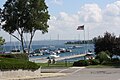 Harbor
 -
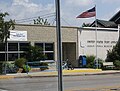 Post office
 -
 Sign on M-119
 -
 View of downtown from the bluff


References
[edit]- ^ "2020 U.S. Gazetteer Files". United States Census Bureau. Retrieved May 21, 2022.
- ^ a b U.S. Geological Survey Geographic Names Information System: Harbor Springs, Michigan
- ^ a b "U.S. Census website". United States Census Bureau. Retrieved January 31, 2008.
- ^ US Census Bureau, 2020 Report, Harbor Springs city, Michigan https://www.census.gov/search-results.html?searchType=web&cssp=SERP&q=Harbor%20Springs%20city,%20Michigan
- ^ "Seeing The Light - Little Traverse Lighthouse". Terrypepper.com. Retrieved July 20, 2019.
- ^ Shay Elementary Archived 2006-07-16 at the Wayback Machine
- ^ "America's Favorite Architecture". American Institute of Architects. 2007. Archived from the original on May 10, 2011.
- ^ "US Gazetteer files 2010". United States Census Bureau. Archived from the original on July 2, 2012. Retrieved November 25, 2012.
- ^ "Harbor Springs, Michigan Travel Weather Averages (Weatherbase)". Weatherbase.
- ^ "Census of Population and Housing". Census.gov. Retrieved June 4, 2015.
- ^ "U.S. Census website". United States Census Bureau. Retrieved November 25, 2012.
- ^ "Pellston Regional Airport Serving Northern Michigan Emmet County". pellstonairport.com.
- ^ via Associated Press. "F. James McDonald, Former G.M. President, Is Dead at 87", The New York Times, June 15, 2010. Accessed July 2, 2010.
External links
[edit]
Municipalities and communities of Emmet County, Michigan, United States | ||
|---|---|---|
| Cities |  | |
| Villages | ||
| Townships | ||
| CDPs | ||
| Other communities | ||
| Ghost towns | ||
| Indian reservations | ||
| Historic settlements |
| |
| Footnotes | ‡This populated place also has portions in an adjacent county or counties | |
| International | |
|---|---|
| National | |
| Geographic | |
| Other | |

Harbor Springs, Michigan
View on GrokipediaOverview
Location and features
Harbor Springs is situated at coordinates 45°25′54″N 84°59′31″W on the north shore of Little Traverse Bay, an inlet of Lake Michigan, within Emmet County in the Lower Peninsula of Michigan.[5] This positioning places the city amid a scenic waterfront landscape characterized by sandy beaches, limestone bluffs, and clear waters that contribute to its appeal as a coastal community.[1] The city encompasses a total land area of 1.30 square miles with no incorporated water bodies, sitting at an elevation of 669 feet above sea level. Its harbor is recognized as the deepest natural harbor on the Great Lakes, providing sheltered docking for vessels and supporting maritime activities in depths reaching up to 170 feet in Little Traverse Bay.[1] Harbor Springs uses ZIP code 49740 and area code 231, and it lies approximately 7 miles west of the neighboring city of Petoskey, accessible via M-119 and U.S. Route 31.[6] As a premier resort destination, Harbor Springs features a vibrant array of art galleries showcasing local and regional works, alongside a diverse culinary scene that highlights fresh Great Lakes seafood and farm-to-table dining options.[1]Government and economy
Harbor Springs operates under a council-manager form of government, where the five-member city council sets policy and the appointed city manager oversees daily operations.[7] The council members serve two-year terms, with the mayor serving as chairman and holding equal voting rights.[8] In the November 5, 2025, election, Jeanne Benjamin was elected to the council and incumbent Kathy Motschall was reelected. As of November 2025, Tom Graham serves as mayor, and Victor Sinadinoski is the city manager, though Sinadinoski announced his resignation effective December 16, 2025, with a search for a replacement underway.[9][10][11][12] City Hall, located at 160 Zoll Street, houses administrative services including zoning administration, utility management, police and fire departments, and oversight of the municipal marina.[13] The local economy is predominantly driven by tourism, retail trade, and small businesses, reflecting the city's role as a resort community on Little Traverse Bay.[14] In 2023, the median household income stood at $60,556, accompanied by a poverty rate of 10%.[15] Key industries encompass hospitality through accommodation and food services, healthcare and social assistance, and professional, scientific, and technical services that support arts and creative endeavors.[15] Employment data from 2023 indicates approximately 41.4% of the workforce in management, business, science, and arts occupations, with the remainder distributed across service, sales, and other sectors; the city lacks a significant manufacturing base.[16][15] The draft 2024 Economic Development Strategy prioritizes waterfront enhancements, such as revitalizing Bay Street infrastructure and public spaces to bolster tourism appeal, alongside business retention efforts including recruitment programs and incentives for property upkeep to sustain downtown vitality.[16] Recent municipal initiatives focus on bolstering local shops and restaurants in the downtown district to promote year-round economic activity and community resilience.[16]History
Early settlement and Native American heritage
The region now known as Harbor Springs was originally inhabited by the Odawa (Ottawa) people, who established a significant presence along the shores of Little Traverse Bay as early as the late 17th century. The area, referred to by the French as L'Arbre Croche—meaning "Crooked Tree" after a prominent bent tree on a nearby bluff—served as a major semi-permanent village site for the Odawa, who fished, hunted, and maintained cultural practices tied to the Anishinaabe traditions. By 1847, L'Arbre Croche hosted the largest concentration of Native Americans in Michigan, underscoring its role as a vital hub for Odawa communities displaced from earlier territories in the Great Lakes region.[17][18] French Jesuit missionaries arrived in the early 18th century, establishing a mission around 1700 amid the L'Arbre Croche villages that extended from Cross Village to what is now Harbor Springs. These missionaries sought to convert the Odawa to Catholicism, integrating religious instruction with the local communities while French fur traders began exploiting the area's abundant beaver populations for the European market. The traders later renamed the vicinity Petit Traverse, or "Little Traverse," reflecting its position as a smaller counterpart to the Grand Traverse Bay to the south, which facilitated early economic exchanges between Odawa villagers and European newcomers.[18][17] In the 19th century, European-American settlement intensified through expanded fur trading posts and missionary efforts, drawing more settlers to the Odawa lands and contributing to gradual population growth. Presbyterian and Catholic missionaries, such as those who founded the Holy Childhood of Jesus mission in 1827 at Little Traverse Bay and opened the New L'Arbre Croche Mission in 1829, focused on education and conversion, establishing schools that interacted closely with Odawa families. A pivotal event was the 1836 Treaty of Washington, in which Odawa leaders from Little Traverse Bay, including figures like Augustin Hamlin and Chief Aish-kab-kay-wen, ceded 13,837,207 acres of ancestral lands in Michigan's Lower and Upper Peninsulas to the United States but secured permanent reservations in northern Michigan to avert forced removal west of the Mississippi River.[19][20][21] The legacy of this early Odawa heritage persists today, with the Little Traverse Bay Bands of Odawa Indians maintaining their tribal offices at 7500 Odawa Circle in Harbor Springs, overseeing a historically delineated reservation encompassing the area. This continuity is evident in operations like the Odawa Casino Resort in nearby Petoskey, opened in 2007 as an economic enterprise owned by the tribe.[22][23]Incorporation and 20th-century development
Harbor Springs was incorporated as a village in 1880 (with government established in 1881), having been renamed from the earlier settlement known as Little Traverse or Petit Traverse, reflecting the influx of settlers from the eastern United States who recognized its potential as a harbor.[3] The community formalized its status further by incorporating as a city in 1932, solidifying its role as a municipal entity amid growing regional development.[24] This incorporation supported infrastructure improvements, including docks and roads that facilitated trade and travel along Little Traverse Bay. In the late 19th and early 20th centuries, Harbor Springs experienced significant growth as a summer resort destination, driven by its scenic waterfront and accessibility via rail and steamship lines from Midwestern cities.[25] The establishment of Wequetonsing as a private resort association in the 1870s marked a key phase in this transformation, with the opening of the Wequetonsing Hotel in 1878 and subsequent construction of cottages by prominent architects, attracting affluent vacationers seeking respite from urban life.[26] This resort development complemented the local lumber economy, where figures like Ephraim Shay, inventor of the geared Shay locomotive used in logging operations, contributed to both industry and architecture; Shay built his innovative hexagonal house in 1892, sheathed in stamped metal for durability.[27] The interplay of lumber milling and tourism spurred a population increase, with the city serving as a hub for seasonal visitors and year-round workers until the lumber industry's peak around 1910. By the mid-20th century, the decline of lumber operations—exacerbated by resource depletion and economic shifts—prompted a pivot to a leisure-based economy, emphasizing resorts, fishing, and boating as primary draws.[28] This transition was punctuated by significant events, including the 1969 fire that destroyed the Club Ponytail music hall, a beloved venue that had hosted prominent performers and drawn crowds from across northern Michigan since the 1950s.[29] In 1973, the completion of the Douglas House, a modernist residence designed by architect Richard Meier for local patrons Jim and Jean Douglas, exemplified the area's evolving architectural landscape; perched on a steep bluff overlooking Lake Michigan, the structure was added to the National Register of Historic Places in 2016 for its innovative design and cultural significance.[30] These developments underscored Harbor Springs' adaptation from industrial roots to a sustained focus on recreational heritage.Geography
Physical geography
Harbor Springs is located at 45°25′52″N 84°59′21″W. Harbor Springs occupies a varied terrain shaped by glacial processes, featuring rolling bluffs that rise above Little Traverse Bay, a segment of Lake Michigan's shoreline. These bluffs, formed from end moraines and drumlins, contribute to a landscape of gentle undulations interspersed with sandy beaches and dense forested areas dominated by northern hardwoods and conifers.[31][32] The area's elevation generally ranges from 600 to 800 feet above sea level, with the city center at approximately 669 feet, providing scenic overlooks of the bay.[33][34] The city's water features center on its namesake sheltered harbor along Little Traverse Bay, which offers depths reaching 60 to 115 feet shortly offshore, facilitating safe boating and maritime activities. Nearby wetlands, such as those in the Thorne Swift Nature Preserve, include marshy areas, cedar swamps, and ponds fed by small streams that drain into the bay, supporting a rich coastal ecosystem.[35][36] These habitats host diverse wildlife, including migratory birds and aquatic species, within the broader Great Lakes coastal environment.[37] Soils in the Harbor Springs vicinity, classified as the Emmet series, consist of very deep, well-drained sandy loam till overlying glacial deposits, which prove suitable for limited agriculture on the outskirts amid the forested and bluff-dominated terrain.[38] The city lies entirely within Emmet County, bordered by Little Traverse Township to the north and west, with proximity to Petoskey across the bay to the south and Cross Village further north along the lakeshore.[35][39]Climate
Harbor Springs experiences a humid continental climate classified as Dfb under the Köppen system, characterized by four distinct seasons, including cold, snowy winters and mild, pleasant summers.[40] Average temperatures reflect this seasonal variation, with July marking the warmest month at a daily high of 78°F (26°C) and a low of 59°F (15°C), while January, the coldest, features a high of 28°F (-2°C) and a low of 15°F (-9°C); the annual mean temperature is approximately 46°F (8°C).[41][42] Annual precipitation totals around 31 inches (790 mm), distributed relatively evenly but with peak rainfall occurring during the summer months; snowfall averages 99 inches (2,500 mm) over approximately 100 days, primarily from November to April due to lake-effect influences.[43][42] The record high temperature reached 97°F (36°C) on July 13, 1936, and the record low was -22°F (-30°C) on January 22, 1985; proximity to Lake Michigan moderates extremes by providing warmer winter air masses and increased moisture for snowfall.[42][35] In the early 2020s, data indicated milder winter temperatures in Emmet County compared to historical norms, alongside elevated water levels in Little Traverse Bay attributed to climate change effects such as increased precipitation and reduced ice cover on Lake Michigan; however, as of 2025, water levels have returned to below-average conditions.[44][45]Demographics
Population trends
The population of Harbor Springs declined notably from 1,557 in 2000 to 1,189 in 2010, a decrease of 23.7 percent, before rebounding slightly to 1,273 in 2020.[46] This early 21st-century drop reflected broader rural depopulation trends in northern Michigan, driven by economic shifts away from traditional industries. By 2023, the ACS 5-year estimate averaged 1,015, but 2024 estimates indicate 1,262 residents, suggesting stabilization.[47][48] Demographic trends highlight an aging community, with the median age rising to 64.9 years in 2023, significantly higher than the state average of 40.1.[49] This shift underscores a predominance of retirees and long-term residents, contributing to slower natural population growth. Despite the small year-round figure, the city experiences a substantial seasonal influx, with the population more than tripling in summer due to tourists and owners of second homes occupying vacation properties and short-term rentals.[2] Projections suggest a stable or slight decline through 2030, consistent with rural Michigan patterns of modest annual losses around 0.2 to 0.4 percent, though factors like increased remote work opportunities following the COVID-19 pandemic may help mitigate further erosion by attracting some newcomers.[49] At approximately one-fifth the size of the county seat Petoskey, whose population exceeds 5,900, Harbor Springs' stability remains closely linked to regional tourism recovery, which has seen visitor traffic return to pre-pandemic levels, bolstering seasonal economic vitality without substantially altering permanent residency.[50]2020 census
As of the 2020 United States census, the population of Harbor Springs was 1,274.[51] This figure represented a 6.7% increase from the 1,194 residents recorded in 2010.[51] The population density stood at 980.8 people per square mile over the city's land area of 1.30 square miles.[52] The racial and ethnic composition of Harbor Springs in 2020, refined with 2023 American Community Survey data, showed 83.55% identifying as White, 4.0% as Native American, 2.2% as Hispanic or Latino (of any race), and 10.2% as two or more races. Smaller proportions included Asian (0.9%) and Black or African American (0.2%) residents.[47] Demographic profiles indicated a median age of 55.8 years in 2020, which rose to 64.9 years by 2023, underscoring an aging population typical of resort communities. The gender distribution was 43.8% male and 56.2% female. There were approximately 660 households in Harbor Springs, with an average household size of 1.93 persons. The poverty rate was 6.8% at the time of the census but increased to 10% by 2023. Housing data revealed that about 70% of units were owner-occupied, contributing to a stable residential base. The median home value surpassed $250,000, influenced by the local resort economy and demand for vacation properties.| Demographic Category | Percentage (2020, refined 2023) |
|---|---|
| White | 83.55% |
| Native American | 4.0% |
| Hispanic/Latino | 2.2% |
| Two or more races | 10.2% |
| Asian | 0.9% |
| Black/African American | 0.2% |