Hubbry Logo
HaslingdenHaslingdenMain
Open search
Haslingden
Community hub
Haslingden
logo
8 pages, 0 posts
0 subscribers
Be the first to start a discussion here.
Haslingden
Haslingden
from Wikipedia

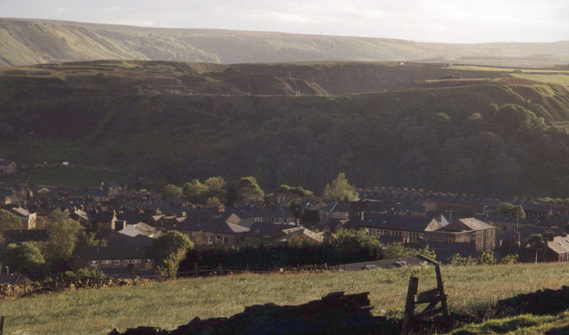
Haslingden /ˈhæzlɪŋdən/ is a town in Rossendale, Lancashire, England. It is 16 miles (26 km) north of Manchester. The name means 'valley of the hazels' or 'valley growing with hazels'.[1] At the time of the 2011 census the town (including Helmshore) had a population of 15,969.[2] The town is surrounded by high moorland; 370 m (1215 ft) to the north; 396 m (1300 ft) Cribden to the east; 418 m (1372 ft) Bull Hill to the south.[3]

Key Information

Haslingden is the birthplace of the industrialist John Cockerill (1790–1840) and the composer Alan Rawsthorne (1905–1971), and was the home for many years of the Irish Republican leader, Michael Davitt (1846–1906). Haslingden Cricket Club is a member of the Lancashire League.

History

[edit]
Arms of the former Haslingden Borough Council

There is some evidence of Bronze Age human presence in the area of Haslingden. Thirteen Stones Hill is 2 km (1.2 mi) west of the town and probably dates from about 3000BC. There is now just one stone visible.[4]

Part of what is now Haslingden, along with the neighbouring towns of Rawtenstall and beyond that Bacup were part of the Forest of Rossendale, itself part of the Forest of Blackburnshire. During the late 13th and 14th centuries the Forest was a hunting park; the term 'Forest' referred to it being parkland rather than being heavily wooded, as the forest declined much earlier, during the Neolithic period. The Forest of Rossendale contained eleven vaccaries (cow-pastures) and was poorly populated, with Haslingden being the only town of significance and possessed of a church.[5]

Haslingden appears to have held markets during the sixteenth century, with the first reference in a Court Roll of 1555 where it records a John Radcliffe being fined for being a 'forestaller of the lords market of Haslyngden'.[6] There are later references to markets and fairs in The Shuttleworth Accounts (1582-1621)[6] and the map-maker Richard Blome writing in 1673 describes Haslingden as originally having 'a small Market-town on Wednesdays', and later, at the time of Charles I, the market had been moved to Saturday.[7] The market continued to grow and Haslingden was designated a Market Town in 1676. It became a coaching station [8] and a significant industrial borough during the Industrial Revolution. Haslingden benefitted in particular with the mechanisation of the wool and cotton spinning and weaving industries from the 18th to the 19th centuries, and the development of watermills, and later steam power. By the latter half of the nineteenth century, the diversity and wealth of industry earned the area the name 'The Golden Valley'.[5] In the 20th century the population declined from 19,000 in the 1911 census to 15,000 in the 1971 census. The 2001 census recorded a population of 16,849 living in the town.

Industrial

[edit]

Quarrying

[edit]

Haslingden is notable for its stone quarrying,[9] and Haslingden Flag (a quartz-based sandstone) was distributed throughout the country in the 19th century with the opening up of the rail network. This stone was used in the paving of London, including Trafalgar Square. Flagstone is a type of sedimentary rock, relatively easy to split or quarry in slabs, and hence ideal for paving. Locally it is also used for making fences and roofing. Geologists have found that it has a hardness and silica content not unlike granite, and its presence was the main reason for the growth of quarrying in Rossendale. Haslingden Flag is unique; two other, common types of flagstone ('rough rocks') are found throughout the Pennines, but a third type is found only in the local Haslingden Flags.[10]

Textiles

[edit]

Like much of East Lancashire, Haslingden has a long association with the textile industry. From the 16th century, after the old Forest of Rossendale was opened up to settlement, farmers raised sheep on the moorlands and made woollen cloth. Initially this was small-scale and local but towards the end of the 18th century cloth workers came together to work in small groups of houses. At the same time advances in technology meant that the first mills were appearing in the area. Most of these were small, water-powered buildings; and Haslingden, with its elevated situation, was not a natural place for the development of these early mills. Locally they were situated lower down in the river valleys, such as at nearby Helmshore.[11]

The long association with wool meant that Haslingden and the other Rossendale towns had expertise with the processes of cloth production, and so were able to switch easily to cotton weaving. Cotton was better suited than wool to industrialised spinning as its fibres were less likely to break than wool. Cotton cloth manufacture quickly became a highly successful industry, and its development was closely associated with its role in the expansion of the slave trade. African slaves being bartered for cotton goods, and cotton being picked by slaves in the Deep South of the U.S.[12]

The growth of mills also had an enormous impact on the landscape, and on the lives of its work force. Cotton weaving in the new factories was largely unregulated, and the workforce kept almost at starvation levels. Hunger drove men and women to fight back, and mobs attacked the power-looms that were seen to be the cause of the decline in status of the workforce. In 1826 almost 3,000 people were reported as 'attacking machinery' in Haslingden. A troop of cavalry was stationed in the vicinity, and ring-leaders were arrested. It was reported from Haslingden in the same year, 1826, that 'a great majority of the unemployed must literally perish from extreme want'. By the 1850 steam power began to supersede water power, and mills grew in size.[13] Grudgingly a minimum wage was introduced, and through the efforts of reformers, the churches and a few enlightened mill-owners, conditions for factory workers slowly improved. Conditions were still harsh, despite the whole Rossendale area being known as the 'Golden Valley'. No longer dependent on the rivers as a source of energy, the mill owners were freed to build elsewhere, and Haslingden began to find that successful mills, such as Hargreaves Street Mill, could be built on its higher land.[13]

The long decline of the cotton industry began in the early years of the 20th century. During the First World War, India and Japan were able to develop their own industries, and after the Second World War, immigration – mainly from Pakistan – was encouraged to help bolster a failing industry. But by the 1950s, mills were closing at an ever-faster rate. The old buildings were later often re-occupied by small businesses specialising in other occupations.

The Cockerill family

[edit]

William Cockerill (1759-1832) and his son John Cockerill (1790-1840), along with other family members, both sons and daughters, are worth a footnote to the industrial history of Haslingden. Both were born in Haslingden, and as a young man William showed great skill as an inventor of machinery. The Slubbing Billy, a roving or slubbing machine, which twists and draws out yarn, is named after him. Slubbing Billy is also the name of a North West Morris Team. Father and son eventually left Haslingden and settled in Belgium, where they built up one of the largest industrial and machinery complexes in mainland Europe. It is said that they instituted the spread of the Industrial Revolution in continental Europe. See John Cockerill (company).

William's beginning are obscure, although it is likely that he worked as a blacksmith in Haslingden before travelling to St. Petersburg, Sweden, and finally to Verviers, near Liège in Belgium. Here he set up spinning and carding machines with his sons Willam, Charles James, and John.[14] John had also been born in Haslingden but moved to Vervier at the age of 12. He was eventually offered a Chateau in Seraing which then became the heart of Belgium's iron, steel and machine-building industries.[15] He is considered to be the founder of Belgian manufacturing and was known as a humanitarian employer.

Immigration and community

[edit]

In the 19th century when the cotton industry was thriving, the town became a magnet for immigrants to Britain. In particular the port of Liverpool was a gateway for waves of immigrants, and many of these were attracted by work in the mills. From the late 1840s a large influx of Irish immigrants forced out of Ireland by the Great Famine of 1846–1852, came to Lancashire and some ended up in Haslingden.[16] At almost the same time, as a result of the political instability in Italy, Italians came to Liverpool and Manchester and a few families moved on to Haslingden. Similarly, in the 1930s various eastern European refugees fleeing Nazi persecution settled in the area. Immediately after World War II young women from Germany were brought over to work in the mills, and a few came to Haslingden and stayed.[17]

From 1950 onwards migrants were encouraged to travel from Commonwealth countries to work in the post-war textile industry. Initially this tended to mean young men who travelled from Pakistan, and later Bangladesh, fully expecting to return home after building up their savings. But by the 1970s, many were joined by wives and families and settled permanently in Haslingden. As a result, the town is now home to a substantial and vibrant community of people with a South Asian heritage, mainly Bangladeshi and Pakistani. Many of the families come from just a few villages: from the Attock and Mirpur areas of north-west Pakistan, and from Patli Union in the Sylhet region of Bangladesh.[18]

The town now houses two mosques and a considerable number of Asian grocers and other shops. In the 2011 census almost 4% of the Rossendale population identify as Muslim, with the majority of these living in Haslingden.[19][needs update]

Governance

[edit]

A civil parish was created in 1866 from the township of Haslingden in the ancient parish of Whalley.[20] A local board was formed for the town in 1875 and the district it governed was extended to cover parts of the townships of Henheads, Higher and Lower Booths in the parish of Whalley, and Musbury and part of Tottington in the ancient parish of Bury.[21] Subsequently, Haslingden was incorporated as a municipal borough in 1891 and in 1894 the civil parish was extended to match the borders of the borough.[20][21] Following the local government reorganisation in 1974 Haslingden became part of the Borough of Rossendale.

In 2005 the Audit Commission rated Rossendale District Council performance as 'poor', and in the Commission's Comprehensive Performance Assessment it was listed as the worst performing district council in the country.[22] By 2009 Rossendale Council was described as 'performing well' by the Audit Commission, with a rating of three out of four stars.[23]

Landmarks

[edit]

St James's Church and the 'Top of the Town'

[edit]

Haslingden's Anglican parish church, dedicated to St James the Great, was rebuilt in 1780[3][9] on a site occupied by a church building since at least 1284. The church is locally known as the 'Top Church' by reason of its dominating position. Murray's 1955 Guide says "it stands well and is plain Georgian, dully Gothicised inside".[24] In 1296 a deed of gift of the Earl of Lincoln to the monks of Stanlaw granted them the parish of Whalley. Haslingden was recorded as being one of Whalley's seven independent chapelries, and was served by two priests.[25]

St James's Church, Haslingden

St James's Church is now located well to the north of the present town centre, but until the 1930s it stood adjacent to the area known as the 'Top of the Town' - the area between Town Gate and Church Street, and the old centre of Haslingden. This location embraced several public house drinking places, along with the original market, the town stocks, and Marsden Square, where travelling shows pitched their tents. Clearance began in 1932 and the area is now largely occupied by recently built housing.[26]

By the west side of the parish church entrance is a large plague stone, with two carved holes. There is some uncertainty about its exact purpose, but most opinion is that such stones were used in times of plague to enable food (or other alms) to be offered to plague victims while avoiding direct contact.[27] A Saxon Cross is mentioned in the Clitheroe court rolls of 1547, and the plague stone may have been placed at the base of the cross, which would date the stone to the 16th century at the latest.[25]

Other churches

[edit]

Beside the Memorial Gardens, the Manchester Road Methodist Church is a classic building with an Italian-inspired interior. Murray's Guide also mentions St Thomas, Helmshore (1851); St Stephen, Grane (1867); St John the Baptist, Stonefold (1885); St Peter, Laneside (1893) and the Roman Catholic Church of the Immaculate Conception (1859) and 'various other nonconformist churches', largely built in the early 19th century.[24]: 146 

St Stephen's, Grane, has a particularly interesting history. Construction started in 1863 and finished four years later, designed by James Maxwell of Haslingden. The church was not consecrated until 1883. The construction of the Ogden Reservoir (which opened in 1912), however, led to almost total depopulation of the community of Grane. St Stephen's remained in use, with most of the villagers having moved to Haslingden town. In 1925 they decided to move the church stone by stone to a new site, 2 miles (3.2 km) away at Three Lanes End, near Holden Cemetery.[26] The church building is now a Holden Wood antiques centre and cafe.[28]

The Public Hall

[edit]

The Public Hall was opened in 1868 and built by a private company formed by 'gentlemen representing the working classes and temperance movement'. It was bought by the town council in 1898 but by the 1990s it was largely unused except for occasional entertainments. The hall had been used for 50 or more years by Rossendale Amateur Operatic Society and other local community groups, but it was finally closed by Rossendale Council in 2005. The hall was sold by the council to a group representing the Asian heritage community and is now a mosque.[29]

The hall was once a venue of Winston Churchill during his early political career. Emmeline Pankhurst once addressed the people of Haslingden from the stage and, after the Battle of the Somme in 1916, it was a temporary hospital for the survivors of the Accrington Pals who were sent home for treatment.

Schools

[edit]

The Wesleyan School, formerly on the site of the current health centre, was the site of the first experiment in the world at a standardised intelligence test. It followed from a suggestion by the industrialist and Liberal politician Sir William Mather in 1900, given after a prize-giving to students to members of the Haslingden Technical Instruction Committee. The test was set by Henry Holman, a schools inspector and educationalist, in 1903. It included questions like 'is there a good reason for making a pie crust ornamental instead of plan?'.[30] Mather introduced apprentice schemes at his factories which used testing as part of the selection method. He also introduced a 48-hour working week for employees.[31][32]

Haslingden High School is a specialist arts, maths and computing college.

Library

[edit]

Originally Haslingden Mechanics' Institute and opened in 1860, it became the public library in 1905. A blue plaque commemorates Michael Davitt. The young Davitt migrated to Haslingden with his family in 1840 as a result of the family being evicted from their tenant farm by a British Landlord. He began working in a cotton mill but at the age of 11 his right arm was entangled in a cogwheel and mangled so badly it had to be amputated. When he recovered from his operation a local benefactor, John Dean, helped to give him an education. He also started night classes at the Mechanics' Institute and used its library.[33] Michael Davitt's family home from 1867 to 1870 on Wilkinson Street is now marked by a memorial plaque.[34] Amongst the library's collection is an early photograph (c. 1892) of Thomas Frederick Worrall labelled Tom Worrall, artist, whose watercolours included a depiction of the Old White Horse Inn (long demolished).

Railway

[edit]

Haslingden was once connected to Accrington and Bury by railway (Rush, 1983). The East Lancashire Railway built a station here, which remained open to passengers under British Railways until 7 November 1960 and to goods until 2 November 1964. The withdrawal of the passenger service was therefore not a victim of Dr. Beeching. The Bury – Accrington line itself remained in use until December 1966. Much of the trackbed of the railway is no longer visible, with the A56 by-pass built over it between Grane Road and Blackburn Road, however, the line can still be traced through Helmshore towards Stubbins where several magnificent viaducts still remain. The East Lancashire Railway Preservation Society was originally established at Helmshore Station in the mid 1960s with the aim of reopening the railway line to Stubbins, the project was abandoned with the organisation relocating to Bury in the 1970s and eventually reopening the Rawtenstall to Bury line.[35]

The nearest National Rail station is 4 miles away, in Accrington. A regular service from Rawtenstall to Manchester has been proposed, using the Heritage East Lancashire Railway terminus station.

Other notable places

[edit]

The town centre is home to the famous Big Lamp originally erected in 1841 and from where all distances in Haslingden are measured, although the original lamp has been replaced by a replica, the original being lost after being taken to America. Cissy Green's Bakery can be found on Deardengate. People visit from across Lancashire to sample the handmade pies which are still made to the original 1920s recipe. To the north of the town is the Holland's Pies factory, and Winfield's, a large warehouse-style retail development selling footwear and clothing, and promoting itself as a family day out. Haslingden's War Memorial is unusual in that it has no names recorded on it. To the northeast there is a 2 kW digital television transmitter serving a wide area.

Chris Aspin writes of the haunting of Tor View, a house no longer standing that was situated behind the Rose & Crown pub on Manchester Road. Young Emma Walton died in the 1840s after a tragic love affair. This story was reported in 1956 by Joseph Braddock in his book Haunted Houses, where the author claimed to have had first-hand experiences of the ghost.[36]

Beauty spots

[edit]
Calf Hey Reservoir in Grane Valley
Haslingden Halo

There is an extensive area of moorland to the west of Haslingden. These moors are divided into Oswaldtwistle Moor and Haslingden Moor. The area forms part of the West Pennine Moors. Plans were made in 2007 to build a wind farm consisting of twelve wind turbines on the moors. This attracted both support and opposition, but the plan was approved by councillors in 2010.[37] Further developments have yet to take place, and the plan remains controversial.

The nearby Snighole (eel-hole) in Helmshore is a well-known beauty spot. The Grane Valley including three reservoirs to the west of the town is popular with walkers.

Victoria Park has a bowling green, children's playground, skateboard park and ball court. The top of the park affords views of Musbury Hill.

The Halo

[edit]

The Panopticons competition was launched in May 2003 by RIBA Competitions organised by Mid-Pennine Arts. The Halo artwork designed by John Kennedy was selected and opened in 2007 and is sited in the hills above Haslingden as the centrepiece of a reclaimed landscape. It glows at night with an impressive viewpoint.[38]

Notable residents

[edit]
William Cockerill, pre-1830
Rhodes Boyson, 1989

Sport

[edit]

See also

[edit]

References

[edit]

Notes

[edit]

Further reading

[edit]
Revisions and contributorsEdit on WikipediaRead on Wikipedia
from Grokipedia
Haslingden is a in the Rossendale Valley of , , situated approximately 19 miles north of . Its name derives from , meaning "valley of the hazel trees," despite its elevated position on a high, windy hill. With a population of around 16,000, it holds the oldest recorded history among the towns in the and was granted status in 1891. The town originated as a station and market center, with its market established in 1676, before expanding significantly during the through wool and cotton textile production powered by watermills and steam engines, alongside quarrying of Haslingden Flagstone, which supplied paving slabs for London's . These industries shaped its economy and landscape, surrounded by high . In modern times, Haslingden features independent retail, food manufacturing including the renowned Holland's Pies founded in 1851, and cultural attractions like the Halo Panopticon, an 18-meter-diameter steel sculpture offering panoramic views of the valley.

Geography

Location and Topography

Haslingden is situated in the , , , approximately 16 miles (26 km) north of . The town occupies a position within the Rossendale Valley, an area characterized by its upland setting amid the . The name Haslingden originates from terms denoting "valley of the hazels," reflecting the historical presence of hazel trees in the local landscape. The topography of Haslingden features a plateau edged by the Pennine Hills, positioned between the valleys of the Rivers Swinnel, Ogden, and Irwell. Elevations in the vicinity average around 902 feet (275 meters), with surrounding and steep narrow valleys contributing to rapid water runoff and a rugged terrain. The River Irwell flows nearby to the south and east, shaping the valley contours that historically channeled settlement along watercourses amid the enclosing hills. Haslingden lies in close proximity to other Rossendale towns, including Rawtenstall approximately 2 miles to the northwest, facilitating regional connectivity within the borough. The local climate aligns with upland Lancashire conditions, marked by temperate oceanic influences, higher precipitation levels due to the Pennine elevation, and cooler temperatures compared to lowland areas.

Demographics

Population and Housing

The population of Haslingden's built-up area was recorded as 15,154 in the 2011 Census, rising modestly to 16,004 by the Census, equating to an average annual growth rate of 0.16%. This stagnation relative to the broader Rossendale borough, which expanded by 4.2% to approximately 71,000 residents over the same decade, reflects limited net migration and aging demographics in post-industrial locales. The town's stood at 3,688 inhabitants per square kilometer in , concentrated amid its 4.34 km² footprint of valleys and moorland edges. Housing in Haslingden predominantly consists of pre-1900 stone-built terraced properties, a legacy of 19th-century mill expansions that accommodated workers in dense, linear developments along valleys. Complemented by scattered farmhouses, barn conversions, and interwar builds, this stock underscores post-industrial adaptation with limited modern infill until recent years. Rossendale's Local Plan targets densities of 50 dwellings per in town centers including Haslingden to support regeneration, aligning with observed completion rates averaging 48 dwellings per in 2017–2018. Affordability challenges persist, with median house prices in Rossendale exceeding 4.75 times median incomes in pressured wards, exacerbated by constrained supply and demand from nearby . Tenure patterns mirror borough trends, with owner-occupation and private renting dominating amid a high share of low-value properties in the lowest band 'A'. Recent approvals emphasize mixed-type developments, including senior living, to avoid over-reliance on high-density formats while addressing demographic shifts.

Ethnic and Religious Composition

In the 2021 United Kingdom census, Haslingden's population of 15,693 was ethnically dominated by the White category, numbering 13,567 individuals or 86.5%, with the Asian category comprising 2,047 residents or 13.0%; smaller groups included 50 Black residents, 29 Arab, and negligible numbers in Mixed or Other categories. This composition shows a higher proportion of non-White residents compared to the broader Rossendale borough, where White residents accounted for 92.4% of 70,868 people, down slightly from 93.8% in 2011, and Asian residents 5.5%. The Asian population in Haslingden primarily consists of those of Pakistani and Bangladeshi heritage, reflecting targeted recruitment of male laborers from regions like Attock in Pakistan starting around 1958 for textile mills, followed by family reunification from the 1970s onward. Earlier, 19th-century Irish immigration to Lancashire, including Haslingden, surged post-Great Famine (1845–1852), drawn by industrial employment opportunities in cotton weaving and quarrying, forming insular communities amid economic pull factors. Religiously, the 2021 census recorded 7,625 Christians (48.6%), a plurality but down from near-universal adherence in the 19th century when the area was overwhelmingly Protestant and Catholic due to native English and Irish settler influences; 5,475 reported no religion (34.9%), aligning with national secularization trends. Muslims formed the next largest group, estimated at around 10–13% based on ethnic correlations, up from negligible levels pre-1960s as South Asian migrants established places of worship to sustain Islamic practice amid settlement. Other faiths remained marginal, with no significant Hindu, Sikh, or Jewish presence documented.
Category2021 NumberPercentage
Ethnicity
13,56786.5%
Asian2,04713.0%
Black/Other<130<1%
Religion
Christian7,62548.6%
No religion5,47534.9%
Muslim~1,600–2,000~10–13%
These shifts trace causally to migration driven by labor demands—Irish for early industrialization, South Asians for mid-20th-century textiles—without evidence of substantial inter-ethnic intermarriage or assimilation metrics altering core group proportions in recent censuses.

History

Early Settlement and Etymology

The name Haslingden derives from elements hæsel or , denoting hazel trees, combined with denu, meaning , thus signifying a "valley of hazels" or a valley characterized by hazel growth, reflecting the wooded of the area during Saxon times. This etymology aligns with the dense hazel woods that once predominated in the Rossendale Valley, prior to later clearances for settlement and . Documentary evidence first records Haslingden in 1241 as part of the manor of , indicating its integration into the medieval feudal structure under the family, lords of Blackburnshire. This places early settlement within the of 13th-century manorial in the Pennine , where Rossendale formed a forested to larger estates, with tenants engaged in assarting—clearing woods for arable and pastoral use—under customary tenures rather than fully developed open-field systems typical of lowland . Settlement patterns likely consisted of scattered homesteads in the valley bottom, suited to the topography's constraints, focusing on of oats, , and rearing adapted to the marginal uplands. Archaeological surveys reveal no known prehistoric or Roman sites in Haslingden itself, contrasting with broader evidence of activity and monuments in coastal and upland fringes elsewhere in the county, suggesting the area's dense forest cover delayed or obscured early human occupation until the medieval period. This absence underscores a baseline of post-Roman woodland continuity in the Rossendale uplands, where causal factors like poor drainage and elevation limited prehistoric viability compared to fertile lowlands. Early medieval expansion here thus relied on incremental clearance within the manorial framework, establishing a dispersed agrarian without prior monumental legacies.

Industrial Revolution and Growth

The advent of mechanized production in Haslingden during the late marked the onset of rapid industrialization, primarily driven by water-powered mills harnessing the fast-flowing streams of the Rossendale Valley. These early factories, utilizing innovations like the introduced in the 1760s and refined by the 1780s, enabled large-scale spinning and weaving, shifting production from domestic handloom operations to centralized sites. This transition was causally linked to abundant local hydraulic resources and proximity to Manchester's markets, fostering an economic surge that attracted migrant labor from rural areas. Population growth exemplified this : Haslingden's inhabitants rose from 4,040 in 1801 to 9,030 by 1851, more than doubling in five decades amid expansion. data from 1851 records a heavily concentrated in , with over 40% of adult males and a substantial female labor force engaged in mill operations, supported by registers showing increased spindlage and rolls. Living conditions, however, reflected the era's exigencies, with 1851 occupational indicating overcrowded housing and child labor prevalent in mills, though empirical records from local document shifts toward regulated hours post-1833 Factory Act. Transport enhancements further propelled growth by easing raw material imports and product exports. Turnpike trusts, established across in the mid-18th century, improved roads like the Bury to Haslingden route, reducing travel times and costs for and . Complementing this, the 1794 Haslingden Act authorized a linking the , & Bury to the & system, aiming to boost trade efficiency despite ultimate non-completion due to topographic challenges and competition. These infrastructural developments, grounded in parliamentary records and toll data, causally amplified industrial viability by integrating Haslingden into regional networks.

Quarrying Industry

The quarrying industry in Haslingden primarily involved the extraction of Haslingden Flag, a quartz-rich formation from the Namurian-age Upper Haslingden Flags within the Group, noted for its granite-like hardness and high silica content suitable for durable building and paving applications. Operations expanded significantly in the , with stone distributed nationally via rail networks that facilitated export from Rossendale Valley sites, including those adjacent to Haslingden. Quarrying techniques encompassed both surface open-pit methods and underground stone , which reached a developmental peak from the onward; early hand-tool labor for drafting margins and splitting blocks evolved to include mechanized cranes, saws, and polishing mills by the late 19th and early 20th centuries. Key sites like Musbury Heights Quarry, operational from before 1850 but formalized under Hargreaves and in 1877, employed narrow-gauge railways for transporting blocks down slopes, enabling efficient output of flagstones, kerbs, and setts. Workers endured severe conditions, including exposure to wind, rain, and silica dust leading to silicosis risks, with piece-rate pay offering no compensation for weather-induced downtime or injuries; boys as young as 14 earned just 6d per hour in the late , prompting the Rossendale and Surrounding District Quarrymen's Association formation in to combat low wages and hazards. The sector declined from the , exemplified by Musbury Heights' closure in 1931 following 1918 strikes over pay and conditions, with broader post-World War II pressures from rising extraction costs and competition with bricks and rendering most operations unviable; legacy sites remain disused, contributing to the area's industrial heritage trails.

Textile Industry and Key Families

The textile industry dominated Haslingden's economy from the late , with mills established between the 1790s and 1830s amid regional advances in mechanized spinning and . Flash Mill, initially a corn mill, was converted to production around 1792 by lessees William Rae the elder and William Rae the younger, exemplifying early entrepreneurial adaptation of water-powered sites for spinning. By the 1810s, the adoption of power looms—driven by horizontal steam engines applied to sheds—accelerated factory-scale output, though it displaced handloom weavers and contributed to local unrest, including participation in the 1826 power-loom riots protesting wage erosion from . Influential families like the Cockerills exemplified the entrepreneurial chains linking local machinery innovation to mill expansion. William Cockerill (1759–1832), a Haslingden-born whose wife worked as a spinner, produced early machines such as spinning jennies, enabling finer production and efficiencies before his 1794 relocation to . These contributions traced causal pathways from artisanal workshops to industrialized output, as machinery investments reduced labor intensity per unit and supported downstream in mills like the later Grane Mill, relocated from a 1798 water-powered origin and rebuilt as a steam-driven weaving facility in 1906 by the Grane Manufacturing Company. By 1891, Haslingden's sector reflected peak operational scale, with at least a dozen mills operational, including Albert Mill (750 ), Hargreaves Street Mill (1,420 ), and Charles Lane Mill (7,000 spindles), sustaining thousands in direct employment amid export-driven demand for cottons. This concentration fueled local wealth accumulation through family-led firms investing in loom and spindle capacity, though without evidence of outsized tied directly to these operations in Haslingden records.

Post-Industrial Decline and Social Changes

The in Haslingden, a cornerstone of the local economy since the , began a sharp decline after the due to intensified global from low-cost imports and the rise of synthetic fibers displacing demand. Mills closed at an accelerating rate through the and , with Lancashire-wide closures averaging nearly one per week; in the nearby Rossendale area, key facilities like those in Helmshore ceased operations in 1967, and at Grane Mill ended by 1978. This directly eroded bases, as Haslingden's mills, once employing thousands in spinning and , shuttered amid structural shifts that favored overseas production. Immigration waves had earlier sustained the industry's labor needs, with Irish workers arriving from the late to fill roles amid Lancashire's booming mills and Ireland's Great Famine, integrating gradually into the working-class communities over subsequent decades. Post-World War II labor shortages prompted recruitment from Commonwealth countries, leading to the arrival of Pakistani men—primarily from villages near —in Haslingden around 1958 for night shifts and unskilled mill work; initial migrants were single young men, but family reunifications under evolving immigration policies from the 1960s onward fostered settled communities over the next 25 years. These groups contributed economically by addressing acute shortages in declining but still operational textiles, yet the subsequent mill closures left many facing redundant skills and limited alternatives. The post-industrial fallout manifested in elevated , with Rossendale's rate reaching 14% by 1983 amid broader manufacturing losses, exacerbating community fragmentation as traditional kinship networks tied to mill work dissolved. Social cohesion faced strains from economic dislocation, including parallel communities formed by earlier immigrants, though empirical metrics show Rossendale maintaining relatively low crime rates across categories compared to national averages, with no disproportionate spikes attributable to alone. Integration challenges persisted, particularly for Pakistani families post-1960s, involving cultural enclaves and occasional tensions over in a shrinking job market, yet their prior economic role in sustaining mills underscored causal ties between labor inflows and industrial resilience until global forces prevailed.

Economy

Historical Economic Foundations

Haslingden's pre-20th-century economy rested on the intertwined industries of quarrying and textiles, bolstered by ancillary and facilitated by established markets. Quarrying of the Haslingden Flags—a quartz-rich prized for its durability—began in the , yielding setts, kerbs, flagstones, and building stone from sites like Hutch Bank quarry to support local expansion. These materials were extracted extensively along the Rossendale Valley and distributed across Britain in the for paving, roofing, and construction, with improved quarrying techniques shifting output from primarily roofing slates to broader structural uses. Textile production, initially woollen and augmented by from the late , formed the core of economic activity, with comprising over half of textile output by 1824. Early mills such as Laneside, established in 1775, and Clough End around 1790 harnessed and power for spinning and , spurring mechanized and population influx from roughly 1,000 residents in 1750 to 4,040 by 1801 and 9,030 by 1851. By the , approximately 14 spinning mills operated in the district, their construction reliant on local quarried stone for foundations and walls. Supporting trades like iron and founding—exemplified by Union in —provided machinery components for operations, while , , , and production met ancillary demands. Markets, granted in 1555 and relocated from Town to Deardengate, served as hubs for local exchange, with the 1795 turnpike linking Haslingden to Bury and enhancing overland trade routes integrated into Lancashire's networks toward Liverpool's port for raw imports and finished goods exports. This interplay of resource extraction, manufacturing specialization, and connectivity generated sustained wealth, embedding Haslingden in the county's textile-driven growth that transformed rural settlements into industrial centers.

Modern Economic Challenges and Regeneration

Haslingden, like much of Rossendale, grapples with the socioeconomic legacies of , including town center vacancy and subdued commercial vitality, despite relatively low headline rates of 2.9% in the for the year ending December 2023. This figure, drawn from data on residents aged 16 and over, reflects a decrease from prior periods but masks underlying issues such as economic inactivity and reliance on low-wage sectors, with borough-wide dwelling vacancy at 3.8% in 2023—above regional norms—and persistent challenges in retail areas. These pressures have manifested in initiatives addressing linked social strains, such as the February 2024 approval of converting the former Commercial Hotel into a homeless and foodbank, accommodating up to eight residents amid concerns over operational ambiguity and neighborhood impacts raised by local councillors. Regeneration efforts have centered on targeted infrastructure upgrades, notably the £500,000 refurbishment of Haslingden Market completed in December 2024, which enhanced accessibility, lighting, and trader facilities to foster a mix of and traditional stalls operating five days weekly. However, by August 2025, the market reduced operations to exclude Thursdays due to insufficient footfall post-refurbishment, highlighting limitations in reversing decline despite council optimism for vibrancy. Broader support draws from the Growth Plan 2025–2035, which prioritizes over £20 billion in county-wide investments, including corridor enhancements to bolster connectivity and employment in Pennine Lancashire areas like Rossendale, though local outcomes remain tied to implementation efficacy rather than projections. These interventions underscore a pattern of modest, localized interventions amid structural constraints, with verifiable metrics like sustained vacancy and variable market performance indicating incomplete regeneration success to date.

Governance and Politics

Local Government Structure

Haslingden is administered as part of the Borough of Rossendale under a two-tier local government system, with Rossendale Borough Council handling district-level services and Lancashire County Council overseeing upper-tier functions such as education, social care, and strategic highways. Rossendale Borough Council was established on 1 April 1974 pursuant to the Local Government Act 1972, which reorganized local authorities by merging former urban and rural districts including Haslingden Urban District. The borough council consists of 30 councillors elected across 10 wards, as determined by a 2023 electoral review conducted by the Local Government Boundary Commission for to ensure equitable representation based on population changes. Haslingden falls within the Haslingden ward, where councillors contribute to council-wide through committees and a cabinet structure that delegates executive powers for services like and . The council holds statutory responsibility for local authority functions, including the development and enforcement of policies, site allocations in the local , and monitoring housing land supply through annual reports such as the 2024/25 assessment covering projected delivery from 2024 to 2029. Rossendale Borough Council's funding primarily comprises precepts collected alongside those from the and any applicable precepts, supplemented by revenue support and rates retention. For the 2024/25 , the borough approved a 2.99% increase to its precept—the maximum allowable under statutory capping provisions—to address budgetary pressures while maintaining services. This results in varying charges by property band; for example, the borough's portion contributes to total Band A levels starting at approximately £1,613.71 when combined with county and other precepts. Haslingden falls within the Rossendale and Darwen parliamentary constituency, represented since the July 4, 2024, general by Labour MP Andy MacNae, who secured 18,247 votes (40.9% share), defeating the incumbent Conservative Jake Berry's 12,619 votes (28.3% share). This result ended 14 years of Conservative representation in the seat, previously held by Berry since 2010, and reflected a swing of approximately 12.5% to Labour amid national shifts following and economic pressures in former heartlands. Locally, Haslingden is encompassed by wards such as Haslingden, Helmshore, and parts of Irwell on Rossendale Borough Council, which Labour has controlled since gaining a in prior cycles, retaining it after the May 2, 2024, all-out where Conservatives lost four seats overall while Greens gained three. Empirical voting data from these wards shows historical Conservative leads narrowing, with Labour capturing key seats in 2024 on turnout around 35-40%, correlating with post-industrial voter realignment toward parties emphasizing regeneration and . In , Haslingden aligns with the Rossendale East and Mid-Rossendale divisions, where the May 1, 2025, elections saw mixed results but contributed to Labour's expanded influence in the borough's divisions, with Conservatives holding slim margins in some but facing challenges from and independents polling 10-15% in protest votes over local issues like housing pressures. Recent trends highlight community responses to policy controversies, such as 2024-2025 clarifications from Rossendale Borough Council denying plans to house asylum seekers in local buildings, countering rumors amid national debates on dispersal grants allocated elsewhere in (e.g., £855,600 to for over 700 placements). These statements, issued to quell speculation, underscore electoral sensitivities around migration and resource allocation, influencing turnout and preferences toward parties advocating stricter controls, as seen in UK's 21.7% constituency share in 2024.

Landmarks and Attractions

Religious and Civic Buildings

St James's Church, dedicated to St James the Great, serves as the principal Anglican in Haslingden and forms a focal point at the 'Top of the Town'. The site's earliest recorded church dates to 1284 as one of seven chapels in Whalley Parish. It was rebuilt between 1550 and 1574 in style, retaining elements like the tower arch and font from that period. A substantial reconstruction followed in 1780 using watershot coursed sandstone, with the tower added in 1872 and further C19 alterations. Other religious buildings reflect Haslingden's denominational diversity amid industrial growth. St Thomas' Church on Helmshore Road, constructed 1850–1857 as a Commissioners' Church by E. H. Shellard, features rock-faced and a roof. Methodist chapels proliferated in the , including King Street Methodist and Independent Methodist on Beaconsfield Street, underscoring Nonconformist influences among textile workers. St Veronica's Roman Catholic Church also stands as a key structure for the town's Catholic community. The Haslingden Public Hall, opened in , exemplifies civic architecture built by working-class subscribers and temperance supporters for community gatherings, lectures, and entertainments. It hosted notable events, including a bazaar opened by in 1900. By the early , the hall had been repurposed for religious and community use following sale to local groups.

Educational and Cultural Facilities

Haslingden High School and Sixth Form serves as the primary secondary educational institution for the town, accommodating 1,534 pupils aged 11 to 18 with a student-teacher ratio of 16:1. In the 2024 GCSE examinations, 42% of pupils achieved a grade 5 or higher in both English and , while the school's Attainment 8 score stood at 44.6. rated the school 'Good' across all categories during its inspection on May 11, 2022, noting strong progress in subjects like English and positive pupil behavior. Primary education in Haslingden is delivered through institutions such as , which enrolls around 430 children and emphasizes inclusive academic standards. The school maintained its 'Good' rating following an inspection on May 2, 2024, with inspectors highlighting effective pupil behavior and respect for school values. At in recent assessments, 52% of pupils reached the higher standard in reading, writing, and mathematics combined. Additional primary options include Haslingden St James' Primary School and Broadway Primary School, contributing to local early education with comparable performance metrics aligned to averages. Haslingden Library functions as the town's central cultural hub, tracing its origins to the Haslingden Mechanics Institute founded in 1860 and repurposed as a public library in 1905. It provides access to public computers, Wi-Fi, scanning facilities, and a specialized local studies collection on Lancashire archives, photographs, and history. The library facilitates community cultural engagement through events such as reading sessions, craft workshops, and heritage exhibitions, including displays of restored historic items and participation in annual Fun Palaces weekends promoting arts and science. These activities support public literacy and historical awareness, though direct causal links to town-wide metrics like enrollment or reading proficiency remain unquantified in official reports.

Transport and Infrastructure

Haslingden was served by a railway station on the East Lancashire Railway's Accrington to Bury line, which opened in 1848 and provided passenger services until its closure on 7 November 1960 due to declining usage and operational costs. The line continued for freight until 2 November 1964, with the full to Stubbins branch ceasing operations in 1966 amid broader rationalizations that predated but aligned with the Beeching Report's recommendations for unprofitable routes. This severance reduced direct rail connectivity to and nearby towns, fostering greater dependence on road transport and contributing to the town's relative isolation in the post-industrial era. Today, Haslingden lacks active rail services, with the nearest station at approximately 4 miles southeast; heritage operations on the terminate at , 3 miles north. Primary access relies on road networks, including the A56 trunk road traversing the town center, which connects southward to the for (about 20 miles away, reachable in under 30 minutes by car under typical conditions). The , completed in its full 28-mile length in 1997, enhances eastward and westward links via nearby Junction 8 at Edenfield (2 miles south), facilitating travel to and Preston. Bus services, operated chiefly by , include the X41 route from through Haslingden to Manchester's , with journeys taking 45-60 minutes depending on traffic. Additional local routes such as the 464 and 481 provide connections within Rossendale and to Bury. Ongoing infrastructure enhancements focus on road capacity and integration with regional growth. The Rossendale Infrastructure Delivery Plan identifies improvements to A56/M66 links as critical for second- and third-period developments (up to 2037), aiming to alleviate congestion toward Manchester without specifying Haslingden-centric timelines. Adjacent to Haslingden, upgrades at M65 Junction 5—including widening of the B6232 Haslingden Road approach and slip road modifications—are underway as part of a £30 million scheme starting in 2025 to reduce bottlenecks for commuter traffic from Blackburn and Darwen. Local public realm works on Deardengate, incorporating temporary road adjustments, support pedestrian and minor vehicular flow but emphasize town center vitality over major trunk enhancements.

Natural Sites and Modern Art

The , situated to the west of Haslingden, serves as a prominent natural area characterized by and that attract walkers and hikers. This valley features scenic trails, including the Haslingden Grane Circular route, which spans approximately 4.1 miles with an elevation gain of 534 feet, offering moderate difficulty and panoramic views of the surrounding Pennine landscape. Calf Hey Reservoir, nestled within Haslingden Grane, exemplifies the area's environmental appeal, providing accessible paths suitable for various abilities, including wheelchair users in parts, amid picturesque moorland and water features. Additional reservoirs such as Ogden and Holden Wood contribute to a network of looped trails totaling up to 6.9 miles, supporting and recreational use managed by . Abandoned quarries in the vicinity, integrated into walking routes like those around Musbury Heights, have evolved into secondary beauty spots, blending industrial remnants with natural reclamation and elevated vistas over . Complementing these natural features, modern public art installations enhance the region's aesthetic and symbolic value. The Halo, a prominent erected in 2007 on Top o' Slate—a reclaimed former site—stands as an 18-meter-diameter lattice structure elevated five meters on a , designed by architect John Kennedy of LandLab as part of the Panopticons project. This initiative, funded through East 's regeneration efforts including the REMADE in Lancashire programme led by Rossendale Borough Council and Groundwork Pennine , aimed to create 21st-century landmarks celebrating industrial landscape restoration and . The open-topped design frames expansive sky and views, integrating artistic expression with environmental rehabilitation amid ongoing development pressures. Conservation measures, such as reclamation, underscore efforts to balance recovery with infrastructural projects like the Haweswater Aqueduct Resilience Programme's Haslingden section, prioritizing ecological surveys and enhancement.

Notable Residents

Sports Personalities

James Edward "Choppy" Warburton (1845–1897), born in Coal Hey, Haslingden, was a prominent long-distance runner in the mid-19th century, setting amateur athletic records including a one-mile time of 4 minutes 31.75 seconds in 1878 and winning the London Athletic Club championship over 10 miles. Later transitioning to , he coached professional riders such as Arthur Linton and Tom Linton, contributing to early Tour de France-era successes amid controversies over his training methods involving stimulants. John Thomas Ashworth (1850–1901), born in New Hall Hey, Haslingden, was a right-handed batsman who played 10 first-class matches for between 1874 and 1880, scoring 153 runs at an average of 10.20. His career highlighted local participation in emerging structures during the late . Leslie Warburton (1910–1984), born in Haslingden, featured in eight first-class matches for from 1929 to 1938 as a right-handed lower-order batsman and right-arm medium-fast bowler, taking 11 wickets at an average of 37.09. He also played extensively in the Lancashire League for Haslingden Cricket Club, spanning from 1926 to 1956, including spells with East Lancashire and Littleborough clubs.

Other Figures

Rhodes Boyson (1925–2012), a Conservative politician born on 11 May 1925 in Haslingden, served as for Brent North from 1974 to 1997, holding positions including for Social Security (1983–1984) and for Education and Science (1985–1987), where he advocated for traditional educational values and opposed comprehensive schooling reforms. Knighted in 1987, Boyson was known for his advocacy of Victorian moral standards and corporal punishment in schools, reflecting his background as a headmaster prior to entering . William Cockerill (1759–1832), born in Haslingden, was an inventor and entrepreneur who pioneered the of British textile machinery to , establishing factories in , , and particularly , where he manufactured machines and spinning equipment that accelerated industrialization in by 1799. His innovations in wool processing machinery laid foundational contributions to Belgium's early industrial base, though his methods involved designs past export restrictions imposed by Britain to protect technological advantages. John Cockerill (1790–1840), son of William and also born in Haslingden on 3 August 1790, expanded the family enterprise in , founding the Société John Cockerill in in 1817, which grew into a major conglomerate producing steam engines, ironworks, and ships, employing over 2,000 workers by the 1830s and symbolizing the transfer of technologies abroad. His ventures faced financial strains leading to shortly before his death, but they significantly influenced Walloon industrial development. Alan Rawsthorne (1905–1971), composer born on 2 May 1905 in Haslingden's Deardengate House, studied architecture and dentistry before pursuing music at the Royal Manchester College of Music, producing over 70 works including symphonies, concertos, and noted for their contrapuntal rigor and neoclassical style, with commissions from the and performances by ensembles like Orchestra. Michael Davitt (1846–1906), who resided in Haslingden from 1853 to 1867 after his family emigrated from due to evictions, began factory work at age nine in a local , an experience that fueled his later activism; he founded the in 1879 to combat landlordism through campaigns for and tenant rights, influencing policies like the Land Acts of the 1880s despite imprisonment for treason felony in 1881. A memorial marks the site of his former Wilkinson Street home in Haslingden, acknowledging his early life there amid the community.

References

Add your contribution
Related Hubs
User Avatar
No comments yet.