


Community hub
Recent from talks
Contribute something
Nothing was collected or created yet.
Heart symbol
View on Wikipedia


The heart symbol is an ideograph used to express the idea of the "heart" in its metaphorical or symbolic sense. Represented by an anatomically inaccurate shape, the heart symbol is often used to represent the center of emotion, including affection and love, especially romantic love. While ancient antecedents may exist, this shape for the heart became fixed in Europe in the middle ages. It is sometimes accompanied or superseded by a "wounded heart" symbol, depicted as a heart symbol pierced with an arrow, indicating lovesickness, or as a "broken" heart symbol in two or more pieces, indicating heartbreak.
History
[edit]Similar shapes from antiquity
[edit]Peepal leaves were used in artistic depictions by the Indus Valley civilisation: a heart-shaped pendant originating from there has been discovered and is now exhibited in the National Museum of India.[1] In the 5th–6th century BC, the heart shape was used in the Roman world to represent the seeds of the plant silphium,[2] a plant possibly used as a contraceptive and an aphrodisiac.[3][4] Silver coins from Cyrene of the 5th–6th century BC bear a similar design, sometimes accompanied by a silphium plant and is understood to represent its seed or fruit.[5]
Since ancient times in Japan, the heart symbol has been called Inome (猪目), meaning the eye of a wild boar, and it has the meaning of warding off evil spirits. The decorations are used to decorate Shinto shrines, Buddhist temples, castles, and weapons.[6][7] The oldest examples of this pattern are seen in some of the Japanese original tsuba (sword guard) of the style called toran gata tsuba (lit., inverted egg shaped tsuba) that were attached to swords from the sixth to seventh centuries, and part of the tsuba was hollowed out in the shape of a heart symbol.[8][9]
Earliest use
[edit]The combination of the heart shape and its use within the heart metaphor was developed in the end of the Middle Ages, although the shape has been used in many ancient epigraphy monuments and texts. With possible early examples or direct predecessors in the 13th to 14th century, the familiar symbol of the heart representing love developed in the 15th century, and became popular in Europe during the 16th.[10]
Before the 14th century, the heart shape was not associated with the meaning of the heart metaphor. The geometric shape itself is found in much earlier sources, but in such instances does not depict a heart, but typically foliage: in examples from antiquity fig leaves, and in medieval iconography and heraldry, typically the leaves of ivy and of the water-lily.
The first known depiction of a heart as a symbol of romantic love dates to the 1250s. It occurs in a miniature decorating a capital 'S' in a manuscript of the French Roman de la poire.[11] In the miniature, a kneeling lover (or more precisely, an allegory of the lover's "sweet gaze" or doux regard) offers his heart to a damsel. The heart here resembles a pine cone (held "upside down", the point facing upward), in accord with medieval anatomical descriptions. However, in this miniature, what suggests a heart shape is only the result of a lover's finger superimposed on an object; the full shape outline of the object is partly hidden, and, therefore unknown. Moreover, the French title of the manuscript that features the miniature translates into "Novel of the pear" in English. Thus the heart-shaped object would be a pear; the conclusion that a pear represents a heart is dubious. Opinions, therefore, differ over this being the first depiction of a heart as a symbol of romantic love.[12]
Giotto in his 1305 painting in the Scrovegni Chapel (Padua) shows an allegory of charity (caritas) handing her heart to Jesus Christ. This heart is also depicted in the pine cone shape based on anatomical descriptions of the day (still held "upside down"). Giotto's painting exerted considerable influence on later painters, and the motive of Caritas offering a heart is shown by Taddeo Gaddi in Santa Croce, by Andrea Pisano on the bronze door of the south porch of the Florence Baptistery (c. 1337), by Ambrogio Lorenzetti in the Palazzo Publico in Siena (c. 1340) and by Andrea da Firenze in Santa Maria Novella in Florence (c. 1365). The convention of showing the heart point upward switches in the late 14th century and becomes rare in the first half of the 15th century.[12]
The "scalloped" shape of the now-familiar heart symbol, with a dent in its base, arises in the early 14th century, at first only lightly dented, as in the miniatures in Francesco da Barberino's Documenti d'amore (before 1320). A slightly later example with a more pronounced dent is found in a manuscript from the Cistercian monastery in Brussels.[13] The convention of showing a dent at the base of the heart thus spread at about the same time as the convention of showing the heart with its point downward.[14] The modern indented red heart has been used on playing cards since the late 15th century.[15]
Various hypotheses attempted to connect the "heart shape" as it evolved in the Late Middle Ages with instances of the geometric shape in antiquity.[16] Such theories are modern, proposed from the 1960s onward, and they remain speculative, as no continuity between the supposed ancient predecessors and the late medieval tradition can be shown. Specific suggestions include: the shape of the seed of the silphium plant, used in ancient times as an herbal contraceptive,[16][17] and stylized depictions of features of the human female body, such as the female's breasts, buttocks, pubic mound, or spread vulva.[18]
-
 The earliest known possible visual depiction of a heart symbol, as a lover hands his heart to the beloved lady, in a manuscript of the Roman de la poire, 13th century
 -
 Giotto's allegory of charity handing her heart to Jesus Christ (c. 1305)
 -
 Charity on the south doors of the Florence Baptistery (c. 1336)


Renaissance and early modern
[edit]

Heart shapes can be seen on various stucco reliefs and wall panels excavated from the ruins of Ctesiphon, the Persian capital (c. 90 BC – 637 AD).[23][24][25]
The Luther rose was the seal that was designed for Martin Luther at the behest of Prince John Frederick, in 1530, while Luther was staying at the Coburg Fortress during the Diet of Augsburg. Luther wrote an explanation of the symbol to Lazarus Spengler: "a black cross in a heart, which retains its natural color, so that I myself would be reminded that faith in the Crucified saves us. 'For one who believes from the heart will be justified' (Romans 10:10)."[26][unreliable source?]
The aorta remains visible, as a protrusion at the top centered between the two "chambers" indicated in the symbol, in some depictions of the Sacred Heart well into the 18th century, and is partly still shown today (although mostly obscured by elements such as a crown, flames, rays, or a cross) but the "hearts" suit did not have this element since the 15th century.
-
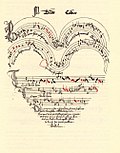 The chanson Belle, Bonne, Sage by Baude Cordier, written in the shape of a heart, in the Chantilly Codex. This is one of two dedicatory pieces placed at the beginning of the older (late 14th century) corpus, probably to replace the original first fascicle, which is missing.
 -
![Early depiction of the Heart of Jesus in the context of the Five Wounds (the wounded heart here depicting Christ's wound inflicted by the Lance of Longinus) in a 15th-century manuscript[27]](//upload.wikimedia.org/wikipedia/commons/thumb/2/24/Sacr%C3%A9-Coeur_K%C3%B6ln.jpg/120px-Sacr%C3%A9-Coeur_K%C3%B6ln.jpg) Early depiction of the Heart of Jesus in the context of the Five Wounds (the wounded heart here depicting Christ's wound inflicted by the Lance of Longinus) in a 15th-century manuscript[27]
Early depiction of the Heart of Jesus in the context of the Five Wounds (the wounded heart here depicting Christ's wound inflicted by the Lance of Longinus) in a 15th-century manuscript[27] -
 1486 depiction of the Five Wounds
 -
![Miniature from the Petit Livre d'Amour (c. 1500), showing the author Pierre Sala [fr] depositing his heart in a marguerite flower (symbolizing his mistress, who was called Marguerite). Also worth mentioning is the miniature on fol. 13r,[28] showing two women catching winged hearts in a net.](//upload.wikimedia.org/wikipedia/commons/thumb/1/1f/Petit_Livre_d%27Amour_6r.jpg/120px-Petit_Livre_d%27Amour_6r.jpg) Miniature from the Petit Livre d'Amour (c. 1500), showing the author Pierre Sala depositing his heart in a marguerite flower (symbolizing his mistress, who was called Marguerite). Also worth mentioning is the miniature on fol. 13r,[28] showing two women catching winged hearts in a net.
Miniature from the Petit Livre d'Amour (c. 1500), showing the author Pierre Sala depositing his heart in a marguerite flower (symbolizing his mistress, who was called Marguerite). Also worth mentioning is the miniature on fol. 13r,[28] showing two women catching winged hearts in a net. -
 The Luther rose, 1706 print after the 1530 design
 -
 Hearts suit in a 1540s German deck of playing cards
 -
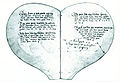 The Danish "Heart Book", a heart-shaped manuscript of love ballads from the 1550s
 -
 Augustine of Hippo holding a heart in his hand which is set alight by a ray emanating from divine Truth (Veritas), painting by Philippe de Champaigne, c. 1650
 -
 Allegorical painting of the Sacred Heart of Jesus. The central heart radiates hearts gathered up by Putti. By Robert la Longe, c. 1705.
 -
 Leaden heart of Raesfeld chapel (funerary casket containing the heart of Christoph Otto von Velen, d. 1733)
 -
 18th-century depiction of the Sacred Heart from the vision of Marguerite Marie Alacoque (d. 1690). The heart is both "heart-shaped" and drawn anatomically correct, with both the aorta and the pulmonary artery visible, with the crucifix placed inside the aorta.
 -
 Another anatomically correct Sacred Heart, painted in c. 1770 by José de Páez

![Early depiction of the Heart of Jesus in the context of the Five Wounds (the wounded heart here depicting Christ's wound inflicted by the Lance of Longinus) in a 15th-century manuscript[27]](https://en.wikipedia.org/wiki/File:Sacr%C3%A9-Coeur_K%C3%B6ln.jpg)

![Miniature from the Petit Livre d'Amour (c. 1500), showing the author Pierre Sala [fr] depositing his heart in a marguerite flower (symbolizing his mistress, who was called Marguerite). Also worth mentioning is the miniature on fol. 13r,[28] showing two women catching winged hearts in a net.](https://en.wikipedia.org/wiki/File:Petit_Livre_d%27Amour_6r.jpg)


Modern
[edit]Since the 19th century, the symbol has often been used on Valentine's Day cards, candy boxes, and similar popular culture artifacts as a symbol of romantic love.
The use of the heart symbol as a logograph for the English verb "to love" derives from the use in "I ♥ NY," introduced in 1977.[29]
Outdoor toilets in Scandinavia traditionally had a heart shaped peephole. In homes a heart symbol made from red painted plywood, or a stuffed fabric one, is often used to assist visitors in finding the modern facility. For image see: Hjerte (symbol)
Heart symbols are frequently used to symbolize "health" or "lives" in video games. The Legend of Zelda (1986) had a "life bar" composed of heart shapes, and many other games continued this convention (the Castlevania franchise being a notable exception, where the hearts are ammunition for the secondary weapons instead of representing health). Since the 1990s, the heart symbol has also been used as an ideogram indicating health outside of the video gaming context, e.g., its use by restaurants to indicate heart-healthy nutrient content claim (e.g., "low in cholesterol"). A copyrighted "heart-check" symbol to indicate heart-healthy food was introduced by the American Heart Association in 1995.[30]
-
 A heart-shaped "Map of Woman's Heart" (1830s)
 -
 Two burning hearts, coloured pink, illustration on a Victorian-era Valentine's Day card
 -
 A "Vinegar Valentine" card from the 1870s, with a red heart symbol pierced by six arrows
 -
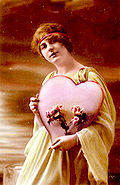 The traditional "heart shape" appears on a 1910 Valentine's Day card.
 -
 Sheet music cover of "Look in His Eyes", from the musical Have a Heart (1913)
 -
 Magazine advertisement for the silent film The Orderly (1921)
 -
 Wedding rings of a groom and bride with shadow in the form of a heart


.jpg)

Heraldry
[edit]

The earliest heart-shaped charges in heraldry appear in the 12th century; the hearts in the coat of arms of Denmark go back to the royal banner of the kings of Denmark, in turn based on a seal used as early as the 1190s. However, while the charges are clearly heart-shaped, they did not depict hearts in origin, or symbolize any idea related to love. Instead, they are assumed to have depicted the leaves of the water-lily.[citation needed] Early heraldic heart-shaped charges depicting the leaves of water-lilies are found in various other designs related to territories close to rivers or a coastline (e.g. Flags of Frisia).
Inverted heart symbols have been used in heraldry as stylized testicles (coglioni in Italian) as in the canting arms of the Colleoni family of Milan.[32]
A seal attributed to William, Lord of Douglas (of 1333) shows a heart shape, identified as the heart of Robert the Bruce. The authenticity of this seal is "very questionable",[33] i.e. it could possibly date to the late 14th or even the 15th century.[34]
Heraldic charges actually representing hearts became more common in the early modern period, with the Sacred Heart depicted in ecclesiastical heraldry, and hearts representing love appearing in bourgeois coats of arms. Hearts also later became popular elements in municipal coats of arms.
Botanical symbolism
[edit]There has been some conjecture regarding the link between the traditional heart symbol and images of the fruit of silphium, a (probably) extinct plant known to classical antiquity and belonging to the genus Ferula, used as a condiment and medicine, (the medicinal properties including contraceptive and abortifacient activity, linking the plant to sexuality and love).[35] Silver coins from the ancient Libya of the 6th to 5th centuries BC bear images strongly reminiscent of the heart symbol, sometimes accompanied by images of the silphium plant.[36][37] The related Ferula species asafoetida – which was actually used as an inferior substitute for silphium – is regarded as an aphrodisiac in Tibet and India, suggesting yet a third amatory association relating to silphium.[38]
-
 Ancient silver coin from Cyrene, Libya depicting the heart-shaped "seed" (actually fruit) of silphium
 -
 Example of a heart-shaped mericarp fruit in a plant (Heracleum sphondylium) belonging, like the unidentified silphium, to the parsley family, Apiaceae
 -
 Ferula assa-foetida: a species of giant fennel belonging to the same genus as the ancient silphium and regarded as having similar properties, while being an inferior substitute for the plant
 -
 Ferula tingitana: a possible identity for silphium


Encoding
[edit]Parametrisation
[edit]A number of parametrisations of approximately heart-shaped curves have been described. The best-known of these is the cardioid, which is an epicycloid with one cusp;[39] though as the cardioid lacks the point, it may be seen as a stylized water-lily leaf, a so-called seeblatt, rather than a heart. Other curves, such as the implicit curve (x2+y2−1)3−x2y3=0, may produce better approximations of the heart shape.[40]

(animated)

(x2 + y2 − 1)3 − x2y3 = 0




-
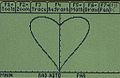 Heart curve on TI-89 graphing calculator
 -
 Parametric equation of heart curve on TI-89 graphing calculator


See also
[edit]- Cordata, Cordatum and Cordatus, Latin adjectives meaning heart-shaped
- Hand heart
- Heart in hand
- Passion (emotion), or passionate love
- Seeblatt, a symbol of a water lily leaf that resembles a heart
References
[edit]Inline citations
[edit]- ^ "Pendant - unknown". Google Arts & Culture. Retrieved 2020-10-21.
- ^ Favorito, E. N.; Baty, K. (February 1995). "The Silphium Connection". Celator. 9 (2): 6–8.
- ^ Did the ancient Romans use a natural herb for birth control?, The Straight Dope, October 13, 2006
- ^ Zaria Gorvett (2017). "The mystery of the lost Roman herb". BBC.
- ^ Buttrey, T. V. (Spring–Summer 1992). "The Coins and the Cult" (PDF). Expedition. 34 (1–2): 59–66. Archived from the original (PDF) on 2023-02-17. Retrieved 2018-01-14.
- ^ 幸せの猪目(いのめ) (in Japanese). Hase-dera. Archived from the original on 30 January 2021.
- ^ お寺にハートマーク (in Japanese). Fukagawa Fudoudou. Archived from the original on 30 April 2022.
- ^ 猪目(いのめ) (in Japanese). weblio. Archived from the original on 8 May 2021.
- ^ 倒卵形鐔(とうらんがたつば) (in Japanese). weblio. Archived from the original on 26 October 2017.
- ^ Martin Kemp. (2011). "Christ to Coke: How Image Becomes Icon", 1st ed. Oxford University Press, ISBN 9780199581115, pp.368, p.96–99.
- ^ (National Library FR MS. 2086, plate 12)
- ^ a b Vinken (2001).
- ^ MS 4459–70, fol 192v. Royal Library of Belgium
- ^ Vinken (2001): "The change from the spherical to the scalloped form of the heart base happened more or less in train with the differing way in which the heart was held, and has dominated visual representations of the heart ever since."
- ^ A Brief History of Playing Cardes, by Charles Knutson, Renaissance Magazine 2001 "Gamester article renaissance magazine". Archived from the original on 2010-12-20. Retrieved 2013-05-27.
- ^ a b McDonell, Keelin (2007-02-13). "The Shape of My Heart". Slate. ISSN 1091-2339. Retrieved 2024-10-21.
- ^ Benedictus, Luke (12 February 2006). "Sowing the seeds of love". The Age.
- ^ Proposed by Gloria Steinem in the 1998 introduction to the Vagina Monologues online copy Archived 2023-04-16 at the Wayback Machine; "For example, the shape we call a heart—whose symmetry resembles the vulva far more than the asymmetry of the organ that shares its name—is probably a residual female genital symbol. It was reduced from power to romance by centuries of male dominance.", based on an earlier suggestion by Tanzer (1969) that the shape was used as a symbol indicating brothels in ancient Pompeii. Tanzer (1969). The Common People of Pompeii. A study of the graffiti. With illustrations and a map
- ^ "Incrustation de meuble". 539.
- ^ Daryaee, Touraj (January 2022). "اسب های بالدار". Bukhara 147.
- ^ "Plate with youths and winged horses | Sasanian | Sasanian". The Metropolitan Museum of Art.
- ^ "Textile Gallery | IAMM".
- ^ "Roundel with radiating palmettes | Sasanian | Sasanian". The Metropolitan Museum of Art. Retrieved 2024-10-21.
- ^ Fragments of stucco roundels in situ, Taq-i Kisra, south building, Ctesiphon, Iraq, 1931–32. (n.d.). Retrieved April 7, 2015, from http://www.metmuseum.org/met-around-the-world/images/wb_large/wb_Ctesiphon2.jpg
- ^ "Wall panel with a bird in roundel | Sasanian | Sasanian". The Metropolitan Museum of Art. Retrieved 2024-10-21.
- ^ gamesmuseum.uwaterloo.ca Archived 2006-10-10 at the Wayback Machine, i-p-c-s.org "Archived copy". Archived from the original on 2013-09-27. Retrieved 2013-03-17.
{{cite web}}: CS1 maint: archived copy as title (link) antiquemapsandprints.com, obviously more research is needed here. - ^ Cologne Mn Kn 28-1181 fol. 116
- ^ fol. 13r
- ^ "Subsequently the heart symbol became a shorthand for enthusiasm for everything from software to Yorkshire terriers. It was a stamp that validated lifestyles. People could ♥ their grandchildren or line dancing or Buddha." Stephen Amidon, Thomas Amidon, The Sublime Engine: A Biography of the Human Heart (2011), p. 193.
- ^ "the heart-check mark that began to appear on a wide array of food packaging in 1995. The symbol consists of a heart branded with a bold, efficient check mark. It is copyrighted by the American Heart Association (AHA), which licenses it for a nominal fee to companies whose products meet the organization's criteria for saturated fat and cholesterol content." Stephen Amidon, Thomas Amidon, The Sublime Engine: A Biography of the Human Heart (2011), p. 193.
- ^ C. Weyers in: Stengel (ed.), Archiv für Diplomatik: Schriftgeschichte, Siegel, und Wappenkunde, Volume 54, 2008, p. 100.
- ^ Woodward, John and George Burnett (1969). Woodward's a treatise on heraldry, British and foreign, page 203. Originally published 1892, Edinburgh: W. & A. B. Johnson. ISBN 0-7153-4464-1. LCCN 02-20303
- ^ McAndrew, Scotland's Historic Heraldry, 2006, p. 141
- ^ McAndrew 2006, p. 213.
- ^ Favorito, E. N.; Baty, K. (February 1995). "The Silphium Connection". Celator. 9 (2): 6–8.
- ^ T. V. Buttrey, "The Coins and the Cult", Expedition magazine vol. 34, Nos. 1–2 "Special Issue: Gifts to the Goddesses—Cyrene's Sanctuary of Demeter and Persephone", Spring–Summer 1992.
- ^ Koerper, H.; Kolls, A. L. (1999). "The silphium motif adorning ancient libyan coinage: Marketing a medicinal plant". Economic Botany. 53 (2): 133–143. doi:10.1007/BF02866492. JSTOR 4256173. S2CID 32144481.
- ^ "Aphrodisiac - Asafoetida (Ferula asa foetida)".
- ^ Weisstein, Eric W., "Cardioid" from MathWorld.
- ^ Eric W. Weisstein, "Heart Curve." From MathWorld
Works cited
[edit]- Martin Kemp, "The Heart" in Christ to Coke: How Image Becomes Icon, Oxford University Press, 2011, 81–113.
- P. J. Vinken (2000), The Shape of the Heart: A Contribution to the Iconology of the Heart (illustrated ed.), Elsevier Health Sciences, ISBN 978-0-444-82987-0
General references
[edit]External links
[edit] Definitions from Wiktionary
 Media from Commons
 Quotations from Wikiquote
 Data from Wikidata


| National | |
|---|---|
| Other | |

_(14747564815).jpg#file)


Heart symbol
View on GrokipediaHistory
Ancient Precursors
One of the earliest known heart-like shapes appears in artifacts from the Indus Valley Civilization, dating to circa 2500 BCE. A notable example is a gold pendant embossed with a heart-shaped fig leaf, likely inspired by the peepal tree (Ficus religiosa), excavated from Harappa and housed in the National Museum, New Delhi. This pendant, worked in repoussé with inlaid faience, reflects decorative and possibly symbolic uses in jewelry, without evidence of romantic connotations. The peepal leaf's distinctive heart form also features in Harappan seals, such as a clay seal depicting a majestic tree with widespreading heart-shaped leaves, suggesting practical or ritualistic applications in ancient South Asian material culture.[4][6] In the ancient Greek colony of Cyrene (modern Libya), coins from the 6th to 5th century BCE depict the seed pods of the silphium plant in a proto-heart shape. Silphium, a giant fennel-like herb endemic to the region, was harvested to extinction by the 1st century CE due to overexploitation. The plant served medicinal purposes, including as a seasoning, perfume, and reputed contraceptive, with its heart-shaped seeds prominently illustrated on silver drachms alongside the plant's stalks, highlighting its economic and therapeutic value rather than symbolic romance. Archaeological evidence from Cyrene confirms these motifs on currency minted during the city's prosperity under Greek and later Roman influence.[7][8][9] In Japan, the inome motif, meaning "boar's eye," emerged as a protective symbol during the Kofun period (circa 300–538 CE), with examples extending into the 6th and 7th centuries. Carved into spearheads, hand guards, and architectural elements like shrine windows, the heart-shaped design mimicked the fierce eye of a wild boar to ward off evil spirits and invoke bravery. Artifacts from this era, including ritual axes and early armor components, demonstrate its apotropaic function in Shinto and Buddhist contexts, emphasizing defensive and spiritual utility over emotional symbolism.[10][11] Persian architectural decorations from the Parthian (247 BCE–224 CE) and Sasanian (224–651 CE) periods, spanning circa 90 BCE to 637 CE, incorporated heart-like forms in stucco work. Excavations at sites like Hajiabad and Tepe Hissar reveal molded stucco panels with heart-shaped vegetal motifs, such as palmettes and ivy leaves, used in repetitive borders and medallions on palace walls and columns. These elements, often combined with geometric patterns, served ornamental purposes in elite residences and fire temples, underscoring aesthetic and structural enhancement in pre-Islamic Iranian art. Specific finds from the Ramavand site in Lorestan Province include circular stucco plaques with heart-shaped frames, dated to the late Parthian-early Sasanian transition.[12][13][14]Emergence in Medieval Europe
The heart symbol first emerged as a distinct emblem of romantic love in 13th-century European manuscripts, with its earliest documented depiction appearing in the French illuminated poem Roman de la poire (Romance of the Pear), composed around 1250–1260 by Thibaut. In this work, a knight named Douce Regart (Sweet Gaze) presents a heart-shaped object to his beloved, symbolizing the offering of his affections in a scene of courtly devotion; this illustration marks the initial metaphorical use of the heart outside anatomical contexts.[15][16] Scholars attribute the symbol's stylistic origins in medieval art to influences from Gothic foliage motifs, particularly ivy leaves, which were commonly stylized in illuminated manuscripts to represent fidelity and eternal attachment. French codices, such as those in the Roman de la poire tradition, and Italian examples like Francesco Barberino's Documenti d'amore (c. 1320), feature heart-like forms derived from such organic shapes, integrated into decorative borders and romantic narratives amid the intricate vine and leaf patterns of Gothic illumination. These early representations often appeared rounded or pinecone-like at the base, reflecting both botanical inspirations and prevailing anatomical ideas from ancient sources like Galen, though adapted to evoke emotional surrender.[17][16] By the 14th century, the heart symbol proliferated through the traditions of courtly love and the development of playing cards, where it became one of the suit emblems alongside cups, coins, and swords in early European decks originating in Italy and France around 1370. This dissemination stylized the form toward a more symmetrical, pointed cusp at the top—contrasting earlier rounded bases—to better convey piercing passion, as seen in literary and artistic depictions of lovers exchanging hearts. The symbol's adoption in these contexts solidified its association with chivalric romance, spreading via illuminated books and secular art across noble courts.[18][4] In the late Middle Ages, by the 15th century, the heart achieved cultural fixity in European iconography, appearing on personal artifacts such as seals, brooches, and jewelry that denoted betrothal or devotion, including enamel heart pendants from French workshops around 1300 and heart-shaped reliquaries in religious-secular hybrids. Examples from the Musée de Cluny and similar collections demonstrate its transition to a standardized romantic ideograph, embedded in everyday expressions of affection amid the waning Gothic era.[17][16]Evolution in Renaissance and Modern Eras
During the Renaissance, the heart symbol gained prominence in heraldry and emblematic art, evolving from its medieval roots to represent deeper theological and emotional concepts. In heraldry, it appeared as a stylized charge symbolizing courage, sincerity, and devotion, often integrated into coats of arms and seals to denote loyalty or piety. A notable example is the Luther Rose, designed in 1530 for the reformer Martin Luther at the request of Prince John Frederick of Saxony. This emblem features a black cross inscribed within a red heart, placed at the center of a white rose, symbolizing faith's joyful union with Christ's suffering and the believer's inner peace.[19][20] Emblem books, popular in the 16th century, further refined the heart's symbolic versatility, pairing it with mottos and verses to illustrate moral or spiritual allegories; hearts were depicted pierced by arrows, chained, or aflame to convey themes of divine love, torment, or redemption in works like those of Andrea Alciato and Cesare Ripa.[21][22] In Europe, 16th- to 18th-century engravings popularized the heart as a romantic motif, transitioning it from religious iconography to personal affection; printers like those in the Netherlands and England produced illustrated broadsheets and jewelry designs featuring interlocking or crowned hearts to signify betrothal and enduring bonds.[23][24] The 19th century marked the heart's widespread commercialization through Valentine's Day cards and sentimental literature, where mass-produced imagery transformed it into a universal emblem of romantic love. With the advent of affordable postal services around 1840, publishers in Britain and the United States churned out chromolithographed cards adorned with lace-trimmed hearts, Cupid's arrows, and floral motifs, sending millions annually by mid-century to express courtship or platonic fondness.[25][26] In the 20th century, the heart symbol's branding potential peaked with the 1977 "I ♥ NY" campaign, created by graphic designer Milton Glaser to revitalize New York City's tourism amid economic decline. The simple typographic logo, featuring "I" followed by a red heart substituting for "love" and "NY," became an instant cultural icon, adorning buttons, billboards, and merchandise to evoke affection for urban identity and spawning countless variations in advertising.[27][28][29]Cultural and Symbolic Significance
Western Interpretations
In Western culture, the heart symbol has been inextricably linked to romantic and platonic love since the Middle Ages, emerging as a visual emblem in manuscripts and art to represent emotional devotion and affection.[4] This association gained prominence through courtly love traditions, where the heart denoted the seat of passion and loyalty in chivalric narratives.[30] By the 13th century, illustrations such as those in the Roman de la Poire depicted the heart as a token exchanged between lovers, solidifying its role as a universal sign of interpersonal bonds.[31] Within Christian iconography, the heart symbol took on profound religious significance, particularly with the devotion to the Sacred Heart of Jesus, which crystallized in the late 17th century following visions reported by St. Margaret Mary Alacoque.[32] The iconography typically portrays the heart as a flaming organ pierced by a lance wound, encircled by thorns, topped with a cross, and radiating divine light, symbolizing Christ's sacrificial love and mercy for humanity.[32] This imagery, first depicted independently around 1685 and later integrated into representations of Christ by the 18th century, emphasized themes of redemption and compassion, influencing Catholic art and devotion worldwide.[33] The symbol's presence in literature and art further underscored its connotations of passion and heartbreak. In Shakespeare's works, such as Romeo and Juliet, the heart evokes intense romantic longing, as in Romeo's query, "Did my heart love till now?"—illustrating love's transformative power.[31] Similarly, Pre-Raphaelite painters in the 19th century, like Arthur Hughes in The Pained Heart (1868), used the motif to convey emotional turmoil and unrequited desire, blending medieval symbolism with Victorian romanticism to depict the heart as both a source of ecstasy and sorrow.[34] Beyond romance, the heart carried broader emotional resonances in Western folklore, symbolizing courage as the metaphorical center of bravery and charity as an expression of selfless giving, rooted in medieval Christian theology.[33] During the Enlightenment, the symbol underwent a notable shift from predominantly religious interpretations to secular ones, with thinkers like Rousseau highlighting the heart's role in natural sympathy and individual emotion, paving the way for its modern emphasis on personal romantic fulfillment amid rising empiricism.[30] This evolution marked a transition toward viewing the heart as an emblem of human interiority rather than solely divine grace.[35]Non-Western and Global Variations
In Japanese culture, the heart symbol traces its origins to the ancient inome pattern, a heart-shaped motif resembling the eye of a wild boar (inoshishi no me), which dates back to the Kofun period (c. 300–538 CE) and appears in shrine architecture and protective talismans to ward off evil spirits and invite prosperity.[10] This traditional form evolved significantly in the post-World War II era amid the rise of kawaii culture, where stylized hearts became ubiquitous in manga, anime, and youth aesthetics, symbolizing cuteness (kawaii), childlike innocence, and affectionate emotions rather than solely romantic love.[36] By the 1970s, teenage girls incorporated doodled hearts into notebooks and fashion, transforming the symbol into a marker of playful endearment and emotional warmth within Japan's burgeoning pop culture.[37] In Indian and South Asian traditions, the heart shape draws from the sacred peepal tree (Ficus religiosa), whose cordate leaves have symbolized divinity, eternal life, and spiritual enlightenment since the Indus Valley Civilization (c. 3300–1300 BCE), as evidenced in ancient seals depicting the tree flanked by worshippers.[38] In Hindu iconography, these heart-like leaves represent the cosmic trinity—roots as Brahma the creator, trunk as Vishnu the preserver, and leaves as Shiva the destroyer—embodying the cycle of existence and divine protection, with rituals like circumambulation (parikrama) affirming the tree's role in fostering longevity and connection to the gods.[39] Contemporary integrations in Bollywood cinema adapt this motif alongside Western influences, using heart visuals in song sequences and romantic narratives to evoke themes of devotion and emotional bonds, bridging ancient reverence with modern expressions of affection.[40] Across Middle Eastern and African contexts, heart motifs appear in adaptations emphasizing spiritual rather than romantic dimensions. In Islamic art, particularly within Sufi traditions, the heart (qalb) serves as a metaphorical symbol of divine love and inner purification, occasionally integrated into geometric and calligraphic designs that evoke the soul's quest for unity with God, as explored in contemplative aesthetics from the medieval period onward.[41] Similarly, in Ethiopian Orthodox Tewahedo Church iconography, influenced by Coptic roots, the heart represents fervent spiritual devotion and the burning passion for Christ, depicted in flaming or radiant forms to signify the transformative love of the Holy Spirit, a motif that underscores the faith's emphasis on mystical union and protection against evil.[42] Contemporary global fusions highlight the heart's adaptability in Latin American celebrations, such as Mexico's Day of the Dead (Día de los Muertos), where the Catholic Sacred Heart—encased in thorns and aflame to denote sacrificial love—blends with indigenous symbols like marigolds and skulls on altars (ofrendas), transforming it into a emblem of ancestral remembrance, communal healing, and the interplay between life, death, and enduring affection.[43] This syncretic use, rooted in Aztec reverence for the dead and Spanish colonial influences, positions the heart as a bridge between pre-Hispanic rituals and Christian devotion, fostering cultural continuity in honoring the departed.[44]Psychological and Emotional Associations
The heart symbol evokes emotional responses tied to romantic love by activating brain regions associated with reward and motivation, similar to those engaged during actual interpersonal affection. Functional magnetic resonance imaging (fMRI) studies from the 2010s demonstrate that viewing stimuli related to romantic love, such as images evoking deep attachment, triggers activity in the ventral tegmental area and caudate nucleus, areas rich in dopamine that underpin feelings of pleasure and bonding.[45] While direct neuroimaging on the heart symbol is limited, its role as a visual cue for love parallels these activations, as romantic symbols can elicit comparable neural patterns by simulating emotional intimacy.[46] In psychological theories, the heart symbol facilitates emotional expression within attachment frameworks, serving as a non-verbal tool to represent secure bonds and vulnerability in relationships. Drawing from attachment theory, which posits that early emotional bonds shape adult relational patterns, the symbol aids in therapy by externalizing feelings of connection or loss, helping individuals articulate unmet needs without direct confrontation.[47] Therapists often incorporate it in expressive arts to foster empathy and regulate emotions, as symbolic representation reduces anxiety associated with insecure attachments.[48] Cross-cultural psychological research highlights how the heart symbol reinforces gender norms in love representations, with surveys indicating varied emphases on emotional expressiveness across societies. A cross-cultural analysis of heart metaphors in Romance and Germanic languages reveals consistent associations with love as an internal force, yet interpretations differ: for instance, English speakers link it more to positive emotions like joy, while Spanish emphasizes suffering, potentially amplifying gendered expectations of women as more emotive in romantic contexts.[49] Beyond romance, the heart symbol extends to associations with grief, empathy, and vitality, supporting symbolic healing in therapeutic settings. In art therapy for bereavement, it represents mended emotional wounds or enduring bonds, allowing individuals to process loss through drawing or crafting, which promotes resilience and empathy toward one's own pain.[50] This broader emotional utility enhances empathy in group settings, as shared symbols validate collective experiences of healing.[48]Specialized Uses
Heraldic Representations
The heart shape appears in European heraldry from the 14th century onward, with one of the earliest documented uses in the arms of the Scottish Clan Douglas (c. 1330). A prominent later example is the royal coat of arms of Denmark from 1449, featuring three blue lions passant accompanied by nine red hearts on a golden field. These hearts, known as søblade or lake leaves, represent stylized water lily pads symbolizing the monarch's authority over Danish waters and territories. A royal decree from 1972 explicitly defines them as such, distinguishing them from later romantic or anatomical interpretations.[51][52] Heraldic depictions of the heart vary stylistically, ranging from the conventional form with a pointed base and scalloped or straight upper edge to more abstracted versions resembling lily pads or water-bougets—paired leather vessels evoking natural motifs. In contrast to these botanical approximations, anatomical-style hearts approximate the human organ's shape and appear in medieval noble arms, such as those on 13th- and 14th-century English and Scottish shields. A prominent example is the arms of the Scottish Clan Douglas, granted in the 14th century: argent, a human heart gules ensigned with an imperial crown proper. This charge commemorates Sir James Douglas carrying the embalmed heart of King Robert the Bruce on a crusade in 1330, fulfilling the king's dying wish for burial in Jerusalem.[53][54] In heraldic tradition, the heart symbolizes love, loyalty, sincerity, charity, and sacrifice, often conveying fealty to a sovereign or divine figure. Religious variants, such as the bleeding or flaming heart, evoke the Sacred Heart of Christ, representing divine love and redemptive suffering; these entered heraldry around the late 15th century in ecclesiastical and noble arms. Authorities like England's College of Arms oversee the proper blazoning and granting of such charges, ensuring they align with principles of distinctiveness and historical propriety while allowing hearts as emblems of piety or county identity.[53][55][56] The heart's role has persisted into modern civic heraldry, where it features in municipal seals and arms to denote community bonds, unity, and collective affection, adapting its medieval connotations to contemporary local identities across Europe.[53]Botanical and Natural Inspirations
The heart symbol's form has been traced to the seed pods of Silphium, an extinct plant endemic to the ancient region of Cyrene in Libya, flourishing from the 7th century BCE until its disappearance around the 1st century CE. This member of the Apiaceae family produced distinctive heart-shaped seed pods, which were depicted on numerous silver coins minted in Cyrene between the 6th and 1st centuries BCE, serving as both economic emblems and visual records of the plant's morphology. Valued for its resin's contraceptive and aphrodisiac properties—described by ancient writers like Pliny the Elder as a cure-all—Silphium's association with love and fertility likely reinforced the symbolic link. Its extinction is attributed primarily to overharvesting for export to Rome, compounded by soil degradation and overgrazing, with the final specimen reportedly preserved as a curiosity for Emperor Nero.[8][57][9][58] During the medieval period in Europe, the heart symbol's stylized curves appear to have been influenced by foliage from garden and wild plants, particularly the lobed leaves of ivy (Hedera helix) and the broad, rounded leaves of water lilies (Nymphaea spp.). Ivy, a resilient evergreen climber symbolizing fidelity and immortality in classical and Christian traditions, featured leaves with a basal sinus and pointed lobes that mirrored the heart's bifurcated top, often incorporated into manuscript illuminations and garden designs from the 12th century onward. Water lily leaves, floating and cordate with a deep notch at the base, evoked similar contours and were linked to purity and rebirth in religious art, contributing to the symbol's refinement in decorative motifs across monasteries and noble estates. These natural forms provided a botanical template for the heart's symmetrical, organic appearance before its widespread adoption in romantic iconography.[17][4][59] In contemporary botany, heart-shaped or cordate leaves—characterized by a rounded base and pointed tip forming a subtle lobe—are observed in numerous species, including members of the Caryophyllaceae family like Cerastium (mouse-ear chickweed), whose elliptic to obovate leaves approximate the form through their rounded, sessile bases. Cultural naming conventions often highlight this morphology, as seen in common names such as "heartleaf" for related plants or regional terms evoking affection, reflecting a persistent human tendency to anthropomorphize natural shapes without implying emotional symbolism. These leaves appear in diverse ecosystems, from temperate meadows to alpine zones, where Cerastium species thrive as ground covers.[60][61] From a scientific perspective, the prevalence of heart-like leaf shapes in botany arises from evolutionary adaptations optimizing resource acquisition and structural integrity, independent of any cultural overlay. Cordate forms enhance petiole attachment strength, reducing torsion in windy or shaded understories, while the basal lobe maximizes light interception for photosynthesis in low-light conditions common to forest floors or aquatic margins. Developmental genetics, involving genes like KNOX and hormonal gradients (e.g., auxin), govern this morphogenesis, as demonstrated in model plants like Arabidopsis, where mutations alter leaf symmetry for survival advantages. Such shapes have evolved convergently across angiosperm lineages, prioritizing functional efficiency over aesthetic resemblance to animal hearts.[62][63][64]Modern Applications
In Popular Culture and Media
In video games, the heart symbol frequently represents health and vitality, a convention popularized in the The Legend of Zelda series beginning with the original 1986 title, where rows of red hearts form Link's life meter, depleted by damage and replenished through items like recovery hearts or collectible pieces that expand maximum capacity. This mechanic has influenced countless action-adventure games, establishing the heart as an intuitive visual cue for player endurance. By the 2010s, the symbol evolved to embody emotional depth, as in Undertale (2015), where a controllable red heart depicts the protagonist's soul, dodging attacks while facilitating choices centered on compassion and relationships rather than combat.[65] In film and television, the heart symbol underscores romantic and emotional narratives, often appearing as literal artifacts that drive plot and character development. The 1997 blockbuster Titanic features the "Heart of the Ocean," a fictional blue diamond necklace given to Rose by her fiancé, symbolizing constrained love that she ultimately rejects by casting it into the sea, echoing her liberation and enduring bond with Jack. Disney animations frequently employ heart motifs to signify life force or affection, such as the glowing green Heart of Te Fiti in Moana (2016), a stolen gem whose restoration heals the island goddess and represents renewal and balance. Similarly, in Frozen (2013), Elsa's ice magic freezes Anna's heart, creating a literal curse that tests sisterly love and sacrifice as the antidote. These uses highlight the heart's role in marking pivotal emotional turning points across genres.[66][67] The heart symbol permeates advertising and merchandise, transforming affection into marketable icons that foster brand loyalty. The iconic "I ♥ NY" logo, sketched by designer Milton Glaser in 1977 for a New York State tourism campaign amid urban decline, replaced "love" with a red heart to evoke passion for the city, generating millions in licensing revenue and drawing over 59 million visitors annually by the 2010s. In K-pop, the finger heart gesture—formed by crossing thumb and index finger—has been used in South Korea since the 1990s, emerging prominently in the early 2010s as idols like those in groups such as aespa used it to convey "saranghae" (I love you) to fans, spawning heart-branded merchandise including apparel, accessories, and light sticks that reinforce fan-idol bonds during concerts and promotions.[68][69] Recent trends in the 2020s have repurposed the heart for advocacy, blending its romantic connotations with calls for equity and wellness. In social justice movements, the rainbow heart—merging the heart shape with Pride flag colors—has gained prominence during Pride Month, symbolizing LGBTQ+ love and inclusivity, as seen in digital campaigns and emojis adopted by platforms like Twitter in 2017 to amplify visibility. Health initiatives, such as the American Heart Association's Go Red for Women campaign, leverage a stylized red heart, a longstanding symbol of the American Heart Association since its founding in 1924, alongside the Red Dress symbol (launched in 2002 via partnership with the National Heart, Lung, and Blood Institute) to combat women's heart disease, the leading cause of death for females, with digital updates enhancing outreach through apps and social media for risk assessment and education. These adaptations underscore the heart's versatility in contemporary media for promoting awareness and unity.[70][71][72]Digital Forms and Emojis
The heart symbol entered digital encoding with the introduction of U+2665 BLACK HEART SUIT in Unicode 1.1 in 1993, representing a simple black outline heart derived from playing card suits. This was followed by U+2764 HEAVY BLACK HEART in Unicode 1.1, also in 1993, which served as the foundational character for the modern red heart emoji ❤️ when color support was added.[5] The red heart was officially incorporated into the emoji standard as part of Emoji 1.0 in 2015, enabling its widespread use across platforms with vibrant rendering.[5] Subsequent updates expanded the emoji set to include a variety of colored hearts, such as blue 💙 (Emoji 1.0), green 💚 (Emoji 1.0), and more recent additions like brown 🤎 (Emoji 11.0 in 2018), allowing nuanced expressions of emotion.[73] In parallel, digital representations of the heart evolved from rudimentary text-based forms to dynamic visuals. Early computing in the 1970s and 1980s featured ASCII art approximations of hearts, using characters like / \ or <3 to create simple graphical effects on terminals and bulletin board systems.[74] By the 1990s, the <3 notation gained popularity in online chat rooms as a compact emoticon for affection.[75] The 2000s saw the rise of animated GIFs depicting pulsing or exploding hearts, often shared in emails and early web forums for expressive flair.[76] In the 2010s, social platforms integrated the heart more seamlessly; for instance, Instagram adopted a red heart icon as its "like" button in 2016, transforming it into a universal gesture of approval and engagement across billions of posts.[77] The cultural impact of digital hearts is profound, with emoji usage statistics highlighting their ubiquity. Globally, over 10 billion emojis are sent daily, and heart variants rank among the most frequently used, with the red heart alone appearing in hundreds of millions of social media interactions annually.[78] On platforms like WhatsApp, which handles over 100 billion messages per day, hearts facilitate quick emotional conveyance in personal and group chats.[79] However, controversies arise from varying interpretations of heart colors in texting; for example, a blue heart 💙 often signals platonic friendship or support, while a red heart ❤️ implies romantic love, leading to generational misunderstandings or unintended signals in digital communication.[80] These differences have sparked discussions on emoji ambiguity, with sources noting that younger users, like Gen Z, assign more specific connotations to colors like purple 💜 for creativity or admiration.[81] Recent developments continue to refine the heart's digital presence for greater inclusivity. While Unicode 17.0, released in September 2025, did not introduce new standalone heart emojis, it supported enhanced rendering for existing variants, including skin tone modifiers for hand-based hearts like 🫶 Heart Hands (introduced in Emoji 14.0 in 2021 with five Fitzpatrick scale options). Ongoing proposals to the Unicode Consortium seek additional heart variants, such as new colors or culturally diverse forms, to better represent global emotional expressions and address representation gaps in diverse user bases.[82] These efforts underscore the symbol's adaptation to evolving digital norms, ensuring it remains a versatile tool for cross-cultural connection.Representation
Mathematical Parametrization
The mathematical parametrization of the heart symbol involves algebraic curves and parametric equations that approximate its stylized, symmetrical shape, often featuring two lobes meeting at a point. These representations emerged in the 20th century as part of mathematical recreations and early computer graphics, where plotting software enabled visualization of complex curves for aesthetic and educational purposes.[83] A foundational approximation is the cardioid, a heart-like curve derived from the path of a point on a circle rolling around a fixed circle of equal radius without slipping. In polar coordinates, its equation is , where is a scaling parameter and ranges from 0 to . To derive this, consider a fixed circle of radius centered at the origin; a rolling circle of radius has its tracing point initially at . As the rolling circle rotates by angle , the center moves to , and the point's position relative to the center is , yielding the combined parametric form , . Converting to polar coordinates gives the equation above. Visually, the cardioid forms a cusp at the origin and a dimple opposite it, resembling a basic heart but lacking the pronounced cleft and rounded lobes of the conventional symbol; rotating it by (e.g., ) aligns it more closely with an upright heart orientation. For a more precise match to the stylized heart, an implicit algebraic equation defines the curve directly: . This sixth-degree polynomial equation describes a plane algebraic curve symmetric about the y-axis, where the term approximates a circle of radius 1 perturbed by the cubic , creating the characteristic indentation at the top and pointed base. To plot it, numerical methods such as solving for y in terms of x via the cubic formula or using contour plotting in software (e.g., setting f(x,y) = 0 and evaluating on a grid) reveal the closed loop; the curve is bounded within , , and scaling by a factor adjusts size. This equation's algebraic structure allows analysis via resultants or Gröbner bases to confirm its genus and singularities.[83] Another common parametrization uses trigonometric functions to trace the curve smoothly:where ranges from 0 to . The x-component leverages the identity for the left-right lobes, while the y-component combines multiple Fourier-like harmonics to form the upper cleft and lower point, with coefficients tuned empirically for symmetry and proportion. Plotting involves evaluating these at discrete t values and connecting points, yielding a closed curve approximately 32 units wide and 18 units tall before normalization. This form is particularly suited to computer rendering due to its periodic nature and avoidance of singularities.[83]