


Community hub
Recent from talks
Contribute something
Nothing was collected or created yet.
Hilbert's third problem
View on Wikipedia
The third of Hilbert's list of mathematical problems, presented in 1900, was the first to be solved. The problem is related to the following question: given any two polyhedra of equal volume, is it always possible to cut the first into finitely many polyhedral pieces which can be reassembled to yield the second? Based on earlier writings by Carl Friedrich Gauss,[1] David Hilbert conjectured that this is not always possible. This was confirmed within the year by his student Max Dehn, who proved that the answer in general is "no" by producing a counterexample.[2]
The answer for the analogous question about polygons in 2 dimensions is "yes" and had been known for a long time; this is the Wallace–Bolyai–Gerwien theorem.
Unknown to Hilbert and Dehn, Hilbert's third problem was also proposed independently by Władysław Kretkowski for a math contest of 1882 by the Academy of Arts and Sciences of Kraków, and was solved by Ludwik Antoni Birkenmajer with a different method than Dehn's. Birkenmajer did not publish the result, and the original manuscript containing his solution was rediscovered years later.[3]
History and motivation
[edit]The formula for the volume of a pyramid, one-third of the product of base area and height, had been known to Euclid. Still, all proofs of it involve some form of limiting process or calculus, notably the method of exhaustion or, in more modern form, Cavalieri's principle. Similar formulas in plane geometry can be proven with more elementary means. Gauss regretted this defect in two of his letters to Christian Ludwig Gerling, who proved that two symmetric tetrahedra are equidecomposable.[3]
Gauss's letters were the motivation for Hilbert: is it possible to prove the equality of volume using elementary "cut-and-glue" methods? Because if not, then an elementary proof of Euclid's result is also impossible.
Dehn's proof
[edit]Dehn's proof is an instance in which abstract algebra is used to prove an impossibility result in geometry. Other examples are doubling the cube and trisecting the angle.
Two polyhedra are called scissors-congruent if one can be cut into finitely many polyhedral pieces that can be reassembled to form the other. Any two scissors-congruent polyhedra have the same volume. Hilbert asks about the converse.
For every polyhedron , Dehn defines a value, now known as the Dehn invariant , with the property that, if is cut into polyhedral pieces , then In particular, if two polyhedra are scissors-congruent, then they have the same Dehn invariant. He then shows that every cube has Dehn invariant zero while every regular tetrahedron has non-zero Dehn invariant. Therefore, these two shapes cannot be scissors-congruent.



A polyhedron's invariant is defined based on the lengths of its edges and the angles between its faces. If a polyhedron is cut into two, some edges are cut into two, and the corresponding contributions to the Dehn invariants should therefore be additive in the edge lengths. Similarly, if a polyhedron is cut along an edge, the corresponding angle is cut into two. Cutting a polyhedron typically also introduces new edges and angles; their contributions must cancel out. The angles introduced when a cut passes through a face add to , and the angles introduced around an edge interior to the polyhedron add to . Therefore, the Dehn invariant is defined in such a way that integer multiples of angles of give a net contribution of zero.


All of the above requirements can be met by defining as an element of the tensor product of the real numbers (representing lengths of edges) and the quotient space (representing angles, with all rational multiples of replaced by zero).[4] For some purposes, this definition can be made using the tensor product of modules over (or equivalently of abelian groups), while other aspects of this topic make use of a vector space structure on the invariants, obtained by considering the two factors and to be vector spaces over and taking the tensor product of vector spaces over . This choice of structure in the definition does not make a difference in whether two Dehn invariants, defined in either way, are equal or unequal.


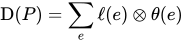
For any edge of a polyhedron , let be its length and let denote the dihedral angle of the two faces of that meet at , measured in radians and considered modulo rational multiples of . The Dehn invariant is then defined as where the sum is taken over all edges of the polyhedron .[4] It is a valuation.


Further information
[edit]In light of Dehn's theorem above, one might ask "which polyhedra are scissors-congruent"? Sydler (1965) showed that two polyhedra are scissors-congruent if and only if they have the same volume and the same Dehn invariant.[5] Børge Jessen later extended Sydler's results to four dimensions.[6] In 1990, Dupont and Sah provided a simpler proof of Sydler's result by reinterpreting it as a theorem about the homology of certain classical groups.[7]
Debrunner showed in 1980 that the Dehn invariant of any polyhedron with which all of three-dimensional space can be tiled periodically is zero.[8]
Jessen also posed the question of whether the analogue of Jessen's results remained true for spherical geometry and hyperbolic geometry. In these geometries, Dehn's method continues to work, and shows that when two polyhedra are scissors-congruent, their Dehn invariants are equal. However, it remains an open problem whether pairs of polyhedra with the same volume and the same Dehn invariant, in these geometries, are always scissors-congruent.[9]
Original question
[edit]Hilbert's original question was more complicated: given any two tetrahedra T1 and T2 with equal base area and equal height (and therefore equal volume), is it always possible to find a finite number of tetrahedra, so that when these tetrahedra are glued in some way to T1 and also glued to T2, the resulting polyhedra are scissors-congruent?
Dehn's invariant can be used to yield a negative answer also to this stronger question.
See also
[edit]References
[edit]- ^ Carl Friedrich Gauss: Werke, vol. 8, pp. 241 and 244
- ^ Dehn, Max (1901). "Ueber den Rauminhalt". Mathematische Annalen. 55 (3): 465–478. doi:10.1007/BF01448001. S2CID 120068465.
- ^ a b Ciesielska, Danuta; Ciesielski, Krzysztof (2018-05-29). "Equidecomposability of Polyhedra: A Solution of Hilbert's Third Problem in Kraków before ICM 1900". The Mathematical Intelligencer. 40 (2): 55–63. doi:10.1007/s00283-017-9748-4. ISSN 0343-6993.
- ^ a b Hazewinkel, M. (2001) [1994], "Dehn invariant", Encyclopedia of Mathematics, EMS Press
- ^ Sydler, J.-P. (1965). "Conditions nécessaires et suffisantes pour l'équivalence des polyèdres de l'espace euclidien à trois dimensions". Comment. Math. Helv. 40: 43–80. doi:10.1007/bf02564364. S2CID 123317371.
- ^ Jessen, Børge (1972). "Zur Algebra der Polytope". Nachrichten der Akademie der Wissenschaften zu Göttingen, Mathematisch-Physikalische Klasse, Fachgruppe II: Nachrichten aus der Physik, Astronomie, Geophysik, Technik: 47–53. MR 0353150. Zbl 0262.52004.
- ^ Dupont, Johan; Sah, Chih-Han (1990). "Homology of Euclidean groups of motions made discrete and Euclidean scissors congruences". Acta Math. 164 (1–2): 1–27. doi:10.1007/BF02392750.
- ^ Debrunner, Hans E. (1980). "Über Zerlegungsgleichheit von Pflasterpolyedern mit Würfeln". Arch. Math. 35 (6): 583–587. doi:10.1007/BF01235384. S2CID 121301319.
- ^ Dupont, Johan L. (2001), Scissors congruences, group homology and characteristic classes, Nankai Tracts in Mathematics, vol. 1, World Scientific Publishing Co., Inc., River Edge, NJ, p. 6, doi:10.1142/9789812810335, ISBN 978-981-02-4507-8, MR 1832859, archived from the original on 2016-04-29.
Further reading
[edit]- Benko, D. (2007). "A New Approach to Hilbert's Third Problem". The American Mathematical Monthly. 114 (8): 665–676. doi:10.1080/00029890.2007.11920458. S2CID 7213930.
- Schwartz, Rich (2010). "The Dehn–Sydler Theorem Explained" (PDF).
- Koji, Shiga; Toshikazu Sunada (2005). A Mathematical Gift, III: The Interplay Between Topology, Functions, Geometry, and Algebra. American Mathematical Society.
External links
[edit]
Hilbert's third problem
View on GrokipediaBackground
Hilbert's List of Problems
In 1900, at the Second International Congress of Mathematicians in Paris, German mathematician David Hilbert delivered an invited address titled "Mathematical Problems," in which he outlined 23 unsolved challenges intended to shape the direction of mathematical research for the 20th century.[4] During the lecture on August 8, Hilbert verbally presented 10 of these problems, with the complete list published in the proceedings shortly thereafter.[5] This presentation marked a pivotal moment, as Hilbert sought to identify key open questions that would drive progress across mathematics by focusing efforts on foundational and unresolved issues. The 23 problems encompassed a broad spectrum of mathematical domains, including number theory, algebra, geometry, analysis, and even connections to physics, serving as enduring benchmarks for innovation and rigor in the field.[6] For instance, Problem 1 addressed the continuum hypothesis and the well-ordering principle in set theory, while Problem 2 concerned the consistency of the axioms of arithmetic; the third focused on the scissors congruence of polyhedra in geometry.[7] Hilbert himself articulated the profound role of these problems in advancing mathematical discovery and rigor, declaring that "the investigator tests the temper of his steel" through their pursuit, thereby expanding methods and uncovering hidden truths.[5] He further emphasized that rigorous solutions to such challenges would simplify proofs and foster new theoretical frameworks, aligning with a "universal philosophical necessity" for precision in science.[5] Several of the 23 problems were resolved during Hilbert's lifetime (1862–1943), with the third resolved shortly after its proposal; the remainder continued to inspire generations of mathematicians well into the 20th century and beyond.[8]Polyhedra and Volume Equivalence
A polyhedron is a three-dimensional solid bounded by a finite number of flat polygonal faces, connected along straight edges and meeting at vertices.[9] In ancient geometry, Euclid's Elements (c. 300 BCE) provided foundational results on volumes of basic polyhedra, such as establishing in Book XII that pyramids with equal bases and equal heights have equal volumes, and deriving formulas for tetrahedra and other pyramidal solids through comparisons with prisms. Volume serves as a fundamental measure of the space enclosed by a polyhedron, remaining invariant under rigid motions such as translations and rotations, which preserve distances and orientations without altering the shape's intrinsic size.[10] By the late 19th century, it was established that in two dimensions, any two polygons of equal area could be dissected into finitely many polygonal pieces that reassemble via rigid motions to form the other, as proven independently by Farkas Bolyai in 1833 and Paul Gerwien in 1835 (building on William Wallace's 1807 formulation).[11] This result, known as the Bolyai-Gerwien theorem, suggested analogous questions about whether equal volumes in three dimensions would permit similar dissections of polyhedra.[12] Dissection in this context refers to partitioning a polyhedron into a finite number of smaller polyhedral pieces via planar cuts, such that these pieces can be rearranged using only rigid motions—translations, rotations, and reflections—to form another polyhedron of the same volume.[13] A representative example is the regular tetrahedron, the simplest polyhedron with four triangular faces; its volume is given by where is the 3×3 matrix whose columns are the coordinate vectors of three vertices relative to the fourth.[14]The Problem Statement
Original Formulation
Hilbert posed his third problem during his address at the Second International Congress of Mathematicians in Paris, focusing on the foundational aspects of geometric volume in three dimensions. In the lecture, he specifically questioned the provability of Euclid's theorem on the volumes of triangular pyramids (tetrahedra) without relying on the axiom of continuity or Archimedes' axiom. The exact statement reads: "In two letters to Gerling, Gauss expresses his regret that certain theorems of solid geometry depend upon the method of exhaustion, i.e. in modern phraseology, upon the axiom of continuity (or upon the axiom of Archimedes). Gauss mentions in particular the theorem of Euclid, that triangular pyramids of equal altitudes are to each other as their bases. Now the analogous problem in the plane has been solved. Gerling also succeeded in proving the equality of volume of symmetrical polyhedra by dividing them into congruent parts. Nevertheless, it seems to me probable that a general proof of this kind for the theorem of Euclid just mentioned is impossible, and it should be our task to give a rigorous proof of its impossibility. This would be obtained, as soon as we succeeded in specifying two tetrahedra of equal bases and equal altitudes which can in no way be split up into congruent tetrahedra, and which cannot be combined with congruent tetrahedra to form two polyhedra which themselves could be split up into congruent tetrahedra."[15] This formulation targets the scissors congruence of tetrahedra but extends to the broader question of whether any two polyhedra of equal volume are equidecomposable, meaning one can be dissected into finitely many polyhedral pieces that reassemble into the other via isometries. In Hilbert's context, the polyhedra are implicitly assumed to be convex to ensure well-defined dissections without topological complications, and the pieces are polyhedra themselves. Reassembly occurs through rigid motions—translations and rotations—excluding reflections to preserve orientation, though the original statement uses "congruent" which traditionally allows mirrors in some geometric contexts unless specified otherwise. Hilbert framed the problem as a test of whether three-dimensional scissors congruence follows the pattern established in two dimensions, where the Bolyai-Gerwien theorem affirms that any two polygons of equal area are equidecomposable by dissection and rigid reassembly.[15] His motivation stemmed from foundational concerns in geometry, echoing Gauss's concerns about the reliance on continuity axioms for volume proofs, aiming to determine if volume alone suffices as an invariant for equidecomposability in 3D without such axioms.[15] The problem was presented on August 8, 1900, as part of Hilbert's list of 23 challenges, and was regarded as relatively accessible compared to more abstract entries, given its concrete geometric nature and ties to classical Euclidean results.[16]Relation to Scissors Congruence
Scissors congruence provides a formal framework for understanding Hilbert's third problem, generalizing the notion of dissection and reassembly in three-dimensional space. Two polyhedra and in Euclidean 3-space are said to be scissors congruent, denoted , if can be dissected into a finite number of polyhedral pieces that can be rigidly moved via isometries (rotations and translations) and reassembled to form .[13] This relation captures the intuitive idea of cutting and rearranging shapes without stretching or overlapping, preserving the geometric structure through congruence of the pieces.[17] Hilbert's third problem specifically inquires whether equal volume is sufficient for scissors congruence among polyhedra in 3D, posing the question of whether implies .[13] In contrast, this equivalence holds in two dimensions: by the Wallace–Bolyai–Gerwien theorem, any two polygons of equal area are scissors congruent via finite dissections into congruent pieces.[17] Thus, volume (or area) serves as a necessary condition for scissors congruence in any dimension, as the operation preserves measure, but the problem highlights whether it is also sufficient in three dimensions.[13] The relation is an equivalence relation on the set of polyhedra, being reflexive (a polyhedron is congruent to itself without dissection), symmetric (reassembly reverses the process), and transitive (composing dissections of intermediate forms).[17] However, equal volume is only a necessary condition for in 3D, not sufficient, as demonstrated by later counterexamples, underscoring the need for further geometric invariants to classify polyhedra up to this equivalence.[13] Hilbert's formulation thus emphasizes the quest for such invariants beyond mere volume to resolve the scissors congruence question.[17]Historical Context
Pre-Hilbert Developments
In the early 19th century, mathematicians advanced the study of geometric dissections primarily in the plane, laying groundwork for later three-dimensional inquiries. The Wallace–Bolyai–Gerwien theorem, developed between the 1830s and 1860s, establishes that any two simple polygons of equal area are equidissectable: they can be cut into a finite number of polygonal pieces that reassemble via rigid motions to form the other polygon. This result was independently proved by Paul Gerwien in 1833, building on unpublished work by William Wallace from around 1807 and Farkas Bolyai's formulation in 1831, which emphasized decomposition into triangles of equal area before rearrangement into squares.[18] The theorem highlighted the sufficiency of area as an invariant for planar equivalence but left open whether volume played an analogous role in three dimensions.[19] By the late 19th century, the extension to polyhedra sparked debate, with no general proof that equal-volume solids could be dissected into each other, yet no counterexamples identified before 1900. In the 1890s, foundational discussions in geometry questioned whether volume alone guaranteed such equivalence in 3D, mirroring planar successes but complicated by the rigidity of spatial figures.[20] These debates were influenced by efforts to compute polyhedral volumes precisely, which underscored the need for rigorous volume invariants beyond simple formulas.[21] Hilbert's student Max Dehn, who studied under him at Göttingen, encountered these issues through Hilbert's lectures on geometric foundations.[22] David Hilbert's Grundlagen der Geometrie (1899) addressed these concerns by introducing a complete axiomatic system for Euclidean geometry, with axioms of congruence that formalized equivalence relations essential for dissection arguments.[23] This rigor exposed gaps in prior notions of spatial equivalence, where intuitive volume equality had not been tied to finite decompositions. Specific cases illustrated the challenge: in 1896, M. J. M. Hill showed that certain irregular tetrahedra could be dissected into cubes of equal volume using finite polyhedral pieces, but such results were limited to particular shapes and did not generalize to arbitrary polyhedra. These pre-Hilbert developments thus revealed the theorem's planar power while underscoring unresolved limitations in higher dimensions.[24]Hilbert's Motivation at the 1900 Congress
The Second International Congress of Mathematicians took place in Paris from August 6 to 11, 1900, providing a platform for leading mathematicians to discuss advancements and future directions in the field. On August 8, David Hilbert delivered his seminal address titled "Mathematical Problems," in which he outlined 23 open questions intended to stimulate research and unify mathematical efforts over the coming century. By presenting these problems, Hilbert aimed to highlight vital areas of inquiry, emphasizing their role in fostering progress and resolving foundational uncertainties in mathematics.[5][25] Hilbert's selection of the third problem was deeply rooted in his ongoing work on the foundations of geometry, particularly following the publication of his Grundlagen der Geometrie in 1899, which axiomatized Euclidean plane geometry without relying on continuity assumptions. Drawing from correspondence by Carl Friedrich Gauss expressing dissatisfaction with the method of exhaustion in proofs of solid geometry theorems—such as Euclid's result that tetrahedra with equal bases and heights have equal volumes—Hilbert sought invariants for three-dimensional geometric equivalences analogous to those in algebraic invariant theory, a field to which he had contributed significantly earlier in his career. He viewed the question of whether two such tetrahedra could always be dissected into finitely many congruent polyhedra as a rigorous test of geometric principles, especially since the two-dimensional analogue for polygons of equal area had been affirmatively resolved through dissections, as shown by results like the Bolyai-Gerwien theorem. Although influenced by these planar successes, Hilbert conjectured a negative outcome for the three-dimensional case, placing the problem third in his list due to its seemingly tractable nature for establishing such impossibility.[5][3] Following the congress, Hilbert's student Max Dehn provided a negative solution in 1901 by constructing two polyhedra of equal volume that were not scissors congruent, confirming Hilbert's conjecture far more swiftly than anticipated. This outcome exemplified Hilbert's broader philosophical stance, articulated in his address, that precisely formulated problems serve as the primary drivers of mathematical advancement—much like his sixth problem, which called for the axiomatization of physical theories to parallel the rigor of pure mathematics.[3][5]Dehn's Solution
Introduction to the Dehn Invariant
The Dehn invariant serves as a crucial geometric measure that captures properties of polyhedra beyond their volume, addressing the limitations of volume additivity in dissections. While volume is preserved under scissors congruence—meaning that polyhedra can be dissected into finitely many pieces that reassemble without gaps or overlaps—the dihedral angles along edges may not align in the same way during reassembly, potentially leading to incongruent configurations despite equal volumes. This discrepancy motivated the development of an angle-sensitive invariant to distinguish polyhedra that are not scissors congruent, even when their volumes match.[26] Introduced by Max Dehn in 1900, shortly after David Hilbert posed his third problem at the International Congress of Mathematicians, the Dehn invariant provides a tool to resolve whether all equal-volume polyhedra are scissors congruent. At age 23 and as Hilbert's doctoral student, Dehn formulated this invariant in his paper "Über raumgleiche Polyeder," demonstrating its role in disproving the conjecture for certain cases like tetrahedra and cubes. The invariant operates in the tensor product space , where real numbers represent lengths and the quotient accounts for angles modulo rational multiples of .[27][28] Formally, for a polyhedron , the Dehn invariant is defined as the sum over all edges of the tensor product of the edge length and the dihedral angle : where is measured in radians. This construction ensures additivity over dissections, making invariant under scissors congruence operations. For example, polyhedra such as cubes have , as their dihedral angles are rational multiples of , which lie in and thus vanish in the quotient structure; however, the invariant is not determined solely by volume, allowing it to detect non-equivalence in other polyhedra.[26][29]Proof that Tetrahedra Are Not Scissors Congruent
To demonstrate that not all polyhedra of equal volume are scissors congruent, Max Dehn constructed an explicit counterexample using a regular tetrahedron and a cube , both of volume 1.[29] These polyhedra have the same volume but differ in their Dehn invariants, which must be preserved under scissors congruence.[30] For the cube with edge length (ensuring volume 1), all twelve edges have length , and all dihedral angles are . The Dehn invariant is thus . Since , this term vanishes in the quotient space , yielding .[31] In contrast, the regular tetrahedron with volume 1 has six edges, all sharing the same dihedral angle . The Dehn invariant simplifies to , where is the edge length. Since is irrational, , so this tensor does not vanish.[32][31] Assume for contradiction that and are scissors congruent. Then their Dehn invariants must be equal: . However, the non-vanishing arises from the linear independence over of and , implying . This contradiction proves that no finite dissection of can be reassembled into , or vice versa.[30] Dehn presented this argument in his 1900 paper "Über raumgleiche Polyeder."[29]Implications and Extensions
Role in Invariant Theory
Dehn's solution to Hilbert's third problem introduced a novel geometric invariant that played a pivotal role in advancing invariant theory within mathematics, particularly by demonstrating the necessity of additional measures beyond volume for equivalence under dissection. This work aligned with Hilbert's broader vision in his sixth problem, which called for an axiomatic treatment of physical sciences using mathematical structures, including invariants derived from geometric foundations.[5] Dehn's invariant served as an early exemplar of how such geometric tools could provide rigorous, non-trivial distinctions in axiomatic geometry, influencing the quest for complete axiomatizations in related fields.[33] The Dehn invariant's construction, involving sums over edge lengths tensored with dihedral angles modulo π, exemplified a tensor product structure that modeled angle-based obstructions to congruence: specifically, elements in the vector space . This algebraic formulation not only resolved the specific counterexample of a regular tetrahedron and cube of equal volume being non-scissors-congruent but also highlighted the interplay between linear algebra and geometry in invariant design.[34] Such structures underscored the shift from classical Euclidean geometry toward more abstract frameworks, where invariants captured symmetries and obstructions in a manner amenable to group-theoretic analysis. Dehn's approach inspired subsequent generalizations to topology, where the invariant was extended to higher dimensions and manifolds, notably through Sydler's 1965 theorem establishing that volume and the Dehn invariant fully classify scissors congruence for Euclidean polyhedra in three dimensions. This work paved the way for further topological applications, linking scissors congruence to manifold decompositions and embedding problems. In the 1970s and 1980s, mathematicians, building on Dehn's ideas, formalized scissors congruence as abelian groups, studying their structure to classify equivalence classes under dissection.[33] More broadly, Dehn's invariant contributed to the evolution of invariant theory by bridging geometric dissection problems with algebraic and topological tools, including connections to Lie groups via representations of motion groups and their homology. This integration facilitated a deeper understanding of how discrete decompositions relate to continuous symmetries, influencing developments in representation theory and geometric group theory.[35]Modern Developments in Geometric Measure Theory
In 1965, Jean-Pierre Sydler established a landmark result in three-dimensional Euclidean space, proving that two polyhedra are scissors congruent if and only if they have the same volume and the same Dehn invariant.[36] This theorem provided an affirmative resolution to the broader question of scissors congruence beyond Hilbert's original focus on tetrahedra, confirming that these two invariants suffice to classify all such equivalences in .[37] In higher dimensions, the situation becomes more complex, requiring additional invariants beyond volume and the Dehn invariant to determine scissors congruence. Early work in the 1930s highlighted the need for extended invariants, and this was further developed in the 1980s by John Dupont and Chih-Han Sah, who constructed analogs of the Dehn invariant using group homology and characteristic classes to address polyhedral decompositions in for .[34] Their framework revealed that the scissors congruence groups in higher dimensions involve richer algebraic structures, such as twisted homology, leading to a hierarchy of obstructions not present in three dimensions.[38] Applications of scissors congruence have extended to non-Euclidean settings, particularly hyperbolic geometry and Riemannian manifolds, where volume and Dehn-like invariants play a key role in classifying decompositions. In hyperbolic space , scissors congruence classes are associated with fundamental domains of discrete groups, enabling the computation of hyperbolic volumes for 3-manifolds and linking to broader questions in low-dimensional topology.[10] These developments contribute to understanding volume spectra and asymptotic behaviors in manifolds, aligning with aspects of Hilbert's 18th problem concerning the distribution of geometric invariants on curved spaces.[39] Recent advancements in the 2020s have incorporated computational methods to verify Dehn invariants for specific polyhedra and manifolds, leveraging algebraic topology software to enumerate families of tetrahedra with zero Dehn invariant and test scissors congruence hypotheses.[40] Such tools facilitate large-scale checks of invariant equalities, providing empirical support for theoretical classifications in both Euclidean and hyperbolic contexts.[41] In 2024 and 2025, further progress has connected scissors congruence to algebraic K-theory, including the introduction of K-theory spectra for equivariant manifolds and explicit trace maps from higher scissors congruence groups to group homology, as explored in recent papers and conferences.[42][43] An important extension arises in non-scissors decompositions, exemplified by the Banach-Tarski paradox of 1924, which demonstrates paradoxical finite-piece equivalences using non-measurable sets under rotations, contrasting sharply with the measurable, polyhedral restrictions of scissors congruence.[44] This highlights the role of the Axiom of Choice in enabling decompositions that evade volume preservation, offering a counterpoint to the invariant-controlled equivalences in geometric measure theory.[45]References
- https://proofwiki.org/wiki/Wallace-Bolyai-Gerwien_Theorem