Hubbry Logo
Beat (music)Beat (music)Main
Open search
Beat (music)
Community hub
Beat (music)
logo
8 pages, 0 posts
0 subscribers
Be the first to start a discussion here.
Beat (music)
Beat (music)
from Wikipedia
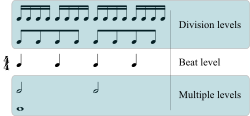
Metric levels: beat level shown in middle with division levels above and multiple levels below.

In music and music theory, the beat is the basic unit of time, the pulse (regularly repeating event), of the mensural level[1] (or beat level).[2] The beat is often defined as the rhythm listeners would tap their toes to when listening to a piece of music, or the numbers a musician counts while performing, though in practice this may be technically incorrect (often the first multiple level).[clarification needed] In popular use, beat can refer to a variety of related concepts, including pulse, tempo, meter, specific rhythms, and groove.

Rhythm in music is characterized by a repeating sequence of stressed and unstressed beats (often called "strong" and "weak") and divided into bars organized by time signature and tempo indications.

Beats are related to and distinguished from pulse, rhythm (grouping), and meter:

Meter is the measurement of the number of pulses between more or less regularly recurring accents. Therefore, in order for meter to exist, some of the pulses in a series must be accented—marked for consciousness—relative to others. When pulses are thus counted within a metric context, they are referred to as beats.

— Leonard B. Meyer and Cooper (1960)[3]

Metric levels faster than the beat level are division levels, and slower levels are multiple levels. Beat has always been an important part of music. Some music genres such as funk will in general de-emphasize the beat, while other such as disco emphasize the beat to accompany dance.[4]

Division

[edit]

As beats are combined to form measures, each beat is divided into parts. The nature of this combination and division is what determines meter. Music where two beats are combined is in duple meter, music where three beats are combined is in triple meter. Music where the beat is split in two are in simple meter, music where the beat is split in three are called compound meter. Thus, simple duple (2
4
, 4
4
, etc.), simple triple (3
4
), compound duple (6
8
), and compound triple (9
8
). Divisions which require numbers, tuplets (for example, dividing a quarter note into five equal parts), are irregular divisions and subdivisions. Subdivision begins two levels below the beat level: starting with a quarter note or a dotted quarter note, subdivision begins when the note is divided into sixteenth notes.

Downbeat and upbeat

[edit]
Beginning of Bach's BWV 736, with upbeat (anacrusis) in red. Play

The downbeat is the first beat of the bar, i.e. number 1. The upbeat is the last beat in the previous bar which immediately precedes, and hence anticipates, the downbeat.[5] Both terms correspond to the direction taken by the hand of a conductor.

This idea of directionality of beats is significant when you translate its effect on music. The crusis of a measure or a phrase is a beginning; it propels sound and energy forward, so the sound needs to lift and have forward motion to create a sense of direction. The anacrusis leads to the crusis, but doesn't have the same 'explosion' of sound; it serves as a preparation for the crusis.[6]

An anticipatory note or succession of notes occurring before the first barline of a piece is sometimes referred to as an upbeat figure, section or phrase. Alternative expressions include "pickup" and "anacrusis" (the latter ultimately from Greek ana ["up towards"] and krousis ["strike"/"impact"] through French anacrouse). In English, anákrousis translates literally as "pushing up". The term anacrusis was borrowed from the field of poetry, in which it refers to one or more unstressed extrametrical syllables at the beginning of a line.[5]

On-beat and off-beat

[edit]
\version "2.22.0"
\header { tagline = ##f}
\score {
  \drums \with {midiInstrument = "drums"}
  \with { \numericTimeSignature }
  {
    \repeat volta 2 {\stemUp
      r4 sne8 sne8 r4 sne r4 sne8 sne8 r4 sne \break
    }
  }
  \layout {}
}

\score {
  \unfoldRepeats {
    \drums \with {midiInstrument = "drums"}{
      \repeat volta 2 {
        r4 sne8 sne8 r4 sne r4 sne8 sne8 r4 sne
      }
    }
  }
  \midi { \tempo  4 = 100 }
}
Off-beat or backbeat pattern, popular on snare drum[7]
"Skank" guitar rhythm[8]Play. Often referred to as "upbeats", in parallel with upstrokes.

In typical Western music 4
4
time
, counted as "1 2 3 4, 1 2 3 4...", the first beat of the bar (downbeat) is usually the strongest accent in the melody and the likeliest place for a chord change, the third is the next strongest: these are "on" beats. The second and fourth are weaker—the "off-beats". Subdivisions (like eighth notes) that fall between the pulse beats are even weaker and these, if used frequently in a rhythm, can also make it "off-beat".[9]

The effect can be easily simulated by evenly and repeatedly counting to four. As a background against which to compare these various rhythms a bass drum strike on the downbeat and a constant eighth note subdivision on ride cymbal have been added, which would be counted as follows (bold denotes a stressed beat):

But one may syncopate that pattern and alternately stress the odd and even beats, respectively:

  • 1 2 3 4 1 2 3 4 — the stress on the "unexpected", or syncopated, beat play

So "off-beat" is a musical term, commonly applied to syncopation, that emphasizes the weak even beats of a bar, as opposed to the usual on-beat. This is a fundamental technique of African polyrhythm that transferred to popular western music. According to Grove Music, the "Offbeat is [often] where the downbeat is replaced by a rest or is tied over from the preceding bar".[9] The downbeat can never be the off-beat because it is the strongest beat in 4
4
time.[10] Certain genres tend to emphasize the off-beat, where this is a defining characteristic of rock'n'roll and ska music.

Backbeat

[edit]
Back beat[11][12] Play
"It's got a backbeat, you can't lose it" – Chuck Berry, "Rock and Roll Music"

A back beat, or backbeat, is a syncopated accentuation on the "off" beat. In a simple 4
4
rhythm these are beats 2 and 4.[13]

"A big part of R&B's attraction had to do with the stompin' backbeats that make it so eminently danceable," according to the Encyclopedia of Percussion.[14] An early record with an emphasised back beat throughout was "Good Rockin' Tonight" by Wynonie Harris in 1948.[15] Although drummer Earl Palmer claimed the honor for "The Fat Man" by Fats Domino in 1949, which he played on, saying he adopted it from the final "shout" or "out" chorus common in Dixieland jazz. There is a hand-clapping back beat on "Roll 'Em Pete" by Pete Johnson and Big Joe Turner, recorded in 1938. A distinctive back beat can be heard on "Back Beat Boogie" by Harry James And His Orchestra, recorded in late 1939.[16] Other early recorded examples include the final verse of "Grand Slam" by Benny Goodman in 1942 and some sections of The Glenn Miller Orchestra's "(I've Got A Gal In) Kalamazoo", while amateur direct-to-disc recordings of Charlie Christian jamming at Minton's Playhouse around the same time have a sustained snare-drum backbeat on the hottest choruses.

Outside U.S. popular music, there are early recordings of music with a distinctive backbeat, such as the 1949 recording of Mangaratiba by Luiz Gonzaga in Brazil.[17]
\version "2.22.0"
\header { tagline = ##f}
\score {
  \drums \with {midiInstrument = "drums"}
  \with { \numericTimeSignature }
  {
    \repeat volta 2 {
       \stemUp
      <cymra bd>8 cymra <cymra sne>^> cymra <cymra bd> <cymra bd> cymra <cymra sne>^>\break
    }
  }
  \layout {}
}

\score {
  \unfoldRepeats {
    \drums \with {midiInstrument = "drums"}{
      \repeat volta 2 {
        \stemUp
      <cymra bd>8 cymra <cymra sne>^> cymra <cymra bd> <cymra bd> cymra <cymra sne>^>\break
      }
    }
  }
  \midi { \tempo  4 = 120 }
}
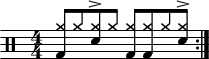
Delayed backbeat (last eighth note in each measure) as in funk music[18]

Slap bass executions on the backbeat are found in styles of country western music of the 1930s, and the late 1940s early 1950s music of Hank Williams reflected a return to strong backbeat accentuation as part of the honky tonk style of country.[19] In the mid-1940s "hillbilly" musicians the Delmore Brothers were turning out boogie tunes with a hard driving back beat, such as the No. 2 hit "Freight Train Boogie" in 1946, as well as in other boogie songs they recorded.[citation needed] Similarly Fred Maddox's characteristic backbeat, a slapping bass style, helped drive a rhythm that came to be known as rockabilly, one of the early forms of rock and roll.[20] Maddox had used this style as early as 1937.[21]

In today's popular music the snare drum is typically used to play the backbeat pattern.[7] Early funk music often delayed one of the backbeats by an eighth note so as "to give a 'kick' to the [overall] beat".[18]

Some songs, such as The Beatles' "Please Please Me" and "I Want to Hold Your Hand", The Knack's "Good Girls Don't" and Blondie's cover of The Nerves' "Hanging on the Telephone", employ a double backbeat pattern.[22] In a double backbeat, one of the off beats is played as two eighth notes rather than one quarter note.[22]

Some drummers slightly delay the backbeat on the snare drum to create a more relaxed feel, a technique known as the "delayed" or "late backbeat." In such cases, the intervals between beats 2 and 3, and between beats 4 and 1, are slightly shortened to prevent the tempo from slowing down. This playing style is particularly common in rock and soul music from the late 1960s to the mid-1970s.[23] Notable examples can be heard in recordings such as "Green Onions" by Booker T. & the M.G.'s, "And Your Bird Can Sing" by The Beatles, "Hey Joe" by The Jimi Hendrix Experience, and "Easy" by The Commodores. Drummer Charlie Watts of The Rolling Stones frequently employed this technique during this period, as heard in tracks like "Monkey Man," "Wild Horses," "Sister Morphine," and "Let It Bleed."[24] A delayed backbeat can also be heard in the famous eight-bar "Funky Drummer" break, played by Clyde Stubblefield.[25] Early backbeats can be heard in Bruce Springsteen's "The River," The Police's "Every Breath You Take," and D'Angelo's "The Line."[26]

Cross-beat

[edit]

Cross-rhythm. A rhythm in which the regular pattern of accents of the prevailing meter is contradicted by a conflicting pattern and not merely a momentary displacement that leaves the prevailing meter fundamentally unchallenged

New Harvard Dictionary of Music (1986: 216).[27][28]

Hyperbeat

[edit]
Hypermeter: 4 beat measure, 4 measure hypermeasure, and 4 hypermeasure verses. Hyperbeats in red.

A hyperbeat is one unit of hypermeter, generally a measure. "Hypermeter is meter, with all its inherent characteristics, at the level where measures act as beats."[28][29]

Beat perception

[edit]

Beat perception refers to the human ability to extract a periodic time structure from a piece of music.[30][31] This ability is evident in the way people instinctively move their body in time to a musical beat, made possible by a form of sensorimotor synchronization called 'beat-based timing'. This involves identifying the beat of a piece of music and timing the frequency of movements to match it.[32][33][34] Infants across cultures display a rhythmic motor response but it is not until between the ages of 2 years 6 months and 4 years 6 months that they are able to match their movements to the beat of an auditory stimulus.[35][36]

[edit]
  • Tatum refers to a subdivision of a beat which represents the "time division that most highly coincides with note onsets".[37]
  • Afterbeat refers to a percussion style where a strong accent is sounded on the second, third and fourth beats of the bar, following the downbeat.[13]
  • In reggae music, the term one drop refers to the complete de-emphasis (to the point of silence) of the first beat in the cycle.
  • James Brown's signature funk groove emphasized the downbeat – that is, with heavy emphasis "on the one" (the first beat of every measure) – to etch his distinctive sound, rather than the back beat (familiar to many R&B musicians) which places the emphasis on the second beat.[38][39][40]

See also

[edit]

References

[edit]

Further reading

[edit]
Revisions and contributorsEdit on WikipediaRead on Wikipedia
from Grokipedia
In music, a beat is the basic , defined as a regular, recurring that underlies the of a composition and serves as the steady temporal foundation for musical events. This is what listeners often perceive physically, prompting instinctive responses such as tapping a foot or hands, distinguishing it from the more complex patterns of that organize sounds and silences against this backdrop. Beats are structured into groups called measures or bars through the concept of meter, which establishes a recurring of strong and weak pulses, as denoted by the —a fractional notation at the start of a musical score indicating the number of beats per measure and the that receives . For instance, in common time (4/4), there are four beats per measure, with the equaling , creating a balanced framework for Western tonal music. The rate at which beats occur defines the , quantified in beats per minute (BPM); a moderate might be 120 BPM, equivalent to two beats per second, influencing the overall pace and feel of the music. In performance and notation, beats are emphasized differently: the downbeat, the first beat of a measure, receives the strongest accent and is typically conducted with a downward gesture, while subsequent beats, such as upbeats, are lighter and build anticipation toward the next downbeat. This organization enables synchronization among performers and is essential across genres, from classical symphonies to contemporary electronic music, where beats drive propulsion and groove. Although the term "beat" can also denote a specific duration (e.g., a note lasting two beats) or, in modern contexts like hip-hop production, an entire instrumental track built around rhythmic pulses, its core role remains as the indispensable pulse shaping musical time.

Fundamentals

Definition

In music theory, a beat is defined as the basic , consisting of a regular, recurring that provides the underlying structure for musical . This serves as the foundational element against which musical events are organized, enabling performers and listeners to perceive and synchronize with the temporal flow of a composition. Beats exhibit key properties that distinguish them as essential components of musical organization: they are typically isochronous, meaning the intervals between successive beats are equal in duration, akin to the steady ticking of a . These pulses may be explicitly audible through percussive or accented sounds, or implied through the overall temporal framework of the music, and they form the basis for both meter—which groups beats into measures—and , measured in beats per minute. While beats establish this steady pulse, they differ fundamentally from rhythm, which refers to the varied patterns of note durations, accents, and silences that occur across multiple beats. In essence, the beat provides the consistent temporal grid, whereas rhythm articulates the expressive and dynamic organization of sounds within that grid. The term "beat" originates etymologically from the Old English beatan, meaning "to strike repeatedly," reflecting its historical association with the physical act of marking time through gestures or percussion. This concept evolved in Western music theory from earlier Renaissance notions of tactus—a steady, hand-conducted pulse—and gained prominence in the 18th century, as seen in Johann Mattheson's Der vollkommene Capellmeister (1739), where he described beat patterns for conducting different meters, classifying them based on even or uneven divisions to guide ensemble performance.

Metrical Division

In music theory, metrical division refers to the organization of beats into hierarchical units, primarily through measures (or bars), which provide the foundational structure for rhythmic patterns. Beats, as the primary pulse, are grouped into measures according to a time signature, a notational device consisting of two numbers: the top indicating the number of beats per measure and the bottom specifying the note value that receives one beat. For instance, in 4/4 time—common in much Western music—a measure contains four quarter-note beats, creating a balanced framework for composing and performing rhythms. This division ensures that musical events align consistently, facilitating both composition and execution. The metrical positions beats at the core level, where they serve as the tactile experienced by listeners and performers. Below the beat, subdivisions known as microbeats emerge, such as eighth in simple meters, which divide each beat into two equal parts for finer rhythmic detail. Above the beat, measures aggregate into larger units called hypermeasures or hyperbeats, typically grouping four measures into a hypermeasure to form phrase-level structures, enhancing the music's architectural coherence. This layered hierarchy—from microbeats through beats to hyperbeats—allows rhythms to nest within broader temporal frameworks, promoting perceptual organization and structural clarity in performances. Time signatures further delineate metrical division into simple and types, based on how beats subdivide. Simple time signatures feature beats that divide evenly into two parts (binary division), resulting in duple, triple, or quadruple meters; examples include 2/4 (two quarter-note beats per measure, often used in marches), 3/4 (three quarter-note beats, typical in ), and 4/4 (four quarter-note beats, versatile across genres). In contrast, time signatures involve beats that divide into three parts (ternary division), with the beat often represented by a ; for example, 6/8 time organizes six eighth notes into two dotted-quarter-note beats per measure, evoking a flow as in some folk dances. These distinctions influence the feel and grouping of beats, with simple meters emphasizing even pulses and meters introducing a grouped, swinging quality. In ensemble conducting, metrical divisions play a crucial role in synchronizing performers by providing clear cues for beat groupings and subdivisions, enabling the conductor's gestures—such as baton patterns tracing measure boundaries—to align the group's internal clocks. This relies on shared metric frameworks, where strong beats within measures guide collective timing and prevent drift during extended pieces. Conductors often emphasize measure divisions through preparatory beats or subdivided patterns, ensuring precise execution across instruments.

Primary Accent Patterns

Downbeat and Upbeat

In music theory, the downbeat refers to the first beat of a measure, which carries the strongest accent and establishes the primary within the metrical framework. This beat is typically emphasized through dynamic stress, harmonic changes, and conducting gestures, such as a downward motion of the baton, signaling the onset of the measure and providing a sense of resolution and structural stability. Harmonic progressions often align with the downbeat to reinforce tonal orientation, as stable chord functions like the tonic are commonly placed there to anchor the listener's perception of key and phrasing. The upbeat, in contrast, denotes the weak beat or beats immediately preceding the downbeat, often within the final position of the prior measure or as an introductory . Known as an when initiating a or section, the upbeat functions to build anticipatory tension, propelling the music forward toward the resolving downbeat and creating a preparatory lift in phrasing. This creates a dynamic contrast: while the downbeat offers closure and grounded stability, the upbeat introduces forward momentum and instability, enhancing the overall metric orientation. In musical notation, the upbeat is commonly represented by an incomplete measure at the beginning of a score or , where the bar line follows the preparatory notes rather than preceding them, ensuring the aligns properly with the full measure structure. This notational convention impacts phrasing by visually and aurally emphasizing the as a lead-in, allowing performers to shape the tension-release arc effectively. A classic example appears in the opening of Beethoven's No. 5 in C minor, Op. 67, where the iconic four-note motif serves as an , heightening dramatic tension before resolving on the ensuing .

On-beat and Off-beat

In music theory, the on-beat refers to rhythmic events or accents that align precisely with the primary of the beat, establishing a of stability and forward momentum in the overall . This alignment reinforces the metric structure, often coinciding with strong beats like the to provide predictability and drive, allowing listeners to easily follow the temporal framework. In contrast, the off-beat involves placing accents or events on subdivisions between the main beats, typically creating by emphasizing weaker metric positions. In 4/4 time, off-beats commonly occur on the "and" counts—such as after each (e.g., 1-and, 2-and, 3-and, 4-and)—shifting emphasis to the second half of the beat and interrupting the expected . This placement generates rhythmic tension through deviation from the established on-beat pattern. The effects of on-beat and off-beat placements differ markedly in their perceptual impact: on-beat rhythms contribute to a steady, propulsive feel that supports harmonic and melodic development, while off-beat introduces groove, surprise, and dynamic energy, often enhancing listener engagement. For instance, acoustic examples like handclaps or snare hits on off-beats in rhythmic patterns can create a lively, propellent "snap" that contrasts the foundational stability of on-beat elements. With roots in earlier polyphonic practices, off-beat syncopation became a deliberate rhythmic device in 18th-century Western music, applied in classical compositions to add expressive variety. It gained prominence in jazz during the early 20th century, where the characteristic swing feel is commonly associated with microtiming deviations on off-beats—such as slight delays—creating a relaxed yet energetic groove through uneven eighth-note divisions.

Rhythmic Emphases

Backbeat

The backbeat is a rhythmic pattern characterized by strong accents on the second and fourth beats of a 4/4 measure, typically produced by the snare drum, rim shots, or equivalent percussive elements like guitar strums or handclaps. This emphasis on the off-beats creates a syncopated contrast to the downbeats, forming a foundational element of groove in even-metered music. Its origins lie in nineteenth- and early twentieth-century African American musical practices, including , work songs, and , where percussive accents on weaker beats fostered communal participation and resistance to social constraints. Elements of the backbeat appeared in swing-era and during the late , though the heavy snare emphasis became more prominent in subsequent R&B and rock styles. The pattern gained widespread prominence in the through rock 'n' roll, where artists like integrated it into high-energy tracks, blending R&B propulsion with influences to captivate audiences. Acoustically, the backbeat generates forward propulsion by introducing rhythmic tension on , which resolves into a compelling sense of motion and bodily entrainment, often amplified in production through crisp, resonant snare tones or layered claps. In Chuck Berry's "Johnny B. Goode" (1958), for instance, the snare accents on beats 2 and 4 underpin the song's galloping guitar and narrative drive, creating an irresistible momentum that exemplifies the backbeat's role in dynamics. This technique not only anchors the meter but also enhances emotional intensity, making it a staple in dance-oriented genres. Variations of the backbeat adapt to stylistic needs; in funk, additional syncopated hits on subdivisions can heighten the groove, though many funk styles, including those pioneered by James Brown in the 1960s, shifted emphasis to the downbeat for a more linear, propulsive feel.

Cross-beat

In music, a cross-beat involves the simultaneous layering of accents on pulses from contrasting subdivisions of the beat, producing rhythmic tension through conflicting metric feels within a single underlying meter. This phenomenon typically manifests as polyrhythmic overlays where one instrument or voice emphasizes a different pulse stream from another, without shifting the overall time signature. A classic instance is the 3:2 cross-beat, in which three even pulses are superimposed against two, creating an interplay where triplet-like groupings clash with duple divisions of the beat. Cross-beats emerge prominently in percussion-based traditions, particularly through ensemble interplay in West African drumming. For example, in Ewe dance-drumming genres like Agbekor, the foundational bell pattern establishes a duple metric framework divided into 12 pulses (often notated in 12/8), which supporting claps and drums overlay with triple subdivisions, accenting every third pulse to form the 3:2 ratio. This mathematical relation—three pulses resolving against two—arises from the deliberate contrast between the bell's steady, referential timeline and the improvisatory or supportive parts that "cross" its beats, fostering a sense of forward propulsion and groove. The mechanism relies on performers internalizing multiple pulse layers simultaneously, with the bell serving as a constant anchor to maintain cohesion amid the dissonance. Representative examples appear in West African timelines adapted to various genres, such as the sikyi bell pattern in Ghanaian music, where the repeating 3+3+2+2+2 configuration (in a 12-pulse cycle) implies the 3:2 cross-beat against duple drum strokes, driving the danceable energy of the style. This pattern, derived from Akan drumming traditions, highlights how cross-beats integrate metrical divisions like eighth-note and triplet groupings to build layered textures. The tension of a cross-beat functions as temporary metric dissonance, resolving to unity when the conflicting pulses synchronize—after six subdivisions in a 3:2 configuration, aligning all accents with the base meter. This resolution reinforces the ensemble's shared , allowing to explore the overlay before returning to consensus, thus preserving rhythmic stability.

Extended Structures

Hyperbeat

In music , a hyperbeat refers to a at a higher metric level that encompasses multiple lower-level beats, functioning as a structural unit in the metric hierarchy. Typically equivalent to one notated measure, a hyperbeat organizes smaller beats—such as s in simple meter or dotted quarters in compound meter—into a cohesive group that listeners perceive as a single, emphasized . For instance, in 12/8 time, the dotted serves as the primary beat, with four such beats forming the hyperbeat of the measure, creating a compound quadruple structure that emphasizes larger pulses over the underlying eighth-note subdivisions. Hyperbeats integrate into broader metric hierarchies by aggregating measures into hypermeasures, often in groups of four, which in turn build hypermeters spanning phrases or sections. This upward layering emerges in additive rhythms, where irregular groupings (e.g., 3+2+3 measures) form hyperbeats that propel large-scale forms like symphonic movements, providing a framework for thematic development and cadential closure. In such contexts, hyperbeats reinforce the metrical division at foundational levels while enabling perceptual grouping of metrical units into extended pulses, as seen in classical works where structures align with hypermetric downbeats to enhance formal coherence. Examples of hyperbeats appear in conducting patterns for triple meters like 3/2 time, where the acts as the primary beat, and the full measure becomes the hyperbeat, conducted with a triangular gesture emphasizing the and two subordinate pulses to maintain ensemble alignment. In , hyperbeats facilitate complex structures; for example, bands like employ hypermetric shifts in songs such as "21st Century Schizoid Man," where irregular measure groupings create perceived larger pulses that mimic symphonic hierarchy amid shifting tempos. Notation challenges arise because hyperbeats are primarily perceptual rather than explicitly notated, often leading to ambiguities where hypermetric irregularities—such as elided or expanded measures—might be misinterpreted as tempo fluctuations. Composers address this by aligning phrase endings with strong hyperbeats or using dynamic accents to clarify , but without such cues, performers may adjust pacing erroneously, conflating metric expansion with ritardando or .

Polyrhythmic Beats

Polyrhythmic beats occur when two or more independent rhythmic layers, each with its own consistent and subdivision, unfold simultaneously within the same temporal framework, resulting in overlapping and contrasting metric structures. Unlike simpler forms such as cross-beats, which operate within a single overarching meter, s allow for full independence between layers, often derived from different time signatures like 4 against 3, where one part divides the duration into four equal beats while another divides it into three. This creates a dense, texture that emphasizes the relativity of time in music. In jazz, polyrhythmic techniques enhance improvisation and propulsion, as exemplified by Dave Brubeck's use in "Blue Rondo à la Turk," where the opening theme layers a 9/8 pattern—grouped as 2+2+2+3—against an underlying 4/4 swing, drawing from Brubeck's fascination with multiple simultaneous rhythms inspired by global traditions. Similarly, in , the tala system supports polyrhythmic interplay during solos, particularly in the Carnatic tradition through , a method where performers recite syllable patterns to superimpose subdivisions like 5 or 7 against the tala's cycle, fostering intricate rhythmic dialogues. The mathematical basis of polyrhythms rests on rational ratios between the layers, such as or 3:2, which dictate how the beats align and diverge over time. In a 3:2 polyrhythm, for instance, three pulses in one layer coincide with two in another within a fixed duration, leading to phasing effects where the accents shift relative to each other until realignment after the of the cycle lengths—six units in this case—producing a sense of and resolution. Performing polyrhythms demands exceptional from musicians, as maintaining separate requires decoupling motor responses across limbs or instruments, often complicated by neural interference in bimanual coordination where the brain's rhythmic processing favors synchronization over divergence. This challenge is amplified in live settings, where performers must sustain the layers without collapsing into a unified pulse, relying on extensive practice to internalize the conflicting hierarchies.

Perception and Cognition

Beat Perception

Beat perception involves the auditory system's ability to group successive sounds into a coherent series of regular , often leveraging Gestalt principles of organization such as temporal proximity and similarity. These principles facilitate the perceptual segregation and integration of rhythmic events, where sounds occurring at consistent intervals are bound together as a unified pulse stream, even in complex auditory environments. This transforms discrete onsets into a perceived steady beat, foundational to rhythm comprehension in music. Human beat detection operates effectively within a tempo range of approximately 40 to 200 beats per minute (BPM), with peak salience around 100-120 BPM corresponding to inter-beat intervals of 500-600 milliseconds. Within this range, perceptual thresholds are influenced by acoustic cues like amplitude variations, where louder events (intensity accents) heighten beat prominence by drawing attention to pulse locations. Timbre differences, such as shifts in instrumental quality, further aid grouping by providing continuity or contrast that reinforces rhythmic periodicity. Behavioral studies reveal that beat salience emerges early in development, with infants from 7 months old demonstrating sensitivity through categorization of metrical structures in rhythms. In experiments, 7-month-olds discriminate and prefer patterns aligned with expected beats, indicating an innate capacity for pulse tracking without prior training. This early proficiency underscores beat perception as a fundamental auditory skill. Key influencing factors include —the regularity of event timing—which sustains beat perception by establishing predictable intervals, and metric salience, which persists even absent explicit accents through the inherent stability of periodic patterns. These elements allow listeners to infer a beat framework from unaccented sequences, relying on the brain's bias toward hierarchical temporal organization.

Neural and Psychological Mechanisms

The neural basis of beat processing involves key brain regions such as the and , which play crucial roles in predicting and perceiving rhythmic pulses. Functional magnetic resonance imaging () studies have demonstrated that beat perception activates the within the and the , with stronger beats eliciting greater neural activity in these motor-related areas compared to irregular s. This motor network engagement suggests that beat prediction relies on internal timing mechanisms that anticipate future events, distinguishing beat processing from mere auditory rhythm detection. Musical entrainment, the synchronization of physiological and behavioral responses to a beat, further implicates these neural circuits, often accompanied by dopamine release that enhances the rewarding aspects of rhythm. For instance, tapping or dancing to a musical beat synchronizes neural oscillations in the basal ganglia-thalamocortical loop, facilitating precise motor timing. Dopamine modulation in the striatum during anticipated musical peaks reinforces this entrainment, linking rhythmic synchronization to and . Disorders like , a specific deficit in processing often associated with congenital (which affects approximately 4% of the ), highlight the specialized nature of these mechanisms. Individuals with congenital exhibit impaired beat synchronization, failing to detect temporal regularities even in simple metrical structures, as evidenced by deficits in tapping tasks and electrophysiological responses to beat deviations. Research on these cases reveals underlying issues in the beat-based timing subsystem, independent of pitch deficits, with potential involvement of disrupted frontal and connectivity. Theoretical frameworks such as the dynamic attending provide a psychological model for how these neural processes operate, positing that dynamically entrains to rhythmic events through oscillating "attending rhythms" that create temporal windows for expecting beats. Developed by Mari Riess Jones, this theory emphasizes how internal attentional pulses adapt to external rhythms, enhancing sensitivity to accented events while filtering irrelevant timing information.

Cultural and Genre Applications

Western Music Traditions

In Western music traditions, the concept of beat evolved significantly from the unmetered rhythms of early sacred music to structured mensural systems. , the foundational monophonic of the medieval period, featured free-flowing, unmetered rhythms that followed the natural flow of text and breath rather than fixed pulses, as neumatic notation indicated only melodic direction without precise durations. This began to change around 1150–1350 with the emergence of , which introduced measurable rhythmic units for polyphonic music, allowing composers to specify exact beat durations and facilitating coordinated ensemble performance. By the 14th century, in the period, this system matured into fully mensural notation, as advanced by theorists like , enabling precise division of beats into binary or ternary subdivisions and standardizing metrical division in Western notation. In classical music theory, the beat was conceptualized within hierarchical structures that organized musical form. German theorist Hugo Riemann, in his early works on musical logic and form, emphasized the interdependence of meter and harmony, viewing beats as layered levels of accentuation—strong-weak patterns at the bar level building to larger phrases in sonata form—where the primary beat aligns with tonal functions to propel structural progression. Riemann's framework, outlined in treatises like Musiktheorie (1879), treated metrical hierarchy as a dynamic force, with downbeats establishing tonal stability and upbeats creating tension leading to cadences, influencing analyses of Beethoven's symphonies where beat groupings delineate exposition, development, and recapitulation. This approach prioritized conceptual beat organization over mere pulse, shaping 19th-century understandings of form in orchestral and chamber works. Folk traditions within contributed distinct beat patterns that informed composed music. English , a ritual folk form dating to the 15th century, typically employs duple meter—often in 4/4 or compound 6/8—to accompany vigorous stepping and processional movements, emphasizing even, grounded pulses that reflect communal energy. In contrast, the , emerging from 18th-century Austrian and German folk dances like the , uses triple meter (3/4) to evoke a gliding, rotational flow, with the strong beat on the first count supporting close-hold partnering and circular patterns that became stylized in contexts by the early . These folk-derived beats influenced composers, integrating rhythmic vitality into while maintaining clear metrical frameworks. In modern classical music, beats were often disrupted to challenge traditional regularity. Igor Stravinsky's (1913) exemplifies this through irregular ostinati and phase shifts, such as in the "Augurs of Spring," where accents displace expected downbeats—creating metrical dissonance via patterns like 9/8 overlaid with —disrupting perceptual stability and evoking primal tension through its rhythmic innovations. This approach marked a shift from hierarchical beats to fragmented pulses, influencing 20th-century works by prioritizing rhythmic instability over conventional meter.

Non-Western and Global Variations

In non-Western musical traditions, the conception of beat often emphasizes cyclical patterns and additive structures rather than linear progression, reflecting cultural priorities of communal participation and narrative continuity. In West African drumming, particularly among Mandinka and other Sahelian groups, beats are organized into additive cycles that build complex polyrhythms through layered drum patterns, where individual beats (pulses) accumulate unevenly to form repeating phrases. These cycles, such as the 12/8 foundational to griot ensembles, use cross-beat relationships to maintain temporal cohesion across multiple instruments like the and tama. , as hereditary musicians and historians, employ these additive beats to accompany oral epics, allowing rhythmic variations that underscore storytelling without fixed metric boundaries. In , the beat is encapsulated within the tala system, a cyclic framework of matras (beats) that structures in both Hindustani and Carnatic traditions. , a prominent tala in Hindustani music, comprises 16 matras divided into four vibhags (sections) of four beats each, with the first beat (sam) serving as a key anchor for performers on instruments like the . This structure allows for intricate rhythmic solos (kayda and ) that expand on the basic pulse, emphasizing the cyclical return to sam as a moment of resolution and communal synchronization. Talas like prioritize the hierarchical organization of beats—strong, weak, and clapping patterns—to support melodic elaboration in ragas, fostering a sense of tied to spiritual and aesthetic expression. Latin American traditions, influenced by African diasporic elements, adapt beats through syncopated patterns that drive dance forms like salsa. The , a core bass line in salsa, features syncopated eighth notes on offbeats, creating a forward-leaning groove that interlocks with percussion like congas and clave rhythms. This pattern, derived from Cuban son and , uses a repeating two-bar cycle to emphasize the "and" of beats, generating tension and release essential for dancers' sections. In salsa ensembles, the 's syncopation unifies the rhythm section, allowing improvisational flourishes while maintaining a palpable, body-responsive . Among Australian Aboriginal peoples, beats in songlines—narrative pathways encoding cultural knowledge—often deviate from isochronous regularity, aligning instead with the organic flow of stories about creation and landscape. These songs, performed with and vocals, incorporate nonaligned rhythms where streams vary in density to mirror narrative events, such as pauses for emphasis or accelerations during descriptions of ancestral journeys. In Central Australian traditions, for instance, the rhythmic structure supports mnemonic functions, with irregular beat groupings ensuring the song's inseparability from its geographic and historical context. This approach contrasts with metric uniformity, prioritizing the beat's role in preserving oral heritage across generations. In rock and pop music, the 4/4 backbeat provides a foundational , typically accentuated by hits on beats two and four, driving the energetic feel of many hits. A prime example is ' "I Want to Hold Your Hand" (1963), where Ringo Starr's drumming emphasizes this backbeat pattern throughout the verses, creating a propulsive that underscores the song's upbeat melody and handclaps on off-beats. This structure, common in early pop-, highlights how the backbeat reinforces listener engagement through its predictable yet dynamic emphasis. Hip-hop beats often rely on sampled loops to establish rhythmic grooves, with the boom-bap pattern—a kick drum "boom" on beat one and a snare "bap" on beat three—emphasizing off-beats for a syncopated, streetwise flow. In 1980s tracks by Run-D.M.C., such as "Sucker M.C.'s" (1984), this pattern is built from minimal drum machine samples, like the Oberheim DMX, creating a stark, looping beat that prioritizes lyrical delivery over dense instrumentation. The off-beat emphasis in these loops evokes the raw energy of New York block parties, marking an evolution from earlier breakbeat sampling. Electronic dance music, particularly , features the four-on-the-floor beat, where the kick drum strikes on every in 4/4 time, providing relentless propulsion for dancing. Emerging from Chicago's underground clubs in the , this pattern defined early house tracks produced on and TR-909 machines, with all downbeats accented to maintain a hypnotic around 120-130 BPM. Pioneers like at the Warehouse club integrated this beat with soulful vocals and basslines, fostering a communal vibe in the city's Black and LGBTQ+ scenes. In jazz, swing eighth-note beats subdivide the quarter-note pulse unevenly—typically with a long-short around 2:1—allowing for fluid, propulsive that often incorporates cross-rhythms. Miles Davis's recordings, such as "So What" from the 1959 album , exemplify this through the rhythm section's swung eighth notes on and bass, enabling Davis's trumpet lines to weave cross-rhythmic phrases against the 4/4 meter. This approach, rooted in and traditions, creates layered polyrhythms during solos, where improvisers like Davis displace accents to generate tension and release.

References

Add your contribution
Related Hubs
User Avatar
No comments yet.