


Community hub
Recent from talks
Contribute something
Nothing was collected or created yet.
Hyperdiffusionism
View on Wikipedia
Hyperdiffusionism is a pseudoarchaeological hypothesis[1] that postulates that certain historical technologies or ideas were developed by a single people or civilization and then spread to other cultures. Thus, all great civilizations that engage in what appear to be similar cultural practices, such as the construction of pyramids, derived them from a single common progenitor.[2] According to proponents of hyperdiffusion, examples of hyperdiffusion can be found in religious practices, cultural technologies, megalithic monuments, and lost ancient civilizations.
The idea of hyperdiffusionism differs from trans-cultural diffusion in several ways. One is the fact that hyperdiffusionism is usually not testable due to its pseudo-scientific nature.[3]: 255–56 Also, unlike trans-cultural diffusion, hyperdiffusionism does not use trading and cultural networks to explain the expansion of a society within a single culture; instead, hyperdiffusionists claim that all major cultural innovations and societies derive from one (usually lost) ancient civilization.[3]: 224–32 Ergo, the Tucson artifacts derive from ancient Rome, carried by the "Romans who came across the Atlantic and then overland to Arizona;" this is believed because the artifacts resembled known ancient Roman artifacts.[3]: 246 One common hyperdiffusionist hypothesis states that the similarities among disparate civilizations were inherited from the civilization of a lost continent, such as Atlantis or Lemuria, which has since sunk into the sea. Egypt is also commonly featured in hyperdiffusionist narratives, either as an intermediate civilization that inherited its culture from such a lost continent and in turn passed it on to other civilizations or as a source of hyperdiffused elements itself.
Key proponents
[edit]Frank Collin, also known as Frank Joseph
[edit]Francis Joseph Collin (born November 3, 1944) is an American former political activist and Midwest coordinator with the American Nazi Party, later known as the National Socialist White People's Party. After being ousted for being partly Jewish (which he denied), in 1970, Collin founded the National Socialist Party of America. (N.S.P.A.)[4] After Collin was convicted and sentenced in 1979 for child molestation, he lost his position in the party.[5][6] He subsequently wrote many books and articles in support of Burrows Cave, an alleged cache of ancient treasure from many parts of the Old World in an unrevealed location, supposedly discovered by Russell Burrows in southern Illinois."[7] In 1987, he had his first New Age book published, The Destruction of Atlantis: Compelling Evidence of the Sudden Fall of the Legendary Civilization.
He wrote articles for Fate magazine, and he was also the editor of The Ancient American magazine.[8] The Ancient American focuses on what it says is evidence of ancient, pre-Columbian transoceanic contact between the Old World and North America, with the implication that all complex aspects of North America's indigenous cultures must have originated on other continents. The magazine's claims are similar to discredited nineteenth century theories, and as a result, they are considered dubious or exploitative by scholars.[9]
British school of diffusionism
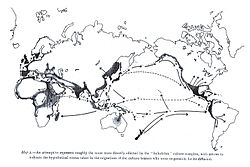
[edit]The British school of diffusionism was an extreme form of diffusionism. Notable proponents included Grafton Elliot Smith and W. J. Perry, who believed Egypt was the source of all civilisation. The so-called Heliolithic Culture hypothesized by Grafton Elliot Smith includes a wide range of hyperdiffused cultural practices such as megaliths and sun worship (the name was coined by Smith himself from helios, "sun", and lith, "stone") and the similar designs and methods of the construction of such pieces are described as having a linear geographical distribution.[10] These heliolithic cultures can refer to religious customs that share distinctive practices, such as the worship of a Solar Deity. As this trope is seen in numerous belief systems, Smith believes that it is diffused from one ancient civilization.[10]: 132
According to G. Elliot Smith, Egypt was the source of civilization for Asia, India, China, and the Pacific, and eventually, it was the source of civilization for America.[10]: 45 Smith sees Mummification as a prime example of how religious customs prove the diffusion of a single ancient culture.[10]: 21 He believes that only an advanced civilization, such as Egypt, could create such a peculiar belief, and that it then spread by way of ancient mariners.[10]: 133–34
Early Man Distribution refers to Smith's belief that Modern Man is derived from "six well-defined types of mankind," which comprise the sources of Earth's population.[11] The six types of mankind are the Aboriginal Australians, Negroes, Mongols, and the Mediterranean, Alpine, and Nordic races.[11]: 15
Carl Whiting Bishop
[edit]Carl Whiting Bishop in the 1930s and the 1940s produced a series of articles arguing hyperdiffusionism in explaining the expansion of technology into China. Among the scholars influenced by Bishop were Owen Lattimore, who was intrigued by Bishop's emphasis on geography as a shaping factor in Chinese civilization and his emphasis on field work rather than library research.[12]
Charles Hapgood
[edit]In Charles Hapgood's book Maps of the Ancient Sea Kings, he concludes that ancient land formations gave way to hyperdiffusionism and the diffusion "of a true culture."[13] This culture could have been more advanced than that of Egypt or Greece because it was the foundation of a worldwide culture. Hapgood also suggests that the Three-age system of archeology is irrelevant due to primitive cultures co-existing with modern societies.[13]: 193–94
According to Hapgood, the pyramids in South America and Mexico may be indicative of cultural practices which the builders of them shared with ancient Egyptian civilization.[13]: 200 He theorized that the ancient Maya were strongly influenced by the diffusion of ancient Egyptian social and political cultures,[14] and that they became a civilized culture due to the migration of citizens from Atlantis after that island sank.[15] For example, he says "How did the Mayans achieve such precise results...the knowledge may have, of course, been derived by the Babylonians or the Egyptians".[13]: 198 It is also said that Mayan artifacts resemble those of a classical culture, possibly Greece.[2]: 147 This plays into Plato's Account of the ancient battle for Atlantis, which led to the downfall of the civilization.
Hapgood finds evidence of ancient Egyptian "expression" in the writings of Hinduism and Buddhism. He notes that in these writings there appear deities that are similar to those worshiped throughout the world. Furthermore, there are myths and creation stories that are said to have a common origin in Egypt.[13]: 204–5
Barry Fell
[edit]Mystery Hill, or America's Stonehenge, is the site which Barry Fell refers to as the primary basis of his hypothesis that ancient Celts once populated New England.[16] Mystery Hill, Fell believes, was a place of worship for the Celts and Phoenician mariners.[16]: 91 These ancient mariners, called the Druids, are said to have populated Europe at the same time. He hypothesizes that they were the ancient settlers of North America. Also, he believes that what he describes as inscriptions on stone and tablet artifacts from this site are in an ancient language derived from common sources of the Goidelic languages.[16]: 92
These authors describe hyperdiffusionism as the driving force behind the apparent cultural similarities and population distribution among all civilizations. Hapgood's hypothesis states that one specific civilization is responsible for similar cultural practices in all other civilizations. Smith says that religions are proof of hyperdiffusionism, as similar worship ceremonies and symbols recur in geographically separated societies. Also, Smith believes that the Earth's population is made up of six types of humans, who diffused across the Earth's continents by virtue of their skin color.[11]: 47–48 Finally, Fell asserts that ancient mariners, such as Druids and Phoenicians, traveled from Europe and comprised the early population of ancient America.
Critiques
[edit]Alexander Goldenweiser
[edit]Alexander Goldenweiser in Culture: The Diffusion Controversy stated that there are reasons for believing that culture may arise independently rather than being transmitted. In addition, Goldenweiser insists that behavior is primitive and that cultural similarities may arise simply because they are reflections of adaptive traits that all human beings have evolved. Goldenweiser disagrees with the theory of hyperdiffusionism, stating that "culture is not contagious"[17]: 104 and that the data fails to support the theory.[17]: 100–106
Stephen Williams
[edit]Stephen Williams uses the phrase "Fantastic Archaeology" to describe the archeological theories and discoveries which he defines as "fanciful archaeological interpretations".[3]: 12 These interpretations usually lack artifacts, data, and testable theories to back up the claims made.
In his chapter "Across The Sea They Came," Williams introduces a few hyperdiffusionists, their discoveries, and how they "tested" artifacts, beginning with Harold S. Gladwin who made his "fantastic" discoveries at an Arizona Pueblo site, Gila Pueblo Archaeological Foundation. Gladwin favored the diffusion theories which later influenced his methodologies for dating the artifacts at the site. This belief led him to ignore the data that was found at the Folsom site in his chronology as it made his "Man descended from Asia into the New World" theory impossible.[3]: 230 The section continues with Cyclone Covey and Thomas W. Bent, specifically their publications on the Tucson Artifacts and their theory that ancient Romans traveled to Arizona. Williams pokes fun at this theory in his book Fantastic Archaeology, and criticizes the authors for failing to explain exactly how and why these artifacts were found in Arizona, and focusing their attention instead only on the artifacts themselves and their similarities to Roman artifacts.[3]: 240 Concluding, Williams points out in the chapter how hyperdiffusionists fail to recognize solid archaeological research methods and/or ignore conflicting data and contextual evidence. They are "tailoring their finds with any similar chronology or in-depth linguistic analysis that fits into their scenarios".[3]: 255–56
Alice Kehoe
[edit]Alice Beck Kehoe says that diffusionism is a "grossly racist ideology".[18]: 144 Although she agrees that diffusion of culture can occur through contact and trading, she disagrees with the theory that all civilization came from one superior ancient society.[18]: 148
Kehoe explores the "independent invention" of works and techniques using the example of boats. Ancient peoples could have used their boat technology to make contact with new civilizations and exchange ideas. Moreover, the use of boats is a testable theory, which can be evaluated by recreating voyages in certain kinds of vessels, unlike hyperdiffusionism.[18]: 158 Kehoe concludes with the theory of transoceanic contact and makes clear that she is not asserting a specific theory of how and when cultures diffused and blended, but is instead offering a plausible, and testable, example of how civilizational similarities may have arisen without hyperdiffusionism, namely by independent invention and maritime contact.[18]: 169
See also
[edit]Notes
[edit]- ^ Moshenska, Gabriel (2017). "Alternative archaeologies". Key Concepts in Public Archaeology. UCL Press. pp. 122–137. doi:10.2307/j.ctt1vxm8r7.13. ISBN 978-1-911576-43-3. JSTOR j.ctt1vxm8r7.13.
- ^ a b Fagan, Garrett G., ed. (2006). Archaeological Fantasies. Oxford, England: Routledge. pp. 362–367. ISBN 978-0-415-30593-8.
- ^ a b c d e f g Williams, Stephen (1991). Fantastic Archaeology: The Wild Side of North American Prehistory. Philadelphia: University of Pennsylvania Press. pp. 224–257. ISBN 0-8122-1312-2.
- ^ Wheaton, Elizabeth (1988). Codename GREENKILL: The 1979 Greensboro Killings. Athens, Georgia: University of Georgia Press. pp. 3–4. ISBN 978-0820309354.
- ^ Kaplan, Jeffrey (2000). Encyclopedia of White Power: A Sourcebook on the Radical Racist Right. Lanham, Maryland: Rowman & Littlefield. p. 62. ISBN 9780742503403. Retrieved 21 January 2014.
- ^ Steiger, Brad; Steiger, Sherry (2012). Conspiracies and Secret Societies: The Complete Dossier (2nd ed.). Detroit, Michigan: Visible Ink Press. p. 18. ISBN 978-1578593682.
In 1979 Collin's ambition to lead a new Nazi America was thwarted when he was arrested, convicted, and sent to prison on child molestation charges.
- ^ Joseph, Frank (2003). The Lost Treasure of King Juba: The Evidence of Africans in America Before Columbus. Rochester, VT: Simon and Schuster. p. 224. ISBN 9781591438519. Retrieved November 20, 2018.
- ^ American Villains, Volume 1: Joe Adonis–Jim Jones. Ipswich, Massachusetts: Salem Press Inc. 2008. p. 125. ISBN 978-1-58765-453-4.
- ^ Birmingham, Robert A.; Eisenberg, Leslie E. (2000). Indian Mounds of Wisconsin. Madison, Wisconsin: University of Wisconsin Press. p. 64. ISBN 978-0-299-16874-2.
- ^ a b c d e Smith, G. Elliot (1929). The Migrations of Early Culture. Manchester: Manchester University Press. OCLC 1868131.
- ^ a b c Smith, G. Elliot (1931). The Evolution of Man. London: Ernest Benn Limited. pp. 13–47. OCLC 637203360.
- ^ Newman, Robert P. (1992). Owen Lattimore and the 'Loss' of China. University of California Press. p. 24. ISBN 978-0-520-07388-3.
- ^ a b c d e Hapgood, Charles H. (1966). Maps of the Ancient Sea Kings. Philadelphia: Chilton Company. pp. 193–206.
- ^ Webster, David (2006). "The Mystique of the Ancient Maya". In Fagan, Garrett G. (ed.). Archaeological Fantasies. Oxford: Routledge. pp. 129–154. 978-0-415-30593-8.
- ^ Hale, Christopher (2006). "The Atlantean Box". In Fagan, Garrett G. (ed.). Archaeological Fantasies. Oxford: Routledge. pp. 235–59. ISBN 978-0-415-30593-8.
- ^ a b c Fell, Barry (1976). Ancient Settlers in the New World. New York: Quadrangle. pp. 81–92. ISBN 0-8129-0624-1.
- ^ a b Goldenweiser, Alexander (1927). Culture: The Diffusion Controversy. New York: W. W. Norton & Company. pp. 99–106. OCLC 1499530.
- ^ a b c d Kehoe, Alice Beck (2008). Controversies in Archaeology. Walnut Creek, CA: Left Coast Press. pp. 140–172. ISBN 978-1-59874-062-2.
Hyperdiffusionism
View on GrokipediaDefinition and Core Principles
Fundamental Concepts
Hyperdiffusionism asserts that significant cultural innovations, technologies, and ideas across disparate societies primarily result from diffusion originating from a single ancient civilization, rather than widespread independent invention.[4] This hypothesis posits that human societies are inherently conservative, with genuine creativity being exceptionally rare, leading to the adoption and adaptation of traits through contact, migration, or imitation rather than parallel development.[5] Proponents argue that observed similarities in artifacts, motifs, and practices—such as pyramid construction or solar symbolism—indicate direct transmission from a "mother culture," minimizing the role of local ingenuity.[1] Central to hyperdiffusionism is the unidirectional model of cultural spread, where advancements flow outward from an urheimat or primary center, often identified as ancient Egypt or a hypothetical lost continent, to less developed regions.[6] This approach contrasts with moderate diffusionism, which allows for multiple centers and reciprocal exchanges, by emphasizing a hierarchical origin that attributes nearly all complex achievements to one source.[7] Linguistic parallels, metallurgical techniques, and megalithic structures are interpreted as evidence of such dissemination, with divergences explained by degeneration or superficial modification over time.[5] The theory's foundational assumption challenges evolutionary models in anthropology, which prioritize endogenous development driven by environmental and social pressures, by privileging empirical correspondences in material culture as proof of contact over functional convergence.[1] While acknowledging some diffusion—such as the spread of agriculture—hyperdiffusionism extends this to encompass global phenomena like mummification practices or navigational knowledge, attributing them to systematic propagation from the core civilization around 3000–2000 BCE.[4] This framework implies a compressed timeline for human cultural history, where post-dispersal innovations are secondary derivatives rather than primary creations.[6]Relation to Broader Diffusion Theories
Diffusion theories in anthropology posit that similarities in cultural traits across societies result primarily from the spread of ideas, technologies, and practices through migration, trade, or conquest, rather than independent invention in isolated locales.[8] This contrasts with evolutionary models emphasizing parallel development and privileges empirical patterns of trait distribution over speculative stages of progress.[7] Within this framework, diffusionism emerged in the late 19th and early 20th centuries as a corrective to unilinear evolutionism, advocating for historical reconstruction of trait movements based on archaeological, linguistic, and ethnographic evidence.[9] Hyperdiffusionism represents an extreme variant of diffusionism, characterized by the assertion that nearly all significant cultural innovations originate from a singular, ancient "cradle" civilization—most often ancient Egypt in the theories of its primary proponent, Grafton Elliot Smith—and radiate outward to explain global parallels.[8] Unlike moderate diffusionist approaches, which permit multiple regional "hearths" or centers of innovation (as in the Kulturkreise school of Fritz Graebner and Wilhelm Schmidt, emphasizing culture complexes diffusing from discrete origins), hyperdiffusionism insists on a monogenetic source, minimizing independent invention and attributing divergences to degeneration or superficial adaptation.[9] This absolutist stance aligns with diffusionism's core mechanism of trait transmission but amplifies it into a universal explanatory principle, often relying on superficial resemblances in artifacts, motifs, or megalithic structures without robust chronological or genetic corroboration.[1] The relationship underscores a spectrum within diffusion paradigms: broader theories integrate diffusion with invention and local adaptation, as seen in American anthropology's focus on patterned borrowing (e.g., Clark Wissler's trait complex distributions across North American tribes), whereas hyperdiffusionism's heliocentric model, exemplified by Smith's 1911 The Ancient Egyptians and the Origin of Civilization, rejects polygenesis outright.[8] This extremity facilitated critiques that hyperdiffusionism veers into pseudoscience by overgeneralizing diffusion to the exclusion of causal factors like environmental adaptation or convergent evolution, yet it shares diffusionism's empirical commitment to mapping trait homologies.[1] Modern cultural anthropology retains moderated diffusionist elements in studies of globalization and technology transfer, but rejects hyperdiffusionism's totalizing claims for lacking falsifiable mechanisms.[7]Historical Origins
Pre-20th Century Precursors
The notion of cultural traits radiating from a singular ancient source traces back to 19th-century speculations on lost civilizations, contrasting with prevailing evolutionist views that emphasized independent invention across societies. Ignatius Donnelly, an American politician and writer, articulated an early hyperdiffusionist framework in his 1882 book Atlantis: The Antediluvian World, arguing that the submerged continent of Atlantis served as the origin of advanced technologies, religious symbols, and monumental architecture observed in disparate regions. Donnelly cited similarities such as pyramid construction in Egypt and Mesoamerica, bronze-working in Europe and the Andes, and sun-worship motifs worldwide as evidence of transoceanic dissemination from Atlantean colonists around 9,600 BCE, predating Egyptian dynasties. German geographer Friedrich Ratzel advanced diffusionist principles in Anthropogeographie (volumes published 1882 and 1891), positing "culture hearths" or innovation centers—often in fertile river valleys—from which cultural elements spread through migration, trade, and conquest, akin to organic growth in nature. Ratzel's model emphasized environmental determinism, where favorable climates fostered primary inventions that radiated outward, influencing secondary cultures; for example, he traced agricultural techniques and state formation from Old World hearths to peripheral areas, rejecting widespread polygenesis of ideas. Though more moderate than later hyperdiffusionism, Ratzel's emphasis on limited origins challenged unilinear evolutionism by prioritizing spatial dissemination over psychic unity of mankind.[10] Earlier roots appeared in colonial-era chronicles, such as 17th-century Spanish accounts proposing American continents as humanity's cradle. Antonio de León Pinelo, in works like La Descubierta del Nuevo Mundo (1651), contended the Garden of Eden lay in the Amazon, with subsequent human dispersal carrying proto-civilizational knowledge to Eurasia and Africa, blending biblical monogenism with empirical observations of New World flora and ruins. These ideas, while speculative and religiously inflected, prefigured secular hyperdiffusion by attributing global cultural parallels—e.g., flood myths and solar deities—to unidirectional spread rather than convergence. Such precursors often relied on superficial artifact analogies without stratigraphic or chronological rigor, a methodological flaw persisting into 20th-century variants.Emergence in Early 20th Century Anthropology
In the early 20th century, anthropological thought transitioned from 19th-century unilinear evolutionism toward historical particularism and diffusionist explanations, emphasizing cultural transmission through migration and contact over independent invention. Diffusionism posited that similarities in artifacts, practices, and beliefs across societies stemmed from historical interconnections rather than universal psychic unity or parallel evolution. This framework gained traction among British anthropologists, who mapped culture traits to trace their dispersal from presumed centers of innovation.[8][10] Hyperdiffusionism, an extreme iteration of this approach, crystallized through the theories of Grafton Elliot Smith, who argued that ancient Egypt served as the singular cradle of advanced civilization around 4000 BCE, with cultural elements like mummification, megalithic construction, and solar worship diffusing globally via seafaring "Children of the Sun." Smith's seminal work, The Ancient Egyptians and the Origin of Civilization (1911), linked Egyptian innovations to worldwide parallels, challenging notions of cultural polygenesis. He further elaborated in The Migrations of Early Culture (1915), using the distribution of mummification practices as key evidence of Egyptian primacy.[2][11][12] Smith collaborated closely with W.J. Perry, who extended hyperdiffusionist claims to megalithic cultures, asserting their transmission from Egypt to regions including the Pacific and Americas. By the 1920s, their "heliolithic" school formalized a monogenetic model, positing that high civilization radiated outward in waves of migration, influencing early archaeological interpretations until broader empirical scrutiny arose. This paradigm shifted focus from evolutionary stages to traceable historical routes, though it overstated diffusion at the expense of local agency.[13][14][2]Major Proponents and Specific Theories
Grafton Elliot Smith and Egyptian Heliolithic Theory
Grafton Elliot Smith (1871–1937) was an Australian-born anatomist, Egyptologist, and proponent of extreme diffusionism, best known for theorizing that ancient Egypt served as the singular cradle of human civilization.[2] Born on 15 August 1871 in Grafton, New South Wales, he studied medicine at the University of Sydney before advancing his career in anatomy, serving as professor in Cairo from 1900 to 1907, where his examinations of mummies informed his later cultural hypotheses.[2] He subsequently held positions at the University of Manchester (1909–1919) and University College London (1919–1937), earning election to the Royal Society in 1907 and a knighthood in 1934.[2] Smith's Heliolithic theory, articulated in works such as The Migrations of Early Culture (1915) and The Ancient Egyptians and the Origin of Civilization (1911, revised 1923), posited that key innovations—including agriculture, metalworking, pyramid construction, mummification, and megalithic monument-building—emerged exclusively in Egypt around the fourth millennium BCE or earlier.[15][2] He termed this the "Heliolithic" culture, deriving from helio- (sun worship) and -lithic (stone monuments), which he argued spread globally through migrations prompted by environmental pressures like drought, carried by seafaring Egyptians or their descendants to regions including the Pacific, India, China, and the Americas.[16] Smith emphasized similarities in practices, such as mummification techniques linking Egyptian methods to those in Peru and the Torres Strait (post-ninth century BCE), and rejected independent invention for such complex traits, insisting they diffused from a Nile Valley epicenter.[2][15] Central to Smith's framework was the idea that cultural elements formed an indivisible complex, with no significant independent developments elsewhere; for instance, he traced European megaliths, Asian rice cultivation, and American stepped pyramids to Egyptian progenitors via Phoenician intermediaries after the ninth century BCE.[2] In Human History (1930) and The Diffusion of Culture (1933), he expanded this to encompass symbolic motifs like the sun god cult and metallurgical knowledge, arguing that archaeological parallels—absent local precursors—evidenced unidirectional spread rather than polygenesis.[2] Collaborating with W. J. Perry, Smith influenced the "British school" of diffusionism, which viewed Egypt's "brunet" peoples as progenitors of a heliolithic wave that "oozed" across warmer climes, integrating anatomical expertise with ethnographic data to challenge evolutionary gradualism in culture.[16]Other Key Figures and Variants
William James Perry (1868–1949), a British geographer and anthropologist who collaborated closely with Grafton Elliot Smith, advanced hyperdiffusionist ideas by positing that cultural dissemination occurred through migrations of "Children of the Sun"—elite groups originating in ancient Egypt who spread megalithic architecture, mummification, and solar worship worldwide.[5] In works such as The Children of the Sun (1923) and The Growth of Civilization (1924), Perry argued that these migrants established outposts in regions like Britain, Peru, and Polynesia around 3000–2000 BCE, attributing pyramid construction and metalworking to Egyptian influence rather than independent invention.[17] His theories extended Smith's by emphasizing economic motivations, such as quests for resources, driving these global voyages, though lacking empirical navigation or genetic evidence.[18] Variants of hyperdiffusionism diverged from the Egyptian-centric model by proposing alternative singular origins, such as Mesopotamia in Pan-Babylonian theories or lost continents like Mu, though these remained marginal in academic anthropology. Fritz Graebner (1877–1934) and Wilhelm Schmidt (1868–1954), associated with the German-Austrian Kulturkreise (culture-circle) school, represented a moderated variant emphasizing diffusion of discrete cultural complexes from multiple ancient hearths—typically in Asia or the Near East—rather than a sole source, influencing early 20th-century ethnographic mappings of trait distributions.[19] This approach, outlined in Graebner's Methode der Ethnologie (1911), prioritized historical reconstruction via trait lists but faced criticism for arbitrary center assignments and neglect of local adaptations.[10] Leo Frobenius (1873–1938), another continental figure, blended diffusionism with mythological interpretations, tracing African and Oceanic motifs to Eurasian origins around 1000 BCE, as in his Erythraea studies, though his work veered toward speculative symbolism over verifiable transmission routes.[8] These figures and variants collectively reinforced hyperdiffusionism's core tenet of centralized innovation but varied in proposed mechanisms, from maritime expeditions to overland waves, often relying on superficial artifact resemblances amid scant chronological or stratigraphic corroboration from contemporary archaeology.[20]Arguments and Evidence in Favor
Archaeological and Artifactual Similarities
Proponents of hyperdiffusionism, such as Grafton Elliot Smith, pointed to the practice of mummification as a key archaeological indicator of cultural transmission from ancient Egypt to distant regions. Smith argued in his 1915 work The Migrations of Early Culture that the specific techniques of evisceration, desiccation, and wrapping found in Egyptian mummies from circa 2600 BCE appeared in comparable forms in coastal Peru (e.g., Chinchorro mummies dated to approximately 5050–3000 BCE), the Torres Strait islands, and the Aleutian Islands, suggesting deliberate diffusion rather than parallel development due to the ritualistic and technical complexities involved.[15] He emphasized that these practices were absent in intermediate regions, implying direct migration routes by culture-bearing groups motivated by beliefs in afterlife preservation tied to solar cults.[21] Monumental architecture provided another focal point for hyperdiffusionist claims, with similarities in pyramid construction and megalithic structures cited as evidence of shared engineering knowledge originating in Egypt. Smith and associates like W.J. Perry highlighted stepped pyramids, such as Egypt's Third Dynasty Djoser pyramid (circa 2670 BCE) and Mesoamerican examples like the Maya at El Mirador (circa 600 BCE), noting superficial resemblances in tiered profiles and alignment with celestial events, which they attributed to diffusion of heliolithic (sun-stone) worship practices rather than independent invention.[22] Megalithic monuments, including dolmens and menhirs in Britain (e.g., Stonehenge's bluestones sourced from Wales around 2500 BCE) and similar structures in Oceania and India, were interpreted by Smith as derivatives of Egyptian stone-working techniques and funerary symbolism, spread via maritime voyagers around 4000–2000 BCE. Artifactual parallels extended to symbolic motifs and technologies, such as lotus and solar disk representations on pottery and reliefs from Egypt appearing in analogous forms in Peruvian Nasca culture ceramics (circa 100 BCE–800 CE) and Mesoamerican iconography, which diffusionists like Smith viewed as emblematic of a common mythological framework involving creation from watery chaos and divine kingship.[23] Similarly, the use of porpoise motifs and reed-bundle boat depictions in Egyptian art paralleled those in Chavín de Huántar artifacts from Peru (circa 900–200 BCE), posited by proponents as traces of transoceanic exchange of navigational and ritual knowledge.[24] These correspondences, while not universal, were marshaled to support the view that complex traits unlikely to arise convergently indicated a single point of origin and subsequent dispersal.[8]Linguistic, Symbolic, and Technological Parallels
Grafton Elliot Smith, a primary proponent of hyperdiffusionism, emphasized technological parallels in mummification practices as key evidence for the spread of culture from ancient Egypt circa 2600 BCE. He mapped the global distribution of similar embalming techniques, including body evisceration, desiccation, and resinous wrapping, from Egyptian Old Kingdom mummies to those in Peru and Oceania, contending that such intricate, non-utilitarian processes originated once and diffused rather than evolving independently in isolated societies. Smith further argued that pyramid construction exemplified technological diffusion, noting structural analogies between Egyptian true pyramids and Mesoamerican stepped platforms, both involving precise orientation and stepped ascents symbolizing solar ascent, which he attributed to Egyptian mariners' voyages rather than convergent evolution.[23] Symbolic parallels formed another pillar, with Smith's "heliolithic" theory positing a unified complex of sun worship, megalith erection, and ancestor cults radiating from Egypt. He cited shared motifs like solar barques in Egyptian and Polynesian iconography, megalithic alignments to solstices in Britain, [Easter Island](/page/Easter Island), and India, and ritual circumambulation of monuments worldwide as indicators of diffused religious symbolism, not polygenetic invention. These elements, including phallic stone symbols and serpent motifs in megalithic art from diverse regions, were seen by Smith as traceable to Egyptian heliopolitan influences disseminated via migration around 2000 BCE.[23] Linguistic parallels received less emphasis in core hyperdiffusionist arguments, as proponents like Smith prioritized archaeological and ethnographic data over etymology; however, some variants invoked superficial resemblances in terms for cultural artifacts, such as words for "pyramid" or "mummy," though these claims lack rigorous comparative linguistic validation and are often critiqued as coincidental.[18] Overall, technological and symbolic correspondences were presented as empirically observable patterns defying probabilistic independent origins, supporting a monogenetic diffusion model.Critiques and Scientific Rebuttals
Anthropological and Methodological Objections
Anthropologists critiqued hyperdiffusionism for undermining the agency of recipient cultures by depicting them as passive adopters of traits from a superior origin, thereby neglecting internal innovation and adaptation processes central to cultural evolution. This view clashed with the Boasian paradigm of historical particularism, which Franz Boas promoted through meticulous ethnographic reconstruction of individual cultural trajectories, rejecting broad diffusionist schemes that speculated on global transmissions without localized evidence.[25] Boas and his students, including Alfred Kroeber, favored moderate diffusionism that accounted for both borrowing and invention within specific historical contexts, viewing extreme variants like heliolithic theory as overly reductive and empirically ungrounded.[8] Such approaches, they argued, failed to integrate diffusion with acculturation dynamics, where traits undergo gradual modification rather than unaltered propagation across continents.[8] Methodologically, hyperdiffusionism relied on an atomistic trait-list approach, isolating elements like motifs or technologies for comparison while disregarding their functional integration and contextual meanings within cultures, leading to erroneous assumptions of homology from superficial resemblances. Critics contended this neglected convergent development, where similar environmental or social pressures could independently yield analogous traits, as seen in pyramid construction arising from practical engineering needs in disparate societies.[5] The theories often lacked verifiable transmission mechanisms, such as intermediary populations or artifacts along proposed routes, and ignored chronological discrepancies, with claimed Egyptian influences on distant civilizations predating feasible travel technologies by millennia.[3] Doctrinaire diffusionism was further faulted for diverting attention from rigorous comparative archaeology toward unsubstantiated speculation, hindering the development of theoretically sound interpretations based on stratified site data and regional sequences.[26] Scholars like Alexander Goldenweiser highlighted the absence of empirical chains linking origins to endpoints, rendering hyperdiffusionist claims pseudoscientific despite their appeal to pattern-seeking.[1]Empirical Counter-Evidence from Archaeology and Genetics
Archaeological chronologies reveal that monumental pyramid construction arose independently in multiple regions without evidence of transoceanic diffusion from Egypt. The earliest Egyptian pyramids, including the Step Pyramid of Djoser at Saqqara, date to circa 2670–2650 BCE and evolved into smooth-sided true pyramids by the Fourth Dynasty around 2580 BCE, primarily functioning as royal tombs with internal chambers and precise astronomical alignments using cut limestone blocks.[27] Mesoamerican pyramids, such as those at the Olmec site of La Venta (circa 1200–400 BCE) or Teotihuacan's Pyramid of the Sun (constructed circa 200 BCE), postdate Egyptian examples by over two millennia and differ fundamentally in form—stepped platforms with flat summits for temples and rituals, constructed via layered earth, rubble, and adobe rather than quarried stone precision engineering.[27] Similar disparities apply to Andean structures like the Caral pyramids in Peru (circa 2600 BCE), which predate Mesoamerican ones but lack Egyptian stylistic or material parallels, with no intervening sites showing hybrid artifacts or trade networks across the Atlantic.[28] Absence of material culture linkages further refutes hyperdiffusionist claims; excavations in the Americas yield no Egyptian imports such as faience beads, scarab amulets, or papyrus remnants predating European contact, nor do Old World sites contain New World crops like maize or cacao before 1492 CE.[29] Independent invention is evidenced by parallel developments in unrelated regions, including the domestication of staple crops—maize in Mesoamerica by 7000 BCE, potatoes and quinoa in the Andes by 5000 BCE, and rice in China by 6200 BCE—without genetic or archaeological traces of Egyptian intermediaries.[30][31] Genetic analyses of ancient remains corroborate these findings by demonstrating distinct population ancestries incompatible with widespread cultural diffusion from a Nile Valley origin. Pre-Columbian American genomes, derived from Beringian migrations around 15,000–20,000 years ago, cluster with Siberian and East Asian lineages, showing no substantive admixture from North African or Levantine sources associated with ancient Egyptians.[32] For instance, whole-genome sequencing of 92 prehistoric Native American individuals reveals 84 unique lineages tracing to Asian founder populations, with post-contact European admixture as the only non-autochthonous signal.[33] Ancient Egyptian DNA from Old Kingdom mummies (circa 2500 BCE) exhibits primary affinities to Levantine and Anatolian groups, with minimal Sub-Saharan input until later periods, and no evidence of gene flow to distant hemispheres.[34][35] These profiles align with localized evolutionary pressures driving independent technological and societal innovations, rather than a singular diffusive epicenter.[36]Controversies and Ideological Dimensions
Accusations of Racism and Cultural Bias
Critics within anthropology and related fields have leveled accusations of racism against hyperdiffusionism, arguing that its emphasis on a singular point of cultural origin—typically an "advanced" society like ancient Egypt—implies the inherent inferiority of other cultures' capacity for independent innovation, thereby reinforcing colonial-era racial hierarchies.[8] Geographer James M. Blaut, in his 1993 analysis, described extreme diffusionism as racist for constructing a model of unidirectional cultural flow from an innovative "core" (often aligned with European or Near Eastern civilizations) to passive "peripheries," which he saw as excusing global inequalities by attributing underdevelopment to supposed cultural dependency rather than exploitative historical processes.[37] This critique posits that such theories diminish non-Western achievements, framing them as derivative imitations rather than original developments, a view Blaut linked to broader Eurocentric biases in 19th- and early 20th-century scholarship.[38] These charges gained prominence during the Boasian revolution in American anthropology in the early 20th century, where figures like Franz Boas and his students prioritized cultural relativism and polygenesis (independent invention across societies) over diffusionist models, partly to counter prevailing notions of racial and cultural superiority.[8] Diffusionists like Grafton Elliot Smith, whose 1911 The Ancient Egyptians and subsequent works mapped global cultural traits back to a Neolithic Egyptian origin around 7000–5000 BCE, were faulted for embedding assumptions of civilizational primacy that aligned with contemporary racial typologies, even if Smith explicitly rejected polygenism and crude eugenics in favor of environmental and migratory explanations for human variation.[39] Smith's heliolithic theory, which traced pyramid-building, mummification, and megalithic practices worldwide to Egyptian dissemination via seafaring migrants, was interpreted by detractors as undervaluing indigenous agency in regions like Polynesia and the Americas, implicitly portraying their societies as recipients of superior external stimuli.[8] Proponents and later analysts have contested the racism label, noting that hyperdiffusionism rested on empirical observations of artifactual, linguistic, and technological parallels—such as shared motifs in Egyptian and Mesoamerican iconography—rather than explicit racial determinism, and that Smith's focus on Egypt as an African origin challenges straightforward Eurocentrism claims.[39] Some critiques, including those equating diffusionism with modern pseudoarchaeological narratives, have been rebutted as anachronistic, projecting post-1960s antiracist frameworks onto pre-WWII debates where diffusion explained observable similarities without denying diffusion's role alongside invention.[40] Nonetheless, the theory's historical entanglement with era-specific views on cultural evolution—where "primitive" societies were seen as less inventive—has sustained perceptions of bias, particularly in academic circles favoring methodological individualism in cultural origins to affirm egalitarian narratives.[38]Implications for Independent Invention vs. Diffusion Debate
Hyperdiffusionism posits that cultural similarities worldwide stem primarily from diffusion originating from a single ancient center, such as Egypt, thereby minimizing the role of independent invention across isolated populations.[5] This stance implies a diminished capacity for human societies to innovate parallel solutions to analogous environmental or social challenges, framing convergent cultural traits as evidence of historical contact rather than adaptive convergence.[1] Proponents like Grafton Elliot Smith argued that feats such as pyramid construction or mummification practices could not arise independently due to their complexity, suggesting instead a unidirectional spread that precludes polycentric origins.[41] The theory's rejection of independent invention has profound implications for the broader debate, as it challenges the evolutionary anthropology paradigm that emphasizes local ingenuity and parallel development. Empirical counter-evidence from archaeology, such as the independent domestication of crops in at least seven global centers—including maize in Mesoamerica around 7000 BCE and rice in China by 6200 BCE—demonstrates that agriculture emerged without diffusion from a singular source, supported by distinct genetic lineages in domesticated species.[8] Similarly, genetic studies of ancient DNA reveal no transoceanic gene flow linking Old World origins to New World pyramid-building cultures, bolstering claims of independent invention for monumental architecture as analogous responses to hierarchical societies rather than borrowed techniques.[42] Critiques of hyperdiffusionism highlight methodological flaws, such as over-reliance on superficial artifactual resemblances (e.g., megalithic structures) without stratigraphic or chronometric corroboration of transmission routes, which has led to a more nuanced consensus in the field: diffusion accounts for demonstrable contacts, like Indo-European language spreads post-3000 BCE, while independent invention explains polygenetic traits like pottery, invented independently in East Asia by 18,000 BCE, the Near East by 7000 BCE, and the Americas by 5000 BCE.[3] This balanced view, informed by radiocarbon dating and phylogeographic analyses, underscores that hyperdiffusionism's extremism inadvertently advanced the debate by necessitating rigorous tests to distinguish homology from analogy, ultimately affirming human cognitive universality in problem-solving across continents.[43]Modern Assessments and Recent Developments
Post-2000 Archaeological Findings
Since 2000, archaeological surveys utilizing LiDAR technology have revealed vast networks of independent urban centers in the Amazon basin, challenging hyperdiffusionist claims of transoceanic cultural transmission from Old World civilizations. In eastern Ecuador's Upano Valley, LiDAR mapping in 2024 identified over 6,000 earthen platforms, rectangular plazas, and road systems spanning 300 square kilometers, dating from approximately 500 BCE to 300-600 CE, supporting a population of up to 10,000-30,000 with sophisticated agriculture and mound-building without evidence of external architectural or material influences.[44] Similarly, 2022 LiDAR scans in Bolivia's Llanos de Mojos region uncovered the Casarabe culture's 6,000+ platform mounds and canal systems covering 4,500 square kilometers, active from 500-1400 CE, demonstrating localized hydraulic engineering and pyramid construction using earthen materials, distinct from Egyptian or Mesopotamian styles.[45] These discoveries highlight endogenous innovation in tropical environments, with no imported tools, ceramics, or iconography indicative of diffusion from a singular origin.[46] In Mesoamerica, post-2000 excavations and remote sensing have further evidenced autonomous technological and societal development. LiDAR surveys from 2016-2018 in Guatemala's Petén region exposed over 60,000 previously unknown Maya structures, including defensive fortifications, causeways, and reservoirs, underscoring a densely populated landscape from 1000 BCE onward reliant on local limestone quarrying and corbelled architecture, absent Old World parallels like true arches or hieroglyphic anomalies suggesting contact.[44] Ongoing work at sites like Monte Albán and Teotihuacan has confirmed independent evolutions in metallurgy—such as Andean-style smelting of copper-arsenic alloys by 1000 BCE—and writing systems, with isotopic analyses of artifacts revealing regional resource exploitation rather than imported technologies.[43] Archaeomaterials studies post-2000 emphasize pyrotechnological innovations, like ceramic firing techniques, as locally derived through experimental replication and residue analysis, countering diffusionist overemphasis on borrowed traits.[43] These findings collectively bolster critiques of hyperdiffusionism by illustrating parallel convergent evolutions in monumental architecture and urban planning across isolated hemispheres, with stratigraphic and artifactual continuity pointing to in-situ adaptation over long-distance imposition. No post-2000 excavations have yielded verifiable Old World imports—such as Egyptian faience or Near Eastern seals—in pre-Columbian American contexts, reinforcing methodological preferences for independent invention supported by contextual seriation and material sourcing.[47] Mainstream assessments, informed by these data, attribute superficial similarities (e.g., stepped pyramids) to universal problem-solving rather than causal diffusion from a heliocentric culture.[3]Contemporary Fringe and Mainstream Views
In contemporary anthropology and archaeology, hyperdiffusionism is widely regarded as a discredited pseudoscientific hypothesis, with mainstream scholars emphasizing polycentric cultural development, independent invention of similar traits under convergent evolutionary pressures, and limited, evidence-based diffusion supported by genetic, linguistic, and artifactual data.[1][48] This rejection stems from the theory's failure to account for empirical counter-evidence, such as radiocarbon-dated sequences showing parallel timelines for innovations like pyramid construction in Egypt (ca. 2630 BCE) and Mesoamerica (ca. 1000 BCE) without transoceanic contact, and genetic studies indicating distinct population ancestries for Old and New World civilizations.[6] Modern frameworks, informed by processual and post-processual archaeology since the mid-20th century, prioritize testable models of local adaptation over monocausal diffusion from a singular origin, viewing hyperdiffusionism as methodologically flawed for its selective use of superficial similarities while ignoring chronological and contextual discrepancies.[8] Fringe proponents, often outside academic institutions, continue to advocate variants of hyperdiffusionism, positing a lost advanced civilization—such as Atlantis or a pre-Ice Age global culture—as the source of worldwide megalithic architecture, astronomical knowledge, and agricultural techniques, disseminated via ancient seafaring.[49] Graham Hancock, in his 2022 Netflix series Ancient Apocalypse, exemplifies this by claiming a cataclysmic event around 12,000 years ago destroyed a sophisticated "mother culture" whose survivors influenced sites like Göbekli Tepe (Turkey, ca. 9600 BCE) and the Giza pyramids, though these assertions rely on speculative reinterpretations rather than peer-reviewed data and have been critiqued for echoing 19th-century racial hierarchies in cultural capability.[48] Similarly, Afrocentric hyperdiffusionists in the 1990s, including figures like Ivan Van Sertima, argued for Egyptian or African origins of Olmec heads and Mesoamerican writing systems predating Columbus, but these claims were rebutted for lacking stratigraphic or isotopic evidence of contact and for projecting modern identity politics onto prehistoric migrations.[50] Such fringe narratives gain traction in popular media and online communities, where they appeal to audiences seeking alternative histories challenging "elite" academic consensus, yet they persist without falsifiable predictions or integration with post-2000 datasets like ancient DNA analyses revealing minimal pre-Columbian gene flow between continents.[51] Mainstream archaeologists, such as those affiliated with the Society for American Archaeology, maintain that while diffusion occurs—evidenced by Polynesian voyaging to South America ca. 1000 CE via sweet potato exchanges—hyperdiffusionism's totalizing scope undermines causal realism by positing improbable long-distance transmissions without supporting artifacts, such as Egyptian-style tools in Pacific contexts.[41] This divide highlights ongoing tensions between empirically grounded science and ideologically driven reinterpretations, with the former advancing through interdisciplinary verification and the latter often amplifying unverified correlations.References
- https://rationalwiki.org/wiki/Hyperdiffusionism