


Community hub
Recent from talks
Contribute something
Nothing was collected or created yet.
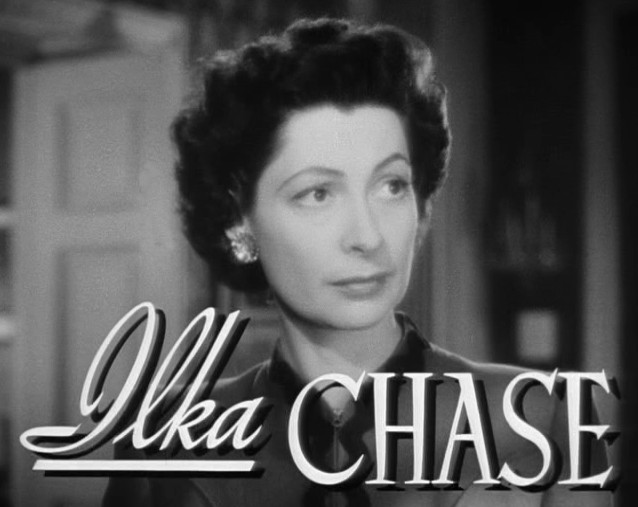
Ilka Chase
View on WikipediaIlka Chase (April 8, 1905 – February 15, 1978)[1] was an American actress, radio host, and novelist.
Key Information


Early life
[edit]Chase was born in New York City and educated at convent and boarding schools in the United States, England, and France. She was the only child of Francis Dane Chase, a merchant mariner who became a dry goods salesman and then the general manager of New York's Hotel Colonial, and Edna Woolman Chase (née Allaway). Her mother, who became the editor-in-chief of Vogue, described Chase's father, whom she married in 1902, as "a lovable, good-looking, irresponsible young man from Boston. His father had been a banker, and depending on when you met them, the family had money."[2] After her parents' divorce, her father married artist Theodora Larsh. Her mother married engineer Richard Newton.[citation needed]
Chase made her stage debut at the age of eight in a convent-school production of Puss in Boots.[3] After graduating from France's Château de Groslay boarding school, Chase made her society debut in December 1923 at a celebrity-studded banquet hosted by Edna at the Cosmopolitan Club in New York City. The 250 guests included Edna's employer, Condé Nast, Vanity Fair editor-in-chief Frank Crowninshield, and future Harper's Bazaar editor-in-chief Carmel Snow.[4]
Career
[edit]Stage
[edit]
Chase's Broadway debut occurred in 1924 in The Red Falcon.[5] Her stage appearances included roles in Days Without End, Forsaking All Others, While Parents Sleep, Small Miracle, On to Fortune, Tampico, Co-Respondent Unknown, Keep Off the Grass, and In Bed We Cry, an adaptation of her novel of the same name. She was in the original Broadway cast of Clare Boothe Luce's play The Women (1938), and many years later appeared in Neil Simon's Broadway hit Barefoot in the Park.[6]
Films
[edit]Her films included Fast and Loose (1930), The Animal Kingdom (1932), Now, Voyager (1942), Once a Sinner (1950), and The Big Knife (1955). Her last motion picture was in Ocean's 11 (1960) as Mrs. Restes.
Radio
[edit]In the early 1940s, Chase was the hostess for Penthouse Party on CBS[7] and Luncheon Date With Ilka Chase, on NBC Red.[8] For several years, she hosted the radio program Luncheon at the Waldorf.
Television
[edit]Chase became host of Fashion Magic on WCAU television in late 1950. The half-hour show was broadcast on Monday and Friday afternoons.[9] She appeared as a panelist on several programs in the early years of television, including Celebrity Time (1949–50), Who Said That? (1950–55), and Masquerade Party (1952–56). She also hosted the CBS TV series Fashion Magic[10] (1950–51).[citation needed]
In 1957, Chase performed the role of the Stepmother in the television production of Rodgers and Hammerstein's Cinderella, which starred Julie Andrews. In 1963, she made a rare television sitcom appearance as Aunt Pauline on The Patty Duke Show.[11][12]
Chase was a regular in The Trials of O'Brien on CBS in the mid-1960s.[13]
Writing
[edit]Her novel In Bed We Cry appeared in 1943[14] and was adapted for the stage, with Chase in the leading role.
Her autobiography Past Imperfect (volume I), in which she wrote, "Those who never fail are those who never try," was published in 1942, and Free Admission (volume II) was published in 1948. She also wrote more than a dozen other books, including The Care and Feeding of Friends, a guide to lighthearted entertaining with over 80 recipes and 20 menus.[15]
Among her other books are several travel books which recount her adventures while traveling around the world with her husband Dr. Norton Brown.
Personal life
[edit]Chase was married three times, first to stage and movie actor Louis Calhern. The couple met while performing in summer stock with the George Cukor Company in Rochester, New York, married in June 1926, and divorced six months later, in February 1927.[citation needed]
She next wed William Buckley Murray, a former music critic of The Brooklyn Daily Eagle and onetime executive of NBC, in Greenwich, Connecticut, on 13 July 1935. Murray also had been a concert manager for the Baldwin Piano Company and became the head of radio and television at the William Morris Agency. In 1932, Chase and Murray had adapted We Are No Longer Children, a play by French playwright Leopold Marchand. From this marriage, she had one stepson, William Buckley Murray Jr. Murray's only child by his previous wife, Natalia Danesi, an opera singer. William Jr., later became a crime novelist and writer for The New Yorker. Ilka and William Sr., were divorced in Las Vegas, Nevada, on 4 December 1946.[16]
Three days later, on 7 December 1946, she married Norton Sager Brown, a physician, in Las Vegas. Chase and Brown had divorced their spouses so they could marry each other.[17] They remained married until her death in 1978. From this marriage, Chase had a stepson, James Brown.[citation needed]
Death
[edit]Chase died of internal hemorrhaging on February 15, 1978, in Mexico City, Mexico. She was 72.[18] She was buried beside her mother in Locust Valley Cemetery on Long Island, New York.[19]
Personal papers
[edit]Chase's personal papers, as well as those of her mother, are in the Billy Rose Theatre Division of the New York Public Library.[20]
Filmography
[edit]| Year | Title | Role | Notes |
|---|---|---|---|
| 1929 | Paris Bound | Fanny Shipman | based on the 1927 play Paris Bound, in which Chase was a member of the cast |
| Why Leave Home? | Ethel | Lost film | |
| The Careless Age | Bunty | ||
| Red Hot Rhythm | Mrs. Fioretta | Lost film | |
| Rich People | Margery Mears | ||
| South Sea Rose | Maid | Lost film | |
| 1930 | Let's Go Places | Mrs. Du Bonnet | Lost film |
| The Big Party | Lost film | ||
| Her Golden Calf | Comedienne | ||
| Born Reckless | High Society Customer at Beretti's | ||
| The Florodora Girl | Fanny | ||
| On Your Back | Dixie Mason | ||
| Fast and Loose | Millie Montgomery | ||
| Free Love | Pauline | ||
| 1931 | Once a Sinner | Kitty King | |
| The Gay Diplomat | Madame Blinis | ||
| 1932 | The Animal Kingdom | Grace | |
| 1936 | Soak the Rich | Mrs. Mabel Craig | |
| The Lady Consents | Susan | ||
| 1939 | Stronger Than Desire | Jo Brennan | |
| 1942 | Now, Voyager | Lisa Vale | |
| 1943 | No Time for Love | Hoppy Grant | |
| 1948 | Miss Tatlock's Millions | Cassie Van Alen | |
| 1954 | It Should Happen to You | Guest Panel #2 | |
| Johnny Dark | Abbie Binns | ||
| 1955 | The Big Knife | Patty Benedict | |
| 1960 | Ocean's 11 | Mrs. Restes |
Bibliography
[edit] |
Novels
[edit]- Chase, Ilka (1943). In Bed We Cry.
- Chase, Ilka (1946). I love Miss Tilli Bean.
- Chase, Ilka (1951). New York 22.
- Chase, Ilka (1956). The Island Players.
- Chase, Ilka (1960). Three Men on the Left Hand.
- Chase, Ilka (1976). Dear Intruder: A novel about an indiscretion.
Non-fiction
[edit]- Chase, Ilka. The Care and Feeding of Friends.
Memoirs
[edit]- Chase, Ilka (1942). Past Imperfect.
- — (1948). Free Admission.
Travel Books
[edit]- Chase, Ilka (1961). The Carthaginian Rose.
- Chase, Ilka (1963). Elephants arrive at half-past five.
- Chase, Ilka (1966). Second Spring and Two Potatoes.
- Chase, Ilka (1967). Fresh From The Laundry.
- Chase, Ilka (1969). The Varied Airs of Spring, Chase.
- Chase, Ilka (1970). Around the World and Other Places, Chase.
Essays and reporting
[edit]- Chase, Ilka (1953). "It was good enough for Father". In Birmingham, Frederic A. (ed.). The Girls from Esquire. London: Arthur Barker. pp. 129–135.
Critical studies and reviews of Chase's work
[edit]- In Bed We Cry
- Wylie, Philip (November 7, 1943). "Gleanings from the Crop of Fall Novels : Cafe Society Amours". The New York Times.
References
[edit]- ^ Birth year of 1905 cited in 1910 U.S. Federal Census for New York City, accessed on ancestry.com on 5 April 2017. Birth year also cited on Chase's passport applications, the earliest being 1921, when she was 15, the age she states, giving her birthdate at 8 April 1905
- ^ Chase, Edna Woolman; Chase, Ilka (1954). Always in Vogue. Garden City, NY: Doubleday. p. 40. Retrieved March 29, 2022.
- ^ "Chase, Ilka (1905–1978) | Encyclopedia.com". www.encyclopedia.com. Retrieved 2024-08-30.
- ^ "Miss Ilka Chase Makes Her Debut". The New York Times. 18 December 1923, page 19, column 1.
- ^ "Ilka Chase's 'Penthouse Party' New WHP Summer Program". Harrisburg Telegraph. June 7, 1941. p. 26. Retrieved May 5, 2015 – via Newspapers.com.
- ^ Ilka Chase at the Internet Broadway Database
- ^ "Ilka Chase 'Penthouse Party' Heard Half-Hour Earlier". Harrisburg Telegraph. June 21, 1941. p. 26. Retrieved May 5, 2015 – via Newspapers.com.
- ^ Burr, Eugene (February 14, 1942). "Program Reviews: 'Luncheon Date With Ilka Chase'" (PDF). Billboard. p. 8. Retrieved 29 March 2015.
- ^ Stretch, Bud (December 7, 1950). "Air Waves". Courier-Post. New Jersey, Camden. p. 15. Retrieved November 23, 2024 – via Newspapers.com.
- ^ "Ilka Chase, hostess of the CBS television show "Fashion Magic" poses..." Getty Images. 2017-12-06. Archived from the original on 2024-03-29. Retrieved 2024-03-29.
- ^ "The Patty Duke Show Season 1 Episodes". TV Guide. Archived from the original on 2024-03-29. Retrieved 2024-03-29.
- ^ Kay, Linda (2014-07-15). "The Patty Duke Show – " The House Guest"". Cinema Cats. Archived from the original on 2024-03-29. Retrieved 2024-03-29.
- ^ "EX-Mother-in-Law Is OK!". The Berkshire Eagle. Pittsfield, Massachusetts. October 9, 1965. p. 19. Retrieved May 5, 2015 – via Newspapers.com.
- ^ Wylie, Philip (November 7, 1943). "Gleanings from the Crop of Fall Novels: Cafe Society Amours". The New York Times. Retrieved December 25, 2020.
- ^ "Ilka Chase Books". Shakari Connection. Retrieved 2024-08-30.
- ^ "Ilka Chase Married to William B. Murray". The New York Times. 14 July 1935. page 74.
- ^ "Ilka Chase Wed in Nevada", The New York Times, 8 December 1946
- ^ "Ilka Chase, Act'ress and Author, 72, is Dead in Mexico". The New York Times. 16 February 1978.
- ^ Wilson, Scott (22 August 2016). Resting Places: The Burial Sites of More Than 14,000 Famous Persons, 3d ed. ISBN 9780786479924.
- ^ "Ilka Chase papers". New York Public Library. Retrieved March 29, 2022.
External links
[edit]
- Ilka Chase at IMDb
- Ilka Chase at the Internet Broadway Database
- Ilka Chase at Find a Grave
- Ilka Chase papers, 1850-1977 bulk (1916-1977), held by the Billy Rose Theatre Division, New York Public Library for the Performing Arts
- Photographic portraits of Ilka Chase by Cecil Beaton, Arnold Genthe, Man Ray, and Edward Steichen, 1925-1930s, held by the Billy Rose Theatre Division, New York Public Library for the Performing Arts

| International | |
|---|---|
| National | |
| Academics | |
| Artists | |
| People | |
| Other | |
Ilka Chase
View on GrokipediaEarly life
Family and upbringing
Ilka Chase was born on April 8, 1905, in New York City, the only child of Edna Woolman Chase and Francis Dane Chase.[3][4] Her mother, Edna Woolman Chase, rose to become editor-in-chief of Vogue magazine, a position she held from 1914 to 1952, which elevated the family's standing in New York's elite fashion and social circles.[2][5] In contrast, her father had a background as a merchant mariner before transitioning to roles as a dry goods salesman and eventually manager of New York's Hotel Colonial, reflecting a life of varied professional pursuits.[6][7] The Chase family traced its roots to a Quaker lineage, including notable ancestors like author John Woolman, though Ilka later highlighted her great-grandmother's bold escapades during the Civil War—running away to marry a Southern doctor, raising a family in Florida, and returning to remarry her first husband—as emblematic of the family's spirited heritage.[7] Despite financial strains noted in her parents' marriage, which ended in divorce when Ilka was young, the household maintained an air of cultural refinement and adventure; her father entertained her with salty sea chanteys before bedtime, fostering an early sense of whimsy and exploration.[7][5] Chase's upbringing involved a mix of strict discipline and international exposure, beginning with attendance at the Convent of the Holy Child Jesus in New York, where she was sent to cultivate proper manners but instead learned to play pool from the nuns using a table left from the school's prior owner.[7] She later transferred to secular schools in the United States and boarding institutions in England and France, immersing her in European society and arts from a young age.[2] This cosmopolitan childhood culminated in her society debut in 1923, a grand event hosted by her mother with 250 guests, marking her entry into New York high society as a prominent young socialite.[2]Education
Chase was sent to convent schools in the United States at the age of five, following her parents' divorce, as these were among the few institutions that accepted children of her age.[1] During her early education, she attended Mrs. Dow's School in Briarcliff Manor, New York, where she participated in school plays, including a role as Malvolio in Twelfth Night, fostering her lifelong passion for theater.[8] In her teenage years, Chase continued her education at boarding schools in England and France, immersing herself in European cultures and languages that would later shape her travel writing.[2] At age eight, in a convent school production of Puss in Boots, she made an early stage appearance as a rabbit, sparking her interest in performance.[9] At sixteen, she attended a private boarding school in Groslay, near Paris, for two years, where her enthusiasm for acting was reignited after seeing actress Vera Sergine in Edmond Rostand's L'Aiglon.[8][1] Upon returning to the United States around 1923, Chase made her society debut in December of that year at a large dinner and dance hosted by her mother, but she quickly chose to pursue a career on the stage over a conventional path into society marriage.[8] She transitioned to professional pursuits in 1923–1924 by joining the Stuart Walker stock company, beginning with small roles that marked the start of her acting career.[8]Career
Stage
Ilka Chase made her Broadway debut in 1924 at the age of 19, appearing in the short-lived drama The Red Falcon as Sister Francesca and a maid.[10] Throughout the 1920s, she established herself as an ingenue in several productions, including the mystery comedy Shall We Join the Ladies? (1925), where she played Mrs. Castro, and Antonia (1925) as Lia.[10] These early roles often cast her in supporting parts that showcased her emerging comedic timing and poise, contributing to her growth as a versatile performer in American theater.[11] Chase's career gained significant momentum in the 1930s with a series of comedic and dramatic roles that highlighted her talent for portraying witty, socially astute characters. A pivotal breakthrough came in 1936 with Clare Boothe Luce's The Women, where she originated the role of Sylvia Fowler, the sharp-tongued socialite and gossip central to the play's all-female ensemble satirizing high society. The production ran for 657 performances, cementing Chase's reputation as a comic actress adept at delivering biting dialogue and sophisticated humor. Her performance in this social satire exemplified her signature style, blending elegance with acerbic commentary on interpersonal dynamics among the elite. Over her career, Chase appeared in at least 19 Broadway productions, spanning comedies, dramas, and musical revues, often emphasizing themes of social observation and verbal sparring.[11] Notable among these were her turns in Philip Barry's The Animal Kingdom (1932) as Grace Macomber, a role that further displayed her flair for drawing-room wit, and Eugene O'Neill's Days Without End (1934) as Lucy Hillman, venturing into more dramatic territory.[10] She also starred in her own adaptation In Bed We Cry (1944), playing Devon Elliott Wainwright in a comedy drawn from her novel.[12] After a hiatus from the stage following World War II, Chase returned in 1966 for Neil Simon's Barefoot in the Park, taking over the role of the eccentric mother-in-law, Mrs. Banks, from May 1966 to April 1967 during the show's long run.[13] This postwar appearance allowed her to reprise her strengths in light comedy, delivering lines with the dry wit that had defined her earlier successes and delighting audiences with her portrayal of a meddlesome yet endearing figure.[14] Through such roles, Chase made enduring contributions to American stage comedy and drama, particularly in works that critiqued social norms with humor and precision.[11]Films
Ilka Chase made her film debut in the 1929 Pathé production Paris Bound, a screen adaptation of Philip Barry's play in which she had appeared on Broadway. Following this entry into early talkies, she continued with supporting roles in 1930s films such as Fast and Loose (1930), where she played Millie Montgomery, and The Animal Kingdom (1932), portraying the sophisticated Grace Palmer. These early appearances marked her transition from stage success to Hollywood, where her Broadway reputation for witty characterizations earned her initial screen offers, though she often faced typecasting in polished, upper-class comedic parts that limited deeper dramatic exploration.[15] One of Chase's most iconic film roles came in 1942 with Now, Voyager, directed by Irving Rapper, in which she portrayed Lisa Vale, the composed yet subtly strained sister-in-law within Bette Davis's domineering family dynamic as Charlotte Vale. Her performance added sharp social commentary to the melodrama, highlighting the constraints of high society. Chase's film career, spanning approximately 25 credits from 1929 to 1960, frequently positioned her as a character actress in aristocratic supporting roles, leveraging her acerbic timing in ensemble casts.[16] In the 1950s, Chase appeared in The Big Knife (1955), playing the gossip columnist Patty Benedict in Clifford Odets's Hollywood satire, a role that better captured her signature caustic wit compared to many of her earlier assignments. She later joined the ensemble of Ocean's 11 (1960), directed by Lewis Milestone, as Mrs. Restes, the mother of Frank Sinatra's character, marking her final film appearance in a star-studded heist comedy. Throughout her screen work, Chase contributed to classic cinema as a reliable purveyor of elegant, biting dialogue, though she noted in interviews that Hollywood rarely fully utilized her range beyond typecast sophistication.[17]Radio
Ilka Chase began her radio career in the early 1930s with guest appearances in comedy sketches, such as a skit on the NBC program Vanity Fair in 1933–1934 alongside Hugh O'Connell.[18] By the late 1930s and into the 1940s, she expanded into dramatic anthologies, performing monologues and roles that highlighted her sharp delivery, including a portrayal of Dorothy Parker's witty persona on Radio Hall of Fame in March 1944.[19] These guest spots on shows like Information Please in 1942 showcased her transition from stage acting to broadcast media, where her acerbic wit—honed in Broadway comedies—translated effectively to audio sketches and adaptations of her theatrical roles.[20] In the 1940s, Chase established herself as a radio host with Penthouse Party on CBS, debuting in 1941 as Ilka Chase's Penthouse Party, a 30-minute musical variety program featuring celebrity interviews, comedy sketches, and performances by regulars like Yvette Harris and Judith Anderson, accompanied by Paul Barton's orchestra.[21] The show, later simply titled Penthouse Party by 1947, emphasized Chase's sophisticated humor in banter with guests, blending entertainment with lighthearted commentary.[18] She also co-hosted an earlier version, Penthouse Party, on NBC-Blue in 1934–1935 with Gladys Glad, marking her initial foray into variety hosting.[18] Chase's most enduring radio role was co-hosting Luncheon at the Waldorf on NBC, which premiered in 1940 as a 30-minute variety show broadcast live from the Waldorf-Astoria Hotel's Empire Room, incorporating music by Paul Baron's orchestra and songs by Frank Luther, while focusing on fashion, society gossip, and current events.[21] The program evolved into the 15-minute dramatic format A Luncheon Date with Ilka Chase by 1942, where she portrayed a socialite hostess discussing topics with guests, drawing on her family's Vogue connections—her mother, Edna Woolman Chase, was the magazine's longtime editor—to lend authenticity to its stylish, daytime appeal.[22] It continued through the late 1940s, with Chase occasionally serving as a panelist on related shows like Leave It to the Girls on Mutual from 1945 to 1949.[18] Throughout her radio tenure, Chase infused sketches and role adaptations with her signature acerbic wit, often adapting stage characters like those from her Broadway successes into audio formats for programs such as The Ilka Chase Program in 1945.[18] By the mid-1950s, however, her radio work declined as the rise of television shifted audience attention to visual media, prompting her pivot to TV hosting opportunities.[21]Television
Ilka Chase transitioned to television in the early 1950s, leveraging her socialite persona and radio experience to host Fashion Magic on CBS, a half-hour fashion advice program that aired on Monday and Friday afternoons starting in late 1950.[23] Sponsored by Playtex, the show featured Chase interviewing guests and offering style tips, reflecting the era's growing emphasis on daytime programming for women.[24] Broadcast from WCAU-TV in Philadelphia, a CBS affiliate, it ran through 1951 and capitalized on Chase's wit and elegance to appeal to homemakers navigating postwar consumer culture.[25] In the 1960s, Chase made notable guest appearances in comedic roles on popular sitcoms, showcasing her talent for portraying sharp-tongued matriarchs. She played the domineering Aunt Pauline in the 1963 episode "The House Guest" of The Patty Duke Show, where her character disrupts the Lane family with overbearing gifts and demands, earning praise for injecting sophisticated humor into the family dynamic.[26] Similarly, from 1965 to 1966, she appeared as Margaret, the ex-mother-in-law, in four episodes of the CBS legal drama The Trials of O'Brien, providing comic relief amid the series' courtroom intrigue starring Peter Falk.[27] Chase also took on occasional dramatic roles in live anthology series, adapting her stage-honed skills to the demands of early television. She starred in episodes of Kraft Television Theatre, including the 1952 production "The Paper Moon" alongside Ruth Chatterton, where she portrayed a complex character in a tale of deception, and the 1953 episode "Day of the Vision," involving supernatural elements with a cast including Harry Townes.[28] These live broadcasts highlighted the medium's challenges, such as the pressure of unscripted mishaps and tight rehearsal schedules, which Chase navigated with her Broadway discipline.[29] Early television offered Chase opportunities to comment on evolving women's roles, as seen in her hosting duties that blended fashion with social commentary on domestic life and independence. In Fashion Magic and similar programs, she addressed how television empowered women viewers by providing practical advice amid shifting gender norms, though she noted the live format's intensity often amplified on-air vulnerabilities.[30] By the mid-1960s, after her Trials of O'Brien stint, Chase's television work tapered off, allowing her to focus increasingly on writing novels and memoirs that explored similar themes of femininity and society.[31]Writing
Ilka Chase's writing career spanned over three decades, producing more than a dozen books that blended sharp wit with incisive observations on society, drawing from her experiences in entertainment and high society.[1] Influenced by her mother's prominent role at Vogue, Chase developed an early affinity for literary pursuits that informed her satirical and autobiographical style.[32] Her debut novel, In Bed We Cry (1943), became a bestseller, offering a humorous satire of high society and the complexities of marriage through the story of an ambitious cosmetics executive navigating romantic entanglements in New York's elite circles.[33] The book drew on Chase's own observations of café society, blending her public persona as an actress and commentator with fictional critique of social ambitions and relationships.[33] Chase's memoirs, beginning with Past Imperfect (1942), provided candid, witty accounts of her early life, European upbringing, and entry into show business, targeting friends, colleagues, and the literary world with "cool aim."[1] This volume, subtitled The Indiscretions of a Lady of Wit and Wisdom, recounted her youth in boarding schools and travels, establishing her voice as one of engaging brittleness and unsparing honesty.[34] Subsequent works like Free Admission (1957) extended this autobiographical thread, covering her Hollywood years, wartime experiences, and marriage with similar candid humor.[35] In her travel books, such as The Carthaginian Rose (1961), Chase chronicled journeys through Europe and Southeast Asia with a comedic, insightful lens on cultural encounters and personal adventures.[36] These narratives highlighted her observational prowess, often infused with the same social commentary that marked her other writings.[37] Chase also contributed essays and articles to magazines like Vogue, addressing fashion, societal norms, and elements of women's independence, reflecting her insider perspective on American elite culture.[32] Her overall style—characterized by acid wit, autobiographical intimacy, and pointed critiques of 20th-century high society—cemented her reputation as a versatile literary figure.[1] While her major works received acclaim, lesser-known essays from her post-World War II travels in Europe, including observations on rebuilding societies behind the Iron Curtain, remain underexplored aspects of her output.[38]Personal life
Marriages
Ilka Chase's first marriage was to actor Louis Calhern on June 2, 1926, in Irondequoit, New York; the union lasted less than a year, ending in divorce in 1926 amid the demands of their early stage careers.[3][8] Her second marriage, to radio executive William B. Murray on July 13, 1935, provided a period of relative stability during her rising prominence in radio and writing, but it concluded in divorce in 1946 after eleven years.[8][32] Chase's third and final marriage was to physician Norton Sager Brown on December 7, 1946, in Las Vegas, following their respective divorces; this partnership endured until her death in 1978 and supported her later travels and creative endeavors, including international trips that informed her travel writing.[8][36] Throughout her marriages, Chase maintained a strong sense of personal independence, a theme reflected in her 1941 lecture tour on "the philosophy of being a woman," where she explored gender roles and self-reliance, aligning with the feminist undertones in her memoirs and essays.[8] Chase had no biological children, though her unions introduced stepfamily dynamics that influenced her perspectives on domestic life as expressed in her writings.[8]Family
Ilka Chase had no biological children, but her family life was deeply influenced by her mother's prominent career in fashion. Her mother, Edna Woolman Chase, served as editor-in-chief of Vogue magazine from 1914 to 1952, establishing it as a leading authority on style and culture. Ilka maintained a close relationship with her mother, collaborating on the 1954 memoir Always in Vogue, which offered insights into Edna's professional achievements and the family's immersion in New York's social and creative circles.[8] The family resided primarily in a luxurious apartment in New York City, where Chase was renowned as a witty and elegant hostess, frequently entertaining artists, writers, and philanthropists.[32]Death and archives
Death
In her later years, Ilka Chase retired from performing in 1972 to devote more time to her writing and travel. After her third husband, Dr. Norton S. Brown, retired as a physician, the couple relocated to Cuernavaca, Mexico—a resort town about 50 miles south of Mexico City—while retaining a residence on Long Island, New York. She authored 18 books across genres including fiction, travelogues, and memoirs, co-wrote her mother's autobiography Always in Vogue (1954), and was actively working on a nineteenth book at the time of her death.[39] On February 13, 1978, while vacationing and shopping in Mexico City, Chase suffered a fall that resulted in internal hemorrhaging. She was rushed to the American-British-Canadian Hospital in Mexico City for treatment but died there two days later, on February 15, at the age of 72.[37][1] Chase was buried beside her mother, Edna Woolman Chase, in Locust Valley Cemetery, Locust Valley, New York.[4] Her death prompted obituaries that highlighted her versatile career and celebrated her as "a practical woman and a practiced wit who greatly brightened her times," reflecting admiration from the theater and literary communities for her enduring legacy.[1]Personal papers
The Ilka Chase Papers are housed in the Billy Rose Theatre Division of the New York Public Library for the Performing Arts.[32] The collection was donated in July 1981 by her third husband, Dr. Norton S. Brown, following Chase's death in 1978.[22] Spanning 1850 to 1977, with the bulk of materials dating from 1916 to 1977, the archive encompasses correspondence, photographs, newspaper clippings, scripts, scrapbooks, and other items primarily related to Chase's career in theater, radio, writing, and public life.[32] These documents cover her professional activities from the 1920s through the 1970s, including interactions with notable figures in the entertainment industry. The collection also incorporates papers from her mother, Edna Woolman Chase, editor of Vogue magazine, adding context to family influences on Ilka's career.[22] Notable components include scripts from her stage and radio productions, personal and professional correspondence reflecting collaborations with theater contemporaries, and scrapbooks compiling memorabilia such as clippings and photographs that document her multifaceted career.[32] While specific drafts of novels are held in a separate collection at Boston University, the New York Public Library holdings provide insight into her creative processes through related writings and ephemera.[40] The archive holds significant research value for scholars examining 20th-century American theater, broadcasting, and women's roles in media and literature, offering primary sources on Chase's contributions and networks.[32] Access is available to researchers by appointment through the Billy Rose Theatre Division, with materials viewable in the reading room; no full digitization is currently available, though portions may be cataloged for on-site use.[41]Works and publications
Filmography
Ilka Chase's film career spanned from 1929 to 1961, encompassing 25 feature films where she typically played supporting roles as elegant society women, gossipy matrons, or comedic figures, reflecting her sharp-witted public image.[16][42] Her appearances were sporadic, with notable gaps—such as over five years between 1936 and 1942—due to her primary commitments to stage acting and radio hosting.[42] No unreleased films or significant uncredited cameos are documented beyond her credited roles, though early works like South Sea Rose were minor parts in lost or obscure productions; comprehensive film databases confirm the following chronological credits.[16]1920s
| Year | Title | Role | Director | Notable Co-Stars |
|---|---|---|---|---|
| 1929 | Paris Bound | Mrs. E. V. Wheeler | Clarence Badger | Fredric March, Kay Francis |
| 1929 | Red Hot Rhythm | Mrs. Fioretta | Leo McCarey | Alan Hale, Kathryn Crawford |
| 1929 | The Careless Age | Bunty | John Griffith Wray | George O’Brien, Rosemary Ames |
| 1929 | Why Leave Home? | Ethel | Raymond Cannon | Sue Carol, Nick Stuart |
| 1929 | Rich People | Margery Mears | William C. deMille | Constance Bennett, Robert Ames |
| 1929 | South Sea Rose | Maid | Allan Dwan | Lenore Ulric, Charles Bickford |
1930s
| Year | Title | Role | Director | Notable Co-Stars |
|---|---|---|---|---|
| 1930 | Let's Go Places | Mrs. Du Bonnet | Frank R. Strayer | Joseph Wagstaff, Lola Lane |
| 1930 | Born Reckless | High Society Customer at Beretti's | John Ford | Rex Bell, Nancy Carroll |
| 1930 | The Big Party | Dot | John G. Blystone | Sue Carol, Dixie Lee |
| 1930 | The Florodora Girl | Fanny | Harry Beaumont | Marion Davies, Lawrence Gray |
| 1930 | Fast and Loose | Millie | Fred C. Newmeyer | Miriam Hopkins, Carole Lombard |
| 1930 | Free Love | Pauline | Richard Thorpe | Conrad Nagel, Leonora Ulric |
| 1931 | The Gay Diplomat | Madame Blinis | William C. McGann | Ivan Lebedeff, Lilyan Tashman |
| 1931 | Once a Sinner | Kitty King | Guthrie McClintic | Dorothy Mackaill, Joel McCrea |
| 1932 | The Animal Kingdom | Grace | Edward H. Griffith | Leslie Howard, Ann Harding |
| 1936 | The Lady Consents | Edith | Alan Crosland | Ann Harding, Herbert Marshall |
| 1936 | Soak the Rich | Mabel Craig | Ben Hecht | Walter Connolly, John Howard |
1940s
| Year | Title | Role | Director | Notable Co-Stars |
|---|---|---|---|---|
| 1942 | Now, Voyager | Lisa Vale | Irving Rapper | Bette Davis, Paul Henreid, Claude Rains |
| 1943 | No Time for Love | Hoppy Grant | Mitchell Leisen | Claudette Colbert, Fred MacMurray |
| 1948 | Miss Tatlock's Millions | Priscilla | Richard Wallace | John Lund, Wanda Hendrix |
1950s–1960s
| Year | Title | Role | Director | Notable Co-Stars |
|---|---|---|---|---|
| 1954 | It Should Happen to You | Herself (cameo) | George Cukor | Judy Holliday, Jack Lemmon |
| 1954 | Johnny Dark | Abbie Binns | George Sherman | Tony Curtis, Piper Laurie |
| 1955 | The Big Knife | Patty Benedict | Robert Aldrich | Jack Palance, Ida Lupino, Rod Steiger |
| 1960 | Ocean's Eleven | Mrs. Restes | Lewis Milestone | Frank Sinatra, Dean Martin, Sammy Davis Jr. |
| 1961 | Tammy Tell Me True | Mrs. Annie Call | Harry Keller | Sandra Dee, John Gavin |
Bibliography
Ilka Chase authored over a dozen books across genres, including novels, memoirs, non-fiction, and travelogues, often drawing on her experiences in theater, society, and journalism. Her writings frequently blended wit, social observation, and personal anecdote, reflecting her multifaceted career. Most were published by Doubleday & Company, with themes ranging from romantic intrigue to postwar travel adventures.[50]Novels
Chase's novels often explored interpersonal dynamics, urban life, and light satire, with several achieving commercial success and stage adaptations.- In Bed We Cry (1943, Doubleday): A tale of emotional and romantic entanglements among New York socialites.[51]
- I Love Miss Tilli Bean (1946, Doubleday): Follows two Quaker sisters navigating adventure and mischief in small-town America.[50]
- New York 22 (1951, Doubleday): Chronicles life in a specific Manhattan district, capturing postwar city vibrancy and relationships.[52]
- The Island Players (1956, Doubleday): Centers on a theater troupe's interpersonal dramas during a summer production.[50]
- Three Men on Third (1960, Doubleday): A comedic exploration of romantic triangles and social faux pas.[8]
- The Carthaginian Rose (1961, Doubleday): Features intrigue and romance set against historical backdrops.[52]
- Elephants Arrive at Half-Past Five (1963, Doubleday): A whimsical story of unexpected encounters and personal growth.[53]
- Fresh from the Laundry (1967, Doubleday): Examines family secrets and reinvention in midlife.[50]
- The Care and Feeding of Friends (1973, Doubleday): Satirizes friendships and social obligations among the elite.[54]
- Dear Intruder (1976, Doubleday): A novel about infidelity and its consequences in high society.[36]
Memoirs
Chase's memoirs provided candid, humorous insights into her early life, career, and celebrity circles, establishing her as a sharp social commentator.- Past Imperfect (1942, Doubleday): Volume one of her autobiography, detailing childhood, entry into acting, and early marriages.[50]
- Free Admission: Further Indiscretions of a Lady of Wit and Opinion (1948, Doubleday): Sequel covering her Broadway successes, Hollywood forays, and personal reflections.[35]
Non-fiction and Essays
Chase contributed essays on fashion, society, and women's roles to magazines like Vogue and Harper's Bazaar, often collected or anthologized; her non-fiction extended these themes into book form.- Always in Vogue (1954, Doubleday, co-authored with Edna Woolman Chase): A history of Vogue magazine from its founding, blending memoir and journalism.[55]
- A Lady's Pleasure: The Modern Woman's Treasury of Good Reading (1946, William Penn Publishing Corp., edited by Chase): An anthology of essays, stories, and poems on women's experiences, featuring contributions from prominent authors.[36]
Travel Books
In her later years, Chase turned to travel writing, recounting journeys with humor and cultural insight, often focusing on Europe, Asia, and the Americas post-World War II.- Second Spring and Two Potatoes: An Amusing Journey to the South Seas, Australia & South Africa (1965, Doubleday): Accounts of midlife travels emphasizing renewal and exotic encounters.[50]
- The Varied Airs of Spring (1969, Doubleday): Chronicles European tours, highlighting seasonal festivals and local customs.[50]
- Around the World and Other Places (1970, Doubleday): A global travel narrative covering diverse destinations and personal anecdotes.[54]
- Worlds Apart: Travel Adventures in Russia, Latin America, and South America (1972, Doubleday): Explores Cold War-era Russia and Latin American sites, commenting on geopolitical contrasts.[56]
Critical Studies and Reviews
Scholarly attention to Chase's writings is limited, focusing primarily on her memoirs' role in mid-20th-century women's literature and social history rather than deep literary analysis.- Lambert, Gavin. On Cukor (1972, Putnam): Includes discussion of Chase's autobiographical influences on her screen personas and writings. (Biographical critique linking her books to film career.)
- Encyclopedia entry in American Women Writers (Encyclopedia.com, 2003 update): Analyzes her novels and memoirs for witty portrayals of gender roles and celebrity culture.[8]
- Kirkus Reviews on Free Admission (1948): Praises the memoir's "engaging, somewhat brittle" style as emblematic of Chase's satirical voice in American letters.[35]