Hubbry Logo
Plot (narrative)Plot (narrative)Main
Open search
Plot (narrative)
Community hub
Plot (narrative)
logo
8 pages, 0 posts
0 subscribers
Be the first to start a discussion here.
Contribute something
Plot (narrative)
Plot (narrative)
from Wikipedia
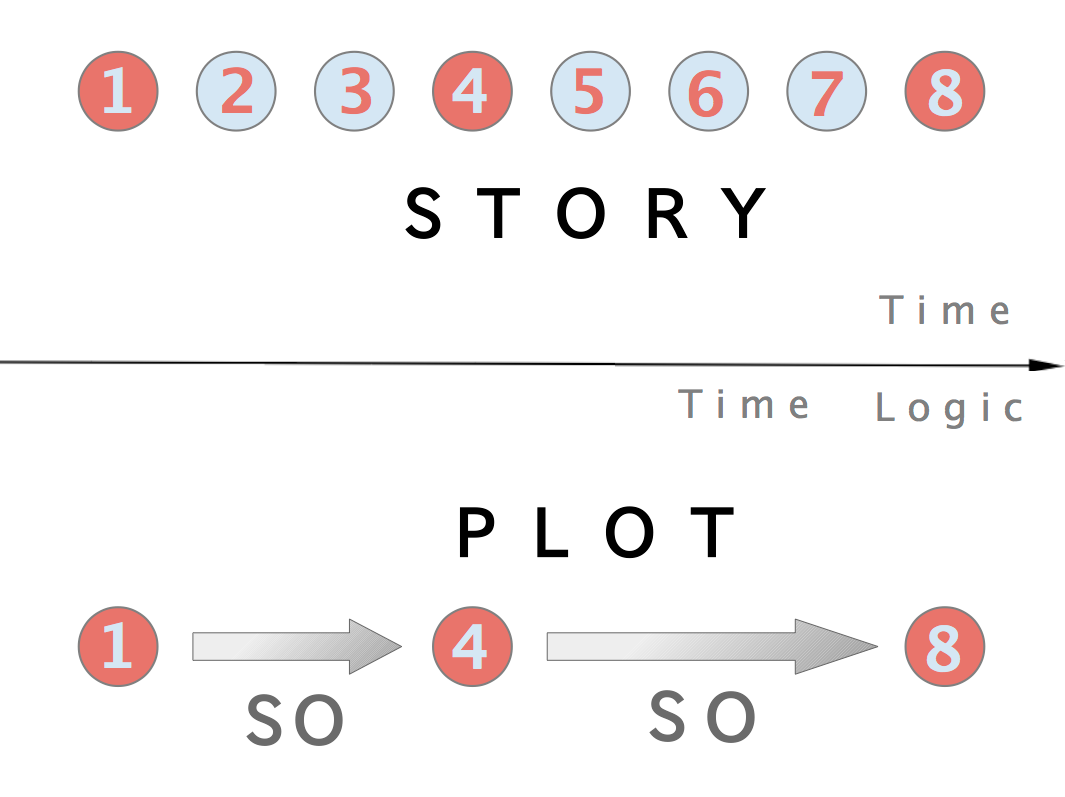
Story events numbered chronologically; the red plot events are a subset connected logically by "so". This basic plot is able to be mapped as a cause‐and‐effect sequence of main events.[1]

In a literary work, film, or other narrative, the plot is the mapping of events in which each one (except the final) affects at least one other through the principle of cause-and-effect. The causal events of a plot can be thought of as a selective collection of events from a narrative, all linked by the connector "and so". Simple plots, such as in a traditional ballad, can be linearly sequenced, but plots can form complex interwoven structures, with each part sometimes referred to as a subplot.

Plot is similar in meaning to the term storyline.[2][3] In the narrative sense, the term highlights important points which have consequences within the story, according to American science fiction writer Ansen Dibell.[1] The premise sets up the plot, the characters take part in events, while the setting is not only part of, but also influences, the final story. An imbroglio can convolute the plot based on a misunderstanding.

The term plot can also serve as a verb, as part of the craft of writing, referring to the writer devising and ordering story events. (A related meaning is a character's planning of future actions in the story.) However, in common usage (e.g., a "film plot"), the word plot more often refers to a narrative summary, or story synopsis.

Definition

[edit]

Early 20th-century English novelist E. M. Forster described plot as the cause-and-effect relationship between events in a story. According to Forster, "The king died, and then the queen died, is a story, while The king died, and then the queen died of grief, is a plot."[4][5][6]

Teri Shaffer Yamada, Ph.D., of CSULB, agrees that a plot does not include memorable scenes within a story that do not relate directly to other events but only "major events that move the action in a narrative."[7] For example, in the 1997 film Titanic, when Rose climbs on the railing at the front of the ship and spreads her hands as if she's flying, this scene is memorable but does not directly influence other events, so it may not be considered as part of the plot. Another example of a memorable scene that is not part of the plot occurs in the 1980 film The Empire Strikes Back, when Han Solo is frozen in carbonite.[1]

Fabula and syuzhet

[edit]

The literary theory of Russian Formalism in the early 20th century divided a narrative into two elements: the fabula (фа́була) and the syuzhet (сюже́т). A fabula is the chronology of the fictional world, whereas a syuzhet is a perspective or plot thread of those events. Formalist followers eventually translated the fabula/syuzhet to the concept of story/plot. This definition is usually used in narratology, in parallel with Forster's definition. The fabula (story) is what happened in chronological order. In contrast, the syuzhet (plot) means a unique sequence of discourse that was sorted out by the (implied) author. That is, the syuzhet can consist of picking up the fabula events in non-chronological order; for example, fabula is ⟨a1, a2, a3, a4, a5, ..., an, syuzhet is ⟨a5, a1, a3.

The Russian formalist, Viktor Shklovsky, viewed the syuzhet as the fabula defamiliarized. Defamiliarization or "making strange," a term Shklovsky coined and popularized, upends familiar ways of presenting a story, slows down the reader's perception, and makes the story appear unfamiliar.[8] Shklovsky cites Lawrence Sterne's Tristram Shandy as an example of a fabula that has been defamiliarized.[9] Sterne uses temporal displacements, digressions, and causal disruptions (for example, placing the effects before their causes) to slow down the reader's ability to reassemble the (familiar) story. As a result, the syuzhet "makes strange" the fabula.

Examples

[edit]
In "Cinderella", one of the key plot elements is the glass shoe fitting her.

Cinderella

[edit]

A story orders events from beginning to end in a time sequence.[1]

Consider the following events in the European folk tale "Cinderella":

  1. The prince searches for Cinderella with the glass shoe
  2. Cinderella's sisters try the shoe on themselves but it does not fit them
  3. The shoe fits Cinderella's foot so the prince finds her

The first event is causally related to the third event, while the second event, though descriptive, does not directly impact the outcome. As a result, according to Ansen Dibell, the plot can be described as the first event "and so" the last event, while the story can be described by all three events in order.

The Wizard of Oz

[edit]
In The Wizard of Oz, Dorothy makes three friends.

Fiction-writing coach Steve Alcorn says that the main plot elements of the 1939 film The Wizard of Oz are easy to find, and include:[10]

  1. A tornado picks up a house and drops it on a witch in a fantastical land
  2. A girl and her dog meet three interesting traveling companions
  3. Another witch sends them on a mission
  4. They melt a third witch with a bucket of water

Concepts

[edit]

Structure and treatment

[edit]

Dramatic structure is the philosophy by which the story is split and how the story is thought of. This can vary by ethnicity, region and time period. This can be applied to books, plays, and films. Philosophers/critics who have discussed story structure include Aristotle, Horace, Aelius Donatus, Gustav Freytag, Kenneth Thorpe Rowe, Lajos Egri, Syd Field, and others. Some story structures are so old that the originator cannot be found, such as Ta'zieh.

Often in order to sell a script, the plot structure is made into what is called a treatment. This can vary based on locality, but for Europe and European Diaspora, the three-act structure is often used. The components of this structure are the set-up, the confrontation and the resolution. Acts are connected by two plot points or turning points, with the first turning point connecting Act I to Act II, and the second connecting Act II to Act III. The conception of the three-act structure has been attributed to American screenwriter Syd Field who described plot structure in this tripartite way for film analysis.

Furthermore, in order to sell a book within the United States, United Kingdom, Canada, New Zealand, and Australia, often the plot structure is split into a synopsis. Again the plot structure may vary by genre or drama structure used.

Aristotle

[edit]

Many scholars have analyzed dramatic structure, beginning with Aristotle in his Poetics (c. 335 BC).

In his Poetics, a theory about tragedies, the Greek philosopher Aristotle put forth the idea the play should imitate a single whole action. "A whole is what has a beginning and middle and end" (1450b27).[11] He split the play into two acts: complication and denouement.[12] He mainly used Sophocles to make his argument about the proper dramatic structure of a play.

Two types of scenes are of special interest: the reversal, which throws the action in a new direction, and the recognition, meaning the protagonist has an important revelation.[13] Reversals should happen as a necessary and probable cause of what happened before, which implies that turning points need to be properly set up.[13] He ranked the order of importance of the play to be: Chorus, Events, Diction, Character, Spectacle.[12] And that all plays should be able to be performed from memory, long and easy to understand.[14] He was against character-centric plots stating “The Unity of a Plot does not consist, as some suppose, in its having one man as its subject.”[15] He was against episodic plots.[16] He held that discovery should be the high point of the play and that the action should teach a moral that is reenforced by pity, fear and suffering.[17] The spectacle, not the characters themselves would give rise to the emotions.[18] The stage should also be split into “Prologue, Episode, Exode, and a choral portion, distinguished into Parode and Stasimon...“[19]

Unlike later, he held that the morality was the center of the play and what made it great. Unlike popular belief, he did not come up with the three act structure popularly known.

Gustav Freytag

[edit]
Freytag's pyramid[20]

The German playwright and novelist Gustav Freytag wrote Die Technik des Dramas,[21] a definitive study of the five-act dramatic structure, in which he laid out what has come to be known as Freytag's pyramid.[22] Under Freytag's pyramid, the plot of a story consists of five parts:[23][20]

  1. Exposition (originally called introduction)
  2. Rising action (rise)
  3. Climax
  4. Falling action (return or fall)
  5. Catastrophe, denouement, resolution, or revelation[24] or "rising and sinking". Freytag is indifferent as to which of the contending parties justice favors; in both groups, good and evil, power and weakness, are mingled.[25]

A drama is then divided into five parts, or acts, which some refer to as a dramatic arc: exposition, rising action, climax, falling action, and catastrophe. Freytag extends the five parts with three moments or crises: the exciting force, the tragic force, and the force of the final suspense. The exciting force leads to the rising action, the tragic force leads to the falling action, and the force of the final suspense leads to the catastrophe. Freytag considers the exciting force to be necessary but the tragic force and the force of the final suspense are optional. Together, they make the eight component parts of the drama.[20]

In making his argument, he attempts to retcon much of the Greeks and Shakespeare by making opinions of what they meant, but did not actually say.[26]

He argued for tension created through contrasting emotions, but did not actively argue for conflict.[27] He argued that character comes first in plays.[28] He also set up the groundwork for what would later be called the inciting incident.[29]

Overall, Freytag argued the center of a play is emotionality and the best way to get that emotionality is to put contrasting emotions back to back. He laid some of the foundations for centering the hero, unlike Aristotle. He is popularly attributed to have stated conflict at the center of his plays, but he argues actively against continuing conflict.[30]

Freytag defines the parts as:

Introduction
The setting is fixed in a particular place and time, the mood is set, and characters are introduced. A backstory may be alluded to. Exposition can be conveyed through dialogues, flashbacks, characters' asides, background details, in-universe media, or the narrator telling a back-story.[31]
Rise
An exciting force begins immediately after the exposition (introduction), building the rising action in one or several stages toward the point of greatest interest. These events are generally the most important parts of the story since the entire plot depends on them to set up the climax and ultimately the satisfactory resolution of the story itself.[32]
Climax
The climax is the turning point, which changes the protagonist's fate. If things were going well for the protagonist, the plot will turn against them, often revealing the protagonist's hidden weaknesses.[33] If the story is a comedy, the opposite state of affairs will ensue, with things going from bad to good for the protagonist, often requiring the protagonist to draw on hidden inner strengths. A plot with an exciting climax is said to be climactic. A disappointing scene is instead called anticlimactic.[34]
Return or Fall
During the Return, the hostility of the counter-party beats upon the soul of the hero. Freytag lays out two rules for this stage: the number of characters be limited as much as possible, and the number of scenes through which the hero falls should be fewer than in the rising movement. The falling action may contain a moment of final suspense: Although the catastrophe must be foreshadowed so as not to appear as a non sequitur, there could be for the doomed hero a prospect of relief, where the final outcome is in doubt.[35]
Catastrophe
The catastrophe (Katastrophe in the original)[36] is where the hero meets his logical destruction. Freytag warns the writer not to spare the life of the hero.[37] More generally, the final result of a work's main plot has been known in English since 1705 as the denouement (UK: /dˈnmɒ̃, dɪ-/, US: /ˌdnˈmɒ̃/;[38]). It comprises events from the end of the falling action to the actual ending scene of the drama or narrative. Conflicts are resolved, creating normality for the characters and a sense of catharsis, or release of tension and anxiety, for the reader. Etymologically, the French word dénouement (French: [denumɑ̃]) is derived from the word dénouer, "to untie", from nodus, Latin for "knot." It is the unraveling or untying of the complexities of a plot.[39]

Plot devices

[edit]

A plot device is a means of advancing the plot in a story. It is often used to motivate characters, create urgency, or resolve a difficulty. This can be contrasted with moving a story forward with dramatic technique; that is, by making things happen because characters take action for well-developed reasons. An example of a plot device would be when the cavalry shows up at the last moment and saves the day in a battle. In contrast, an adversarial character who has been struggling with himself and saves the day due to a change of heart would be considered dramatic technique.

Familiar types of plot devices include the deus ex machina, the MacGuffin, the red herring, and Chekhov's gun.

Plot outline

[edit]

A plot outline is a prose telling of a story which can be turned into a screenplay. Sometimes it is called a "one page" because of its length. In comics, the roughs refer to a stage in the development where the story has been broken down very loosely in a style similar to storyboarding in film development. This stage is also referred to as storyboarding or layouts. In Japanese manga, this stage is called the nēmu (ネーム, pronounced like the English word "name"). The roughs are quick sketches arranged within a suggested page layout. The main goals of roughs are to:

  • lay out the flow of panels across a page
  • ensure the story successfully builds suspense
  • work out points of view, camera angles, and character positions within panels
  • serve as a basis for the next stage of development, the "pencil" stage, where detailed drawings are produced in a more polished layout which will, in turn, serve as the basis for the inked drawings.

In fiction writing, a plot outline gives a list of scenes. Scenes include events, character(s) and setting. Plot, therefore, shows the cause and effect of these things put together. The plot outline is a rough sketch of this cause and effect made by the scenes to lay out a "solid backbone and structure" to show why and how things happened as they did.

Plot summary

[edit]

A plot summary is a brief description of a piece of literature that explains what happens. In a plot summary, the author and title of the book should be referred to and it is usually no more than a paragraph long while summarizing the main points of the story.[40][41]

A-Plot

[edit]

An A-Plot is a cinema and television term referring to the plotline that drives the story. This does not necessarily mean it is the most important, but rather the one that forces most of the action.

See also

[edit]

Notes

[edit]

References

[edit]

Further reading

[edit]
[edit]
Revisions and contributorsEdit on WikipediaRead on Wikipedia
from Grokipedia
In narrative theory, the plot constitutes the structured sequence of events in a story, organized by causal connections and logical progression rather than mere chronology, serving as the foundational arrangement that drives the narrative forward and engages the audience through conflict, suspense, and resolution. This distinguishes plot from "story," which E.M. Forster defined as a simple narrative of events in time-sequence, such as "The king died and then the queen died," whereas plot introduces causality and motivation, as in "The king died, and then the queen died of grief." Originating in classical literary analysis, the concept traces back to Aristotle's Poetics, where plot (mythos) is deemed the "soul" of tragedy—the imitation of a complete action with a unified beginning, middle, and end, bound by necessity or probability to evoke pity and fear leading to catharsis, prioritizing the arrangement of incidents over character or spectacle. Key structural models, such as Gustav Freytag's 19th-century pyramid, further delineate plot into phases including exposition (introducing setting and characters), rising action (building conflict), climax (pivotal confrontation), falling action (consequences), and denouement (resolution), providing a framework applicable to dramas, novels, and other narrative forms. Beyond these elements, plot manipulates reader expectation through devices like reversals, foreshadowing, and obstacles that protagonists overcome, ensuring narrative coherence and emotional impact while adapting to genres from epic poetry to modern fiction.

Definition and Fundamentals

Core Definition

In narrative theory, the plot refers to the structured arrangement of causally connected events that constitute the backbone of a story, progressing through conflict toward resolution and imitating an action in a cohesive manner. This arrangement emphasizes not merely the occurrence of events but their logical interconnections via cause and effect, forming a unified whole that drives the narrative forward. The concept originates from Aristotle's Poetics, where the Greek term mythos—meaning "word, speech, account, or fiction"—is used to denote the imitation of action through an ordered sequence of events, establishing plot as the "soul" of tragedy. A key distinction exists between the story, which comprises the chronological sequence of events as they hypothetically occurred, and the plot, which presents those events in a deliberate order shaped by the narrator to heighten impact. In a linear plot, events unfold in temporal order, as in a straightforward adventure tale where the protagonist's journey progresses from departure to return without interruption. Conversely, a non-linear plot disrupts chronology through techniques like flashbacks or foreshadowing, such as in narratives where future outcomes are revealed early to build intrigue around intervening causes. This presentation order, often termed syuzhet in contrast to the raw event sequence or fabula, allows authors to manipulate audience perception (detailed further in discussions of formalist theory). The plot's primary role is to generate tension, suspense, and emotional engagement by orchestrating rising conflicts that culminate in a climax, compelling the audience to infer motivations and anticipate outcomes. Through causal linkages, it fosters coherence and immersion, enabling readers or viewers to experience cathartic release upon resolution while underscoring the narrative's thematic depth.

Fabula and Syuzhet

In Russian Formalism, a literary movement that emerged in the 1910s and 1920s, the distinction between fabula and syuzhet provides a foundational framework for analyzing narrative structure. This theoretical binary was developed by key figures such as Viktor Shklovsky in his 1925 work Theory of Prose and Boris Tomashevsky in his contemporaneous essay "Thematics," with parallel concepts appearing in Vladimir Propp's 1928 Morphology of the Folktale. The fabula represents the raw, chronological sequence of causally linked events in a narrative—the underlying "story" reconstructed as it logically occurred within the fictional world, independent of its presentation. As Tomashevsky articulates, the fabula is "the abstract, reconstructed whole of events," forming a logical and temporal chain that can be inferred from the text but exists prior to any artistic ordering. Propp extended this idea in his structural analysis of Russian folktales, identifying 31 invariant functions that constitute the fabula's core progression, such as the hero's departure or receipt of aid, regardless of specific narrative variations. In contrast, the syuzhet refers to the deliberate arrangement and presentation of those events to the audience—the "plot" as it unfolds through techniques that manipulate order, perspective, and emphasis for emotional or perceptual impact. Shklovsky described the syuzhet as a deformation of the fabula, where the linear story is reorganized to extend perception and achieve ostranenie (defamiliarization), making ordinary experiences newly perceptible by delaying resolution or altering expectations. Tomashevsky further clarified that the syuzhet is "the concrete, palpable form of the narrative," imposing a cognitive structure on the fabula's events through devices like repetition, ellipsis, or shifts in motivation. Formalists employed syuzhet manipulations to heighten artistic effect, such as flashbacks that disrupt chronology to reveal backstory piecemeal or foreshadowing that hints at future events without immediate causal explanation, thereby creating suspense and defamiliarizing the audience's understanding of the fabula. In Propp's folktale analyses, the syuzhet varies across tales while preserving the fabula's functional sequence, allowing motifs like villainy or struggle to be presented in nonlinear or embellished forms to engage listeners. These techniques underscore the Formalist view that narrative art lies not in the events themselves but in their stylized ordering.

Historical Frameworks

Aristotelian Analysis

In his Poetics, Aristotle identifies plot, or mythos, as the "soul of tragedy," asserting that it is the most essential element in crafting an effective dramatic work. He ranks plot above character and spectacle, explaining that the plot ought to be so framed that, even without seeing the things take place, he who simply hears the account of them shall be filled with horror and pity, whereas character serves a secondary role in motivating actions, and spectacle is the least artistic component, relying on external effects rather than the structure of the narrative itself. This prioritization underscores Aristotle's belief that tragedy imitates a complete action through plot arrangement, rather than mere events or personalities. Central to Aristotle's conception of plot are the principles of structural unity, which ensure coherence and impact. The unity of action demands a single, complete plot focused on one connected sequence of events, where every incident is necessary and probable, excluding extraneous subplots or digressions that could fragment the whole; as he conveys, the unity of a plot does not consist in the unity of the hero, but in the unity of action. Complementing this, the unity of time requires that the action unfold within a single revolution of the sun, or no more than a brief extension, to maintain intensity and plausibility, allowing the audience to follow the causal chain without diffusion. Although not explicitly mandated in the Poetics, the unity of place, confining events to a single location, became associated with Aristotelian doctrine in later interpretations to reinforce the overall tightness of the dramatic form. Through its structured imitation of action, plot plays a pivotal role in evoking the emotions of pity and fear, which Aristotle describes as essential to tragedy's purpose. He argues that a well-constructed plot, particularly one involving reversal (peripeteia) and recognition (anagnorisis), arouses these passions by presenting a protagonist's misfortune stemming from a grave error rather than vice, leading to the audience's emotional purification or catharsis. This process, integral to the plot's arrangement, distinguishes tragedy from other forms by transforming vicarious experience into a therapeutic release. Since its composition in the 4th century BCE, Aristotle's Poetics has profoundly shaped Western narrative theory, serving as the foundational text for dramatic structure and influencing playwrights, critics, and theorists across centuries in their approach to plotting cohesive, emotionally resonant stories. Later frameworks, such as Freytag's pyramid, drew inspiration from Aristotle's notions of rising and falling action to visualize tragic progression.

Freytag's Pyramid

Gustav Freytag, a 19th-century German writer and critic, developed his model of dramatic structure in the 1863 book Die Technik des Dramas (translated as Technique of the Drama), where he analyzed the five-act organization of classical Greek and Shakespearean plays to identify a recurring pattern of plot progression. Freytag's framework builds on Aristotelian principles of unity of action, emphasizing a cohesive narrative flow that builds and resolves tension through distinct phases. The model divides the plot into five key phases: the exposition introduces the characters, setting, and initial circumstances to establish the story's foundation; the rising action presents complications and conflicts that intensify the central struggle; the climax serves as the turning point of maximum emotional and dramatic intensity; the falling action depicts the consequences and unraveling of the climax's events; and the denouement provides the final resolution, tying up loose ends and restoring equilibrium. These phases correspond roughly to the acts in a five-act play, with the first and last acts encompassing exposition and denouement, while the middle three build toward and descend from the peak. Freytag visualized this progression as a pyramid, with the base representing the exposition and denouement, the ascending slope the rising action, the apex the climax marking the height of suspense, and the descending slope the falling action, symbolizing the emotional arc's rise and decline. This graphical form highlights the pyramid's symmetry, underscoring the balance between buildup and release in effective drama. Freytag applied his pyramid extensively to Shakespearean tragedies, such as Hamlet and Macbeth, where the exposition establishes the protagonist's dilemma (e.g., Hamlet's ghostly encounter), rising action accumulates intrigue and moral conflicts, the climax delivers the decisive confrontation (e.g., Hamlet's duel), falling action explores tragic repercussions, and denouement affirms the catastrophe. This analysis reveals how Shakespeare's plots conform to the pyramid's linear escalation and decline, enhancing thematic depth through structured intensity. While influential for linear dramatic narratives, Freytag's pyramid has limitations when applied to non-linear modern stories, such as those in interactive media or fragmented postmodern literature, where chronological disruption and multiple plot threads challenge the model's assumption of sequential progression.

Structural Elements

Plot Outline

A plot outline is a preliminary sketch that maps out the major events, characters, and conflicts of a narrative before the full writing process commences, serving as a foundational tool to organize the story's progression. This planning document allows writers to visualize the overall arc without committing to detailed prose, enabling flexibility during drafting. Key elements of a plot outline typically include the inciting incident, which disrupts the status quo and launches the central conflict; major turning points that propel the story forward and escalate tension; the resolution, where conflicts are addressed and the narrative concludes; and scene breakdowns that outline specific actions, character developments, and settings for each segment. Outlines may incorporate frameworks like Freytag's Pyramid for dramatic plots, structuring events into phases such as exposition, rising action, climax, falling action, and denouement. Writers employ various methods to create plot outlines, including beat sheets that list sequential plot beats—such as the influential Save the Cat beat sheet developed by screenwriter Blake Snyder, which divides the story into 15 key moments across three acts. Another approach uses physical index cards, with one card per scene to detail events and allow easy rearrangement for testing narrative flow. Digital tools, such as screenwriting software like Final Draft, facilitate outlining through features like beat boards and outline editors that enable virtual scene organization and structural visualization. The benefits of using a plot outline include maintaining coherence across the narrative by ensuring logical progression of events and character arcs, as well as preemptively identifying and avoiding plot holes—gaps in logic or unresolved elements that could undermine the story's integrity. This preparatory step streamlines the writing process, reduces revisions, and supports sustained momentum from conception to completion.

Plot Summary

A plot summary serves as a condensed overview of a narrative's primary events, designed to encapsulate the story's core progression and major developments often designed to avoid major spoilers in promotional contexts, while encyclopedic entries typically include spoilers, without delving into interpretive analysis. It is commonly employed in literary reviews, encyclopedic entries, and promotional synopses to orient audiences to the narrative's essence, allowing potential readers or viewers to grasp the fundamental arcs and conflicts at play. By focusing on key events—such as the introduction of the central conflict, rising complications, and resolution—the summary conveys the story's trajectory in a manner that preserves the overall intrigue. Effective plot summaries adhere to specific guidelines to maintain clarity and brevity. They are typically structured in chronological or structural order, tracing the sequence of major incidents from inception to conclusion while omitting peripheral details like minor subplots unless they are integral to the main arc. Writers should prioritize the protagonist's journey through the conflict, using objective language to describe actions and outcomes without injecting personal commentary or thematic explanations. The ideal length varies by context, typically 400 to 700 words for encyclopedic summaries of full-length works, or shorter (e.g., 1-2 paragraphs) for reviews. Plot outlines often serve as precursors to these summaries during the writing process, providing a skeletal framework that is later refined into a polished, audience-facing distillation. Plot summaries differ markedly from related forms such as loglines and treatments. A logline functions as a one-sentence hook that captures the narrative's high-concept premise, protagonist, conflict, and stakes, primarily used for pitching ideas in screenwriting or publishing to generate immediate interest. In contrast, a treatment expands into a detailed prose outline, often spanning 5 to 30 pages, that includes scene breakdowns, character motivations, and stylistic elements to guide development before full scripting. The plot summary occupies a middle ground, offering a narrative-focused recap longer than a logline but far less elaborate than a treatment, emphasizing event flow over creative planning or elaboration. Common pitfalls in crafting plot summaries include over-revealing twists, which can diminish the story's suspense by prematurely disclosing climactic revelations or endings, and conflating the summary with character analysis, where interpretive insights into motivations or symbolism inadvertently supplant factual event description. Such errors transform an objective recap into a subjective critique, undermining its utility as a neutral orientation tool. To avoid these, summaries must remain strictly descriptive, adhering to verifiable plot progression while resisting the urge to explain implications or evaluate outcomes.

A-Plot and Subplots

In narrative structure, the A-plot serves as the primary storyline, centering on the protagonist's central conflict and driving the overall progression toward resolution. This main thread establishes the story's core stakes and propels the key events, ensuring focus on the protagonist's transformative journey. Subplots, designated as B-plot, C-plot, or further, function as secondary narratives that operate alongside the A-plot, intersecting to provide emotional contrast, character development for supporting figures, or thematic expansion. These threads often explore peripheral conflicts that reinforce the main narrative without overshadowing it, such as romantic entanglements or personal growth arcs that highlight broader motifs like loyalty or redemption. Effective integration of subplots employs techniques like parallel development, where secondary stories unfold independently yet synchronously with the A-plot to build tension; mirroring, in which subplots echo the protagonist's dilemmas to amplify emotional resonance; and convergence, where disparate threads unite during the climax to heighten impact and deliver multifaceted resolutions. In epic novels and television series, balancing the A-plot with subplots creates layered complexity while preserving unity; for example, J.R.R. Tolkien's The Lord of the Rings features the A-plot of Frodo's quest to destroy the One Ring, interwoven with B-plots like Merry and Pippin's entanglement with the Ents, which parallel themes of unlikely heroism and converge to aid the final battle. Similarly, the HBO series The Wire maintains equilibrium across multiple subplots—such as institutional corruption in the police department (A-plot) alongside drug trade dynamics and political maneuvering (B- and C-plots)—to depict interconnected societal failures without fragmenting the narrative. While Aristotelian unity of action ideally limits subplots to maintain a singular, cohesive progression, contemporary narratives frequently leverage multiple threads for richer exploration.

Narrative Devices and Techniques

Plot Devices

Plot devices are narrative techniques employed by authors to propel the story forward, introduce twists, or resolve conflicts in ways that manipulate audience expectations and maintain interest. These mechanisms often operate within the syuzhet, the presented order of events, to create surprise or redirection without adhering strictly to logical progression. While effective when integrated thoughtfully, plot devices can enhance thematic depth or heighten tension, but their misuse risks undermining narrative credibility. One prominent plot device is the deus ex machina, which involves a sudden and improbable resolution to an otherwise intractable conflict, often introduced through an external or unforeseen element. Originating in ancient Greek theater, where a god (deus) would be lowered onto the stage via a mechanical crane (ex machina) to intervene and conclude the drama, this technique was critiqued by Aristotle in his Poetics for its artificiality in resolving plots without prior buildup. In modern literature, examples include the unexpected eagle rescue in J.R.R. Tolkien's The Hobbit, where deus ex machina serves to avert disaster but can leave readers feeling unsatisfied if it bypasses earned tension. This device impacts storytelling by providing quick closure, yet it frequently draws criticism for lacking organic development, potentially disengaging audiences who prefer resolutions grounded in established narrative logic. The red herring functions as a deliberate misdirection, presenting a misleading clue or element that diverts attention from the true resolution, thereby building suspense and encouraging active reader participation in unraveling the plot. Commonly used in mystery and thriller genres, it draws from the practice of using smoked herring to train hounds off a scent, symbolizing distraction. Agatha Christie's novels, such as The Murder of Roger Ackroyd, exemplify this through false suspects that prolong intrigue before the reveal. By fostering uncertainty, red herrings heighten emotional investment and cognitive engagement, as readers analyze clues; however, overuse can erode trust in the narrative, leading to frustration if perceived as manipulative rather than clever. Chekhov's gun embodies a principle of narrative economy, asserting that every introduced element must contribute meaningfully to the plot, with superfluous details eliminated to ensure tight construction. Attributed to Russian playwright Anton Chekhov, who in letters advised against idle descriptions—like a rifle on the wall that must eventually fire—the device promotes foreshadowing and relevance, as seen in Ernest Hemingway's Hills Like White Elephants, where symbolic objects drive thematic payoff. This approach strengthens audience immersion by rewarding attention to detail and avoiding clutter, fostering a sense of purposeful storytelling; critics note that rigid adherence might stifle creative freedom, though it generally elevates engagement through perceived coherence. The MacGuffin represents an object, event, or goal that motivates characters and initiates action but holds little intrinsic value to the story's deeper themes or outcome. Coined by filmmaker Alfred Hitchcock, who described it as "the arbitrary but effective incentive to chase the characters through the plot," classic examples include the stolen plans in The 39 Steps or the briefcase in Pulp Fiction. By focusing pursuit on this catalyst, MacGuffins streamline narrative momentum and sustain tension across genres like adventure and espionage; their effectiveness lies in audience buy-in to the quest, but overuse can render plots formulaic, diminishing emotional stakes as the device overshadows character development. Overall, plot devices like these significantly influence audience engagement by structuring surprises and maintaining narrative drive, often amplifying suspense or thematic resonance when balanced. However, criticisms of overuse abound, with literary scholars arguing that reliance on contrived elements—such as abrupt resolutions or distractions—can fracture immersion, leading to accusations of laziness and reduced replay value in serialized works. When deployed judiciously, these devices enrich the fabula-syuzhet dynamic, but excess risks alienating discerning readers who prioritize authenticity over artifice.

Pacing and Treatment

Pacing in narrative refers to the controlled variation in the speed at which plot events unfold, influencing the reader's sense of time, tension, and emotional investment. Narratologists describe it as a dynamic element of narrative movement, achieved through techniques that adjust the rhythm of storytelling, such as altering the duration of reported events relative to their diegetic time. For instance, summaries compress multiple events into brief passages to accelerate the pace, while stretched scenes expand single moments with detailed action to maintain or heighten immediacy. This manipulation ensures the plot's forward momentum without overwhelming or boring the audience. Authors vary pacing through scene length, level of detail, and structural devices like cliffhangers to fine-tune narrative flow. Short scenes with minimal exposition propel the story quickly, ideal for building urgency in action sequences where rapid dialogue and clipped descriptions mimic heightened adrenaline. In contrast, longer scenes with expansive details—such as sensory observations or internal reflections—decelerate the pace, allowing characters and readers space for emotional processing and thematic depth. Cliffhangers, by suspending resolution at key junctures, create abrupt pauses that spike anticipation and encourage continued engagement, as seen in serialized fiction where they isolate crises to amplify dramatic impact. Balancing these elements prevents narrative drag from excessive slowness or disorientation from unrelenting speed, fostering a rhythmic progression that sustains immersion. Treatment encompasses the stylistic choices in presenting plot events, shaping how they are perceived and interpreted by the reader. Objective treatment employs an external, detached viewpoint that reports actions and dialogues without accessing characters' inner thoughts, akin to a neutral observer, which can heighten suspense by limiting foresight. Subjective treatment, conversely, incorporates focalization through a character's perspective, infusing events with personal biases, emotions, and sensations to deepen psychological realism. These approaches—rooted in narratological concepts of external and internal focalization—influence emotional response by either universalizing events through impartiality or personalizing them via intimacy. Plot devices like twists may briefly reference such treatments to spike pacing, but the core execution lies in consistent stylistic application. Pacing and treatment adapt to genre conventions, tailoring narrative flow to expected emotional arcs. Thrillers favor accelerated pacing with frequent scene shifts and sparse details to sustain relentless tension and propel plot momentum, mirroring the genre's emphasis on immediate stakes. Dramas, by contrast, often decelerate through subjective treatments and reflective interludes, using extended internal monologues to explore interpersonal dynamics and moral ambiguities, thereby evoking empathy over urgency. This genre-specific balance ensures the plot resonates with its intended affective goals, whether rapid exhilaration or gradual catharsis.

Illustrative Examples

Cinderella

The fairy tale Cinderella, as popularized in Charles Perrault's 1697 version Cendrillon ou la Petite Pantoufle de Verre, serves as a quintessential example of narrative plot in folklore, illustrating a linear progression from hardship to resolution through key structural elements and devices. In this story, a young woman, mistreated by her stepmother and stepsisters after her father's remarriage, endures servitude while yearning for dignity and love, ultimately achieving triumph through a royal marriage. The fabula of Cinderella unfolds chronologically as a sequence of causally linked events tracing the protagonist's journey from oppression to triumph. It begins with the establishment of her lowly status in the household, marked by her relegation to menial tasks amid familial abuse, and progresses through her isolation from social opportunities, such as the royal ball. The narrative then advances to her magical transformation and participation in the event, leading to a romantic encounter, the loss of her slipper, a kingdom-wide search, and her eventual recognition and elevation to princess. This raw timeline emphasizes themes of perseverance and justice without disruptions in order. In contrast, the syuzhet presents these events in a manner that builds suspense through selective emphasis and a pivotal twist: the sudden appearance of the fairy godmother. While the fabula maintains strict chronology, the syuzhet delays revelation of the godmother's aid until Cinderella's despair peaks, creating an unexpected intervention that propels the story forward and heightens emotional stakes before returning to linear progression. This ordering device underscores the tale's reliance on wonder to disrupt the protagonist's stasis. Applying Freytag's pyramid to Cinderella reveals a classic dramatic arc adapted to fairy tale form. The exposition introduces the family dynamics, depicting Cinderella's gentle nature against the cruelty of her stepfamily, setting the initial conflict of social exclusion. Rising action builds through escalating tensions, including the invitation to the ball and her exclusion, culminating in the climax at the ball where she captivates the prince but must flee at midnight. The falling action involves the slipper's loss and the prince's quest, leading to the denouement with the slipper's fitting, forgiveness of the stepfamily, and her marriage, resolving the plot in harmonious restoration. Key plot devices in Cinderella include the fairy godmother's magical intervention, functioning as a deus ex machina that abruptly resolves the heroine's insurmountable barriers to the ball. This supernatural aid, appearing without prior foreshadowing, transforms ordinary elements like a pumpkin and rags into a carriage and gown, enabling her escape from oppression in a manner typical of folkloric resolution. Similarly, the lost glass slipper operates as a MacGuffin, an object that drives the central action—the prince's search across the kingdom—while its intrinsic value lies solely in advancing the recognition motif, ultimately irrelevant once the union is secured. The tale exemplifies Aristotelian unity in its simple, complete action, encompassing a single misfortune-to-happiness trajectory without extraneous episodes.

The Wizard of Oz

In L. Frank Baum's The Wonderful Wizard of Oz (1900), the central A-plot revolves around Dorothy Gale, an orphaned girl living on a Kansas farm, who is whisked away by a cyclone to the fantastical land of Oz. Upon landing, her house crushes the Wicked Witch of the East, earning Dorothy the deceased witch's silver slippers and prompting the good Witch of the North to advise her to seek the great Wizard in the Emerald City, reachable by following the yellow brick road. This quest drives the narrative, as Dorothy, accompanied by her dog Toto, navigates Oz's perils in pursuit of a way home, underscoring themes of displacement and the search for belonging. Parallel to Dorothy's journey, the novel weaves in subplots for her three companions, each embodying a quest for personal fulfillment that mirrors yet contrasts her own. The Scarecrow, a straw-stuffed figure hung on a pole in a Munchkin cornfield, joins Dorothy seeking "brains" from the Wizard to escape his perceived intellectual inadequacy, revealed through his backstory of being built by farmers but yearning for wisdom (Chapter 5). The Tin Woodman, once a flesh-and-blood woodsman cursed by the Wicked Witch of the East, rusted solid after repeated enchantments and now lacks a heart, pursues emotional capacity to love again, his subplot highlighting loss and restoration (Chapter 6). The Cowardly Lion, a beast who rules the forest but hides his timidity, demands "courage" to match his physical strength, his arc exploring inner resolve amid external bravado (Chapter 6). These subplots enrich the A-plot by creating a collective odyssey, where the group's shared trials foster mutual growth without overshadowing Dorothy's goal. Key plot devices propel the story's momentum and twists. The silver slippers, bestowed on Dorothy after the cyclone, function as a MacGuffin—an enigmatic object motivating action, as characters believe the Wizard holds the key to their desires, while the slippers' true teleportation power remains latent until Glinda the Good Witch reveals it post-resolution (Chapters 2, 14). The Wizard deceives the seekers by initially manifesting in terrifying forms (fire, beast, giant head), only to be unmasked as a fraudulent balloonist from Omaha using smoke and mirrors, subverting expectations of omnipotence and emphasizing self-reliance (Chapters 11, 16). The pacing unfolds through an episodic structure suited to a children's novel, dividing the yellow brick road journey into self-contained adventures that accumulate challenges, from crossing a river via the companions' ingenuity to battling the Wicked Witch of the West's minions in her castle (Chapters 7–13). This segmented progression builds suspense incrementally, delaying gratification until the Emerald City climax, where the Wizard dispatches the group on a secondary quest for the witch's broomstick, heightening stakes before the swift resolution in which each character affirms their innate qualities—brains via cleverness, heart through loyalty, courage in action—and Dorothy taps the slippers' magic to return to Kansas (Chapters 14–24). The journey's accumulating challenges exemplify Freytag's rising action, transforming isolated episodes into a cohesive arc of discovery.

References

Add your contribution
Related Hubs
Contribute something
User Avatar
No comments yet.