


Community hub
Recent from talks
Contribute something
Nothing was collected or created yet.
Threaded insert
View on Wikipedia
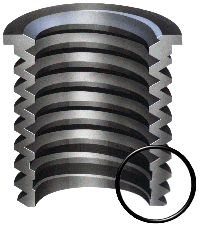
A threaded insert, also known as a threaded bushing or insert nut, is a fastener element that is inserted into an object to add a threaded hole.[1] They may be used to repair a stripped threaded hole, provide a durable threaded hole in a soft material, place a thread on a material too thin to accept it, mold or cast threads into a work piece thereby eliminating a machining operation, or simplify changeover from unified to metric threads or vice versa.[2]
In woodworking, an insert nut provides a threaded socket for a wooden workpiece, similar to a wall anchor. Insert nuts are inserted into a pre-drilled hole by one of two means: screw in and hammer in. In both cases, the external protrusions bite into the wood, preventing the nut from either turning or pulling out.
Types
[edit]Thread inserts come in many varieties, depending on the application. Threaded inserts for plastics are used in plastic materials and applied with thermal insertion or ultrasonic welding machines.
Manufacturers of ready-to-assemble furniture often ship the parts with threaded inserts and other kinds of knock-down fasteners pre-installed.
People who use sheet metal or sandwich panel or honeycomb sandwich-structured composite often install threaded inserts to spread shear, tension, and torque loads over a larger area of the material.[3]
Captive nut
[edit]Captive nuts come in two basic styles. One type, the cage nut or clip-on nut is a conventional nut held captive by a sheet metal carrier that clips onto the part to be connected. These are generally used to attach screws to sheet metal parts too thin to be threaded, and they can generally be attached, removed and reused with simple hand tools.
The second type of captive nut is a threaded insert. These are either pressed into holes in the material to be joined or moulded in. In either case, part of the insert is generally knurled to get a good grip on the material supporting the insert. One variant, the swage nut, has a knurled portion that swages the sides of a soft metal hole to more tightly grip the nut. Press fit and swaged captive nuts are used in panels that are too thin to be threaded or in soft materials that are too weak to be threaded. They are installed by pressing them in with an arbor press.[4]
Threaded inserts are commonly used in plastic casings, housing, and parts to create a metal thread (typically: brass or stainless steel) to allow for screws to be used in the assembly of many consumer electronics and consumer products. These may be cast in place in injection molded parts or they may be added by thermal insertion. In the latter, the insert is heated and then pressed into a hollow in the plastic part. The heat causes local melting in the plastic.[5] Ultrasonic Insertion is the process used to apply vibration and pressure to install the threaded insert into a molded hollow boss (hole) of a plastic part. The ultrasonic vibrations melt the thermoplastic material where the metal insert is in contact, and pressure is applied to press it into position. The material typically reforms around the knurled body of the threaded insert to ensure a good retention.
Externally-threaded inserts
[edit]
An externally threaded insert has threads on the outside and inside. The insert can be threaded into a pre-tapped hole, or a self-tapping insert creates its own threads in a drilled or molded hole. It is then anchored by various means, such as a nylon locking element. Inserts that are anchored via Loctite are more commonly known by the trademarked name E-Z Lok.[6] A thin-walled solid-bushing insert by the trademarked name TIME-SERT is locked in by rolling the bottom few internal thread into the base material with a special install driver which will permanently lock the insert in place.[citation needed] Key-locking inserts, more commonly known by the trademarked name Keenserts, use keys that are hammered into grooves through the threads, permanently locking the insert.[7][8][9] Inserts that are self-tapping and lock via friction are more commonly known by the trademarked names Tap-lok or Speedserts.
Helical insert
[edit]
A helical insert (also called a screw thread insert (STI), although most users call them all by one of the prominent brand names: KATO®, Heli-Coil® or Recoil®) is an insert made of stainless steel or phosphor bronze wire, with a diamond cross section, coiled to form inner and outer threads. The coil of wire screws into a threaded hole, where it forms a smaller-diameter internal thread for a screw or stud.[10] These inserts provide a convenient means of repairing stripped internal threads. These inserts are commonly sold in kits with matched taps and insert tools.
In soft materials, they are used to provide stronger threads than can be obtained by direct tapping of the base materials, e.g. aluminium, zinc die castings, wood, magnesium, plastic.
An example application is engine repair after unintentionally destroying the threads in a socket for a spark plug by over-torquing or cross-threading.
Mold-in inserts
[edit]A mold-in insert has a specially shaped outer surface to anchor the insert in plastic. For injection-molded plastic, the insert is placed in a mold before it is filled with plastic, making an integral part. An insert can also be heated and pressed into pre-made thermoplastic material.[11]
For softer, more pliable plastics, hexagonal or square inserts with deep and wide grooves allow the softer plastics to hold the inserts sufficiently. The process allows large product manufacture i.e. fuel tanks, boats etc., so the torque inserts may be of large thread sizes.
Press-fit inserts
[edit]A press-fit insert is internally threaded and has a knurled outer surface. It is pressed into a plain hole with an arbor press.[11]
Potted inserts
[edit]A potted insert is set in epoxy to fix it, such as in a honeycomb sandwich panel, often used in commercial aircraft, and is said to be potted in.
Rivet nut
[edit]A rivet nut, also known as a blind rivet nut, or rivnut, is a one-piece internally threaded and counterbored tubular rivet that can be anchored entirely from one side.
Strength factors of threaded inserts
[edit]Pull-out resistance & torque-out resistance are the two main strength factors of threaded inserts.
- Pull-out resistance: the force required to begin to pull the insert out of the parent material
- Torque-out: the amount of torque required to begin to turn the fastener
Installation methods
[edit].jpg)
For industrial purposes, the following installation methods are the standards:
- Thermal insertion
- Injection molding
- Manual pressing
For craft purposes, they might be:
- Screw-in type: Screw-in insert nuts have an external thread and hex head and are screwed in with a Flat Blade Screwdriver or an Allen wrench. The screw-in insert nuts come in various sizes and take different screw sizes. For example, an M6 insert nut will take an M6 bolt, a "1/4-20" insert nut will take a 1/4-20 inch bolt., etc The pre-drilled hole must be as deep as the length of the insert nut plus any portion of the bolt that may be screwed past the end of the nut in the work piece.
- Hammer-in type: Hammer-in insert nuts, also known as knock-in nuts,[citation needed] are lined with barbs and are hammered in. They are often made of steel, brass or nylon. They are designed to work in wood and particle board.[12]
See also
[edit]References
[edit]Notes
[edit]- ^ "Repairing damaged threads: Types of thread repair inserts |". rtstools.com. 20 July 2017. Retrieved 2017-09-30.
- ^ "Newman Tools Inc". Newmantools.com. Retrieved 2012-02-29.
- ^ "Delron Inserts for Honeycomb and Sandwich Panels" (PDF). Retrieved 2013-06-03.
- ^ McMaster-Carr, p. 3150.
- ^ Sullivan, G. & Crawford, L. "The Heat Stake Advantage" (PDF). Plastic Decorating Magazine (January / February 2003). Archived from the original (PDF) on 2015-06-10. Retrieved 2013-04-26.
- ^ "Inserts For Metal". E-Z Lok.
- ^ McMaster-Carr, p. 3204.
- ^ McMaster-Carr, p. 3206.
- ^ McMaster-Carr, p. 3207.
- ^ "What is a helicoil insert?". blog.katoadvanex.com. 2023-09-21. Retrieved 2023-10-12.
- ^ a b McMaster-Carr, p. 3209.
- ^ Willacy, p. 39.
Bibliography
[edit]- McMaster-Carr catalog (114th ed.), McMaster-Carr.
- Sullivan, Gary & Crawford, Lance, "The Heat Stake Advantage".[permanent dead link] Plastic Decorating Magazine. January/February 2003 Edition. ISSN 1536-9870. (Topeka, KS: Peterson Publications, Inc.). Section: Assembly: pages 11–12, covers Sullivan & Crawford's article.
- Willacy, David M. (1992), Craft and Design in Wood, Nelson Thornes, ISBN 0-7487-1066-3.

Threaded insert
View on GrokipediaFundamentals
Definition and Purpose
A threaded insert is a cylindrical or similarly shaped fastener component featuring internal threads designed to be embedded into a base material, thereby creating a durable, reusable threaded hole for securing screws, bolts, or other male-threaded fasteners.[1] These inserts serve as specialized bushings that integrate seamlessly with the host material, offering a reliable connection point without requiring the base to support threads directly.[4] The primary purpose of threaded inserts is to overcome the challenges associated with tapping threads directly into softer, more brittle, or composite materials, where standard threading often leads to stripping, cracking, or insufficient load distribution.[12] By encapsulating and reinforcing the threaded interface, inserts enhance overall joint integrity, allow for repeated assembly and disassembly, and mitigate risks of material failure under torque or vibration.[13] This makes them essential in applications demanding high-strength fastening in materials ill-suited for conventional threads, such as plastics, wood, or lightweight alloys. In terms of basic anatomy, threaded inserts typically include external retention features like knurls for mechanical grip or flanges for axial positioning and load distribution, paired with precisely machined internal threads that conform to standardized specifications, including Unified National Coarse (UNC), Unified National Fine (UNF), or metric sizes.[4] These design elements ensure secure embedding and compatibility with common fasteners, facilitating efficient installation and performance. Threaded inserts evolved in response to early 20th-century demands in aviation and machinery, where reliable fastening in non-metallic or low-strength components became critical for safety and efficiency.[14] Pioneered in the 1930s to address stress concentrations in aircraft engine threads, they provided a solution for embedding strong, wear-resistant connections in challenging materials.[14] Forms such as helical coils or solid bodies emerged to fulfill this role across diverse engineering needs.[1]Historical Development
A significant advancement occurred in the 1930s within the aerospace sector, where the need for stronger threads in high-stress environments drove innovation. In 1939, engineer Harold Caminez developed the helical wire thread insert, initially known as the Aero-Thread Screw Thread System, to mitigate notch effects and stress concentrations in aircraft engine threads, such as those in Allison engines.[14] This design was first commercially applied in Pratt & Whitney engines by late 1939 and soon adopted by other manufacturers including Lycoming and Wright Aeronautical. By 1942, the insert was renamed Heli-Coil, a name coincidentally derived from the initials of inventor Harold Caminez and sales manager Harkness Cram, marking the standardization of helical inserts for aviation.[15] Following World War II, threaded inserts expanded beyond aerospace into broader industrial uses, including automotive and electronics sectors, as manufacturing demands grew for reliable fastening in mass-produced components. Key-locking variants, originally designed during the war for aircraft, evolved post-war to support lighter, more efficient assemblies in vehicles and electronic devices.[16] The 1960s saw further evolution with inserts optimized for plastics, building on earlier Bakelite applications but adapting to new thermoplastics through methods like ultrasonic insertion and heat staking, enabling stronger, reusable threads in consumer electronics and automotive interiors.[17] Standardization efforts in the 1970s and 1980s formalized threaded insert specifications, with organizations like ASME and ISO developing guidelines for thread forms and tolerances; for instance, ISO R 1501 (1970) addressed miniature threads suitable for inserts, while ASME B1.1 updates in the 1980s refined unified inch screw threads for broader compatibility.[18][19] In the 2000s, self-tapping threaded inserts gained prominence for composite materials, offering installation without pre-tapping and improved performance in lightweight structures like those in aerospace and automotive composites, with designs from manufacturers like Tappex emphasizing chip-free entry into fiber-reinforced polymers.[20] As of 2025, threaded inserts continue to evolve with integration into 3D printing processes, where heat-set and press-fit variants enhance durability in additively manufactured parts, particularly in renewable energy applications such as wind turbine components, alongside sustainable material adaptations like recycled brass alloys to reduce environmental impact.[21][22][23]Types
Helical Inserts
Helical inserts, also known as wire thread inserts, consist of a precision-formed coil made from diamond-shaped wire, typically in materials such as 304 stainless steel, which creates internal threads through the edges of the wire when installed in a specially tapped hole with a 60° thread form.[24] This helical spring-like structure distributes loads evenly across the parent material, minimizing stress concentrations and enabling effective use in repairing damaged threads or reinforcing thin materials.[24] These inserts offer high resistance to vibration and shock due to their flexible coil design, which absorbs dynamic loads and prevents fastener loosening in demanding environments.[25] They require minimal material removal during installation, as the special STI (Screw Thread Insert) tap is only slightly larger than the original hole, preserving the integrity of the workpiece, and are particularly suited for thread repair in metals where original threads have been stripped or worn.[26] Compared to solid inserts, helical designs provide a lighter weight alternative while maintaining comparable thread strength.[24] Variants include standard free-running inserts with smooth threads for general applications, as well as coarse and fine pitch options available in UNC/UNF inch sizes or metric equivalents to match specific fastener requirements.[24] Locking features, such as screw-locking types with deformed coils or chords that grip the fastener, enhance hold under vibration; additional options like Hi-Torque for lubricated high-load scenarios or stud-lock for rods further customize performance.[24] Inserts come in tanged (with a drive tang for installation) and tangless configurations to reduce foreign object debris in sensitive assemblies.[24] Installation involves drilling the hole to the specified size, countersinking the entrance, tapping with an STI tool to create the helical groove, and then inserting the coil using a mandrel or prewinder tool, which expands the insert to lock it in place.[24] For tanged variants, a unique step follows where the protruding tang is broken off and removed after insertion to ensure a flush, secure fit without interfering with the fastener.[24] This process can be performed manually or with pneumatic/electric tools for efficiency in production settings.[24]Solid Inserts
Solid threaded inserts feature fully solid metal or alloy bodies, typically constructed from steel, stainless steel, brass, or aluminum, which provide internal threads for mating with fasteners while incorporating external features such as threads, knurls, or barbs for secure retention in the host material.[27][28] These inserts differ from repair-oriented helical types by serving as primary, permanent fastening solutions in demanding applications.[29] Key subtypes include externally threaded variants, which screw directly into a pre-tapped hole for robust engagement, and press-fit designs that rely on knurling or barbs to lock into place without threading, suitable for installation via pressing, ultrasonics, or heat.[27][30] Captive or self-retaining nuts represent another subtype, featuring a clinching mechanism that deforms the surrounding material to anchor the insert permanently, often used in sheet metal panels.[31] These inserts offer superior shear strength compared to alternatives, with examples achieving pull-out resistances up to 61,360 pounds in phenolic materials, making them ideal for high-load scenarios in metals like aluminum and cast iron, as well as hard plastics.[27][32] Their solid construction eliminates risks associated with unraveling components, ensuring long-term durability and resistance to vibration without compromising thread integrity.[27] Specific variants include flanged designs, which incorporate a wider head to distribute loads over a larger surface area and provide a bearing surface for added stability, versus flush types that install level with the surface for aesthetic or space-constrained applications.[33] Self-tapping solid inserts, equipped with cutting edges or slots, form their own initial threads in the host material during installation, reducing the need for precise pre-drilling and enhancing efficiency in softer substrates like thermoplastics.[27][32] Load distribution in solid inserts occurs through direct engagement of external threads or retention features with the base material, enabling effective torque transmission and preventing rotation under stress, which supports higher clamping pressures—up to 50% greater than standard tapped holes.[27][32]Molded and Potted Inserts
Molded and potted inserts represent methods for integrating threaded fasteners directly into plastic or composite materials during or shortly after the forming process, ensuring seamless encapsulation and enhanced load distribution. These inserts typically feature brass or stainless steel bodies engineered with features like knurling, undercuts, or flanges to promote mechanical interlocking and chemical bonding with the surrounding matrix.[34][11] In mold-in variants, the inserts are positioned within the mold cavity using core pins or orientation jigs to maintain precise thread alignment before the resin cures, allowing the molten plastic to flow around and encapsulate the insert fully during injection or compression molding.[35][11] This encapsulation process creates a robust chemical and mechanical bond between the insert and the base material, providing superior resistance to pull-out and torque compared to post-molded installations, while eliminating the need for secondary assembly steps.[35] Molded inserts are particularly advantageous for high-volume production in thermoplastics, where automated placement enables consistent integration across large batches.[34] Specific variants include symmetrical or blind-ended designs suited for thermosets and filled plastics, as well as heat-staking mold-in types that leverage thermal deformation of thermoplastics to secure the insert during the molding cycle.[11] Potted inserts, in contrast, involve inserting the fastener into a pre-formed hole and filling the surrounding void with a resin such as epoxy to achieve encapsulation, making them suitable for irregular holes or repairs in composites.[36][37] The potting compound is injected after excavating any core material if present, curing to form a strong bond that enhances overall strength in composite structures.[37] Epoxy-potted variants offer versatility for applications requiring post-insertion adjustment, providing reliable performance in softer substrates like plastics.[36]Materials and Design
Common Materials
Threaded inserts are commonly manufactured from metals such as brass, stainless steel, carbon steel, and aluminum, each selected for specific properties that ensure compatibility with various base materials and applications.[38][39] Brass offers excellent corrosion resistance, machinability, and thermal conductivity, making it ideal for electrical, marine, and plastic applications where it provides strong holding power without excessive wear on softer substrates.[39][38] Stainless steel provides superior strength and rust resistance, particularly in A2 and A4 grades, suiting it for harsh, chemical-exposed, or high-load environments like marine or industrial settings.[38][39] Carbon steel, often zinc-plated for added protection, delivers cost-effective durability for general-purpose uses in heavy-duty assemblies.[38][39] Aluminum, being lightweight and recyclable, is favored in aerospace and automotive components where weight reduction is critical, though it requires careful handling to avoid thread stripping due to its relative softness.[39][38] Polymer alternatives, such as nylon inserts or those with polymer coatings, are used for vibration damping in dynamic applications, absorbing shocks and preventing loosening without the conductivity of metals.[40] Material selection prioritizes compatibility with the base material, including matching thermal expansion coefficients to prevent issues like cracking in plastics—brass is often chosen for thermoplastics like ABS due to its similar expansion rate.[38][41] Additionally, hardness differences between the insert and mating fastener are considered to minimize galling.[42] As of 2025, trends emphasize sustainability through lead-free alternatives like aluminum and advanced coatings such as zinc flake, supporting eco-friendly manufacturing while maintaining performance.[38] Material choices directly influence load-bearing capacity, with harder options like stainless steel enhancing pull-out resistance in demanding scenarios.[38]Design Considerations
The design of threaded inserts begins with geometry factors that ensure compatibility and performance in the host material. Thread pitch must match the intended bolt size to achieve proper seating torque, such as M5 x 0.8 or 10-32 configurations that align with standard fastener dimensions.[11] Flange diameter plays a critical role in load distribution by providing an increased bearing surface, as seen in headed inserts where the flange spreads forces to prevent localized stress concentrations.[11] Knurl patterns are selected based on the need for grip; straight knurls enhance torsional resistance, while helical knurls at 30-45° angles improve pull-out strength particularly in soft materials.[11] Compatibility considerations focus on integration with the receiving hole and overall assembly reliability. Hole tolerances, such as H7 for press-fit applications, ensure precise insertion without excessive play or binding, with recommended hole depths at least the insert length plus two thread pitches to accommodate full engagement.[11] Pull-out resistance is optimized through features like barb angles, which in designs such as hexagonal-barbed inserts provide mechanical interlocking, achieving forces up to 135 lbs in materials like ABS.[13] Customization allows adaptation to specific engineering needs. Oversized inserts compensate for wear in high-cycle applications by providing additional material for repeated threading.[11] Multi-thread starts facilitate quicker assembly by reducing the number of rotations needed for engagement.[43] Adherence to established standards ensures interoperability and quality. Internal threads typically conform to ASME B1.1 (Unified Inch Screw Threads) for class 2B fits or ASME B1.13M (Metric Screw Threads) for 6H tolerances, promoting consistent performance across manufacturers.[13] In softer metals, finer knurls can be incorporated to maximize grip without compromising material integrity.[11]Performance Factors
Strength and Load-Bearing Capacity
Threaded inserts are engineered to provide robust mechanical performance under various loads, with axial pull-out force serving as a primary metric for tensile strength. This force quantifies the maximum axial load an insert can resist before extraction from the host material, typically governed by shear failure at the thread interface. The pull-out force is approximated by the formula where is the mean diameter at the shear plane, is the length of engagement, and is the ultimate shear strength of the weaker material (insert or parent), with a safety factor applied based on application demands.[44] This calculation relies on the minimum shear engagement area multiplied by the allowable shear stress, ensuring the insert outperforms direct tapping in softer materials like aluminum.[45] Torsional strength evaluates an insert's resistance to rotational loads, crucial for applications involving tightening or vibrational torque. Key factors influencing torsional performance include engagement length, material properties, and thread geometry. Common failure in torsion occurs via thread stripping, where the torque exceeds the shear capacity of the threads. To approximate, the stripping torque can be estimated considering the shear area across engaged threads.[46] Key factors influencing these strengths include engagement length, with a minimum of 1.5 times the diameter recommended for metallic parent materials to optimize load distribution and prevent premature stripping.[47] Additionally, the standard 60° thread form in Unified systems promotes even stress distribution, enhancing overall torsional performance.[48] Under cyclic loading, fatigue resistance becomes paramount, as repeated axial or torsional stresses can lead to progressive weakening. Fatigue life is assessed through standards like ISO 3800, which outlines axial load fatigue testing to generate S-N curves for threaded fasteners, including inserts, under controlled cyclic conditions.[49] For composite applications, ASTM D7332 specifies pull-through testing to measure resistance to bearing failure under multidirectional loads. Common failure modes include thread stripping—a shear-dominated extraction of the insert—or base material yield, where the parent deforms plastically; the latter is preferable as it allows for inspection and repair without total joint compromise.[50] To illustrate engagement guidelines based on material strengths, the following table provides recommended minimum lengths in multiples of nominal diameter:| Parent Material Shear Strength (MPa) | Screw Ultimate Strength (MPa): 300 | 400 | 500 | 600 | 800 | 1000 |
|---|---|---|---|---|---|---|
| 70 | 1.5 | 2 | 2.5 | 3.5 | - | - |
| 100 | 1 | 1.5 | 1.5 | 2 | 2.5 | 3 |
| 150 | 1 | 1 | 1.5 | 1.5 | 2 | 2 |
| 200 | 1 | 1 | 1 | 1 | 1.5 | 1.5 |
| 250 | 1 | 1 | 1 | 1 | 1 | 1.5 |
| 300 | 1 | 1 | 1 | 1 | 1 | 1.5 |
| 350 | 1 | 1 | 1 | 1 | 1 | 1.5 |