


Community hub
Recent from talks
Contribute something
Nothing was collected or created yet.
Flag of Iran
View on Wikipedia
 | |
| Tricolour Flag of Iran | |
| Use | National flag and ensign    |
|---|---|
| Proportion | 4:7 (de jure) (see below) |
| Adopted | 7 October 1907 (original version) 29 July 1980 (current version) |
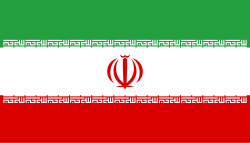
| Design | A horizontal tricolour of green, white, and red with the National Emblem in red centred on the white band and the Takbir written in the Kufic script in white, repeated 11 times along the bottom edge of the green band and 11 times along the top edge of the red band, for a total of 22 times on the fringe of the bands reminiscent of 22 Bahman. |
| Designed by | Hamid Nadimi |
The national flag of Iran, also known as the Tricolour Flag of Iran (Persian: پرچم سهرنگ ایران), is a tricolour featuring the Pan-Iranian colours comprising equal horizontal bands of green, white and red with the national emblem (Allah) in red centred on the white band and the takbir written 11 times each in the Kufic script in white, at the bottom of the green and the top of the red band.[1]
Originally adopted on 7 October 1907 with the lion and sun emblem in the center, the current flag was adopted on 29 July 1980[not verified in body] following the Iranian Revolution of 1979.
Many Iranian exiles opposed to the Iranian government use the Iranian monarchy tricolour flag with the Lion and Sun at the centre,[2] or the tricolour without additional emblems. This is, however, not the official flag of the Islamic Republic of Iran.
Flag description
[edit]Colour symbolism
[edit]The Iranian flag, which was later designed under Darius I, symbolised this unity and victory (green above white and red) as the flag of the people of Iran.[3][need quotation to verify]
Colour scheme
[edit] |
| Green | White | Red | |
|---|---|---|---|
| RGB | 35/159/64 |
255/255/255 |
218/0/0
|
| Hexadecimal | #239f40 |
#FFFFFF |
#da0000
|
| CMYK | 78/0/60/38 |
0/0/0/0 |
0/100/100/15
|
Construction
[edit]Physical requirements for the Iranian flag, a simple construction sheet, and a compass-and-straightedge construction for the emblem and the takbir are described in the national Iranian standard ISIRI 1.[4][5]
History
[edit]Prehistory
[edit]
The oldest flag found in Iran is the Bronze Age Shahdad Standard, found in Shahdad, Kerman province, dating back to c. 2400 BCE, made of bronze. It features a seated man and a kneeling woman facing each other, with a star in between. This iconography can be found in other Bronze Age pieces of art in the area as well.[6][7][8][9]
Achaemenid Empire
[edit]The Old Persian word for "banner, standard" was drafša- (Avestan drafša-, Middle Persian drafš, cognate with Sanskrit drapsá-). Xenophon in Cyropaedia (7.1.4) describes the standard of Artaxerxes II at Cunaxa as "a golden eagle, with outspread wings, borne aloft on a long spear-shaft",[10] the same banner recorded to be used by Cyrus the Great.[11]
According to Herodotus (9.59), each Persian army division had its own standard, and "all officers had banners over their tents" (Xenophon, 8.5.13). One such banner, a square plaque in saltire, is depicted on a Greek vase, the so-called "Douris cup" held by the Louvre.[12] A similar design is known from an Urartian bronze disk from Altıntepe.[13] Similar square plaques on poles are known from six of the audience scenes of the Throne Hall relief at Persepolis.[14] The Alexander Mosaic of Pompeii, a Roman-era copy of a Hellenistic painting dated c. 320 BCE, also shows the royal Persian standard.,[15] depicted as a rectangular plaque, possibly originally in purple, with a dark red border with yellow dots. In the field, a golden bird is only partially preserved. The "royal falcon" of Persia (varəγna) represented farr 'glory', while the eagle was associated with the Achaemenid dynasty itself.[16]
A square tile representing a miniature (12 cm2) banner was discovered at Persepolis in 1948.[17] The tile is made of Egyptian blue frit and likely represents Ancient Egyptian Horus, but in the Persian context suggests local association with the Avestan varəγna or the royal eagle of the Achaemenids.[18]
Sassanid Empire
[edit]
Seljuk Empire
[edit]Various emblems and banners have been recorded to be used by the Seljuks in different periods. Early Seljuks were using their traditional emblems, but they gradually adopted local Muslim emblems and banners. The official flag of the empire was most probably a black flag, similar to the flag of the Abbasid Caliphate. The flag was decorated with emblems, which were either superimposed over it or was placed above the flag.[20] This black flag was traditionally presented to the Seljuk sovereigns by the Abbasid caliphs.[21]
A yellow flag was also used to denote Seljuk sovereignty over a town.[21]
Ghaznavid dynasty
[edit]The Turkic Ghaznavid dynasty were invested in promoting Iranian culture. They are known to have displayed a number of heraldic emblems that harked back to pre-Islamic Iran, including the Sun and Lion motif, as well as the Griffin motif.[22] Their banners appear to have shown chequered motifs.[23]
Safavid dynasty
[edit]
By the time the Safavids created a unified state and promoted Shiʿism as the national creed, the lion and sun had become a familiar sign everywhere—on copper coins, on banners, and on artworks. although various ʿalams and banners were employed by the Safavids, the lion and sun symbol had become by the time of Shah Abbas the recognised emblem of Persia. The association may originally have been based on a learned interpretation of the Shahnameh's references to "the Sun of Iran" and "the Moon of the Turanians/Turks." As noted earlier, the Sasanians had called their king “the Sun of the East” and the Roman emperor "the Moon of the West." The evidence of the Shahnameh was certainly well known to the Safavid kings. Since the crescent moon had been adopted as the dynastic and ultimately national emblem of the Ottoman sultans, who were the new sovereigns of “Rūm,” the Safavids of Persia, needing to have a dynastic and national emblem of their own, chose the lion and sun motif.[24]
Afsharid dynasty
[edit]Nader Shah consciously avoided the using the colour green, as green was associated with Shia Islam and the Safavid dynasty.[25]

The two imperial standards were placed on the right of the square already mentioned: one of them was in stripes of red, blue, and white, and the other of red, blue, white, and yellow, without any other ornament: though the old standards required 12 men to move them, the shah lengthened their staffs, and made them yet heavier; he also put new colours of silk upon them, the one red and yellow striped, the other yellow edged with red: they were made of such an enormous size, to prevent their being carried off by the enemy, except by an entire defeat. The regimental colours were a narrow slip of silk, sloped to a point, some were red, some white, and some striped.[26][27]
Navy Admiral flag being a white ground with a red Persian Sword in the middle.[28]
Flags
[edit]
An Imperial Standard of the Afsharid dynasty

Another Imperial Standard of the Afsharid dynasty

Nader Shah's flag

Naval flag of Afsharid period
.svg)
.svg)
_-_No._1.svg)

Zand dynasty
[edit]The state flag of the Zand dynasty was a white triangular pennant with a green border and a gold lion and sun in the centre.[29] Another version shown below included the same design but with green and red.
Flags
[edit]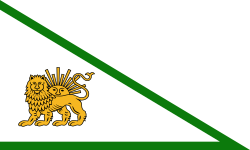
Flag of the Zand dynasty

Another Flag of the Zand dynasty

The "Ya Karim" flag, which was a pun on Karim Khan Zand's name, and Al-Karim (the generous), which is one of the names of God in Islam


Early Qajar dynasty
[edit]Few sources directly describe the national flag during Agha Mohammad Khan Qajar's reign. Gholam Hossein Afzal ol-Molk refers to the Beyraq Qapuq ('execution flag') of the Naserid period as originating from Agha Mohammad Khan's time.[30] This pennon flag is red and displays the lion and sun motif with a sword, although it is unlikely that the emblem resembled that of Agha Mohammad Khan's time given the sword-less design on the coins of this era. Several modern sources attribute a square flag with a red background and a pale yellow circle in the center, featuring a lion and a sun motif with a sword, to the period of Agha Mohammad Shah. The only visible source for this design is an unidentified portrait of Agha Mohammad Shah, where such a banner is present next to him. This painting was featured on the cover of the 1992 book Les Rois oubliés: L'épopée de la dynasty Kadjare, by Ali Mirza Qajar (grandson of Mohammad Ali Shah Qajar). Moreover, the painting was also photographed at a Qajar family gathering at Chateau de Bonmont, Cheserex, Switzerland in 2003.[31]
In contradistinction, various contemporary and modern sources provide more detailed descriptions of Iranian flags and the development of the lion and sun motif during Fath-Ali Shah's rule, particularly in military contexts. Colonel Gaspard Drouville, a French officer who served as a military instructor for the Iranian government after the signing of the Treaty of Finckenstein, authored a two-volume travelogue that offers additional information on Iranian flags and standards.[32]

Drouville expounds that in 1813, Fath-Ali Shah Qajar and Abbas Mirza attended a royal inspection of the regular infantry in Azarbaijan to personally confer each standard to their respective corps.[33] These flags included the lion and sun motif, a date or number pertaining to the unit, and the inscription: "Sultan ibn Sultan Fath-Ali Shah Qajar" (Sultan son of Sultan Fath-Ali Shah Qajar), in reference to Abbas Mirza's title.[33] The flags and standards are further described as similar to those of the French, adorned with taffeta white streamers and golden fringes.[33] Based on Drouville's illustration, the larger flags of the regular infantry were painted red, and the flagpole was crowned by the silver Hand of Ali. The smaller standards that were prescribed to the cavalry lancers were a deep blue and featured a crouching lion brandishing a curved sword before a setting sun. These standards were topped by golden spears that were "as sharp as those of the Houlans".[34]

An illustration by the French battle painter Joseph Louis Hippolyte Bellangé depicts Abbas Mirza reviewing Persian regular troops. The infantry corps carries a standard with a spearhead finial bearing a couchant lion and sun with a sword, similar to the cavalry flag of the Nezam lancers depicted by Drouville. However, as the work dates to 1835, two years after Abbas Mirza's death, the flag's design may be an artistic oversight.[35]
_and_a_military_banner.jpg)
In his accounts of the Russo-Persian war, Captain Yermolov, the Russian commander-in-chief in the Caucasus, documented the Iranian military in detail. One excerpt from his notes provides a vivid portrayal of a Nezam drummer, soldier, and officer carrying a Sarbaz infantry military banner dated to 1817. This banner, which shares many similarities with contemporary European regimental flags, features a lion and sun motif devoid of a sword within a white lozenge accented by a golden border. The light blue banner boasts a flagpole crowned by the silver Hand of Ali.[36]


A painting, believed to be the work of Allahverdi Afshar between 1814 and 1817, which adorned the walls of Abbas Mirza's Ojan castle portrays the Iranian triumph at the Battle of Sultanabad on 13 February 1812. The painting exhibits Persian troops carrying banners of Napoleonic style, featuring the passant lion and sun equipped with a sword.[37]
No contemporary sources have made any other indications of a sword wielded by the lion until the reign of Mohammad Shah.[32] Nonetheless, this illustration provides valuable insight into the evolution of the emblem and its use on Iranian flags during the Qajar period.[38] However, Zoka mentions the inscription of a coin from the Urmia mint, dated 1833 (1249 AH), in which a couchant lion is depicted holding a sword. According to Zoka, these sources prove that the earliest representation of the sword-wielding lion and sun pre-dates the reign of Mohammad Shah and was likely institutionalised in the latter years of Fath-Ali Shah's reign.[38]
During Fath-Ali Shah's reign, the state flag and other flags adopted by the Iranian government purportedly opted for square or rectangular shapes over the pennon flags commonly used in earlier eras. Another distinction noted in the designs of the lion and sun depicted on coins and flags of Fath-Ali Shah's era relative to those of prior years is the appearance of the lion. Before the middle of Fath-Ali Shah's reign, a Persian lion, which is maneless and smaller in stature was prominent, whereas later depictions evolved to an African lion.[38] Towards the end of Fath-Ali Shah's reign the two common symbols of the Qajar empire were combined to include the Zulfiqar and the lion and sun in the official flag.[24]
While there is little evidence, several modern sources state that Fath-Ali Shah adopted three different state flags; a plain red flag with a couchant lion and sun motif as the war flag, a plain white flag with a couchant lion and sun for diplomatic purposes, and a green flag with a lion passant in front of the setting sun, wielding a sword during peacetime.[29][39]

Alexis Soltykoff's Voyage en Perse includes an illustration depicting a standing lion wielding a sword. The painting is titled Entrée de l'ambassade de Perse a St. Petersbourg ('Entrance of the Persian Embassy to St. Petersburg') and shows the arrival of Mirza Abolhassan Khan Ilchi, then the Iranian ambassador to Russia, in 1838. The image features a Persian standard-bearer holding a rectangular flag with a lion passant, holding a curved sword in front of the setting sun. Atop the flagpole is the Hand of Ali finial. The painting was included in Soltykoff's book, which was published in 1851, several years after the events it depicts.[40]
French orientalist Louis Dupeux stated that one of the privileges enjoyed by the Shah of Iran was the right to "raise" several flags. Dubeux suggests that Mohammad Shah had two flags. He describes one of these flags as displaying the Zulfiqar while the other depicted a couchant lion and sun motif.[41]

While Iranian flags and military banners were largely uniform and similar in design by Mohammad Shah's reign, Ahmad Naqash's 1860 oil painting depicting the successful Iranian siege of the fort of Ghurian in 1837 serves as a contradictory source of information. Several noteworthy discrepancies arise. Firstly, the use of pennon banners is unusual as square and rectangular flags were more prominently used in Iran and adopted by the military at that time. Secondly, the sword-less lion and sun motif depicted in the painting is outdated. Thirdly, the white and green colour combination contradicts contemporary literature describing military banners and standards as being red or blue. According to Zoka, the painter may have relied on local designs as the work likely originated from Isfahan or Shiraz, where forts in the provinces often raised flags different from those in Tehran. Zoka also suggests that the Herat expedition's army could have reused dated standards predating the new designs.[40]
Under Nasser al-Din Shah, the principal flag was white with a green border on three sides and a lion and emblem in the centre.[42] There was also a naval ensign which had a red and green border and a civil ensign which looked the same as the naval ensign but without the lion and sun in the middle.
Flags
[edit]
Flag of Mohammad Khan

War flag of Fat′h Ali Shah

Diplomatic flag of Fat′h Ali Shah

Peace flag of Fat′h Ali Shah (version with sword)

Flag used during the reign of Mohammad Shah

Tricolour flag designed by Amir Kabir, State flag 1848–1852

State flag 1852–1907

Civil ensign until 1906

Naval ensign until 1906

Tricolour flag reported in 1886


.svg)


.svg)
Post-Constitutional Revolution
[edit].svg)
The first version of the modern Iranian tricolour was adopted in the wake of the Iranian Constitutional Revolution of 1906.[citation needed] The Supplementary Fundamental Laws of 7 October 1907 described the flag as a tricolour of green, white, and red, with a lion and sun emblem in the middle.[43] A decree dated 4 September 1910 specified the exact details of the emblem, including the shape of the lion's tail and the position and the size of the lion, the sword, and the sun.[2]
During this period, the colours of the flag were very pale, with the red appearing closer to pink in practice. There were three variants of the flag in use. The state flag was a tricolour with the lion and sun emblem in the centre. The national flag and civil ensign was a plain tricolour with no emblem. The naval ensign and war flag was similar to the state flag, but the emblem was surrounded by a wreath and surmounted by a crown. All three flags had a 1:3 ratio.[citation needed]
The flag was modified twice during the Pahlavi era. In 1933, the colours of the flag were darkened and the design of the emblem was changed. The sun's facial features were removed and the Kiani Crown on the naval ensign was replaced with the Pahlavi Crown.[citation needed] In 1964, the ratio was changed from 1:3 to 4:7 and the emblem on the naval ensign was shrunk to fit entirely within the white stripe.[citation needed]
Following the Iranian Revolution, the Interim Government of Iran removed the crown from the naval ensign. The old state and national flags remained unchanged until 29 July 1980, when the modern Iranian flag was adopted.[44][failed verification] However, the post-revolutionary Iranian government had viewed the Lion and Sun symbol as representing the "oppressive Westernising monarchy" that had to be replaced, despite the emblem's traditional Shi'a meanings and the lion's association with Ali, the first Imam of the Shi'a.[45] For that reason, the name of the Red Lion and Sun Society was changed to Red Crescent Society.

Currently, the Lion and Sun flag is used by Iranian communities in exile as a symbol of opposition to the Islamic Republic. Some political groups in Iran, including monarchists, continue to use it as well. In Los Angeles, California and other cities with large Iranian expatriate communities, the Lion and Sun, as a distinguishing marker, appears on Iranian flags and souvenirs to an extent that far surpasses its display during the years of monarchy in its homeland,[2] where the plain tricolour was usually used even prior to the revolution. After the Islamic Revolution in Iran and the replacement of the lion and sun flag with the new flag, new designs of this flag were still presented.
Historical flags
[edit]| Years in use | Naval ensign | Civil flag | State flag |
|---|---|---|---|
| 1736–1747 |
|
|
|
| 1797–1834 |
|
|
|
| 1834–1848 |
| ||
| 1848–1852 |
| ||
| 1852–1906 |
|
| |
| 1906–1907, 1910–1933 |
|
| |
| 1933–1964 |
|
| |
| 1964–1979 |
|
| |
| 1979–1980 |
|
| |
| 1980–present |
|
|


.svg)
.svg)
.svg)
.svg)
.svg)
.svg)

Gallery
[edit]-
 Iranian flag (as the Islamic Republic) in this photo.
 -
 Supporters of Hassan Rouhani with Islamic Republican flags plastered.
 -
 Child with the Islamic Republic flag during the 38th anniversary of the Iranian Revolution.
 -
 Flag of the Islamic Republic flying at the Iranian Embassy in Oslo.
 -
 Islamic Republican flag flown at Abshar Park.
 -
 Residential Embassy of the Islamic Republic of Iran in Prague with the national flag.
 -
 Football fan holding the Islamic Republic flag.
 -
 Two flags of the Imperial Lion and Sun flying.
 -
 Soldiers in the parade with the series of Imperial flags during the 2,500 year celebration of the Persian Empire.
 -
 Political activist Hassan Dai addressing in Toronto with the Imperial flag.
 -
 Ayatollah Ali Khamenei inspecting troops with the Islamic Republic military colours during a special ceremony.
 -
 Mohammad Bagheri speaking with the Islamic Republic and military flags at the background.
 -
 Lap of Honor of Kimia Alizade during 2016 Summer Olympics with the Islamic Republic tricolour flag of Iran
 -
 A number of Imperial flags seen in Germany in solidarity during the Mahsa Amini protests, October 2022.
 -
 Sadeq Tabatabaei speaking at a post-revolution press conference with the Imperial flag behind him.

.jpg)


.jpg)

.jpg)


See also
[edit]

References
[edit]Citations
[edit]- ^ Constitution of the Islamic Republic of Iran: Chapter II, Article 18: "The official flag of Iran is composed of green, white and red colours with the special emblem of the Islamic Republic, together with the motto (0)."
- ^ a b c d Najmabadi, Afsaneh (2005), Women with Mustaches and Men without Beards: Gender and Sexual Anxieties of Iranian Modernity, University of California Press, pp. 86–88, ISBN 0-520-24262-9
- ^ Koch, Heidemarie 1989: Persepolis. Theran Yasavoli
- ^ ISIRI 1 Archived 1 November 2013 at the Wayback Machine (in Persian), 1st revision. Retrieved 19 June 2012
- ^ ISIRI 1 / IRANIAN ISLAMIC REPUBLIC FLAG, 1371 Archived 21 June 2012 at the Wayback Machine (in Persian), 3rd edition, March 1993. Retrieved 19 June 2012.
- ^ Graef, Katrien De; Tavernier, Jan (7 December 2012). Susa and Elam. Archaeological, Philological, Historical and Geographical Perspectives.: Proceedings of the International Congress Held at Ghent University, December 14–17, 2009. BRILL. ISBN 978-9004207400.
- ^ Pittman, Holly; N.Y.), Metropolitan Museum of Art (New York (12 December 1984). Art of the Bronze Age: Southeastern Iran, Western Central Asia, and the Indus Valley. Metropolitan Museum of Art. ISBN 9780870993657.
- ^ Hansen, Donald P.; Ehrenberg, Erica (12 December 2017). Leaving No Stones Unturned: Essays on the Ancient Near East and Egypt in Honor of Donald P. Hansen. Eisenbrauns. ISBN 9781575060552.
- ^ Hakemi, Ali; Archeologiche, Istituto italiano per il Medio ed Estremo Oriente Centro Scavi e Ricerche (12 December 1997). Shahdad: archaeological excavations of a bronze age center in Iran. IsMEO. ISBN 9788120410176.
- ^ George Henry Preblem, The Symbols, Standards, Flags, and Banners of Ancient and Modern Nations, The Flag Research Center (1980).
- ^ Shahbazi, Alireza Shapur (15 December 1994). "DERAFŠ". Encyclopaedia Iranica. Vol. VII. pp. 312–315.
- ^ E. Pottier, Douris, London, 1909, p. 105 fig. 20, Plate XXV.b
- ^ O. A. Taşyürek, "Darstellungen des urartischen Gottes Haldi", in: S. Şahin, E. Schwertheim, J. Wagner (eds.), Studien zur Religion und Kultur Kleinasiens. Festschrift für Friedrich Karl Dörner, Leiden, 1978, p. 942 fig. 7; pl. CCXVIII/4–5.
- ^ E. F. Schmidt, Persepolis I, III, Chicago, 1953, 1970., p. 166, pls. 98, 99, 123.
- ^ T. Hölscher, Griechische Historienbilder des 5. und 4. Jahrhunderts v. Chr., Würzburg, 1973, pp. 122–69, 270–88.
- ^ Aelian, De Natura Animalium 12.21 has a legend of Achaemenes having been raised by an eagle. Ezra (18:13) has "Eagle of the East" in reference to Cyrus.
- ^ Īrān-Bāstān Museum, Tehran, no. 2436; Sāmī, Persepolis, tr. R. Sharp, Shiraz, 1970, fig. facing p. 100; H. Luschey, "Ein königliches Emblem", AMI 5, 1972, pp. 257–60.
- ^ A. Shapur Shahbazi, DERAFŠ, Encyclopedia Iranica (1994, 2011).
- ^ Wiesehöfer, Josef. "FRATARAKA". Encyclopædia Iranica. Retrieved 22 July 2012.
- ^ کوپریلی، فؤاد (۱۳۷۹). «پرچم٫ ۱:تاریخچه پرچم در جهان اسلام». در حداد عادل، غلامعلی. دانشنامه جهان اسلام. ۵. تهران: بنیاد دایرةالمعارف اسلامی. بایگانیشده از اصلی در ۱ آوریل ۲۰۲۰.
- ^ a b Güzel, Hasan Celâl; Oğuz, Cem; Karatay, Osman (2002). The Turks: Middle ages. Yeni Türkiye. p. 595.
- ^ K. Farrokh, The Lion and Sun Motif of Iran: A brief Analysis (2009), citing S. Nafisi, Derafsh-e Iran va Shir o Khoshid [The Banner of Iran and the Lion and the Sun]. Tehran: Chap e Rangin (1949), pp. 45, 48–58; G.H. Yusofi, Farrokh e Sistani. Mashad, (1962), p. 422.
- ^ based on the History of Rashid-al-Din Hamadani, see Rice, D. T., & Gray, B., The Illustrations of the "World History" of Rashīd al-Dīn, Edinburgh (1967), plates 38, 44, 57, 60.
- ^ a b "Encyclopædia Iranica: FLAGS i. Of Persia". Retrieved 12 November 2010.
- ^ Shapur Shahbazi|1999|Encyclopædia Iranica
- ^ Hanway, Jonas (1753). "XXXVII". An Historical Account of the British Trade over the Caspian Sea: With a Journal of Travels through Russia into Persią. 248-249. London: Mr. Dodsley. Retrieved 15 January 2020.
- ^ "An Historical Account of the British Trade over the Caspian Sea Vol.1,2". 1753.
- ^ Nādir Shāh's Campaigns in 'Omān, 1737–1744 By Laurence Lockhart, Bulletin of the School of Oriental Studies, University of London, Vol. 8, No. 1 (1935), pp. 157–171
- ^ a b "The Lion and Sun Motif of Iran: A brief Analysis". Dr. Kaveh Farrokh. Retrieved 12 November 2010.
- ^ ببریدیزج, مهربان (1388). "انواع بیرق و کاربردهای آن در نتایج یک پژوهش عهد ناصری" (PDF). يام بهارستان: 908.
- ^ "Meine Familie – Home". 3 April 2019. Archived from the original on 3 April 2019. Retrieved 10 April 2023.
- ^ a b Zoka, Yahya (1344). "تاریخچه تغییرات و تحولات درفش و علامت دولت ایران از آغاز سده سیزدهم هجری قمری تا امروز" (PDF). هنر و مردم: 14.
- ^ a b c Drouville, Gaspard (1825). Voyage en Perse, fait en 1812 et 1813, Volume 1 (in French). Masson et Yonet. p. 116.
- ^ Drouville, Gaspard (1825). Voyage en Perse, fait en 1812 et 1813, Volume 1 (in French). Masson et Yonet. p. 118.
- ^ "Brown Digital Repository | Item | bdr:231139". repository.library.brown.edu. Retrieved 10 April 2023.
- ^ "PERSIAN REGULAR ARMY OF THE FIRST HALF OF THE 19TH CENTURY (part 1)". warfare.6te.net. Retrieved 10 April 2023.
- ^ "The Battle of Sultanabad, Persia, 1812". warfare.6te.net. Retrieved 11 April 2023.
- ^ a b c Zoka, Yahya (1344). "تاریخچه تغییرات و تحولات درفش و علامت دولت ایران از آغاز سده سیزدهم هجری قمری تا امروز". هنر و مردم: 15–16.
- ^ "Iranian Flag, A Brief History (English version)" (PDF). Archived from the original on 26 July 2011. Retrieved 12 November 2010.
- ^ a b Zoka, Yahya (1344). "تاریخچه تغییرات و تحولات درفش و علامت دولت ایران از آغاز سده سیزدهم هجری قمری تا امروز (2)" (PDF). هنر و مردم: 33–34.
- ^ Dubeux, Louis (1841). La Perse (in French). Paris: Firmin Didot frères. p. 462.
- ^ Le Gras, M. A. (1858). Album des pavillons, guidons et flammes de toutes les puissances maritimes. Paris: Dépôt des Cartes et Plans de la Marine.
- ^ Browne, Edward G. (1910) [October 7, 1907]. "4. The Supplementary Fundamental Laws of October 7, 1907". The Persian Revolution of 1905-1909/Appendix A: The Bases of the Persian Constitution. Cambridge University Press. p. 373 – via Wikisource.
Art. 5. The official colours of the Persian flag are green, white and red, with the emblem of the Lion and the Sun.
- ^ "Flags of the World: Iran: Transition period (1979–1980)". Retrieved 10 November 2010.
- ^ Babayan, Kathryn (2002), Mystics, Monarchs, and Messiahs: Cultural Landscapes of Early Modern Iran, Harvard College, p. 491, ISBN 0-932885-28-4
External links
[edit]
- Vexilla Mundi.
- Flags Of Iran
- Flags i. Of Persia—Encyclopædia Iranica
- Iran Flag & National Anthem
- Geometric, algebraic and numeric construction of the National Flag
- Iran's Lion and Sun flag website


Flag of Iran
View on GrokipediaAdopted on 29 July 1980 in the wake of the 1979 Islamic Revolution, the design supplanted the Lion and Sun emblem that had adorned a similar tricolour flag since the Constitutional Revolution of 1906 under the Qajar and subsequent Pahlavi dynasties, marking a deliberate shift from symbols rooted in Persian imperial and pre-Islamic heritage to those emphasizing Shia Islamic theology and revolutionary ideology.[1][3]
The green stripe signifies Islam and prosperity, white denotes peace and purity, and red represents the blood of martyrs and courage; the emblem alludes to the oneness of God and the five pillars of Islam, with the inscription count referencing the Revolution's triumph on 22 Bahman 1357 in the Persian calendar (corresponding to 11 February 1979).[1][3] While serving as the state's civil, state, and war flag, its imposition has fueled contention, as substantial segments of the Iranian populace, including protesters and expatriates, reject it in favor of the pre-revolutionary version, viewing the current iteration as emblematic of theocratic suppression rather than national unity.[4][5]
Design and Symbolism
Construction and Proportions
The current flag of Iran consists of three equal horizontal stripes: green at the top, white in the middle, and red at the bottom, with the central emblem placed on the white stripe.[6] The overall proportions are 4:7, meaning the height is to the width as 4 is to 7.[7] Each stripe has a height equal to one-third of the total flag height.[1] The official colors are specified as Pantone 355C for green, Pantone 186C for red, and white for the middle stripe.[1] These colors adhere to the standards set following the flag's adoption on July 29, 1980.[6] The central emblem, a stylized form resembling a tulip with eleven interlocking segments derived from Kufic script representing the name "Ali," is topped by a horizontal sword.[6] It is centered on the white stripe and occupies one-third of the flag's height, with the sword's length equal to the height of one stripe. The design follows a geometric construction detailed in national standards for precise replication, ensuring symmetry and proportional integrity.[8]Color Scheme
The color scheme of the Iranian national flag comprises three equal horizontal bands of green (top), white (center), and red (bottom), forming a tricolour palette that emphasizes visual balance and durability in official manufacturing standards. These Pan-Iranian colors trace their origins to 19th-century Qajar dynasty flags, where green-white-red combinations appeared in military and state banners as early as the 1850s under Naser al-Din Shah, reflecting continuity in Persian heraldic traditions rather than novel invention.[9][10] Standardization of the shades occurred in 1933 under Reza Shah Pahlavi, who enacted modifications to ensure uniformity across state-issued flags, shifting from earlier variable dyes to more consistent formulations for national cohesion.[11] Pre-synthetic era reds, derived from natural sources like madder root, exhibited variability in hue and proneness to fading under sunlight exposure, necessitating empirical testing for official fabrics; post-1980 adoption of synthetic aniline-based reds improved lightfastness, with Iranian state protocols requiring flags to retain color integrity for at least five years in outdoor conditions.[3] The 1980 redesign following the Islamic Revolution preserved this exact tricolour scheme without alteration to the base hues, as stipulated in official decrees from the Islamic Consultative Assembly, which mandated adherence to the pre-revolutionary palette while updating emblematic elements.[12] Contemporary specifications approximate the green as Pantone 355 C (a medium emerald tone), white as neutral, and red as Pantone 186 C (bright crimson), though production tolerances allow minor variations for fabric type; no further hue adjustments have been decreed since, ensuring empirical stability across government-issued variants.[1][13]| Color Band | Pantone Equivalent | HEX Code | RGB Values |
|---|---|---|---|
| Green (top) | 355 C | #239F40 | (35, 159, 64)[13] |
| White (center) | White | #FFFFFF | (255, 255, 255)[13] |
| Red (bottom) | 186 C | #CE1126 | (206, 17, 38)[13] |