Hubbry Logo
JacquerieJacquerieMain
Open search
Jacquerie
Community hub
Jacquerie
logo
8 pages, 0 posts
0 subscribers
Be the first to start a discussion here.
Jacquerie
Jacquerie
from Wikipedia

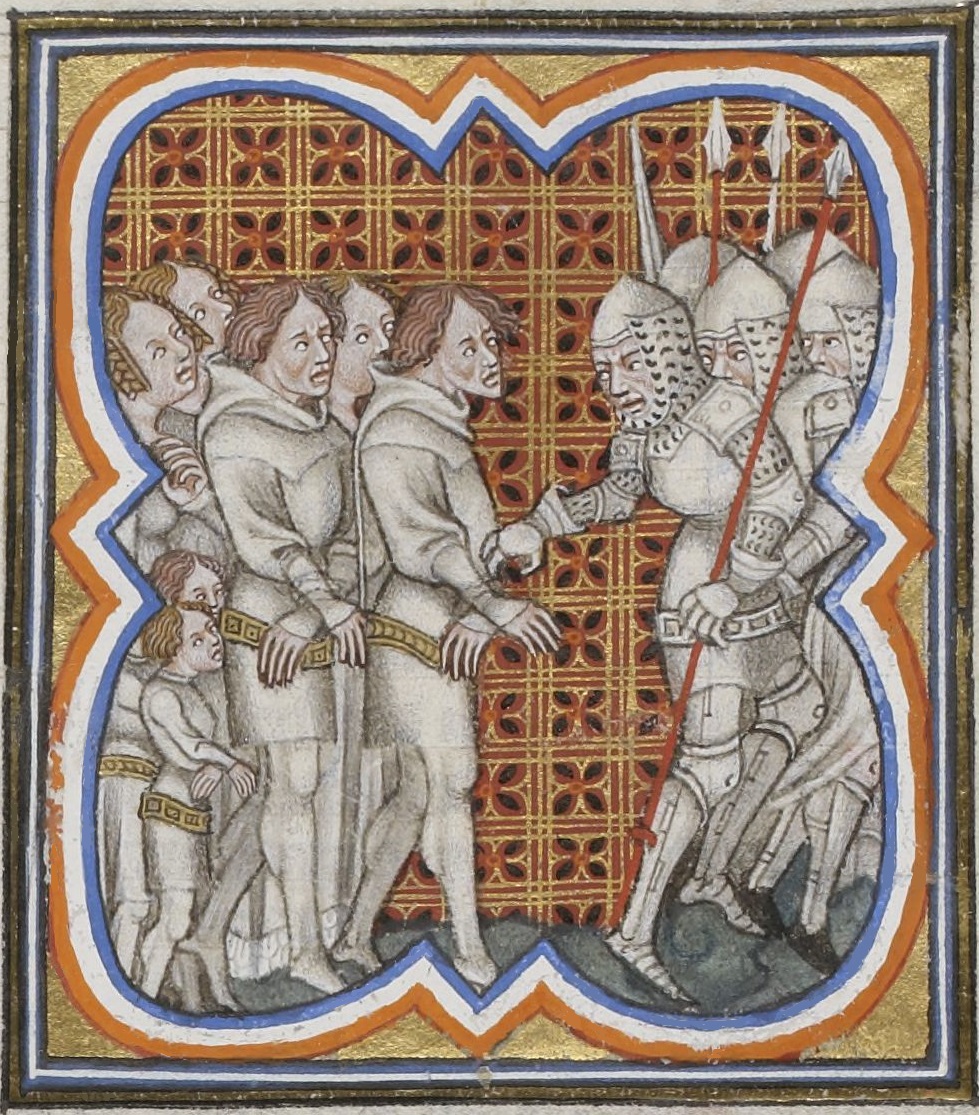
Prisoners in an illuminated manuscript by Jean Froissart

The Jacquerie (French: [ʒakʁi]) was a popular revolt by peasants that took place in northern France in the early summer of 1358 during the Hundred Years' War.[1] The revolt was centred in the valley of the Oise north of Paris and was suppressed after over two months of violence.[2] This rebellion became known as "the Jacquerie" because the nobles derided peasants as "Jacques" or "Jacques Bonhomme" for their padded surplice, called a "jacque".[3] The aristocratic chronicler Jean Froissart and his source, the chronicle of Jean le Bel, referred to the leader of the revolt as Jacque Bonhomme ("Jack Goodfellow"), though in fact the Jacquerie 'great captain' was named Guillaume Cale. The word jacquerie became a synonym of peasant uprisings in general in both English and French.[4]

Background

[edit]

After the capture of the French king (John II, Froissart's bon roi Jean "good king John") by the English during the Battle of Poitiers in September 1356, power in France devolved fruitlessly among the Estates-General and John's son, the Dauphin, later Charles V.

The Estates-General were too divided to provide effective government and their alliance with King Charles II of Navarre, another claimant to the French throne, provoked disunity amongst the nobles. Consequently, the prestige of the French nobility sank to a new low. The century had begun poorly for the nobles at Courtrai (the "Battle of the Golden Spurs"), where they fled the field and left their infantry to be hacked to pieces; they were also accused of having given up their king at the Battle of Poitiers. The passage of a law that required the peasants to defend the châteaux that were emblems of their oppression was the immediate cause of the spontaneous uprising.[5] The law was particularly resented as many commoners already blamed the nobility for the defeat at Poitiers. The chronicle of Jean de Venette articulates the perceived problems between the nobility and the peasants, yet some historians, such as Samuel K. Cohn, see the Jacquerie revolts as a reaction to a combination of short- and long-term effects dating from as early as the grain crisis and famine of 1315.

In addition, as a result of the temporary lull in hostilities of the Hundred Years' War due to the French defeat at Poitiers, thousands of soldiers and mercenaries on both sides of the conflict found themselves "without commanders or wages". Many of them responded by forming free companies, attacking both military and civilian targets such as castles and villages (often to ransom for a profit) and engaging in frequent acts of rape, looting and murder. Their ability to do so was exacerbated by the lack of an efficient government authority in many parts of France, which left the French peasantry disillusioned with France's nobility that was perceived as failing to meet its feudal obligations.[6]

Uprising

[edit]

This combination of problems set the stage for a brief series of bloody rebellions in northern France in 1358. The uprisings began in a village of St. Leu near the Oise river, where a group of peasants met to discuss their perception that the nobles had abandoned the King at Poitiers. "They shamed and despoiled the realm, and it would be a good thing to destroy them all."[3]

The account of the rising by the contemporary chronicler Jean le Bel includes a description of horrifying violence:[7]

I dare not write the horrible deeds that they did to ladies and damsels; among others, they slew a knight and [then] put him on a spit and roasted him at the fire in sight of the lady, his wife and children, and after that the lady was forced and raped by ten or twelve of them, and then they made her eat of her husband, and after made her die an evil death with all her children.

Examples of violence on this scale by the French peasants are offered throughout the medieval sources, including accounts by Jean de Venette and Jean Froissart, an aristocrat who was particularly unsympathetic to the peasants. Among the chroniclers, the one sympathetic to their plight is Jean de Venette, sometimes (but erroneously) known as the continuator of the chronicle of Guillaume de Nangis.[8]

Jean le Bel speculated that governors and tax collectors spread the word of rebellion from village to village to inspire the peasants to rebel against the nobility. When asked as to the cause of their discontent they apparently replied that they were just doing what they had witnessed others doing. Additionally it seems that the rebellion contained some idea that it was possible to rid the world of nobles. Froissart's account portrays the rebels as mindless savages bent on destruction, which they wrought on over 150 noble houses and castles, murdering the families in horrific ways. The bourgeoisie of Beauvais, Senlis, Paris, Amiens, and Meaux, sorely pressed by the court party, accepted the Jacquerie, and the urban underclass were sympathetic.[9] Village notables often provided leadership for some of the peasant bands, although in letters of pardon issued after the suppression of the rising, such individuals claimed that they were forced to do so.[10]

The Jacquerie must be seen in the context of this period of internal instability. At a time of personal government, the absence of a charismatic king was detrimental to the still-feudal state. The Dauphin had to contend with roaming free companies of out-of-work mercenaries, the plotting of Charles the Bad, and the possibility of another English invasion. The Dauphin gained effective control of the realm only after the supposed surrender of the city of Paris after the murder of the leader of the Estates General Étienne Marcel, prevôt des marchands on 31 July 1358. It is notable that churches were not generally the targets of peasant fury, with the possible exception of some clerics in Champagne.

Suppression

[edit]
Defeat of the Jacquerie in Meaux on 9 June 1358

The revolt was suppressed by French nobles and gentry led by the Dauphin and Charles of Navarre, cousin, brother-in-law, and mortal enemy of the Regent, whose throne he was attempting to usurp. His army and the peasant force opposed each other near Mello on 10 June 1358, when Guillaume Cale, the leader of the rebellion, was invited to truce talks by Charles. He went to the enemy camp, where he was seized by the French nobles, who considered that the conventions and standards of chivalry did not apply to him; he was tortured and decapitated.[3]

The now leaderless army, which Froisart claimed to be 100,000 strong in his narrative heavily influenced by chivalric romance, was ridden down by divisions of mounted knights. In the ensuing Battle of Mello and in a campaign of terror throughout Beauvais, knights, squires, men-at-arms and mercenaries roamed the countryside lynching peasants.

Another major battle transpired at Meaux, where the fortified citadel was crowded with knights and their dependents. On 9 June, a band of armed commoners came out of Paris under the leadership of Etienne Marcel to support the rising. One contemporary source, Jacques of Froissart, wrote that the band was 10,000 in number. When the band from Paris appeared before Meaux, they were taken in hospitably by the disaffected townspeople and fed. The fortress, somewhat apart from the town, remained unassailable.

Two captain adventurers, returning from the Prussian Crusade, were at Châlons: Gaston III, Count of Foix and his noble Gascon cousin, Jean III de Grailly. The approach of their well-armed lancers encouraged the besieged nobles in the fortress, and a general rout of the Parisian force ensued. The nobles then set fire to the suburb nearest the fortress, entrapping the burghers in the flames. The mayor of Meaux and other prominent men of the city were hanged. There was a pause, and then the force led by the nobles and gentry plundered the city and churches and set fire to Meaux, which burned for two weeks. They then overran the countryside, burning cottages and barns and slaughtering all the peasants they could find.

The reprisals continued through July and August. Senlis defended itself. Knights of County of Hainaut, County of Flanders, and Duchy of Brabant joined in the carnage. Following the declaration of amnesty issued by the Regent on 10 August 1358, such heavy fines were assessed upon the regions that had supported the Jacquerie that a general flight ensued.[11] Historian Barbara Tuchman says: "Like every insurrection of the century, it was smashed, as soon as the rulers recovered their nerve, by weight of steel, and the advantages of the man on horseback, and the psychological inferiority of the insurgents".[3]

The slanted but vivid account of Froissart can be balanced by the Regent's letter of general amnesty, a document that comments as severely on the nobles' reaction as on the peasants' rising and omits the atrocities detailed by Froissart: "it represents the men of the open country assembling spontaneously in various localities, in order to deliberate on the means of resisting the English, and suddenly, as with a mutual agreement, turning fiercely on the nobles".[9]

The Jacquerie traumatized the aristocracy. In 1872 Louis Raymond de Vericour remarked to the Royal Historical Society:

To this very day the word "Jacquerie" does not generally give rise to any other idea than that of a bloodthirsty, iniquitous, groundless revolt of a mass of savages. Whenever, on the Continent, any agitation takes place, however slight and legitimate it may be, among the humbler classes, innumerable voices, in higher, privileged, wealthy classes, proclaim that society is threatened with a Jacquerie.[12]

In the arts

[edit]
  • The contemporary literary chronicles were influenced by other medieval genres: romance, satire, and complaint.[13]
  • The subject of the Jacquerie engaged the Romantic historical imagination, resulting in numerous nineteenth-century historical novels with somewhat operatic plots set against the backdrop of the Jacquerie—The Jacquerie, or, The Lady and the Page: An Historical Romance by G. P. R James (1842) and the like— and even an opera, La jacquerie, by Édouard Lalo.
  • In Charles Dickens' A Tale of Two Cities, the revolutionaries call themselves "Jacques".
  • Eugène Sue's novel The Iron Trevet (part of Sue's "Mysteries of the People" sequence) gives a sympathetic account of the Jacquerie rebels.[14]
  • In Thomas Love Peacock's Crotchet Castle, Dr Folliott compares a local riot with the Jacquerie and expresses nostalgia for "that blessed middle period, after the Jacquerie was down and before the March of Mind was up".
  • Arthur Conan Doyle's historical novel "The White Company" includes a chapter where the English free company of the title rescue French nobility from peasants of the Jacquerie - portrayed as savage and brutish.
  • The 1961 novel A Walk with Love and Death by Hans Koningsberger takes place in northern France during the Jacquerie. The revolt provided the basis for a film of the same name directed by John Huston in 1969.
  • A somewhat fictionalized version of the Jacquerie is featured in the 1962 Blake and Mortimer comic album The Time Trap.
  • German progressive rock band Eloy's 1975 concept album Power and the Passion partially takes place in France in 1358 with the Jacquerie being an important part of the story.
  • In the satirical short story ‘The Stampeding of Lady Bastable’ c.1911 by Saki (Hector Hugh Munro) the following appears: ‘...Lady Bastable was roused from the world of newspaper lore by hearing a Japanese screen in the hall go down with a crash. Then the door leading from the hall flew open and her young guest tore madly through the room, shrieked at her in passing, "The jacquerie! They're on us!" and dashed like an escaping hawk out through the French window. The scared mob of servants burst in on his heels, the gardener still clutching the sickle with which he had been trimming hedges, and the impetus of their headlong haste carried them, slipping and sliding, over the smooth parquet flooring towards the chair where their mistress sat in panic-stricken amazement.’

Notes

[edit]

References

[edit]
Revisions and contributorsEdit on WikipediaRead on Wikipedia
from Grokipedia
The Jacquerie was a revolt that erupted in northern in late May 1358, during the , when rural communities rose against noble lords amid widespread devastation from English invasions and seigneurial exactions. Named derisively by nobles after the common moniker "Jacques Bonhomme," the uprising began on 28 May at Saint-Leu-d'Esserent, where villagers killed nine noblemen, igniting a rapid spread of attacks on châteaus and estates across the Beauvaisis, , and Île-de-France regions. The revolt stemmed from acute grievances: the French countryside had been ravaged by chevauchées—scorched-earth raids by English forces—coupled with the captivity of King John II since , leaving the realm under the ineffective regency of the Dauphin and enabling nobles to impose heavier taxes and labor demands for personal ransoms and protection fees that often proved illusory. Participants, drawn primarily from village elites and middling rural folk rather than the destitute, organized communally to enforce a perceived restoration of order, targeting symbols of noble authority while sparing some non-combatants. Under leaders like Guillaume Cale, a villager from Mello, the rebels achieved initial successes, including a temporary alliance with Parisian reformer Étienne Marcel against Dauphinist forces, though opposed by , who led the suppression by seizing Cale during truce talks near Mello and executing him, followed by the defeat of the peasant army at the Battle of Mello, but lacked sustained military cohesion. The uprising collapsed within weeks due to noble counter-mobilization; key defeats occurred at the Battle of Mello on 10 June, following Cale's capture and execution, and at , where royal and noble armies massacred thousands of rebels and . Post-revolt reprisals were severe, with systematic executions and property seizures reinforcing feudal hierarchies, though the events exposed vulnerabilities in noble- relations and informed later European movements. Scholarly analysis, drawing on chronicles and royal remission letters, portrays the Jacquerie not as mindless savagery but as a calculated response to systemic failures in and , challenging earlier narratives of irrational fury.

Historical Context

The Hundred Years' War and Its Burdens

The Hundred Years' War erupted in 1337 amid English King Edward III's claims to the French throne and disputes over Gascony, initiating a protracted conflict marked by intermittent campaigns and English tactical dominance in early phases. English strategy emphasized chevauchées, large-scale mounted raids penetrating deep into French territory to plunder resources, burn settlements, and destroy agricultural infrastructure, thereby undermining economic productivity and royal authority without committing to prolonged sieges. These operations, conducted by unpaid or poorly supplied troops, systematically targeted rural areas from 1339 onward, ravaging regions such as Normandy, the Loire Valley, and Languedoc through looting of livestock and grain, arson of villages and mills, and disruption of harvest cycles, which compounded vulnerabilities in an agrarian economy already strained by prior famines and the Black Death. By 1356, intensified chevauchées under commanders like escalated devastation; his raid from northward in summer 1356 alone destroyed over 500 settlements, incinerated crops across central , and severely curtailed tax revenues by depopulating productive lands. This campaign provoked a French pursuit, culminating in the on September 19, 1356, where John II's forces suffered catastrophic defeat, resulting in the king's capture along with much of the . John's imprisonment in until 1360 paralyzed central governance under the regency of his son, the Dauphin Charles, fostering administrative disarray as nobles negotiated individual ransoms or evaded feudal obligations. The king's ransom, fixed at 3 million gold écus in the 1360 Treaty of Brétigny—equivalent to several years of crown revenues—imposed unprecedented fiscal demands, necessitating expanded taxation that disproportionately burdened rural taxpayers. To meet these, the crown levied aides, indirect taxes on commodity sales like wine and salt averaging 5-10% ad valorem, and tailles, direct assessments on peasant-held land and movable wealth, with yields surging from roughly 78,000 livres in 1350-1351 to multiples thereof by mid-decade amid emergency war aids. Noble indiscipline exacerbated this, as captured lords redeemed themselves via personal funds or loans, often shifting costs downward while neglecting patrol duties, which allowed disbanded soldiers—French and English alike—to coalesce into routiers free companies that roamed ungoverned territories, demanding extortionate "protection" payments from isolated villages in lieu of royal enforcement.

Pre-Revolt Socio-Economic Conditions

The , which ravaged between 1348 and 1350, inflicted severe demographic losses on rural populations in and adjacent areas, with mortality rates estimated at 30 to 50 percent across much of , including significant reductions in labor forces vital to manorial . This depopulation left vast tracts of undercultivated, as surviving peasants grappled with the burdens of customary feudal obligations amid a shrunken . Seigneurs responded to these labor shortages by intensifying efforts to bind peasants to the land, reinstating or enforcing serfdom-like restrictions such as prohibitions on migration and heightened demands for labor to sustain estate revenues depleted by absentee tenants and heirs. Royal ordinances under kings like John II attempted to cap wage increases and compel laborers to remain in their villages, reflecting seigneurial pressures to counteract the gained by scarce rural workers. These measures, while aimed at preserving the manorial system, often exacerbated vulnerabilities in an agrarian economy already strained by fluctuating grain yields and inflationary pressures from monetary debasements tied to wartime financing. In the Oise valley north of , direct wartime devastation was limited in the early 1350s compared to border regions, yet chronic noble absenteeism—stemming from prolonged military campaigns in the —fostered reliance on local stewards who rigidly collected fixed dues, even as depopulation reduced taxable output and heightened economic fragility among holdings. This dynamic perpetuated a cycle of subsistence for peasants, whose customary payments or coin persisted irrespective of harvest shortfalls or labor constraints.

Causes

Systemic Grievances Against Nobility

Peasants in northern France during the mid-14th century labored under a feudal system that imposed multiple exactions, including tallages—arbitrary direct taxes levied by lords on serfs and non-nobles—which could be demanded without fixed limits or consent, often escalating during wartime to fund military campaigns. Banalités further burdened peasants by enforcing monopolies on essential facilities like mills, ovens, and presses owned by lords, requiring payment of fees (typically a portion of the produce processed) for their use, thereby limiting economic autonomy and inflating daily costs. Corvées, or compulsory unpaid labor, compelled peasants to perform tasks such as road maintenance, castle repairs, or harvesting on seigneurial lands, with demands varying by region but frequently intensifying to support infrastructure neglected amid ongoing conflict. The exacerbated these obligations, as the capture of King John II at in prompted the Dauphin Charles to impose heavier royal tallages and aides to finance ransoms and defenses, with tax yields surging to sustain the realm's fiscal needs beyond traditional expedients. Lords, in turn, passed on these pressures through increased local levies and requisitions, while the proliferation of routier bands—unpaid mercenaries often sheltered or employed by nobles—led to widespread pillaging of holdings as nobles prioritized personal ransom pursuits over territorial protection. Quartering of troops in villages compounded the strain, forcing hosts to provision soldiers without compensation, fostering toward nobles perceived as complicit in or direct perpetrators of these depredations. Yet nobles maintained essential roles in feudal defense, furnishing knights and retaining military expertise to counter English incursions, as evidenced by their frontline engagements despite defeats like , where chivalric obligations drove participation even at high cost to the . Grievances often targeted specific rapacious lords or disrupted networks rather than the nobility as a monolithic class, with chroniclers noting variation in seigneurial conduct—some lords upheld protective customs, while others exploited wartime chaos for gain, underscoring localized abuses over inherent systemic antagonism. This dynamic reflected causal pressures from fiscal-military demands, where noble failures in protection stemmed partly from battlefield losses and mercenary dependencies, not universal dereliction of duty.

Immediate Precipitants

In the spring of 1358, escalating raids by routier companies—disbanded mercenaries preying on the countryside—exposed the nobility's failure to fulfill their feudal obligation to protect rural populations, breeding acute resentment among peasants. Chroniclers reported instances where nobles abandoned their defensive posts or retreated in the face of these threats, leaving villagers to confront the attackers alone or pay ransoms, which peasants interpreted as betrayal amid ongoing English incursions during the . This perception was heightened by reports in May 1358 of noble retreats, such as those documented in regional accounts, where lords prioritized personal safety or internal feuds over safeguarding dependents, fueling a sense of abandonment that eroded traditional loyalties. Compounding these military lapses, a issued around this time mandating that peasants and defend noble châteaus—symbols of seigneurial —against invaders represented a breaking point, as it imposed burdens without reciprocal protection and evoked memories of exploitative taxation. Economic pressures intensified the crisis, with the Dauphin's repeated debasements of the French currency from 1356 onward causing rampant and eroding for staple goods, while poor yields from prior seasons amplified food shortages and indebtedness in northern . These factors converged to transform latent grievances into immediate desperation, as peasants faced demands for unpaid dues on ravaged lands without noble intervention. Links to urban unrest in under Étienne Marcel's reformist regime provided ideological sparks but lacked structured coordination with rural actors. Marcel's 1357–1358 challenges to royal authority and inspired some through shared anti-seigneurial rhetoric, yet evidence indicates any contact occurred post-outbreak, with rural mobilization driven primarily by local initiatives rather than direct urban orchestration. This limited interplay underscores how precipitants arose organically from regional flashpoints, escalating isolated defenses against into broader defiance without preempting autonomous agency.

The Uprising

Outbreak in the Oise Valley

The Jacquerie ignited on 28 May 1358 at Saint-Leu-d'Esserent, a village on the Oise River north of Paris, when local peasants massacred nine noblemen who had sought shelter there amid regional disorders. This violent act stemmed from accumulated grievances against noble inaction during wartime depredations, marking the revolt's spontaneous yet targeted onset in the Oise Valley. In the immediate aftermath, peasants from nearby villages rapidly assembled, with hundreds converging to justify their uprising by declaring that the nobles "have betrayed the kingdom" through failure to defend it against English incursions and internal ravages. These early gatherings formalized a collective rationale, framing the nobility's perceived treason as warranting retribution and the destruction of symbols of seigneurial authority, such as châteaus housing noble retinues. By the end of May, the scale escalated as word of the Saint-Leu killings spread, drawing thousands of rural participants into assemblies across the valley, who began systematically assaulting fortified noble residences to dismantle infrastructure enabling exploitation and evasion of duties. Primary chronicles record this phase as an "unheard of thing," underscoring the unprecedented mobilization grounded in shared accusations of noble betrayal rather than mere .

Expansion, Violence, and Peasant Actions

The revolt expanded swiftly from its initial outbreak in the Beauvaisis region along the Oise Valley in late May 1358, extending into , Champagne, , and portions of by early June, as disparate rural bands coalesced and moved against noble holdings. These groups, initially comprising hundreds but swelling to thousands of participants in larger concentrations, lacked and operated through assemblies driven by local grievances rather than coordinated . The violence centered on the destruction of noble estates, with rebels burning over 100 castles and manors, as estimated by contemporary chronicler Jean le Bel, often methodically and razing structures to eliminate symbols of seigneurial . Peasant actions combined targeted assaults on with indiscriminate brutality toward non-combatants, including the slaughter of noble families in their entirety. Froissart's recounts specific atrocities, such as rebels storming a fortified manor, killing a after compelling him to dance mockingly, then murdering his wife, children, and retainers, with reports of mutilations like severing limbs and genitals from corpses. Other documented incidents involved gang rapes of noblewomen and damsels, alongside the killing of infants and pregnant women, with bodies desecrated by or exposure. While some rebels articulated aims of against noble failures to curb mercenary ravages and wartime exactions, the executions extended to kin and servants uninvolved in , revealing a pattern of retributive excess beyond defensive necessity. The dual character of these actions—professed communal protection juxtaposed against opportunistic ferocity—manifested in property devastation that undermined welfare, such as torching mills, granaries, and bridges essential to local and . Bands frequently prioritized plunder and over sustained resistance, with chaos amplified by the absence of ; participants included rural laborers, minor , and occasional bourgeois allies, but cohesion dissolved into fragmented raids yielding short-term gains at the cost of broader economic disruption. This savagery, while rooted in accumulated resentments, inflicted collateral harm on rebel communities through the obliteration of shared , highlighting the revolt's descent into unstructured vengeance.

Leadership and Internal Dynamics

The Jacquerie lacked centralized leadership and operated as a decentralized uprising of local bands rather than a coordinated movement with a hierarchical command structure. Chroniclers such as Jean le Bel and , writing from noble perspectives, emphasized the rebels' disorganization to underscore their perceived barbarism, portraying them as unstructured mobs driven by impulse rather than strategy. This assessment aligns with post-revolt evidence from letters of remission and noble reprisal records, which document numerous autonomous village-level actions without reference to overarching directives. Guillaume Cale, a relatively prosperous peasant from the village of Mello near , emerged as the most prominent figure, self-appointing himself as capitaine and demonstrating rudimentary tactical skill in coordinating early assemblies of several thousand rebels for assaults on fortified sites. However, Cale's authority was nominal and regionally confined, extending primarily to forces in the and lacking mechanisms for sustained control over distant groups; his role appears exaggerated in elite chronicles to personify the threat for narrative purposes, while primary documents like assembly summons reveal mobilizations rather than formal obedience. No evidence from charters or trial testimonies indicates a formal chain of command or ideological manifesto, with actions unified mainly by immediate grievances against noble depredations rather than a programmatic vision. Attempts at broader alliances, such as Cale's delegation to Parisian reformer Étienne Marcel in late May 1358, highlighted internal fractures between rural insurgents and urban factions. Marcel's forces sought political leverage against the crown through noble alliances, while peasants pursued unfiltered vengeance, leading to tensions over tactics and objectives; this rural-urban divide, evident in Marcel's eventual distancing from the Jacquerie to preserve bourgeois credibility, contributed to the revolt's fragmentation. Chronicler biases amplify these divisions, often omitting peasant agency in favor of depictions of manipulation, yet corroborative records from Navarrese interventions confirm the absence of enduring cohesion.

Suppression

Noble Mobilization and Strategy

In early June 1358, French nobles facing the rapid spread of the Jacquerie uprising formed ad hoc coalitions to mount a defense, as the captivity of King John II in England since 1357 limited centralized royal authority and the Dauphin's regency was preoccupied with urban unrest in Paris and factional civil strife. Local gentry and high nobility, threatened by peasant attacks on their manors and families, allied with opportunistic foreign lords who held territorial interests or grudges against the French crown, including Charles II of Navarre, who mobilized hundreds of troops to counter rebels in areas like Clermont, and Gascon contingents under Gaston Phoebus, Count of Foix, whose forces bolstered noble efforts through cross-border support. These alliances drew on mercenaries and regional levies from areas like Flanders, Hainault, and Brabant, reflecting a pragmatic unification of disparate noble interests amid the Hundred Years' War's disruptions. Nobles initially adopted a defensive strategy of retreating to fortified châteaus, towns, and castles—such as —to regroup and deny rebels access to strongpoints, while dispatching urgent calls for reinforcements from royalist sympathizers and hired soldiers to amplify their numbers. This approach prioritized survival and consolidation over immediate confrontation, leveraging the rebels' lack of heavy armament and discipline to buy time for coordinated counteroffensives. Royal involvement remained peripheral, with the Dauphin issuing limited pardons and logistical support only after initial noble initiatives, as evidenced by remissions granted in August 1358 for participants in the suppression. The coalitions were driven primarily by nobles' imperatives of self-preservation against the destruction of their estates and the slaughter of kin, coupled with a thirst for reprisal against the insurgents who had upended feudal hierarchies, and a broader aim to reimpose social order in a countryside ravaged by war and economic collapse. Figures like the young Enguerrand de Coucy exemplified this resolve, rallying forces in their domains to safeguard noble privileges without awaiting distant crown directives. Mercenaries proved instrumental, providing tactical expertise and manpower that local levies alone could not match, underscoring the nobles' reliance on professional soldiery amid the revolt's chaos.

Pivotal Clashes and Reprisals

The Battle of Mello on June 10, 1358, marked a turning point in the suppression of the Jacquerie, where forces led by , numbering approximately 1,500 to 2,500 knights and men-at-arms, engaged Guillaume Cale's peasant army estimated at 4,000 to 5,000. Cale, the revolt's captain-general, accepted an invitation to truce negotiations under a flag of but was seized, tried summarily for and , and beheaded after a mock as "King of the Jacques," exposing the peasants to immediate disarray. The noble cavalry exploited this vulnerability with coordinated charges, slaughtering thousands of peasants in the ensuing rout while suffering minimal losses themselves, highlighting the tactical disparity between professional armored knights and the lightly equipped, untrained rural fighters. Concurrent skirmishes at Meaux in early June demonstrated similar noble advantages, as small detachments under Gaston Phoebus, Count of Foix, and Jean I, Captal de Buch—totaling fewer than 200 men-at-arms—routed bands of up to 5,000 peasants sheltering in the town's abbey and surrounding areas. Employing swift mounted assaults and exploiting the peasants' lack of defensive cohesion, the nobles overwhelmed the rebels, reportedly killing several thousand with negligible casualties on their side before dumping bodies into the Marne River. These engagements underscored the peasants' reliance on sheer numbers and improvised weapons like scythes and pikes, which proved ineffective against disciplined heavy cavalry tactics. In the reprisals following these clashes, noble forces systematically razed villages associated with the uprising, survivors en masse to deter further resistance; chroniclers, often sympathetic to the , record totals of 7,000 to 20,000 peasant deaths across June and July 1358, though these figures likely reflect elite biases exaggerating rebel barbarity to legitimize the carnage. By mid-July, additional defeats, such as at Montdidier against Navarrese troops, fragmented remaining Jacques bands, with nobles prioritizing terror over pitched battles to restore order through overwhelming force and punitive destruction.

Consequences

Human and Material Toll

The Jacquerie inflicted significant casualties on the nobility, with modern historical analysis estimating dozens of noblemen killed during the uprising's peak violence in late May and June 1358. Contemporary chroniclers, such as Jean Froissart, claimed higher figures reaching into the hundreds, including non-combatant family members, though these accounts likely exaggerate to underscore noble vulnerability. In response, noble reprisals after pivotal defeats like Mello and Meaux led to thousands of peasant executions across the Île-de-France and surrounding regions by early July 1358, encompassing combatants and villagers alike. Material destruction was widespread, as rebels systematically targeted symbols of seigneurial power by burning numerous châteaus and manor houses, often ransacking furnishings and records within. This , combined with trampled crops and disrupted harvests in war-ravaged areas, compounded food shortages and delayed agricultural recovery into 1359. Judicial proceedings in the revolt's aftermath involved mass trials under royal and noble authority, imposing collective fines on communities and reaffirming through punitive oaths and indemnities that burdened survivors for years.

Short-Term Political Ramifications

The Jacquerie of 1358 strained the Dauphin Charles's regency amid ongoing war disruptions, compelling him to delegate suppression to ad hoc noble militias while coordinating from afar, thereby exposing vulnerabilities in centralized royal command. This fragmentation enabled to capitalize on noble desperation, positioning himself as a de facto leader in counteroffensives against peasant forces in the and Champagne regions during 1358; his forces, including recruited knights, inflicted decisive defeats such as at Mello and , temporarily elevating Navarre's political leverage through alliances with disaffected nobles wary of Dauphin loyalists. Post-suppression reprisals by nobles, often exceeding 10,000 peasant deaths by chroniclers' estimates, nonetheless provoked sporadic peasant counterstrikes in peripheral zones like Beauvaisis into July 1358, where surviving bands targeted isolated manor houses and seigneurial agents, sustaining localized vendettas that delayed full pacification until the Dauphin's return to in August. These residual clashes underscored immediate tensions in noble-peasant relations, with nobles invoking customary feudal reprisals to reassert dominance, though at the cost of further rural destabilization. By late 1358 and into 1359, the Dauphin promulgated ordinances curtailing rural assemblies and unauthorized leagues, explicitly reaffirming servile obligations and seigneurial jurisdictions to forestall organized dissent, measures enforced through parlementary registration and local bailiffs. This administrative clampdown, coupled with the execution of over 100 ringleaders, facilitated the restoration of provisional governance stability by 1360, bolstering Charles's position ahead of his father's and own accession, while entrenching noble privileges as a bulwark against popular mobilization.

Legacy and Interpretations

Long-Term Societal Effects

The Jacquerie inflicted lasting damage on rural infrastructure in northern , with many manors and castles remaining in ruins for decades after 1358, as evidenced by administrative records from the 1370s still referencing properties "destroyed at the time of the commotions." This destruction exacerbated economic stagnation amid the and residual effects of the , delaying agricultural rebuilding and intensifying labor shortages without prompting systemic reforms to feudal . While post-plague labor scarcities elsewhere encouraged sporadic commutations of labor dues to monetary payments in certain regions during the late , affected areas of the Jacquerie saw no accelerated or widespread of peasants; servile obligations and hierarchical dependencies persisted, underscoring the revolt's negligible role in altering core rural institutions. Social relations hardened in the revolt's aftermath, as noble survivors and their allies imposed stricter and fortified remaining estates to deter recurrence, reflecting a deepened class antagonism rooted in the scale of reprisals. , decimated by estimated thousands killed in counterattacks, exhibited growing wariness toward urban alliances, particularly after the collapse of ties with Parisian reformers like Étienne Marcel, whose execution in 1358 severed potential political bridges. This mutual distrust entrenched divisions, with nobility leveraging chroniclers' accounts to perpetuate images of peasant savagery, thereby justifying enhanced coercive measures over conciliatory adjustments. The Jacquerie's influence on subsequent unrest remained localized and fragmented, manifesting in minor rural disturbances through the 1370s but failing to forge a unified national amid ongoing feudal fragmentation. Without institutional breakthroughs, such as or legal protections for rural laborers, the event reinforced rather than eroded hierarchical structures, contributing to a of contained volatility rather than transformative upheaval in 14th-century French countryside dynamics.

Historiographical Debates

Medieval chroniclers such as Jean le Bel and depicted the Jacquerie as an eruption of irrational savagery, portraying participants as a disorganized mob driven by base instincts to commit atrocities against nobles, including the slaughter of families and of estates. These accounts, written from an aristocratic perspective amid the Hundred Years' War's chaos, emphasized the rebels' alleged brutality—such as claims of widespread and —to justify noble reprisals, though empirical analysis of surviving charters reveals selective exaggeration to underscore feudal order's fragility. Such sources, while valuable for contemporary reactions, exhibit class , prioritizing moral condemnation over causal factors like wartime devastation and taxation burdens that empirical records confirm exacerbated grievances. In the nineteenth century, Siméon Luce's Histoire de la Jacquerie d'après des documents inédits (1892) marked a shift toward documentary , compiling judicial records and charters to document the revolt's scope without romanticizing it as either mindless chaos or heroic uprising, though Luce maintained a view of limited peasant agency constrained by local warlord influences. Early twentieth-century interpretations, influenced by Marxist frameworks, reframed the Jacquerie as a proto-revolutionary class struggle against feudal exploitation, attributing its to systemic economic rather than individual barbarism; however, this lens often overemphasizes ideological coherence absent in primary , such as the lack of manifestos or sustained egalitarian demands, projecting modern class narratives onto a revolt better explained by immediate survival imperatives amid English incursions and noble absenteeism. Recent scholarship, exemplified by Justine Firnhaber-Baker's 2021 monograph, integrates quantitative analysis of over 200 charters and trial records to argue for greater political coordination than previously acknowledged, positing the Jacquerie as a defensive response to noble failures in protection during the 1358 vacuum, with localized leadership enabling tactical alliances rather than wholesale . Yet debates persist on the scale of organization—Firnhaber-Baker concedes decentralized violence precluded unified strategy—contrasting views of "mindless rage" in biased chronicles with evidence of rational targeting of fortified sites as reprisal for wartime pillage, though atrocities against non-combatants underscore that war's causal chain amplified, without originating, aggression. This empiricist turn privileges verifiable data over ideological framings, revealing the revolt's violence as a symptom of disrupted feudal reciprocity amid , not inherent brutality or intent, though institutional biases in academia toward class-conflict models warrant scrutiny for underplaying contingent triggers.

Cultural Representations

Literary and Artistic Portrayals

Jean Froissart's Chroniques, composed in the late , offer the most vivid contemporary literary portrayal of the Jacquerie, depicting the rebels as savage hordes driven by base instincts who razed over 150 noble residences and committed atrocities against families therein, thereby framing the uprising as a descent into anarchy quelled by noble heroism. This narrative, drawn from eyewitness reports and noble informants, amplifies dramatic elements like massacres at on June 10, 1358, to emphasize themes of order versus chaos, though modern analysis notes its exaggeration for moral edification rooted in class prejudice. In 19th-century French literature, the Jacquerie inspired romantic historical novels that often recast the revolt through lenses of and class antagonism, as in Eugène Sue's The Iron Trevet, or Jocelyn the Champion (serialized 1842–1843), which portrays peasant protagonists challenging feudal oppression amid the , blending historical events like the destruction of castles with fictional heroism to critique enduring inequalities. Prosper Mérimée's 1828 play La Jacquerie, later adapted into an opera by Édouard Lalo (composed 1860s, premiered 1895), similarly dramatizes the uprising's tensions, focusing on noble-peasant clashes and the reprisals that ended it, using the event to explore motifs of vengeance and societal rupture without fully endorsing rebel aims. Artistic representations, primarily 19th-century illustrations and paintings, tend to visualize pivotal moments such as the Battle of Meaux, where , led forces to crush the rebels on June 10, 1358, employing graphic scenes of combat and noble triumph to evoke the revolt's ferocity while aligning with conservative views of peasant excess. These works, including French School engravings of peasants storming towns, perpetuate tropes of rustic barbarism versus civilized authority, influencing broader European depictions of medieval uprisings in visual media. Such portrayals rarely idealize the ' cause, instead underscoring the restorative violence of suppression as a bulwark against disorder.

References

Add your contribution
Related Hubs
User Avatar
No comments yet.