Hubbry Logo
Japan Freight Railway CompanyJapan Freight Railway CompanyMain
Open search
Japan Freight Railway Company
Community hub
Japan Freight Railway Company
logo
8 pages, 0 posts
0 subscribers
Be the first to start a discussion here.
Japan Freight Railway Company
from Wikipedia
The unique 12-foot (3.7 m) intermodal container used by JR Freight

Key Information

Japan Freight Railway Company (日本貨物鉄道株式会社, Nippon Kamotsu Tetsudō Kabushiki-gaisha), or JR Freight (JR貨物, Jeiāru Kamotsu), is one of the seven constituent companies of Japan Railways Group (JR Group). It provides transportation of cargo nationwide throughout Japan. Its headquarters are in Shibuya, Tokyo near Shinjuku Station.[1]

The Japan Railways Group was founded on 1 April 1987, when Japanese National Railways (JNR) was privatized. Japanese National Railways was divided into six regional passenger rail companies and a single freight railway company, Japan Freight Railway Company.

The company has only about 50 kilometers (31 mi) of track of its own, and therefore operates on track owned by the six JR passenger railways as well as other companies which provide rail transport in Japan.

Economics

[edit]

In 2017, only about 5% of all freight in Japan is carried by rail but nearly all of that, 99%, is carried by JR Freight.[2] Trucks carry about 50% and ships about 44%.[2] JR Freight has seen its share of the freight market gradually decrease since 1993.[citation needed] In the 2010s JR Freight has been carrying more freight because of the decrease in the number of available truck drivers due to age as well as government policy to reduce carbon dioxide.[2] JR Freight has run a deficit for many years.[3]

Lines

[edit]

Rolling stock

[edit]

As of 1 March 2017, JR Freight owns and operates the following rolling stock,[4] with most of the newer motive stock being exclusively built by Toshiba Infrastructure Systems & Solutions:

Diesel locomotives

[edit]

Electric locomotives

[edit]

Electric multiple units

[edit]

Former rolling stock

[edit]

See also

[edit]

References

[edit]
[edit]
Revisions and contributorsEdit on WikipediaRead on Wikipedia
from Grokipedia
The Japan Freight Railway Company (JR Freight) is a Japanese operator established on April 1, 1987, as part of the and division of the former (JNR), specializing in nationwide freight services including the transportation of containers, bulk cargo, industrial materials, consumer goods, and household items. As the sole freight with a comprehensive national network in , it operates across 75 lines totaling 7,805.5 kilometers, serving 237 stations and handling approximately 399 freight trains daily, which collectively cover about 186,000 train-kilometers per day. JR Freight's operations emphasize safety, reliability, and environmental sustainability, transporting a total of 26,520 thousand tons of cargo in 2023, equivalent to 17,500 million ton-kilometers, while maintaining a fleet that includes 403 electric locomotives, 122 diesel locomotives, and over 7,000 container wagons. Beyond core rail freight, the company engages in ancillary businesses such as warehousing, vehicle maintenance, civil engineering, and advertising, supported by a workforce of 5,637 employees as of April 1, 2024. Headquartered in Minato-ku, Tokyo, with capital of 19 billion yen fully owned by Japan Railway Construction, Transport and Technology Agency, JR Freight has played a critical role in Japan's logistics, including disaster relief efforts like those following the 2011 Great East Japan Earthquake, and continues to innovate through initiatives such as the Super Rail Cargo system introduced in 2004.

History

Formation from JNR privatization

In the 1980s, Japanese National Railways (JNR) faced a severe financial crisis characterized by chronic operating losses since 1964, escalating debt, labor disputes, and competition from road transport, culminating in liabilities exceeding ¥37 trillion by 1987. This situation prompted the Japanese government to enact the Japanese National Railways Reform Law in December 1986, which outlined the dissolution of JNR and its restructuring into independent companies to improve efficiency and reduce fiscal burdens. The privatization took effect on April 1, 1987, when JNR was divided into seven Japan Railways (JR) Group entities: six regional passenger railway companies and one nationwide freight operator, Japan Freight Railway Company (JR Freight). JR Freight inherited JNR's freight operations and , including locomotives and freight cars, with initial capital of ¥19 billion, enabling it to assume responsibility for national cargo transport. This separation allowed JR Freight to focus exclusively on freight while avoiding the ownership of extensive , which was allocated to the passenger companies. From its inception, JR Freight's operations emphasized nationwide cargo services, relying on track access agreements with the JR passenger companies to utilize their networks for freight trains. These agreements, established under the reform framework, permitted JR Freight to "borrow" tracks, paying usage fees based on avoidable costs to ensure viability without bearing full expenses. The transition began seamlessly on April 1, 1987, as the former JNR freight division integrated into JR Freight's structure, marking the start of independent freight operations within the privatized system.

Post-privatization development and challenges

Following its establishment in as part of the , Japan Freight Railway Company (JR Freight) achieved early profitability through aggressive cost-cutting and promotion of modal shifts from road to . Between and 1992, the company recorded ordinary profits of approximately ¥6–7 billion annually, driven by management improvements, workforce reductions, and operational streamlining that reduced employee numbers and optimized engine and freight car usage. This period benefited from Japan's bubble economy, which boosted freight volumes to a peak of 59 million tons in 1990, with container transport gaining traction as trucking companies adopted rail for longer hauls to lower costs and address driver shortages. The brought significant challenges as following the 1993 recession led to declining freight volumes, with JR Freight posting losses amid intensified competition from cheaper road and ferry transport. The Great Hanshin earthquake in January 1995 severely disrupted key lines like the Tokaido and , exacerbating financial strain. By the late , overall freight tonne-kilometers had stabilized but remained below pre-recession levels, prompting JR Freight to introduce block train systems for efficient, high-speed direct services between major cities and terminals, reaching 425 container block trains daily by 1999. In an effort to restore profitability, JR Freight implemented the New Freight 21 plan in the late , reducing staff by about 1,800 and costs by ¥31 billion through restructuring. Post-2000 recovery efforts centered on intermodal services to recapture , including the launch of transport in 1999 between and Fukuoka, alongside bimodal and super piggyback systems to integrate rail with trucking for wider delivery networks. In the 2010s, JR Freight continued to expand container freight operations, adapting infrastructure for larger 40-foot high-cube containers to handle growing intermodal demand. The caused major disruptions, damaging refineries and lines like the Sendai Rinkai Railway, but JR Freight swiftly restarted oil product transport in stages as facilities recovered, avoiding rolling blackouts through coordinated power management. As of November 2025, JR Freight continues to prioritize amid declining traditional freight volumes, including , by promoting modal shifts to rail for and modernizing equipment to enhance efficiency in container and intermodal services. In September 2024, the company temporarily halted all operations following the discovery of data tampering and other irregularities, but resumed services shortly thereafter. Recent innovations include the launch of for liquid milk products in July 2025 and tests of integrated automated truck-rail systems in the same month. Efforts focus on reducing emissions through optimized operations and upgrades, aligning with national goals for a 50% or greater modal shift to railway and coastal shipping in long-distance general freight by fiscal 2030.

Organization and operations

Corporate structure and governance

Japan Freight Railway Company (JR Freight) is wholly owned by the Japan Railway Construction, Transport and Technology Agency (JRTT), a government entity responsible for holding shares in certain JR Group companies. Established as part of the 1987 privatization of Japanese National Railways, JR Freight operates as an independent freight railway within the JR Group framework, with its shares managed by JRTT to ensure national oversight of freight transport infrastructure. This ownership structure supports JR Freight's role in maintaining a unified national rail freight network while allowing operational autonomy. The company's headquarters is located at the W Building, 1-8-15 Konan, Minato-ku, 108-0075, , following a relocation from its previous site in in early 2025. is directed by a , chaired by Koichi Shingai and led by President Shin Inukai, who oversees strategic decisions and executive operations. The board includes four outside directors on a part-time basis to provide independent perspectives on management, safety, and (as of June 2024). JR Freight's activities are regulated by the Ministry of Land, Infrastructure, Transport and Tourism (MLIT), which enforces compliance with the Railway Business Act, conducts safety audits, and approves key operational rules. Internally, JR Freight is organized into several headquarters divisions, including the Management Headquarters for overall administration, the Railway Business Headquarters for core operations, the Safety Management Headquarters led by General Director Teturo Nakagawa, and the Headquarters for expansion initiatives. Regional offices, such as those in Kansai and Kanto, support localized coordination. As of April 1, 2024, the company employs 5,637 staff members focused on , operations, and support roles. Key governance policies emphasize safety as the foundational priority, with the corporate philosophy stating, "Safety is our priority and the foundation of everything." Following broader JR Group safety enhancements after the 2005 accident, JR Freight implemented a comprehensive , including rigorous training, equipment standards, and incident reporting protocols overseen by MLIT. In September 2024, JR Freight suspended operations following the discovery of falsified data on wheel assembly pressure, prompting an internal investigation and regulatory review. Labor relations are conducted within the framework of the Japan of Railway Workers' Unions (JR Soren), which represents employees across JR companies and negotiates collective agreements on wages, working conditions, and . These policies ensure alignment with national labor standards and promote sustainable workforce practices.

Freight services and network access

Japan Freight Railway Company (JR Freight) offers a range of freight services tailored to Japan's industrial needs, including block trains for such as automotive parts and raw materials, which enable efficient, dedicated transport between major production sites. Container services form a core offering, utilizing intermodal hubs to handle standardized domestic and international containers, including 20- and 40-foot units, facilitating seamless integration with maritime and . Unit trains are deployed for high-volume commodities like and , consisting of fixed formations that optimize loading and unloading for long-haul efficiency. JR Freight operates without owning significant track infrastructure, possessing only about 50 kilometers of its own rails, and instead accesses over 8,000 kilometers of the national JR network owned by the six passenger JR companies. The company pays track usage fees to these operators, covering incremental costs associated with freight operations while the passenger companies handle maintenance and signaling. This access model allows JR Freight to run services nationwide, primarily during off-peak hours to minimize conflicts with passenger traffic, under negotiated agreements approved by the Ministry of Land, Infrastructure, Transport and Tourism. In recent years, JR Freight has transported key commodities including , , and containerized goods, which together account for a substantial portion of its freight volume; for fiscal year 2023, overall railway freight in reached approximately 39 million metric tons, with JR Freight handling the majority at 26.5 million metric tons, and containers comprising over 50% of the company's cargo share. and remain vital, supporting and sectors, though exact breakdowns vary annually due to economic fluctuations. The operational model relies on centralized 24/7 dispatching from control centers that coordinate movements across the network, achieving approximately 186,000 train-kilometers daily as of April 2024 through integrated scheduling systems. To complete delivery, JR Freight partners with trucking firms for last-mile , forming intermodal chains that transfer from rail terminals to final destinations, as seen in initiatives replacing pure with rail-truck combinations for commodities like newsprint. In the 2020s, JR Freight has introduced innovations such as the PRANETS GPS-based system for real-time train positioning and driver support, enhancing operational safety and efficiency on key routes. RFID tagging for containers enables automated tracking at stations, while collaborations like the 2024 Fujitsu digital transformation project integrate maintenance and status monitoring for rolling stock, supporting real-time cargo oversight. These advancements, including tests with automated trucks for intermodal links, aim to boost reliability amid rising logistics demands.

Economics and performance

Financial history and metrics

Japan Freight Railway Company (JR Freight) was established in 1987 as part of the privatization of the Japanese National Railways (JNR), inheriting significant financial challenges from the former freight division, which had been a major contributor to JNR's overall deficits. In the 1990s, JR Freight experienced persistent operating losses amid declining market share to trucking and rising costs; for instance, its operating income dropped by approximately ¥10 billion in fiscal 1993 compared to the previous year, reflecting broader struggles in the post-privatization era. These losses were exacerbated by an operating revenue-to-cost ratio that fell to 0.974 by 1998, below the 1.065 level at privatization in 1987, with average operating costs per car-km rising to 138 yen from 133 yen over the same period. JR Freight's primary revenue sources consist of freight transportation fees charged to shippers for rail services, which accounted for about 90% of total operating in fiscal 2024 (¥169.4 billion out of ¥188.5 billion), supplemented by income from and other non-rail activities. The company also receives government subsidies to support operations on unprofitable lines, helping to offset social service obligations as part of the framework's legacy arrangements, including access to stabilization funds derived from JNR's . The cost structure of JR Freight is dominated by labor expenses, estimated at around 40% of total operating costs, followed by at approximately 30%, and track access fees paid to passenger JR companies for network usage at about 20%, with the remainder covering , , and other items. These fees are calculated based on avoidable costs to ensure equitable access without full burdens. Post-2010s efficiency measures, such as optimized routing and improvements, contributed to gradual profitability gains, though margins remained slim. Key financial metrics illustrate a turnaround in recent years after prolonged deficits; operating revenue stood at ¥188.5 billion in fiscal 2024 (ended March 2024) with an operating loss of ¥4.8 billion, but improved to ¥200.7 billion in fiscal 2025 (ended March 2025) with an operating profit of ¥2.7 billion, yielding a margin of about 1.3%. This shift was supported by higher cargo volumes and cost controls until 2016, when privatization-related financial aids like from the Japanese Railway Transport Trust began phasing out. In fiscal year 2025, JR Freight transported 27,800 thousand tons of cargo, equivalent to 18,200 million ton-kilometers, reflecting increases from prior years. In 2025 (ended March 2025), JR Freight's performance benefited from government support for green initiatives, including subsidies for low-emission locomotives and modal shift programs to rail, aligning with Japan's carbon neutrality goals. However, yen depreciation amid global economic pressures increased volumes, boosting but also raising imported and parts costs.

Market role and competition

Japan Freight Railway Company (JR Freight) holds a modest position in Japan's overall freight transport sector, accounting for approximately 0.4% of total freight by tonnage but about 5% by ton-kilometers as of fiscal year 2023, primarily through its dominance in long-haul bulk cargo such as coal, steel, and ores. While its share remains low in parcel and short-distance shipments, JR Freight transports the majority of Japan's rail freight, operating approximately 400 freight trains daily and serving as the primary rail operator for inter-regional bulk movements. Road transport dominates the market with over 90% of freight volume, driven by major hauliers like Yamato Transport, Sagawa Express, and Nippon Express, which benefit from flexibility and door-to-door service. Minor rail competitors include private operators on localized lines, but these handle negligible volumes compared to JR Freight's nationwide network. JR Freight plays a critical strategic role in supporting Japan's industrial supply chains, particularly for heavy industries like production and automotive manufacturing, where it efficiently moves raw materials and finished vehicles over long distances. For instance, it facilitates the transport of iron and products essential to sectors such as and machinery, while also handling automobiles for export-oriented assembly lines. Additionally, rail freight offers significant environmental advantages, emitting considerably less CO2 per unit of transport volume than road alternatives—up to 10 times lower for equivalent loads—aligning with Japan's carbon neutrality goals by 2050. Despite these strengths, JR Freight faces challenges from shifting market dynamics, including declining demand for due to Japan's toward renewables and LNG, which has reduced coal's share in power generation and thus freight volumes. , once a major cargo comprising around 20% of JR Freight's load, has seen consistent declines amid pushes for decarbonization, exacerbating overall rail freight stagnation. Competition from high-speed trucking on upgraded expressways further pressures long-haul segments, as road operators offer faster delivery times for time-sensitive goods. Looking ahead, JR Freight aims for 10% market growth by 2030 through investments in , such as advanced train control systems, and further to enhance efficiency and reduce emissions. These initiatives, including for optimized routing and hybrid locomotives, are projected to support a of over 3.6% for the rail freight sector, bolstering JR Freight's role in sustainable logistics.

Infrastructure

Operated lines and routes

Japan Freight Railway Company (JR Freight) operates freight services across a network spanning 7,805.5 kilometers as of April 1, 2024, comprising 75 lines primarily shared with the six JR passenger railway companies. This enables nationwide cargo transport, with a focus on major corridors that handle the bulk of Japan's rail freight volume. The network's design emphasizes integration with passenger lines, allowing efficient movement of goods while minimizing conflicts through scheduled operations. The primary trunk lines form the backbone of JR Freight's operations. The , connecting to , serves as a key artery for containerized cargo, transporting approximately 40% of JR Freight's total tonnage along this corridor. Complementing this, the extends from to Moji in , playing a vital role in the shipment of steel products from industrial regions in western . These lines facilitate high-volume inter-regional flows, supporting Japan's and sectors. Regional routes extend coverage to northern, southern, and island areas. The runs northward from to and beyond, handling industrial materials, automotive parts, and consumer goods from northern regions. In the south, lines, including segments of the Kagoshima Main Line, support imports through major ports, linking Fukuoka and other gateways to the national network. Access to is provided via the Tsugaru Kaikyo Line through the , operational since 1988, which connects to over 1,198 kilometers. Since the 2016 opening of the , this undersea route has incorporated dual-gauge tracks to accommodate both high-speed passenger and freight services, enhancing connectivity despite shared usage constraints. Operational specifics on these routes prioritize efficiency amid mixed traffic. JR Freight predominantly utilizes night-time slots on passenger-dominated lines for container trains, reducing interference with commuter and long-distance services. Additionally, dedicated freight spurs connect the network to key ports, such as those in and , enabling seamless transfer of international to rail. Substantial portions of the network are electrified, supporting the deployment of electric locomotives for improved energy efficiency and performance on trunk and regional corridors.

Yards, terminals, and facilities

JR Freight operates a network of key yards and terminals essential for cargo consolidation, , and distribution across . The Tokyo Freight Terminal stands as the company's largest facility, serving as a primary hub for inter-regional freight movements, particularly to and from western Japan along major corridors. This terminal features extensive sidings and handling areas optimized for containerized cargo, supporting high-volume operations with modern equipment for efficient loading and unloading. Complementing , the Freight Terminal near functions as a critical intermodal yard, facilitating the transfer of goods between rail and other transport modes in the . Other major yards include the Niiza Freight Terminal in and the Freight Terminal, which handle regional freight aggregation and support logistics for central . These facilities are strategically located near urban centers and industrial zones to minimize transit times and enhance connectivity. JR Freight maintains 140 container rail terminals nationwide, equipped with overhead cranes, reach stackers, and advanced tracking systems such as RFID for inventory management. Notable examples include the Freight Terminal, which processes significant automotive and manufactured goods shipments, and the Fukuoka Freight Terminal in , serving as a gateway for southern regional distribution. These terminals emphasize standardized 12-foot containers, enabling seamless integration with JR Freight's nationwide services. Maintenance facilities ensure the reliability of JR Freight's operations through regular inspections and repairs, adhering to stringent safety regulations set by the Ministry of Land, Infrastructure, Transport and Tourism. The Koriyama Freight Terminal incorporates dedicated areas for and overhauls, including annual checks and component replacements. Additional support comes from the company's Central Training Center, established in 1994, and the Technical Training Institute, opened in 2005, which focus on skilled workforce development for facility upkeep. In 2024, JR Freight partnered with to implement a digital system for centralized management of maintenance, covering status monitoring, planning, and repair records to improve efficiency. Specialized sites address niche cargo needs, such as the freight depot at Ube Station in , which handles bulk commodities including and through dedicated loading infrastructure. For automotive , facilities like those in the Kawasaki area feature rail ramps for secure vehicle loading onto multi-level cars, supporting Japan's export-oriented auto industry. These sites incorporate safety features like automated gates and environmental controls to manage hazardous or oversized loads effectively. Recent investments underscore JR Freight's commitment to modernization, with 2023 upgrades introducing tsumikae (vanning and devanning) stations at the and Koriyama terminals to automate cargo handling and reduce manual labor. These enhancements include conveyor systems and sorting , boosting throughput at major hubs. Earlier developments, such as the Rail Gate WEST in 2020 and EAST in 2022, expanded multi-tenant spaces integrated with rail access, promoting sustainable freight solutions.

Rolling stock

Diesel locomotives

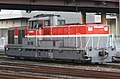
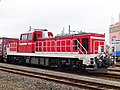
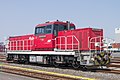
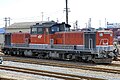
The Japan Freight Railway Company (JR Freight) relies on diesel locomotives for freight operations on non-electrified routes, particularly in northern regions such as the Tohoku and lines, where overhead electrification is limited. These locomotives handle mainline hauls and shunting duties, complementing the electric fleet on electrified networks. As of April 1, 2024, JR Freight's diesel locomotive fleet totals 122 units, supporting nationwide cargo transport while prioritizing and environmental performance. The Class DF200 represents the backbone of JR Freight's diesel fleet, introduced for commercial service in March 1993 to revive advanced diesel-electric technology for heavy freight duties. Built by , the DF200 features a suited for Japan's 1,067 mm narrow-gauge tracks and is powered by twin V12 diesel engines, enabling reliable operation in harsh conditions like Hokkaido's cold climate. These locomotives achieve a top speed of approximately 110 km/h and are deployed primarily for long-haul freight on lines including the Muroran Main Line, where they haul container and trains. With their robust design, DF200 units have been instrumental in maintaining service continuity on non-electrified segments, integrating seamlessly with electric locomotives at interchange points for hybrid operations. For eco-friendly short-haul and shunting tasks, JR Freight introduced the Class HD300 hybrid diesel-battery locomotives in 2010, marking a shift toward sustainable traction. Developed jointly with , these units combine a small with lithium-ion batteries and permanent magnet synchronous motors, achieving 36% fuel savings and 61% lower emissions compared to conventional diesel switchers. Deployed at key terminals like Freight Terminal, the HD300 supports yard operations and light freight movements, reducing environmental impact in urban areas; initial prototypes entered service in 2012, with ongoing production to phase out older models. The Class DD200, entering service in 2017, addresses shunting and secondary mainline needs on non-electrified lines as a modern successor to aging types like the DE10. Co-developed by JR Freight, , and Mitsubishi Electric, this diesel-electric locomotive delivers 1,200 hp from an , with a lightweight design that improves by 20.3% and reduces emissions by 18.6% relative to predecessors, alongside quieter operation at 55 dB(A) during idling. Recent procurements, including units delivered in 2022, underscore ongoing fleet modernization efforts by Kawasaki, ensuring compatibility with JR Freight's broader strategy.

Electric locomotives

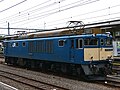
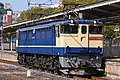
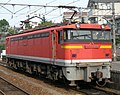
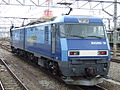
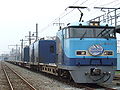
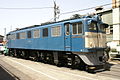
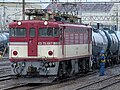
The electric locomotive fleet of Japan Freight Railway Company (JR Freight) forms the core of its operations on electrified main lines, enabling efficient hauling of heavy freight loads across high-volume corridors such as the Tōkaidō and San'yō Main Lines. As of April 1, 2024, JR Freight maintains 403 active electric locomotives, supporting daily operations of approximately 399 freight trains nationwide. These locomotives are designed for reliability on Japan's 1,500 V DC and 20 kV AC (50/60 Hz) electrification systems, with maximum operating speeds of 110-120 km/h to facilitate timely container and bulk cargo transport. The Class EF66, introduced in 1968 by (JNR) as a high-power DC electric locomotive for fast freight services, served as the backbone of operations on the Tōkaidō freight route for decades. With a power output of 3,900 kW from six MT52 traction motors and a wheel arrangement, it was capable of hauling 1,200-tonne trains at up to 110 km/h, featuring enhanced braking systems for steep gradients. Over 89 units were produced in two series (0 from 1968-1974 and 100 from 1989-1991), but following in 1987, JR Freight inherited 40, with phased retirements reducing the active fleet to 15 units by April 2025, primarily deployed in the Greater and Kansai areas for residual duties. Among modern models, the Class EH500, nicknamed "Kintaro," represents a significant advancement in dual-voltage () capability, entering service in 2000 to streamline freight flows on the "Gold Line" (Uetsu Main Line along the coast) without locomotive changes at voltage boundaries. This + articulated design delivers 4,000 kW under AC and 3,400 kW under DC, powered by eight three-phase AC induction motors with variable frequency control and for energy efficiency. A total of 82 units have been built since the prototype in 1997, all based at Akita Depot, enabling single-unit operation of 1,300-tonne trains at 120 km/h maximum speed and featuring single-arm pantographs optimized for 20 kV AC catenary. The Class EF510, introduced in 2002 and inspired by European heavy freight designs in its modular construction, addresses northern corridor needs on the Tohoku Main Line with multi-voltage performance. Equipped with a arrangement and VVVF-IGBT traction, it provides 3,390 kW output and , achieving 120 km/h speeds for 1,300-tonne hauls while replacing older EF81 units. By April 2025, 55 units are in service across variants (0 for , 500 repurposed from passenger use, and 300 for ), allocated to depots in Toyama, , and for Tohoku and routes. These locomotives undergo periodic maintenance every 100,000 km to ensure operational integrity, supported by digital inspection systems implemented in 2024 for real-time tracking of components like pantographs and braking systems. JR Freight's electric locomotives complement diesel models on mixed-traffic secondary lines, prioritizing on high-density electrified networks to minimize emissions and operational costs.

Other vehicles and former stock

JR Freight maintains a fleet of 7,092 freight cars as of April 1, 2024, encompassing a diverse array of wagons designed for bulk, , and intermodal . These include hopper cars for and aggregates, inherited from the (JNR) era and still in active service for heavy bulk commodities. Tank cars, such as the high-performance Taki 1000 series developed in the , are utilized for transporting chemicals, , and other liquids, featuring improved braking systems for speeds up to 95 km/h. Container flatcars, predominantly from the Koki series like the Koki 104 and Koki 200, support standard 20-foot and 40-foot TEU containers, forming the backbone of JR Freight's intermodal operations with 7,049 such units in the fleet. In addition to owned stock, JR Freight hauls privately owned wagons from shipping companies and manufacturers, contributing to a broader operational that exceeds its direct holdings. The company operates 42 electric multiple units, employed in limited roles for yard shunting and internal movements rather than mainline freight services. Prior to JR Freight's establishment in 1987, from the JNR era had been fully retired by the mid-1970s, marking the end of steam-powered freight operations in . In the modern period, the EF65 class electric locomotives, introduced in 1965 for general freight duties, underwent phased withdrawal during the 2020s, with regular services ceasing in 2025 as newer models like the EF210 took over. Similarly, the DD51 class diesel-hydraulic locomotives, built from 1962 for non-electrified lines, were completely retired from JR Freight operations in March 2021, with many units subsequently scrapped. Preserved examples of former JR Freight stock are displayed at institutions like the Railway Museum in Omiya, Saitama, which features retired freight locomotives such as the EF66 class electric unit. This museum, operated in collaboration with JR East and highlighting JR Group heritage, showcases operational and static exhibits of historical to educate on Japan's rail evolution. JR Freight manages its through a centralized digital system implemented in 2024, which tracks inventory status, maintenance schedules, parts, and repair histories to optimize fleet reliability and efficiency. Annual audits and updates ensure compliance and address wear on aging wagons, supporting sustainable operations amid ongoing fleet modernization.

References

Add your contribution
Related Hubs
User Avatar
No comments yet.