Hubbry Logo
JarmoJarmoMain
Open search
Jarmo
Community hub
Jarmo
logo
8 pages, 0 posts
0 subscribers
Be the first to start a discussion here.
Jarmo
Jarmo
from Wikipedia

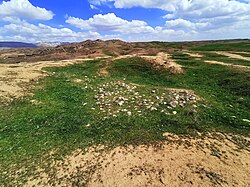
Jarmo (Kurdish: چەرمۆ, romanizedÇermo or Qelay Çermo, also Qal'at Jarmo) is a prehistoric archeological site located in modern Iraqi Kurdistan on the foothills of the Zagros Mountains. It lies at an altitude of 800 m above sea-level in a belt of oak and pistachio woodlands in the Adhaim River watershed. Excavations revealed that Jarmo was an agricultural community dating back to around 7090 BC. It was broadly contemporary with other important Neolithic sites such as Jericho in the Southern Levant and Çatalhöyük in Anatolia.

Key Information

Discovery and excavation

[edit]

The site was originally discovered by the Iraqi Directorate of Antiquities in 1940, and later became known to archaeologist Robert Braidwood from the University of Chicago Oriental Institute. At the time, he was looking for suitable places to research the origins of the Neolithic Revolution.[1][2] Braidwood worked as part of the Iraq-Jarmo programme for three seasons, those of 1948, 1950-1951 and 1954-1955; a fourth campaign, to be carried out in 1958-1959 did not come about because of the 14 July Revolution. During the excavations in Jarmo in 1954-1955, Braidwood used a multidisciplinary approach for the first time, in an attempt to refine the research methods and clarify the origin of the domestication of plants and animals. Among his team were a geologist, Herbert Wright, a palaeo-botanist, Hans Helbaek, an expert in pottery and radio-carbon dating, Frederic Mason, and a zoologist, Charles Reed, as well as a number of archaeologists. The interdisciplinary method was subsequently used in all serious field work in archaeology.

Jarmo, the village

[edit]
Personal adornments from Jarmo – University of Chicago Oriental Institute
Area of the Fertile Crescent, circa 7500 BC, with main sites. Jarmo is one of the important sites of the Pre-Pottery Neolithic period. The area of Mesopotamia proper was not yet settled (as in founding of permanent settlements) by humans.

The excavations exposed a small village, covering an area of 12,000 to 16,000 m2, and which has been dated (by carbon-14) to 7090 BC, for the oldest levels, to 4950 BC for the most recent. The entire site consists of twelve levels. Jarmo appears to be two older, permanent Neolithic settlements and, approximately, contemporary with Jericho or the Neolithic stage of Shanidar. The high point is likely to have been between 6200 and 5800 BC. This small village consisted of some twenty five houses, with adobe walls and sun-dried mud roofs, which rested on stone foundations, with a simple floor plan dug from the earth. These dwellings were frequently repaired or rebuilt. In all, about 150 people lived in the village, which was clearly a permanent settlement. In the earlier phases there is a preponderance of objects made from stone, silex—using older styles—and obsidian. The use of this latter material, obtained from the area of Lake Van, 200 miles away, suggests that some form of organized trade already existed, as does the presence of ornamental shells from the Persian Gulf. In the oldest level baskets have been found, waterproofed with pitch, which is readily available in the area.

Agriculture and cattle farming

[edit]

Agricultural activity is attested by the presence of stone sickles, cutters, bowls and other objects, for harvesting, preparing and storing food, and also by receptacles of engraved marble. In the later phases instruments made of bone, particularly perforating tools, buttons and spoons, have been found. Further research has shown that the villagers of Jarmo grew wheat of two types, emmer and einkorn, a type of primitive barley and lentils (it is common to record the domestication of grains, less so of pulses). Their diet, and that of their animals, also included species of wild plant, peas, acorns, carob seeds, pistachios and wild wheat. Snail shells are also abundant. There is evidence that they had domesticated goats, sheep and dogs. On the higher levels of the site pigs have been found, together with the first evidence of pottery.

Pottery and religion

[edit]

Jarmo is one of the oldest sites at which pottery has been found, appearing in the most recent levels of excavation, which dates it to the 7th millennium BC. This pottery is handmade, of simple design and with thick sides, and treated with a vegetable solvent. There are clay figures, zoomorphic or anthropomorphic, including figures of pregnant women which are taken to be fertility goddesses, similar to the Mother Goddess of later Neolithic cultures in the same region. These constitute the inception of the Art of Mesopotamia.

[edit]

See also

[edit]

Notes

[edit]

Further reading

[edit]
[edit]
Revisions and contributorsEdit on WikipediaRead on Wikipedia
from Grokipedia
Jarmo is a situated in the Chemchemal Valley of , on the foothills of the at an elevation of 800 meters, representing one of the earliest known examples of a sedentary farming village in the , with occupation spanning approximately 7400–6000 BCE. Excavated primarily between 1948 and 1955 under the direction of Robert J. Braidwood from the University of Chicago's Oriental Institute, Jarmo yielded evidence of mud-brick rectilinear houses arranged in a clustered settlement, marking a key transition from societies to organized agricultural communities during the (PPNB) and early Pottery Neolithic periods. The site's significance lies in its role as a key village in the eastern , where interdisciplinary studies revealed a mixed economy reliant on domesticated crops such as emmer wheat, , lentils, and , alongside wild plants like acorns and pistachios, and animal resources including herded sheep and goats as well as hunted like and foxes. Key artifacts from Jarmo include flint and obsidian tools, bone implements, ground stone objects, shell ornaments, and later ceramic vessels, with analyses from investigations since 2012, including 2022–2023 excavations, confirming culinary practices such as production and preparation from the 8th millennium BCE, underscoring the site's contributions to understanding early food production and plant domestication. As a precursor to later Mesopotamian urban centers, Jarmo's findings have profoundly influenced reconstructions of lifeways, highlighting innovations in , , and in prehistoric .

Discovery and Research History

Initial Discovery

The Jarmo archaeological site was first identified in 1940 by the Iraqi Directorate of Antiquities during routine surveys conducted in the foothills of the Zagros Mountains in northern Iraq. Located east of modern Kirkuk, the site appeared as a low mound with visible prehistoric indicators on the surface, prompting its recording in early inventories of regional heritage. Initial surface collections from the discovery revealed scattered pottery sherds and lithic tools, suggesting the presence of an ancient settlement predating known historical periods. These artifacts, collected without formal excavation, pointed to a village context but lacked stratigraphic context at the time, leading officials to classify Jarmo provisionally as a significant prehistoric locale. In the early , reports from local antiquities officials emphasized Jarmo's potential as a village site, based on the surface materials' resemblance to early farming-era assemblages identified elsewhere in . No systematic digs were undertaken during this period, as wartime disruptions and limited resources constrained further immediate action. This recognition built on broader pre-World War II archaeological interest in , where surveys and excavations since the —such as those at caves like Zarzi—had highlighted the region's role in human prehistory. The initial identification of Jarmo set the foundation for international collaboration, later involving American archaeologist Robert Braidwood as a .

Major Excavations (1948–1955)

The major excavations at Jarmo were conducted under the leadership of Robert J. Braidwood from the University of Chicago's Oriental Institute as part of the Iraq-Jarmo Project, building on the site's initial identification in 1940. These efforts spanned three field campaigns: a preliminary sounding in 1948, more extensive work in 1950–1951 that uncovered significant portions of the settlement, and the largest phase in 1954–1955, which involved systematic trenching and area exposures to document the site's full stratigraphic profile. The 1954–1955 season marked a pioneering use of a multidisciplinary approach, assembling specialists in (H. E. Wright Jr.), (H. Helbaek), (C. A. Reed), and , alongside ceramic experts (F. R. Matson), to integrate environmental, subsistence, and material analyses with archaeological data for a holistic reconstruction of life. This team, directed by Braidwood with Bruce Howe as field associate, excavated across multiple trenches, revealing 12 stratigraphic levels that spanned approximately 1,000 years of occupation. These levels documented a continuous sequence from phases, characterized by mud-brick architecture and early domesticates, to later pottery-bearing horizons with more refined s and tools, illustrating evolutionary changes in technology and economy. A planned fourth campaign for 1958–1959 was ultimately canceled due to the political upheaval of Iraq's , which overthrew the monarchy and introduced widespread instability in the Zagros region, preventing the team's return and shifting focus to projects in . Early interpretations from these excavations positioned Jarmo as a pivotal site in understanding the Neolithic "Agricultural Revolution," highlighting its evidence for a gradual transition from foraging to sedentary farming and herding over millennia, rather than abrupt innovation. This view emphasized the site's role in the broader Zagros foothills as a cradle for incipient food production, influencing subsequent models of prehistoric development in the .

Recent Investigations (2012–Present)

In 2012 and 2014, the (UCL) Jarmo Project conducted new excavations at the site to re-evaluate the stratigraphic sequence originally established by Robert Braidwood's mid-20th-century work, while applying advanced sampling techniques to investigate early and plant use. The project opened two test pits in 2012 and three trenches in 2014, employing a single-context recording system, bucket flotation for archaeobotanical recovery in the initial season, and machine flotation combined with dry sieving using a 250 µm mesh in 2014. was performed on short-lived plant remains, such as lentils and peas, yielding calibrated dates of 7050–6710 BCE and 7030–6650 BCE, which refined the occupation timeline to approximately 7400–6000 BCE across four phases. Archaeobotanical analysis of over 83 samples from 4463 liters of soil revealed a dominance of domesticated crops including lentils, , a novel glume type, and , indicating cereal-based foods like breads and porridges alongside soups, thus confirming Jarmo's status as a substantial () village integrated with early farming practices. Building on such revisits, the Charmo (Jarmo) Prehistoric Investigations, led by the , initiated work in the region from 2014 and produced preliminary reports in 2022 and 2023 focused on Zarzian period contexts and broader transitions. The 2022 season involved small-scale excavations in squares such as JT (5×10 m) and J-II central (10×10 m), with intensive sampling for paleoenvironmental data using methods like terrestrial cosmogenic nuclides (TCN) dating. Modern technologies included (UAV) surveys for 3D topographic mapping, (GPR) and magnetometric geophysical surveys, portable (pXRF) for sourcing, and (AMS) to establish a spanning Pre-Pottery to Pottery phases. Key findings highlighted the settlement's extension northwestward over at least 16 hectares, evidence of through infant burials within domestic contexts (no off-site identified), and Zarzian-period activity at the nearby Turkaka site (ca. 18,500–16,500 BCE) as a chipped stone workshop, underscoring Jarmo's landscape integration with spring-based farming. The 2023 season extended excavations in the J-II central NW area (5m x 5m) to virgin soil, uncovering pisé structures, tannurs, ash pits, hearths, and dwelling-pit-like features across layers 5–11, with approximately 70 carbon samples dated via 14C to refine the sequence, indicating the village's end in the late 7th millennium BCE. New discoveries included about 20,000 snails suggesting dietary use, six burials (including two new ones: Sk4 in and Sk5 in Layer 11 with snail shell ), 83 clay objects (e.g., animal figurines and geometric shapes), stone vessels, bone implements, ornaments, and five stone axes in Layer 10. GPS and UAV surveys supported for documentation. These investigations have incorporated geographic information systems (GIS) for of site layout and environmental contexts, enhancing understandings of occupation dynamics beyond earlier manual mapping. However, fieldwork faces significant challenges from ongoing political instability in , including recurrent disruptions since the 1960s that historically stalled research, recent economic crises limiting funding and logistics, and restricted access due to border closures and security risks. Preservation issues are exacerbated by site erosion and unchecked development, such as road construction and , which threaten unassessed areas without adequate mitigation.

Site Overview

Location and Environmental Context

Jarmo is situated in the foothills of the in , specifically on the Chamchamal Plain in Sulaimaniyah Province, approximately 9–11 km east of the town of Chamchamal and about 50 km east of , at coordinates 35°33′20.87″N, 44°55′49.05″E. The site lies on a natural promontory overlooking the Cham-Gawra , a seasonal river flowing southwest from the mountains, providing access to water resources essential for early settlement. At an elevation of around 800 meters above sea level, the tell mound—formed by successive layers of human occupation—spans an area of roughly 14,000 square meters, with the mound rising due to accumulated debris from activities. The surrounding landscape consists of gently sloping hilly terrain characterized by cuesta topography of alternating sandstone and marlstone layers, interspersed with alluvial fans and terraces that supported fertile soils conducive to . Springs emerging from sandstone fractures and the proximity to the Cham-Gawra offered reliable sources, while the region featured oak-pistachio woodlands and diverse wild and , including cereals and game animals, which supplemented early subsistence strategies. Jarmo's position near the Basian Pass facilitated connections to broader networks, evidenced by the presence of sourced from Anatolian deposits around (such as Bingöl A/B and Nemrut Dağ) and marine shells originating from the , indicating long-distance exchange routes. Paleoenvironmental reconstructions for the 8th–6th millennia BC reveal a in the Zagros foothills, with regional multi-proxy evidence (including and faunal remains) pointing to wetter conditions than today, marked by higher and less erosion, which transitioned toward greater stability suitable for the emergence of farming communities. Soil profiles and analyses from the site suggest limited local wood resources but ample availability from springs, contributing to the environmental suitability for a sedentary village like Jarmo. This ecological setting, with its blend of riverine access, fertile plains, and resource-rich uplands, played a pivotal role in influencing the site's establishment and longevity as an early agricultural center.

Chronology and Stratigraphy

The of Jarmo was occupied over a period spanning approximately 2,000 years, from circa 7090 BC in the earliest levels to circa 4950 BC in the latest, based on early radiocarbon analyses of and samples from the mid-20th century excavations. Recent () dating of seeds and faunal remains has refined this temporal framework, suggesting an initial occupation around 7400 cal BC and continuation until about 6000 cal BC, thereby confirming the site's role as a long-enduring settlement in the Zagros region. The at Jarmo is divided into 16 main levels, encompassing a 7-meter-deep deposit that transitions from (PPN) to Pottery Neolithic phases, with the lower eleven levels generally lacking ceramics and the upper five showing their emergence. Radiocarbon dates from these levels, including calibrated ranges of 7470–7070 cal BC from pig bones in Level 6 and 7050–6710 cal BC from lentils in correlated lower strata, establish the onset of settled in the early . In the upper levels, dates around 6800–6600 cal BC from contexts with chaff-tempered sherds mark the introduction of pottery, aligning with the shift to Pottery Neolithic . The site's phasing reflects progressive developments: early levels feature precursors to mud-brick construction, such as compacted earth and tauf structures; middle levels indicate stabilization of village life with refined building techniques; and upper levels introduce ceramic technologies alongside architectural enhancements. This sequence correlates with broader regional trajectories, including contemporary PPNB occupations at Tell Ramad in and the incipient stages of the in northern , highlighting Jarmo's integration into early farming networks across the . The Zagros foothills' fertile environmental context facilitated this extended stratigraphic record of cultural evolution.

Settlement and Daily Life

Architecture and Village Layout

The settlement at Jarmo was organized as a compact village comprising approximately 20 to 25 houses clustered across a tell spanning about 1.3 hectares (13,000 ). These dwellings were arranged in an organic layout without a formal street grid, with houses often built contiguously along at least two sides, separated by low walls, and incorporating small courtyards or open spaces likely used for communal activities. The houses generally aligned variably with the contours of the tell and the surrounding Chemchemal plain, reflecting adaptation to the mound's rather than rigid planning. Individual houses were constructed using tauf walls—sun-dried mixed with , laid in horizontal courses without molds—resting on rough foundations of fieldstones to provide stability against the sloping terrain. The structures featured rectangular or rectilinear plans, typically single-story with flat roofs supported by wooden beams and reed mats plastered in ; some examples included multiple rooms, such as a complex with seven interconnected spaces, including a long main room measuring about 5.6 by 2.2 meters and smaller ancillary rooms around 2.0 by 1.5 meters. Interiors contained packed-earth floors, often bedded with reeds and burnished clay, along with central hearths formed from flat river stones and storage areas such as clay-lined bins or pits for , indicating deliberate planning for domestic functions. Domed ovens with scoop-shaped openings and semi-circular chimneys were commonly integrated, often accessible from courtyards. Architectural forms evolved across the site's 11 identified stratigraphic layers in recent analyses, spanning a depth of roughly 7 to 8 meters and representing approximately 1,400 years of occupation (ca. 7400–6000 BCE). Earliest phases, reaching virgin soil, consisted of simple pit-houses: shallow, oval depressions dug into the ground with puddled mud walls and basic hearths, as confirmed in recent excavations uncovering dwelling-pit-like structures in the lowest layers. By mid-occupation, these transitioned to more permanent above-ground mud-brick buildings on stone foundations, with no major stylistic shifts but increasing complexity in room arrangements and features like multi-room dwellings. This progression from semi-subterranean to surfaced structures underscores the community's growing investment in sedentary life, supporting an estimated population of around 150 inhabitants at its peak.

Population and Social Organization

The Neolithic settlement at Jarmo is estimated to have housed a of 100 to 150 individuals, inferred from the site's extent and the presence of approximately 25 houses arranged in a compact village layout. This scale reflects a small, self-sustaining typical of early farming villages in the Zagros , where settlement density and architectural remains provide the primary proxies for demographic reconstruction. Archaeological evidence points to family-based households, with each dwelling accommodating 4 to 6 people, as suggested by room sizes ranging from 4 to 7 per structure and the distribution of domestic artifacts such as storage vessels and hearths. Patterns in waste disposal, including dedicated dumping areas like the "snail layer" containing over 20,000 shells, indicate communal management practices that imply coordinated social efforts beyond individual families. Additionally, variations in tool production—such as finely crafted bone spoons and diverse stone axes among the 1,345 recovered chipped stones—suggest emerging craft specialization, potentially involving dedicated artisans within the community. Limited skeletal remains, including infant burials and a probable male interment beneath a mud-plastered , offer sparse direct insights into demographics, while artifact associations provide inferences on gender roles; for instance, ground stone tools like querns and mortars, used for , are commonly linked to activities that may have been gendered in contexts. The site's multi-layered , spanning approximately 1,400 years (ca. 7400–6000 BCE) without signs of fortifications, mass graves, or disruption, underscores long-term social stability and continuity in occupation.

Economy and Subsistence

Plant Cultivation

Archaeobotanical analysis of remains from Jarmo reveals the presence of domesticated wheat (Triticum dicoccum), einkorn wheat (Triticum monococcum), two-row (Hordeum vulgare subsp. distichum), and lentils (Lens culinaris) as primary staple crops, particularly evident in the site's early levels to approximately 7500–7000 BCE. These identifications stem from carbonized seeds recovered during Robert Braidwood's 1948–1955 excavations, as detailed in Hans Helbaek's botanical studies, which documented non-brittle rachis traits in barley indicative of . Recent investigations from 2012–2014, including flotation techniques, confirmed wheat and lentils as dominant, with lentils showing 37.35% ubiquity across samples and emmer positively identified in 3.73% of remains, though einkorn was rare or absent in these samples. Evidence of other domesticated plants, such as (Linum usitatissimum), further underscores the site's agricultural foundation. Over the site's occupational phases, spanning the Pre-Pottery Neolithic B (ca. 7400–6800 BCE) to the Pottery Neolithic (ca. 6800–6300 BCE), archaeobotanical assemblages show increasing cultivation intensity, with cereals and pulses becoming more prevalent in domestic contexts like building floors compared to middens. Carbonized seed concentrations, totaling over 700 identifiable specimens from recent work, indicate a shift from mixed wild and cultivated flora in lower strata to predominantly domesticated forms higher up, reflecting progressive reliance on managed fields; wild plants such as acorns and pistachios remained supplementary in early phases. While phytolith analysis has been limited, seed impressions in mudbrick and chaff remains suggest processing of hulled grains, aligning with broader Zagros Neolithic patterns of crop diversification. Farming at Jarmo adapted to the semi-arid Zagros through dry, rain-fed cultivation, employing small-scale hoe-based methods without , as inferred from the site's altitude (800 m) and seasonal patterns. Harvesting utilized stone sickles, evidenced by glossed blades from multiple levels, facilitating efficient reaping of cereals in their mature stage. Storage occurred in subterranean pits lined with plaster and in early stone vessels, with over 1,300 such containers recovered, preserving grains against moisture and pests before the advent of around 6800 BCE. These practices supported a sedentary village , with forming the core of subsistence. Residue analysis on foodcrusts from vessels and hearths demonstrates heavy dietary dependence on , with cereals accounting for 87.8% of identified particles and pulses in 7.5% of samples, indicating porridges and flatbreads as staples. This botanical emphasis, comprising the majority of caloric intake, complemented limited animal herding and foraging, highlighting Jarmo's pivotal role in the Revolution's spread across Southwest Asia around 7000 BCE, where plant gathering transitioned to systematic .

Animal Domestication and Herding

At Jarmo, early occupants practiced a mixed subsistence including wild game, such as , deer, hemiones, and smaller mammals like , , and , alongside domestic animals that formed the majority of the faunal assemblage from the levels dating to the late 8th millennium cal. BCE. These wild species comprised a portion of the initial bone remains, reflecting a transitional pattern as developed. By the mid-occupation levels in the Pottery (ca. 7000–6000 BCE), there was a clear shift toward animal , with (Capra hircus) emerging as the dominant at approximately 40% of the assemblage, followed by sheep (Ovis aries) at 24%. show morphological indicators of , including reduced size and managed harvest profiles, while sheep appear to have been introduced from other regions rather than locally domesticated. Dogs (Canis familiaris) were present across all stratigraphic levels, likely aiding in or herd protection, though specific management details remain limited. Pigs (Sus scrofa) were introduced in the later levels around 6000 BCE, representing a transitional form between wild and fully domestic populations, with biometric data showing size reduction but retention of some wild traits. Their management focused on meat production, as age-at-death data from dental and post-cranial elements indicate selective slaughter, with 78% of individuals killed before one year and 97% before two years. Zooarchaeological studies of the 6,649 identified specimens highlight practices through mortality profiles: exhibit a pattern of young male (primarily 1–2 years old) for optimization, while sheep were mostly harvested as mature adults, possibly for secondary products like . Log-size index (LSI) analysis confirms positive in caprine measurements, indicative of human-controlled breeding and rather than wild harvesting. Additionally, the presence of shed milk teeth in young caprines suggests opportunities for exploitation, though direct residue evidence is absent. Herding strategies at Jarmo likely involved seasonal vertical to nearby Zagros pastures, inferred from intra-tooth stable isotope ratios in caprine molars: average δ¹³C values of -9.9‰ and δ¹⁸O of -2.3‰, with maximum ranges up to 7.6‰ indicating strong and movement between highland and lowland areas during warmer periods. Non-coincident peaks in δ¹³C (reflecting diet shifts to C₃ browse) and δ¹⁸O (tracking temperature) further support managed mobility or supplemental winter foddering to sustain herds year-round. Caprines formed the core of the faunal economy, providing a major protein source that complemented plant cultivation and accounted for the majority of identifiable remains across levels. This animal-based component, including contributions from pigs and hunted game, supported a balanced subsistence system in the emerging village context.

Tools and Technological Innovations

The tool assemblage at Jarmo primarily consisted of chipped and ground stone implements that supported agricultural and domestic activities. Flint blades, often finely retouched and exhibiting silica gloss from contact with plant stems, were prevalent for harvesting cereals such as and . These blades, typically measuring 3-5 cm in length, were likely hafted into composite sickles, marking an early specialization in farming tools. Ground stone tools, including saddle querns and ovoid handstones crafted from local or imported , facilitated the processing of grains into and . Querns, averaging 40-60 cm in length, showed heavy wear patterns consistent with repetitive grinding, with their use intensifying in later occupation levels as domesticated crops became more central to the diet. and implements further diversified the toolkit; awls made from or sheep long bones served for perforating hides and basketry, while slender needles (up to 8 cm long) enabled of or early fabrics, and curved hooks suggested applications in fishing or tasks. Technological progression is apparent across Jarmo's 12 stratigraphic levels, spanning circa 7100-5800 BCE, with early phases dominated by simple chipped flint tools and later ones incorporating ground and polished stone for enhanced durability and efficiency. Non-local materials underscore extensive exchange networks: blades and flakes, superior for cutting due to their , originated from sources near in eastern , approximately 300 km distant, comprising up to 5% of the lithic inventory. shells ( spp.), imported from the over 500 km away, were perforated for use as beads, indicating trade links with coastal or intermediary southern Mesopotamian groups. Among the innovations, mud-brick production represented a pivotal advancement in construction technology, with plano-convex bricks (circa 30x15x10 cm) molded from local clay and dried in the sun to form walls up to 50 cm thick on stone socles, allowing for stable, multi-room dwellings. Impressions of coiled and twined basketry on unbaked clay lumps and fragments reveal early proficiency in plaiting techniques using reeds or fibers, likely for storage and carrying. These tools and methods were integral to Jarmo's , enabling effective harvesting, , and herd management.

Material Culture and Artifacts

Pottery Development

Pottery first appears in the upper stratigraphic levels of Jarmo, specifically in the higher third of the site's deposits, including floors 5, 4, and 3 during the 1950/51 excavation season, with 204 sherds recovered from these early pottery-bearing floors. This emergence marks Jarmo as one of the earliest sites with ceramics in the Near East, dated to the Jarmo phase around 6750 BC based on radiocarbon evidence (e.g., sample W-665 at 11,200 ± 200 years B.P., adjusted to circa 6750 BC), placing it within the 7th millennium BC and spanning approximately 7250–6250 BC. The pottery is absent from the site's earliest pre-pottery phases, indicating a technological introduction late in the occupation sequence, with the highest concentrations—several thousand sherds—recovered from the uppermost floors in the 1954/55 season. The vessels are handmade, featuring thick sides and coarse textures, tempered with a mix of organic materials like and , as well as minerals including fine , , , , flint, , , and ocher. Common forms include shallow bowls (20–40 cm in diameter), deep carinated cups (8–20 cm), shouldered jars or double-ogee profile storage jars (up to 60 cm in diameter), cooking pots, straight-walled mugs (10–20 cm), and trays resembling Hassunan husking trays. Production relied on and slab-building techniques, with walls often constructed around a flat basal slab, reflecting a straightforward of local clay resources. Firing occurred at low temperatures, estimated at 600–700°C for about an hour in open fires, resulting in lightly baked, fragile wares with uneven oxidation—often showing a buff to orange-buff exterior and a darkened, unoxidized black core. Early examples tend to be finer and harder, while later ones become coarser, softer, and thicker-walled. Functional evolution is evident in the shift from simple, undecorated storage and cooking vessels in initial appearances to more varied items in later phases, incorporating incised or impressed motifs, occasional painted linear patterns (such as oblique blobbed lines with red slip), pierced lug handles, and rare burnishing. This progression highlights increasing technical competence and aesthetic experimentation, though painted decoration remains minimal overall. The introduction of signifies a key technological shift from perishable basketry and stone vessels to durable ceramics, correlating with greater stability and the consolidation of sedentary village in the transition. In the upper levels, ceramics begin to supplant some stone containers, underscoring their role in supporting emerging agricultural practices and daily subsistence needs. Recent excavations (2012–2024) have recovered over 1,000 additional pottery sherds from upper layers, confirming the late introduction and coarse ware dominance.

Other Artifacts and Implements

Among the non-pottery clay artifacts recovered from Jarmo are small figurines and token-like objects, primarily from layers, crafted from local clay and intentionally fired at temperatures between 550°C and 700°C, indicating household-level production rather than specialized workshops. These include anthropomorphic and zoomorphic forms, as well as geometric shapes possibly used for social or economic purposes; original excavations yielded over 5,000 fragments, while recent analyses of 2023–2024 finds document around 90 additional such items. Additionally, clay fragments bear negative impressions of woven textiles and matting, providing evidence of early processing techniques such as basketry and cloth production, with patterns suggesting the use of plant fibers like or hair. Personal adornments at Jarmo encompass bone beads, shell ornaments (e.g., dentalium and pierced tablike objects), and items such as stone pendants and bracelets, often found in contexts and reflecting early exchange networks. These traded materials, including and beads, highlight connections to broader regional , with shell items perforated for suspension as jewelry. Household implements include grinding slabs (querns), mortars, and pestles made from coarse local stone, used for processing grains into or , with variations in size and shape suited to domestic food preparation tasks. In the site's latest levels, rare traces of appear, such as small beads or pins hammered from unrefined metal, marking some of the earliest evidence of metal use in the region. Craft tools comprise flint implements for general cutting and blades imported from for precision tasks like hide working or , alongside clay spindle whorls that facilitated spinning from animal fibers. These lithic tools vary from large scrapers to microliths, with constituting a notable portion of the finer blades. Recent work (2012–2024) has identified additional microblades and blades, supporting Anatolian provenance. The majority of these artifacts were concentrated in domestic areas, such as floors and courtyards, exhibiting variability across house clusters that suggests diverse activities and resource use within the village.

Religion and Symbolic Practices

Evidence of Ritual and Beliefs

Archaeological evidence for ritual and beliefs at Jarmo is sparse and largely indirect, owing to the perishable nature of organic materials commonly used in Neolithic ceremonial practices, but inferences can be drawn from structural features, depositional patterns, and human remains uncovered during excavations. The site's domestic-oriented rituals appear integrated into and communal spaces, contrasting with more monumental expressions seen elsewhere in the (PPN). Possible ritual spaces include a small clay platform (approximately 30 cm x 30 cm) in a central village square, associated with clusters of broken artifacts suggestive of ceremonial deposition. A notable deposit in Layer 9, featuring over 20,000 snail shells alongside carbonized seeds, points to symbolic gatherings or ritual meals that may have reinforced social bonds in this early farming community. These features, often located in central or residential areas, indicate that rituals were embedded in everyday village life rather than confined to dedicated temples. Intentional depositional practices further hint at spiritual concerns, with human burials placed beneath house floors or in courtyards, a pattern common in PPN sites and suggestive of ancestor veneration to ensure household protection and continuity. Excavations by Braidwood in the 1950s revealed fragmented human remains without formal grave pits or elaborate goods, while recent work (2012–2023) identified at least six individuals, including infants interred in soil layers and an adult male in a primary burial under a mud-plastered floor, accompanied by snail shells possibly as symbolic grave offerings. Such intramural burials, lacking clear grave preparations, align with regional PPN traditions where the dead were incorporated into living spaces to maintain communal ties. The inferred beliefs at Jarmo reflect a emphasis on and seasonal cycles, tied to the origins of in the , where rituals likely sought to ensure bountiful harvests and community prosperity; interpretations vary, with some scholars viewing these practices as evidence of fertility cults and others as apotropaic or personal talismans. This domestic cultic focus, evidenced by the integration of ceremonial elements into village layout, shares chronological overlap with early farming developments (ca. 8500–7000 BCE) and parallels PPN rituals at sites like , though Jarmo's practices prioritize household-level observances over large-scale monumentalism.

Figurines and Iconography

Excavations at Jarmo, conducted primarily by Robert J. Braidwood between 1948 and 1955, uncovered over 7,500 fragments of clay objects, including a substantial corpus of anthropomorphic and zoomorphic figurines that provide insight into early symbolic practices. These artifacts, detailed in Vivian Broman Morales's analysis, encompass both realistic and abstract forms, with human representations dominating the assemblage. Realistic anthropomorphic figurines often depict seated, naked females, typically 5-10 cm in height, featuring detailed modeling of torsos, arms, and heads with incised lines indicating hair, eyes, or jewelry; a notable example is a 7.1 cm tall female figurine with pronounced anatomical features. Approximately 100 torso fragments suggest a focus on the upper body, while heads show varied styles, from schematic to more defined facial elements. Zoomorphic figurines from the same excavations primarily represent wild animals, such as dogs and caprines, modeled in simple, solid forms without bases, emphasizing legs and heads through pinching and techniques; these lack the elaboration seen in human figures but indicate familiarity with local . Abstract forms, including "lady stalks"—elongated, stalk-like female representations—and double-winged bases, appear in earlier layers, transitioning to more naturalistic styles in later phases, reflecting evolving artistic conventions. Male figurines are rarer and smaller, often distinguished by phallic attributes rendered in clay or associated stone objects, suggesting gendered tied to reproductive or potency themes. Iconographic elements in Jarmo's figurines highlight bodily emphasis, particularly on female forms with exaggerated hips, breasts, or pregnant bellies in some examples, interpreted as symbols of fertility and abundance in a nascent agricultural society. Incised patterns on limbs or torsos may denote clothing, tattoos, or ritual markings, while the absence of facial details in many abstract pieces points to a focus on symbolic rather than portraiture functions. Broman Morales posits that these objects reflect community-level intelligence and cultural expression, potentially used in household rituals rather than elite contexts. Recent investigations at Jarmo (2023-2024) by Akira Tsuneki and colleagues revealed an additional 90 small clay objects from layers, comprising anthropomorphic, zoomorphic, and geometric forms, including token-like items. These were crafted from local clays and intentionally fired at 550-700°C using diverse techniques, indicating non-specialized, household-based production across multiple units. Dark fire-exposure patches on surfaces suggest burning or use in ceremonies, with proposed functions spanning social bonding, symbolic representation, economic tallying, and exchange networks—extending beyond purely religious roles. This assemblage underscores continuity in clay-working traditions while highlighting pre-pottery pyro-technology in the Zagros region.

References

Add your contribution
Related Hubs
User Avatar
No comments yet.