


Community hub
Recent from talks
Contribute something
Nothing was collected or created yet.
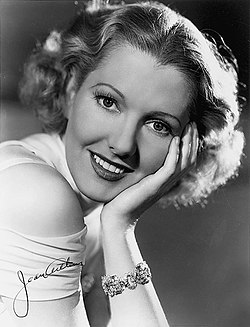
Jean Arthur
View on Wikipedia
Jean Arthur (born Gladys Georgianna Greene; October 17, 1900 – June 19, 1991)[1] was an American film and theater actor whose career began in silent films in the early 1920s and lasted until the early 1950s.
Key Information


Arthur had feature roles in three Frank Capra films: Mr. Deeds Goes to Town (1936) with Gary Cooper, You Can't Take It with You (1938) co-starring James Stewart, and Mr. Smith Goes to Washington (1939), also starring Stewart. These three films all championed the "everyday heroine", personified by Arthur. She also co-starred with Cary Grant in the adventure-drama Only Angels Have Wings (1939) and in the comedy-drama The Talk of the Town (1942). She starred as the lead in the acclaimed and highly successful comedy films The Devil and Miss Jones (1941) and A Foreign Affair (1948), the latter of which she starred alongside Marlene Dietrich. Arthur was nominated for an Academy Award for Best Actress in 1944 for her performance in The More the Merrier (1943), a comedy which also starred Joel McCrea.[2]
James Harvey wrote in his history of the romantic comedy: "No one was more closely identified with the screwball comedy than Jean Arthur. So much was she part of it, so much was her star personality defined by it, that the screwball style itself seems almost unimaginable without her."[3] She has been called "the quintessential comedic leading lady".[4] Her last film performance was non-comedic, playing the homesteader's wife in George Stevens's Shane in 1953.
Like Greta Garbo, Arthur was well known in Hollywood for her aversion to publicity; she was very guarded about her privacy and rarely signed autographs or granted interviews. Life observed in a 1940 article: "Next to Garbo, Jean Arthur is Hollywood's reigning mystery woman."[5] As well as recoiling from interviews, after a certain age, she avoided photographers and refused to become a part of any kind of publicity.[6]
Early life
[edit]Arthur was born Gladys Georgianna Greene in Plattsburgh, New York, to Protestant parents Johanna Augusta Nelson and Hubert Sidney Greene.[7] Gladys' Lutheran maternal grandparents immigrated from Norway to the American West after the Civil War. Her Congregationalist paternal ancestors immigrated from England to Rhode Island in the second half of the 17th century. During the 1790s, Nathaniel Greene helped found the town of St. Albans, Vermont, where his great-grandson, Hubert Greene, was born.
Arthur had three older brothers.[8]
The product of a nomadic childhood, Arthur lived at times in Saranac Lake, New York; Jacksonville, Florida, and Schenectady, New York. The family lived on and off in Westbrook, Maine, from 1908 to 1915, while Arthur's father worked at Lamson Studios in Portland. Relocating in 1915 to New York City, the family settled in the Washington Heights neighborhood of upper Manhattan.[9]
Arthur dropped out of high school in her junior year due to a "change in family circumstances".[10]
Career
[edit]Silent film
[edit]_-_1.jpg)
Discovered by Fox Film Studios while she was doing commercial modeling in New York City in the early 1920s, the newly named Jean Arthur landed a one-year contract and debuted in the silent film Cameo Kirby (1923), directed by John Ford. She reputedly took her stage name from two of her greatest heroes, Joan of Arc (Jeanne d'Arc) and King Arthur.[11] The studio was at the time looking for new American sweethearts with sufficient sex appeal to interest the Jazz Age audiences. Arthur was remodeled as such a personality, a flapper.[12]
_-_1.jpg)
Following the small role in Cameo Kirby, she received her first female lead role in The Temple of Venus (1923), a plotless tale about a group of dancing nymphs. Dissatisfied with her lack of acting talent, the film's director, Henry Otto, replaced Arthur with actress Mary Philbin during the third day of shooting. Arthur agreed with the director: "There wasn't a spark from within. I was acting like a mechanical doll personality. I thought I was disgraced for life."[13]
Arthur was planning on leaving the California film industry for good, but reluctantly stayed due to her contract, and appeared in comedy shorts, instead. Despite lacking the required talent, Arthur liked acting, which she perceived as an "outlet". To acquire some fame, she registered herself in the Los Angeles city directory as a photo player operator, as well as appearing in a promotional film for a new Encino nightclub, but to no avail.[14]
It would have been better business if I cried in front of the producers. It isn't a bad idea to get angry and chew up the scenery. I've had to learn to be a different person since I've been out here. Anybody that sticks it out in Hollywood for four years is bound to change in self-defense... Oh, I'm hard-boiled now. I don't expect anything. But it took me a long time to get over hoping, and believing, people's promises. That's the worst of this business, everyone is such a good promisor.[15]
Change came when one day she showed up at the lot of Action Pictures, which produced B Westerns, and impressed its owner, Lester F. Scott, Jr., with her presence. He decided to take a chance on a complete unknown, and she was cast in over 20 Westerns in a two-year period. Only receiving $25 a picture, Arthur suffered from difficult working conditions: "The films were generally shot on location, often in the desert near Los Angeles, under a scorching sun that caused throats to parch and make-up to run. Running water was nowhere to be found, and even outhouses were a luxury not always present. The extras on these films were often real cowboys, tough men who were used to roughing it and who had little use for those who were not."[16] The films were moderately successful in second-rate Midwestern theaters, though Arthur received no official attention. Aside from appearing in films for Action Pictures between 1924 and 1926, she worked in some independent Westerns, including The Drug Store Cowboy (1925), and Westerns for Poverty Row, as well as having an uncredited bit part in Buster Keaton's Seven Chances (1925) as the receptionist.[17]
In 1927, Arthur attracted more attention when she appeared opposite Mae Busch and Charles Delaney as a gold-digging chorus girl in Husband Hunters. Subsequently, she was romanced by actor Monty Banks in Horse Shoes (1927), both a commercial and critical success. She was cast on Banks's insistence, and received a salary of $700.[18] Next, director Richard Wallace ignored Fox's wishes to cast a more experienced actress by assigning Arthur to the female lead in The Poor Nut (1927), a college comedy, which gave her wide exposure to audiences. A reviewer for Variety did not spare the actress in his review:
With everyone in Hollywood bragging about the tremendous overflow of charming young women all battering upon the directorial doors leading to an appearance in pictures, it seems strange that from all these should have been selected two flat specimens such as Jean Arthur and Jane Winton. Neither of the girls has screen presence. Even under the kindliest treatment from the camera, they are far from attractive and in one or two side shots almost impossible.[19]

Fed up with the direction that her career was taking, Arthur expressed her desire for a big break in an interview at the time. She was skeptical when signed to a small role in Warming Up (1928), a film produced for a big studio, Famous Players–Lasky, and featuring major star Richard Dix. Promoted as the studio's first sound film, it received wide media attention, and Arthur earned praise for her portrayal of a baseball club owner's daughter. Variety opined, "Dix and Arthur are splendid in spite of the wretched material", while Screenland wrote that Arthur "is one of the most charming young kissees who ever officiated in a Dix film. Jean is winsome; she neither looks nor acts like the regular movie heroine. She's a nice girl – but she has her moments."[20] The success of Warming Up resulted in Arthur being signed to a three-year contract with the studio, soon to be known as Paramount Pictures, at $150 a week.
Transition to sound film
[edit]
With the rise of the talkies in the late 1920s, Arthur was among the many silent-screen actors of Paramount Pictures initially unwilling to adapt to sound films.[21] Upon realizing that the craze for sound films was not a phase, she met with sound coach Roy Pomeroy. Her distinctive, throaty voice – in addition to some stage training on Broadway in the early 1930s – eventually helped make her a star in the talkies, but it initially prevented directors from casting her in films.[22] In her early talkies, this "throaty" voice is still missing, and whether it had not yet emerged or whether she hid it remains unclear.[23] Her all-talking film debut was The Canary Murder Case (1929), in which she co-starred opposite William Powell and Louise Brooks. Arthur impressed only a few with the film, and later claimed that at the time she was a "very poor actress ... awfully anxious to improve, but ... inexperienced so far as genuine training was concerned."[24]
In the early years of talking pictures, Paramount was known for contracting Broadway actors with experienced vocals and impressive background references. Arthur was not among these actors, and she struggled for recognition in the film industry. Her personal involvement with rising Paramount executive David O. Selznick – despite his relationship with Irene Mayer Selznick – proved substantial; she was put on the map and became selected as one of the WAMPAS Baby Stars in 1929. Following a silent B Western called Stairs of Sand (1929), she received some positive notices when she played the female lead in the lavish production of The Mysterious Dr. Fu Manchu (1929).[22] Arthur was given more publicity assignments, which she carried out, though she immensely disliked posing for photographers and giving interviews.[22]

Through Selznick, Arthur received her "best role to date" opposite famous sex symbol Clara Bow in the early sound film The Saturday Night Kid (1929).[25] Of the two female leads, Arthur was thought to have "the better part", and director Edward Sutherland claimed, "Arthur was so good that we had to cut and cut to keep her from stealing the picture" from Bow.[26] While some argued that Bow resented Arthur for having the "better part,"[27] Bow encouraged Arthur to make the most of the production.[26] Arthur later praised her working experience with Bow: "[Bow] was so generous, no snootiness or anything. She was wonderful to me."[28] The film was a moderate success, and The New York Times wrote that the film would have been "merely commonplace, were it not for Jean Arthur, who plays the catty sister with a great deal of skill."[27]
Following a role in Half way to Heaven (1929) opposite popular actor Charles "Buddy" Rogers (of which Variety opined that her career could be heading somewhere if she acquired more sex appeal),[27] Selznick assigned her to play William Powell's wife in Street of Chance (1930). She did not impress the film's director, John Cromwell, who advised the actress to move back to New York because she would not make it in Hollywood.[27] By 1930, her relationship with Selznick had ended, causing her career at Paramount to slip.[29] Following a string of "lifeless ingenue roles" in mediocre films, she debuted on stage in December 1930 with a supporting role in Pasadena Playhouse's 10-day production run of Spring Song. Back in Hollywood, Arthur saw her career deteriorating, and she dyed her hair blonde in an attempt to boost her image and avoid comparison with the more successful actress Mary Brian.[30] Her effort did not pay off; when her three-year contract at Paramount expired in mid-1931, she was given her release with an announcement from Paramount that the decision was due to financial setbacks caused by the Great Depression.[30]
Broadway
[edit]In late 1931, Arthur returned to New York City, where a Broadway agent cast Arthur in an adaptation of Lysistrata, which opened at the Riviera Theater on January 24, 1932. A few months later, she made her Broadway debut in Foreign Affairs opposite Dorothy Gish and Osgood Perkins. Though the play did not fare well and closed after 23 performances, critics were impressed by her work on stage.[31] She next won the female lead in The Man Who Reclaimed His Head, which opened on September 8, 1932, at the Broadhurst Theatre to mostly mixed notices for Arthur; negative reviews for the play caused the production to be halted quickly.[32] Arthur returned to California for the holidays, and appeared in the RKO film The Past of Mary Holmes (1933), her first film in two years.
Back on Broadway, Arthur continued to appear in small plays that received little attention. Critics, however, continued to praise her in their reviews. In this period, Arthur arguably developed confidence in her acting craft for the first time.[33] On the contrast between films in Hollywood and plays in New York, Arthur commented:
I don't think Hollywood is the place to be yourself. The individual ought to find herself before coming to Hollywood. On the stage I found myself to be in a different world. The individual counted. The director encouraged me and I learned how to be myself.... I learned to face audiences and to forget them. To see the footlights and not to see them; to gauge the reactions of hundreds of people, and yet to throw myself so completely into a role that I was oblivious to their reaction.[33]
The Curtain Rises, which ran from October to December 1933, was Arthur's first Broadway play in which she was the center of attention.[34] With an improved résumé, she returned to Hollywood in late 1933, and turned down several contract offers until she was asked to meet with an executive from Columbia Pictures.[35] Columbia hired her.
Columbia Pictures
[edit]During production of her first Columbia feature, she was offered a long-term contract that promised financial stability for herself and both of her parents.[35] Though hesitant to give up her stage career, Arthur signed the five-year contract on February 14, 1934.[10]
Jean Arthur's first two features for Columbia starred the studio's number-one boxoffice draw, the action star Jack Holt. Holt had a loyal following among fans and exhibitors, and Columbia's president Harry Cohn knew that Arthur would benefit from the exposure, and from working with screen veteran Holt. Whirlpool cast tough-guy Holt as a once-convicted gambler reunited with the daughter he has never seen. Arthur played the daughter with sincerity and sympathy, while Holt displayed a tenderness and compassion never before seen in his two-fisted melodramas. The Hollywood Reporter observed, "Particularly touching and well done are [Holt's] scenes with his daughter. He is given splendid assistance by Jean Arthur, and by the director, Roy William Neill. Without overplaying or mawkish sentimentality, these scenes have a natural, human quality that counts."[36]
Holt and Arthur were teamed a few months later for a follow-up, The Defense Rests (1934); Arthur's character, fresh out of law school, wants to work for a celebrated criminal lawyer, played by Holt, and soon learns the inside story of his success.
Arthur's success in the Holt pictures had a salutary effect on the actress's outlook, according to Picture Play:
Her entire personality has changed, and from a somewhat immature actress of nice but no startling ability she has blossomed into a distinctive artist, and only the future can tell how high she will soar... [She] now receives, from Whirlpool alone, approval that any far more experienced actress might spend years in building up.[37]
In 1935, at age 34, Arthur starred opposite Edward G. Robinson in the gangster farce The Whole Town's Talking, also directed by Ford, and her popularity began to rise. It was the first time Arthur portrayed a hard-boiled working girl with a heart of gold, the type of role with which she would be associated for the rest of her career.[38] She enjoyed the acting experience and working opposite Robinson, who remarked in his biography that it was a "delight to work with and know" Arthur.[39] By the time of the film's release, her hair, naturally brunette throughout the silent-film portion of her career, was bleached blonde and mostly stayed that way. She was known for maneuvering to be photographed and filmed almost exclusively from the left; Arthur felt that her left was her better side, and worked hard to keep it in the fore. Director Frank Capra recalled producer Harry Cohn's description of Jean Arthur's imbalanced profile: "half of it's angel, and the other half horse."[40]
Her next few films, Party Wire (1935), Public Hero No. 1 (1935), and If You Could Only Cook (1935), did not match the success of The Whole Town's Talking, but they all brought the actress positive reviews.[39] In his review for The New York Times, critic Andre Sennwald praised Arthur's performance in Public Hero No. 1, writing that she "is as refreshing a change from the routine it-girl as Joseph Calleia is in his own department."[41] Another critic wrote of her performance in If You Could Only Cook that "[she is] outstanding as she effortlessly slips from charming comedienne to beautiful romantic."[42] With her now apparent rise to fame, Arthur was able to extract several contractual concessions from Harry Cohn, such as script and director approval and the right to make films for other studios.[43]

The turning point in Arthur's career came when she was chosen by Frank Capra to star in Mr. Deeds Goes to Town (1936). Capra had spotted her in a daily rush[40] from the film Whirlpool in 1934[44] and convinced Cohn to have Columbia Studios sign her for his next film, playing a tough newspaperwoman who falls in love with a country bumpkin millionaire. Though several colleagues later recalled that Arthur was troubled by extreme stage fright during production, Mr. Deeds was critically acclaimed and propelled her to international stardom.[45] In 1936 alone, she earned $119,000, more than the President of the United States and baseball star Lou Gehrig combined.[46][47][48]
With fame also came media attention, something Arthur greatly disliked. She did not attend any social gatherings, such as formal parties in Hollywood, and acted difficult when having to work with an interviewer. She was named the American Greta Garbo – who was also known for her reclusive life – and magazine Movie Classic wrote of her in 1937: "With Garbo talking right out loud in interviews, receiving the press and even welcoming an occasional chance to say her say in the public prints, the palm for elusiveness among screen stars now goes to Jean Arthur."[49]


Arthur's next film was The Ex-Mrs. Bradford (1936), on loan to RKO Pictures, in which she starred opposite William Powell on his insistence,[50] and hoped to take a long vacation afterwards. Cohn, however, rushed her into two more productions, Adventure in Manhattan (1936) and More Than a Secretary (1936). Neither film attracted much attention.[51]
Next, again without pause, she was reteamed with Cooper, playing Calamity Jane in Cecil B. DeMille's The Plainsman (1936) on another loan, this time for Paramount Pictures. Arthur, who was De Mille's second choice after Mae West, described Calamity Jane as her favorite role thus far.[51]
In 1937, she appeared as a working girl, her typical role, in Mitchell Leisen's screwball comedy, Easy Living (1937), with Ray Milland. She followed this with another screwball comedy, Capra's You Can't Take It with You (1938), which teamed her with James Stewart. The film won an Academy Award for Best Picture, with Arthur getting top billing.
So strong was her box-office appeal by now that she was one of four finalists for the role of Scarlett O'Hara in Gone with the Wind (1939). The film's producer, David O. Selznick, had briefly romanced Arthur in the late 1920s when they both were with Paramount. Arthur reunited with director Frank Capra and Stewart for Mr. Smith Goes to Washington (1939), with Arthur cast once again as a working woman, this time one who teaches the naïve Mr. Smith the ways of Washington, DC. Arthur was offered a third reunion with Capra and Stewart in It's a Wonderful Life (1946), playing the role of Stewart's wife Mary (which eventually went to Donna Reed), but she refused to attend Stephens College.[52]
Arthur continued to star in films such as Howard Hawks' Only Angels Have Wings (also 1939), with Cary Grant, The Talk of the Town (1942), directed by George Stevens (with Cary Grant and Ronald Colman, working together for the only time, as Arthur's two leading men), and again for Stevens as a government clerk in The More the Merrier (1943), for which Arthur was nominated for the Academy Award for Best Actress (losing to Jennifer Jones for The Song of Bernadette). As a result of being in dispute with studio boss Harry Cohn, her fee for The Talk of the Town (1942) was only $50,000, while her male co-stars Grant and Colman received upwards of $100,000 each.
Arthur remained Columbia's top star until the mid-1940s, when she left the studio; Rita Hayworth took over as the studio's biggest name. Stevens famously called her "one of the greatest comediennes the screen has ever seen," while Capra credited her as "my favorite actress."[53]
Later career and retirements
[edit]
Arthur announced her retirement when her contract with Columbia Pictures expired in 1944. She reportedly ran through the studio's streets, shouting "I'm free, I'm free!"[54] For the next several years, she turned down virtually all film offers, the two exceptions being Billy Wilder's A Foreign Affair (1948), in which she played a congresswoman and rival of Marlene Dietrich's, and as a homesteader's wife in Stevens' classic Western Shane (1953), which turned out to be the biggest box-office hit of her career. The latter was her final film, and the only color film in which she appeared.[55]
Arthur's postretirement work in theater was intermittent, somewhat curtailed by her unease and discomfort about working in public.[56] Capra claimed she vomited in her dressing room between scenes, yet emerged each time to perform a flawless take. According to John Oller's biography, Jean Arthur: The Actress Nobody Knew (1997), Arthur developed a kind of stage fright punctuated with bouts of psychosomatic illnesses. A prime example was in 1945, when she was cast in the lead of the Garson Kanin play Born Yesterday. Her nerves and insecurity got the better of her and she left the production before it reached Broadway, opening the door for a then-unknown Judy Holliday to take the part.[57][58] Nevertheless, Arthur appeared as Peter Pan in the 1950 Broadway musical Peter Pan.[59]

After Shane and A Foreign Affair, Arthur went into retirement for 11 years.
In 1965, the reclusive Arthur returned to show business to star in an episode of Gunsmoke, as Julie Blane in season 10, episode 24's "Thursday's Child". In 1966, she took on the role of Patricia Marshall, an attorney, on her own television sitcom, The Jean Arthur Show, which was cancelled midseason by CBS after only 12 episodes.
In 1967, Arthur was coaxed back to Broadway to appear as a Midwestern "spinster" who falls in with a group of hippies in the play The Freaking Out of Stephanie Blake. In his book The Season, William Goldman reconstructed the disastrous production, which eventually closed during previews when Arthur refused to go on.[60]
Arthur next decided to teach drama, first at Vassar College and then the North Carolina School of the Arts.
While living in North Carolina, in 1973, Arthur made front-page news by being arrested and jailed for trespassing on a neighbor's property to console a dog she felt was being mistreated.[61] An animal lover her entire life, Arthur said she trusted them more than people.[62] She was convicted, fined $75, and given three years' probation.[61]
After 11 performances of First Monday in October in Cleveland, Ohio, in 1975, Arthur then retired for good, retreating to Driftwood Cottage, her oceanside home on Carmel Point at the southern city limits of Carmel-by-the-Sea, California,[63] steadfastly refusing interviews until her resistance was broken down by the author of a book about Capra. Arthur once famously said that she would rather have her throat slit than give an interview.[64]
Personal life
[edit]Arthur's first marriage, to photographer Julian Anker in 1928, was annulled after one day.[65] She married producer Frank Ross, Jr. in 1932. They divorced in 1949.[66]
In 1979, lesbian actress Patsy Kelly told gay writer Boze Hadleigh that she believed Arthur was a lesbian.[67]
Arthur lived in Carmel-by-the-Sea, California, for 30 years,[68] and died from heart failure on June 19, 1991,[69] at the age of 90.[66][70] No funeral service was held.[69] She was cremated, and her remains were scattered off the coast of Point Lobos, California.[71]
Driftwood Cottage
[edit]Driftwood Cottage, in Carmel Point, California, was once the home of Arthur and her mother Johanna Greene.[72][73] Arthur remodeled the house and created a large outdoor garden, with landscape artist George Hoy, in a Japanese architecture style, including a Japanese bronze dragon gate latch.[73]
Legacy
[edit]Upon her death, film reviewer Charles Champlin wrote the following in the Los Angeles Times:
To at least one teenager in a small town (though I'm sure we were a multitude), Jean Arthur suggested strongly that the ideal woman could be – ought to be – judged by her spirit as well as her beauty … The notion of the woman as a friend and confidante, as well as someone you courted and were nuts about, someone whose true beauty was internal rather than external, became a full-blown possibility as we watched Jean Arthur.[74]
For her contribution to the motion-picture industry, Arthur has a star on the Hollywood Walk of Fame at 6333 Hollywood Blvd.[75]
In 2014, Arthur was inducted into the Hall of Great Western Performers at the National Cowboy & Western Heritage Museum in Oklahoma City.[76]
Filmography
[edit]Radio performances
[edit]| Year | Program | Episode/source |
|---|---|---|
| 1937 | Lux Radio Theatre | Mr. Deeds Goes to Town[77] |
| 1937 | Lux Radio Theatre | The Plainsman |
| 1938 | Lux Radio Theatre | Seventh Heaven |
| 1939 | Lux Radio Theatre | Only Angels Have Wings |
| 1939 | Lux Radio Theatre | Pygmalion |
| 1940 | Screen Guild Theater | Jezebel |
| 1941 | Lux Radio Theatre | Remember the Night |
| 1943 | Lux Radio Theatre | The Talk of the Town |
| 1953 | Theatre Guild on the Air | The Grand Tour[78] |
See also
[edit]


References
[edit]- ^ "Jean Arthur, American actress". Encyclopedia Britannica. Archived from the original on October 22, 2017. Retrieved October 22, 2017.
- ^ "The 16th Academy Awards". Academy of Motion Picture Arts and Sciences. October 5, 2014. Archived from the original on July 15, 2015. Retrieved July 15, 2015.
- ^ Harvey 1987, p. 351.
- ^ Osborne, Robert. "Dedication at 17-film salute to Jean Arthur". Turner Classic Movies (broadcast), January 2007.
- ^ Oller 1997, p. 1.
- ^ Oller 1997, p. 2.
- ^ "Genealogy: Jean Arthur" Archived January 4, 2008, at the Wayback Machine. Freepages.genealogy.rootsweb.com, August 14, 2010.
- ^ 1900 US Census, Plattsburgh, New York; and 1910 US Census, Cumberland, Maine.
- ^ Oller 1997, p. 33
- ^ a b Oller 1997, p. 34.
- ^ Collins, Thomas W. Jr (2000). "Arthur, Jean (17 October 1900–19 June 1991)". American National Biography. New York: Oxford University Press. doi:10.1093/anb/9780198606697.article.1803494. (subscription required)
- ^ Oller 1997, p. 40.
- ^ Oller 1997, p. 41.
- ^ Oller 1997, p. 42.
- ^ Oller 1997, p. 46.
- ^ Oller 1997, p. 43.
- ^ "Seven Chances – Full Cast & Crew". TV Guide. Archived from the original on November 6, 2022. Retrieved November 6, 2022.
- ^ Oller 1997, p. 45.
- ^ Oller 1997, pp. 45–46.
- ^ Oller 1997, p. 47.
- ^ Oller 1997, p. 51.
- ^ a b c Oller 1997, p. 58.
- ^ Oller 1997, p. 52.
- ^ Oller 1997, p. 53.
- ^ Oller 1997, p. 60.
- ^ a b Stenn 1988, p. 178.
- ^ a b c d Oller 1997, p. 61.
- ^ Stenn 1988, p. 179.
- ^ Oller 1997, p. 62.
- ^ a b Oller 1997, p. 64.
- ^ Oller 1997, p. 69.
- ^ Oller 1997, p. 70.
- ^ a b Oller 1997, p. 71.
- ^ Oller 1997, p. 72.
- ^ a b Oller 1997, p. 73.
- ^ The Hollywood Reporter, April 3, 1934, p. 3.
- ^ Whitney Williams in Picture Play, September 1934, p. 55.
- ^ Oller 1997, p. 81.
- ^ a b Oller 1997, p. 82.
- ^ a b Capra 1971, p. 184.
- ^ "Read TCM's article on Public Hero No. 1". Turner Classic Movies. Archived from the original on May 26, 2013. Retrieved November 16, 2012.
- ^ "Read TCM's article on If You Could Only Cook". Turner Classic Movies. Archived from the original on December 4, 2012. Retrieved November 16, 2012.
- ^ Oller 1997, p. 83.
- ^ Oller 1997, p. 84.
- ^ Oller 1997, p. 85-86.
- ^ Oller 1997, p. 89.
- ^ [1] Archived February 12, 2022, at the Wayback Machine Salary History of the United States President, $75,000 in 1936.
- ^ [2] Archived December 3, 2010, at the Wayback Machine Lou Gehrig salaries at baseball-reference.com. $36,000 in 1936.
- ^ Oller 1997, p. 92.
- ^ "Notes for The Ex-Mrs. Bradford". Turner Classic Movies. Archived from the original on May 26, 2013. Retrieved November 19, 2012.
- ^ a b Oller 1997, p. 93.
- ^ Oller, John (2004). Jean Arthur: The Actress Nobody Knew. Limelight Editions. p. 132. ISBN 0-87910-278-0.
- ^ Capra 1971, pp. 184–185.
- ^ Morgan, Kim (May 5, 2020). "Jean Arthur, the Nonconformist". The Criterion Collection. Retrieved May 16, 2020.
- ^ Anthony, Elizabeth. "Jean Arthur at Screen Classics." Archived December 13, 2007, at the Wayback Machine Reelclassics.com, July 21, 2010. Retrieved: August 14, 2010.
- ^ "TCM Movie Database: Jean Arthur." Archived September 30, 2007, at the Wayback Machine Tcmdb.com, August 14, 2010.
- ^ Bordman, Gerald Martin; Hischak, Thomas S. (2004). The Oxford Companion to American Theatre. Oxford University Press, US. ISBN 0-19-516986-7. Archived from the original on May 19, 2023. Retrieved May 19, 2023.
- ^ Kennedy, Eugene (February 21, 1988). "'Born Yesterday' Reborn in Chicago". The New York Times. p. 5 (Section 2). Archived from the original on May 19, 2023. Retrieved May 19, 2023.
- ^ "Peter Pan". ibdb.com. The Broadway League. Retrieved August 30, 2025.
- ^ Smith, Kyle (May 19, 2021). "The best book on theater | The New Criterion". Archived from the original on May 21, 2024. Retrieved May 21, 2024.
- ^ a b "Actress Jean Arthur arrested, convicted". Greeley Daily Tribune. Greeley Daily Tribune. April 14, 1973. p. 18. Archived from the original on August 16, 2024. Retrieved June 30, 2015 – via Newspapers.com.

- ^ Oller, John (2004). Jean Arthur: The Actress Nobody Knew. Limelight Editions. p. 167. ISBN 0-87910-278-0.
- ^ Russell Mac Masters (1976). "Architectural Digest: Jean Arthur". archive.architecturaldigest.com. Archived from the original on November 8, 2022. Retrieved November 8, 2022.
- ^ Parish 2002, p. 92.
- ^ Oliver, Myrna (July 20, 1991). "Jean Arthur Dies; Comedy Film Star of the '30s and '40s."". Los Angeles Times. Archived from the original on October 14, 2023. Retrieved August 14, 2010.
- ^ a b Sarvady et al. 2006, p. 17.
- ^ Hollywood Lesbians, by Boze Hadleigh; p. 62; published 1994 by Barricade Books; "PK: But it figures why certain actresses – the sisterhood? – want to be Peter Pan. Gals like Mary Martin and Jean Arthur. They want to be boys. BH: You mean because Martin and Arthur are lesbians. PK: In a nutshell."
- ^ King, Susan (April 21, 2017). "Here is what really happened to Joan Crawford, Bette Davis and others after 'Feud'". Hartford Courant. Archived from the original on April 22, 2017. Retrieved December 11, 2022.
- ^ a b "Actress Jean Arthur Dies Wednesday". Tyrone Daily Herald. Tyrone Daily Herald. June 20, 1991. p. 3. Archived from the original on March 4, 2016. Retrieved June 30, 2015 – via Newspapers.com.
- ^ "Jean Arthur, Actress Who Starred In Films by Capra, Is Dead at 90". New York Times. June 20, 1991.
- ^ Brooks, Patricia; Brooks, Jonathan (2006). Laid to Rest in California: A Guide to the Cemeteries and Grave Sites of the Rich and Famous. Globe Pequot. pp. 313–314. ISBN 0-762-74101-5.
- ^ Hale, Sharron Lee (1980). A Tribute to Yesterday: The History of Carmel, Carmel Valley, Big Sur, Point Lobos, Carmelite Monastery, and Los Burros. Santa Cruz, California: Valley Publishers. pp. 54, 120. ISBN 9780913548738. Retrieved March 18, 2022.
- ^ a b Russell Mac Masters (1976). "Architectural Digest: Jean Arthur". archive.architecturaldigest.com. Retrieved November 8, 2022.
- ^ Champlin, Charles. "An Appreciation – Jean Arthur's Legacy of Indelible Performances – Movies: The actress, who died Wednesday at 90, brought a striking beauty, a unique voice and spirit to the roles that established her fame." Archived 2024-04-18 at the Wayback Machine Los Angeles Times, June 20, 1991. Retrieved: September 3, 2009.
- ^ "Jean Arthur". Hollywood Walk of Fame. Archived from the original on February 5, 2015. Retrieved July 1, 2015.
- ^ "Jean Arthur".
- ^ "Those Were The Days". Nostalgia Digest. 40 (1): 32–39. Winter 2014.
- ^ Kirby, Walter (May 31, 1953). "Better Radio Programs for the Week". The Decatur Daily Review. The Decatur Daily Review. p. 40. Archived from the original on March 4, 2016. Retrieved June 30, 2015 – via Newspapers.com.

Further reading
[edit]- Capra, Frank. Frank Capra, The Name Above the Title: An Autobiography. New York: The Macmillan Company, 1971. ISBN 0-306-80771-8.
- Harvey, James. Romantic Comedy in Hollywood: From Lubitsch to Sturges. New York: Knopf, 1987. ISBN 0-394-50339-2.
- Oller, John. Jean Arthur: The Actress Nobody Knew. New York: Limelight Editions, 1997. ISBN 0-87910-278-0.
- Parish, James Robert. The Hollywood Book of Death: The Bizarre, Often Sordid, Passings of More Than 125 American Movie and TV Idols. New York: Contemporary Books, 2002. ISBN 0-8092-2227-2.
- Parish, James Robert. The Hollywood Book of Extravagance: The Totally Infamous ... Archived August 16, 2024, at the Wayback Machine Hoboken, New Jersey: John Wiley and Sons, 2007. ISBN 978-0-470-05205-1.
- Sarvady, Andrea, Molly Haskell and Frank Miller. Leading Ladies: The 50 Most Unforgettable Actresses of the Studio Era. San Francisco: Chronicle Books, 2006. ISBN 0-8118-5248-2.
- Stenn, David. Clara Bow: Runnin' Wild. New York: Doubleday, 1988. ISBN 0-385-24125-9.
External links
[edit]
- Jean Arthur at IMDb
- Jean Arthur at the TCM Movie Database
- Jean Arthur at the Internet Broadway Database
- Literature on Jean Arthur
- Turner Classic Movies "Star of the Month" Profile
- Soares, Andre: Jean Arthur on TCM, Alternative Film Guide
- Gouveia, Michele: The Girl with the Croak: Jean Arthur
- Atkinson, Michael: Jean Therapy
- "Recalling Jean Arthur's teaching days at Vassar" in the Poughkeepsie Journal, December 31, 2014.
- John Oller Blog – by the author of Jean Arthur: The Actress Nobody Knew, containing updates to the information in his book

Jean Arthur
View on GrokipediaEarly life
Birth and family background
Jean Arthur was born Gladys Georgianna Greene on October 17, 1900, in Plattsburgh, New York.[1] Her parents were Johanna Augusta Nelson, a homemaker of Norwegian immigrant descent, and Hubert Sidney Greene, a photographer who had earlier worked as an itinerant cowboy and painter in the American West.[10][1] The Greene family experienced a nomadic childhood, relocating frequently due to her father's pursuits in photography and related ventures. From 1908 to 1915, they lived on and off in Westbrook, Maine, while Hubert worked at the renowned Lamson Studios in nearby Portland, a prominent photography establishment.[1] Additional moves took the family to locations such as Saranac Lake and Schenectady in New York, Jacksonville in Florida, and eventually Washington Heights in Manhattan during her high school years.[1] Arthur had three older brothers—Donald Hubert (1890–1967), Robert B. (1892–1955), and Albert Sidney (1894–1926)—with the youngest of them, Albert, dying at age 32 from respiratory illness.[1] In 1923, as she began her professional acting career, Greene adopted the stage name Jean Arthur, drawing inspiration from two historical figures she admired: Joan of Arc (for "Jean") and King Arthur.[1][11] She legally changed her name to Jean Arthur in 1928, coinciding with her brief first marriage to photographer Julian Ancker.[2]Education and initial career steps
Arthur attended public schools in upstate New York during her early childhood. The family settled in New York City in 1915. She then continued her education at George Washington High School, though her studies were cut short by the ongoing economic pressures on her household.[12] At the age of 15, Arthur dropped out of high school during her junior year to contribute to her family's support, taking a position as a stenographer in New York City. This practical step reflected the instability inherited from her parents' peripatetic and often impoverished lifestyle. While working, she nurtured an interest in the performing arts through involvement in amateur dramatic groups, which provided an outlet for her emerging talents beyond clerical duties.[12] Arthur's entry into professional entertainment began with modeling in her late teens. During her final year of high school, she posed for a commercial photographer at the suggestion of friends, leading to a contract with the prominent J. Walter Thompson advertising agency from 1919 to 1923; she appeared in numerous magazine advertisements, gaining visibility in the commercial world. This exposure led her to relocate to Hollywood later that year at age 22, hoping to break into the burgeoning film industry.[13][14]Film career
Silent era roles
Arthur signed her first studio contract with Fox Film Corporation in 1923 after a screen test, marking her entry into Hollywood following modeling work in New York.[5] Her debut came that same year in a bit part as Ann Playdell in the silent western Cameo Kirby, directed by John Ford.[15] The one-year agreement limited her to supporting roles, reflecting the challenges faced by newcomers in the competitive silent industry.[5] From 1923 to 1928, Arthur appeared in over 20 silent films, predominantly in uncredited or minor parts within low-budget westerns and comedies produced by various studios.[8] Examples include The Day of Faith (1923), a drama distributed by Associated Exhibitors, and The Fighting Coward (1924), a Paramount comedy where she played a small role.[16] After her Fox contract expired in 1924, she freelanced across independent producers like Realart and Pathé, often typecast as a petite blonde ingenue in quick-turnaround projects that offered little creative fulfillment or financial reward.[15][4] Her silent era work emphasized volume over prominence, with standout appearances in Buster Keaton's comedy Seven Chances (1925), where she had a supporting role, and the transitional part-talkie The Canary Murder Case (1929) as Alice LaFosse, the fiancée of suspect Jimmy Spottswoode.[16] These roles highlighted her versatility in ensemble casts but underscored the era's constraints for aspiring actresses, as low-budget schedules and typecasting hindered deeper character development.[15]Transition to talkies and early sound films
As the silent film era transitioned to sound in the late 1920s, Jean Arthur appeared in a supporting role in Paramount Pictures' Warming Up (1928), the studio's first sound production, which featured music and sound effects but no spoken dialogue.[14] Her partial sound debut followed in The Canary Murder Case (1929), a hybrid film that combined silent sequences with early dialogue, where she played the minor role of Alice LaFosse, the fiancée of suspect Jimmy Spottswoode.[17] This marked Arthur's entry into the talkies amid the industry's rapid shift, during which many actors struggled to adapt. Arthur's first fully dialogued sound film, Street of Chance (1930), highlighted her distinctive husky voice as a strength rather than a liability, enabling nuanced performances like that of Judith Marsden, a supportive wife in a gambling drama opposite William Powell.[14] The voice, described as cracked and raspy yet endearing, allowed her to convey vulnerability and wit effectively in the new medium.[14] She continued freelancing in 1930 with roles in The Silver Horde for RKO, portraying the refined Mildred opposite Joel McCrea in a romantic drama set against Alaskan salmon fishing rivalries, and in the all-star revue Paramount on Parade, where she appeared in comedic sketches.[18] Under contract with Paramount from the late 1920s, Arthur took on supporting parts in sound films like The Return of Dr. Fu Manchu (1930), reprising her role as Lia Eltham in a sequel adventure. However, her three-year Paramount contract expired in mid-1931 without renewal, prompting a period of freelancing across studios as she sought stronger opportunities.[5] Roles in this phase included The All American (1932) and Get That Venus (1933), light comedies that showcased her emerging comedic timing but did not yet elevate her to leading status.[19] By 1934, after navigating contract uncertainties and independent projects, Arthur achieved her breakthrough in Whirlpool, a Columbia Pictures melodrama directed by Roy William Neill, where she starred as Sandy Neilson, a carnival dancer entangled in crime and redemption.[20] This role, coming after over a decade in Hollywood, began defining her "fast-talking" persona—a blend of street-smart toughness and emotional fragility that would become her signature.[21] She followed with Most Precious Thing in Life (1934), playing Elizabeth Holmes, a socialite who learns humility through personal loss, further honing this dynamic character type in a heartfelt drama.[22] These films, produced outside her prior Paramount ties amid ongoing industry disputes over roles and pay, signaled her rising prominence just before her major Columbia contract.[5]Peak at Columbia Pictures
In 1934, Jean Arthur signed a long-term contract with Columbia Pictures under studio head Harry Cohn, marking the beginning of her most prolific and successful phase in Hollywood.[23] This agreement came after a series of supporting roles in sound films at other studios, allowing her to transition into leading parts tailored to her distinctive husky voice and expressive face. By 1936, Arthur had ascended to become Columbia's top female star, headlining a string of box-office successes that solidified her status in the burgeoning screwball comedy genre.[24] Arthur's Columbia output during this era emphasized her talent for portraying resilient, quick-witted women who navigated chaotic situations with a mix of bravado and hidden tenderness. In The Whole Town's Talking (1935), directed by John Ford, she played Wilma McCoy, a sassy stenographer entangled in a doppelganger mix-up with Edward G. Robinson's mild-mannered clerk, delivering rapid-fire banter that exemplified the film's comedic rhythm. That same year, Public Hero No. 1 cast her as Maria Theresa "Terry" O'Reilly, the gangster's sister who falls for an FBI agent, opposite Chester Morris and Lionel Barrymore as a doctor, blending suspense with her trademark sarcasm. Party Wire (1935) showcased her as a gossipy small-town switchboard operator whose meddling sparks romantic entanglements, highlighting her ability to infuse everyday characters with charm and energy. Even in loan-outs and independent projects associated with her Columbia tenure, Arthur maintained this persona. Loaned to RKO for The Ex-Mrs. Bradford (1936), she starred as a feisty mystery novelist pressuring her ex-husband, a doctor played by William Powell, into solving a racetrack killing, resulting in one of her most acclaimed screwball performances. Back at Columbia, More Than a Secretary (1936) featured her as a loyal assistant who impersonates her boss's fiancée to advance her career, opposite George Brent, underscoring themes of ambition and deception in the workplace. Her independent film History Is Made at Night (1937), produced by Walter Wanger and released by United Artists, offered a romantic twist as a socialite faking an affair with waiter Charles Boyer to escape her jealous husband, revealing Arthur's vulnerability amid high-stakes drama.[25] Arthur's success continued into the 1940s with standout roles that further showcased her versatility in screwball and dramatic comedies. In Only Angels Have Wings (1939), directed by Howard Hawks, she played Bonnie Lee, a spirited singer entangled in the perilous world of aviators led by Cary Grant, blending romance and adventure. She earned an Academy Award nomination for Best Actress as Connie Milligan in The More the Merrier (1943), a wartime housing comedy opposite Joel McCrea and Charles Coburn, where her quick-witted landlady navigates a roommate mix-up with charm and ingenuity. Other key films included The Talk of the Town (1942), as a woman hiding a fugitive (Ronald Colman) from a lawyer (James Stewart) in a satirical comedy, and The Devil and Miss Jones (1941), portraying a department store clerk undercover to expose employee grievances. These roles cemented her as a box-office draw, grossing millions for Columbia.[19] Despite her professional triumphs, Arthur's relationship with Cohn grew increasingly strained due to disagreements over script choices, working conditions, and his reputed harassment of female talent. She frequently challenged assignments she deemed unsuitable, leading to suspensions and renegotiations that tested her commitment to the studio. By the early 1940s, her stature allowed her to command peak earnings of around $100,000 per film, reflecting her value to Columbia amid the era's competitive landscape.[26]Collaborations with Frank Capra
Jean Arthur's collaborations with director Frank Capra marked a defining phase in her career, beginning with her breakthrough role in Mr. Deeds Goes to Town (1936), where she portrayed Babe Bennett, a cynical New York reporter who initially exploits the naive small-town poet Longfellow Deeds (Gary Cooper) but ultimately falls for his genuine idealism.[27] This film, Capra's first with Arthur in a leading role, showcased her distinctive blend of sarcasm and vulnerability, transforming her from a supporting player into a star and earning praise as a shrewd comedy that highlighted themes of authenticity amid urban corruption. Their partnership continued with You Can't Take It with You (1938), an adaptation of the Pulitzer Prize-winning play by George S. Kaufman and Moss Hart, in which Arthur played Alice Sycamore, the level-headed daughter in an eccentric family that clashes with her fiancé Tony Kirby's (James Stewart) wealthy parents. Arthur's performance grounded the film's whimsical ensemble dynamics, contributing to its status as a lively and heartwarming comedy that won the Academy Award for Best Picture.[28] The movie's success further solidified Arthur's rapport with Capra, emphasizing her ability to embody relatable, spirited heroines who bridge class divides with humor and warmth. The duo's most iconic joint effort was Mr. Smith Goes to Washington (1939), where Arthur starred as Clarissa "Saunders" Saunders, a jaded congressional secretary who mentors the idealistic new Senator Jefferson Smith (James Stewart) and rediscovers her own faith in democracy during his marathon filibuster against corruption. This role, often cited as Arthur's defining Capra performance, captured her husky, multifaceted voice—described by contemporaries as both girlish and edged with conviction—perfectly suiting the character's transformation from cynic to believer.[29][30] The film set a seasonal high for comedy upon release, blending satire and patriotism to underscore Capra's vision of everyday Americans combating political cynicism, with Arthur's everyman appeal amplifying its inspirational core.[29] Capra frequently lauded Arthur as his favorite actress, crediting her preparation, hard work, and unique screen presence for elevating his populist narratives; in his autobiography, he recalled her voice as a key asset that could "make a fella murder his mother," a sentiment echoed by studio head Harry Cohn.[7][31] These collaborations, all major commercial successes for Columbia Pictures, grossed millions at the box office and cemented Arthur as Capra's muse, influencing American cinema by popularizing the archetype of the feisty, relatable female lead who champions moral integrity against institutional flaws. Their mutual synergy not only boosted Arthur's stardom during her peak at the studio but also exemplified Capra's signature style of optimistic social commentary, with her perfectionist approach—marked by intense self-criticism—ensuring nuanced portrayals that resonated deeply with audiences.[32]Stage and broadcast career
Broadway appearances
Arthur made her Broadway debut in the romantic comedy Foreign Affairs on April 13, 1932, at the Avon Theatre, playing the role of Anna in a production that ran for 22 performances before closing.[33] The short-lived show marked her initial foray into stage work amid her early film career, but it did not lead to immediate further opportunities on Broadway.[34] She continued with additional Broadway roles in the early 1930s, including Adele Verin in The Man Who Reclaimed His Head (September 8–October 1, 1932), Lucy in Twenty-five Dollars an Hour (May 10, 1933), Elsa Karling in The Curtain Rises (October 19–December 16, 1933), and Klari in The Bride of Torozko (September 13, 1934).[35] After focusing primarily on Hollywood following 1934, Arthur returned to Broadway in 1942, appearing in multiple roles including Pvt. McMullen in the revue Count Me In at the Ethel Barrymore Theatre, which ran from October 8 to November 21.[36] In 1950, Arthur took on dual challenges with back-to-back productions that highlighted her enduring appeal on stage. She first appeared as Peter Pan in a musical adaptation of J.M. Barrie's classic at the Imperial Theatre, opening April 24 and running for 321 performances with music by Leonard Bernstein.[37] At age 49, Arthur performed the physically demanding role, including flying sequences on wires, opposite Boris Karloff as Captain Hook and Mr. Darling, bringing a spirited, boyish energy that drew enthusiastic audiences and set attendance records.[38] These roles demonstrated her range in fantasy and historical drama, though they were interspersed with her ongoing battle against severe stage fright, which had worsened after years in front of the camera and occasionally disrupted rehearsals and previews.[30] Arthur's later Broadway attempt in 1967, starring as Stephanie Blake in William Goodhart's The Freaking Out of Stephanie Blake, never officially opened due to her illness during previews at the Cort Theatre on November 1, underscoring how stage fright and health issues ultimately limited her return to the theater after the 1950s. Despite these challenges, her Broadway work, particularly in the 1940s and 1950s, remains noted for revitalizing her career at key junctures away from film.[39]Radio performances
Jean Arthur entered the radio medium in 1937, debuting on the Lux Radio Theatre in an adaptation of her breakthrough film Mr. Deeds Goes to Town, co-starring with Gary Cooper as the idealistic Longfellow Deeds's love interest, Babe Bennett.[40] This performance marked the beginning of her prolific radio career, which spanned over two decades and featured more than a dozen verified appearances on major anthology programs, adapting many of her cinematic successes to the audio format.[41] Throughout the late 1930s and early 1940s, Arthur was a frequent guest on Lux Radio Theatre, reprising roles that highlighted her signature blend of spunk and tenderness. Notable broadcasts included The Plainsman (May 31, 1937), where she voiced Calamity Jane opposite Gary Cooper's Wild Bill Hickory; Seventh Heaven (October 17, 1938) with Don Ameche; Only Angels Have Wings (May 29, 1939) alongside Cary Grant; Too Many Husbands (November 27, 1939); Remember the Night (December 22, 1941) with Fred MacMurray; and The Talk of the Town (January 4, 1943) featuring Ronald Colman.[41] These hour-long dramatizations often drew directly from her Columbia Pictures hits, preserving the essence of her on-screen persona while leveraging her distinctive husky voice, which critics noted conveyed intimacy and emotional depth ideally suited to radio's audio-only intimacy.[42] Arthur expanded her radio presence on the Screen Guild Theater, appearing in adaptations like Jezebel (October 27, 1940), where she took on Bette Davis's fiery Southern belle opposite Walter Pidgeon, and A Star is Born (November 17, 1940) as the aspiring actress Esther Blodgett with Jeffrey Lynn.[43] She also featured on the Ford Theater in The Devil and Miss Jones (December 10, 1944), portraying the undercover department store employee Mary Jones.[41] As her film career paused after 1943 amid personal and professional burnout, Arthur turned to radio for creative outlet during World War II and the immediate postwar years, sustaining her popularity through these broadcasts before resuming movies in 1948. In the early 1950s, she returned to anthology series with Screen Directors Playhouse episodes of Mr. Smith Goes to Washington (February 10, 1950), recreating her role as Clarissa Saunders alongside Robert Young, and The Devil and Miss Jones (June 2, 1951).[41] These performances not only echoed her film legacy but also introduced her wry, resilient characters to radio listeners, cementing her versatility in the era's dominant broadcast entertainment.Television ventures
Arthur's entry into television was delayed by her well-documented aversion to the medium, rooted in chronic stage fright that had long affected her performances and led to abrupt departures from several projects.[30] Despite her radio experience providing a foundation for broadcast work, she avoided live television's demands until the mid-1960s.[44] Her television debut occurred in 1965, when she guest-starred as Julie Blane, a protective mother, in the Gunsmoke episode "Thursday's Child."[45] This appearance on the popular Western series marked her first on-screen role in over a decade, following her final film, Shane (1953), and showcased her enduring appeal in dramatic contexts amid the rough frontier setting. In 1966, Arthur headlined the CBS situation comedy The Jean Arthur Show, portraying Patricia Marshall, a widowed attorney who integrates her newly graduated son into her law firm while navigating cases with wit and determination.[46] Co-starring Ron Harper as her son and Leonard Stone as her chauffeur, the series aired 12 episodes from September 12 to December 5 but was canceled mid-season due to insufficient viewership.[47] These ventures highlighted Arthur's selective engagement with television, limited by her discomfort with its immediacy and her preference for film and stage, though they affirmed her versatility in adapting her signature husky voice and feisty persona to the small screen.[48]Later years and retirement
Post-1950s activities
Following her prolific years at Columbia Pictures, Arthur returned to the screen in a supporting role as Marian Starrett, the resilient wife of a Wyoming homesteader, in George Stevens's acclaimed Western Shane (1953), opposite Alan Ladd as the titular gunslinger.[42][23] This Paramount production marked her final feature film appearance, shifting from her signature comedic roles to a more subdued dramatic portrayal amid the tensions of frontier life.[42] Arthur entered semi-retirement by the mid-1950s, limiting herself to selective engagements rather than pursuing a full return to Hollywood.[23] Her deliberate withdrawal allowed her to maintain privacy while occasionally contributing to other media, though film opportunities dwindled as she prioritized personal fulfillment over industry demands.[23]Teaching and final retirement
In the late 1960s and early 1970s, Arthur shifted her focus to education, conducting acting workshops at Vassar College from 1968 to 1973, where she emphasized voice modulation, character interpretation, and expressive delivery, often incorporating insights from her decades in film and theater.[49][50] Among her students was a young Meryl Streep, whose talent Arthur quickly identified and encouraged, foreseeing her rise to stardom.[51] Exhausted by the demands of her prior professional engagements, Arthur withdrew completely from public performance after a short, tumultuous stint in the 1975 stage production First Monday in October, marking her full retirement at age 75.[52] She then lived reclusively in her longtime home in Carmel-by-the-Sea, California, shunning interviews and social engagements to preserve her privacy.[53][54] Arthur made only rare public outings in her final decades, such as contributing archive footage to the 1980 American Film Institute tribute to James Stewart.[55] Having no children, she maintained a private existence centered on personal reflection until her health declined. On June 19, 1991, she died of heart failure at Carmel Convalescent Hospital at age 90; no funeral was held, and her ashes were scattered at sea near Carmel.[54][53]Personal life
Marriages and relationships
Jean Arthur's first marriage was to photographer Julian Anker in 1928; the union was annulled after just one day.[54] In 1932, Arthur married Hollywood producer Frank J. Ross Jr., a relationship that lasted 17 years until their divorce in 1949.[32] The marriage was described as bumpy, marked by tensions amid Arthur's rising career demands.[56] The couple had no children, and the divorce proceedings concluded in January 1950.[57] Arthur never remarried following her divorce from Ross and chose to emphasize her independence in her later personal life, maintaining a high degree of privacy about her relationships.[54] While unconfirmed rumors of romantic involvements with figures like director Frank Capra circulated in Hollywood circles, Arthur's reticence on such matters left her sexuality and private partnerships largely undocumented.[5] Speculation about possible lesbian relationships has persisted among biographers, though Arthur herself offered no public confirmation or details.[5]Residences and lifestyle
In the 1920s, as Jean Arthur established her early career in silent films, she resided in modest apartments in Hollywood, often sharing spaces with friends to navigate the uncertainties of the emerging industry.[5] During the 1930s and 1940s, Arthur owned Driftwood Cottage, a beachfront property in Carmel-by-the-Sea, California, which she first rented in 1937 alongside her mother before purchasing it; the home featured nautical decor reflecting her affinity for the coastal environment.[58][59] In the 1940s, Arthur relocated to New York City to pursue stage opportunities, maintaining an apartment there amid her growing interest in theater. Her marriages influenced several relocations, including a period of stability with her second husband, Frank Ross, before their 1949 divorce prompted further changes. Later in the 1950s, she acquired a home in Pacific Palisades, California, which she sold following her retirement from acting.[58] Arthur's lifestyle emphasized privacy and personal principles; an avid animal lover throughout her life, she shared her homes with dogs and cats, often prioritizing their well-being over human interactions and intervening to protect mistreated animals.[11][58] In her final years, Arthur returned to a cottage in Carmel-by-the-Sea, where she embraced solitude, devoting time to reading and reflection away from public scrutiny.[58]Legacy
Critical reception and influence
During the 1930s, Jean Arthur's performances received widespread praise for her distinctive "androgynous" appeal and rapid, husky delivery, which blended toughness with vulnerability in roles that defied traditional femininity. Critics noted how her voice—described as grating yet endearing, like "fresh peppermint"—enabled a unique comedic timing that energized screwball dialogues, particularly in films like Easy Living (1937), where her quick-witted secretary showcased a tomboyish charm appealing to both genders.[5][60] Variety highlighted her as "Columbia's greatest asset" that year, crediting her for elevating the studio's output through versatile portrayals of independent women navigating chaotic worlds.[61] Retrospective assessments have revived Arthur's reputation, with the American Film Institute including her among the nominees for its 1999 list of 100 greatest screen legends, affirming her enduring impact on American cinema. Her tomboyish heroines influenced later actresses, such as Diane Keaton, whose neurotic, androgynous personas in 1970s films echoed Arthur's blend of wit and awkwardness, and Jodie Foster, who drew on similar empowered, boyish roles in early career vehicles like Bugsy Malone (1976).[62] Critiques, however, have pointed to a perceived limited range beyond comedy, arguing her signature voice and persona confined her to quirky everywomen rather than broader dramatic depths, though this very specificity amplified her strengths in genre-defining works.[63] Feminist readings of Arthur's collaborations with Frank Capra emphasize her empowered female characters, such as the savvy Clarissa Saunders in Mr. Smith Goes to Washington (1939), who subvert patriarchal structures by guiding idealistic men through corruption with sharp intellect and moral fortitude, challenging 1930s stereotypes of passive women. Her cultural impact solidified the archetype of the "screwball heroine"—a feisty, self-reliant figure who disrupts social norms with humor and resilience—as seen in analyses of her roles across Capra's populist films. Documentaries and biographies, including explorations of her reclusive persona in works like John Oller's Jean Arthur: The Actress Nobody Knew (1997), have delved into this enigma, portraying her as a trailblazing yet elusive icon whose private struggles contrasted her on-screen vivacity.[5][64]Awards and honors
Jean Arthur received a single Academy Award nomination during her career, for Best Actress for her role as Connie Milligan in the romantic comedy The More the Merrier (1943).[65] This performance, opposite Joel McCrea, showcased her comedic timing and husky voice, earning her recognition at the 16th Academy Awards in 1944, though she lost to Jennifer Jones for The Song of Bernadette.[65] In 1960, Arthur was honored with a star on the Hollywood Walk of Fame for her contributions to motion pictures, located at 6333 Hollywood Boulevard.[1] The ceremony on February 8, 1960, celebrated her status as a leading figure in screwball comedies and Westerns during Hollywood's Golden Age.[66] Following her death in 1991, Arthur's legacy was further acknowledged through the preservation of her films in the National Film Registry by the Library of Congress. Mr. Smith Goes to Washington (1939), in which she starred as Clarissa Saunders, was inducted in 1989 for its cultural and historical significance as a landmark political drama. Only Angels Have Wings (1939), featuring her as Bonnie Lee, followed in 2017, recognized for its aviation adventure genre influence.[67] Additionally, Shane (1953), where she played Marian Starrett, was added in 1993, noted for defining the Western genre. In 1999, the American Film Institute included Arthur among the nominees for its list of 100 greatest screen legends in AFI's 100 Years...100 Stars, affirming her enduring impact as a versatile performer in over 90 films. In 2014, she was posthumously inducted into the Hall of Great Western Performers at the National Cowboy & Western Heritage Museum.[66]Filmography
Feature films
Jean Arthur's career in feature films spanned from the silent era to the late 1950s, encompassing over 90 credits, with more than 40 full-length features where she progressed from bit parts to leading roles in acclaimed comedies and dramas.[19] The following table presents her major feature film roles in chronological order, including her character, director, notable co-stars, and relevant notes on success where applicable.| Year | Title | Role | Director | Notable Co-stars | Notes |
|---|---|---|---|---|---|
| 1923 | Cameo Kirby | Bit part | John Ford | John Bowers, Doris Kenyon | Early silent bit role. |
| 1923 | The Day of Faith | Minor role | Tod Browning | Eleanor Boardman, Tyrone Power Sr. | Supporting in religious drama. |
| 1924 | Wine of Youth | Bit part | King Vidor | Eleanor Boardman, William Haines | Minor appearance in coming-of-age story. |
| 1924 | Fast and Fearless | Mary Brown | Richard Thorpe | Jay Wilsey, William H. Turner | Supporting role in Western. |
| 1924 | Biff Bang Buddy | Bonnie Norton | Lloyd Ingraham | Buddy Roosevelt, Buck Connors | Comedy bit. |
| 1925 | Seven Chances | Bit part | Buster Keaton | Buster Keaton, Ruth Dwyer | Uncredited extra in Keaton comedy. |
| 1925 | The Dark Angel | Bit part | George Fitzmaurice | Ronald Colman, Vilma Bánky | Minor in war romance. |
| 1927 | The Poor Nut | Margie | Richard Wallace | Jack Mulhall, Charles Murray | First notable speaking role in comedy. |
| 1928 | Sins of the Fathers | Bit part | Ludwig Berger | Emil Jannings, Ruth Chatterton | Early talkie transition support. |
| 1929 | The Canary Murder Case | Bit part | Malcolm St. Clair | William Powell, Louise Brooks | Supporting in mystery. |
| 1930 | Street of Chance | Judith Marsden | John Cromwell | William Powell, Kay Francis | Breakout supporting role as gambler's wife. |
| 1931 | The Silver Horde | Cherry Malloy | George Archainbaud | Joel McCrea, Evelyn Brent | Alaskan adventure lead. |
| 1932 | Whistling in the Dark | Carol Jensen | Elliott Nugent | Ernest Truex, Una Merkel | Comedy-mystery support. |
| 1933 | The Past of Mary Holmes | Mary Holmes | Michael Curtiz | George Brent, Helen Chandler | Dramatic lead. |
| 1934 | Whirlpool | Sandy Beane | Roy William Neill | Jack Holt, Ralph Morgan | Comedy lead. |
| 1935 | The Whole Town's Talking | Wilma McCoy | John Ford | Edward G. Robinson, Arthur Hohl | Gangster comedy, dual role support. |
| 1935 | Diamond Jim | Gertrude | A. Edward Sutherland | Edward Arnold, Binnie Barnes | Biographical comedy, leading lady. |
| 1936 | The Ex-Mrs. Bradford | Polly Bradford | Stephen Roberts | William Powell, James Gleason | Screwball comedy lead. |
| 1936 | Adventure in Manhattan | Claire Warren | Edward Ludwig | Robert Taylor, Sterling Holloway | Romantic thriller. |
| 1936 | Mr. Deeds Goes to Town | Babe Bennett (reporter) | Frank Capra | Gary Cooper, George Bancroft | Breakout lead role; grossed $2.08 million domestic.[68] |
| 1937 | Easy Living | Mary Smith | Mitchell Leisen | Edward Arnold, Ray Milland | Screwball comedy classic. |
| 1937 | History Is Made at Night | Irene La Salle | Frank Borzage | Charles Boyer, Leo Carrillo | Romantic drama lead. |
| 1938 | You Can't Take It with You | Alice Sycamore | Frank Capra | James Stewart, Lionel Barrymore | Oscar-winning film; Arthur's comedic highlight. |
| 1939 | Only Angels Have Wings | Bonnie Lee | Howard Hawks | Cary Grant, Richard Barthelmess | Aviation adventure lead. |
| 1939 | Mr. Smith Goes to Washington | Clarissa Saunders | Frank Capra | James Stewart, Harry Carey | Iconic role; grossed $3.735 million domestic.[69] |
| 1940 | Too Many Husbands | Vicky Wilbur | Wesley Ruggles | Melvyn Douglas, Fred MacMurray | Romantic comedy. |
| 1941 | The Devil and Miss Jones | Mary Jones | Sam Wood | Charles Coburn, Robert Cummings | Comedy lead; Coburn won Oscar. |
| 1942 | The Talk of the Town | Nora Shelley | George Stevens | Ronald Colman, Cary Grant | Romantic comedy-drama. |
| 1943 | The More the Merrier | Connie Milligan | George Stevens | Joel McCrea, Charles Coburn | Wartime comedy; Oscar-nominated. |
| 1944 | A Lady Takes a Chance | Molly Truesdale | William A. Seiter | John Wayne, Charles Winninger | Western comedy romance. |
| 1946 | The Impatient Years | Jan Andrews | Irving Cummings | Lee Bowman, Charles Coburn | Post-war comedy. |
| 1948 | A Foreign Affair | Phoebe Frost (Congresswoman) | Billy Wilder | Marlene Dietrich, John Lund | Political satire comedy. |
| 1953 | Shane | Marian Starrett | George Stevens | Alan Ladd, Van Heflin | Western drama supporting role. |
| 1959 | The Devil's Disciple | Sarah Duncan | Guy Hamilton | Burt Lancaster, Kirk Douglas | Final film; period drama. |