Hubbry Logo
Jennifer JonesJennifer JonesMain
Open search
Jennifer Jones
Community hub
Jennifer Jones
logo
8 pages, 0 posts
0 subscribers
Be the first to start a discussion here.
Jennifer Jones
Jennifer Jones
from Wikipedia

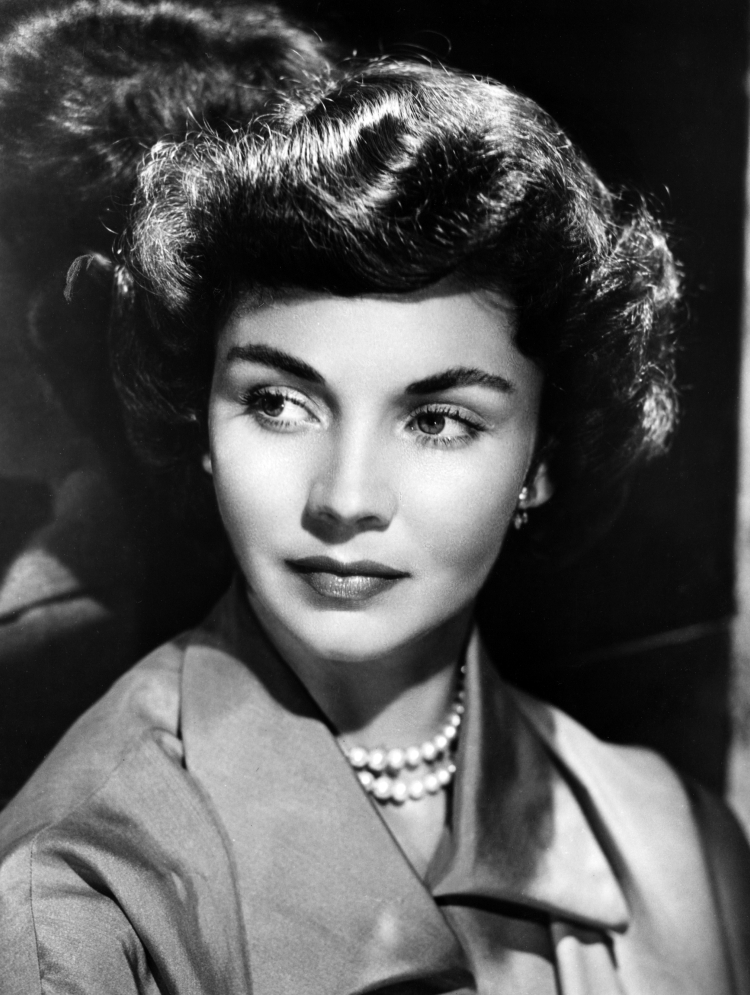
Jennifer Jones (born Phylis Lee Isley; March 2, 1919 – December 17, 2009), also known as Jennifer Jones Simon, was an American actress and mental-health advocate. Over the course of her career that spanned more than five decades, she was nominated for an Academy Award five times, including one win for Best Actress, and a Golden Globe Award for Best Actress in a Motion Picture – Drama.

Key Information

A native of Tulsa, Oklahoma, Jones worked as a model in her youth before transitioning to acting, appearing in two serial films in 1939. Her third role was a lead part as Bernadette Soubirous in The Song of Bernadette (1943), which earned her the Academy Award and Golden Globe for Best Actress. She went on to star in several films that garnered her significant critical acclaim and a further three Academy Award nominations in the mid-1940s, including Since You Went Away (1944), Love Letters (1945) and Duel in the Sun (1946).

In 1949, Jones married film producer David O. Selznick and appeared as the eponymous Madame Bovary in Vincente Minnelli's 1949 adaptation. She appeared in several films throughout the 1950s, including Ruby Gentry (1952), John Huston's adventure comedy Beat the Devil (1953) and Vittorio De Sica's drama Terminal Station (1953). Jones earned her fifth Academy Award nomination for her performance as a Eurasian doctor in Love Is a Many-Splendored Thing (1955). After Selznick's death in 1965, Jones married industrialist Norton Simon and entered semi-retirement. She made her final film appearance in The Towering Inferno (1974), a performance which earned her a nomination for a Golden Globe Award for Best Supporting Actress in a Motion Picture.

Jones suffered from mental-health problems during her life. After her 22 year-old daughter, Mary Jennifer Selznick, took her own life in 1976, Jones became deeply involved in mental health education. In 1980, she founded the Jennifer Jones Simon Foundation for Mental Health and Education. Jones enjoyed a quiet retirement, living the last six years of her life in Malibu, California, where she died of natural causes in 2009 at the age of 90.

Biography

[edit]

1919–1939: Early life

[edit]

Jones was born[1] in Tulsa, Oklahoma, on March 2, 1919, the daughter of Flora Mae (née Suber) and Phillip Ross Isley.[2] Her father was originally from Georgia, and her mother was a native of Sacramento, California.[2] She was an only child, and she was raised Catholic. Her parents, both aspiring stage actors, toured the Midwest in a traveling tent show that they owned and operated. Jones accompanied them, performing on occasion as part of the Isley Stock Company.[3]

Jones with Ray Corrigan (left) and John Wayne (right) in New Frontier (1939)

In 1925, Jones enrolled at Edgemere Public School in Oklahoma City, then attended Monte Cassino, a Catholic girls school and junior college in Tulsa.[4] After graduating, she enrolled as a drama major at Northwestern University in Illinois, where she was a member of Kappa Alpha Theta sorority before transferring to the American Academy of Dramatic Arts in New York City in September 1937.[5] It was there that she met and fell in love with fellow acting student Robert Walker, a native of Ogden, Utah, and left school.[6][7][5] They married on January 2, 1939.[8]

Jones and Walker returned to Tulsa for a 13-week radio program arranged by her father and then moved to Hollywood. She landed two small roles, first in the 1939 John Wayne Western New Frontier, which she filmed in the summer of 1939 for Republic Pictures.[9] Her second project was the serial titled Dick Tracy's G-Men (1939), also for Republic.[10] In both films, she was credited as Phylis Isley.[11] After failing a screen test for Paramount Pictures, she became disenchanted with Hollywood and returned to New York City.[12]

1940–1948: Career beginnings

[edit]

Shortly after Jones married Walker, she gave birth to two sons: Robert Walker Jr. (1940–2019), and Michael Walker (1941–2007). While Walker found steady work in radio programs, Jones worked part-time modeling hats for the Powers Agency, and posing for Harper's Bazaar while looking for acting jobs.[13] When she learned of auditions for the lead role in Rose Franken's hit play Claudia in the summer of 1941, she presented herself to David O. Selznick's New York office but fled in tears after what she thought was a bad reading.[14] However, Selznick had overheard her audition and was impressed enough to have his secretary call her back. Following an interview, she was signed to a seven-year contract.[15]

Jones as Bernadette Soubirous in The Song of Bernadette (1943)

She was carefully groomed for stardom and given a new name: Jennifer Jones. Director Henry King was impressed by her screen test as Bernadette Soubirous for The Song of Bernadette (1943), and she won the coveted role over hundreds of applicants.[16] In 1944, on her 25th birthday, she won the Academy Award for Best Actress for her performance as Bernadette, her third screen role.[17]

Simultaneously to her rise in prominence for The Song of Bernadette, Jones began an affair with producer Selznick. She separated from Walker in November 1943, co-starred with him in Since You Went Away (1944), and formally divorced him in June 1945.[18] For her performance in Since You Went Away, she was nominated for her second Academy Award, this time for Best Supporting Actress.[19] She earned a third successive Academy Award nomination for her performance with Joseph Cotten in Love Letters (1945).[20]

Jones's saintly image from her first starring role was starkly contrasted three years later when she was cast as a biracial woman in Selznick's controversial Duel in the Sun (1946), in which she portrayed a mixed-race indigenous (mestiza) orphan in Texas who falls in love with a white man (Gregory Peck).[21]

Also in 1946, she starred as the title character in Ernst Lubitsch's romantic comedy Cluny Brown as a working-class English woman who falls in love just before World War II.[22] She next appeared in the fantasy film Portrait of Jennie (1948), again costarring with Cotten. The film was based on the novella of the same name by Robert Nathan.[23][24] However, it was a commercial failure, grossing only $1.5 million against a $4 million budget.[25]

1949–1964: Marriage to Selznick

[edit]
Jones and second husband David O. Selznick in 1957

Jones married Selznick at sea on July 13, 1949, en route to Europe after a five-year relationship.[26] Over the following two decades, she appeared in numerous films that he produced, and they established a working relationship.[27] In 1949, Jones starred opposite John Garfield in John Huston's adventure film We Were Strangers.[28] Bosley Crowther of The New York Times felt that Jones's performance was lacking, noting: "There is neither understanding nor passion in the stiff, frigid creature she achieves."[29] She was subsequently cast as the title character of Vincente Minnelli's Madame Bovary (1949), a role originally intended for Lana Turner that Turner declined.[30] Variety deemed the film "interesting to watch, but hard to feel," although it noted that "Jones answers to every demand of direction and script."[31] In 1950, Jones starred in the Powell and Pressburger-directed fantasy Gone to Earth as a superstitious gypsy woman in the English countryside.[32]

Jones next starred in William Wyler's drama Carrie (1952) with Laurence Olivier.[33] Crowther criticized her performance, writing: "Mr. Olivier gives the film its closest contact with the book, while Miss Jones' soft, seraphic portrait of Carrie takes it furthest away."[34] Also in 1952, she costarred with Charlton Heston in Ruby Gentry, playing a femme fatale in rural North Carolina who becomes embroiled in a murder conspiracy after marrying a local man.[35] The role was previously offered to Joan Fontaine, who felt that she was "unsuited to play backwoods."[36] In its review, Variety deemed the film a "sordid drama [with] neither Jennifer Jones nor Charlton Heston gaining any sympathy in their characters."[37]

Jones and Montgomery Clift in Terminal Station (1953)

In 1953, Jones was cast opposite Montgomery Clift in Italian director Vittorio De Sica's Terminal Station (Stazione termini), a drama set in Rome about a romance between an American woman and an Italian man.[38] The film, produced by Selznick, had a troubled production history, and Selznick and De Sica clashed over the screenplay and tone of the film.[39] Clift sided with De Sica and reportedly called Selznick "an interfering fuck-face" on set.[40] Aside from the tensions between cast and crew, Jones was mourning the recent death of her first husband Robert Walker, and also missed her two sons, who were staying in Switzerland during production.[41] Terminal Station was screened at the 1953 Cannes Film Festival[42] and was released in a heavily truncated form in the United States with the title Indiscretion of an American Wife.[43] Also in 1953, Jones teamed again with director John Huston to star in his film Beat the Devil (1953), an adventure comedy costarring Humphrey Bogart.[44] The film was a box-office flop and was critically panned upon release, and Bogart distanced himself from it.[44] However, it was reevaluated in later years by critics such as Roger Ebert, who included it in his list of "Great Movies" and cited it as the first "camp" film.[45] In August 1954, Jones gave birth to her third child, daughter Mary Jennifer Selznick.[46]

Jones was cast as Chinese-born doctor Han Suyin in the drama Love Is a Many-Splendored Thing (1955), a role that brought her fifth Academy Award nomination.[47] Crowther lauded her performance as "... lovely and intense. Her dark beauty reflects sunshine and sadness."[48] Next, she starred as a schoolteacher in Good Morning, Miss Dove (1955),[49] followed by a lead role in The Man in the Gray Flannel Suit, a drama about a World War II veteran.[50]

Jones with Gregory Peck in a film still for The Man in the Gray Flannel Suit (1956)

In 1957, she starred as the poet Elizabeth Barrett Browning in the historical drama The Barretts of Wimpole Street, based on the 1930 play by Rudolf Besier.[51] She next played the lead role in the Ernest Hemingway adaptation A Farewell to Arms (1957).[52] The film received mixed reviews,[53] with Variety noting that "the relationship between Rock Hudson and Jennifer Jones never takes on real dimensions."[54] Jones's next project came five years later with the F. Scott Fitzgerald adaptation Tender Is the Night (1962).[55]

1965–2009: Later life and activities

[edit]

Selznick died at age 63 on June 22, 1965, and after his death, Jones semiretired from acting. Her first role in four years was a lead part in the British drama The Idol (1966) as the mother of an adult son in Swinging Sixties London who has an affair with his best friend.[56]

In 1966, Jones made a rare theatrical appearance in the revival of Clifford Odets' The Country Girl, costarring Rip Torn, at New York's City Center. On November 9, 1967, the same day on which her close friend Charles Bickford died of a blood infection, Jones attempted suicide. Informing her physician of her intention to jump from a cliff overlooking Malibu Beach, she swallowed barbiturates before walking to the base of the cliff, where she was found unconscious amidst the rocky surf.[57] According to biographer Paul Green, it was news of Bickford's death that triggered Jones's suicide attempt.[57] She was hospitalized in a coma from the incident.[58][59] She returned to film with Angel, Angel, Down We Go in 1969, about a teenage girl who uses her association with a rock band to manipulate her family.[60]

Jones with husband Norton Simon after their marriage, May 1971

On May 29, 1971, Jones married her third husband Norton Simon, a multimillionaire industrialist, art collector and philanthropist from Portland, Oregon.[8] The wedding took place aboard a tugboat five miles off the English coast and was conducted by Unitarian minister Eirion Phillips.[8] Years before, Simon had attempted to buy the portrait of Jones that was used in the film Portrait of Jennie. Simon later met Jones at a party hosted by fellow industrialist and art collector Walter Annenberg.[61] Jones's last film appearance came in the disaster film The Towering Inferno (1974).[62] Her performance as a doomed resident in the eponymous skyscraper earned her a Golden Globe nomination for Best Supporting Actress.[63] Early scenes in the film showed paintings lent to the production by the art gallery of Jones's husband Simon.[64]

On May 11, 1976, Jones's 21-year-old daughter, Mary, a student at Occidental College, died by suicide by jumping from the roof of a 22-floor apartment hotel in downtown Los Angeles.[65] This led to Jones's interest in mental health issues. In 1979, with husband Simon (whose son Robert died by suicide in 1969[66]), she founded the Jennifer Jones Simon Foundation for Mental Health and Education, which she ran until 2003.[67] One of Jones's primary goals with the foundation was to destigmatize mental illness.[68] In 1980, Jones said: "I cringe when I admit I've been suicidal, had mental problems, but why should I? I hope we can reeducate the world to see there's no more need for stigma in mental illness than there is for cancer." She also divulged that she had been a psychotherapy patient since age 24.[68]

Jones spent the remainder of her life outside of the public eye. Four years before the death of her husband Simon in June 1993, he resigned as president of Norton Simon Museum in Pasadena, California, and Jones was appointed chairman of the board of trustees, president and executive officer.[69] In 1996, she began working with architect Frank Gehry and landscape designer Nancy Goslee Power to renovate the museum and gardens. She remained active as the director of the museum until 2003, when she was awarded emerita status.[citation needed]

Personal life

[edit]

Jones was a registered Republican who supported Dwight Eisenhower's campaign in the 1952 presidential election.[70]

Jones suffered from shyness for much of her life and avoided discussing her past and personal life with journalists. She was also averse to discussing critical analysis of her work.[1] Public discussion of her working relationship with Selznick often overshadowed her career. Biographer Paul Green contends that, while Selznick helped facilitate her career and sought roles for her, "Jones excelled because she not only possessed outstanding beauty but she also possessed genuine talent."[27]

Death

[edit]
Jones' star on the Hollywood Walk of Fame at 6429 Hollywood Boulevard

Jones enjoyed a quiet retirement, living with her eldest child, son Robert Walker Jr., and his family in Malibu for the last six years of her life. Jones's younger son, actor Michael Ross Walker, died from cardiac arrest on December 23, 2007, at age 66, while Robert Jr. died on December 5, 2019, at age 79.[71]

Jones participated in Gregory Peck's AFI Life Achievement Award ceremony in 1989 and appeared at the 70th (1998) and 75th (2003) Academy Awards as part of the shows' tributes to past Oscar winners. In the last six years of her life, she granted no interviews and rarely appeared in public. She died of natural causes on December 17, 2009, at age 90.[72] She was cremated and her ashes were interred with her second husband in the Selznick private room at the Forest Lawn Memorial Park in Glendale, California.

Minor planet 6249 Jennifer is named in her honor.[73]

Filmography

[edit]
Year Title Role Notes
1939 New Frontier Celia Braddock As Phyllis Isley; film debut[74]
Dick Tracy's G-Men Gwen Andrews As Phyllis Isley; 15-chapter serial
1943 The Song of Bernadette Bernadette Soubirous Academy Award for Best Actress
Golden Globe Award for Best Actress – Motion Picture Drama
Locarno International Film Festival - Best Actress
1944 Since You Went Away Jane Deborah Hilton Nominated — Academy Award for Best Supporting Actress
1945 Love Letters Singleton / Victoria Morland Nominated — Academy Award for Best Actress
1946 Cluny Brown Cluny Brown Locarno International Film Festival - Best Actress
Duel in the Sun Pearl Chavez Nominated — Academy Award for Best Actress
1948 Portrait of Jennie Jennie Appleton
1949 We Were Strangers China Valdés
Madame Bovary Emma Bovary
1950 Gone to Earth Hazel Woodus Released as The Wild Heart (heavily edited) in the U.S.
1952 Carrie Carrie Meeber
Ruby Gentry Ruby Gentry
1953 Terminal Station Mary Forbes Released as Indiscretion of an American Wife in the U.S.
Beat the Devil Mrs. Gwendolen Chelm
1955 Love Is a Many-Splendored Thing Dr. Han Suyin Nominated — New York Film Critics Circle Award for Best Actress (3rd place)

Nominated — Academy Award for Best Actress

Good Morning, Miss Dove Miss Dove
1956 The Man in the Gray Flannel Suit Betsy Rath
1957 The Barretts of Wimpole Street Elizabeth Barrett
A Farewell to Arms Catherine Barkley
1962 Tender Is the Night Nicole Diver
1966 The Idol Carol
1969 Angel, Angel, Down We Go Astrid Steele a.k.a. Cult of the Damned
1974 The Towering Inferno Lisolette Mueller Nominated — Golden Globe Award for Best Supporting Actress – Motion Picture

Awards and nominations

[edit]

See also

[edit]

References

[edit]

Sources

[edit]

Further reading

[edit]
[edit]
Revisions and contributorsEdit on WikipediaRead on Wikipedia
from Grokipedia
Jennifer Jones (born Phyllis Lee Isley; March 2, 1919 – December 17, 2009) was an American actress renowned for her emotive performances in Hollywood films during the mid-20th century, most notably winning the for her portrayal of in The Song of Bernadette (1943). Born in , to parents who operated a traveling , Jones began performing as a child and achieved stardom under the guidance of producer , who discovered her and renamed her after signing her to a contract in 1941. Over her career, she received five Academy Award nominations for , establishing herself as a versatile leading lady in dramas and romances, though her personal life was marked by tumultuous marriages and tragedies. Jones's early life immersed her in the world of from a young age. The only child of Phillip R. Isley and Flora Mae Suber, who ran the Isley Stock Company—a Midwestern tent show presenting plays and —she made her stage debut at age five and continued performing during family travels. After the 1929 , her family settled in Tulsa, where her father acquired movie theaters, further exposing her to film. She attended Junior College in Tulsa, then studied drama at in and the American Academy of Dramatic Arts in starting in 1937, where she met her first husband, actor Robert Walker. Her film career began modestly under her birth name in low-budget Westerns for , including (1939) and the serial Dick Tracy's G-Men (1939), but her breakthrough came with Selznick's sponsorship. Following her Oscar-winning debut in The Song of Bernadette, she starred in Selznick-produced hits like (1944), Love Letters (1945), and Duel in the Sun (1946), earning consecutive Best Actress nominations for the first three. Later roles included the titular character in (1948), the romantic lead in Love Is a Many-Splendored Thing (1955)—another Oscar nomination—and her final film appearance in the disaster epic (1974). She largely retired from acting in the 1950s to focus on family but remained active in , co-founding the Jennifer Jones Simon Foundation in 1980 to support research. On a personal level, Jones's life was fraught with challenges. She married Walker in 1939, with whom she had two sons, Walker Jr. and Michael Walker, but divorced in 1945 amid her rising fame. Her 1949 marriage to Selznick produced a daughter, Mary Jennifer, but was strained by his controlling influence and her career pressures; Selznick died in 1965. In 1971, she wed industrialist , supporting him through his battle with Guillain-Barré syndrome until his death in 1993; the couple had no children together. Jones passed away at her home in , at age 90 from natural causes, leaving a legacy as one of Hollywood's most acclaimed yet enigmatic stars.

Early life

Family background and childhood (1919–1935)

Phylis Isley was born on March 2, 1919, in , the only child of Phillip R. Isley and Flora Mae (née Suber) Isley. Her parents were both performers and entrepreneurs in the theater world, owning and operating the Isley Stock Company, a family-run troupe that staged plays and productions. The Isley Stock Company led a nomadic existence, touring rural areas across the and Midwest with vaudeville-style tent shows that brought entertainment to small towns. Phylis frequently accompanied her parents on these travels, spending summers immersed in the operations of the troupe, where she assisted by selling tickets and concessions while observing rehearsals and performances up close. This peripatetic lifestyle exposed her to the rigors of from an early age. At around five years old, Phylis made her stage debut in one of the family's productions, marking the beginning of her hands-on involvement in acting and further igniting her passion for performance. She occasionally participated in these plays, gaining practical experience amid the troupe's demanding schedule. The Great Depression, beginning with the 1929 stock market crash, severely strained the family's finances and the viability of live touring theater, resulting in closures of many such operations and forcing a pivot in their business. In response, Phillip Isley acquired a string of movie houses in Oklahoma, which required additional relocations and underscored the economic instability of the era for theatrical families like theirs.

Education and initial pursuits (1936–1939)

Following her graduation from Monte Cassino Junior College in , in 1936, where she received foundational education in a Catholic girls' institution, Phylis Isley enrolled at in , to pursue a degree in . This choice was influenced by her family's longstanding involvement in regional theater, providing her with an early motivator to seek structured training beyond informal performances. However, after completing one year of study in 1937, she grew restless with the curriculum and decided to transfer to a more specialized program. In the fall of 1937, Isley moved to and enrolled at the American Academy of Dramatic Arts, one of the oldest conservatories in the United States, where she remained until 1939. Supported financially by her father, she immersed herself in the academy's rigorous two-year curriculum, which emphasized practical performance training. There, she honed essential skills in voice projection, physical movement, and , drawing on the institution's focus on classical techniques for stage and emerging screen work. During her time at the academy, Isley participated in early amateur theater experiences, taking on small roles in student-led productions that allowed her to apply classroom techniques in a supportive environment. These opportunities helped build her onstage confidence and prepare for professional transitions.

Acting career

Early roles and breakthrough (1939–1943)

Jones began her professional entertainment career in 1939, shortly after marrying aspiring actor Robert Walker on January 2 in . The couple returned to her hometown for a 13-week arranged by her father, Phillip R. Isley, where she performed under her , Phyllis Isley. That same year, Isley and Walker moved to Hollywood seeking film opportunities. She signed a contract with Republic Pictures and debuted on screen in two low-budget productions: the Western New Frontier, directed by George Sherman and starring John Wayne, in which she played Celia Braddock; and the 15-chapter serial Dick Tracy's G-Men, where she portrayed Gwen Andrews, Dick Tracy's secretary. These minor roles, credited to Phyllis Isley, offered little advancement, and after failing a screen test at Paramount Pictures, the couple returned to New York amid financial hardships. Walker's support proved crucial during this period of persistence. On April 15, 1940, Isley gave birth to their first son, Robert Walker Jr., at Jamaica Hospital in , while the family navigated career uncertainties and limited acting prospects. A second son, Michael Walker, followed in 1941. Jones's breakthrough arrived in 1943 through the intervention of producer , who had signed her to a seven-year personal contract around 1941 after an impressive audition in New York. Selznick aggressively lobbied 20th Century Fox to cast her—over established stars like and —as the visionary in The Song of Bernadette, adapted from Franz Werfel's novel and directed by Henry King. Her portrayal of the young peasant girl who experiences apparitions of the Virgin Mary garnered widespread critical acclaim for its ethereal intensity and emotional depth, marking her emergence as a major talent.

Rise to fame and key collaborations (1943–1949)

Jennifer Jones's ascent to stardom began with her portrayal of in The Song of Bernadette (1943), directed by Henry King for 20th Century-Fox. Selected from over 2,000 applicants after an intensive talent search, Jones delivered a performance noted for its sincerity and intensity, capturing the peasant girl's visions of the Virgin Mary in 19th-century . The production faced significant challenges due to restrictions, including transportation shortages and labor issues, leading to all filming on studio sets with elaborate recreations of and a 450-foot artificial river. Her debut under the stage name Jennifer Jones earned her the at the in 1944, establishing her as a premier dramatic actress and marking the film's success with additional Oscars for cinematography, art direction, and musical score. Producer , who had signed Jones to a personal seven-year contract through his Vanguard Films in , loaned her to Fox and orchestrated a promotional campaign to position her as a luminous new talent. Following this triumph, Jones demonstrated her range in (1944), a wartime epic co-produced by Selznick under Vanguard Films and . As Jane Hilton, the resilient teenage daughter navigating loss and duty on the , she portrayed a spectrum of emotions from youthful romance to profound grief, contributing to the film's epic scope with a $3 million budget and over 170-minute runtime. The picture, written and produced by Selznick based on Buell Wilder's novel, grossed more than $7 million and earned Jones an Academy Award nomination for Best Supporting Actress, further solidifying her versatility in ensemble-driven dramas. Jones continued to explore ethereal and romantic characterizations in subsequent roles, often under Selznick's oversight, which included meticulous control over her public image and project selections to cultivate her as an idealized screen presence. In Love Letters (1945), directed by , she played an amnesiac woman uncovering a hidden past, earning another nomination for her delicate, introspective performance opposite . She shifted to light comedy as the spirited Cluny Brown in Ernst Lubitsch's 1946 film of the same name, portraying a plumber's niece whose unorthodox charm disrupts English high society during , showcasing her adaptability beyond drama. Her ethereal persona reached a fantastical peak in Portrait of Jennie (1948), directed by , where she embodied a mysterious girl who ages dramatically to inspire a struggling , blending romance and elements in a Vanguard Films production that highlighted Selznick's vision for her as a transcendent figure. Throughout this period, Selznick's management via Vanguard Films ensured her roles emphasized romantic allure and emotional depth, loaning her selectively while retaining veto power over her career choices.

Mature roles and industry influence (1949–1958)

Following her foundational partnership with producer David O. Selznick, which began in the mid-1940s, Jennifer Jones's performance in Duel in the Sun (1946) continued to resonate into the late 1940s and 1950s as a benchmark for her portrayal of complex, conflicted women. In the film, Jones played Pearl Chavez, a half-Native American woman torn between passion and propriety in a Western setting, a role that sparked significant controversy for its sensual undertones and was censored in several major cities due to its provocative content. Despite critical backlash—earning the nickname "Lust in the Dust"—the movie achieved massive box-office success, becoming one of the top-grossing Westerns of the decade with adjusted earnings exceeding $400 million, underscoring Selznick's intense personal and professional investment in elevating Jones as a star of dramatic intensity. In 1949, Jones expanded her range with two notable releases that garnered international acclaim for their depth in period dramas. She portrayed a Cuban revolutionary in John Huston's We Were Strangers, a tense adventure film opposite John Garfield that highlighted her ability to embody resilient, politically charged characters amid revolutionary intrigue. Later that year, in Vincente Minnelli's adaptation of Madame Bovary, Jones delivered a textured performance as the titular Emma Bovary, a dissatisfied provincial wife whose desires lead to tragedy, earning praise for capturing the character's psychological turmoil in a lavish literary adaptation. These roles demonstrated Jones's versatility in shifting from contemporary action to introspective 19th-century narratives, contributing to her reputation as an actress capable of nuanced emotional portrayals. By the early 1950s, Jones embraced more contemporary and psychologically layered characters, further showcasing her evolution amid the waning . In Ruby Gentry (1952), directed by , she starred as a fierce, lower-class Southern woman entangled in a , a role that echoed the "troubled" female archetypes she pioneered, blending sensuality and defiance in a backwoods drama that became one of her biggest commercial hits since Duel in the Sun. That same year, in William Wyler's Carrie, Jones played the vulnerable yet ambitious titular figure opposite , adapting Theodore Dreiser's novel to explore class struggles and moral ambiguity in post-Civil War . Her collaboration with Huston resumed in Beat the Devil (1953), where she portrayed a sharp-witted con-woman in the director's quirky adventure-comedy, injecting levity and cunning into an led by , which broadened her appeal beyond pure drama. In 1955, Jones starred as Dr. Han Suyin in Love Is a Many-Splendored Thing, a romantic drama set in opposite , earning her fifth Award nomination for . Jones's mid-career choices influenced Hollywood's casting trends toward more introspective "troubled" female leads, as the industry transitioned from rigid studio formulas to character-driven stories following the 1948 Paramount Decree. Under Selznick's guidance, which often emphasized shots to highlight her expressive features, she advocated for roles with greater psychological depth, pushing against the romantic mold to portray women grappling with desire, identity, and societal constraints—a shift that mirrored broader changes in cinema toward adult-oriented narratives. This artistic evolution not only contributed to her five Award nominations over her career but also helped redefine opportunities for actresses in dramatic genres as the studio era declined.

Final films and retirement (1959–1965)

In the late 1950s, Jennifer Jones continued her selective approach to roles, focusing on dramatic portrayals that reflected her interest in complex emotional landscapes. In 1956, she starred as Betsy Rath, the supportive yet increasingly discontent wife of a corporate executive, in The Man in the Gray Flannel Suit, directed by and co-starring as her husband, Tom Rath. The film, adapted from Sloan Wilson's novel, examined the tensions of post-World War II suburban life and ethical compromises in the workplace, with Jones's performance highlighting the personal sacrifices of family devotion. Jones's next project, (1957), saw her as Catherine Barkley, a British nurse entangled in a tragic romance with American ambulance driver Frederick Henry (), in David O. Selznick's ambitious adaptation of Ernest Hemingway's novel, directed by . The production faced significant turmoil, including the mid-shoot dismissal of initial director due to irreconcilable creative clashes with Selznick over the film's tone and scope, leading to Vidor's replacement and extensive reshoots that extended filming and heightened stress on the cast. This strain took a notable personal toll on Jones, who was deeply involved through her marriage to the producer. Critics often pointed to her as the youthful Catherine as mismatched, though the film's sweeping Italian locations and visuals were commended. By the early 1960s, Jones's film output had diminished, culminating in her final leading role in (1962), directed by Henry King, where she portrayed Nicole Diver, a wealthy but psychologically unstable married to her former psychiatrist (Jason Robards Jr.), in an adaptation of F. Scott Fitzgerald's novel produced by Selznick. The screenplay by drew criticism for its lack of clarity and pacing issues, with reviewers frequently citing Jones's age as ill-suited to the character's early fragility, contributing to perceptions of miscasting amid the film's opulent settings. Nonetheless, Jones received praise for her nuanced depiction of Nicole's emotional descent and recovery, delivering a proficient range from vulnerability to composure that anchored the story's exploration of and marital decay. Following Selznick's sudden from a heart attack on June 22, 1965, Jones announced her retirement from later that year, attributing her decision to profound exhaustion accumulated from decades of intense professional demands and personal hardships. Though she largely retired from after Selznick's , she made sporadic appearances in a few more films in the late 1960s and 1970s, including The Idol (1966), Angel, Angel, Down We Go (1969), and her final screen role in (1974), before fully withdrawing from the industry and prioritizing privacy thereafter.

Personal life

Marriages and relationships

Jennifer Jones's first marriage was to fellow aspiring actor Robert Walker, whom she met in 1938 while both were students at the American Academy of Dramatic Arts in New York. They wed on January 2, 1939, and initially supported each other's early career struggles in Hollywood, but the union faced strain as Jones's stardom surged ahead of Walker's. The couple separated in the fall of 1943 amid Jones's burgeoning affair with producer David O. Selznick, and they divorced in 1945, a period that tested Jones's personal stability while elevating her public profile through high-profile roles. Jones began a romantic involvement with David O. Selznick in 1943, while both were still married to others; Selznick, 17 years her senior, discovered her talent and meticulously shaped her career, renaming her Jennifer Jones and securing her Oscar-winning role in The Song of Bernadette. Their affair, which became a Hollywood scandal, culminated in marriage on July 2, 1949, aboard a yacht off the coast of , forming one of the industry's most powerful couples. The relationship was marked by intense passion but also Selznick's controlling nature—he dictated her professional choices, public appearances, and even personal decisions, contributing to Jones's emotional fragility and a reported in 1946—yet it solidified her image as a glamorous leading lady until Selznick's death from a heart attack on June 22, 1965. Following a period of mourning, Jones married industrialist and art collector Norton Simon on May 30, 1971, after a whirlwind three-week courtship aboard another yacht in the English Channel. This union, lasting until Simon's death on June 1, 1993, provided a stabilizing partnership in her later years, centered on shared interests in philanthropy and art; Jones influenced Simon's acquisition of Indian artworks, and they supported each other's endeavors, including her oversight of the Norton Simon Museum. The marriage enhanced her public image as a cultured philanthropist while allowing greater personal privacy. Jones did not remarry after Simon's passing, maintaining a low profile amid occasional unsubstantiated rumors of romantic interests, and focused on seclusion and legacy-building until her death in 2009.

Family and children

Jennifer Jones and her first husband, actor Robert Walker, had two sons: Robert Walker Jr., born on April 15, 1940, in , New York, and Michael Walker, born on March 17, 1941, also in . Both sons pursued acting careers, with Robert Walker Jr. appearing in films such as (1969) and episodes of , while Michael Walker worked in television and film production. Following their divorce in 1945, Jones and Walker shared of their young sons, who were aged five and four at the time, allowing both parents continued involvement in their upbringing despite the separation. Jones maintained a close relationship with her sons, often prioritizing family amid her rising career, though the post-divorce arrangement required coordination between their households in New York and . Jones's second marriage to producer in 1949 introduced her to his two sons from his previous marriage to : Jeffrey Selznick, born in 1932, and Daniel Selznick, born in 1936. The blended family integrated through shared travels and home life at their estates, including the Selznicks' properties in Malibu and Benedict Canyon, where Jones participated in family outings and holidays. With Selznick, Jones gave birth to their daughter, Mary Jennifer Selznick, on August 12, 1954. Mary Jennifer, who struggled with issues, tragically died by in 1976 at age 21, an event that profoundly affected Jones and deepened her commitment to mental health advocacy. Jones had no biological children with her third husband, industrialist , whom she married in 1971, but she embraced their blended family dynamic, including Simon's surviving children from his prior marriage. The couple hosted family gatherings and holidays at their estates, such as their Malibu home and the grounds in Pasadena, fostering connections with step-relatives during Simon's later health challenges from Guillain-Barré syndrome. Jones provided care for Simon until his death in 1993, drawing strength from these familial ties. In her later years, Jones enjoyed interactions with her grandchildren and great-grandchildren, numbering eight and four respectively at the time of her . She lived reclusively in Malibu with her son Robert Walker Jr. and his family, who offered support during her periods of withdrawal following personal losses, including the of her in 1976 and son Michael in 2007. This family proximity provided emotional stability in her final decades.

Health issues and philanthropy

Throughout her life, Jennifer Jones battled severe depression, which began in the 1940s amid the intense pressures of her acting career under the control of her second husband, producer . These struggles intensified in the 1950s, leading to multiple attempts involving sleeping pills. In November 1967, following the death of her friend and co-star , Jones attempted again by overdosing on barbiturates and consuming wine; she was found unconscious in the surf near Malibu and hospitalized in a before recovering, later describing the incident as an rather than intentional. The of her daughter Mary Jennifer Selznick in 1976 exacerbated her challenges, prompting a deeper commitment to advocacy in the following decades. In the post-1960s period, Jones channeled her experiences into advocacy, co-founding the Jennifer Jones Simon Foundation for and Education in 1980 with her third husband, industrialist and philanthropist . She personally donated $1 million to establish the organization, which focused on funding research grants and educational programs to advance understanding and treatment of mental illnesses. The foundation supported various initiatives until at least 2009, including efforts to combat stigma and promote scientific inquiry into psychiatric disorders. Jones's philanthropy extended to the arts through her partnership with Simon, whom she married in 1971; she played a key role in sustaining and expanding his renowned art collection, which formed the basis of the in Pasadena, established in 1969. After Simon's illness in the 1980s, she assumed the presidency of the museum's board, and following his death in 1993, she served as chairwoman, overseeing a $3 million renovation of the galleries completed in 1999 to enhance public accessibility and display. Her contributions to were part of broader support, reflecting her Hollywood roots, though specific personal donations in this area were not publicly detailed. Beyond and , Jones actively supported child welfare and causes from the 1970s through the 1990s, often through board roles and fundraising. In the mid-1960s, after retreating from , she volunteered with the Salvation Army's , establishing residential treatment facilities for youth struggling with narcotics addiction—a commitment she maintained for many years. She spearheaded campaigns for and hereditary diseases, serving on related advisory boards and directing foundation resources toward these efforts, which were particularly meaningful given personal family losses.

Later years and death

Post-retirement activities (1965–2000)

Following David O. Selznick's death in 1965, Jennifer Jones entered a period of semi-retirement, largely stepping away from while occasionally engaging in cultural pursuits. She married industrialist and art collector in 1971, after which she became actively involved in expanding the Norton Simon Museum's collection in , which had opened in 1969. Jones influenced her husband's acquisitions, particularly in Asian and Southeast Asian art, by suggesting a honeymoon trip to that sparked Simon's interest in these areas. Jones played a key role in the museum's development throughout the and , contributing to its growth as a premier institution for European, Asian, and . Although the museum's Impressionist holdings, including works by , were largely amassed by Simon prior to their marriage, Jones supported curatorial efforts and public programming that highlighted these collections. Her involvement extended to fostering community engagement, transforming the institution into a hub for exhibitions and educational initiatives. In the , following Simon's in , Jones assumed the position of president and board chairwoman of the Foundation, overseeing a major interior renovation from 1996 to 1999 designed by Frank O. Gehry. This project enhanced the galleries with improved lighting and layout, boosting annual visitor numbers to approximately 170,000 and solidifying the museum's role as a cultural landmark. She emphasized accessibility and legacy preservation, hosting events like the 1999 unveiling ceremony to celebrate these changes. Despite her increasing focus on private endeavors, Jones made select public appearances during this era. She attended the 1976 tribute to director as an audience member, demonstrating her continued connection to the film community. In 1989, she participated in the AFI ceremony honoring , reflecting her selective engagement with industry milestones. These outings were rare, aligning with her preference for a low-profile centered on artistic and philanthropic extensions through the .

Final years and death (2001–2009)

In her final years, Jennifer Jones maintained a reclusive lifestyle, residing in , with her son Robert Walker Jr. and his family. She held emeritus status on the Foundation Board since 2003, continuing her oversight of the museum's operations from Pasadena while prioritizing her privacy away from public view. Although specific details on her health in this period are limited, Jones, approaching her 90s, limited interactions and granted no interviews, reflecting her long-standing preference for seclusion. Jones died of natural causes on December 17, 2009, at her Malibu home at the age of 90. Her passing was confirmed by Leslie C. Denk, spokeswoman for the , and services were held privately, attended only by close family members. She was survived by her son Robert Walker Jr., eight grandchildren, and four great-grandchildren; her other son, Michael Walker, had predeceased her in 2007. Following her death, Jones's estate supported ongoing philanthropic efforts, including bequests to initiatives through the Jennifer Jones Simon Foundation, which she had established in 1980. The foundation continued issuing grants into the 2010s, funding research on topics such as and adolescent development at institutions like UCLA. In lieu of flowers, her family requested contributions to the and the Hereditary Disease Foundation. Public tributes highlighted her enduring legacy, with obituaries reflecting on her 1960 star as a symbol of her influential career in classic cinema.

Professional legacy

Filmography

Jennifer Jones's acting career began under her birth name, Phyllis Isley, and transitioned to her professional name after signing with David O. Selznick. Her credited roles span feature films from 1939 to 1974, as listed below.
YearTitleRoleDirector
1939New FrontierCelia BraddockGeorge Sherman
1939Dick Tracy's G-MenGwen AndrewsWilliam Witney, John English
1943The Song of BernadetteBernadette SoubirousHenry King
1944Since You Went AwayJane Deborah HiltonJohn Cromwell
1944Dark WatersNollyArchie L. Mayo
1944The Keys of the KingdomNora MintryJohn M. Stahl
1945Love LettersSingleton / Victoria MorlandWilliam Dieterle
1946Cluny BrownCluny BrownErnst Lubitsch
1946Duel in the SunPearl ChavezKing Vidor
1947Daisy KenyonDaisy KenyonOtto Preminger
1948Portrait of JennieJennie AppletonWilliam Dieterle
1949We Were StrangersJennyJohn Huston
1949Madame BovaryEmma BovaryVincente Minnelli
1950Gone to EarthHazel WoodusMichael Powell, Emeric Pressburger
1952CarrieCarrie MeeberWilliam Wyler
1952Ruby GentryRuby Gentry / Ruby CoreyKing Vidor
1953Terminal StationMary ForbesVittorio De Sica
1953Beat the DevilMrs. Gwendolen ChelmJohn Huston
1955Good Morning, Miss DoveMiss DoveHenry Koster
1955Love Is a Many-Splendored ThingDr. Han SuyinHenry King
1956The Man in the Gray Flannel SuitBetsy RathNunnally Johnson
1957The Barretts of Wimpole StreetElizabeth BarrettSidney Franklin
1957A Farewell to ArmsCatherine BarkleyCharles Vidor
1962Tender Is the NightNicole DiverHenry King
1966The IdolCarolDaniel Petrie
1969Angel, Angel, Down We GoAstrid SteeleRobert Thom
1974The Towering InfernoLisolette MuellerJohn Guillermin
Early in her career, Jones appeared in test films and screen tests during the early 1940s under Selznick's guidance, including uncredited or minor appearances in shorts and pilots that were not released as feature films. She was cast in but declined the lead role in Laura (1944), directed by , due to scheduling conflicts managed by her agent. Additionally, she was initially set for the role of Georgie Elgin in The Country Girl (1954) but was replaced by owing to .

Awards and nominations

Jennifer Jones garnered significant recognition for her performances, particularly during the when she emerged as a leading actress in Hollywood. Her portrayal of in The Song of Bernadette (1943) earned her the at the in 1944, solidifying her status as a major talent and marking the first time the Golden Globe Award for in a Motion Picture – Drama was presented. This breakthrough role also brought her additional honors from critics' groups, highlighting her ability to embody spiritual depth and vulnerability. Over her career, Jones accumulated five Academy Award nominations, one win, and various other prestigious accolades, though she largely retreated from public life after the , receiving lifetime tributes for her contributions to cinema.

Academy Awards

Jones's Academy Award nominations spanned leading and supporting roles, reflecting her versatility in dramatic and romantic genres. She won once and was nominated four additional times, as detailed below.
YearCategoryFilmResult
1944Best ActressThe Song of BernadetteWon
1945Best Supporting ActressNominated
1946Best ActressLove LettersNominated
1947Best ActressDuel in the SunNominated
1956Best ActressLove Is a Many-Splendored ThingNominated

Golden Globe Awards

In addition to her Oscar success, Jones won the inaugural Golden Globe for Best Actress – Motion Picture Drama for The Song of Bernadette in 1944, an award that underscored the film's critical and commercial impact. She received one further nomination in 1975 for Best Supporting Actress – Motion Picture for her role in The Towering Inferno, her final major film appearance.

Other Awards and Honors

For her overall career, Jones received a star on the Hollywood Walk of Fame in the Motion Pictures category on February 8, 1960, located at 6429 Hollywood Boulevard. In recognition of her enduring legacy, she was presented with the Lifetime Achievement Award at the German Film Awards in 1997, one of her last public honors.

References

Add your contribution
Related Hubs
User Avatar
No comments yet.