


Community hub
Recent from talks
Contribute something
Nothing was collected or created yet.
Jeconiah
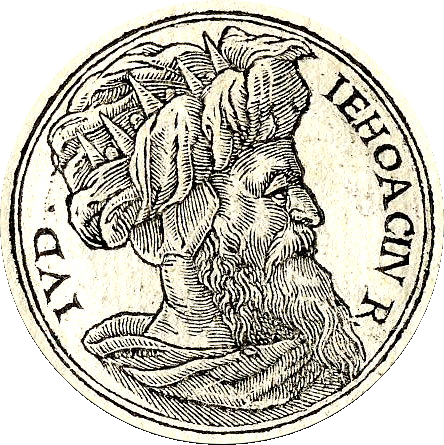
View on WikipediaJeconiah (Biblical Hebrew: יְכָנְיָה, romanized: Yəḵonəyā [jəxonjɔː] meaning "Yahweh has established";[2] Greek: Ἰεχονίας; Latin: Iechonias, Jechonias), also known as Coniah[3] and as Jehoiachin (יְהוֹיָכִין Yəhoyāḵin [jəhoːjɔːˈxiːn]; Latin: Ioachin, Joachin), was the nineteenth and penultimate king of Judah who was dethroned by the King of Babylon, Nebuchadnezzar II in the 6th century BCE and was taken into captivity. He was the son and successor of King Jehoiakim, and the grandson of King Josiah. Most of what is known about Jeconiah is found in the Hebrew Bible. Records of Jeconiah's existence have been found in Iraq, such as the Jehoiachin's Rations Tablets. These tablets were excavated near the Ishtar Gate in Babylon and dated to c. 592 BCE. Written in cuneiform, they mention Jeconiah (Akkadian: 𒅀𒀪𒌑𒆠𒉡}, romanized: Yaʾukinu [ia-ʾ-ú-ki-nu]) and his five sons as recipients of food rations in Babylon.[4]
Key Information


Jeconiah in scripture
[edit]Reign
[edit],_King_of_Judah_and_the_Babylonian_captivity._From_Babylon,_Iraq._C._580_BCE._Vorderasiatisches_Museum,_Berlin.jpg)
Jeconiah reigned three months and ten days, beginning December 9, 598 BCE. He succeeded Jehoiakim as king of Judah after raiders from surrounding lands invaded Jerusalem and killed his father.[5] It is likely that the king of Babylon was behind this effort, as a response to Jehoiakim's revolt, starting sometime after 601 BCE. Three months and ten days after Jeconiah became king, the armies of Nebuchadnezzar II seized Jerusalem, with the intention to take high class Judahite captives and assimilate them into Babylonian society. On March 15/16th, 597 BCE, Jeconiah, his entire household and three thousand Jews were exiled to Babylon.[6][7][8]: 217
The Masoretic Text of 2 Chronicles 36 states that Jeconiah's rule began at the age of eight, while in 2 Kings 24:8 Jeconiah is said to have come to the throne at eighteen.[9][10] Modern scholars have treated the difference between "eight" and "eighteen" as reflecting a copying error on one side or the other of the issue.[11]
During exile
[edit]After Jeconiah was deposed as king, his uncle Zedekiah (2 Kings 24:17) was appointed by Nebuchadnezzar to rule Judah. Zedekiah was the son of Josiah.[12] Jeconiah would later be regarded as the first of the exilarchs. In the Book of Ezekiel, the author refers to Jeconiah as king and dates certain events by the number of years he was in exile. The author identifies himself as Ezekiel, a contemporary of Jeconiah, and he never mentions Zedekiah by name.[13]
Release from captivity
[edit]According to 2 Kings 25:27–30, Jeconiah was released from prison "in the 37th year of the exile", in the year that Amel-Marduk (Evil-Merodach) came to the throne, and given a prestigious position at court. Jeconiah's release in Babylon brings to a close the Books of Kings and the Deuteronomistic history. Babylonian records show that Amel-Marduk began his reign in October 562 BCE.[14] According to Jeremiah 52:31, Jeconiah was released from prison "in the twelfth month, on the twenty-fifth day of the month": this indicates the first year of captivity to be 598/597 BCE, according to Judah's Tishri-based calendar. The 37th year of captivity was thus, by Judean reckoning, the year that began in Tishri of 562, consistent with the synchronism to the accession year of Amel-Marduk given in Babylonian records.
Curse
[edit]Jeremiah (22:28–30) cursed Jeconiah that none of his descendants would ever sit on the throne of Israel:
This is what the LORD says: 'Record this man as if childless, a man who will not prosper in his lifetime, for none of his offspring will prosper, none will sit on the throne of David or rule anymore in Judah.
— Jeremiah 22:30, NIV
Chapter 1, verses 11–12 of the Gospel of Matthew lists Jeconiah in the genealogy of Jesus, through Joseph. If Joseph was the biological father of Jesus (contrary to Christian belief), then Jesus could not rightfully claim to be the Messiah as the curse of Jeconiah, if true, would apply to Him.[15]
Richard Challoner interpreted the two genealogies of Matthew and Luke to be referring to a biological offspring and an offspring from a Levirate marriage. According to this concept, Joseph may have been a biological descendant from Jeconiah, but within Jewish law he would have been counted as a descendant of someone else due to the carrying of a brother's name through the Levirate marriage.[citation needed]
In Rabbinical literature
[edit]Jehoiachin was made king in place of his father by Nebuchadnezzar; but the latter had hardly returned to Babylon when some one said to him, "A dog brings forth no good progeny," whereupon he recognized that it was poor policy to have Jehoiachin for king (Lev. R. xix. 6; Seder 'Olam R. xxv.). In Daphne, near Antiochia, Nebuchadnezzar received the Great Sanhedrin, to whom he announced that he would not destroy the Temple if the king were delivered up to him. When the king heard this resolution of Nebuchadnezzar he went upon the roof of the Temple, and, turning to heaven, held up the Temple keys, saying: "As you no longer consider us worthy to be your ministers, take the keys that you have entrusted to us until now." Then a miracle happened; for a fiery hand appeared and took the keys, or, as others say, the keys remained suspended in the air where the king had thrown them (Lev. R. l.c.; Yer. Sheḳ. vi. 50a; other versions of the legend of the keys are given in Ta'an. 29a; Pesiḳ. R. 26 [ed. Friedmann, p. 131a], and Syriac Apoc. Baruch, x. 18). The king as well as all the scholars and nobles of Judah were then carried away captive by Nebuchadnezzar (Seder 'Olam R. l.c.; compare Ratner's remark ad loc.). According to Josephus, Jehoiachin gave up the city and his relatives to Nebuchadnezzar, who took an oath that neither they nor the city should be harmed. But the Babylonian king broke his word; for scarcely a year had elapsed when he led the king and many others into captivity.
Jehoiachin's sad experiences changed his nature entirely, and as he repented of the sins which he had committed as king he was pardoned by God, who revoked the decree to the effect that none of his descendants should ever become king (Jer. xxii. 30; Pesiḳ., ed. Buber, xxv. 163a, b); he even became the ancestor of the Messiah (Tan., Toledot, 20 [ed. Buber, i. 140]). It was especially his firmness in fulfilling the Law that restored him to God's favor. He was kept by Nebuchadnezzar in solitary confinement, and as he was therefore separated from his wife, the Sanhedrin, which had been expelled with him to Babylon, feared that at the death of this queen the house of David would become extinct.
They managed to gain the favor of Queen Semiramis, who induced Nebuchadnezzar to ameliorate the lot of the captive king by permitting his wife to share his prison. As he then manifested great self-control and obedience to the Law, God forgave him his sins (Lev. R. xix., end). Jehoiachin lived to see the death of his conqueror, Nebuchadnezzar, which brought him liberty; for within two days of his father's death Evil-merodach opened the prison in which Jehoiachin had languished for so many years.

Jehoiachin's life is the best illustration of the maxim, "During prosperity a man must never forget the possibility of misfortune; and in adversity must not despair of prosperity's return" (Seder 'Olam R. xxv.). On the advice of Jehoiachin, Nebuchadnezzar's son cut his father's body into 300 pieces, which he gave to 300 vultures, so that he could be sure that Nebuchadnezzar would never return to worry him ("Chronicles of Jerahmeel," lxvi. 6). Evil-merodach treated Jehoiachin as a king, clothed him in purple and ermine, and for his sake liberated all the Jews that had been imprisoned by Nebuchadnezzar (Targ. Sheni, near the beginning). It was Jehoiachin, also, who erected the magnificent mausoleum on the grave of the prophet Ezekiel (Benjamin of Tudela, "Itinerary," ed. Asher, i. 66). In the Second Temple there was a gate called "Jeconiah's Gate," because, according to tradition, Jeconiah (Jehoiachin) left the Temple through that gate when he went into exile (Mid. ii. 6).[16]
Genealogy
[edit]Jeconiah was the son of Jehoiakim and Nehushta, the daughter of Elnathan of Jerusalem.[17] He had eight children: Assir, Shealtiel, Malkiram, Pedaiah, Shenazzar, Jekamiah, Hoshama and Nedabiah. (1 Chronicles 3:17–18). Jeconiah is also mentioned in the first book of Chronicles as the father of Pedaiah, who in turn was the father of Zerubbabel. A list of his descendants is given in 1 Chronicles 3:17–24.
In listing the genealogy of Jesus Christ, Matthew 1:11 records Jeconiah the son of Josiah as an ancestor of Joseph, the husband of Mary. This Jeconiah is uncle of Jeconiah son of Jehoiakim (1 Chron 3:16), which the Jeconiah/Jehoiakim lineage was cursed (Jer 22:24,30). The Jeconiah/Josiah (Matt 1:11) lineage to Jesus is not cursed.
Dating Jeconiah's reign
[edit]
The Babylonian Chronicles establish that Nebuchadnezzar captured Jerusalem for the first time on 2 Adar (16 March) 597 BCE.[18] Before Wiseman's publication of the Babylonian Chronicles in 1956, Thiele had determined from biblical texts that Nebuchadnezzar's initial capture of Jerusalem and its king Jeconiah occurred in the spring of 597 BCE, whereas Kenneth Strand points out that other scholars, including Albright, more frequently dated the event to 598 BCE.[19]: 310, 317
Thiele's dates
[edit]Thiele said that the 25th anniversary of Jeconiah's captivity was April 25 (10 Nisan), 573 BCE, implying that he began the exile to Babylon on 10 Nisan 597, 24 years earlier. His reasoning in arriving at this exact date was based on Ezekiel 40:1, where Ezekiel, without naming the month, says it was the tenth day of the month, "on that very day." Since this fits with his idea that Jeconiah's (and Ezekiel's) exile to Babylon began a month later than the capturing of the city, thus allowing a new Nisan-based year to begin, Thiele took these words in Ezekiel as referring to the day in which the captivity or exile proper began. He therefore ended Jehoiachin's reign of three months and ten days on this date. The dates he gives for Jeconiah's reign are then: 21 Heshvan (9 December) 598 BCE to 10 Nisan (22 April) 597 BCE.[19]: 187
Thiele's reasoning in this regard has been criticized by Rodger C. Young, who advocates the 587 date for the fall of Jerusalem.[20][21] Young argues that Thiele's arithmetic is inconsistent, and adds an alternative explanation of the phrase "on that very day" (be-etsem ha-yom ha-zeh) in Ezekiel 40:1. This phrase is used three times in Leviticus 23:28–30 to refer the Day of Atonement, always observed on the tenth of Tishri, and Ezekiel's writings in several places show familiarity with the Book of Leviticus.[21]: 121, n. 7 A further argument in favor of this interpretation is that in the same verse, Ezekiel says it was Rosh Hashanah (New Year's Day) and also the tenth of the month, indicating the start of a Jubilee year, since only in a Jubilee year did the year begin on the tenth of Tishri, the Day of Atonement (Leviticus 25:9). The Talmud (tractate Arakin 12a,b) and the Seder Olam (chapter 11) also say that Ezekiel saw his vision at the beginning of a Jubilee year, the 17th, consistent with this interpretation of Ezekiel 40:1.
Because this offers an alternative explanation to Thiele's interpretation of Ezekiel 40:1, and because Thiele's chronology for Jeconiah is incompatible with the records of the Babylonian Chronicle, the infobox below dates the end of Jeconiah's reign to 2 Adar (16 March) 597 BCE, the date of the first capture of Jerusalem as given in the Babylonian records. Thiele's dates for Jeconiah, however, and his date of 586 BCE for the fall of Jerusalem, continue to hold considerable weight with the scholarly community.[22][23]
However, no such complication[clarification needed] is necessary since the tenth of Tishri 574 BCE is precisely as stated in Ezekiel 40:1, both in the fourteenth year of the Temple's destruction in 587 BCE and the twenty-fifth year of Jeconiah's exile in 597 BCE.[24]
Gershon Galil also attempted to reconcile a 586 date for the fall of Jerusalem with the data for Jeconiah's exile. Like Thiele, he assumed that the years of exile should be measured from Nisan, but for a different reason. Galil hypothesized that Israel’s calendar was one month ahead of that of Babylon because Babylon had inserted an intercalary month and Israel had not yet done so.[25] This would make Adar (the twelfth month) in the Babylonian records correspond to Nisan (the first month) in Judean counting. But this hypothesis, like Thiele's, runs into difficulty with Ezekiel 40:1, since the 25th year of captivity would begin in Nisan of 573 and the fall of Jerusalem, 14 years earlier, would be in 587, not the 586 that Galil and Thiele advocate. There is further conflict with the Babylonian data, because the 37th year of captivity, the year in which Jeconiah was released from prison, would be the year starting in Nisan of 561 BCE, not Nisan of 562 BCE as given in the Babylonian Chronicle. Recognizing these conflicts, Galil admits (p. 377) that his date for the fall of Jerusalem (586 BCE) is inconsistent with the precise data given in the Bible and the Babylonian Chronicle.
Dating the fall of Jerusalem using Jeconiah's dating
[edit]
The reign of Jeconiah is considered important in establishing the chronology of events in the early sixth century BCE in the Middle East. This includes resolving the date of the fall of Jerusalem to Nebuchadnezzar. According to Jeremiah 52:6, the city wall was breached in the summer month of Tammuz in the eleventh year of Zedekiah.
Historians, however, have been divided on whether the year was 587 or 586 BCE. A 1990 study listed eleven scholars who preferred 587 and eleven who preferred 586.[26] The Babylonian records of the second capture of Jerusalem have not been found, and scholars looking at the chronology of the period must rely on the Biblical texts, as correlated with extant Babylonian records from before and after the event. In this regard, the Biblical texts regarding Jeconiah are especially important, because the time of his reign in Jerusalem was fixed by Donald Wiseman's 1956 publication, and this is consistent with his thirty-seventh year of captivity overlapping the accession year of Amel-Marduk, as mentioned above.
Ezekiel's treatment of Jeconiah's dates are a starting point for determining the date of the fall of Jerusalem. He dated his writings according to the years of captivity he shared with Jeconiah, and he mentions several events related to the fall of Jerusalem in those writings. In Ezekiel 40:1, Ezekiel dates his vision to the 25th year of the exile and fourteen years after the city fell. If Ezekiel and the author of 2 Kings 25:27 were both using Tishri-based years, the 25th year would be 574/573 BCE and the fall of the city, 14 years earlier, would be in 588/587—i.e., in the summer of 587 BCE. This is consistent with other texts in Ezekiel related to the fall of the city. Ezekiel 33:21 relates that a refugee arrived in Babylon and reported the fall of Jerusalem in the twelfth year, tenth month of "our exile." Measuring from the first year of exile, 598/597, this was January of 586 BCE, incompatible with Jerusalem falling in the summer of 586 BCE, but consistent with its fall in the summer of 587 BCE. The other side holds that since Jeconiah surrendered in March 597, January 586 is less than eleven years later and therefore can not be considered in the twelfth year of the exile.
Thiele held to a 586 BCE date for the capture of Jerusalem and the end of Zedekiah's reign. Recognizing to some extent the importance of Ezekiel's measuring time by the years of captivity of Jeconiah, and in particular the reference to the 25th year of that captivity in Ezekiel 40:1, he wrote,
Although the Babylonian tablets dealing with the final fall and destruction of Jerusalem have not been found, it should be noticed that the testimony of Ezekiel 40:1 is definitive in regard to the year 586. Since Ezekiel had his vision of the temple on the twenty-fifth anniversary of his and Jehoiachin's captivity (28 April 573), and since this was the fourteenth year after Jerusalem's fall, the city must have fallen eleven years after the captivity. Eleven years after 597 is 586.[8]: 191
In order to justify his 586 date, Thiele had assumed that the years of captivity for Jeconiah must be calendar years starting in Nisan, in contrast to the Tishri-based years that he used everywhere else for the kings of Judah. He also assumed that Jeconiah's captivity or exile was not to be measured from Adar of 597 BCE, the month Nebuchadnezzar captured Jerusalem and its king according to the Babylonian Chronicle, but in the next month, Nisan, when Thiele assumed Jeconiah began the trip to Babylon. Granting these assumptions, the first year of captivity would be the year starting in Nisan of 597 BCE. The twenty-fifth year of captivity would start in Nisan of 573 BCE, (573/572) twenty-four years later. Years of captivity must be measured in this non-accession sense (the year in which the captivity started was considered year one of the captivity), otherwise the 37th year of captivity, the year in which Jeconiah was released from prison, would start on Nisan 1 of 560 BCE (597 − 37), two years after the accession year of Amel-Marduk, according to the dating of his accession year that can be fixed with exactitude by the Babylonian Chronicle. Thiele then noted that Ezekiel 40:1 says that this 25th year of captivity was 14 years after the city fell. Fourteen years before 573/572 is 587/586, and since Thiele is assuming Nisan years for the captivity, this period ended the day before Nisan 1 of 586. But this is three months and nine days before Thiele's date for the fall of the city on 9 Tammuz 586 BCE. Even Thiele's assumption that the years of captivity were measured from Nisan does not reconcile Ezekiel's chronology for the captivity of Jeconiah with a 586 date, and the calculation given above that uses the customary Tishri-based years yields the summer of 587, consistent with all other texts in Ezekiel related to Jeconiah's captivity.
Another text in Ezekiel offers a clue to why there has been such a conflict over the date of Jerusalem's fall in the first place. Ezekiel 24:1–2 (NIV) records the following:
In the ninth year, in the tenth month on the tenth day, the word of the Lord came to me: "Son of man, record this date, this very date, because the king of Babylon has laid siege to Jerusalem this very day."
Assuming that dating here is according to the years of exile of Jeconiah, as elsewhere in Ezekiel, the Babylonian siege of Jerusalem began on January 27, 589 BCE.[27] This can be compared to a similar passage in 2 Kings 25:1 (NIV):
So in the ninth year of Zedekiah's reign, on the tenth day of the tenth month, Nebuchadnezzar king of Babylon marched against Jerusalem with his whole army. He encamped outside the city and built siege works all around it.
The ninth year, tenth month, tenth day in Ezekiel is identical to the period in 2 Kings. In Ezekiel, the years are everywhere else measured according to Jeconiah's captivity, which must be taken in a non-accession sense, so that the beginning of the siege was eight actual years after the beginning of the captivity. The comparison with 2 Kings 25:1 would indicate that Zedekiah's years in 2 Kings were also by non-accession reckoning. His eleventh year, the year in which Jerusalem fell, would then be 588/587 BCE, in agreement with all texts in Ezekiel and elsewhere that are congruent with that date.
Some who maintain the 586 date therefore maintain that in this one instance, Ezekiel, without explicitly saying so, switched to the regnal years of Zedekiah, although Ezekiel apparently regarded Jeconiah as the rightful ruler and never names Zedekiah in his writing. Another view is that a later copyist, aware of the 2 Kings passage, modified it and inserted it into the text of Ezekiel. In his study of all biblical texts related to the Babylonian capture of Jerusalem, Young concludes that these conjectures are not necessary, and that all texts related to the fall of Jerusalem in Jeremiah, Ezekiel, 2 Kings, and 2 Chronicles are internally consistent and consistent with the fall of the city in Tammuz of 587 BCE.[28]
Archeological findings
[edit]During his excavation of Babylon in 1899–1917, Robert Koldewey discovered a royal archive room of King Nebuchadnezzar near the Ishtar Gate. It contained tablets dating to 595–570 BCE. The tablets were translated in the 1930s by the German Assyriologist, Ernst Weidner. Four of these tablets list rations of oil and barley given to various individuals—including the deposed King Jehoiachin—by Nebuchadnezzar from the royal storehouses, dated five years after Jehoiachin was taken captive.
One tablet reads:
10 (sila of oil) to the king of Judah, Yaukin; 2 1/2 sila (oil) to the offspring of Judah's king; 4 sila to eight men from Judea.
Another reads:
1 1/2 sila (oil) for three carpenters from Arvad, 1/2 apiece; 11 1/2 sila for eight wood workers from Byblos ...; 3 1/2 sila for seven Greek craftsman, 1/2 sila apiece; 1/2 sila to the carpenter, Nabuetir; 10 sila to Ia-ku-u-ki-nu, the son of Judah's king[1]; 2 1/2 sila for the five sons of the Judean king.
The Babylonian Chronicles are currently housed in the Pergamum Museum in Berlin.
See also
[edit]- Siege of Jerusalem (597 BC)
- Kingdom of Judah
- List of biblical figures identified in extra-biblical sources
- Elnathan, maternal grandfather who was a high court official [29]
References
[edit]- ^ 2 Kings 24:8
- ^ John W. Olley (12 January 2012). The Message of Kings. InterVarsity Press. p. 362. ISBN 978-0-8308-2435-9.
- ^ Jeremiah 22:24 and 22:28
- ^ James B. Pritchard, ed., Ancient Near Eastern Texts Relating to the Old Testament (Princeton, NJ: Princeton University Press, 1969) 308.
- ^ 2Ki.24:6, 2Ki.24:2
- ^ Anchor Bible Dictionary New York: Doubleday 1997, 1992. "It is now known that the end of Jehoiachin's reign occurred on the 2d day of the month of Adar in the 7th year of Nebuchadrezzar (BM 21946 verso, line 12; see Wiseman 1956: 73; TCS 5, 102). This date corresponds to either March 15 or March 16 (the Babylonian day extended from sunset to sunset, and thus overlaps 2 days of our calendar) 597 b.c.e.
- ^ "Jehoiachin". Eerdmans Dictionary of the Bible, 2000. (ISBN 9053565035, ISBN 978-90-5356-503-2), pg. 678
- ^ a b Edwin Thiele, The Mysterious Numbers of the Hebrew Kings, (1st ed.; New York: Macmillan, 1951; 2d ed.; Grand Rapids: Eerdmans, 1965; 3rd ed.; Grand Rapids: Zondervan/Kregel, 1983). (ISBN 082543825X, 9780825438257).
- ^ 2 Chronicles 36:9, 2 Kings 24:8
- ^ However, the Septuagint and Syriac versions state that his reign started at the age of eighteen. See the New English Translation of the Septuagint for the Septuagint reading at 2 Chronicles / 2 Supplements 36:9 [1]
- ^ According to James R. Critchlow, these modern scholars include Ray Dillard, Edward L. Curtis, Hugh Williamson, Sara Japhet, and Jacob M. Myers. See James R. Critchlow (15 January 2013). Looking Back for Jehoiachin: Yahweh's Cast-Out Signet. Wipf and Stock Publishers. pp. 12–13. ISBN 978-1-62032-111-9.
- ^ "Jehoiachin", Jewish Encyclopedia
- ^ Daniel I. Block (2014). Beyond the River Chebar: Studies in Kingship and Eschatology in the Book of Ezekiel. Casemate Publishers. p. 12. ISBN 978-0-227-17440-1.
... Ezekiel never mentions a king of Israel or Judah by name.
- ^ Richard Parker and Waldo Dubberstein, Babylonian Chronology 626 B.C. – A.D. 75 (Providence RI: Brown University Press, 1956) 12.
- ^ Hood, Jason B. (2011-05-26). The Messiah, His Brothers, and the Nations: (Matthew 1.1-17). A&C Black. pp. 82, 158. ISBN 978-0-567-35667-3.
- ^ Jeconiah Jewish encyclopedia
 This article incorporates text from this source, which is in the public domain.
- ^ (1 Chronicles 3:16, 2 Kings 24:6–8)
- ^ D. J. Wiseman, Chronicles of Chaldean Kings in the British Museum (London: Trustees of the British Museum, 1956) 73.
- ^ a b Kenneth Strand (1998). "Thiele's Biblical Chronology as a corrective for extrabiblical dates" (PDF). Andrews University Seminary Studies. 34 (2): 295–317.
- ^ Rodger C. Young, "When Did Jerusalem Fall?" Journal of the Evangelical Theological Society 47 (2004) 21–38. [2]
- ^ a b Rodger C. Young (2008). "Evidence for inerrancy from a second unexpected source: the Jubilee and Sabbatical cycles". Bible and Spade. 21 (1): 109–122.
- ^ Leslie McFall, "A Translation Guide to the Chronological Data in Kings and Chronicles," Bibliotheca Sacra 148 (1991) 40, 45.
- ^ Jack Finegan, Handbook of Biblical Chronology (rev. ed.; Peabody, MA: Hendrickson, 1998) 257–259.
- ^ Andrew E. Steinmann, From Abraham to Paul: A Biblical Chronology (St. Louis, MO: Concordia, 2011) 169, 172.
- ^ Gershon Galil, "The Babylonian Calendar and the Chronology of the Last Kings of Judah", Biblica 72 (1991), 373–377.
- ^ Jeremy Hughes, Secrets of the Times (Sheffield: Sheffield Academic Press, 1990) 229.
- ^ Parker and Dubberstein, Babylonian Chronology 28.
- ^ Rodger C. Young (2004). "When Did Jerusalem Fall?" JETS.
- ^ "Jehoiachin". Eerdmans, 2000, p.678

External links
[edit]
- Jehoiachin in Babylonia Archived 2015-07-24 at the Wayback Machine, discussion of the Babylonian evidence
| International | |
|---|---|
| National | |
| Other | |

Jeconiah
View on GrokipediaJeconiah, also known as Jehoiachin, was the second-to-last king of Judah, who ascended the throne at age eighteen following the death of his father Jehoiakim and reigned for three months in 597 BCE.[1][2] Amid a Babylonian siege led by Nebuchadnezzar II, Jeconiah surrendered Jerusalem, resulting in his deportation to Babylon along with thousands of Judahite elites, skilled workers, and sacred vessels from the Temple.[1][3] Babylonian administrative tablets unearthed in Babylon record rations of oil and barley allocated to Jeconiah, designated as "king of Judah," and his five sons during their captivity, providing extrabiblical corroboration of his historical existence and status.[1] After thirty-seven years of imprisonment, he was released by Nebuchadnezzar's successor, Evil-Merodach, and received preferential treatment in the Babylonian court, including seating precedence over other vassal kings.[1]
Biblical Account
Ascension to the Throne and Brief Reign
Jeconiah, also known as Jehoiachin, ascended to the throne of Judah following the death of his father, King Jehoiakim, amid mounting pressure from the Neo-Babylonian Empire under Nebuchadnezzar II. According to 2 Kings 24:8, he was eighteen years old at the time of his accession, though 2 Chronicles 36:9 records his age as eight, a discrepancy attributed by scholars to a possible scribal error in the Chronicler's text, as the Septuagint version of 2 Chronicles aligns with the eighteen-year figure from Kings, consistent with Jeconiah having wives and issuing royal progeny.[4][5] His mother, Nehushta daughter of Elnathan from Jerusalem, held the influential position of queen mother.[4] Jeconiah's reign lasted only three months in Jerusalem, extended to three months and ten days in the Chronicler's account, during which he continued the pattern of his predecessors by doing evil in the sight of Yahweh, mirroring the sins of his father. This brief rule coincided with Nebuchadnezzar's military campaign against rebellious vassals; in the spring of 597 BC, Babylonian forces besieged Jerusalem, prompting Jeconiah to surrender the city to avoid total destruction.[1] The decision reflected a pragmatic acknowledgment of Judah's weakened state and inevitable defeat, given the empire's superior forces and Judah's recent rebellions.[6] Upon surrender, Jeconiah, along with his mother, court officials, and eunuchs, submitted personally to Nebuchadnezzar, leading to the deportation of approximately 10,000 elites, including warriors, craftsmen, and smiths, who formed the core of Judah's skilled and military manpower.[7] Temple treasures and royal vessels were also carried off to Babylon, stripping Jerusalem of its wealth and symbolic power. This event marked the first major wave of the Babylonian exile, hollowing out Judah's leadership without razing the city, as Nebuchadnezzar installed Jeconiah's uncle Zedekiah as a puppet ruler.[8]Capture, Deportation, and Initial Captivity
In the eighth year of Nebuchadnezzar's reign, Babylonian forces besieged Jerusalem, prompting King Jehoiachin—after a three-month rule—to surrender himself, his mother, servants, princes, and officers to the Babylonian king.[7][9] This voluntary submission occurred amid the city's encirclement, averting immediate destruction but initiating Judah's subjugation.[10] Nebuchadnezzar deported Jehoiachin to Babylon, along with the queen mother, his wives, officials, and leading men of the land.[11] The exile encompassed all of Jerusalem's elite: officers, fighting men, skilled workers, and artisans, totaling ten thousand captives, including seven thousand warriors and one thousand craftsmen and smiths.[12][6] None remained except the poorest of the people, whom Nebuchadnezzar appointed to work the vineyards and fields.[13] Concurrently, Babylonian troops looted the temple treasures and royal palace, stripping Judah of its wealth.[14] Nebuchadnezzar installed Jehoiachin's uncle, Zedekiah (Mattaniah), as vassal king over the remnant in Judah, renaming him to signify loyalty. Jehoiachin, stripped of his throne, entered initial captivity in Babylon as a prisoner, his royal status revoked yet his life spared, marking the onset of Judah's elite displacement and the kingdom's vassalage.[1] This deportation weakened Judah's military and administrative capacity, setting conditions for subsequent rebellions.Release from Prison and Honored Status
In the thirty-seventh year of Jehoiachin's exile in Babylon, following the accession of Evil-Merodach (also known as Amel-Marduk) to the throne after Nebuchadnezzar II's death, the new king released Jehoiachin from prison.[15][16] This event occurred in the twelfth month, with accounts specifying either the twenty-fifth or twenty-seventh day, likely reflecting the issuance of the order and its execution.[17] The release took place around 561–560 BCE, aligning with Evil-Merodach's first regnal year.[18] Evil-Merodach treated Jehoiachin with favor, speaking kindly to him, replacing his prison garments, and seating him above all other captive kings in Babylon. Jehoiachin received a daily allowance of food from the royal table, equivalent to that provided to the other elevated kings, ensuring his provision for the remainder of his life. His sons were similarly granted rations alongside him, signifying a restoration of familial status and exemption from the forced labor or privations endured by many Judean exiles. This elevation postdated the destruction of Jerusalem by over three decades, reflecting a Babylonian administrative policy that occasionally privileged high-status deportees for potential utility or diplomatic leverage.[17]Prophetic Curse Pronounced Against Him
The prophet Jeremiah delivered an oracle against Jeconiah, identified as Coniah son of Jehoiakim, declaring divine rejection despite his symbolic value as a signet ring on God's right hand, which would be torn off and cast to enemies including Nebuchadnezzar king of Babylon.[19] This judgment extended to Jeconiah's deportation with his mother to a foreign land where he would die, unreturnable to his homeland, portraying him as a despised, broken vessel unfit for purpose.[20] The passage culminates in God's command to record Jeconiah as childless, ensuring none of his offspring would prosper or rule on David's throne in Judah, emphasizing dynastic barrenness as punishment.[21] This curse formed part of Jeremiah's indictments against Judah's kings for systemic injustice, shedding innocent blood, and oppressing the vulnerable, sins inherited and continued under Jeconiah's brief rule amid national idolatry and defiance of prophetic warnings.[22] As successor to Jehoiakim, whose reign exemplified covenant betrayal through alliance-seeking and rejection of Yahweh's law, Jeconiah's accountability stemmed from complicity in the house's pattern of failed stewardship, triggering removal from the land as foretold.[23] The oracle's immediacy tied to pre-exilic crises around 597 BCE, underscoring causal consequences of royal unfaithfulness: exile and throne forfeiture as enforcement of covenant stipulations for obedience.[24]Extrabiblical Historical Corroboration
Mentions in Babylonian Chronicles
The Babylonian Chronicle designated ABC 5, also known as the Jerusalem Chronicle, documents Nebuchadnezzar II's military campaigns in his accession to eighth regnal years, spanning approximately 605–595 BCE. In the entry for the seventh year, it records that "the king of Akkad mustered his troops, to Hatti he marched" and "against the city of Judah he encamped; on the second day of the month Addaru he captured the city and seized its king; a king of his choice he appointed in the city; he took the city's wealth, its possessions, small cattle, silver, gold, he brought (them) to Babylon."[25] This corresponds to early 597 BCE by modern reckoning, with the siege commencing around Kislimu (December 598 BCE) and the capture in Addaru (March 597 BCE), aligning with Babylonian lunar calendar dating.[25][26] The chronicle's reference to the "city of Judah" unambiguously denotes Jerusalem, as corroborated by its geographic context within Hatti and the specificity of the campaign's outcome, including the unresisted handover of the royal person without mention of widespread destruction or prolonged resistance.[25][27] The seized king is Jeconiah (Jehoiachin), inferred from the precise temporal alignment with his attested three-month reign and deportation, though the text employs the standard cuneiform convention of not naming peripheral vassal rulers explicitly.[25][26] The appointed replacement king matches Zedekiah's installation as a Babylonian puppet, with extracted tribute encompassing precious metals and livestock, indicative of a targeted punitive extraction rather than total annexation at this juncture.[25][27] This record employs regnal-year counting from Nebuchadnezzar's accession in 605 BCE, yielding no discrepancies with the event's placement in Judah's accession-year system for Jeconiah's rule, thereby synchronizing Neo-Babylonian and Judahite chronologies without requiring interpretive adjustments.[25][26] As a contemporary administrative document from Babylonian scribal tradition, it furnishes empirical, non-partisan attestation to the siege's logistics, the monarchy's capitulation, and the regime change, bolstering the event's factual historicity against scholarly minimalism that has questioned the veracity of late Judahite royal narratives due to perceived lack of external evidence.[25][27]Ration Tablets and Administrative Records
, along with his family members.[1][28] These artifacts, excavated by Robert Koldewey during German excavations at Babylon from 1899 to 1917, consist of four relevant tablets published by Assyriologist Ernst Weidner in 1939.[1][29] One tablet explicitly lists "10 sila of oil to Ya'u-kīnu, king of the land of Yahudu, [and] ... to the five sons of the king of the land of Yahudu," confirming the presence of Jeconiah and five royal princes—likely his sons—in Babylonian custody.[29][1] The provisions, measured in sila (approximately 0.85 liters each), exceeded those allotted to many other exiles, with Jeconiah receiving up to 20 times the standard amount for individuals, suggesting a status of maintained royal dignity rather than punitive deprivation.[30][1] Dated paleographically and contextually to around 592 BCE during Nebuchadnezzar II's reign, the tablets align with the period of Jeconiah's deportation in 597 BCE and precede his biblical release under Evil-Merodach (Amel-Marduk) circa 561 BCE.[29][28] Now housed in the Vorderasiatisches Museum in Berlin, these records provide direct extrabiblical evidence of Jeconiah's identity, titled sovereignty in exile, and sustained family support through state-administered rations.[1][31]Chronology and Historical Dating
Duration and Precise Dating of Reign
Jeconiah ascended the throne following the death of his father Jehoiakim, with biblical accounts recording his reign as three months in duration according to 2 Kings 24:8. A parallel passage in 2 Chronicles 36:9 specifies three months and ten days, reflecting the precise span from accession to deportation amid the Babylonian siege of Jerusalem.[4] Scholarly chronologies, such as that developed by Edwin R. Thiele, date Jeconiah's accession to late 598 BCE, approximately December 9 (21 Heshvan in the Judahite calendar), accounting for the transition after Jehoiakim's death without a formal co-regency but aligning with Judah's accession-year reckoning where the initial partial year does not count as year one.[32] The reign concluded with the surrender of Jerusalem on 2 Adar in Nebuchadnezzar's seventh regnal year, corresponding to March 16, 597 BCE in the Julian calendar, as corroborated by Babylonian administrative dating.[1] Deportation followed shortly thereafter, often placed in early Nisan 597 BCE (around April), marking the effective end of his rule and installation of Zedekiah.[3] Discrepancies between Hebrew lunisolar reckoning (Tishri-based civil year) and Babylonian Nisan-based system are resolved through synchronization of regnal years and eclipse data, with Thiele's framework adjusting for non-accession practices in earlier periods transitioning to accession-year counting for late Judahite kings, yielding a precise timeline of approximately 128 days from accession to capture.[32] This alignment privileges the Babylonian Chronicle's fixed seventh-year reference over vague biblical month counts, ensuring causal consistency with attested Neo-Babylonian campaigns.[28]Synchronization with Broader Neo-Babylonian Events
Nebuchadnezzar II ascended the Babylonian throne in 605 BCE shortly after his decisive victory over Egyptian forces at Carchemish, which shifted control of the Levant to Babylonian hegemony and prompted the submission of local rulers, including Judah's king Jehoiakim.[33] In the following years, Nebuchadnezzar undertook campaigns to enforce vassal loyalty across the Hatti-land, culminating in the heavy but inconclusive clash with Egypt in 601 BCE that depleted Babylonian resources and sparked widespread rebellions among western tributaries.[34] Judah's position as a buffer state between the recovering Egyptian power and Babylonian interests amplified its vulnerability, as Jehoiakim's subsequent defiance reflected broader instability in the empire's frontier zones.[34] Jeconiah's three-month reign from late 598 BCE aligned precisely with Nebuchadnezzar's response to these revolts, as documented in the Babylonian Chronicle ABC 5, which details the king's mobilization in his seventh regnal year (598/597 BCE) for a march into Hatti-land, resulting in Jerusalem's capture on 16 Adar (March 16, 597 BCE) and Jeconiah's surrender.[25][35] This intervention formed part of a systematic effort to quell uprisings triggered by the Egyptian campaign's fallout, restoring order through deportations and the installation of compliant rulers, thereby linking Judah's fate to imperial dynamics beyond local affairs.[34] The absolute dating of these events relies on the sequential regnal framework of the Babylonian Chronicles, corroborated by astronomical data such as lunar eclipses recorded in cuneiform tablets, which anchor the Neo-Babylonian timeline from Nabopolassar's reign onward without unresolved variances.[36] This synchronization underscores causal connections, where peripheral states like Judah bore the brunt of central authority's reconsolidation amid great power rivalries.[37]Role in Establishing Dates for Jerusalem's Fall
The deportation of Jeconiah to Babylon in 597 BCE, explicitly dated to the second day of Addaru (March 16) in the seventh regnal year of Nebuchadnezzar II by the Babylonian Chronicle (ABC 5), establishes an extrabiblical fixed point corroborated by cuneiform records and aligned with astronomical data for absolute chronology.[25] This event anchors the timeline of Judah's final kings, as biblical texts synchronize Zedekiah's accession immediately after Jeconiah's three-month reign and specify the fall of Jerusalem in Zedekiah's eleventh year (2 Kings 25:2–8; Jeremiah 52:5–12).[3] Subtracting eleven years from 597 BCE yields 586 BCE for the city's capture and the First Temple's destruction on the ninth of Ab (July/August), resolving apparent discrepancies in regnal year counts between the Books of Kings/Chronicles and prophetic literature through recognition of Judah's shift to accession-year reckoning post-Jeconiah.[38] Edwin R. Thiele's chronological framework, integrating this benchmark with Neo-Babylonian king lists and eclipse records, confirms the 597 BCE exile as the pivot for dating subsequent events, including the 586 BCE fall, by harmonizing biblical non-accession reckoning for earlier Judahite kings with Babylonian practice.[38] Gershon Galil's independent analysis similarly employs the exile as a synchronism, aligning it with Nebuchadnezzar's campaigns to fix Zedekiah's reign endpoints and the temple's destruction precisely at 586 BCE, countering alternative 587 BCE proposals that conflict with Ezekiel's dated oracles.[39] Prophetic books further validate this anchor: Ezekiel, exiled with Jeconiah, dates his visions from the deportation year (Ezekiel 1:2; 8:1; 20:1), placing his inaugural prophecy in 593 BCE (fifth year) and a post-fall lament in 585 BCE (twelfth year, Ezekiel 32:1, 17), which empirically matches the eleven-year interval to the 586 BCE destruction and enables cross-verification of timings like the siege's start in Zedekiah's ninth year (588 BCE, Ezekiel 24:1).[3] This methodology not only reconciles internal biblical variances—such as overlapping regnal years—but also tests prophetic fulfillment claims against the empirically grounded sequence from Jeconiah's exile onward.[40] Scholarly consensus, including Thiele and Galil models, thus privileges the 597–586 BCE framework for its consistency with cuneiform, lunar, and regnal data over less corroborated alternatives.[38][39]Genealogical and Dynastic Significance
Lineage from David and Key Descendants
Jeconiah, also known as Jehoiachin, was the son of King Jehoiakim and grandson of King Josiah, establishing his place in the unbroken Davidic lineage through Solomon's descent. This ancestry is recorded in the historical books, with 1 Chronicles 3:15-16 explicitly listing Josiah's sons, including Jehoiakim, and Jehoiakim's son as Jeconiah. The sequence of Judah's kings from Rehoboam onward forms a direct patrilineal chain from Solomon to Jeconiah, spanning approximately eighteen generations.[41] Biblical genealogies detail Jeconiah's immediate descendants, naming seven sons born during or after his captivity: Shealtiel (explicitly called "his son"), Malkiram, Pedaiah, Shenazzar, Jekamiah, Hoshama, and Nedabiah.[41] Shealtiel is identified as the father of Zerubbabel, who led the first wave of Jewish returnees from Babylon and governed Yehud under Persian authority circa 520 BCE. Further progeny extend through Pedaiah and Zerubbabel, including Zerubbabel's sons Meshullam and Hananiah, daughters Shelomith, and additional lines such as Hashubah, Ohel, Berechiah, Hasadiah, Jushab-hesed, and down to sixth-generation figures like Anani during the exile. These records in 1 Chronicles 3:17-24 preserve the Davidic family's continuity amid displacement, documenting multiple branches active in the post-exilic period.[41] Some scholarly interpretations suggest Shealtiel's position may reflect levirate marriage or adoption due to variant paternal attributions for Zerubbabel (Pedaiah in 1 Chronicles 3:19 versus Shealtiel elsewhere), though the text primarily affirms Shealtiel's direct link to Jeconiah.[42]Implications of the Curse for Royal Succession
The curse in Jeremiah 22:30 declared Jeconiah "childless," specifying that none of his offspring would prosper by sitting on David's throne or ruling in Judah, effectively barring his line from future kingship.[21] This pronouncement carried profound dynastic consequences, as historical records confirm no descendant of Jeconiah ever reclaimed the Judahite monarchy post-exile, despite the survival and prominence of his lineage.[43] Zerubbabel, identified as Jeconiah's grandson via Shealtiel in 1 Chronicles 3:17-19, emerged as a key figure in the restoration circa 538 BCE, leading exiles back to Jerusalem under Persian authorization and serving as peḥâ (governor) of Yehud medinata.[44] Appointed by Cyrus the Great's successors, his role emphasized administrative oversight rather than sovereign rule, as Achaemenid policy integrated Yehud as a sub-province without restoring indigenous monarchy.[45] Prophets Haggai and Zechariah, active around 520-516 BCE, lauded Zerubbabel's temple rebuilding efforts—Haggai 2:23 symbolically designating him as a signet ring—yet no contemporary evidence indicates enthronement, underscoring the curse's constraint amid Persian hegemony.[44] Subsequent leadership in Yehud shifted to non-royal figures, including further governors and high priests, with archaeological and textual sources like the Persepolis tablets attesting Persian bureaucratic control but no Davidic regal revival from Jeconiah's seed.[45] The causal chain—sustained imperial domination by Achaemenids, followed by Hellenistic successors—precluded autonomous succession, as Judah lacked the political sovereignty for throne reclamation; later Hasmonean rulers (circa 140-37 BCE) derived authority from priestly Levite stock, not the cursed Davidic branch.[46] Thus, the vacancy of the throne persisted, aligning empirically with the prophecy's dynastic interdiction through geopolitical realities rather than internal Jewish abdication alone.[43]Rabbinic and Traditional Interpretations
Legends and Explanations in Talmud and Midrash
In the Babylonian Talmud, tractate Sanhedrin 37b, Rabbi Yoḥanan asserts that exile atones for all transgressions, rendering the sinner renewed, and cites Jeconiah's case as scriptural proof: despite the curse in Jeremiah 22:30 declaring him childless, his lineage continued with sons born in Babylonian exile, implying divine mitigation through penitence or suffering.[47] This interpretation frames Jeconiah's deportation not as mere punishment but as a redemptive process, with the verse from 1 Chronicles 3:17—"And the sons of Jeconiah, the same is Assir, Shealtiel his son"—demonstrating that the curse's finality was averted, allowing progeny despite prophetic decree.[48] Midrashic traditions elaborate on Jeconiah's personal transformation, portraying his exile-induced humility and repentance as key to nullifying the curse's severity for his descendants. In Midrash Tehillim 67:4, it is related that the Divine Presence did not dwell upon Jeconiah until his sincere teshuvah (repentance), after which God accepted his contrition, revoking the absolute bar on his seed's kingship prospects. These aggadic narratives link Jeconiah's son Assir to later figures like Mordecai, emphasizing intergenerational merit: Mordecai's piety in the Purim story is seen as inheriting and amplifying Jeconiah's reformed legacy, with the curse interpreted not as biological sterility but as precluding immediate throne restoration, preserving potential for messianic redemption through accumulated righteousness.[49] Rabbinic exegesis further positions Zerubbabel, Jeconiah's grandson via Shealtiel, as an exceptional beneficiary of this mitigation, his leadership in temple rebuilding attributed to exemplary piety that overrode residual curse effects. The Talmud in Sanhedrin explains Zerubbabel's governorship under Persian rule as divine favor earned through ancestral atonement, barring direct Davidic kingship yet enabling provisional authority as a harbinger of future exaltation.[48] Overall, these traditions view the curse as conditional and surmountable via ethical merit, distinguishing interpretive legend from literal scriptural pronouncement while underscoring exile's purgative role in Jewish theology.[50]Views on Repentance and Curse Mitigation
In rabbinic tradition, Jeconiah's repentance during his Babylonian exile is credited with partially mitigating the curse pronounced in Jeremiah 22:30, which declared that none of his seed would prosper or sit upon the throne of David. The Talmud in Sanhedrin 37b teaches that exile atones for sins, citing Jeconiah as an exemplar whose penitence in captivity prompted divine reversal of the decree's full severity, allowing his lineage to endure and achieve prominence despite disqualification from kingship.[48] This narrative underscores a causal principle wherein sincere remorse—demonstrated through Jeconiah's transformation from youthful rebellion to contrition—balances retributive justice with merciful forbearance, enabling descendants to lead without restoring monarchy.[51] Rashi, commenting on Jeremiah 22:30, interprets the curse as barring Jeconiah's direct progeny from royal rule in Judah, yet affirms that his repentance softened its permanence, permitting figures like Zerubbabel to emerge as governors and rebuilders rather than sovereigns. On Haggai 2:23, Rashi further elaborates that God restored Jeconiah's line to symbolic favor as a "signet," reversing the earlier prophetic imagery of removal from divine favor, with Zerubbabel's leadership over the returnees serving as empirical validation of this tempered judgment.[52] Such interpretations maintain the curse's core prohibition on throne-sitting while positing spiritual or administrative kingship as viable, thus preserving the Davidic chain's exilic continuity through merit-earned exception rather than wholesale annulment. This framework reflects broader midrashic reasoning that divine oaths yield to superior human agency like teshuvah (repentance), where Jeconiah's merits override the curse's finality without negating its initial justice, evidenced by his lineage's survival and Zerubbabel's honored role in temple reconstruction circa 520 BCE.[48] Commentators harmonize this with biblical accounts of Jeconiah's later release and provision under Evil-Merodach (2 Kings 25:27-30), viewing it as a sign of partial redemption tied to contrition, though restricted to non-regal authority to uphold prophetic integrity.[52]Theological and Scholarly Debates
Historicity Versus Skeptical Critiques
![Clay tablet with Akkadian cuneiform inscription listing rations mentioning Jeconiah (Jehoiachin)][float-right] Babylonian administrative records provide independent corroboration for Jeconiah's existence, capture, and subsequent treatment as a royal captive in Babylon. Cuneiform ration tablets excavated from Babylon in the early 20th century by Robert Koldewey list oil and barley allotments for "Ya'ukin, king of the land of Yahudu," alongside his five sons, dated to the 10th through 35th years of Nebuchadnezzar II's reign (ca. 595–570 BCE).[1] These artifacts, now housed in the Pergamon Museum in Berlin, detail elite provisioning consistent with the biblical depiction of Jeconiah's deportation after Jerusalem's surrender in 597 BCE and his maintenance at state expense (2 Kings 25:27–30).[53] The Nebuchadnezzar Chronicle (ABC 5) further confirms the event, recording the Babylonian king's march to Hatti, the siege of Jerusalem, and the delivery of tribute including the surrender of "Jehoiachin, king of Judah," with the installation of Zedekiah as vassal.[28] Skeptical critiques, often rooted in biblical minimalism, have questioned the historicity of Judahite kings like Jeconiah, positing that narratives of the late monarchy reflect ideological constructs rather than verifiable events. Scholars such as Philip R. Davies argued that much of Israel's ancient history, including state-level entities in Iron Age Judah, was retrojected from Persian or Hellenistic periods, downplaying archaeological traces of a centralized Judahite kingdom as insufficient for the biblical scale.[54] However, the ration tablets and chronicles directly refute claims of legendary invention by attesting to Jeconiah's royal status and familial entourage in a non-biblical context, embedding him within Babylon's realpolitik of deporting and subsidizing client elites to neutralize threats.[1] Empirical data from these sources reveal no material contradictions with the biblical timeline or sequence, prioritizing administrative minutiae over mythic embellishment. The tablets' focus on quotidian rations—e.g., specific measures for Jeconiah distinct from common laborers—underscores a pragmatic Babylonian policy of co-opting exiled nobility, paralleling treatment of other conquered rulers like those from Elam or Ashkelon.[53] This aligns with broader Neo-Babylonian patterns of conquest, where mass deportations stabilized imperial control, as evidenced in annals of Nabopolassar and Nebuchadnezzar, rendering deconstructive theories that dismiss such figures as ahistorical implausible absent countervailing evidence.[28] Academic minimalism, while influential in circles skeptical of traditional chronologies, falters against this convergence of textual and artifactual records, which affirm Jeconiah's role in the 597 BCE crisis without reliance on later theological framing.[1]Messianic Implications Across Jewish and Christian Traditions
In Jewish exegesis, the prophetic curse articulated in Jeremiah 22:30—that none of Jeconiah's seed shall prosper or sit on David's throne—renders his entire patrilineal descendants ineligible for messianic kingship, prompting traditional identifications of the Messiah with David's son Nathan or untainted Solomonides predating Jeconiah's branch.[55][56] This view upholds the curse's irrevocability as a divine decree barring royal restoration through that line, with rabbinic literature emphasizing alternative Davidic paths to preserve messianic legitimacy without biological or legal ties to the disqualified progeny.[55] Christian theology counters the apparent disqualification by distinguishing legal from biological descent: Matthew 1:1-16 traces Jesus' royal claim via Joseph's adoptive lineage through Jeconiah, but the virgin birth (Matthew 1:18-25; Isaiah 7:14) precludes any cursed blood inheritance, as Joseph contributed no genetic material.[57][58] Luke 3:23-38, interpreted as Mary's genealogy, further evades Jeconiah by routing through Nathan, providing a curse-free biological Davidic tie while harmonizing with the legal Solomonide claim.[59][57] Additional resolutions invoke scriptural and traditional mitigations: Haggai 2:23 symbolically revokes the curse's signet-ring imagery (cf. Jeremiah 22:24) by designating Zerubbabel—Jeconiah's grandson and governor circa 520 BCE—as God's chosen signet for temple restoration, implying conditional or limited scope rather than perpetual barrenness.[51][57] Talmudic accounts (e.g., Sanhedrin 37b, per rabbinic tradition) posit Jeconiah's repentance in Babylonian exile lifted the decree, a motif adopted in some patristic and modern Christian defenses to affirm post-curse viability of the line.[60][51] Early interpreters like Jerome, in commentaries on Matthew's genealogy, addressed such prophetic tensions by emphasizing adoption and divine sovereignty over curses, resolving them through Christ's unique incarnation.[61]References
- https://commons.wikimedia.org/wiki/File:Clay_tablet._The_Akkadian_cuneiform_inscription_lists_certain_rations_and_mentions_the_name_of_Jeconiah_%28Jehoiachin%29%2C_King_of_Judah_and_the_Babylonian_captivity._From_Babylon%2C_Iraq._C._580_BCE._Vorderasiatisches_Museum%2C_Berlin.jpg