Hubbry Logo
AhazAhazMain
Open search
Ahaz
Community hub
Ahaz
logo
8 pages, 0 posts
0 subscribers
Be the first to start a discussion here.
Ahaz
Ahaz
from Wikipedia
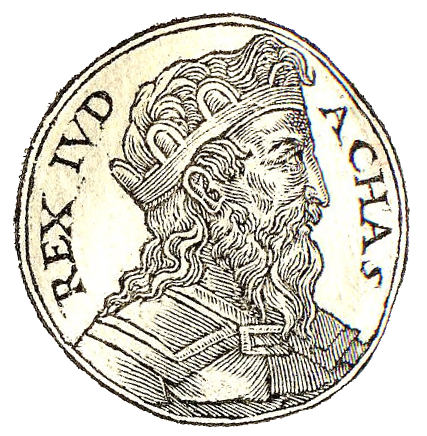
King Ahaz of Judah, from the north rose window of Chartres Cathedral

Key Information

Uzziah, Jotham, and Ahaz, from the Sistine Chapel ceiling.
Ahaz, Hezekiah, and Manasseh, by Lucas van Leyden
After the prophet Oded rebukes the Israelite army for its mistreatment of the captives from Judah, the men of Ephraim care for the captives and return them to their kinsfolk at Jericho (2 Chronicles 28:8-15)

Ahaz (Hebrew: אָחָז, ʼĀḥāz, "has held"; Greek: Ἄχαζ, Ἀχάζ Akhaz; Latin: Achaz)[1] an abbreviation of Jehoahaz II (of Judah), "Yahweh has held" (Hebrew: יְהוֹאָחָז, Modern: Yəhō’aḥaz, Tiberian: Yŏhō’āḥāz;[2] Akkadian: 𒅀𒌑𒄩𒍣 Ya'úḫazi [ia-ú-ḫa-zi])[3] was the twelfth king of Judah, and the son and successor of Jotham. Ahaz was 20 when he became king of Judah and reigned for 16 years.

Ahaz is portrayed as an evil king in the Second Book of Kings (2 Kings 16:2).

In Edwin R. Thiele's opinion, Ahaz was co-regent with Jotham from 736/735 BC, and his sole reign began in 732/731 and ended in 716/715 BC.[4] However, William F. Albright has dated his reign to 744–728 BC.

The Gospel of Matthew lists Ahaz of Judah in the genealogy of Jesus. He is also mentioned in Isaiah 7 and Isaiah 14:28.

Reign

[edit]

Ahaz's reign commenced at the age of 20, in the 17th year of the reign of Pekah of Israel. It is described in 2 Kings 16; Isaiah 7–9; and 2 Chronicles 28.

Destruction of Northern Kingdom

[edit]

Immediately upon his accession, Ahaz had to meet a coalition formed by northern Israel, under Pekah, and Damascus (Syria), under Rezin. These kings wished to compel him to join them in opposing the Assyrians, who were arming a force against the Northern Kingdom under Tiglath-Pileser III (Pul). Isaiah counsels Ahaz to trust in God rather than foreign allies, and tells him to ask for a sign to confirm that this is a true prophecy (verse 7:11). Ahaz refuses, saying he will not test God (7:12). Isaiah replies that Ahaz will have a sign whether he asks for it or not, and the sign will be the birth of a child, and the child's mother will call it Immanuel, meaning "God-with-us" (7:13–14).[5]

To protect himself Ahaz called in the aid of the Assyrians. Tiglath-Pileser sacked Damascus and annexed Aram.[6] According to 2 Kings 16:9, the population of Aram was deported and Rezin executed. Tiglath-Pileser then attacked Israel and "took Ijon, Abel Beth Maacah, Janoah, Kedesh and Hazor. He took Gilead and Galilee, including all the land of Naphtali, and deported the people to Assyria." Tiglath-Pileser also records this act in one of his inscriptions.[7]

Through Assyria's intervention, and as a result of its invasion and subjection of the kingdom of Damascus and the Kingdom of Israel, Ahaz was relieved of his troublesome neighbors; but his protector henceforth claimed and held suzerainty over his kingdom. This war of invasion lasted two years (734–732 BC), and ended in the capture and annexation of Damascus to Assyria and of the territory of Israel north of the border of Jezreel. Ahaz in the meanwhile furnished auxiliaries to Tiglath-Pileser. This appeal to Assyria met with stern opposition from the prophet Isaiah, who counseled Ahaz to rely upon the Lord and not upon outside aid. Ahaz, during his whole reign, was free from troubles with which the neighboring rulers were harassed, who from time to time revolted against Assyria. Thus it was that, in 722, Samaria was taken and northern Israel wholly incorporated into the Assyrian empire.[8]

Religious observance

[edit]

Ahaz yielded readily to the glamour and prestige of the Assyrians in religion as well as in politics. In 732, he went to Damascus to swear homage to Tiglath-Pileser and his gods; and, taking a fancy to an altar which he saw there, he had one like it made in Jerusalem, which, with a corresponding change in ritual, he made a permanent feature of the Temple worship. Changes were also made in the arrangements and furniture of the Temple, "because of the king of Assyria" (2 Kings 16:18). Furthermore, Ahaz fitted up an astrological observatory with accompanying sacrifices, after the fashion of the ruling people. In other ways Ahaz lowered the character of the national worship.

2 Kings 16:3 records that Ahaz offered his son by fire to Moloch (or made his son pass through fire), a practice condemned by Leviticus 18:21.[8] The words may refer to a ceremony of purification or a sacrificial offering.[9] The account in 2 Chronicles 28:3 refers to sons (plural).

His government is considered by the Deuteronomistic historian as having been disastrous for the religious state of the country, and a large part of the reforming work of his son Hezekiah was aimed at undoing the evil that Ahaz had done.[8]

Succession

[edit]

He died at the age of 36 and was succeeded by his son, Hezekiah. Because of his wickedness he was "not brought into the sepulchre of the kings" (2 Chronicles 28:27). An insight into Ahaz's neglect of the worship of the Lord is found in the statement that on the first day of the month of Nisan that followed Ahaz's death, his son Hezekiah commissioned the priests and Levites to open and repair the doors of the Temple and to remove the defilements of the sanctuary, a task which took 16 days.[10]

Rabbinic literature

[edit]

According to the Talmudic rabbis, who refer to II Chron. xxviii. 19–25, Ahaz was the king who persisted in his wickedness even in the face of all the trials to which he was subjected, and would not repent (Sanh. 103a, Meg. 11a). Worse than this, he threatened Israel's religion to its very foundation, in order to destroy all hope of regeneration. He closed the schools and houses of worship so that no instruction should be possible, and the Shekinah (or Glory of God) should abandon the land. It was for this reason that Isaiah had to teach in secret (Yer. Sanh. x. 28b; Gen. R. xlii.), though Ahaz always humbly submitted to the prophet's rebukes—his only redeeming feature (Sanh. 104a).[11] Abi saved the life of her son Hezekiah, whom her godless husband, Ahaz, had designed as an offering to Moloch. By anointing him with the blood of the salamander, she enabled him to pass through the fire of Moloch unscathed (Sanh. 63b).[12]

Chronological notes

[edit]

Surviving artifacts

[edit]

In the mid-1990s a bulla appeared on the antiquities market. This bulla measures 0.4 inches (10 mm) wide. The back of the bulla bears the imprint of the papyrus it once sealed, as well as the double string which held it together. It contains a fingerprint on the left edge. Like many bullae, it was preserved due to being baked by fire, presumably incidentally (house or city was burned), as in a kiln. The inscription reads: "Belonging to Ahaz (son of) Yehotam, King of Judah." Given the process that created and preserved bullae, they are virtually impossible to forge, so most scholars believe this bulla to be authentic. It bears the seal of King Ahaz of Judah, who ruled from 732 to 716 BC.[15][16]

An orange carnelian scaraboid seal dating to the 8th century BC also mentions Ahaz. Its inscription reads, "Belonging to Ushna servant of Ahaz." While Ushna is unknown, the seal refers to Ahaz, king of Judah, who is mentioned in 2 Kings 16. This artifact is currently part of the Yale University's collection of ancient seals.[17]

Another important source regarding the historicity of Ahaz comes from the Tiglath-Pileser III annals, mentioning tributes and payments he received from Ahaz, king of Judah and Menahem, king of Israel.[18][19] Furthermore, in 2015, Eilat Mazar discovered a royal bulla of the Judean king Hezekiah, biblical son of Ahaz, that reads "Belonging to Hezekiah [son of] Ahaz king of Judah", and dates to between 727 and 698 BC.[20]

See also

[edit]

References

[edit]
[edit]
Revisions and contributorsEdit on WikipediaRead on Wikipedia
from Grokipedia
Ahaz (Hebrew: אָחָז) (fl. 8th century BCE) was the eleventh king of Judah, reigning as co-regent from circa 735 BCE and sole ruler from circa 732 BCE for a total of sixteen years until approximately 715 BCE. He succeeded his father and was succeeded by his son , during whose early reign archaeological evidence of Judah's administrative continuity, such as bullae impressions, attests to Ahaz's royal authority. Faced with invasion by a coalition of under and the northern kingdom of under , Ahaz sought military intervention from the Assyrian king rather than relying on prophetic assurances of divine protection. In exchange for Assyrian campaigns that subdued the coalition—culminating in the conquest of —Ahaz dispatched tribute from the Jerusalem Temple and palace treasuries, including gold, silver, tin, and other valuables, establishing Judah as an Assyrian . This policy is corroborated by 's Summary Inscription Seven, which records receipt of tribute from "" alongside other regional rulers, marking one of the earliest direct extrabiblical confirmations of a Judahite . Ahaz's reign is distinguished by administrative artifacts, including a bulla inscribed "Belonging to Ahaz (son of) Yehotam, King of Judah," unearthed in and dated to the eighth century BCE, providing tangible evidence of his governance. He introduced religious alterations to the Temple, such as a large modeled on one observed in , and permitted practices including high-place sacrifices and worship, which later reforms under sought to reverse through the dismantling of associated cultic installations at sites like Arad and . These actions positioned Ahaz as a pivotal figure in Judah's shift toward Assyrian cultural and political influence, averting short-term collapse but entrenching dependency on Mesopotamian overlords.

Historical Context

Kingdom of Judah Prior to Ahaz

Jotham (יוֹתָם) ascended to the throne of around 750 BCE, following the long reign of his father (also known as ), who had ruled from circa 783 BCE but was incapacitated by in his later years, necessitating Jotham's co-regency. Jotham's 16-year rule, ending circa 735 BCE, marked a period of relative internal stability and continued fortification efforts, such as the extension of the wall of the in and construction of gates and towers, reflecting administrative competence amid persistent regional tensions. However, transitional challenges persisted, including dynastic continuity under the and early skirmishes with Ammonite incursions, which Jotham subdued, extracting annual tribute of 100 talents of silver, 10,000 kors of wheat, and 10,000 of barley to bolster 's resources. Geopolitically, Judah under faced escalating threats from the kingdoms of , led by , and northern under , whose coalitions began probing Judah's borders in aggressive raids during the latter part of Jotham's reign, foreshadowing intensified conflict. These pressures stemmed from broader Levantine instability as Assyrian power under revived after a period of decline, initiating campaigns around 745 BCE that indirectly influenced smaller states like Judah through disrupted alliances and tribute demands on neighbors, though Judah itself avoided direct subjugation at this stage. Economically, Judah benefited from inherited expansions under Uzziah, including control over southern trade routes via recaptured and access to Arabian commerce through ports, fostering growth in , herding, and artisanal production despite no major new conquests under . Tribute obligations to and defensive preparations strained resources, yet Jerusalem's strategic position sustained a viable economy oriented toward regional exchange rather than extensive , with limited Assyrian economic overlay until later interventions. Religiously, while Jotham is portrayed as upholding centralized worship in the Temple and avoiding the idolatries of some predecessors, syncretistic practices endured among the populace, including sacrifices at high places and incorporation of Canaanite fertility cults into local rituals, which diluted exclusive devotion to and reflected ongoing in rural and peripheral areas. This blend of orthodox royal piety with popular polytheistic elements set a for to foreign religious influences amid political stresses.

Geopolitical Pressures in the 8th Century BCE

In the mid-8th century BCE, the Neo-Assyrian Empire underwent a revival under Tiglath-Pileser III, who ascended the throne in 745 BCE following a coup against the weakening regime of Ashur-nirari V, thereby arresting decades of internal decay and provincial revolts. His reforms, including the professionalization of the army through deportation policies and the establishment of eponym lists for administrative efficiency, enabled systematic westward campaigns that dismantled Aramean and Levantine resistances, capturing key cities like Arpad in 740–738 BCE and imposing tribute on states from the Zagros to the Mediterranean. This expansionism created a causal disequilibrium in regional power balances, as smaller kingdoms confronted an imperial force capable of fielding armies exceeding 50,000 troops and leveraging iron weaponry for decisive advantages. The Assyrian advance provoked defensive coalitions among peripheral states, exemplified by the alliance between of and of circa 735 BCE, which sought to expand anti-Assyrian resistance by coercing Judah into joint opposition. These invasions targeted Judah's northern territories, besieging and ravaging border areas to install a compliant ruler, reflecting the coalition's strategy to consolidate a Levantine front against Assyrian incursions documented in Tiglath-Pileser III's annals as tributary demands on , Tyre, and by 734–732 BCE. Assyrian records corroborate the coalition's threat through accounts of punitive expeditions that fragmented Aram and , deporting over 27,000 from alone and reducing to a provincial capital in 732 BCE. Judah's geopolitical position amplified these pressures, as its compact territory—spanning approximately 8,000 square kilometers with limited arable land and reliance on highland fortifications—left it exposed to incursions from the north via the and east across the , while Assyrian logistics enabled rapid strikes from established bases in . Empirical assessments of military capacities reveal Judah's forces, estimated at under 10,000 effective troops, as insufficient against combined Aramean-Israelite armies numbering in the tens of thousands, compounded by disruptions to copper trade routes in the and vulnerability to Edomite raids in the south amid Assyrian-fostered instability in Transjordan. This configuration of forces underscored a realist dynamic wherein Judah's survival hinged on navigating the hegemonic shadow of without provoking direct conquest, as evidenced by the empire's selective vassalage of compliant states over annihilation of defiant ones.

Reign and Policies

Ascension and Domestic Rule

Ahaz succeeded his father as king of Judah, ascending the throne at the age of twenty and ruling for sixteen years, from approximately 735 BCE to 715 BCE. This timeline aligns with broader Near Eastern chronologies, including Assyrian records of regional states, though precise synchronisms remain debated among historians due to overlapping regnal formulas in ancient Levantine kingdoms. The transition to Ahaz's rule likely involved a period of co-regency with starting around 735 BCE, transitioning to sole authority circa 732 BCE, a inferred to reconcile biblical regnal lengths with the young age of his successor , who began reigning at twenty-five. Such co-regencies were common in Judah to ensure dynastic continuity amid health issues or external threats faced by predecessors like , who contended with incursions from Aram and . As part of the Davidic lineage, Ahaz's immediate family included his father , son of , and his own son , who would later inherit the throne, reflecting stable succession within the royal house despite potential factional influences, such as pro-Assyrian elements that may have facilitated his installation. Domestically, his administration maintained Judah's bureaucratic framework, including oversight of tribute and labor systems, though archaeological evidence from eighth-century Judahite sites indicates no major infrastructural innovations uniquely attributable to his era, with water management precursors appearing more prominently under successors.

Foreign Alliances and Military Campaigns

Ahaz faced an existential threat from the Syro-Ephraimite coalition, comprising of and of , who sought to depose him and install a ruler in around 735 BCE. In response, Ahaz dispatched envoys to of with tribute extracted from the Temple and royal palace treasuries—specifically gold, silver, and other valuables—declaring loyalty to secure . This pragmatic maneuver exploited 's expansionist campaigns in the , aligning Judah with the dominant regional power against proximate aggressors despite the inherent risks of dependency. Tiglath-Pileser III accepted the overture, launching a western campaign that culminated in the siege and capture of Damascus in 732 BCE, where was executed and Aram annexed as an Assyrian province. Assyrian annals corroborate Ahaz's submission, identifying him as "Yauhazi" (or among tributary rulers delivering payments in 734 BCE during operations against and . The intervention dismantled the coalition: was assassinated, enabling pro-Assyrian to seize 's throne, while Assyrian forces deported populations from northern and annexed territories up to the Brook of , sparing Judah direct conquest but enforcing its tributary status. The alliance yielded short-term survival benefits for Judah, averting conquest and dynastic overthrow by foes whose combined forces outnumbered Judah's defenses, as evidenced by the coalition's failure to breach despite besieging it. However, it imposed long-term costs through obligations: annual drained Judah's resources, fostering economic strain and architectural adaptations like Assyrian-style altars in the Temple, while curtailing amid power asymmetries where smaller states traded for protection from imperial rivals. Assyrian records, as primary imperial documentation, affirm these dynamics without ideological distortion, highlighting how Ahaz's calculus prioritized immediate regime preservation over indefinite independence, a pattern recurrent in Levantine under Assyrian .

Religious and Cultic Practices

Ahaz implemented cultic reforms that integrated foreign religious elements into Judahite worship, marking a departure from exclusive toward influenced by Assyrian and regional pagan traditions. Biblical accounts describe him constructing an modeled on one observed in during his alliance negotiations with around 732 BCE, directing the Uriah to replicate its design in the Temple using precise measurements sent via messenger. This new altar supplanted the traditional bronze for burnt offerings, with Ahaz reconfiguring Temple elements—including relocating the royal entry, basins, and laver stands—to prioritize the foreign structure, actions interpreted by scholars as accommodating Assyrian overlordship and diluting indigenous ritual purity. Such modifications reflect causal pressures from geopolitical submission, evidenced by Ahaz's subsequent use of Temple metals for tribute to . Ahaz further promoted deviant practices, including by fire in the Valley of Hinnom—a site linked to Molech worship—and offerings to and astral deities on high places throughout Judah and . He erected altars in the Temple's courts for foreign gods and molten images for idol worship, eventually shuttering the Temple doors to redirect veneration toward these illicit sites. While direct archaeological attestation for Ahaz-specific remains elusive in Judah—due to the perishable nature of such rites and limited Judean tophets—comparative evidence from Phoenician reveals mass infant burials (over 20,000 remains) in sacrificial contexts, confirming the regional prevalence of the practice Ahaz adopted. Archaeological findings at , a Judahite fortress active circa 760–715 BCE overlapping Ahaz's reign (735–715 BCE), corroborate foreign-influenced rituals through chemical analysis of altar residues. Small stone altars in the site's yielded cannabinoids from flowers (heated without seeds to maximize psychoactive THC) mixed with animal dung for combustion, alongside , indicating intentional use of hallucinogenic in cultic offerings atypical of strict . This empirical data aligns with biblical depictions of Ahaz's idolatrous expansions, as the Arad —featuring and possibly iconography—was desecrated and buried under , suggesting a targeted purge of such syncretistic elements post-Ahaz. These innovations empirically eroded monotheistic exclusivity, prioritizing experiential rituals over prescriptive observance amid Assyrian .

Biblical Portrayal

Accounts in Kings and Chronicles

The account in 2 Kings 16 portrays Ahaz's reign primarily through the lens of foreign policy and cultic innovations influenced by Assyrian contacts. Ahaz ascended in the seventeenth year of king of , at age twenty, ruling sixteen years in while engaging in practices deemed unrighteous, including and high-place worship akin to Israelite kings. Facing invasion by of Aram and , Ahaz appealed to of , stripping the temple and for , which prompted Assyrian campaigns against , resulting in Rezin's capture and execution. Ahaz then traveled to , admired an there, commissioned a replica via Uriah for 's temple, and reordered sacrifices and furnishings, including relocating the bronze sea and bases to appease Assyrian styles. In contrast, 2 Chronicles 28 emphasizes military defeats and escalating domestic during Ahaz's identical sixteen-year tenure starting at age twenty. Ahaz provoked invasions: Pekah's forces slew 120,000 Judeans in one day, including royal kin, and took 200,000 captives with plunder, though urged their release to avert divine wrath. Edomites recaptured sites, seized cities, and Ahaz's intensified —sacrificing sons in the Valley of Hinnom, adopting Aramean gods—led to temple closure and widespread high places. His plea to for aid, despite prior , yielded only further distress, underscoring failed alliances amid religious trespass. The narratives align on core facts, including Ahaz's age, reign length, successor , and synchronism with amid the Syro-Ephraimite conflict, alongside appeal to and religious unorthodoxy paralleling northern practices. Divergences reflect compositional emphases: 2 Kings, from Deuteronomistic sources, highlights diplomatic maneuvering and Assyrian intervention as resolving external threats, with cultic shifts tied to that alliance; 2 Chronicles amplifies punitive losses from neighbors and internal collapse, portraying Assyrian dependence as counterproductive. These variances suggest selective reporting for theological ends—retribution in Chronicles versus pragmatic kingship in Kings—yet shared events like the altar and extraction indicate a common historical substrate, aiding reconstruction of Ahaz's era around 735–715 BCE despite editorial shaping.

Interactions with Prophets

During the Syro-Ephraimite crisis circa 735 BCE, when King of and King of threatened to invade Judah and replace Ahaz with a puppet ruler, the approached Ahaz at the conduit of the upper pool to deliver a divine assurance that the alliance would fail within 65 years, emphasizing that Judah's survival depended on faith rather than military alliances. urged Ahaz to request a sign of confirmation, offering flexibility in its scope—"deep as or high as heaven"—but Ahaz refused, claiming by stating he would not "test the ." This refusal is interpreted in the biblical narrative as an expression of underlying distrust in divine protection, masking Ahaz's preexisting inclination toward Assyrian alliance, which ultimately led to Judah's vassalage under rather than independent deliverance. In response, Isaiah proclaimed the sign of Immanuel independently: a young woman (or virgin in the Hebrew almah) would conceive and bear a son, and before the child could distinguish good from evil, the lands of the two threatening kings would be forsaken. This prophecy aligned temporally with the Assyrian campaigns of 734–732 BCE, which dismantled the anti-Assyrian coalition—culminating in the fall of Damascus in 732 BCE and Pekah's overthrow—thus fulfilling the immediate sign of threat neutralization without requiring Ahaz's faith. However, Ahaz's rejection precluded a faith-based resolution, causal to his subsequent tribute to Assyria (2 Kings 16:7–9), initiating a dependency that imposed tribute burdens and later fueled Hezekiah's revolts, incurring severe reprisals including the 701 BCE siege of Jerusalem. Another prophetic intervention during Ahaz's reign involved Oded, who confronted the victorious army after their raid on Judah captured 200,000 captives, including women and children. Oded attributed Judah's defeat to for Ahaz's idolatries but warned against perpetual enmity by enslaving fellow , prompting northern leaders to release the prisoners, provide , and return spoils—demonstrating prophetic efficacy in mitigating Ahaz-era consequences despite the king's unresponsiveness. Secular interpretations sometimes posit Isaiah 7 as a post-event composition retrofitting to , yet this view conflicts with the eighth-century BCE dating of the , corroborated by Assyrian annals documenting Tiglath-Pileser III's timely interventions and Ahaz's tributary status (e.g., the Iran Stele naming "Yauhazi of Judah"), aligning the prophetic timeline predating fulfillment rather than inventing it ex post facto.

Archaeological Corroboration

Seals and Inscriptions Bearing Ahaz's Name

A clay bulla, or seal impression, inscribed in paleo-Hebrew script with the words "Belonging to Ahaz (son of) Yehotam, King of Judah" provides direct epigraphic attestation to Ahaz's royal status and filiation during the BCE. Acquired on the antiquities market in 1995 and now in a , the artifact measures approximately 12 mm in , bears impressions of fibers and cord, and includes a possible fingerprint, consistent with administrative use for sealing documents. Paleographic analysis dates it to the late BCE, aligning with Ahaz's reign circa 735–715 BCE, though its unverified necessitates caution regarding authenticity despite expert endorsements. An additional seal belonging to a subordinate further corroborates Ahaz's administration: a scaraboid inscribed "Belonging to Ushna, servant of Ahaz," purchased around and housed at Yale University's Babylonian Collection. Featuring Egyptian-style , it dates to the 8th century BCE via script and style, indicating bureaucratic continuity under Ahaz's rule. Extra-biblical confirmation appears in Assyrian records, where Tiglath-Pileser III's Summary Inscription 7, excavated from his palace at () in , lists "Ia-u-ha-zi of Judah" (rendering Jehoahaz/Ahaz) among regional rulers compelled to pay tribute of gold, silver, tin, iron, and other goods during campaigns in 734–732 BCE. This cuneiform tablet, held at the , documents Ahaz's vassalage following the Syro-Ephraimite crisis, without narrative embellishment, and aligns with the scale of tribute implied in contemporary accounts.

Evidence from Key Sites like Tel Arad and Jerusalem

Excavations at have revealed a Judahite complex from the II period, active through the 8th century BCE, featuring at the entrance to its . Chemical analysis of residues on these altars, conducted in 2020 using gas chromatography-mass spectrometry, identified cannabinoids from flowers mixed with animal dung for low-temperature burning, alongside on a smaller . This combination suggests intentional use of psychoactive substances in cultic rituals, potentially to induce , reflecting syncretistic practices that align with the 8th-century BCE introduction of foreign cultic elements in Judah. The 's architecture, including a debir and niche for divine symbols, parallels descriptions of worship but incorporates materials like not native to standard Levantine traditions, indicating adaptations during eras of geopolitical stress and cultural exchange. The Arad shrine's use persisted into the late 8th century BCE, with strata showing continuity amid Judah's vassalage to , before deliberate desecration in subsequent reforms. Burn layers and abandonment phases at Arad and nearby sites correlate with regional conflicts, including Aramean and Israelite incursions during the around 735–732 BCE, when of and of pressured Judah, as evidenced by destruction horizons at peripheral Judean fortifications. These layers, dated via and radiocarbon to the mid-8th century BCE, show arrowheads and fire damage consistent with activity, though Arad's core fortress endured, underscoring selective impacts on Judah's southern defenses during Ahaz's reign. In , archaeological work in the Siloam and City of David areas has uncovered fortification enhancements and water management features from the late BCE, potentially initiated under Ahaz amid threats from the Syro-Ephraimite and Assyrian expansion. These include proto-forms of defensive walls and conduits predating Hezekiah's expansions, reflecting architectural shifts toward Assyrian-influenced models for resilience against invasion, such as reinforced gates and scarps designed for prolonged sieges. While direct remnants of Ahaz's reported Damascene-style altar remain elusive, the period's —evidenced by imported Assyrian and seal styles in Judean contexts—demonstrates , including cultic adaptations that presage later reforms. No major destruction layers appear in Jerusalem's core from these events, aligning with accounts of the city's defense holding against the .

Chronological and Scholarly Debates

Synchronisms with Israelite and Assyrian Kings

The biblical narrative synchronizes the beginning of Ahaz's reign with the seventeenth year of Pekah, king of Israel (2 Kings 16:1), while placing the start of Hoshea's rule over Israel in Ahaz's twelfth regnal year (2 Kings 17:1). Assyrian royal annals under Tiglath-Pileser III record the deposition of Pekah and enthronement of Hoshea as a vassal following military operations in the Galilee and Samaria regions, dated precisely to the eponym year of Nabû-šarru-uṣur (732 BCE) via the limmu (eponym) lists. These campaigns, part of a broader western offensive from 734–732 BCE targeting Philistine territories, Tyre, and anti-Assyrian coalitions, align with Ahaz's appeal for aid against the Syro-Ephraimite alliance of Pekah and Rezin of Damascus (2 Kings 16:5–9; Isaiah 7), during which Ahaz dispatched tribute from Jerusalem's temple treasury. To integrate these accounts, Ahaz's accession is positioned circa 735 BCE, anchoring his seventeenth year of Pekah to the prelude of Tiglath-Pileser III's Philistine incursion in 734 BCE and subsequent Israelite subjugation, with the Assyrian king's reign securely framed from 745–727 BCE by eponym chronicles cross-verified against the lunar eclipse of June 15, 763 BCE. This dating accommodates biblical regnal spans—Ahaz's sixteen years (2 Kings 16:2)—while addressing overlaps: Pekah's biblical twenty-year tenure (2 Kings 15:27) likely incorporates pre-formal influence or co-leadership amid the unstable succession from Menahem (ca. 752–742 BCE) and Pekahiah (ca. 742–740 BCE), extending effectively to his Assyrian-documented ouster in 732 BCE without contradicting the fixed limmu sequence. The discrepancy between Ahaz's twelfth year and Hoshea's 732 BCE installation (implying ca. 724–723 BCE under strict accession-year counting) is reconciled through divergent calendrical reckonings—Judahite years commencing in autumn (Tishri), Israelite in spring (Nisan)—and potential non-accession year adjustments for Israelite kings, yielding an effective overlap of one to two years. Further alignment involves Hezekiah's co-regency with Ahaz, inferred from the biblical placement of Hezekiah's accession in Hoshea's third year (2 Kings 18:1) and Samaria's fall in Hezekiah's sixth (2 Kings 18:10), coinciding with Sargon II's 722–720 BCE conquest after Hoshea's rebellion. This posits Hezekiah's overlap with Ahaz from circa 729–715 BCE, extending his total twenty-nine-year span (2 Kings 18:2) to ca. 715–686 BCE, consistent with Sennacherib's 701 BCE invasion. Assyrian eponym lists and king annals provide the empirical backbone, with Babylonian chronicles offering indirect sequence validation through synchronized Neo-Assyrian successions post-Tiglath-Pileser III. Such co-regencies, evidenced in parallel Near Eastern practices, resolve apparent regnal extensions without altering core accession data, privileging the precision of Assyrian dated events over isolated biblical year counts potentially affected by throne-sharing or usurpation dynamics.

Discrepancies and Proposed Resolutions

One prominent chronological discrepancy in the biblical accounts involves the accession of in the third year of king of (2 Kings 18:1), juxtaposed with the fall of in 's sixth year (2 Kings 18:10), which implies the event occurred approximately eight to nine years into 's reign. This appears inconsistent with 's total regnal length, derived from synchronisms placing his accession in Ahaz's twelfth year (2 Kings 17:1) and the Assyrian capture of around 722/721 BCE. Resolutions invoking textual corruption or wholesale redaction, as proposed by some scholars, lack direct evidence and privilege hypothetical emendations over observable patterns in ancient Near Eastern regnal data. Instead, harmonizations employing co-regencies—such as Ahaz's overlap with beginning circa 729 BCE ('s third year)—align the sequences without alteration, treating 's "sixth year" as inclusive of the co-regency period, thus positioning 's fall consistently within 's ninth year under standard accession-year reckoning. Scholarly debates further center on synchronizing Judah's kings with Assyrian rulers, particularly Ahaz's interactions with (745–727 BCE), whose campaigns against and (734–732 BCE) prompted Ahaz's tribute (2 Kings 16:7–9). Assyrian annals and eponym lists corroborate these events, dating Ahaz's reign from 735 BCE onward and confirming tribute from "" in Tiglath-Pileser's Summary Inscription 7, without necessitating downward revisions to biblical timelines. Maximalist frameworks, building on Edwin Thiele's analysis of overlapping reigns and variances (e.g., Judah's Tishri-based versus Israel's Nisan-based years), achieve precise fits with Assyrian king lists and eclipse dates, as verified through cross-references like the 853 BCE . Minimalist critiques, prevalent in certain academic circles, often dismiss these alignments by prioritizing non-biblical sources and assuming ideological fabrication in the Hebrew texts, yet such positions falter against empirical regnal overlaps that demonstrate causal coherence—e.g., Ahaz's vassalage enabling Judah's survival amid Assyrian expansions—without contrived gaps or inventions. Revisionist downplaying of synchronistic precision overlooks how co-regencies, attested in both biblical (e.g., 2 Kings 15:5) and extrabiblical records, resolve apparent conflicts through straightforward historical mechanics rather than skepticism biased toward discounting Israelite data. Evidence-based models thus uphold the accounts' internal reliability, countering claims of systemic inaccuracy with verifiable chronological scaffolding.

Rabbinic and Interpretive Traditions

Views in Talmudic and Midrashic Literature

In the Babylonian Talmud, Ahaz is depicted as a paradigmatic wicked king who actively suppressed Jewish religious practice despite repeated divine chastisements. Tractate 103b records that he nullified Temple services and "sealed the ," prohibiting its study, based on an interpretation of 8:16 referring to his efforts to bind and conceal sacred teachings from disciples. Even after delivered him into the hands of the kings of as punishment, Ahaz responded by offering sacrifices to their idols rather than repenting, exemplifying unyielding defiance amid trials described in 2 Chronicles 28:19-25. This portrayal amplifies the biblical narrative to underscore the consequences of persistent , positioning Ahaz as a foil to kings who heeded prophetic rebuke. The further elaborates on Ahaz's institutional sabotage, stating that he closed synagogues and academies, fostering a spiritual nadir that eroded observance and leadership continuity. Midrashic literature expands these themes, viewing his reign as a direct catalyst for against Judah. In Bereshit Rabbah, Ahaz is noted as one to whom extended an extraordinary offer to request a or favor—echoing Isaiah 7—yet he rejected opportunities for redemption, linking his failures to ancestral patterns of moral lapse, such as being a "wicked descendant" in Aggadat Bereshit. Rabbinic interpreters, drawing on 2 Kings 16:3, condemn his initiation of to Molech as a grave pagan abomination that provoked invasions and national affliction, serving as ethical caution against emulating foreign rites over covenantal fidelity. These traditions heighten biblical accounts for didactic purposes, emphasizing Ahaz's choices as self-inflicted triggers for calamity without mitigating his agency.

Theological Evaluations of Ahaz's Legacy

The biblical accounts evaluate Ahaz's reign negatively, stating that "he did not do what was right in the sight of the his , as his had done," but instead followed the practices of the kings of , engaging in and adopting the detestable customs of surrounding nations. This idolatry is causally connected to Judah's military defeats and subjugation, as Ahaz's refusal to trust divine protection—despite prophetic assurances—led him to ally with , resulting in payments and loss of that exposed the kingdom to exploitation rather than . The Chronicler's parallel assessment reinforces this, portraying Ahaz's provocations of through pagan altars and temple desecration as precipitating invasions by Aram, , and , with over 120,000 Judean casualties attributed to forsaking the who had previously granted victories. Rabbinic literature amplifies this verdict, depicting Ahaz as an archetypal villain among Judah's kings for his unrepentant , which halted Temple sacrifices and divine responsiveness during his rule, symbolizing a rupture in covenantal fidelity that invited historical retribution. Talmudic sources highlight his Temple desecrations—erecting idols in sacred spaces and suppressing —as acts that endangered the nation's spiritual continuity, with midrashic traditions linking his sins to ancestral curses and portraying him as a foil for divine justice, where persistent wickedness despite afflictions exemplified retributive causality over mere misfortune. The notes the long-term religious fallout, such as disrupted rituals persisting until reforms, underscoring Ahaz's legacy as a cautionary of how elite correlates with communal decline, without dissenting rabbinic views softening this portrayal of him as irredeemably adversarial to piety. This traditional synthesis prioritizes the observable pattern of polytheistic deviation preceding Assyrian dominance as evidence of theological realism, rather than coincidence.

Long-Term Impact

Influence on Hezekiah's Reforms

Hezekiah's religious reforms explicitly reversed the syncretistic practices introduced by his father , who had constructed unauthorized in the Temple precincts and promoted at high places throughout Judah. According to 2 Kings 18:4, Hezekiah demolished the high places, smashed sacred pillars, and cut down poles, actions that directly targeted the cultic innovations of Ahaz's reign, such as the replication of a Damascene altar in and the of Temple furnishings. 2 Chronicles 29–31 further details Hezekiah's purification of the Temple, removing unclean vessels and idols accumulated under Ahaz, thereby restoring centralized Yahwistic and reinstating Levitical oversight neglected during his father's . Archaeological findings corroborate this policy reversal, with evidence of deliberate decommissioning of provincial sanctuaries in Judah during the late 8th century BCE, aligning with Hezekiah's efforts to centralize cultic activity in . At sites like , the temple complex was systematically dismantled and filled with debris around 700 BCE, interpreted as enforcement of Hezekiah's ban on peripheral worship sites. Similar desecrations occurred at Lachish, where horned altars were smashed prior to the Assyrian siege of 701 BCE, and at , where a dismantled altar structure suggests targeted destruction of non- cultic installations. These actions indicate a causal shift from Ahaz's decentralized, syncretistic allowances—likely pragmatic responses to Assyrian cultural impositions—to Hezekiah's rigorous enforcement of Deuteronomistic exclusivity. Ahaz's era of religious compromise, marked by vassalage-induced polytheistic accommodations, arguably cultivated conditions for Hezekiah's reformist zeal, fostering a backlash that intensified Judahite amid existential threats. While Ahaz's policies may have temporarily stabilized Judah under Assyrian by tolerating foreign elements in worship, they eroded traditional Yahwistic purity, prompting Hezekiah's comprehensive purges as a corrective to avert . Scholarly assessments note that this paternal legacy of provided the ideological foil for Hezekiah's centralization, though debates persist on the full extent of archaeological attribution due to overlapping chronologies with Assyrian campaigns. The reforms' success in unifying Judah's cult under likely stemmed from the stark contrast to Ahaz's fragmentation, enabling resilience against imperial pressures.

Role in Judah's Assyrian Vassalage

Ahaz's appeal to during the Syro-Ephraimite crisis around 735–734 BCE resulted in Judah's formal incorporation into the Assyrian network, with the king dispatching from the Temple treasury to secure Assyrian intervention against and . This payment, explicitly recorded in Tiglath-Pileser III's Summary Inscription 7 as received from "" alongside other regional rulers in 734 BCE, established a recurring obligation that bound Judah economically and politically to . The arrangement averted immediate conquest by Assyrian forces targeting rebellious states but initiated a dependency dynamic, where Judah's resources—estimated in silver, gold, and goods—were periodically extracted to maintain favor, straining the kingdom's fiscal capacity without reciprocal military protection beyond the initial campaign. Over the subsequent decades, this vassalage preserved Judah's territorial integrity relative to the northern kingdom's fall in 722 BCE, delaying full-scale Assyrian absorption and allowing continuity under Ahaz's son until at least 715 BCE. However, the entrenched system eroded Judah's independence, as Assyrian oversight restricted autonomous alliances and imposed administrative influences that prioritized imperial stability over local sovereignty. From a realist perspective, Ahaz's created a self-reinforcing trap of compliance, where short-term survival through submission precluded opportunities for diplomatic diversification, perpetuating vulnerability to Assyrian demands even as the empire's priorities shifted under successors like . The long-term outcome manifested in Judah's constrained position by the early 7th century BCE, with vassal obligations contributing to internal pressures that tested but ultimately sustained the kingdom's existence through the 701 BCE Sennacherib campaign—where tribute arrears prompted invasion, widespread destruction, and forced reaffirmation of loyalty, yet spared Jerusalem from sack. Ahaz's policy thus extended Judah's lifespan as a semi-autonomous entity by integrating it into Assyria's buffer system against Egypt and other powers, but at the irreversible cost of diminished self-determination, as evidenced by the absence of recorded Judean revolts or expansions until Hezekiah's limited defiance. This pragmatic alignment, while averting annihilation, locked Judah into a cycle of economic extraction and political subordination that outlasted Ahaz's reign by generations.

References

Add your contribution
Related Hubs
User Avatar
No comments yet.