Recent from talks
Nothing was collected or created yet.
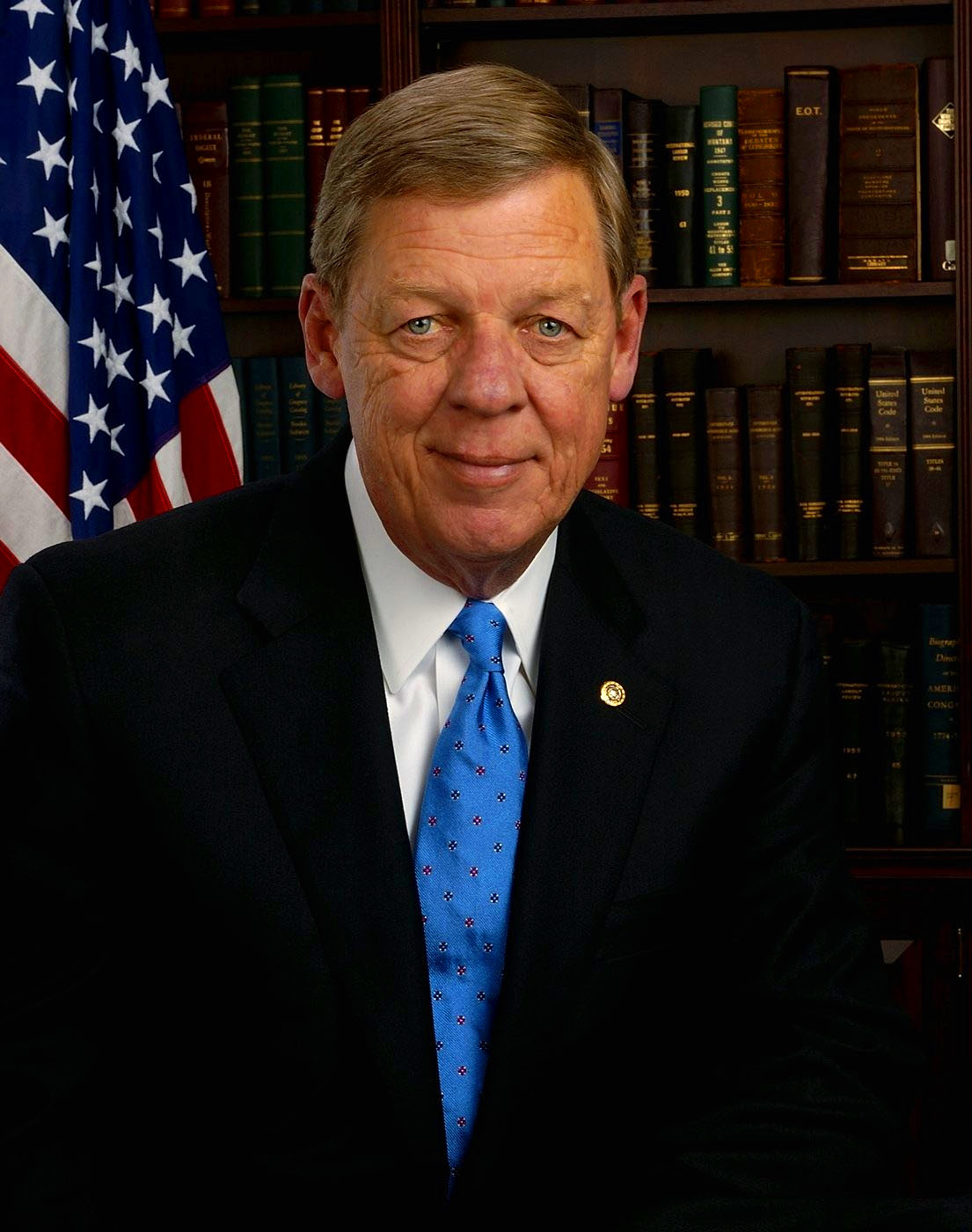
Johnny Isakson
View on Wikipedia
John Hardy Isakson (December 28, 1944 – December 19, 2021) was an American businessman and politician who served as a United States senator from Georgia from 2005 until his resignation in 2019 following health concerns.[3] A member of the Republican Party, he previously served in the Georgia legislature and the United States House of Representatives.
Key Information
Born in Atlanta, Georgia, Isakson served in the Georgia Air National Guard (1966–1972) and graduated from the University of Georgia. He opened a real estate branch for Northside Realty and later served 22 years as the company's president. After a failed bid for the Georgia House of Representatives in 1974, he was elected in 1976. He served seven terms, including four as minority leader. Isakson was the Republican candidate for governor of Georgia in 1990, but lost. Two years later, he was elected to the Georgia Senate and served one term. He unsuccessfully ran in the Republican primary in the 1996 U.S. Senate election.
After 6th District Congressman and Speaker of the House Newt Gingrich resigned, Isakson ran in the February 1999 special election to succeed him, winning by a 40-point margin. He ran for the U.S. Senate in 2004 after Democratic incumbent Zell Miller opted not to run for re-election. With the backing of much of Georgia's Republican establishment, he won both the primary and general elections by wide margins. He became the senior senator from Georgia when Saxby Chambliss retired in 2015. On December 31, 2019, midway through his third Senate term, Isakson resigned from the Senate due to health concerns and was succeeded by fellow Republican Kelly Loeffler who was appointed by Brian Kemp, the Republican Governor of Georgia, to fill the vacant seat. He died two years later on December 19, 2021.
Early life, education, and real estate career
[edit]Isakson was born on December 28, 1944, in Atlanta, Georgia, the son of Julia (née Baker) and Edwin Andrew Isakson, a Greyhound bus driver,[4] who later established an Atlanta real estate firm.[5] His paternal grandparents were of Swedish descent, and his paternal grandfather was born in Östersund. His mother was of mostly British ancestry, and her family has been in the American South since the colonial era.[6][7]
Isakson served in the Georgia Air National Guard from 1966 to 1972, leaving service as a staff sergeant.[8] Isakson enrolled at the University of Georgia, where he became a member of the Sigma Alpha Epsilon social fraternity.[9][10] Shortly after graduating from UGA, he opened the first Cobb County office of Northside Realty, a prominent Atlanta-area real estate firm that his father, Ed, helped to establish. Isakson became company president in 1979, a post he held for 22 years, during which Northside became the biggest independent real estate company in the Southeast and one of the largest in the United States.[11][better source needed]
Early political career (1974–1998)
[edit]
Georgia House of Representatives
[edit]In 1974, Isakson first ran for the Georgia House of Representatives in an eastern Cobb County district and lost. He ran again in 1976 and won. He served seven terms in the House. He won re-election unopposed in 1984[12] and 1988.[13] In his last four terms (1983–1990), he was the Republican Minority leader. In 1988 and 1996, he was co-chair for U.S. Senator Bob Dole's presidential primary campaigns.[14]
1990 gubernatorial election
[edit]
Isakson was the Republican candidate for Governor of Georgia in 1990. He won the Republican primary with 74% of the vote in a four candidate field.[15] In the general election, he was defeated by Democratic Lieutenant Governor Zell Miller 53%–45%.[16] His campaign was managed by Jay Morgan while Miller's campaign was managed by James Carville. Miller ran on a pledge to start a state lottery and use the revenue for public schools. Isakson proposed a ballot referendum on the lottery.[17]
Georgia Senate
[edit]
In 1992, Isakson was elected to the Georgia Senate.[18]
1996 U.S. Senate election
[edit]In 1996, Isakson ran in the Republican primary for the U.S. Senate seat being vacated by retiring Democratic U.S. Senator Sam Nunn. During his campaign, Isakson expressed his support for abortion rights in a campaign advertisement.[19] Isakson finished second in the primary election with 35% of the vote, but the winner Guy Millner, a millionaire businessman, failed to get a majority of the vote (receiving only 42%).[20] Therefore, per Georgia law, he was forced into a primary runoff election. Millner defeated Isakson in the runoff 53%–47%.[21] Millner lost the general election to Democrat Max Cleland.[22]
In December 1996, Isakson was appointed head of the State Board of Education by Gov. Zell Miller.[23]
U.S. House of Representatives (1999–2005)
[edit]Elections
[edit]- 1999
In November 1998, 6th District U.S. Congressman and Speaker of the House Newt Gingrich faced a revolt in his caucus after the Republicans lost five seats in the midterm elections. Amid the turmoil, Gingrich announced on Friday after the Tuesday elections not only that he would not run for a third term as Speaker, but he would also not take his seat for an eleventh term beginning in January 1999. Isakson ran for the seat in a special election in February. He won the election with 65% of the vote, forty points ahead of the second-place finisher Christina Fawcett Jeffrey.[24]
- 2000
Isakson won re-election to his first full term with 74.75% of the vote.[25]
- 2002
Isakson won re-election to his second full term with 79.87% of the vote.[26]

Tenure
[edit]During his tenure in the House of Representatives, Isakson served on the Committee on Education and the Workforce, aiding President Bush in passing the No Child Left Behind Act.[4] As a Representative, Isakson sponsored 27 bills.[27] He was a member of the U.S. House Education Committee.[28] In October 2002, Isakson voted in favor of the authorization of force against the country of Iraq.[29]
U.S. Senate (2005–2019)
[edit]

Elections
[edit]2004
[edit]In early 2003, conservative Democratic U.S. Senator Zell Miller—who had been appointed to fill out the term of the late Republican Senator Paul Coverdell and elected to the post in his own right in 2000—declared his intention not to run for a full term in the Senate in 2004. Isakson immediately entered the race. He faced 8th District U.S. Congressman Mac Collins and businessman Herman Cain in the primary.[30]
It was initially thought Isakson would face a difficult primary since many socially conservative Republicans still felt chagrin at Isakson's declared support for abortion rights in 1990. However, he won the Republican primary with 53%, with Cain a distant second and Collins third, averting the need for a runoff. In the general election, he easily defeated the Democratic candidate, 4th District Congresswoman Denise Majette, by 18 points. Isakson's election marked the first time in Georgia's history that both of the state's U.S. Senate seats had been held by Republicans, as Saxby Chambliss had won the other seat by defeating Nunn's successor, Max Cleland, two years earlier.[31][circular reference]
2010
[edit]In 2010, Isakson was unopposed in the primary. He won re-election with 58.3% of the vote in 2010, defeating State Commissioner of Labor Mike Thurmond.[32]
2016
[edit]Isakson was re-elected to a third term in 2016 with 54.8% of the vote.[33]
Tenure and legislation
[edit]As a senator, Isakson sponsored or co-sponsored 130 bills, just 8 of which became law.[34]
In 2010, Isakson apologized for referring to voters as "the unwashed" in off-hand comments, saying he "didn't mean anything derogatory by it."[35]
Isakson resigned from the Senate for health reasons on December 31, 2019.[36] He is the longest serving Republican senator in the history of Georgia.[37]
Committee assignments
[edit]Political positions
[edit]
When compared to his Republican peers in the Senate, Isakson was close to center of his party; he was neither significantly more conservative nor liberal than his peers.[43]
Abortion
[edit]During his U.S. Senate campaign in 1996, Isakson expressed his support for abortion rights in a campaign advertisement.[19] In 2005, Isakson reportedly identified himself as pro-life with exceptions.[44] In March 2017, Isakson—who was recovering from back surgery—came to the U.S. Capitol in a wheelchair to vote to repeal an Obama administration rule that had made it unlawful for states to bar abortion providers from receiving Title X funding. The Senate vote on the bill was 50–50, and Vice President Mike Pence cast a tie-breaking vote that allowed the bill to pass.[45]
Agriculture
[edit]In July 2019, Isakson was one of eight senators to introduce the Agricultural Trucking Relief Act, legislation that would alter the definition of an agricultural commodity to include both horticultural and aquacultural products and promote a larger consistency in regulation through both federal and state agencies as part of an attempt to ease regulatory burdens on trucking and the agri-community.[46]
Gun laws
[edit]In 2017, Isakson said that while he did support concealed carry nationwide, he did not support campus carry and stated that it is "not the appropriate thing to do."[47]
In February 2018, in response to the Stoneman Douglas High School shooting, Isakson said, "We have to do everything we can within our powers to make sure it never happens again."[48]
Healthcare
[edit]Isakson voted against the Affordable Care Act (also known as Obamacare) and voted more than 60 times to repeal it.[49][better source needed]
Immigration
[edit]In 2019, Isakson voted to support President Donald Trump's national emergency declaration regarding border security.[50]
Personal life
[edit]Isakson and his wife, Dianne, were married in 1968, and had three children.[51] His wife is a watercolor artist,[52] and served as honorary co-chair for Marietta's Theatre in the Square playhouse in 2007.[53]
Health and death
[edit]In June 2015, Isakson disclosed that he had been diagnosed with Parkinson's disease, but added that the diagnosis would not affect his 2016 re-election plans.[54] He continued his campaign and was elected in November 2016 to serve a third six-year term in the Senate. On August 28, 2019, however, Isakson announced that he would resign his Senate seat for health reasons on December 31, 2019.[55]
Isakson died at his home in Atlanta on December 19, 2021, nine days short of his 77th birthday.[56][57]
Electoral history
[edit]| Party | Candidate | Votes | % | ±% | |
|---|---|---|---|---|---|
| Democratic | Zell Miller | 766,662 | 52.89 | −17.62 | |
| Republican | Johnny Isakson | 645,625 | 44.54 | +15.05 | |
| Libertarian | Carole Ann Rand | 37,367 | 2.58 | ±0 | |
| Majority | 121,037 | 8.35 | |||
| Turnout | 1,449,654 | ||||
| Democratic hold | |||||
| Party | Candidate | Votes | % | |
|---|---|---|---|---|
| Republican | Johnny Isakson (incumbent) | 256,595 | 74.75% | |
| Democratic | Brett DeHart | 86,666 | 25.25% | |
| Total votes | 343,261 | 100.00% | ||
| Turnout | ||||
| Republican hold | ||||
| Party | Candidate | Votes | % | |
|---|---|---|---|---|
| Republican | Johnny Isakson (incumbent) | 163,209 | 79.91% | |
| Democratic | Jeff Weisberger | 41,043 | 20.09% | |
| Total votes | 204,252 | 100.00% | ||
| Turnout | ||||
| Republican hold | ||||
| Party | Candidate | Votes | % | |
|---|---|---|---|---|
| Republican | Johnny Isakson | 346,765 | 53.2% | |
| Republican | Herman Cain | 170,464 | 26.2% | |
| Republican | Mac Collins | 134,053 | 20.6% | |
| Party | Candidate | Votes | % | ±% | |
|---|---|---|---|---|---|
| Republican | Johnny Isakson | 1,864,205 | 57.88% | +19.97% | |
| Democratic | Denise Majette | 1,287,695 | 39.98% | −18.22% | |
| Libertarian | Allen Buckley | 69,051 | 2.14% | +2.14% | |
| Majority | 576,510 | 17.90% | |||
| Turnout | 3,220,951 | ||||
| Republican gain from Democratic | Swing | ||||
| Party | Candidate | Votes | % | |
|---|---|---|---|---|
| Republican | Johnny Isakson (incumbent) | 558,298 | 100.00% | |
| Total votes | 558,298 | 100.00% | ||
| Party | Candidate | Votes | % | ±% | |
|---|---|---|---|---|---|
| Republican | Johnny Isakson (incumbent) | 1,489,904 | 58.31% | +0.43% | |
| Democratic | Michael Thurmond | 996,516 | 39.00% | −0.98% | |
| Libertarian | Chuck Donovan | 68,750 | 2.69% | +0.55% | |
| Independent | Steve Davis (write-in) | 52 | 0.00% | N/A | |
| Independent | Raymond Beckworth (write-in) | 24 | 0.00% | N/A | |
| Independent | Brian Russell Brown (write-in) | 12 | 0.00% | N/A | |
| Majority | 493,388 | 19.31% | |||
| Total votes | 2,555,258 | 100.00% | |||
| Republican hold | |||||
| Party | Candidate | Votes | % | |
|---|---|---|---|---|
| Republican | Johnny Isakson (incumbent) | 447,661 | 77.50% | |
| Republican | Derrick Grayson | 69,101 | 11.96% | |
| Republican | Mary Kay Bacallao | 60,898 | 10.54% | |
| Total votes | 577,660 | 100.00% | ||
| Party | Candidate | Votes | % | ±% | |
|---|---|---|---|---|---|
| Republican | Johnny Isakson (incumbent) | 2,135,806 | 54.80% | −3.51% | |
| Democratic | Jim Barksdale | 1,599,726 | 41.04% | +2.04% | |
| Libertarian | Allen Buckley | 162,260 | 4.16% | +1.47% | |
| Total votes | 3,897,792 | 100.0% | N/A | ||
| Republican hold | |||||
See also
[edit]References
[edit]- ^ "Our Campaigns – GA State Senate 21 Race – Nov 03, 1992". www.ourcampaigns.com.
- ^ "Our Campaigns – GA State Senate 21 Race – Nov 08, 1994". www.ourcampaigns.com.
- ^ Mattingly, Alex Rogers,Eric Bradner,Kaitlan Collins,Phil (August 28, 2019). "Georgia Republican Sen. Johnny Isakson to resign at end of year | CNN Politics". CNN. Retrieved May 7, 2025.
{{cite web}}: CS1 maint: multiple names: authors list (link) - ^ a b "GEORGIA Johnny Isakson (R)". The Washington Post. November 4, 2004. Retrieved August 29, 2010.
- ^ "Atlanta roots lie under real estate's family tree". Atlanta Business Chronicle. May 10, 2010.
- ^ "Floor Statement on Immigration Reform Remarks as Delivered on the Senate Floor". Johnny Isakson. April 13, 2005. Retrieved February 20, 2007.
- ^ "Johnny Isakson ancestry". Archived from the original on August 9, 2016. Retrieved January 4, 2012.
- ^ "Greeks in the 113th Congress". North-American Interfraternity Conference. Archived from the original on March 27, 2014. Retrieved September 2, 2013.
- ^ "Three-term Senator to retire". The Record Online. Retrieved December 20, 2021.
Sigma Alpha Epsilon has a rich history of Brothers who have served the United States in an elected office, but few as many times as Johnny Isakson (Georgia '66). He holds the distinction of being the only person elected to represent the state of Georgia in the state House (1977-1990, seven terms), state Senate (1993-1997, two terms), U.S. House (1999-2005, two terms) and U.S. Senate (2005-present, three terms).
- ^ "Johnny Isakson Senate". Johnny Isakson Biography. Archived from the original on September 9, 2018. Retrieved November 18, 2014.
- ^ "Our Campaigns – GA State House 021 Race – Nov 06, 1984". www.ourcampaigns.com.
- ^ "Our Campaigns – GA State House 021 Post 2 Race – Nov 08, 1988". www.ourcampaigns.com.
- ^ "Johnny Isakson will seek Senate seat". bizjournals.com. American City Business Journals. January 15, 2003. Retrieved July 22, 2020.
- ^ "Our Campaigns – GA Governor – R Primary Race – Jul 17, 1990". www.ourcampaigns.com.
- ^ "Our Campaigns – GA Governor Race – Nov 06, 1990". www.ourcampaigns.com.
- ^ Parker, Laura (October 12, 1990). "Lotto Fever in Georgia Governor's Race". The Washington Post. Retrieved December 20, 2021.
- ^ McKee, Don (August 31, 2016). "DON McKEE: Sen. Johnny Isakson: Tireless warrior for veterans, citizens". mdjonline.com. Marietta Daily Journal. Retrieved July 22, 2020.
- ^ a b Sack, Kevin (June 16, 1996). "Georgian Makes a Bold Stand on Abortion". The New York Times.
- ^ "Our Campaigns – GA US Senate – R Primary Race – Jul 09, 1996". www.ourcampaigns.com. Retrieved August 6, 2018.
- ^ "Our Campaigns – GA US Senate – R Runoff Race – Aug 06, 1996". www.ourcampaigns.com. Retrieved August 6, 2018.
- ^ "Ga.: Democrats Win Key Senate Battle In Peach State". cnn.com. Cable News Network (CNN). Retrieved July 22, 2020.
- ^ Almanac of American Politics 2008, p. 463.
- ^ "Official Results of the February 23, 1999 Special Election". Georgia Secretary of State. March 16, 1999. Archived from the original on February 11, 2022. Retrieved April 28, 2018.
- ^ "Our Campaigns – GA District 6 Race – Nov 07, 2000". www.ourcampaigns.com. Retrieved August 6, 2018.
- ^ "Our Campaigns – GA District 6 Race – Nov 05, 2002". www.ourcampaigns.com. Retrieved August 6, 2018.
- ^ "Representative Isakson's Legislation". Library of Congress. Retrieved December 8, 2014.
- ^ "Column: In their own words: Isakson's impact on education". Augustachronicle.com. The Augusta Chronicle. Retrieved July 22, 2020.
- ^ "FINAL VOTE RESULTS FOR ROLL CALL 455" (H J RES 114 YEA-AND-NAY). U.S. House. October 10, 2002.
- ^ Pettys, Dick. "Isakson Wins GOP Primary For Georgia's Senate Seat". washingtonpost.com. WP Company, LLC. Retrieved July 22, 2020.
- ^ "List of United States senators from Georgia". Wikipedia.org. Retrieved July 24, 2020.
- ^ "Georgia – Election Results 2010". The New York Times. Retrieved July 22, 2020.
- ^ "Georgia U.S. Senate Results: Johnny Isakson Wins". The New York Times. August 2017. Retrieved July 22, 2020.
- ^ "Senator Isakson's Legislation". Library of Congress. Retrieved July 14, 2017.
- ^ "Isakson apologizes for calling voters 'unwashed'". The Atlanta Journal-Constitution. June 17, 2010. Archived from the original on June 21, 2010. Retrieved August 15, 2014.
- ^ Rogers, Alex; Bradner, Eric; Mattingly, Phil (August 28, 2019). "Georgia Republican Sen. Johnny Isakson to resign at end of year". CNN. Retrieved August 28, 2019.
- ^ Wells, Myrydd (December 19, 2021). "Colleagues and friends in Georgia and nationwide remember Senator Johnny Isakson". Atlanta Magazine. Retrieved December 20, 2021.
- ^ a b "Senate Finance subcommittee assignments set". Tax News Update. Ernst & Young. January 31, 2019. Retrieved December 20, 2021.
- ^ Remo, Andrew (December 19, 2013). "Senate Hearing Focuses on Retirement Income". National Association of Plan Advisors. Retrieved December 20, 2021.
- ^ a b c "A smorgasbord of subcommittees". The Atlanta Journal-Constitution. February 1, 2015. p. A6. Retrieved December 19, 2021.
- ^ Malloy, Daniel (April 19, 2012). "Isakson says Kony still a priority". The Atlanta Journal-Constitution. p. A2. Retrieved December 19, 2021.
- ^ "Subcommittees". senate.gov. Retrieved November 17, 2019.
- ^ Parlapiano, Haeyoun Park, Alicia; Sanger-katz, Margot (July 13, 2017). "Republicans Made 4 Key Changes to Their Health Care Bill. Here's Who They Were Trying to Win Over". The New York Times. ISSN 0362-4331. Retrieved July 17, 2017.
{{cite news}}: CS1 maint: multiple names: authors list (link) - ^ "An Ardent Moderate". January 1, 2005.
- ^ Barrett, Ted (March 30, 2017). "Isakson returns to Senate to cast key vote on Planned Parenthood". CNN.
- ^ Galford, Chris (July 2, 2019). "Bipartisan Senate effort seeks to ease regulation of agricultural trucking". transportationtodaynews.com.
- ^ Harris, Nate (March 15, 2017). "Senator Isakson speaks out against campus carry". The Red and Black. Retrieved October 4, 2017.
- ^ Saporta, Maria (February 20, 2018). "Sen. Johnny Isakson: 'Of course' planning to run for re-election in 2022". Business Journal. Retrieved March 8, 2020.
- ^ "Health Care – U.S. Senator Johnny Isakson". Archived from the original on February 20, 2017. Retrieved February 19, 2017.
- ^ Hallerman, Tamar (March 14, 2019). "Isakson, Perdue vote to uphold Trump's border emergency". The Atlanta Journal-Constitution. Retrieved February 13, 2021.
- ^ Clanton, Nancy. "5 things to know about Johnny Isakson". The Atlanta Journal-Constitution. Retrieved July 22, 2020.
- ^ McQueen, Tucker (December 19, 2008). "White House tree features Georgia". The Atlanta Journal-Constitution. pp. C1. Retrieved December 19, 2021.
- ^ Bentley, Rosalind (March 23, 2012). "How Marietta lost its theater". The Atlanta Journal-Constitution. Retrieved December 19, 2021.
- ^ Sen. Johnny Isakson discloses he has Parkinson’s disease (Washington Post article-June 10, 2015)
- ^ Byrnes, Jesse (August 28, 2019). "GOP Sen. Johnny Isakson to resign at end of year". TheHill.
- ^ Hallerman, Tamar; Malloy, Daniel (December 19, 2021). "Johnny Isakson, 76, Georgia politician respected by both sides, dies". The Atlanta Journal-Constitution. ISSN 1539-7459. Retrieved December 19, 2021.
- ^ McFadden, Robert D. (December 19, 2021). "Johnny Isakson, Longtime Senator From Georgia, Is Dead at 76". The New York Times. Retrieved December 19, 2021.
- ^ "1990 General Election Results - Governor". sos.ga.gov. Georgia Secretary of State. Retrieved December 20, 2021.
- ^ "Georgia Election Results - Official Results of the November 7, 2000 General Election". sos.ga.gov. Georgia Secretary of State. Retrieved December 20, 2021.
- ^ "Georgia Election Results Official Results of the November 5, 2002 General Election". sos.ga.gov. Georgia Secretary of State. Retrieved July 27, 2020.
- ^ "United States Senator". sos.ga.gov. Georgia Secretary of State. Archived from the original on October 31, 2007. Retrieved February 1, 2019.
- ^ "United States Senator". sos.ga.gov. Georgia Secretary of State. December 21, 2005. Archived from the original on October 31, 2007. Retrieved December 3, 2008.
- ^ "7/20/2010 – United States Senator, Isakson". sos.ga.gov. Georgia Secretary of State. Archived from the original on July 23, 2010. Retrieved August 21, 2010.
- ^ "11/2/2010 – United States Senator, Isakson". sos.ga.gov. Georgia Secretary of State.
- ^ "Official Results". clarityelections.com. Retrieved July 20, 2016.
- ^ "General Election November 8, 2016". clarityelections.com. Retrieved December 19, 2016.
External links
[edit]- Senator Johnny Isakson Archived December 27, 2019, at the Wayback Machine official U.S. Senate website
- Johnny Isakson for Senate Archived October 29, 2016, at the Wayback Machine
Johnny Isakson
View on GrokipediaEarly Life and Military Service
Childhood and Family Background
John Hardy Isakson was born on December 28, 1944, in Atlanta, Fulton County, Georgia, to Edwin Andrew Isakson and Julia Baker Isakson.[1][11] His father, a Greyhound bus driver who repaired and flipped houses on the side, later founded Northside Realty, transitioning the family into Atlanta's burgeoning real estate sector during the post-World War II economic expansion.[12][11] The family, including siblings Andy and Betty, resided in south Fulton County, embodying a middle-class Southern household rooted in immigrant industriousness without extraordinary wealth or hardship.[13] Isakson's paternal grandfather, Andrew Isakson, had immigrated from Östersund, Sweden, in 1903 as a stonemason and wood craftsman, establishing the second-generation American lineage that prized self-reliance and entrepreneurship.[14] This heritage, combined with his mother's longstanding Southern family ties, exposed young Isakson to Georgia's intertwined agricultural, commercial, and suburban development dynamics in mid-20th-century Atlanta, cultivating a pragmatic outlook attuned to local economic growth and community stability.[15][12]Education and Initial Career Steps
Isakson attended North Fulton High School in Atlanta before transferring to Dykes High School, from which he graduated in 1962.[16] [17] He then enrolled at the University of Georgia, where he pursued a Bachelor of Business Administration degree, completing the program in 1966 with an emphasis on practical business principles such as management and real estate fundamentals rather than theoretical or ideological pursuits prevalent in some academic circles of the era.[4] [7] [18] Upon graduation, Isakson entered the real estate industry directly, joining the family-owned Northside Realty firm in Atlanta in 1967 as a salesperson, capitalizing on the post-war housing boom in suburban Georgia.[7] [19] Demonstrating early initiative, he opened the company's first office in Cobb County that same year, focusing on residential sales in a competitive Southern market characterized by rapid population growth and limited inventory, which required hands-on negotiation and market savvy to secure listings and closings. [20] This step marked his self-reliant entry into entrepreneurship, building on familial ties but relying on personal drive amid economic conditions favoring disciplined, value-oriented professionals over speculative or activist distractions of the 1960s.[21]Air Force Reserve Service
Johnny Isakson enlisted in the Georgia Air National Guard, a reserve component of the United States Air Force, in 1966 following his graduation from the University of Georgia.[4] He served continuously until 1972, achieving the rank of staff sergeant.[6] His duties were performed stateside, contributing to the readiness of air reserve forces amid Cold War geopolitical pressures and the ongoing Vietnam War, without overseas deployment.[22] This period of service exemplified a commitment to national defense obligations during an era when draft avoidance was common among some demographics, underscoring Isakson's adherence to duty through structured reserve participation rather than active combat roles.[23] The consistent record established a foundation for his later advocacy on veterans' issues, informed by firsthand experience in military administration and logistics support, though without claims of personal heroism.[24]Business and Pre-Political Professional Life
Real Estate Career and Business Achievements
In 1967, following his graduation from the University of Georgia, Johnny Isakson joined the family-owned Northside Realty and established its first office in Cobb County, targeting the rapid suburban expansion around Atlanta. This move positioned the firm to capitalize on Georgia's post-World War II housing boom, driven by population influx and private-sector development in residential markets.[7] Isakson became president of Northside Realty in 1979, leading the company for 22 years during which it expanded into the largest independent residential real estate brokerage in the Southeast.[25] Under his management, the firm grew to employ more than 1,000 people and handled high volumes of home sales, reflecting effective strategies in client acquisition and market adaptation amid economic cycles.[26] The brokerage's success stemmed from relationship-building and operational efficiency, enabling it to outpace competitors in Georgia's competitive residential sector without documented dependence on public incentives.[3] By the late 1990s, Northside Realty had become one of the nation's largest independent brokerages by transaction volume, contributing to local wealth creation through commissions and employment in sales, marketing, and support roles.[11] Isakson transitioned away from daily operations around 1999–2001 to prioritize public service, having built a multimillion-dollar enterprise that exemplified scalable private brokerage in a free-market environment.[19] His tenure underscored the causal role of entrepreneurial initiative in fostering economic vitality in Atlanta's suburbs, verifiable through the firm's documented scale and regional dominance.State-Level Political Career
Service in Georgia House of Representatives
Isakson was first elected to the Georgia House of Representatives in November 1976, beginning a 14-year tenure that encompassed seven terms.[7] Representing a district in the Atlanta suburbs during a period of Democratic dominance in the state legislature, he focused on advancing Republican priorities within the minority party.[5] From 1983 to 1990, Isakson served as the Republican minority leader, a role that positioned him to negotiate fiscal restraint measures against prevailing liberal spending tendencies in budget deliberations.[4] In this capacity, he pursued bipartisan compromises on controlling state expenditures while upholding core conservative stances on limiting government expansion, including efforts to curb tax increases and promote efficient resource allocation for infrastructure needs in rural and developing areas.[27] His legislative record emphasized tax policy reforms aimed at reducing burdens on businesses and individuals, alongside education initiatives seeking greater accountability and local control to counter centralized bureaucratic approaches. These positions reflected a commitment to deregulation that sought to stimulate economic growth by easing regulatory hurdles, particularly benefiting Georgia's rural economies through targeted infrastructure bills that prioritized practical development over expansive statist programs.[28]1990 Gubernatorial Election Campaign
In the 1990 Georgia gubernatorial election, Johnny Isakson, serving as Republican House Minority Leader, won his party's nomination unopposed in the primary on July 17, 1990, positioning himself as a fiscal conservative and business outsider against the long-entrenched Democratic majority.[29] He faced Lieutenant Governor Zell Miller, who had prevailed in a competitive Democratic runoff against Andrew Young, in the general election on November 6, 1990.[30] Isakson's campaign emphasized economic growth through private-sector incentives, leveraging his two decades in real estate development to advocate for job creation and infrastructure investment in suburban growth areas like Cobb County.[31] Isakson critiqued Democratic fiscal policies as unsustainable, warning that "Georgia is going broke" under prolonged one-party rule and highlighting state budget shortfalls amid recessionary pressures.[32] He opposed Miller's signature proposal for a state lottery to fund education initiatives, arguing it represented gimmickry rather than structural reform for revenue stability and ethical governance.[32] Despite substantial fundraising—outpacing prior Republican efforts—and aggressive media advertising targeting Miller's establishment ties, Isakson garnered 645,625 votes (44.5 percent), trailing Miller's 766,662 (52.9 percent), with Libertarian Carole Ann Rand taking the remainder.[30] [33] The outcome underscored empirical barriers for Republicans in Georgia, where Democrats had controlled the governorship since Reconstruction, commanding solid rural and urban Black voter majorities alongside incumbency-like advantages in a non-presidential year.[31] Voter turnout favored Miller's lottery-backed appeal for pre-kindergarten and scholarships, which resonated amid economic anxieties without alienating core demographics.[32] Isakson's respectable showing in suburban Atlanta precincts demonstrated viability for GOP messaging on growth and accountability, informing subsequent strategic pivots toward bipartisan collaboration over ideological confrontation in a state gradually shifting via demographic realignment.[34]Georgia State Senate Tenure
Johnny Isakson was elected to the Georgia State Senate in November 1992, representing a district in the Atlanta suburbs, and took office in January 1993.[5] He served two terms through 1996 in a chamber controlled by Democrats, where Republicans held a minority position amid the party's gradual growth in the state legislature during the 1990s.[20] As a fiscal conservative, Isakson prioritized policies promoting economic growth and limiting government expansion, consistent with his prior House experience and subsequent federal roles.[1] In the Senate, Isakson contributed to debates on state budgeting and infrastructure, advocating for efficient resource allocation without broad tax increases, drawing on empirical evidence of transportation needs in growing metro areas like Cobb County.[35] He opposed unchecked welfare expansions, emphasizing work requirements supported by data linking dependency to long-term poverty cycles rather than structural barriers alone, reflecting causal analyses from conservative policy circles.[36] These efforts highlighted his role in building bipartisan coalitions to advance Republican priorities against the majority's liberal-leaning agenda, though specific bills sponsored remain less documented than his later congressional record.[4] Isakson's Senate service also foreshadowed his education focus, as he pushed precursors to school choice mechanisms, such as accountability measures, amid rising empirical critiques of public system inefficiencies in Georgia.[7] He supported tort reform initiatives to curb lawsuit abuse driving up business costs, aligning with first-principles arguments for reducing litigation's disincentives to investment, though major enactments came later in state history.[37] His tenure ended in 1996 as he pursued higher office, but it solidified his reputation for pragmatic conservatism in a challenging minority context.[35]1996 U.S. Senate Election Bid
In 1995, following incumbent Democratic Senator Sam Nunn's announcement of retirement after four terms, Johnny Isakson launched a campaign for the Republican nomination in Georgia's open U.S. Senate seat.[38] Drawing on his state legislative experience and business background, Isakson positioned himself as an outsider focused on fiscal discipline, portraying himself in campaign ads as a fighter against government waste and inefficiency.[39] His platform also emphasized national security priorities, informed by his Air Force Reserve service, amid post-Cold War debates on military restructuring.[1] The Republican primary on July 9, 1996, featured a crowded field, with Isakson securing second place at 34.7% of the vote (155,141 votes), behind businessman Guy Millner's 41.9% (187,177 votes).[40] This advanced Isakson to an August 6 runoff against Millner. During the campaign, Isakson adopted a pro-choice stance on abortion, a departure from the party norm that drew criticism from conservative voters and endorsements for his opponent.[41][42] In the runoff, Isakson garnered 47.2% (151,560 votes) to Millner's 52.8%, a margin of approximately 5.6 percentage points, ending his bid for the nomination.[43][42] Millner advanced to the general election but lost narrowly to Democrat Max Cleland by 2.7 percentage points, reflecting Georgia's competitive partisan landscape at the time despite Republican gains elsewhere in the state.[44] Isakson's strong showing in the runoff demonstrated his appeal among moderate voters but underscored intraparty tensions over social conservatism in a transitioning electorate.[35]U.S. House of Representatives Tenure
Elections to the House
Isakson secured the Republican nomination in the January 19, 1999, primary for Georgia's 6th congressional district special election, defeating challengers including Christina Jeffrey by emphasizing his business experience and commitment to fiscal restraint. In the February 23 general election, held to fill the vacancy left by Newt Gingrich's resignation, Isakson won with 65 percent of the vote (51,548 votes) against a field of opponents, including Jeffrey's 26 percent (20,116 votes), in a district characterized by affluent, pro-business suburbs north of Atlanta.[45][46][47] Campaigning amid the aftermath of President Clinton's impeachment, Isakson positioned himself as a reliable conservative focused on local priorities such as alleviating traffic congestion from suburban growth, reducing property taxes, and opposing federal overreach, which resonated with voters seeking steady governance over partisan flash. The district's empirical preference for anti-big-government policies was evident in Isakson's decisive primary victory over more ideological rivals and his general election margin, underscoring approval for pragmatic Republican stewardship in a reliably conservative area.[48] Isakson was reelected in 2000 with 74.8 percent (256,595 votes) against Democrat Brett DeHart's 25.2 percent (86,666 votes), maintaining strong support in the redrawn district encompassing Cobb, Fulton, and Forsyth counties.[49] In 2002, after an unopposed Republican primary, he won the general election outright against nominal opposition, capturing over 80 percent of the vote and reflecting sustained voter endorsement of his emphasis on economic conservatism and infrastructure needs amid ongoing regional development pressures.[50][51] These lopsided results demonstrated the electorate's consistent validation of Isakson's low-key, results-oriented approach over alternatives, in a constituency prioritizing business-friendly policies.Key Legislative Contributions in the House
During his tenure in the U.S. House of Representatives from 1999 to 2005, Johnny Isakson served on the Committee on Transportation and Infrastructure, where he contributed to efforts enhancing aviation security prior to the September 11, 2001, attacks. As a committee member, he participated in hearings examining vulnerabilities in airport screening and screener training, advocating for improved federal oversight of private security contractors at U.S. airports to address risks from inadequate personnel and technology.[52] These discussions informed pre-9/11 legislative pushes for standardized training and risk-based screening protocols, reflecting concerns over inconsistent airline security practices that had allowed prior incidents like explosive threats on flights. Isakson focused on reducing regulatory burdens on small businesses through targeted tax and compliance relief. In the 108th Congress, he sponsored H.R. 2731, the Occupational Safety and Health Small Employer Compliance Improvement Act, which aimed to award attorney's fees and costs to very small employers successfully challenging Occupational Safety and Health Administration citations, thereby easing legal costs for compliance disputes.[53] Complementing this, H.R. 2730 sought independent reviews of OSHA citations to prevent arbitrary enforcement against resource-limited firms, prioritizing procedural fairness over expansive federal mandates.[54] He also cosponsored the Marriage Penalty and Family Tax Relief Act of 2001 (H.R. 6), which included provisions doubling the child tax credit and phasing out the marriage penalty, delivering direct tax reductions averaging $1,100 annually for affected households and small business owners filing jointly.[55] On fiscal matters, Isakson consistently opposed expansive spending measures, aligning with Republican efforts to curb omnibus appropriations that bypassed regular order and inflated deficits. His voting record emphasized restraint, as evidenced by support for the 2001 and 2003 tax reconciliation acts that cut marginal rates and capital gains taxes to stimulate investment without corresponding expenditure growth. In agriculture policy, he backed the Farm Security and Rural Investment Act of 2002, which allocated $16.5 billion for conservation programs and enhanced crop insurance for Georgia commodities like peanuts and cotton, providing market-stabilizing aid to producers amid volatile prices without broadening welfare entitlements.[56] This legislation extended direct payments and counter-cyclical support, yielding $1.3 billion in targeted Georgia farm assistance over its duration while preserving farm-level incentives over centralized redistribution.[57]U.S. Senate Career
Senate Elections
Isakson transitioned to the U.S. Senate in 2004 after serving five years in the House of Representatives, leveraging his incumbency and prior state legislative experience to secure the Republican nomination and general election victory against Democrat Denise Majette.[1] This move capitalized on his established reputation in Georgia politics, where he had previously held seats in the state House and Senate, positioning him as a seasoned conservative alternative in a state leaning Republican at the federal level.[2] His path underscored voter preference for continuity in representation, with no prior U.S. Senate experience but a track record emphasizing fiscal restraint and veterans' issues that resonated in suburban and rural districts.[11] Throughout his Senate career, Isakson retained his seat through two re-elections in 2010 and 2016, defeating Democratic challengers amid national partisan shifts yet maintaining strong support from Georgia's conservative base.[28] These outcomes reflected repeated mandates from voters favoring his steady approach over more progressive alternatives, with coalitions of rural agricultural communities and growing Atlanta suburbs providing decisive turnout advantages.[4] Absent major personal scandals—unlike some contemporaries—Isakson's campaigns focused on his unblemished service record, which helped neutralize Democratic narratives portraying him as out of touch on key state issues.[11] This pattern of incumbency-driven success highlighted Georgia's electoral dynamics during the period, where Republican holds depended on broad conservative appeal rather than narrow ideological extremes.2004 Election
In the 2004 U.S. Senate election in Georgia, Republican Johnny Isakson defeated Democratic nominee Denise Majette on November 2, receiving 1,864,205 votes (57.9 percent) to Majette's 1,287,695 votes (40.0 percent).[58] The race filled the seat vacated by retiring Democratic Senator Zell Miller, and Isakson's victory marked the first time Georgia had two Republican senators since Reconstruction.[59] His campaign leveraged President George W. Bush's re-election coattails, as Bush carried Georgia amid a national Republican wave that expanded the party's Senate majority.[60] Isakson's fundraising advantage, bolstered by contributions from the real estate industry totaling over $945,000 in the 2003-2004 cycle—reflecting his prior career founding a commercial real estate brokerage firm—enabled a robust advertising effort that outpaced Majette's resources.[61] He emphasized his congressional experience on issues like homeland security, drawing on his service on the House Transportation and Infrastructure Committee amid post-9/11 priorities, while appealing to voters through criticism of trial lawyers and support for tort reform to curb frivolous lawsuits.[62] The outcome reinforced Republican gains across the South, contributing to the party's sweep of open seats in the region and underscoring sustained conservative momentum despite some media narratives minimizing the ideological shift in Southern politics.[60]2010 Election
Incumbent Republican Senator Johnny Isakson secured the Republican nomination for reelection through a party convention on May 21, 2010, facing no significant primary challenge.[63] This process reflected his established position within Georgia's Republican establishment amid the broader Tea Party movement's rise, allowing him to avoid intra-party ideological contests.[63] In the general election on November 2, 2010, Isakson defeated Democratic Labor Commissioner Michael Thurmond, who had won his party's primary runoff against R.J. Hadley on July 20.[64] Isakson received 1,489,904 votes (58.3 percent), while Thurmond garnered 996,516 votes (39.0 percent), with Libertarian Chuck Donovan taking the remainder.[65] Pre-election polling, such as a Rasmussen Reports survey in April 2010, showed Isakson leading Thurmond 51 percent to 35 percent among likely voters, underscoring his strong positioning.[66] Isakson's campaign emphasized opposition to the Patient Protection and Affordable Care Act, which he had voted against during its March 2010 Senate consideration, framing it as an unsustainable expansion of government spending amid Georgia's fiscal conservative priorities.[67] This stance aligned with the electorate's revolt against federal overreach without endorsing more disruptive tactics like government shutdowns, which emerged later in national GOP strategies. His victory validated a pragmatic approach, prioritizing legislative experience and constituent-focused service—particularly on veterans' issues from his Air Force background—over demands for ideological purity from Tea Party activists.[68] Job performance polls in mid-2010 indicated around 47 percent approval among Georgia voters, sufficient in the state's Republican-leaning environment to deliver a decisive margin.[69]2016 Election
In June 2015, Isakson disclosed his early-stage Parkinson's disease diagnosis but affirmed his intent to seek reelection, emphasizing that the condition would not impede his service.[70] He faced no significant opposition in the Republican primary held on May 24, 2016, securing nomination with over 88% of the vote against minor challengers. Throughout the campaign, Isakson highlighted his leadership as chairman of the Senate Veterans' Affairs Committee, including efforts to address systemic corruption and accountability failures at the Department of Veterans Affairs, as outlined in his May 2016 op-ed advocating for cultural reforms within the agency.[71] In the general election, Isakson confronted Democrat Jim Barksdale, a former state representative, positioning his campaign around economic growth, veterans' services, and his legislative record appealing to Georgia's business community and military voters.[72] Following Donald Trump's securing of the Republican presidential nomination in July 2016, Isakson endorsed him as the party standard-bearer, maintaining support amid controversies by prioritizing policy alignments on issues like veterans' care over personal style, as reiterated in campaign debates and public statements.[73][74] On November 8, 2016, Isakson won reelection with 54.8% of the vote to Barksdale's 40.5%, alongside Libertarian Allen Buckley's 4.2%, demonstrating the durability of his moderate conservative appeal in Georgia despite national partisan divisions.[75][76] The margin reflected strong turnout among veterans and suburban voters, underscoring Isakson's incumbency advantage in a solidly Republican state.Major Legislative Initiatives and Reforms
Isakson spearheaded efforts on the Veterans Access, Choice, and Accountability Act of 2014, which permitted eligible veterans facing VA appointment delays exceeding 30 days or residing over 40 miles from a VA medical facility to seek treatment from approved community providers using VA funds. Enacted amid revelations of systemic scheduling manipulations inflating access data, the measure expanded non-VA care eligibility to approximately 9 million veterans without mandating wholesale privatization, instead introducing targeted accountability for VA executives via expedited firings for poor performance.[77] Post-implementation analyses showed average wait times declining across primary care, mental health, and specialty services from fiscal year 2015 to 2018, with rural veterans experiencing reductions in optometry and physical therapy delays from 43 and 28 days, respectively.[78] Isakson voted for the Tax Cuts and Jobs Act of 2017, which lowered the top individual income tax rate to 37 percent, cut the corporate rate to 21 percent, and doubled the standard deduction to $12,000 for individuals. In Georgia, the law delivered average tax reductions exceeding $1,600 per household through these changes, alongside enhanced deductions for pass-through businesses prevalent in the state's economy, correlating with sustained GDP expansion from 3.3 percent in late 2017 into subsequent years driven by investment incentives.[79] Internal Revenue Service filings reflected broader adoption of the standard deduction, rising from 30.9 percent itemizers in 2017 to 88.7 percent in 2018 nationally, with similar shifts in Georgia amplifying disposable income for reinvestment.[80] On agriculture, Isakson backed the Agriculture Improvement Act of 2018, which fortified crop insurance subsidies covering up to 85 percent of premiums for producers and updated reference prices for commodities like peanuts and cotton to shield family operations from market volatility and input cost spikes.[81] The bill curtailed certain conservation reserve expansions that could encroach on tillable land while streamlining permitting to counter regulatory expansions under prior administrations, thereby preserving operational flexibility for Georgia's 42,000-plus farms averaging 244 acres each.[82] These provisions sustained sector output, with peanut production holding at over 1.2 million tons annually post-enactment despite trade disruptions.[81]Committee Assignments and Leadership Roles
Isakson was assigned to the Senate Committee on Veterans' Affairs upon entering the Senate in 2005 and chaired it from January 3, 2015, to December 31, 2019, succeeding Barbara Boxer and preceding Jerry Moran.[5][24] His chairmanship followed the 2014 Department of Veterans Affairs scandal involving falsified wait times and delayed care for over 40,000 veterans at the Phoenix VA facility, as documented in a Veterans Affairs Inspector General report, prompting congressional demands for structural reforms to enhance accountability and oversight.[24] Isakson's prior service in the Georgia Air National Guard from 1966 to 1972 positioned him as a trusted voice on military-related policy, enabling rigorous scrutiny of VA operations and resource allocation.[24] Throughout his Senate career, Isakson served on the Committee on Foreign Relations, where he contributed to oversight of U.S. diplomacy, sanctions, and strategic engagements amid rising geopolitical tensions.[5] His assignments on this committee reflected Republican leadership's confidence in his pragmatic approach to international relations, informed by his business background and ability to forge cross-party consensus on treaty ratifications and aid packages.[5] Isakson also held seats on the Committee on Finance, addressing trade, taxation, and entitlement programs, as well as the Committee on Health, Education, Labor, and Pensions, focusing on regulatory impacts on labor markets and public health systems.[5] These roles underscored his versatility in leveraging committee platforms for substantive policy examination rather than partisan posturing.Political Ideology and Positions
Fiscal Conservatism and Economic Policies
Isakson championed fiscal discipline rooted in his background as a Georgia state legislator, where annual balanced budgets mandated rigorous justification for expenditures. He co-sponsored the Balanced Budget Amendment to require federal deficits to be offset by spending cuts or revenue increases, and the Commitment to American Prosperity Act, which proposed automatic spending reductions if Congress failed to pass a budget. In 2017, he introduced the Biennial Budgeting and Appropriations Act to shift federal budgeting to two-year cycles, aiming to reduce uncertainty, enhance oversight, and curb impulsive spending through extended review periods.[83] While Isakson voted against several debt ceiling increases without attached reforms—such as opposing hikes tied to unchecked spending—he supported others conditioned on bipartisan spending caps or deficit reduction triggers, including the 2011 Budget Control Act that aimed to cut $2.1 trillion over a decade.[84][85] Critics, including libertarian challengers, highlighted his record of approving roughly $7 trillion in debt limit expansions during his tenure, arguing it contributed to unchecked federal borrowing despite his rhetorical emphasis on restraint.[86] He consistently critiqued Keynesian-style interventions, voting against the $787 billion American Recovery and Reinvestment Act of 2009 for its "bloated" non-infrastructure allocations and insufficient tax relief, favoring instead private-sector-led recovery through deregulation and market incentives over government outlays that empirical analyses later deemed inefficient due to temporary job impacts and persistent deficits.[87][88] On economic policy, Isakson prioritized tax simplification and rate reductions to spur growth, endorsing the 2017 Tax Cuts and Jobs Act for its corporate rate cut from 35% to 21%, which he argued would repatriate overseas capital and boost investment without raising deficits long-term via dynamic revenue effects.[89] He advocated deregulation to enhance competitiveness, co-sponsoring the 2015 Affordable Reliable Energy Now Act to repeal EPA's Clean Power Plan, which he and co-sponsors viewed as imposing $7.4 billion in annual compliance costs on states like Georgia, potentially stifling manufacturing and energy sector jobs in favor of unreliable alternatives.[90] This stance aligned with Georgia's post-recession manufacturing resurgence, where sector output grew 15% from 2010 to 2016 amid reduced federal barriers, though causal attribution remains debated beyond broader recovery trends.Social Conservatism and Cultural Issues
Isakson maintained a pro-life stance throughout his career, opposing abortion except in cases of rape, incest, or to save the mother's life, reflecting a commitment to protecting fetal development as a biological continuum of human life from conception.[8] He earned high marks from pro-life organizations, scoring in the 85-100% range for his legislative record, including opposition to federal funding expansions for abortion providers.[91] In September 2015, shortly after undergoing surgery for a kidney stone, Isakson returned to the Senate floor to vote against a measure that would have continued funding for Planned Parenthood amid investigations into its practices, prioritizing restrictions on taxpayer support for organizations involved in elective abortions.[92] On Second Amendment rights, Isakson was a consistent defender, earning endorsements and support from the National Rifle Association for upholding the constitutional right to bear arms as a foundational safeguard against tyranny and for self-defense.[93] Following the 2012 Sandy Hook Elementary School shooting, he opposed expansive gun control proposals, including the 2013 Manchin-Toomey amendment for universal background checks, arguing that such measures would infringe on law-abiding citizens' rights without addressing criminal misuse of firearms.[94] His votes aligned with NRA priorities, such as authorizing armed pilots for cockpit defense post-9/11, emphasizing empirical evidence that armed, trained individuals deter threats more effectively than regulatory expansions targeting legal gun owners.[93] Isakson supported the traditional definition of marriage as between one man and one woman, rooted in biological complementarity and the natural procreative purpose of the institution, even as he acknowledged the 2015 Supreme Court decision in Obergefell v. Hodges as settled law.[95] In response to the ruling, he stated, "Many Americans, including myself, will continue to personally believe that marriage is between one man and one woman," resisting cultural relativism by affirming marriage's role in stabilizing family structures centered on biological parent-child bonds.[95] This position extended to broader cultural issues, where he critiqued judicial overreach in redefining longstanding societal norms without democratic consensus, prioritizing evidence-based recognition of sex-based differences over ideological reinterpretations.[11]National Security, Foreign Policy, and Veterans Affairs
Isakson, a member of the Senate Committee on Foreign Relations from 2007 to 2019, consistently supported stringent sanctions on Iran to counter its nuclear ambitions and sponsorship of terrorism. In 2015, he co-sponsored legislation demanding Iranian compensation for American hostages held since the 1979 revolution as a precondition for any nuclear agreement, emphasizing accountability for Iran's actions against U.S. personnel.[96][97] He criticized the Joint Comprehensive Plan of Action (JCPOA) as insufficient, warning that it effectively ceded strategic advantages to Iran over time by phasing out sanctions without verifiable concessions on ballistic missiles or regional proxies.[98] In 2016, Isakson backed a GOP-led bill imposing new sanctions specifically for Iran's terrorist support, reflecting his prioritization of deterrence through economic pressure over diplomatic concessions.[99] On military engagements in Iraq and Afghanistan, Isakson participated in Senate hearings evaluating counterinsurgency progress, endorsing strategies aimed at stabilizing governance and defeating insurgencies through sustained U.S. presence rather than premature withdrawal.[100][101] His positions aligned with a realist approach, favoring troop commitments necessary for regional security without expansive nation-building, as evidenced by his oversight of foreign aid bills strengthening U.S. alliances in Africa and the Middle East to counter adversarial influences.[102] As chairman of the Senate Committee on Veterans' Affairs from 2015 to 2019, Isakson drove reforms to enhance care access and accountability, authoring the VA MISSION Act of 2018, signed into law on June 6 by President Trump.[103][104] The legislation consolidated fragmented community care programs into the Veterans Community Care Program, granting eligible veterans—those facing wait times over 20 days for primary care or 28 days for specialty care, or living more than 40 miles from facilities—expanded options to seek private providers at VA expense, aiming to bypass bureaucratic delays exposed by the 2014 VA scandal.[104] It also mandated infrastructure reviews and performance metrics to align VA resources with demand, prioritizing veteran choice over centralized control.[105] Isakson co-sponsored the Johnny Isakson and David P. Roe, M.D. Veterans Health Care and Benefits Improvement Act of 2020, enacted as part of the Consolidated Appropriations Act, which bolstered post-service benefits including GI Bill oversight, expanded caregiver support, and protections for education assistance during disruptions like the COVID-19 pandemic.[106][107] These measures focused on fiscal responsibility, requiring VA risk-based approvals for high-cost programs to prevent waste while ensuring benefits reflected cost-of-living adjustments for disabled veterans.[108] His leadership emphasized empirical accountability, with over 15 veterans' bills signed into law during his tenure, countering narratives of underfunding by streamlining operations and expanding private-sector integration.[103]Healthcare, Immigration, and Other Domestic Policies
Isakson opposed the Patient Protection and Affordable Care Act (ACA), voting against its passage and supporting repeal efforts, including the 2017 Senate vote to advance legislation dismantling key provisions. He criticized the law's individual mandate and required essential health benefits as barriers to competition that inflated premiums and limited consumer choice.[109][110][111] In place of federal mandates, Isakson promoted market-driven alternatives, such as permitting interstate sales of health insurance policies to expand options and lower costs through competition, alongside reductions in Obamacare's regulatory requirements.[111][110] On immigration, Isakson prioritized border enforcement, insisting that comprehensive reform required first securing the southern border to curb illegal entries, with funding for physical barriers, technology, and personnel. He opposed blanket amnesty, advocating enforcement triggers before legal status adjustments, and in 2006 stated that federal inaction on borders undermined any guest worker or pathway proposals.[112][113] Isakson backed targeted reforms distinguishing legal from illegal immigration, supporting legal pathways while pushing enforcement to reduce unauthorized flows; he endorsed the 2014 House Republican principles sequencing security enhancements before status regularization. In 2018, he co-sponsored a bipartisan amendment pairing DACA protections for certain undocumented youths with mandatory border security investments.[114][115][113] In agriculture policy, Isakson supported federal subsidies and crop insurance expansions vital to Georgia's peanut, cotton, and rice sectors, voting for the 2013 farm bill that authorized over $500 billion in five-year spending, including enhanced insurance against price volatility and disasters to bolster food security without full market exposure risks. He urged administrative aid for cotton farmers in 2017 amid global competition, emphasizing targeted protections for domestic production stability.[116][117][118]Controversies, Criticisms, and Bipartisan Engagements
Debates Over VA Reforms and Accountability
In response to the 2014 Department of Veterans Affairs (VA) wait-time scandal, which an inspector general investigation revealed involved systemic falsification of records to conceal delays exceeding 30 days for primary care in facilities like Phoenix, Senator Johnny Isakson, as chairman of the Senate Committee on Veterans' Affairs, prioritized accountability reforms to expedite the removal of underperforming staff.[119] He championed the VA Accountability and Whistleblower Protection Act of 2017, enacted on June 23, which empowered VA secretaries to fire senior executives and other employees for poor performance or misconduct with abbreviated appeals processes, effectively overriding union-backed Merit Systems Protection Board protections that had previously delayed terminations for up to two years.[120][77] Unions such as the American Federation of Government Employees criticized the measure as eroding due process, but Isakson argued it was essential to combat entrenched bureaucratic resistance to change, citing ongoing VA failures to implement prior firing authorities due to legal challenges.[121][122] Isakson extended these efforts through expansions of community care access, building on the 2014 Veterans Access, Choice, and Accountability Act by authoring the VA MISSION Act of 2018, signed into law on June 6, which broadened eligibility for non-VA providers based on wait times over 30 days, drive distances exceeding 30 minutes in urban areas or 60 minutes rural, or other access barriers.[103] The legislation consolidated fragmented programs into a unified system while mandating VA infrastructure improvements, leading to documented reductions in appointment delays; VA data showed primary care wait times averaging 22.5 days in 2014 decreasing to meet or approach the 20-day internal standard by fiscal year 2018, with overall access enhancements offloading demand from overburdened facilities.[123][124] These outcomes contrasted with pre-reform averages often surpassing 30 days in scandal-affected sites, demonstrating causal links between expanded options and alleviated internal bottlenecks rather than mere resource shifts.[125] Liberal critics, including advocacy groups aligned with VA unions, dismissed these hybrid expansions as covert privatization schemes destined to starve VA funding and fragment care, echoing concerns from outlets and Democrats that prioritizing private options incentivized neglect of public facilities.[126][127] Isakson rebutted such characterizations as misleading, insisting the MISSION Act reinforced VA as the primary provider while pragmatically addressing unmet needs, with no intent to outsource core functions—a stance he reiterated amid implementation debates.[128][129] Intra-party tensions arose from conservative factions, such as those influenced by Concerned Veterans for America, urging deeper privatization to dismantle perceived VA monopolies, but Isakson defended the balanced approach as realistic, prioritizing veteran outcomes over ideological overhauls and warning that full outsourcing ignored the VA's specialized expertise in treating service-related conditions.[130][119] This positioned his reforms against both bureaucratic inertia and purist alternatives, yielding bipartisan passage while empirical metrics validated targeted accountability over wholesale systemic upheaval.[131]Conservative Critiques of Moderation and Party Loyalty
Some conservative activists and commentators, particularly from the MAGA-aligned wing of the Republican Party, criticized Senator Johnny Isakson for perceived disloyalty to former President Donald Trump, especially following Isakson's public rebuke of Trump's March 2019 attacks on the late Senator John McCain. Isakson described Trump's comments—such as stating he was "never a fan" of McCain and regretting his 2018 funeral attendance—as "deplorable" and indicative of a "lack of respect," emphasizing McCain's military service and contributions to the party.[132][133] This stance drew backlash from Trump supporters who viewed it as undermining party unity during Trump's presidency, framing Isakson as prioritizing personal alliances over loyalty to the movement's leader. Isakson's voting record on fiscal brinkmanship further fueled accusations of moderation over ideological purity. During the 2018–2019 government shutdown, triggered by disputes over border wall funding, Isakson joined five other Republicans on January 24, 2019, in supporting a Democratic-led continuing resolution to reopen the government without additional wall appropriations, arguing that prolonged closure harmed federal workers and the economy.[134] Hardline conservatives labeled such votes as RINO ("Republican In Name Only") behavior, contending they weakened leverage for immigration enforcement and betrayed the party's base demands for strict border policies, even as Isakson consistently won reelection in Georgia with over 50% of the vote in 2004, 2010, and 2016.[135] These critiques often overlooked Isakson's substantive conservative achievements, such as his support for the 2017 Tax Cuts and Jobs Act, which reduced corporate rates from 35% to 21% and doubled the standard deduction, delivering tangible economic benefits that aligned with results-oriented governance rather than procedural standoffs. Detractors' focus on ideological litmus tests—such as unwavering alignment with Trump's personal rhetoric or shutdown tactics—contrasted with Isakson's emphasis on legislative productivity, including his role in advancing veterans' healthcare reforms and avoiding defaults that could exacerbate national debt, then at $21.5 trillion.[135] Such attacks remained marginal within broader Republican circles, where Isakson's deal-making was credited with sustaining party influence amid divided government.Liberal Opposition to Key Votes and Stances
Liberals and Democratic opponents criticized Senator Johnny Isakson for his support of efforts to repeal the Affordable Care Act (ACA) in 2017, arguing that such measures would result in millions losing health coverage and exacerbate access issues without adequate replacement plans.[136] Isakson voted in favor of procedural motions and amendments aimed at repealing key ACA provisions, including the individual mandate, as part of Republican-led bills like the Better Care Reconciliation Act.[137] [138] However, empirical data indicate that ACA implementation under the Obama administration correlated with substantial premium increases, with national average individual health insurance costs rising 129 percent from 2013 to 2019, doubling the financial burden on many non-subsidized consumers.[139] Following the February 2018 Parkland school shooting, liberal advocates and Democrats expressed ire toward Isakson's defense of Second Amendment rights and his cautious stance against expansive gun restrictions, viewing it as insufficient response to rising mass violence and prioritizing industry interests over public safety.[140] [141] Isakson emphasized enforcing existing laws rather than new federal mandates like assault weapons bans, aligning with broader Republican resistance to post-Parkland proposals for universal background checks or red-flag laws.[140] Comprehensive reviews of gun policies, however, find inconclusive or limited evidence that common restrictions—such as assault weapons bans—causally reduce mass shootings, with studies showing no statistically significant decline during the 1994-2004 federal ban period.[142] [143] Democratic critics labeled Isakson's advocacy for stricter immigration enforcement, including border security prerequisites and opposition to expansive amnesty without controls, as xenophobic and obstructive to comprehensive reform, particularly his votes against 2006 and 2013 bills favoring guest worker paths and citizenship routes.[144] [145] Isakson proposed amendments requiring border fortifications before proceeding with legalization, which Senate majorities rejected amid accusations of derailing bipartisan deals.[146] Yet data on chain migration—family-based immigration chains—reveal net fiscal costs, with immigrant-headed households via this system often imposing burdens exceeding taxes paid, contributing to state and local deficits estimated in tens of billions annually due to welfare usage and low-skilled labor profiles.[147] [148]Personal Life and Later Years
Family, Personal Interests, and Character
Isakson married Dianne Isakson, a watercolor artist, in 1968, and the couple raised three children: sons John and Kevin, and daughter Julie.[36][149][150] The family resided in Marietta, Georgia, where they maintained a close-knit household, with Isakson survived by nine grandchildren at the time of his death.[149][5] Isakson's personal life reflected a commitment to family stability and community engagement, including participation in local events and alumni activities at the University of Georgia, his alma mater.[7] He and his wife supported educational and civic initiatives in Georgia, emphasizing traditional values of service and involvement beyond professional duties.[4] Colleagues and observers frequently described Isakson as possessing a courteous and approachable character, shaped by Southern traditions of hospitality and respect, which fostered broad personal likability.[151][152] He encapsulated this outlook in the view that "there are two types of people in this world: friends and future friends," a mindset that underscored his emphasis on genuine relationships over confrontation.[152] This reputation for decency, distinct from partisan posturing, stemmed from consistent personal conduct rather than strategic accommodation.[153]Health Struggles, Retirement, and Death
In 2013, Isakson was diagnosed with Parkinson's disease after experiencing stiffness in his left arm, though he did not publicly disclose the condition until June 10, 2015, when he announced it during preparations for his 2016 reelection campaign, emphasizing that it was in the early stages and would not impede his service.[154][70] Despite the diagnosis, Isakson continued his Senate duties, including co-chairing the Congressional Caucus on Parkinson's Disease and advocating for related research funding, while managing symptoms that progressively affected his mobility and energy.[155] By 2019, the advancement of Parkinson's, compounded by additional health setbacks such as a fall in his Washington apartment that fractured four ribs, prompted Isakson to reassess his capacity to serve effectively.[11] On August 28, 2019, he announced his intention to resign from the Senate at the end of the year, stating explicitly that the decision stemmed from his deteriorating health rather than external political pressures, as the progression of the disease and recent surgeries—including one to remove a kidney stone—had rendered full participation untenable.[9][156] In his farewell address on the Senate floor on December 3, 2019, Isakson reflected on his career without referencing partisan conflicts as a factor, underscoring personal limitations as the sole driver for stepping down midway through his third term.[157] Isakson officially resigned on December 31, 2019, and endorsed former Georgia Governor appointee Kelly Loeffler as his interim successor, praising her as a capable conservative to maintain continuity in the seat.[156] Following his retirement, he retreated from public life to focus on managing his health in Atlanta, occasionally engaging in advocacy for Parkinson's research through affiliations like the Parkinson's Foundation board.[158] Isakson died at his home in Atlanta on December 19, 2021, at the age of 76, with his son attributing the immediate cause to renal failure amid ongoing complications from Parkinson's disease, which he had battled for approximately eight years.[159][149] Bipartisan tributes followed, with Senate colleagues from both parties, including Minority Leader Mitch McConnell and Georgia's junior Senator Jon Ossoff, lauding his institutional knowledge, decency, and role in facilitating cross-aisle cooperation on issues like veterans' affairs, though no formal cause-of-death autopsy details were released publicly.[160][161]Electoral History
Isakson was elected to Georgia's 6th congressional district in a special election on February 23, 1999, to fill the vacancy left by Newt Gingrich's resignation, securing 65% of the vote against Democratic and Libertarian opponents.[46] He won full terms in the general elections of 2000 and 2002 with widening margins in the Republican-leaning suburban Atlanta district, reflecting strong support from the conservative base amid voter turnout favoring incumbents in safe districts.[49]| Year | Election Type | Candidate | Party | Votes | % |
|---|---|---|---|---|---|
| 1999 | Special General | Johnny Isakson | Republican | - | 65.0 |
| 1999 | Special General | Opponents (D/L) | - | - | 35.0 |
| 2000 | General | Johnny Isakson | Republican | 256,595 | 74.8 |
| 2000 | General | Brett DeHart | Democratic | 86,666 | 25.2 |
| Year | Election Type | Candidate | Party | Votes | % |
|---|---|---|---|---|---|
| 2004 | Republican Primary | Johnny Isakson | Republican | 346,765 | 53.2 |
| 2004 | Republican Primary | Herman Cain | Republican | 170,464 | 26.2 |
| 2004 | Republican Primary | Mac Collins | Republican | 134,053 | 20.6 |
| 2004 | General | Johnny Isakson | Republican | 1,864,205 | 57.9 |
| 2004 | General | Denise Majette | Democratic | 1,287,695 | 40.0 |
| 2010 | General | Johnny Isakson | Republican | 1,489,904 | 58.3 |
| 2010 | General | Michael Thurmond | Democratic | 996,516 | 39.0 |
| 2016 | General | Johnny Isakson | Republican | 2,135,806 | 54.8 |
| 2016 | General | Jim Barksdale | Democratic | 1,599,726 | 41.0 |
