Hubbry Logo
KabayakiKabayakiMain
Open search
Kabayaki
Community hub
Kabayaki
logo
8 pages, 0 posts
0 subscribers
Be the first to start a discussion here.
Kabayaki
Kabayaki
from Wikipedia

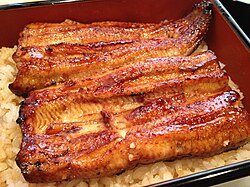
Eel kabayaki on rice
Eel kabayaki shop. Ukiyoe by Katsukawa Shuntei, 1804–1810

Kabayaki (蒲焼) is a preparation of fish, especially unagi eel,[1] where the fish is split down the back[2] (or belly), gutted and boned, butterflied, cut into square fillets, skewered, and dipped in a sweet soy sauce-based marinade before being cooked on a grill or griddle.

Besides unagi, the same preparation is made of other long scaleless fish such as hamo (pike conger),[2] dojō (loach),[1][2] catfish,[1] anago (conger eel),[1] and gimpo (ギンポ) (gunnels).[1] One can also find canned products labeled as kabayaki-style sanma (Pacific saury).

Kabayaki eel is very popular and a rich source of vitamins A and E, and omega-3 fatty acids.[3] A popular custom from the Edo period[4] calls for eating kabayaki during the summer to gain stamina,[4] especially on a mid-summer day called Midsummer Ox Day (doyō-no ushi-no-hi [ja] (土用の丑の日),[3][4]) which falls between July 18 and August 8 each year.[5]

The eel kabayaki is often served on top of a bowl (donburi) of rice, and called unadon, the fancier form of which is the unajū, placed inside a lacquered box called jūbako. It is also torn up and mixed up evenly with rice to make hitsumabushi (ひつまぶし), which is enjoyed especially in the Nagoya area.

Kantō vs. Kansai

[edit]
Unaju, a Japanese dish which contains eel kabayaki on rice
Shirayaki, grilled eel

Broadly, two schools of cooking kabayaki exist. In the Kantō region (eastern Japan), the eel is slit down its back[6] and butterflied, so a lighter-colored stripe of the belly runs down the middle of each fillet on the skin side. The long eel is cut into shorter, squarer fillets and skewered.[7] In Kanto, the skewered eel is first grilled, plain, into what is known as shirayaki [ja] (白焼き or 素焼き),[1][7] then steamed, before being flavored and grilled again; as a result, it turns out more tender and flakier after grilling.[8]

In the Kansai region (western Japan), the eel is slit down the belly[6] and directly grilled without being steamed, often still in their original length, and called nagayaki (長焼き).[7] The outer skin can be tough and chewy, so eel cooked in Kansai style may be placed between layers of hot rice, for the steam to help tenderize it.

In the Kansai area, the eel is often called mamushi,[7][9] just like the name of the common viper in Japan, Gloydius blomhoffii). Some speculate the name is a corruption of mabushi meaning "besprinkle",[7] while others say it is a reference to the eel being rather similar to the viper in shape and vigor-endowing abilities when consumed.[7]

Etymology

[edit]

Several hypothesized origins for the name kabayaki are given. The name came to be generally written using the kanji 蒲焼 meaning cattail-grilled. Resemblance to the brown plush flower spikes of the cattail plant has been suggested as etymological origin in several old writings (Zokugo kō (『俗語考』, "Considerations on colloquial words"); the writings of Mankō Morisada [ja]; Kinsei jibutsu kō (『近世事物考』, "Considerations on near modern age items")[10]). Food historian Tekishū Motoyama (ja:本山荻舟)(1881–1958) has argued that originally the whole eel was skewered vertically and cooked that way, giving rise to the name on the resemblance to the cattail both in form and color.[1][11] This is incidentally the same as one hypothesized etymology for kamaboko.

Another touted theory explains the name as due to resemblance of the charred skin side to the kaba-kawa (樺皮; i.e. "beech-bark")[1] (Yōshū fushi (『雍州府志』, "Record of Yamashiro province"), Honchō Seji Danki (『本朝世事談綺』, "Record of Yamashiro province").[10] Motoyama also notes a proposed etymology from kōbashī (香ばしい; "fragrant (esp. of toasted or roasted items)").[1]

References

[edit]

Further reading

[edit]
Revisions and contributorsEdit on WikipediaRead on Wikipedia
from Grokipedia
Kabayaki is a traditional Japanese cooking method primarily used for preparing freshwater , known as (Anguilla japonica), where the eel is split open along the back or belly, gutted, boned, butterflied, skewered, and grilled multiple times while being basted with a thick, savory-sweet made from , , sugar, and . This preparation results in tender, flavorful fillets with a glossy caramelized exterior, often served over steamed rice as dishes like (eel ) or unaju (eel in a lacquered box). The origins of kabayaki trace back to ancient times, with evidence of unagi consumption dating to the (c. 14,000–300 BCE), though the modern grilling technique emerged and popularized during the (1603–1868). Specifically, the kabayaki style took shape in the era (1688–1704) in (modern ), where it was developed as a contrasting with the Kansai region's belly-split method. Regional variations persist, such as the Kantō style (back-split, grilled, steamed, then grilled again for softer texture) versus the Kansai style (grilled without steaming for a firmer bite). Eel farming, which began in 1891 at , has helped meet demand by rearing wild-caught juveniles to market size, though it remains reliant on declining wild stocks; the (Anguilla japonica) is classified as Endangered by the IUCN as of 2025, with over 99% of global eel products deriving from endangered species and ongoing debates at the conference for stricter trade regulations. In Japanese culture, kabayaki holds significant seasonal and nutritional value, traditionally eaten on Doyo no Ushi no Hi (Ox Day, the midsummer hottest day in late July or early August) to provide stamina against summer heat, a custom attributed to 18th-century scholar . It is enjoyed year-round at specialty unagi-ya restaurants or general eateries, often accompanied by sanshō (Japanese pepper) to cut the richness, and symbolizes prosperity and good fortune, linked to a traditional pun associating "unagi" with "Ox Day" due to their shared starting sound "u". Despite its popularity, unagi remains expensive and is considered a luxury, with key production areas including , Tokyo's , and Chiba's Narita.

Overview and Etymology

Definition and Characteristics

Kabayaki is a traditional Japanese method of preparing fish, primarily unagi (Japanese freshwater eel, Anguilla japonica), in which the fish is split open along the back or belly, gutted, boned, butterflied into fillets, skewered to maintain shape, and grilled over charcoal while being repeatedly basted with a thick, sweet soy-based sauce called tare. The tare typically consists of soy sauce, mirin, sake, and sugar, simmered to create a glossy glaze that enhances flavor through caramelization. This preparation yields a tender, flaky interior contrasted by a rich, umami-packed exterior. Although most commonly associated with unagi, the kabayaki technique is also applied to other elongated, scaleless fish such as hamo (pike conger, Muraenesox cinereus), dojō (Japanese loach, Misgurnus anguillicaudatus), catfish (Siluriformes), anago (saltwater conger eel, Conger myriaster), and gimpo (rock gunnel, Pholidae family); canned products labeled as kabayaki-style sanma (Pacific saury, Cololabis saira) are also available. The grilling process results in a distinctive glossy, caramelized surface from the sauce's adhesion and Maillard reaction, imparting a sweet-savory profile with subtle smokiness. Kabayaki is typically enjoyed as a standalone grilled , often skewered and served hot, or as the key component atop steamed rice in (eel ). Regional differences exist in the exact sequence of splitting, , and the fish before application.

Etymology

The term kabayaki is derived from the Japanese word kaba, which refers to the flower spikes of the cattail plant (), owing to the visual resemblance of the skewered and grilled eel fillets to these brown, plush spikes. This etymological explanation appears in several 18th- and 19th-century Japanese texts, including Zokugo kō (1781) by Ōta Zōan and Kinsei jibutsu kō (1837–1842) by Terakado Seiken, which describe the name as stemming from this shape similarity. An alternative theory posits a connection to kaba-kawa ( or tree bark), based on the charred appearance of the eel's skin after , though this is less commonly referenced. The term emerged during the (1603–1868), when the preparation method of splitting, skewering, and grilling became standardized, distinguishing kabayaki—which involves a soy-based glaze—from simpler styles like shirayaki, or plain grilled without sauce. Primarily associated with (), the name reflects the dish's distinctive presentation in traditional culinary literature.

History

Origins in Edo Period

Kabayaki first emerged in the late 17th to early 18th century (Genroku era, 1688–1704) in (modern-day ) as a specialized preparation of by street vendors who transformed simpler methods into a more refined dish. Prior to this, eel was often chopped perpendicular to the backbone, skewered, and grilled plainly, but vendors began the eel, skewering it from head to tail, and repeatedly glazing it with a sweet to enhance flavor and texture. This innovation catered to the growing demand in a bustling urban center where unagi specialists set up portable stalls to sell affordable portions. The explosive urban growth of , which became Japan's largest city with over a million residents by the mid-18th century, played a pivotal role in kabayaki's development as . As the economic and cultural hub under the , Edo's expanding population of , merchants, and laborers created a thriving market for quick, portable meals. Vendors known as botefuri (flag wavers) roamed streets with their grills, selling kabayaki for around 16 mon—a price reflecting the labor-intensive boning process unique to Edo style. These stalls frequently positioned near theaters and entertainment districts like and , where audiences sought energizing snacks between performances, embedding kabayaki in the city's vibrant and theater . Early documentation of kabayaki recipes appears in Edo-period accounts, such as the Morisada mankō (mid-19th century, describing 18th-century practices), which detail the use of a sweet-salty tare made from soy sauce and mirin to create an irresistible glaze that broadened the dish's appeal to all social classes. The use of mirin in the tare sauce added a subtle sweetness that balanced the savory elements, making kabayaki a standout among the era's "big four" street foods—alongside soba, tempura, and sushi. This tare-focused preparation not only preserved the eel's moisture during grilling but also contributed to its rapid popularity as a nourishing treat in the humid summer months.

Evolution and Popularization

Following its initial development in the , kabayaki expanded significantly in the as transportation networks improved during the late and early Meiji eras, facilitating the distribution of fresh eels from eastern to the around and . This dissemination led to stylistic divergences, with Kansai preparations favoring a belly cut (hara-biraki) for quicker cooking and a savory sauce profile, contrasting the Kantō's back cut (se-biraki) followed by for tenderness and a sweeter glaze. These regional adaptations reflected local preferences and resources, solidifying kabayaki's place in diverse culinary traditions across . Post-Meiji Restoration commercialization further entrenched kabayaki as a premium offering, with establishments like Nodaiwa in —founded in the late ( era)—elevating it through refined techniques and branding as a status symbol for urban diners. By the Taishō (1912–1926) and early (1926–1989) periods, kabayaki's luxury appeal grew amid Japan's modernization, boosted by railway expansion that enabled (station ) featuring grilled for travelers, and the rise of food halls (depachika) where it was sold as a high-end ready-to-eat . This era marked kabayaki's transition from seasonal street fare to a nationwide emblem of affluence, with eel farming innovations in regions like scaling production to meet demand. After , kabayaki experienced a resurgence tied to Japan's , as rising incomes during the high-growth period (1950s–1970s) made it accessible beyond elites, culminating in peak domestic production of approximately 40,000 tons annually by the mid-. This boom reflected broader consumer trends in postwar recovery, with kabayaki symbolizing and in a rebuilding society. However, by the late , early signals of emerged, foreshadowing sustainability challenges as wild eel stocks dwindled due to intensive harvesting and habitat loss, prompting initial regulatory discussions before more formal measures in the .

Preparation

Ingredients and Marinade

Kabayaki relies on fresh , the (Anguilla japonica), as its primary ingredient, with specimens typically measuring 30-50 cm in length to ensure sufficient meat for filleting and grilling. These eels are sourced from wild river or, more commonly in modern production, facilities, particularly in , where glass eels are grown out in ponds and exported to Japan, with some processing occurring in both locations. The signature defines kabayaki's sweet-savory profile and is prepared by combining , , sugar, and , using a mixture of , , sugar, and in varying proportions, then simmering the mixture to reduce it into a thick, glossy glaze that coats the during . This reduction process concentrates the flavors, with the providing subtle sweetness and the delivering , while balances the mixture and helps remove alcohol through boiling. Variations in the tare may incorporate broth for enhanced depth or to adjust sweetness levels, reflecting subtle regional adaptations in flavor intensity. Secondary elements include skewers, which are essential for securing the butterflied fillets into a flat, even shape prior to , ensuring uniform cooking. An initial light salting of the draws out excess moisture, firming the texture and preparing the flesh to absorb the tare without becoming soggy.

Grilling Techniques

The preparation of kabayaki begins with filleting the , typically split open along the belly or back to create a flat fillet, followed by the removal of bones and internal organs to ensure a clean, even structure. The filleted is then skewered using thin or metal sticks inserted perpendicular to the length, which helps maintain its flat shape during and prevents curling. This skewering technique is essential for uniform cooking and presentation. The grilling process follows a sequential method starting with shirayaki, or plain grilling, where the skewered eel is seared over charcoal to remove excess fat and firm the texture without any . This initial sear occurs at medium-high heat until excess fat is removed and the texture firms, creating a crisp exterior while preserving moisture. In some styles, such as Kantō, the eel is steamed after the initial grilling to achieve a softer texture before final saucing and grilling. After the plain grill, the eel is repeatedly basted with tare—a sweet soy-based —and returned to the grill multiple times, allowing the sauce to caramelize and infuse flavor. The charcoal provides consistent, high heat with minimal smoke, contributing to the dish's characteristic aroma and texture. Quality in kabayaki grilling is indicated by even char marks across the surface, a glossy adhesion of the caramelized tare that forms a lacquered finish, and the eel cooked until fully opaque. These markers confirm proper searing and sauce integration without overcooking the delicate flesh.

Regional Variations

Kantō Style

In the , particularly around , kabayaki is prepared using the se-miyaki technique, where the is slit open along its back to remove the bones and entrails while preserving the rich belly fat, which contributes to the dish's tender and flavorful profile. This method contrasts with other regional approaches by prioritizing a softer texture through an additional step. The is then skewered lengthwise from head to tail on long metal spits to ensure even cooking and maintain its shape during the process. The preparation begins with an initial plain grilling over charcoal without seasoning, which firms up the exterior and removes excess moisture, followed by for approximately 10 minutes to soften the flesh and eliminate any muddy odors, resulting in a plump, melt-in-the-mouth consistency. This , a hallmark of Kantō style developed in the , uses residual heat or a dedicated steamer to achieve tenderness without overcooking. The is then subjected to a final double-grilling: first dipped in a sweet soy-based * and grilled briefly, then glazed once more and grilled again to caramelize the surface, yielding a flaky texture with subtle smokiness from the charcoal. Kantō-style kabayaki is prevalent in urban eateries of , where it is often served as or unaju—grilled eel fillets layered over steamed rice in a lidded , a presentation popularized in the district around 200 years ago. This style reflects the region's emphasis on refined, accessible luxury, with establishments like those in continuing to showcase the technique's balance of tenderness and glaze.

Kansai Style

In the Kansai style of kabayaki, particularly associated with regions like and , the is prepared by making a slit along the belly, known as hara-miyaki, which facilitates easier gutting and opening of the . This method contrasts with other approaches by emphasizing direct from the raw state without any preliminary , allowing the eel to be skewered on an iron spit and cooked over while basted repeatedly with the —typically a mixture of , , sugar, and —right from the initial grilling stage. This direct grilling process results in a chewier texture with tougher and a more concentrated, smoky flavor profile, as the prolonged exposure to heat caramelizes the exterior and intensifies the sauce's integration into the meat. The bold incorporation of the tare, applied multiple times during cooking, creates a glossy, robust coating that enhances the eel's natural richness without softening the overall bite. Historically, this style traces its roots to vendors in and during the , where early records indicate that consumption was already prevalent in these areas, with the hara-miyaki technique and sauce-heavy grilling reflecting the region's commercial culinary traditions focused on hearty, flavorful preparations. Kansai-style kabayaki is commonly served as , where the grilled is placed directly over steamed rice, allowing the bold sauce to soak into the grains for a cohesive dish.

Serving and Cultural Role

Traditional Dishes and Serving Methods

Kabayaki eel is most commonly presented in the form of , a donburi-style dish where fillets of grilled are placed atop a bowl of steamed , often drizzled with additional for enhanced flavor. This preparation originated in the late in (then ), when a theater patron named Imasuke Okubo requested that his takeout kabayaki be served over hot rice to maintain its warmth during transit home, making it an accessible and portable meal for urban dwellers. is typically garnished with a sprinkle of sansho pepper, which adds a citrusy, numbing heat that complements the eel's rich, sweet glaze. A related presentation is unaju, where the grilled eel and rice are served in a lacquered box (jubako), offering a more elegant and formal dining experience compared to the casual bowl. In , kabayaki features prominently in hitsumabushi, a specialized dish where finely chopped is scattered over rice in a wooden vessel, allowing diners to enjoy it in three distinct styles. The first portion is savored plain to appreciate the pure flavors of the grilled and ; the second incorporates condiments such as wasabi, chopped , seaweed, and additional sansho for layered textures and tastes; the final portion is transformed into ochazuke by pouring hot or broth over the mixture, creating a soothing, soup-like finish. This methodical progression highlights regional ingenuity in extending the eel's indulgence across multiple experiences within a single serving. Beyond rice-based presentations, kabayaki can be served standalone as a main protein, accompanied by simple sides such as slices, Japanese pickles, or to balance its intensity, or integrated into multi-course meals as a grilled highlight. Standard portions range from 150 to 200 grams of per serving, providing a substantial yet refined amount suitable for these formats.

Seasonal and Symbolic Importance

Kabayaki, the grilled freshwater preparation, holds significant seasonal importance in Japanese culture, particularly through its association with Doyo no Ushi no Hi, the Day of the Ox, which occurs between mid-July and early August depending on the . This day marks one of the hottest periods of summer, and consuming kabayaki is believed to bolster stamina and vitality, helping individuals endure the intense heat and humidity. The tradition draws from ancient Chinese yin-yang and the five elements , which posits that aligning food intake with seasonal energies maintains bodily balance during extreme weather. Eel is symbolically viewed as a potent source of strength and endurance in , often linked to its serpentine form evoking resilience akin to mythical creatures, thereby reinforcing its role as a restorative . The custom's widespread adoption traces back to the 18th-century scholar , who cleverly advised an eel vendor to market on Ushi no Hi—exploiting the phonetic similarity between "ushi" () and "u" in unagi—to stimulate sluggish summer sales; this strategy transformed a practical ploy into an enduring cultural practice. Regional festivals and events further emphasize kabayaki's communal significance, such as the annual Urawa Unagi Festival in , where vendors and attendees gather to celebrate eel dishes, promoting shared meals that strengthen social bonds during the summer season. In areas like , renowned for its hitsumabushi variation of kabayaki, local fairs and promotions around Doyo no Ushi no Hi highlight the dish's role in fostering community resilience against seasonal challenges.

Modern Aspects

Nutritional Profile

Kabayaki, derived from the nutrient-rich freshwater eel (Anguilla japonica), offers a balanced profile of macronutrients and micronutrients that contribute to its status as a healthful dish when consumed in moderation. A typical 100-gram serving provides approximately 236 calories, with 23.7 grams of high-quality protein supporting muscle maintenance and repair, alongside 15 grams of fat, including beneficial polyunsaturated fatty acids. The eel's composition is particularly notable for its high levels of , exceeding 100% of the daily value, which plays a crucial role in maintaining vision and immune function, and at about 34% of the daily value, functioning as a potent to protect cells from . Additionally, kabayaki is a source of omega-3 fatty acids, with around 838 milligrams per 100 grams, primarily in the form of EPA and DHA, which are linked to improved heart health by reducing and supporting cardiovascular function. The grilling process enhances flavor while preserving much of the eel's natural nutrient density, though the traditional —made from , , and sugar—introduces added sodium (often 300-600 milligrams per serving) and sugars (up to 20 grams per fillet), which balance the eel's inherent fats but require portion control for those monitoring sodium or intake. In Kantō-style preparation, the preliminary steaming step retains more moisture compared to the direct in Kansai style, potentially aiding in better overall nutrient preservation by minimizing excessive drying. While kabayaki's benefits are substantial, potential risks include trace mercury contamination, particularly in wild-caught , where levels average around 0.085 parts per million—classified as low by health authorities. Farmed eels generally exhibit 2- to 12-fold lower mercury concentrations than wild counterparts, mitigating this concern for most commercial sources. Consumers with sensitivities to should opt for verified farmed or low-mercury certified products to maximize safety.

Sustainability and Global Adaptations

The Japanese eel (Anguilla japonica), the primary species used in kabayaki, has faced severe population declines due to overfishing, habitat degradation, and barriers to migration, leading to its classification as Endangered on the IUCN Red List in 2014 (assessed 2018; status unchanged as of 2025). This status reflects a drastic reduction in wild stocks, with global consumption dominated by threatened species like the Japanese eel, which accounts for about 18% of international trade volume. In response, Japan and China have increasingly turned to aquaculture to meet demand, though production still relies heavily on wild-caught juveniles (glass eels) for stocking farms, as closed-cycle systems remain limited. China operates over 1,000 eel farms, including large-scale recirculating aquaculture systems (RAS) facilities producing hundreds of tons annually, while Japan has advanced research into full-cycle cultivation, such as at Kindai University, to reduce wild dependency. Despite these efforts, no eel farms hold Marine Stewardship Council (MSC) or Aquaculture Stewardship Council (ASC) certification, prompting calls from organizations like the World Wildlife Fund to avoid non-sustainable sources until verifiable standards are met. Recent developments include 2025 DNA analyses revealing approximately 40% of retail kabayaki products in Japan as non-Japanese eel species (e.g., American or European eels), highlighting mislabeling issues, and a CITES proposal in October 2025 to list all Anguilla species under Appendix II for enhanced trade regulation. Emerging lab-grown eel production, such as trials by ForSea Foods, offers potential to further alleviate pressure on wild stocks. Kabayaki's global popularity has grown through Japanese restaurants in the United States and , where unagi dishes are menu staples in cities like New York, , , and , often sourced from imported farmed eels. This international spread has spurred adaptations, including vegan versions that mimic the dish's texture and glaze using or , featured in Western cookbooks and online recipes as sustainable alternatives to . For instance, grilled slices basted in a soy-mirin glaze replicate the caramelized exterior of traditional kabayaki, while tofu-based preparations offer a protein-rich substitute, appealing to environmentally conscious consumers amid eel scarcity concerns. These plant-based innovations highlight kabayaki's versatility in fusion cuisines, reducing pressure on wild populations without altering the core sweet-savory flavor profile. Japan's reliance on imports underscores the economic stakes, with annual eel supply (and consumption) of approximately 57,000–60,000 tons as of 2023 to support kabayaki and related dishes, exceeding domestic production of about 18,000 tons. In 2023, imports totaled 38,750 tons (primarily from at about 90%), contributing to price volatility driven by supply shortages and regulations. Wholesale prices for have averaged around ¥5,000 per in the 2020s (e.g., ¥4,998 in 2022, ¥5,553 in 2023), contributing to retail kabayaki dishes costing ¥3,000–6,000 ($20–40 USD) per serving and reflecting the luxury status amid ongoing stock management challenges.

References

Add your contribution
Related Hubs
User Avatar
No comments yet.