


Community hub
Recent from talks
Contribute something
Nothing was collected or created yet.
Kabocha
View on Wikipedia

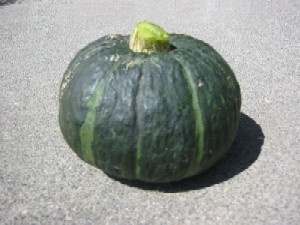
Kabocha (/kəˈboʊtʃə/; from Japanese カボチャ, 南瓜) is a type of winter squash, a Japanese variety of the species Cucurbita maxima. It is also called kabocha squash or Japanese pumpkin[1] in North America. In Japan, kabocha may refer to either this squash, to the Western pumpkin, or indeed to other squashes.[2] In Australia, "Japanese pumpkin" is a synonym of Kent pumpkin, a variety of winter squash (C. moschata).[3]
Many of the kabocha in the market are kuri kabocha, a type created from seiyo kabocha (buttercup squash). Varieties of kabocha include Ajihei, Ajihei No. 107, Ajihei No. 331, Ajihei No. 335, Ebisu, Emiguri, Marron d'Or and Miyako.[4]
Description
[edit]Kabocha is hard on the outside with knobbly-looking skin that is often dark green, red-orange, or gray. It is shaped like a squat pumpkin and has an intense yellow-orange color on the inside. In many respects it is similar to buttercup squash, but without the characteristic protruding "cup" on the bottom.[5] An average kabocha weighs two to three pounds, but a large squash can weigh as much as eight pounds.[6]
Culinary use
[edit]Kabocha has an exceptionally sweet flavor, even sweeter than butternut squash. It is similar in texture and flavor to a pumpkin and sweet potato combined.[7] Some kabocha can taste like russet potatoes or chestnuts.[citation needed] The rind is edible, although some cooks may peel it to speed up the cooking process or to suit their personal taste preferences. Kabocha is commonly used in side dishes and soups, or as a substitute for potato or other squash varieties. It can be roasted after cutting the squash in half, scooping out the seeds, and then cutting the squash into wedges. With a little cooking oil and seasoning, it can be baked in the oven. Likewise, cut kabocha halves can be added to a pressure cooker and steamed under high pressure for 15–20 minutes. One can slowly bake kabocha whole and uncut in a convection oven, after which the entire squash becomes soft and edible, including the rind.
Kabocha is available all year but is best in late summer and early fall. Kabocha is primarily grown in Japan, South Korea, Thailand, California, Florida, Hawaii, Southwestern Colorado, Mexico, Tasmania, Tonga, New Zealand, Chile, Jamaica, and South Africa, but is widely adapted for climates that provide a growing season of 100 days or more. Most of the kabocha grown in California, Colorado, Tonga and New Zealand is actually exported to Japan.[citation needed]
Japan
[edit]In Japan, kabocha is a common ingredient in vegetable tempura and is also made into soup and croquettes.[8] Less traditional but popular uses include incorporation in desserts such as pies, pudding, and ice cream.[8][9]
-
 Nimono of kabocha, part of Japanese cuisine
 -
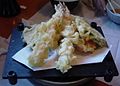 Shown on the right, kabocha is a common ingredient in tempura


Korea
[edit]In Korea, danhobak (단호박) is commonly used for making hobak-juk (pumpkin porridge). Danhobak literally means 'sweet pumpkin'.[10]
-
 Danhobak-buchimgae (kabocha pancake)
 -

-
 Danhobak-juk (kabocha porridge)
 -
 Danhobak-salad (kabocha salad)
 -
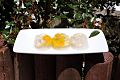
-
 Danhobak-latte (kabocha latte)


.jpg)


Thailand
[edit]Fak thong (Thai: ฟักทอง) is used in traditional Thai desserts and main courses. Kabocha is used in Jamaican chicken foot soup.[citation needed]
Nutrition
[edit]This squash is rich in beta carotene, with iron,[11] vitamin C, potassium, and smaller traces of calcium, folic acid, and minute amounts of B vitamins.[12]
Ripeness
[edit]When kabocha is just harvested, it is still growing. Therefore, unlike other vegetables and fruits, freshness is not as important. It should be fully matured first, in order to become flavorful, by first ripening the kabocha in a warm place (77 °F/25 °C) for 13 days to convert some of the starch to sugar. Then the kabocha is transferred to a cool place (50 °F/10 °C) and stored for about a month in order to increase carbohydrate content. In this way the just-harvested, dry, bland-tasting kabocha is transformed into a smooth, sweet kabocha. Fully ripened, succulent kabocha will have reddish-yellow flesh, a hard skin, and a dry, corky stem. It reaches the peak of ripeness about 1.5–3 months after it is harvested.[13]
History
[edit]All squashes were domesticated in Mesoamerica. In 1997, new evidence suggested that domestication occurred 8,000 to 10,000 years ago, a few thousand years earlier than previous estimates.[14] That would be 4,000 years earlier than the domestication of maize and beans, the other major food plant groups in Mesoamerica.[15] Archeological and genetic plant research in the 21st century suggests that the peoples of eastern North America independently domesticated squash, sunflower, marsh elder, and chenopod.[16]
Portuguese sailors introduced kabocha to Japan in 1541, bringing it with them from Cambodia. The Portuguese name for the squash, Camboja abóbora (カンボジャ・アボボラ), was shortened by the Japanese to kabocha. Alternatively, the Portuguese origin is the word cabaça for gourd. Kabocha is written in Kanji as 南瓜 (literally, "southern melon"), and it is also occasionally referred to as 南京瓜 (Nanking melon).[citation needed] In China, this term is applied to many types of squashes with harder skin and beefier flesh (including pumpkins), not just kabochas.
Gallery
[edit]-
 Seedling
 -
 First leaf
 -
 Branching habit
 -
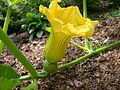 Flower
 -
 Flower and flower bud
 -
 Young fruit
 -
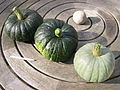 Whole squashes
 -
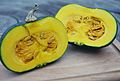 Section, showing seeds
 -
 Flower scar
 -
 Peduncle
 -
 Dish of roasted kabocha
_21June2005_sown_14June.JPG)


_sown_14June.JPG)


See also
[edit]References
[edit]- ^ "What is Kabocha Squash (Japanese Pumpkin)?". Cooking Light Magazine. Archived from the original on 23 September 2017. Retrieved 22 September 2017.
- ^ "Vegetable diagram (Kabocha)". Agriculture & Livestock Industries Corporation. Archived from the original on 18 April 2016. Retrieved 22 September 2017.
- ^ "Japanese pumpkin is a collective term used only for varieties of C. moschata originally grown in Japan. In Australia the most popular cultivar is known as Ken’s Special which was selected in North Queensland. It is marketed as Japanese pumpkin in most Australian retail fruit and vegetable outlets." https://www.researchgate.net/profile/David-Midmore/publication/303686355_Kabocha_and_Japanese_pumpkin_in_Australia/links/5b912f2f45851540d1d55c61/Kabocha-and-Japanese-pumpkin-in-Australia.pdf
- ^ Cumarasamy, R.; Corrigan, V.; Hurst, P.; Bendall, M. (21 June 2002). "Cultivar differences in New Zealand "Kabocha" (buttercup squash, Cucurbita maxima)". New Zealand Journal of Crop and Horticultural Science. 30 (3): 197–208. Bibcode:2002NZJCH..30..197C. doi:10.1080/01140671.2002.9514215.
- ^ "Kabocha and Buttercup Squash for Western Oregon Gardens". Extension Communications. 2019-11-06. Retrieved 2025-10-02.
- ^ "Food Dictionary at Epicurious.com: kabocha squash". Archived from the original on 2014-10-25. Retrieved 2008-02-27.
- ^ "Vegetable Notes for Vegetable Farmers in Massachusetts" (PDF). UMASS Extension. 18 (4): 2. 31 May 2007. Archived (PDF) from the original on 31 March 2020.
- ^ a b "Kabocha (Japanese Pumpkin): A Flavor of the Earth" (PDF). Gochiso (English): 36–37. 2006.
- ^ "Just One Cookbook: Kabocha Pie かぼちゃパイ". 21 November 2016. Retrieved 2020-11-26.
- ^ National Institute of Korean Language. "단호박". Korean-English Learner's Dictionary. Retrieved 2025-04-01.
- ^ "Why You Should be Eating Kabocha Squash, Pumpkin's Sweeter Cousin".
- ^ Kabocha, By Setsuko Yoshizuka, About.com, Wayback Machine
- ^ "Kabocha (Japanese Pumpkin) A Flavor of the Earth" Gochiso Web Magazine, 2006, p. 8
- ^ Roush, Wade (1997). "Squash Seeds Yield New View of Early American Farming". Science. 276 (5314): 894–895. doi:10.1126/science.276.5314.894. S2CID 158673509.
- ^ Smith, Bruce D. (1997). "The Initial Domestication of Cucurbita pepoin the Americas 10,000 Years Ago". Science. 276 (5314): 932–934. doi:10.1126/science.276.5314.932.
- ^ Smith, B. D. (2006). "Eastern North America as an independent center of plant domestication". Proceedings of the National Academy of Sciences. 103 (33): 12223–12228. Bibcode:2006PNAS..10312223S. doi:10.1073/pnas.0604335103. PMC 1567861. PMID 16894156.
| Species |  | ||||||
|---|---|---|---|---|---|---|---|
| Cultivars |
| ||||||
| Related topics |
| ||||||

Kabocha
View on GrokipediaBotany and Varieties
Taxonomy
Kabocha is botanically classified as a cultivar of Cucurbita maxima Duchesne ex Lam., a species within the genus Cucurbita and the family Cucurbitaceae.[1][2] The Cucurbitaceae family encompasses a diverse group of plants, including other squashes, pumpkins, gourds, and cucumbers, many of which share similar vining growth habits and fruit structures.[6][1] While kabocha is primarily associated with C. maxima, some modern varieties are hybrids involving Cucurbita moschata Duch. ex Poir., which contributes traits like disease resistance in crosses such as Tetsukabuto.[7] This distinction highlights C. maxima's role as the foundational species for traditional kabocha, separate from C. moschata's use in butternut-types and certain hybrid developments.[8] As a domesticated winter squash, C. maxima originated in South America, where it was selectively bred by indigenous peoples over millennia before global dissemination.[2][9] The term "kabocha" entered Japanese lexicon in the 16th century via Portuguese traders, deriving from "camboja abóbora," a phrase combining "Camboja" (Portuguese for Cambodia) with "abóbora" (pumpkin or squash).[10][11] These traders introduced the squash to Japan around 1541, likely routing through Cambodian ports, leading to the name's adaptation despite the plant's American origins.[11][3]Description
Kabocha squash exhibits a distinctive round and squat shape, often resembling a flattened globe or small pumpkin, with a typical diameter of 8 to 10 inches and weight ranging from 3 to 4 pounds.[12][1] This compact form makes it comparable in size to butternut squash, though shorter and broader, while sharing edibility with acorn squash due to its fully consumable flesh and rind when mature.[13] As a member of the species Cucurbita maxima, it develops a hard, smooth rind that is characteristically dark green, sometimes featuring mottled stripes or grayish-blue hues.[13] The rind of mature kabocha is thick and dense, providing durability for storage, with a dull finish that may include subtle ribbing or speckles.[1] Beneath this exterior lies bright orange flesh that is dense and creamy in texture, offering a firm yet tender consistency when prepared.[13] This flesh contributes to the squash's inherent sensory qualities, delivering a sweet and nutty flavor profile often likened to a hybrid of sweet potato and chestnut.[13][1]Varieties
Kabocha squash encompasses a range of cultivars primarily derived from Cucurbita maxima, with many modern varieties resulting from interspecific hybrids developed in Japan during the 1940s by crossing C. maxima with C. moschata to enhance disease resistance, flavor, yield, early maturity, and heat tolerance.[13] These hybrids form the basis for both traditional Japanese selections and later adaptations in other regions. Common varieties include the Delica, a Japanese F1 hybrid bred by Takii Seed Company in 1964, featuring a dark green rind, thick yellow flesh with a sweet and nutty flavor, and fruits weighing 3–4 pounds that mature in about 85 days.[14][15][16] The Sunshine, an American F1 hybrid and All-America Selections winner from 2004, draws influences from buttercup squash types, displaying a vibrant red-orange rind, bright orange sweet flesh ideal for baking and pies, and fruits of 3–5 pounds on semi-bush plants.[17][13][18] The Black Forest cultivar offers a compact option suited for home gardens, producing 4–5 squat, round fruits per medium-vining plant, each with a deep green to gray rind, dense golden-orange flesh that is sweet, dry, and flaky in texture, and weighing 3–4 pounds.[19][20][21] Regional adaptations highlight differences, such as sweeter, nuttier Japanese strains like Delica, which emphasize dense, starchy flesh akin to sweet potatoes, compared to American hybrids like Sweet Mama.[13][15] The Sweet Mama, an early-maturing F1 hybrid and All-America Selections winner from 1979, features a gray-green drum-shaped rind, bright yellow nutty and dry flesh, short vines for space efficiency, and 4-pound fruits with excellent storage.[22][13][23]| Variety | Rind Color | Flesh Characteristics | Average Size | Key Traits and Origin |
|---|---|---|---|---|
| Delica | Dark green | Thick, yellow, sweet, nutty | 3–4 lbs | Japanese F1 hybrid (Takii, 1964); early maturity, high yield[14][15] |
| Sunshine | Red-orange | Bright orange, sweet, smooth | 3–5 lbs | American F1 hybrid (AAS 2004); buttercup influences, semi-bush[17][13] |
| Black Forest | Deep green/gray | Golden-orange, sweet, dry, flaky | 3–4 lbs | Compact plants, 4–5 fruits/plant; suited for home gardens[19][20] |
| Sweet Mama | Gray-green | Bright yellow, nutty, dry | 4 lbs | American F1 hybrid (AAS 1979); short vine, long storage[22][13] |