


Community hub
Recent from talks
Contribute something
Nothing was collected or created yet.
Grain size
View on Wikipedia | This article includes a list of general references, but it lacks sufficient corresponding inline citations. (July 2011) |
| Granulometry | |
|---|---|
 | |
| Basic concepts | |
| Particle size, Grain size, Size distribution, Morphology | |
| Methods and techniques | |
| Mesh scale, Optical granulometry, Sieve analysis, Soil gradation | |
Related concepts | |
| Granulation, Granular material, Mineral dust, Pattern recognition, Dynamic light scattering | |


Grain size (or particle size) is the diameter of individual grains of sediment, or the lithified particles in clastic rocks. The term may also be applied to other granular materials. This is different from the crystallite size, which refers to the size of a single crystal inside a particle or grain. A single grain can be composed of several crystals. Granular material can range from very small colloidal particles, through clay, silt, sand, gravel, and cobbles, to boulders.
Krumbein phi scale
[edit]Size ranges define limits of classes that are given names in the Wentworth scale (or Udden–Wentworth scale named after geologists Chester K. Wentworth and Johan A. Udden) used in the United States. The Krumbein phi (φ) scale, a modification of the Wentworth scale created by W. C. Krumbein[1] in 1934, is a logarithmic scale computed by the equation
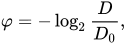
where
- is the Krumbein phi scale,
- is the diameter of the particle or grain in millimeters (Krumbein and Monk's equation)[2] and
- is a reference diameter, equal to 1 mm (to make the equation dimensionally consistent).


This equation can be rearranged to find diameter using φ:
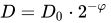
| φ scale | Size range (metric) |
Size range (approx. inches) |
Aggregate name (Wentworth class) |
Other names |
|---|---|---|---|---|
| <−8 | >256 mm | >10.1 in | Boulder | |
| −6 to −8 | 64–256 mm | 2.5–10.1 in | Cobble | |
| −5 to −6 | 32–64 mm | 1.26–2.5 in | Very coarse gravel | Pebble |
| −4 to −5 | 16–32 mm | 0.63–1.26 in | Coarse gravel | Pebble |
| −3 to −4 | 8–16 mm | 0.31–0.63 in | Medium gravel | Pebble |
| −2 to −3 | 4–8 mm | 0.157–0.31 in | Fine gravel | Pebble |
| −1 to −2 | 2–4 mm | 0.079–0.157 in | Very fine gravel | Granule |
| 0 to −1 | 1–2 mm | 0.039–0.079 in | Very coarse sand | |
| 1 to 0 | 0.5–1 mm | 0.020–0.039 in | Coarse sand | |
| 2 to 1 | 0.25–0.5 mm | 0.010–0.020 in | Medium sand | |
| 3 to 2 | 125–250 μm | 0.0049–0.010 in | Fine sand | |
| 4 to 3 | 62.5–125 μm | 0.0025–0.0049 in | Very fine sand | |
| 8 to 4 | 3.9–62.5 μm | 0.00015–0.0025 in | Silt | Mud |
| 10 to 8 | 0.98–3.9 μm | 3.8×10⁻⁵–0.00015 in | Clay | Mud |
| 20 to 10 | 0.95–977 nm | 3.8×10⁻⁸–3.8×10⁻⁵ in | Colloid | Mud |
In some schemes, gravel is anything larger than sand (comprising granule, pebble, cobble, and boulder in the table above).
International scale
[edit]ISO 14688-1:2017 establishes the basic principles for identifying and classifying soils based on those material and mass characteristics most commonly used for soils for engineering purposes. ISO 14688-1 applies to natural soils in situ, similar man-made materials in situ and soils redeposited by people.[3]
| Name | Size range (mm) | Size range (approx. in) | |||
|---|---|---|---|---|---|
| Very coarse soil | Large boulder | lBo | >630 | >24.8031 | |
| Boulder | Bo | 200–630 | 7.8740–24.803 | ||
| Cobble | Co | 63–200 | 2.4803–7.8740 | ||
| Coarse soil | Gravel | Coarse gravel | cGr | 20–63 | 0.78740–2.4803 |
| Medium gravel | mGr | 6.3–20 | 0.24803–0.78740 | ||
| Fine gravel | fGr | 2.0–6.3 | 0.078740–0.24803 | ||
| Sand | Coarse sand | cSa | 0.63–2.0 | 0.024803–0.078740 | |
| Medium sand | mSa | 0.2–0.63 | 0.0078740–0.024803 | ||
| Fine sand | fSa | 0.063–0.2 | 0.0024803–0.0078740 | ||
| Fine soil | Silt | Coarse silt | cSi | 0.02–0.063 | 0.00078740–0.0024803 |
| Medium silt | mSi | 0.0063–0.02 | 0.00024803–0.00078740 | ||
| Fine silt | fSi | 0.002–0.0063 | 0.000078740–0.00024803 | ||
| Clay | Cl | ≤0.002 | ≤0.000078740 | ||
Sorting
[edit]An accumulation of sediment can also be characterized by the grain size distribution. A sediment deposit can undergo sorting when a particle size range is removed by an agency such as a river or the wind. The sorting can be quantified using the Inclusive Graphic Standard Deviation:[4]

where
- is the Inclusive Graphic Standard Deviation in phi units
- is the 84th percentile of the grain size distribution in phi units, etc.


The result of this can be described using the following terms:[5]
| Diameter (phi units) | Description |
|---|---|
| < 0.35 | very well sorted |
| 0.35 < < 0.50 | well sorted |
| 0.50 < < 1.00 | moderately sorted |
| 1.00 < < 2.00 | poorly sorted |
| 2.00 < < 4.00 | very poorly sorted |
| 4.00 < | extremely poorly sorted |
See also
[edit]References
[edit]- ^ Krumbein, W. C. (1934). "Size frequency distributions of sediments". Journal of Sedimentary Petrology. 2 (4). doi:10.1306/D4268EB9-2B26-11D7-8648000102C1865D.
- ^ PetroWiki: Estimating permeability based on grain size
- ^ "ISO 14688-1:2017 – Geotechnical investigation and testing – Identification and classification of soil – Part 1: Identification and description". International Organization for Standardization (ISO).
- ^ Folk, Robert L.; Ward, William C. (1957). "Brazos River bar: a study in the significance of grain-size parameters" (PDF). Journal of Sedimentary Petrology. 27 (1): 3–26. Bibcode:1957JSedR..27....3F. doi:10.1306/74d70646-2b21-11d7-8648000102c1865d. Archived from the original (PDF) on 12 May 2014. Retrieved 11 May 2014.
- ^ Folk, Robert L. (1980). Petrology of sedimentary rocks. Austin, Tex: Hemphill Pub. Co. ISBN 978-0-914696-14-8.
External links
[edit]- R D Dean & R A Dalrymple, Coastal Processes with Engineering Applications (Cambridge University Press, 2002)
- W C Krumbein & L L Sloss, Stratigraphy and Sedimentation, 2nd edition (Freeman, San Francisco, 1963).
- Udden, J. A. (1914). "Mechanical composition of clastic sediments". Geological Society of America Bulletin. 25 (1): 655–744. Bibcode:1914GSAB...25..655U. doi:10.1130/GSAB-25-655.
- Wentworth, C. K. (1922). "A Scale of Grade and Class Terms for Clastic Sediments". The Journal of Geology. 30 (5): 377–392. Bibcode:1922JG.....30..377W. doi:10.1086/622910. JSTOR 30063207. S2CID 128682870.


Grain size
View on GrokipediaFundamentals
Definition
Grain size refers to the average diameter of individual particles, or clasts, in unconsolidated sediments or lithified clastic rocks. This parameter characterizes the texture of sedimentary materials derived from the mechanical breakdown and transport of pre-existing rocks or minerals.[6][7][1] It is distinct from crystallite size, which denotes the dimensions of individual crystalline domains within a single grain, often relevant in materials science or petrology of polycrystalline structures. In sedimentary geology, grain size focuses on the overall particle dimensions rather than internal crystalline substructures.[8][9] The term applies to a range of granular materials in sedimentary environments, including clay, silt, sand, gravel, cobbles, and boulders, which form through physical weathering and deposition. It does not extend to crystalline rocks, such as igneous or metamorphic types, where grain size conventionally describes the size of constituent crystals formed during solidification or recrystallization.[1][10][11] For macroscopic grains, measurements are typically expressed in millimeters (mm).[7]Importance
Grain size analysis plays a central role in sedimentology by providing insights into the transport distance of sediments, the energy levels of depositional environments, and the characteristics of source materials. Coarser grains typically indicate short transport distances and high-energy settings, such as riverbeds or beaches, while finer grains suggest longer transport and lower-energy environments like deep ocean basins.[12] This fundamental property influences sediment entrainment, transport, and deposition processes, allowing geologists to reconstruct the dynamics of ancient sedimentary systems.[13] In hydrology and engineering, grain size significantly impacts soil and aquifer properties, including permeability, porosity, and erosion potential. Larger grain sizes enhance permeability by creating wider pore spaces, facilitating fluid flow in aquifers and influencing groundwater movement.[14] Porosity remains relatively independent of individual grain size but is affected by grain size distribution, while finer grains increase erosion susceptibility under hydraulic stress, affecting dam stability and embankment design.[15] These factors are critical for managing water resources and preventing geotechnical failures. Environmentally, grain size classification aids in analyzing beach sands, riverbeds, and wind-blown deposits to reconstruct paleoenvironments. Variations in grain size distributions reveal past changes in sediment transport energy and depositional processes, such as shifts from fluvial to aeolian conditions in loess deposits.[16] This approach helps interpret climate histories and landscape evolution over geological timescales. Economically, grain size influences oil reservoir quality by determining porosity and permeability; coarser sands typically yield higher hydrocarbon recovery rates due to better fluid connectivity.[17] In construction, aggregate grain size selection for concrete affects cohesion and strength, with finer grains enhancing mixture cohesion but potentially reducing permeability in specialized applications like permeable pavements.[18] Grain size also relates to sorting, which together assesses overall sediment maturity in depositional sequences.[12]Measurement Methods
Field Techniques
Field techniques for assessing grain size in natural sediment settings emphasize non-destructive, on-site methods suitable for immediate evaluation without sample extraction. These approaches are particularly valuable in reconnaissance surveys of rivers, beaches, and exposed deposits, where rapid assessment informs broader geological or environmental studies.[19] Visual estimation relies on comparison to standardized charts or direct observation with hand lenses to categorize grains roughly, such as distinguishing sand (0.0625–2 mm) from gravel (>2 mm). Geologists use portable grain size charts, often based on the Wentworth scale, to match sediment appearance against visual references for quick classification during fieldwork. Hand lenses (typically 10x magnification) aid in inspecting finer fractions like sand on site, though precision is limited to broad categories. This method, described in early field geology manuals, allows for subjective but efficient categorization in diverse terrains.[19] For coarser sediments like pebbles and gravel, the Wolman pebble count method involves systematically selecting and measuring the intermediate (b-) axis of 100 or more particles along transects using calipers or a gravelometer template. The gravelometer, a portable tool with apertures corresponding to size classes (e.g., from 2 mm to 256 mm), enables direct classification by passing or fitting particles through slots, commonly applied in riverbeds and beaches. This technique, introduced in 1954, provides a representative size distribution for coarse fractions without full sieving.[20] In situ sieving uses portable sieve sets to process loose surface sediments directly in the field, particularly for sand and coarse sand fractions on beaches or riverbars. Operators collect small volumes of unconsolidated material (e.g., via scoops or syringes) and pass it through stacked sieves of decreasing mesh sizes (e.g., 0.063 mm to 4 mm), weighing retained fractions on portable balances to derive distributions. This approach suits accessible, dry-to-moist environments and is often combined with pebble counts for mixed beds.[20][21] Photographic analysis captures images of exposed sediment surfaces using rulers or grids for scale, followed by digital processing to measure grain dimensions. Field photos of gravel or sand patches are analyzed with software like ImageJ, where grains are outlined or segmented to compute sizes via pixel calibration, offering a non-contact alternative for larger areas. Recent advancements as of 2025 include machine learning-based object detection for automated grain sizing from images, unmanned aerial vehicle (UAV) photogrammetry for mapping gravel-bed rivers, and hand-held devices like Instagrain, which provide instant (~2 seconds) grain size measurements using on-device AI. These methods, refined in studies of streambeds and coastal sediments, automate sizing for hundreds of particles but require clear visibility and post-processing.[22][23][24][25][26] These techniques face limitations in accuracy due to environmental factors, such as wet or compacted sediments obscuring grain boundaries, and challenges with heterogeneous mixtures where fine fractions (<0.063 mm) evade detection. Visual and photographic methods are prone to operator bias and reduced precision in turbid or vegetated settings, making them best for preliminary surveys rather than definitive analysis; validation often complements laboratory methods for finer resolutions.[27][28]Laboratory Techniques
Laboratory techniques for grain size analysis provide high-precision quantification of particle size distributions in sediment samples, typically involving controlled separation and measurement processes under standardized conditions. These methods are essential for obtaining detailed histograms or cumulative curves that describe the proportions of different size fractions, often achieving resolutions down to micrometers.[29] Sample preparation is a critical initial step to ensure accurate representation of individual grains without alteration. This includes disaggregation using mechanical or chemical means to break apart aggregates, oven-drying at low temperatures (e.g., 60–105°C) to remove moisture while preserving grain integrity, and organic removal via hydrogen peroxide treatment or sieving to eliminate biogenic material that could bias size measurements.[30][31] Dry sieving is widely used for coarser fractions, such as sands ranging from 0.063 to 2 mm. It involves stacking a series of mesh screens with progressively smaller apertures (e.g., ASTM or ISO standard sizes) atop a receiver pan, placing the dried sample on the top sieve, and mechanically shaking the stack for a set duration (typically 10–15 minutes) using a sieve shaker. Retained material on each sieve is then weighed to determine the weight percentage of each size fraction, yielding a discrete distribution.[32] For finer, cohesive materials like silts that may form aggregates, wet sieving employs water or dispersants to suspend particles during separation. The prepared sample is soaked and gently agitated in water, then passed through a stack of sieves (often a single 63 μm mesh to isolate sands from fines), with continuous rinsing to ensure complete disaggregation. The coarse fraction is dried and weighed, while the suspended fines proceed to further analysis; this method minimizes clogging and improves accuracy for particles below 63 μm.[33][34] Sedimentation analysis targets particles smaller than 0.063 mm, relying on gravitational settling in a liquid medium. The pipette method withdraws subsamples at specific depths and times from a settling column containing dispersed fines, with particle concentration measured gravimetrically to infer sizes via settling velocities. The hydrometer method similarly monitors density changes over time using a hydrometer immersed in the suspension. Both approaches are based on Stokes' law, which relates settling velocity to particle diameter, fluid viscosity, and density differences, enabling calculation of size distributions for silts and clays.[35][36][37] Modern instrumental techniques extend analysis across broader ranges with greater efficiency. Laser diffraction measures the full spectrum from 0.001 to 2000 μm by dispersing particles in a fluid and analyzing the angular distribution of scattered laser light, which correlates to size via Mie or Fraunhofer theory approximations; this non-destructive method provides rapid, continuous distributions suitable for both coarse and fine fractions. For very fine grains (e.g., clays <2 μm), scanning electron microscopy (SEM) offers direct imaging of individual particles, where high-resolution scans allow manual or automated measurement of dimensions, often combined with energy-dispersive X-ray spectroscopy for compositional context. As of 2025, X-ray microtomography (micro-CT) enables non-destructive, high-resolution (micrometer-scale) 3D mapping of grain sizes in sediment cores, facilitating upscale predictions without sample alteration.[29][38][39][40]Classification Scales
Wentworth Scale
The Wentworth scale is a linear classification system for describing the grain sizes of clastic sediments, developed as a refinement of earlier work by J.A. Udden. Udden introduced the foundational geometric progression for sediment grading in his 1898 publication, The Mechanical Composition of Wind Deposits, which emphasized measurable particle diameters to categorize wind-blown materials.[41] In 1922, Chester K. Wentworth expanded and standardized this approach in his seminal paper, A Scale of Grade and Class Terms for Clastic Sediments, tailoring it specifically for geological applications in describing unconsolidated deposits. Wentworth's version adopted a consistent geometric ratio (primarily powers of 2) to define boundaries in millimeters, ensuring precise and reproducible categorization across sediment types.[42] The scale delineates sediment classes based on the longest axis or nominal diameter of particles, providing descriptive terms that directly correspond to metric measurements. Key categories include:| Category | Subcategory | Size Range (mm) |
|---|---|---|
| Clay | - | < 0.004 |
| Silt | - | 0.004–0.0625 |
| Sand | Very coarse | 1–2 |
| Coarse | 0.5–1 | |
| Medium | 0.25–0.5 | |
| Fine | 0.125–0.25 | |
| Very fine | 0.0625–0.125 | |
| Gravel | Granules | 2–4 |
| Pebbles | 4–64 | |
| Cobbles | 64–256 | |
| Boulders | - | > 256 |
Krumbein Phi Scale
The Krumbein phi scale, introduced by W. C. Krumbein in 1934, transforms grain diameters into a logarithmic scale to normalize the typically skewed distributions of sediment sizes, facilitating their statistical analysis in sedimentology. This approach addresses the limitations of linear measurements by converting them into dimensionless units that approximate normal distributions for arithmetic operations. The scale is defined by the formulawhere is the grain diameter in millimeters and the reference diameter mm corresponds to . The inverse calculation yields the diameter as
This logarithmic base-2 transformation ensures that each unit increase in represents a halving of the grain size, providing a uniform progression across orders of magnitude. For instance, a 2 mm grain corresponds to , while a 0.5 mm grain is . A key benefit of the phi scale is its compatibility with standard statistical techniques; sediment size data in phi units can be treated as normally distributed, allowing straightforward computation of parameters like the arithmetic mean grain size and standard deviation to quantify central tendency and sorting. This enables quantitative comparisons of sediment populations, such as assessing transport history or depositional environments, without the distortions inherent in linear scales. The phi scale categorizes grains from coarse boulders to fine colloids, with negative values for larger particles and positive values for smaller ones. It builds on earlier descriptive categories by assigning precise phi intervals. The table below outlines the primary size classes, their phi ranges, corresponding diameters, and names, extending from boulders (less than -8 ) to colloids (greater than 10 ):
| Range | Diameter (mm) | Class Name |
|---|---|---|
| < -8 | > 256 | Boulder |
| -8 to -6 | 64 to 256 | Cobble |
| -6 to -4 | 16 to 64 | Pebble |
| -4 to -2 | 4 to 16 | Coarse gravel |
| -2 to -1 | 2 to 4 | Granule |
| -1 to 0 | 1 to 2 | Very coarse sand |
| 0 to 1 | 0.5 to 1 | Coarse sand |
| 1 to 2 | 0.25 to 0.5 | Medium sand |
| 2 to 3 | 0.125 to 0.25 | Fine sand |
| 3 to 4 | 0.0625 to 0.125 | Very fine sand |
| 4 to 8 | 0.0039 to 0.0625 | Silt |
| 8 to 10 | 0.00098 to 0.0039 | Clay |
| > 10 | < 0.00098 | Colloid |
International Scale
The International Scale refers to the standardized classification system for soil particle sizes outlined in ISO 14688-1:2017, which provides rules for the identification and description of soils in geotechnical investigations.[45] This standard establishes a flexible framework applicable to natural soils, man-made materials in situ, and redeposited soils, prioritizing characteristics relevant to engineering behavior such as particle size distribution, composition, and structure.[46] It is designed for use by experienced practitioners in field and laboratory settings to ensure consistent terminology across international projects. Soils are broadly divided into very fine soil, fine soil, and coarse soil based on particle diameters, with further subdivisions for precision in engineering assessments. The categories and their size ranges are as follows:| Category | Subcategory | Size Range (mm) |
|---|---|---|
| Very fine soil | Clay | ≤ 0.002 |
| Silt | > 0.002 to ≤ 0.063 | |
| Fine soil | Sand | > 0.063 to ≤ 2 |
| Coarse soil | Gravel | > 2 to ≤ 63 |
| Cobbles | > 63 to ≤ 200 | |
| Boulders | > 200 |
Sediment Characteristics
Sorting
Sorting refers to the degree of variation in grain sizes within a sediment sample, which provides insights into the processes that deposited the sediment. Well-sorted sediments exhibit a narrow range of grain sizes, typically resulting from prolonged transport and selective deposition by agents like wind or waves that separate particles based on size and density. In contrast, poorly sorted sediments contain a wide range of grain sizes, often from rapid deposition with minimal sorting.[11] Sorting is measured using cumulative frequency curves derived from sieve analysis data, where grain sizes are plotted in phi (φ) units on a probability scale. The key statistic is the inclusive graphic standard deviation (σᵢ), which quantifies the spread of the distribution by emphasizing the tails. The formula is: where φ₈₄, φ₁₆, φ₉₅, and φ₅ are the grain sizes at the 84th, 16th, 95th, and 5th percentiles, respectively, from the phi-scale distribution. This measure depends on the phi scale for logarithmic transformation of grain diameters.[49] Sediments are categorized by σᵢ values as follows:| Category | σᵢ (φ units) |
|---|---|
| Very well sorted | < 0.35 |
| Well sorted | 0.35–0.50 |
| Moderately sorted | 0.50–0.71 |
| Poorly sorted | 0.71–1.00 |
| Very poorly sorted | 1.00–2.00 |
| Extremely poorly sorted | > 2.00 |