Hubbry Logo
Insect mouthpartsInsect mouthpartsMain
Open search
Insect mouthparts
Community hub
Insect mouthparts
logo
8 pages, 0 posts
0 subscribers
Be the first to start a discussion here.
Insect mouthparts
Insect mouthparts
from Wikipedia
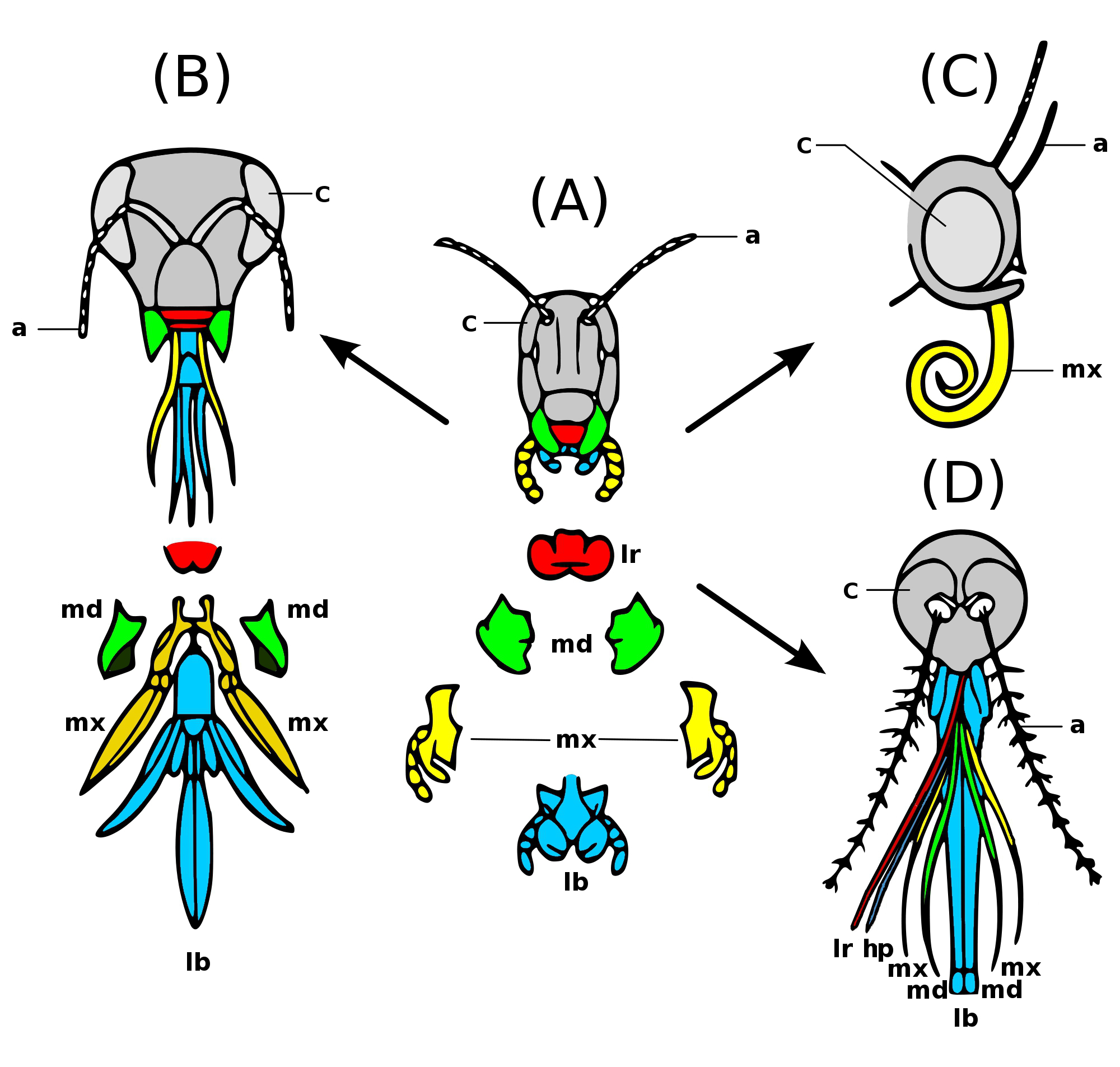
The development of insect mouthparts from the primitive chewing mouthparts of a grasshopper in the centre (A), to the lapping type (B) of a bee, the siphoning type (C) of a butterfly and the sucking type (D) of a female mosquito. Legend: a, antennae; c, compound eye; lb, labium; lr, labrum; md, mandibles; mx, maxillae; hp hypopharynx.

Insects have mouthparts that may vary greatly across insect species, as they are adapted to particular modes of feeding. The earliest insects had chewing mouthparts. Most specialisation of mouthparts are for piercing and sucking, and this mode of feeding has evolved a number of times independently. For example, mosquitoes (which are true flies) and aphids (which are true bugs) both pierce and suck, though female mosquitoes feed on animal blood whereas aphids feed on plant fluids.

Evolution

[edit]

Insect mouthparts show a multitude of different functional mechanisms across the wide diversity of insect species. It is common for significant homology to be conserved, with matching structures forming from matching primordia, and having the same evolutionary origin. However, even if structures are almost physically and functionally identical, they may not be homologous; their analogous functions and appearance might be the product of convergent evolution.[citation needed]

Chewing insects

[edit]
The trophi, or mouthparts of a locust, a typical chewing insect:
1 Labrum
2 Mandibles;
3 Maxillae
4 Labium
5 Hypopharynx

Examples of chewing insects include dragonflies, grasshoppers and beetles. Some insects do not have chewing mouthparts as adults but chew solid food in their larval phase. The moths and butterflies are major examples of such adaptations.

Mandible

[edit]
The mandibles of a bull ant
European honeybee (Apis mellifera) lapping mouthparts, showing labium and maxillae

Mandibles in insects are pairs of hardened structures that are used to grind, crush and chew food.[1] Mandibles have a broad molar region with ridged structures lined across to assist during chewing before it is swallowed.[2] When paired with the maxillae (upper jaw structures), it is referred to as one of the gnathal appendages.[3]

In carnivorous chewing insects, the mandibles commonly are particularly serrated and knife-like, and often with piercing points. In herbivorous chewing insects mandibles tend to be broader and flatter on their opposing faces, as for example in caterpillars.

In males of some species, such as of Lucanidae and some Cerambycidae, the mandibles are modified to such an extent that they do not serve any feeding function, but are instead used to defend mating sites from other males. In some ants and termites, the mandibles also serve a defensive function (particularly in soldier castes). In bull ants, the mandibles are elongate and toothed, used both as hunting and defensive appendages. In bees, that feed primarily by the use of a proboscis, the primary use of the mandibles is to manipulate and shape wax, and many paper wasps have mandibles adapted to scraping and ingesting wood fibres.

Maxilla

[edit]

Situated beneath (caudal to) the mandibles, paired maxillae manipulate and, in chewing insects, partly masticate, food. Each maxilla consists of two parts, the proximal cardo (plural cardines), and distal stipes (plural stipites). At the apex of each stipes are two lobes, the inner lacinia and outer galea (plurals laciniae and galeae). At the outer margin, the typical galea is a cupped or scoop-like structure, located over the outer edge of the labium. In non-chewing insects, such as adult Lepidoptera, the maxillae may be drastically adapted to other functions.

Unlike the mandibles, but like the labium, the maxillae bear lateral palps on their stipites. These palps serve as organs of touch and taste in feeding and in the inspection of potential foods and/or prey.

In chewing insects, adductor and abductor muscles extend from inside the cranium to within the bases of the stipites and cardines much as happens with the mandibles in feeding, and also in using the maxillae as tools. To some extent the maxillae are more mobile than the mandibles, and the galeae, laciniae, and palps also can move up and down somewhat, in the sagittal plane, both in feeding and in working, for example in nest building by mud-dauber wasps.

Maxillae in most insects function partly like mandibles in feeding, but they are more mobile and less heavily sclerotised than mandibles, so they are more important in manipulating soft, liquid, or particulate food rather than cutting or crushing food such as material that requires the mandibles to cut or crush.

Like the mandibles, maxillae are innervated by the subesophageal ganglia.

Labium

[edit]

The labium typically is a roughly quadrilateral structure, formed by paired, fused secondary maxillae.[4] It is the major component of the floor of the mouth. Typically, together with the maxillae, the labium assists manipulation of food during mastication.

Dragonfly nymph feeding on fish that it has caught with its labium and snatched back to the other mouthparts for eating. The labium is just visible from the side, between the front pairs of legs.

The role of the labium in some insects, however, is adapted to special functions; perhaps the most dramatic example is in the jaws of the nymphs of the Odonata, the dragonflies and damselflies. In these insects, the labium folds neatly beneath the head and thorax, but the insect can flick it out to snatch prey and bear it back to the head, where the chewing mouthparts can demolish it and swallow the particles.[citation needed]

The labium is attached at the rear end of the structure called cibarium, and its broad basal portion is divided into regions called the submentum, which is the proximal part, the mentum in the middle, and the prementum, which is the distal section, and furthest anterior.

The prementum bears a structure called the ligula; this consists of an inner pair of lobes called glossae and a lateral pair called paraglossae. These structures are homologous to the lacinia and galea of maxillae. The labial palps borne on the sides of labium are the counterparts of maxillary palps. Like the maxillary palps, the labial palps aid sensory function in eating. In many species the musculature of the labium is much more complex than that of the other jaws, because in most, the ligula, palps and prementum all can be moved independently.

The labium is innervated by the sub-esophageal ganglia.[5][6][7]

In the honey bee, the labium is elongated to form a tube and tongue, and these insects are classified as having both chewing and lapping mouthparts. [8]

The wild silk moth (Bombyx mandarina) is an example of an insect that has small labial palpi and no maxillary palpi.[9]

Hypopharynx

[edit]

The hypopharynx is a somewhat globular structure, located medially to the mandibles and the maxillae. In many species it is membranous and associated with salivary glands. It assists in swallowing the food. The hypopharynx divides the oral cavity into two parts: the cibarium or dorsal food pouch and ventral salivarium into which the salivary duct opens.

Siphoning insects

[edit]
Butterflies coil the proboscis when not feeding.

This section deals only with insects that feed by sucking fluids, as a rule without piercing their food first, and without sponging or licking. Typical examples are adult moths and butterflies. As is usually the case with insects, there are variations: some moths, such as species of Serrodes and Achaea do pierce fruit to the extent that they are regarded as serious orchard pests.[10] Some moths do not feed after emerging from the pupa, and have greatly reduced, vestigial mouthparts or none at all. All but a few adult Lepidoptera lack mandibles (the superfamily known as the mandibulate moths have fully developed mandibles as adults), but also have the remaining mouthparts in the form of an elongated sucking tube, the proboscis.

Proboscis

[edit]

The proboscis, as seen in adult Lepidoptera, is one of the defining characteristics of the morphology of the order; it is a long tube formed by the paired galeae of the maxillae. Unlike sucking organs in other orders of insects, the Lepidopteran proboscis can coil up so completely that it can fit under the head when not in use. During feeding, however, it extends to reach the nectar of flowers or other fluids. In certain specialist pollinators, the proboscis may be several times the body length of the moth.

Piercing and sucking insects

[edit]

A number of insect orders (or more precisely families within them) have mouthparts that pierce food items to enable sucking of internal fluids. Some are herbivorous, like aphids and leafhoppers, while others are carnivorous, like assassin bugs and female mosquitoes. Thrips, insects of the order Thysanoptera, have unique mouthparts in that they only develop the left mandible, making the mouthparts asymmetrical. Some consider thrips to have piercing-sucking mouthparts, but others describe them as rasping-sucking.[11]

Stylets

[edit]
Mouthparts of a female mosquito feeding on blood. The flexible labium supports the bundle of stylets which penetrates the host's skin.

In female mosquitoes, all mouthparts are elongated. The labium encloses all other mouthparts, the stylets, like a sheath. The labrum forms the main feeding tube, through which blood is sucked. The sharp tips of the labrum and maxillae pierce the host's skin. During piercing, the labium remains outside the food item's skin, folding away from the stylets.[12] Saliva containing anticoagulants, is injected into the food item and blood sucked out, each through different tubes.

Proboscis

[edit]

The defining feature of the order Hemiptera is the possession of mouthparts where the mandibles and maxillae are modified into a proboscis, sheathed within a modified labium, which is capable of piercing tissues and sucking out the liquids. For example, true bugs, such as shield bugs, feed on the fluids of plants. Predatory bugs such as assassin bugs have the same mouthparts, but they are used to pierce the cuticles of captured prey.

Sponging insects

[edit]
Proboscis of the fly (Gonia capitata): note also the protruding labial palps.

Labellum

[edit]

The housefly is a typical sponging insect. The labellum's surface is covered by minute food channels, known as pseudotrachea, formed by the interlocking elongate hypopharynx and epipharynx, forming a proboscis used to channel liquid food to the oesophagus. The food channel draws liquid and liquified food to the oesophagus by capillary action. The housefly is able to eat solid food by secreting saliva and dabbing it over the food item. As the saliva dissolves the food, the solution is then drawn up into the mouth as a liquid.[13]

References

[edit]
[edit]
Revisions and contributorsEdit on WikipediaRead on Wikipedia
from Grokipedia
Insect mouthparts are highly specialized appendages located on the anterior region of an insect's head, derived from ancestral leg-like structures in worm-like forebears, and primarily adapted for acquiring and processing to support diverse feeding strategies across the class Insecta. These structures exhibit remarkable morphological diversity, reflecting evolutionary adaptations to solid, liquid, or semi-liquid diets, and are essential for , , and ecological roles such as or predation. Key components include the labrum (an unpaired anterior lip that covers the mouth), paired mandibles (jaw-like structures for biting or grinding), paired maxillae (manipulative appendages often bearing palps for sensory and handling functions), the unpaired hypopharynx (a tongue-like structure aiding in food manipulation and salivation), and the labium (posterior lip with palps that forms the floor of the mouth). The basic architecture of insect mouthparts is conserved but undergoes extensive modification depending on the species' diet and lifestyle, allowing into two broad functional categories: mandibulate () types for solid foods and haustellate (sucking) types for liquids. In mandibulate forms, prominent mandibles move laterally or vertically to bite and grind plant material, prey, or other solids, as seen in grasshoppers () where side-to-side motion facilitates herbivory. Haustellate mouthparts, in contrast, feature elongated, tubular structures like the for imbibing fluids, with subtypes including piercing-sucking (e.g., mosquitoes using stylets to penetrate skin for blood, to access plant sap), siphoning (e.g., uncoiling a galeal from fused maxillae to draw nectar), and sponging (e.g., house flies with labellar pads that secrete to liquefy food before uptake). Beyond these primary types, hybrid forms such as occur in honey bees, where mandibles chew while a hairy laps , and rasping-sucking in rasps epidermal cells to access plant juices. This variability often differs between larval and adult stages within the same —for instance, many holometabolous larvae possess chewing mouthparts, while adults may shift to haustellate forms. The diversity of mouthparts underscores in insects, influencing everything from pest management (e.g., piercing-sucking types vectoring plant pathogens) to beneficial interactions (e.g., siphoning types in ), and serves as a key taxonomic trait for identifying orders and families.

General Anatomy

Appendages

The insect mouthparts in their generalized form consist of several paired and unpaired appendages derived from specific head segments, which together facilitate food acquisition and manipulation. These structures evolved from segmental appendages in the ancestor, with the labrum representing a non-appendicular element and the others arising from the gnathal (jaw-bearing) segments. The labrum is a non-segmental, median flap arising from the prostomial region of the protocephalon, functioning as the upper lip to cover the mouth and aid in forming the preoral cavity for food manipulation. Its inner surface, known as the epipharynx, is a membranous extension that continues into the and often bears sensory structures. The paired mandibles originate from the second head segment (first gnathal segment) and are heavily sclerotized, toothed jaws adapted primarily for and grinding food through lateral movements. Each mandible articulates with the head capsule via anterior and posterior condyles, featuring an process for cutting and a molar area for crushing, powered by adductor and abductor muscles. The paired maxillae derive from the third head segment (second gnathal segment) and consist of a basal cardo articulating with the head, a sub-basal stipes, an inner lacinia lobe for grasping and tearing food, an outer galea lobe for manipulation, and a multi-segmented palp for sensory evaluation. These structures assist the in handling food, with the lacinia and galea acting as accessory jaws. The labium, a fused unpaired from the fourth head segment (third gnathal segment), serves as the lower lip to enclose the food mass and consists of a proximal mentum, a distal prementum bearing a central ligula (fused glossae and paraglossae for manipulation), and paired segmented palps for sensory input. It supports the mouth posteriorly and channels food toward the . These mouthpart appendages exhibit homologies with structures, reflecting their shared ancestry; for instance, mandibles are directly homologous to crustacean mandibles as single-piece gnathal organs, while the maxillae and labium correspond to the first and second maxillae in crustaceans, respectively, adapted for similar -handling roles. Basic sensory capabilities are provided by setae (mechanosensory hairs) and chemoreceptors concentrated on the maxillary and labial palps, which detect chemical cues in and the environment to guide feeding .

Associated Structures

The hypopharynx is an unpaired, tongue-like projection arising from the floor of the in , forming a ventral lobe that suspends within the preoral cavity and aids in channeling food toward the while facilitating the secretion of . This structure originates embryonically from the sternal regions of the mandibular and maxillary segments or the prostomial region associated with the intercalary segment and stomodeum, often supported by a suspensorial apparatus of chitinous rods or plates for muscle attachment. In generalized mouthparts, the hypopharynx bears hairs directed toward the to guide food particles and mixes ingested material with salivary s, contributing to initial lubrication and preventing during feeding. The salivary glands, typically paired exocrine structures located in the adjacent to the , connect to the hypopharynx via ducts that unite into a common channel opening into the salivarium, a ventral pocket behind the hypopharynx. These glands produce containing such as amylases and proteases, which the ducts deliver through the hypopharynx to initiate and lubricate food boluses in the preoral cavity. This connection ensures precise enzyme deposition at the site of , enhancing mechanical breakdown across diverse feeding strategies in the basic mouthpart apparatus. The , as the initial narrow, muscular section of the , forms the dorsal wall of the and receives from the preoral cavity, where dilator muscles attached to the cranium or tentorium facilitate suction. The cibarium, representing the dorsal portion of the preoral cavity, serves as a food pouch bounded by the mouthparts and hypopharynx, modified in many to accommodate intake through rhythmic contractions that propel material into the . Together, these components enable the initial stages of by combining mechanical filtration with salivary lubrication, promoting efficient nutrient extraction in generalized forms. In primitive mandibulate insects, such as grasshoppers, the hypopharynx remains a simple, fleshy lobe aiding chewing mechanics, whereas in derived fluid-feeding forms like mosquitoes, it evolves into a hollow, elongated structure enclosing salivary channels for targeted delivery. These variations underscore the hypopharynx's role in adapting internal support to external interactions, such as with the maxillae to form temporary channels. Such persistent elements trace back to ancestors, maintaining core functions in feeding despite diversification.

Development and Ontogeny

Embryonic Development

The embryonic development of insect mouthparts begins with the segmentation of the head, which is orchestrated by that confer regional identity to the anterior segments. In , the head comprises six to seven segments, including preoral (ocular, antennal, intercalary) and gnathal (mandibular, maxillary, labial) regions, where such as labial, proboscipedia (pb), Deformed (Dfd), and Sex combs reduced (Scr) are expressed in a collinear manner along the anteroposterior axis. Specifically, Dfd specifies maxillary segment identity, promoting the formation of maxillary appendages, while Scr and pb act cooperatively to define labial identity, ensuring proper development of labial palps and associated structures. These genes are activated early in embryogenesis through interactions with gap and pair-rule genes, establishing the foundational pattern for mouthpart precursors. Appendage primordia for the mouthparts—mandibles from the mandibular segment, maxillae from the maxillary segment, and labium from the labial segment—arise as thickenings or limb buds from the ventral of the respective head segments. These primordia form through a combination of of the and subsequent evagination, where cells proliferate and migrate to shape the anlagen around the developing mouth opening. The labrum, an unpaired preoral structure often considered derived from the anterior acron or fused segmental elements, develops independently as a median outgrowth anterior to the antennal segment, contributing to the roof of the oral cavity without direct Hox control in the gnathal manner. Meanwhile, the hypopharynx emerges from an of the stomodeal , forming a median lobe that integrates with the mouthparts to create the food channel and salivary apparatus. In model organisms like , these processes are visualized through antibody staining for segment polarity genes like Engrailed, revealing the dynamic fusion of head lobes via a "bend and zipper" mechanism that positions the mouthparts ventrally. Developmental differences exist between hemimetabolous and holometabolous insects, particularly in how appendage primordia are specified for postembryonic elaboration. In hemimetabolous insects, such as the milkweed bug Oncopeltus fasciatus, mouthpart appendages develop directly from embryonic limb buds that grow continuously from embryo to adult, retaining segmental continuity without a pupal stage. In contrast, holometabolous insects like Drosophila and the red flour beetle Tribolium castaneum set aside precursors of imaginal discs during embryogenesis; these internalized clusters of cells in the gnathal segments represent the primordia for adult mouthparts, which undergo extensive remodeling later in larval and pupal stages. Key studies in Drosophila embryology, including Hox mutant analyses, have elucidated these mechanisms, showing that disruptions in Dfd or Scr lead to homeotic transformations, such as maxillary structures adopting mandibular fates, underscoring the conserved role of Hox genes across insects.

Metamorphosis and Variation

In holometabolous insects, which undergo complete metamorphosis, larval mouthparts are typically adapted for chewing solid foods, differing markedly from the specialized adult structures that often facilitate liquid feeding. For instance, in , caterpillars possess robust biting-chewing mandibles suited for consuming foliage, whereas adult butterflies develop a coiled for siphoning . This divergence allows larvae to exploit different ecological niches than adults, optimizing resource use across life stages. The transformation of mouthparts in holometabolous species occurs via imaginal discs—clusters of undifferentiated cells present in larvae that proliferate during post-embryonic growth. During pupation, these discs, including those destined for maxillary and labial appendages, evert and differentiate into mouthparts under hormonal cues, while larval structures undergo histolysis, or programmed breakdown, followed by sclerotization of the emerging components. In Diptera, this remodeling is particularly pronounced: larvae feature mouth hooks or simplified mandibles for rasping , which are histolyzed, giving way to the 's sponging labellum for lapping liquids. In contrast, hemimetabolous insects exhibit incomplete with gradual post-embryonic changes, where nymphal mouthparts closely resemble those of adults and undergo minimal remodeling across . For example, in orthopterans like grasshoppers, both nymphs and adults retain chewing mouthparts adapted for herbivory, with progressive sclerotization but no histolysis of major components. Hormonal regulation orchestrates these transitions, primarily through , which initiates molting and metamorphic processes like disc eversion and histolysis, and , which maintains larval characteristics and prevents premature adult differentiation when present at high levels. The balance between these hormones ensures timed remodeling, with declining juvenile hormone titers during the final larval permitting full adult mouthpart formation. Intraspecific variation in mouthparts also arises during development, particularly in social such as , where caste-specific differences emerge due to nutritional and hormonal influences on larval growth. Worker castes often develop smaller, versatile mandibles for and brood care, while castes exhibit enlarged, robust mandibles specialized for defense, reflecting polyphenic responses to needs.

Evolutionary Aspects

Phylogenetic Origins

The phylogenetic origins of insect mouthparts trace back to the ancestral condition, where feeding appendages were part of a biramous limb groundplan shared with crustacean-like ancestors. In this primitive state, post-antennal appendages consisted of a protopodite bearing endites and a telopodite with exopodite and endopodite rami; mandibles, as the first pair of gnathal appendages, evolved from modifications of these biramous structures, specifically with the gnathal edge ( and molar processes) derived from a single coxal endite on the protopodite, while palps and outer rami were reduced or lost. This gnathobasic derivation represents a synapomorphy of mandibulate (, crustaceans, and myriapods), distinguishing them from chelicerates, and reflects serial homology with subsequent maxillary and thoracic limbs. Cambrian fossils provide key evidence for this transition, with fuxianhuiids—early euarthropods from approximately 520 million years ago—exhibiting a mandibulate head organization, including paired mandibles and associated gnathal edges suggestive of functionality, positioned posterior to a limbless intercalary segment. These structures indicate that mandibulate-like mouthparts arose deep within the euarthropod stem, predating the divergence of major mandibulate lineages, and share affinities with total-group , highlighting a basal position for such feeding apparatuses in evolution. Regarding the labrum, an anterior non-appendicular flap in that aids in food containment, its homology remains debated but is supported as deriving from an ancestral pair of frontal appendages, potentially akin to the antennules of crustaceans or the great appendages of radiodontans, rather than , with conservation across euarthropods as a unifying feature. The earliest direct evidence of insect-specific mouthparts appears in Early Devonian fossils, such as Rhyniognatha hirsti from around 407 million years ago, which preserves dicondylic, triangular mandibles with tooth-like projections characteristic of basal ectognathous insects, indicating a mandibulate configuration already present in winged hexapods near the origin of the . In the hexapod lineage, evolutionary modifications included the loss of certain ancestral appendages, notably the absence of tritocerebral (second antennal) structures, which are retained in crustaceans but suppressed in and myriapods, simplifying the head to a single pair of antennae and emphasizing the mandibular-maxillary complex for feeding. Molecular data reinforce these segmental origins, with the engrailed (en) gene expressed at boundaries of the six head segments (including those bearing mouthparts) in a conserved pattern across arthropods, marking parasegmental divisions and facilitating the differentiation of gnathal appendages from preoral and postoral regions.

Adaptive Radiations

The diversification of insect mouthparts represents a classic example of , where ecological opportunities drove the evolution of specialized feeding structures from a primitive chewing groundplan across major geological epochs. During the Permian-Triassic transition (approximately 299–201 million years ago, MYA), chewing mouthparts became dominant among surviving polyneopteran lineages, such as early orthopterans and plecopterans, enabling exploitation of terrestrial vegetation in recovering ecosystems following the end-Permian mass extinction. Concurrently, piercing-sucking mouthparts appeared in paleodictyopteroids, exemplified by the Robust Beak class, which allowed fluid feeding on exudates and contributed to the addition of seven new mouthpart classes in the Permian, representing 48.6% of total known diversity. Sucking mouthparts evolved independently multiple times, with parallel origins documented in at least six major geological epochs, facilitating shifts to liquid diets like and in groups such as and Diptera. This convergent innovation, including segmented beaks in hemipterans and haustellate types in early flies, added further mouthpart classes during the (seven new, reaching 67.6% total diversity) and supported dietary expansions amid post-extinction recovery. Ontogenetic flexibility in mouthpart development likely accelerated these transitions by allowing rapid modifications within lineages. In the (201–145 MYA), sponging mouthparts emerged as a key innovation within cyclorrhaphan flies, characterized by labellate structures for lapping liquids, coinciding with the diversification of terrestrial habitats and the Lacustrine Revolution. This period saw seven additional mouthpart classes, elevating total diversity to 83.3%, driven by adaptations to new sources from and hemipterans. evidence from compression deposits highlights these shifts, with early dipteran mouthparts showing transitional forms between and sponging. The (145–66 MYA) marked a pinnacle of mouthpart , particularly with siphoning types in , where elongated evolved in tandem with the rise of angiosperm flowers around 100 MYA, enabling efficient extraction and mutualisms. This era added three new classes (97.1% total), including hexastylate siphons in flies and siphonomandibulate forms linked to floral resources, reflecting broader diet shifts toward angiosperm-derived liquids. fossils from Burmese and Lebanese deposits (circa 100–130 MYA) preserve exceptional details of these transitions, such as proboscis elongation in lepidopterans and relict Permian types, underscoring bursts of innovation tied to ecological pressures like the angiosperm .

Specialized Mouthpart Types

Biting-Chewing Mouthparts

Biting-chewing mouthparts, also known as mandibulate mouthparts, represent the primitive and unmodified configuration of feeding appendages, primarily adapted for the mastication of solid foods such as material and prey. These structures retain the basic segmental appendages of the head, with robust, toothed mandibles serving as the primary cutting and grinding elements, while the maxillae and labium function to hold and manipulate food items during processing. The labrum acts as a protective cover over the mandibles, and the hypopharynx, a tongue-like projection, secretes to moisten and initiate of the chewed material. This configuration provides mechanical leverage through powerful adductor muscles attached to the cranium, enabling efficient force transmission for biting and crushing. The primary functions of biting-chewing mouthparts include grinding tough plant tissues and capturing prey, as seen in various insect orders. In herbivorous species, these mouthparts allow for the breakdown of fibrous vegetation, while in predatory forms, they facilitate the dismemberment of animal tissues. For instance, in grasshoppers (order ), the mandibles are asymmetrical, with the left overlapping the right to form a scissor-like mechanism optimized for grinding grasses and leaves. Similarly, beetles (order Coleoptera) employ these mouthparts for diverse feeding; ground beetles use sharp, forward-directed mandibles to impale prey, whereas wood-boring species like those in the family Cerambycidae retain a chewing-based structure adapted for excavating and consuming wood fibers, despite specializations in mandibular shape. As the ancestral mouthpart type, biting-chewing structures persist across a broad spectrum of insect diversity, occurring in more than half a million described species belonging to orders such as Coleoptera, , and . This prevalence underscores their evolutionary persistence from early hexapod lineages, where they provided versatile adaptation to solid-food diets before specialized modifications arose in derived groups. The mechanical efficiency of these mouthparts, derived from the leverage ratio of adductor muscle insertion points relative to mandibular fulcrums (often ranging from 0.37 to 0.47 in model species like ), enhances their suitability for high-force applications in feeding.

Piercing-Sucking Mouthparts

Piercing-sucking mouthparts represent a highly specialized in certain orders, particularly and Diptera, where the mouthparts are elongated into a or designed for penetrating host tissues and extracting fluids such as plant sap or blood. These structures evolved from primitive mandibular and maxillary appendages, with the labium extending to form a protective sheath that encloses paired stylets derived from the modified mandibles and maxillae. The interlocking stylets enable precise insertion into vascular tissues, minimizing damage while facilitating fluid uptake. The mandibular stylets primarily function in piercing, featuring serrated edges for cutting through tough epidermal layers and navigating to target sites like or blood vessels. In contrast, the maxillary stylets interlock to create dual canals: a canal for imbibing liquids and a salivary canal for injecting enzymes that liquefy or anticoagulate the ingested material, aiding and preventing clotting. This division of labor allows efficient penetration and sustained feeding, with the labial sheath providing without directly participating in tissue entry. Representative examples illustrate adaptations to specific diets. In (Hemiptera: ), the short targets sieve tubes, where stylets probe intercellular spaces before puncturing cells to access nutrient-rich with minimal injury. Mosquitoes (Diptera: Culicidae) employ a containing six stylets, including robust mandibular ones for penetration and maxillary ones forming canals to draw blood, enabling females to obtain protein for egg production. Cicadas (Hemiptera: ) possess a long rostrum suited for feeding, where the stylets reach deep into tissues to extract water and dilute minerals under low-pressure conditions. Suction is powered by muscular pumps in the head, notably the cibarial pump formed by dilator and compressor muscles around the pharynx, which generates negative pressure to draw fluids through the food canal. This mechanism is particularly developed in piercing-sucking insects to overcome varying fluid viscosities and pressures, such as the high turgor in phloem versus the tension in xylem. Piercing-sucking mouthparts have evolved convergently across insect lineages, with distinct configurations in hemipteran suborders: in , the rostrum originates anteriorly on the head for versatile predation or phytophagy, while in , it arises ventrally for specialized plant sap extraction.

Siphoning Mouthparts

Siphoning mouthparts, characteristic of most adult , consist of a coiled adapted for imbibing and other liquids from flowers. The is formed by the elongation and fusion of the maxillary galeae, which interlock via specialized linkages to create a sealed tubular structure enclosing a central food canal. In this configuration, the labium is reduced to a small structure supporting labial palps for sensory functions, while mandibles are vestigial or entirely absent, reflecting specialization for fluid feeding rather than solid mastication. The coiling mechanism of the proboscis enables compact storage beneath the head when not in use, achieved through elastic properties of the cuticular components and intrinsic musculature. Resilin, an elastomeric protein in the dorsal wall of the galeae, facilitates rapid recoiling upon relaxation of hydrostatic pressure, while galeal and stipital muscles control extension and fine movements during feeding. Internally, the food canal is lined with smooth cuticle to minimize friction during liquid uptake, and the proboscis tip features sensory sensilla, such as styloconica and chaetica, for detecting nectar quality and flower orientation. The labrum and hypopharynx are minimal or atrophied, contributing little to the feeding process beyond basic structural support. Examples of this mouthpart type are prevalent in and moths, where length varies with floral adaptations; for instance, many have proboscides around 1-2 cm suited to shallow flowers, while hawk moths like Xanthopan praedicta possess exceptionally long ones up to 28 cm to access deep spurs. This variation enhances efficiency by matching corolla depths in specific plants. Evolutionarily, the siphoning arose in the , coinciding with the radiation of angiosperm flowers, enabling to exploit as a primary adult food source. During , the larval biting-chewing mouthparts are remodeled, with galeae elongating from maxillary bases to form the functional tube.

Sponging Mouthparts

Sponging mouthparts are a specialized type of haustellate feeding apparatus primarily found in calyptrate flies within the order Diptera, characterized by the distal expansion of the labium into a pair of fleshy, pad-like labellae that facilitate the absorption of liquid nutrients. The labellae are equipped with intricate networks of pseudotracheae, which are sclerotized grooves or C-shaped channels on their ventral surface, enabling to draw fluids into the oral cavity. These pseudotracheae also serve a role, preventing particulate matter from entering the food canal while allowing liquids to pass through to the cibarial pump, a muscular structure in the head that aids in . Within the labellae, vestigial stylets—reduced remnants of the mandibles and maxillae—are enclosed but non-functional for deep penetration, contributing minimally to the overall structure. The primary function of sponging mouthparts is to soak up exposed liquids such as nectar, plant juices, or blood, with the labellae pressed directly against the food source to maximize contact area. In species like the housefly (Musca domestica), these mouthparts enable feeding on solid substances by regurgitating saliva containing digestive enzymes onto the material, dissolving it into a liquefied form that can then be absorbed via the pseudotracheae. Pumping action is provided by contractions of the cibarial muscles, which create suction to draw the filtered liquid through the food canal formed between the labrum and hypopharynx. Some calyptrate flies possess prestomal teeth—small, cuticular projections at the base of the labellae—that allow for minor rasping of surfaces to release additional fluids, as seen in blowflies (Calliphoridae) that sponge up blood meals from wounds. This mouthpart type represents an evolutionary derivation within the suborder, where ancestral piercing-sucking structures were modified into a more versatile sponging form to exploit diverse liquid resources, including those from decaying matter and vertebrate tissues. In blowflies, for instance, the labellae efficiently absorb liquefied proteins from carrion or blood, supporting their role as decomposers and occasional hematophages. The labium, as the foundational appendage, undergoes ontogenetic expansion from larval forms during to form this adult configuration.

Miscellaneous Types

Insect mouthparts exhibit a range of less common specializations beyond the primary , piercing-sucking, siphoning, and sponging types, including rasping-sucking configurations, adaptations for prey capture, and vestigial reductions associated with dietary shifts or life stages. These forms often represent evolutionary convergences or secondary modifications from ancestral structures, enabling niche adaptations across diverse orders such as Thysanoptera, Mantodea, , Diptera, , Phthiraptera, and (Coccoidea). Rasping-sucking mouthparts are characteristic of thrips (order Thysanoptera), particularly in families like Phlaeothripidae, where the mouth cone is asymmetric due to the vestigial right and a prominent left paired with maxillary stylets. This configuration allows thrips to rasp or scrape epidermal cells, releasing cellular contents that are then ingested through sucking. The maxillary stylets interlock to form a food canal, facilitating the uptake of juices while the asymmetric design minimizes tissue damage for efficient feeding on , fungi, or tissues. Such mouthparts exemplify a specialized piercing modification adapted for phytophagy in minute . Raptorial mouthparts, adapted for rapid prey seizure, occur in predatory where components like the labium or mandibles are elongated and armed for grasping. In larval (dragonflies and damselflies), the labium is profoundly modified into a protrusible "mask" with segmented appendages and apical hooks, enabling explosive extension to capture aquatic prey before retraction to the mouth for consumption. In adult Mantodea (praying mantises), the mouthparts retain a biting-chewing base but feature robust, toothed mandibles integrated with forelegs for subduing larger prey, where the maxillae and labium assist in manipulation. These structures highlight convergences in predatory efficiency, often evolving from generalized appendages through elongation and sclerotization. Vestigial mouthparts represent secondary reductions, typically in shifting to liquid diets or non-feeding adult stages, rendering chewing components nonfunctional. In higher Diptera (e.g., calyptrate flies like house flies), mandibles are reduced or absent, with the specialized for lapping liquids, though some females retain minimal piercing capability post-reproductive phases. Similarly, in such as workers (Formicidae), mandibles are diminutive and adapted for handling liquids or trophallaxis rather than solid mastication, reflecting dietary specialization on or honeydew. These reductions often stem from ancestral chewing forms, minimizing energy allocation in castes focused on colony maintenance. Other specialized forms include those in parasitic insects like Phthiraptera (lice), where biting lice possess reduced mandibulate mouthparts for chewing skin debris, feathers, or blood in a few species, with the head capsule compacted for ectoparasitism. In scale insects (superfamily Coccoidea, e.g., root-feeding mealybugs like Rhizoecus), mouthparts form long, filamentous stylets for piercing roots and sucking sap from soil-inhabiting positions, enabling sessile feeding on underground plant tissues. Across these groups, evolutionary contexts involve repeated convergences in reduction or elongation, driven by host associations or habitat constraints in orders like Thysanoptera and .

References

Add your contribution
Related Hubs
User Avatar
No comments yet.