Hubbry Logo
Lake TimiskamingLake TimiskamingMain
Open search
Lake Timiskaming
Community hub
Lake Timiskaming
logo
8 pages, 0 posts
0 subscribers
Be the first to start a discussion here.
Lake Timiskaming
Lake Timiskaming
from Wikipedia

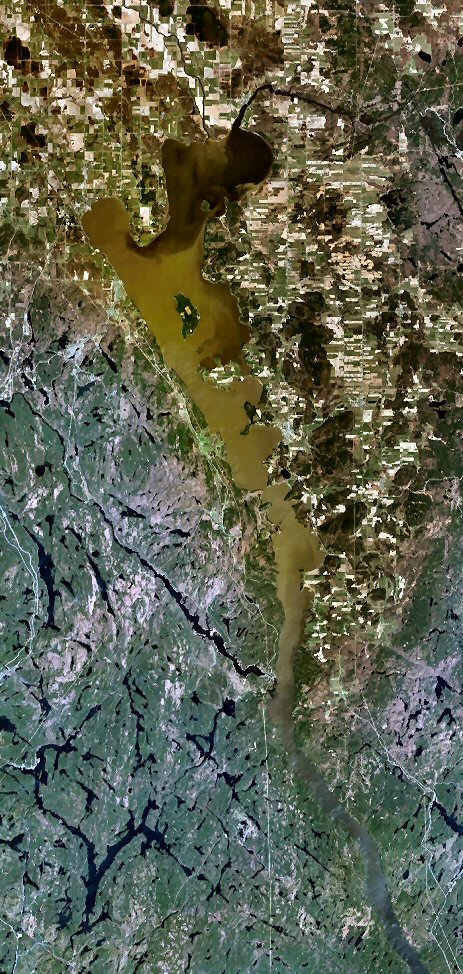
Lake Timiskaming or Lake Temiskaming (French: Lac Témiscamingue, pronounced [lak temiskamɛ̃ɡ]) is a large freshwater lake on the provincial boundary between Ontario and Quebec, Canada. The lake, which forms part of the Ottawa River, is 110 km (68 mi) in length and covers an area of 304 km2 (117 sq mi). Its water level ranges between 175 m (574 ft) and 179 m (587 ft) above sea-level, with a mean annual average of 178.4 m (585 ft).[4] The lake is in places up to 216 m (709 ft) deep. There are several islands on the lake, notably Mann and du Collège Islands.

Key Information

The name is from the Algonquin Temikami or Temikaming, meaning "deep body of water with rapid winds”

There are 30 species of fish in Lake Timiskaming, the best known are northern pike, sturgeon, lake trout, walleye, smallmouth bass, bullhead, carp, burbot, perch, and whitefish.

The lake was shaped during the last ice age when glaciers carved into the rock. It is also the remnants of a huge basin called Lake Ojibway, which existed about 9,500 years ago.

For the trading post and some history see Fort Témiscamingue.

One of Canada's greatest boating tragedies occurred when twelve boys and a staff member of Ted Byfield's St John's School of Claremont died of drowning and hypothermia on a canoe trip on 11 June 1978 on the lake.[5]

Looking south over Lake Timiskaming from Fort Témiscamingue near Ville-Marie, Quebec.

Timiskaming Graben

[edit]

Lake Timiskaming is located within the ancient major rift valley Timiskaming Graben. It is the northern extension of the Ottawa-Bonnechere Graben, which is part of the Saint Lawrence rift system.

There have been recent earthquakes along the rift valley, the most recent being in 2000. There are numerous faults in the area and has produced cliffs such as Devil's Rock, just 5 km (3 mi) south of Haileybury and is dated to be 2.2 billion years old. There are known kimberlite pipes within the rift valley that are considered to be diamondiferous.[6]

See also

[edit]

References

[edit]
[edit]
Revisions and contributorsEdit on WikipediaRead on Wikipedia
from Grokipedia
Lake Timiskaming, also known as Lac Témiscamingue, is a large freshwater lake straddling the border between the Canadian provinces of and , approximately 217 km northeast of Sudbury, . It measures 108 km in length, covers a surface area of 304 km², and reaches a maximum depth of 216 m, making it one of the deepest lakes in . The lake forms part of the upper system and serves as a vital for regional , , and historical trade routes. Geologically, Lake Timiskaming occupies the Timiskaming Graben, a fault-bounded within the broader Ottawa-Bonnechere Graben system, with significant extension around 155 million years ago during the breakup of the supercontinent Pangea. The basin was shaped by tectonic faulting, including the active Lake Timiskaming West Shore Fault, and filled as a remnant of the post-glacial Lake Barlow-Ojibway approximately 10,000 years ago, with glacial deposits contributing to the surrounding Little Clay Belt's fertile soils. The region exhibits ongoing neotectonic activity, evidenced by frequent , including a magnitude 6.1 in 1935 that caused significant local damage. Notable geological features include steep cliffs like Devil's Rock and outcrops containing fossils from 400–500 million years ago. The lake's name derives from the Algonquin word temikami, meaning "deep waters," reflecting its profound depths and cultural significance to Indigenous peoples, including the Algonquin Anishinaabeg, who have inhabited the area for over 6,000 years and relied on it for , travel, and sustenance. European contact began in the late with the establishment of fur trading posts, such as the first one built between 1679 and 1688 at the lake's outlet by the Compagnie du Nord, facilitating exchanges between Indigenous communities and French traders. Settlement expanded in the , with reserves set aside for Algonquin communities in 1851 and agricultural colonization along its shores promoting the growth of nearby towns like . Ecologically, the lake supports diverse fish populations, including (Acipenser fulvescens), , , and , though it faces challenges from mercury and like rainbow smelt. Today, it is valued for , , and conservation efforts within areas like the South Timiskaming Shoreline Conservation Reserve.

Geography

Physical characteristics

Lake Timiskaming is an elongated north-south that straddles the border between and , forming part of the system. It measures approximately 108 km in length and up to 8 km in width at its broadest point. The lake covers a surface area of 304 km², with an average depth of 122 m and a maximum depth reaching 216 m. Its surface elevation is 178 m above . The surrounding terrain consists of dense boreal forests and ancient Precambrian Shield rock formations, with steep granite cliffs rising prominently along the eastern shore, such as the 91 m high escarpment at Devil's Rock near Temiskaming Shores. Notable islands include du Collège Island and Mann Farr Island, the two largest in the upper lake. Du Collège Island, located near Ville-Marie, Quebec, is connected to the mainland by a causeway and features historical significance as a former site for a college. Mann Farr Island lies further north in the lake's upper reaches, at coordinates approximately 47° 25′ 52″ N, 79° 36′ 33″ W.

Hydrology and watershed

Lake Timiskaming serves as a significant in the upper system, receiving inflows primarily from several key tributaries originating in the region of and . The major inflows include the Blanche River, which drains a large agricultural and forested area in , ; the Montreal River, flowing from the Canadian Shield highlands in the ; and the Matabitchuan River, which contributes from its watershed in Nipissing and s. Additionally, upper branches of the itself, such as the Kipawa River, provide substantial input from 's Laurentian Plateau. These tributaries deliver water from a diverse of forests, lakes, and wetlands, supporting the lake's role as a natural storage basin. The lake's outflow occurs at its southern end through the Timiskaming Dam Complex, where water continues southward into the , eventually reaching and the system. This regulated discharge helps manage downstream flooding and power generation, with the dam controlling levels to mitigate seasonal peaks. The overall watershed of Lake Timiskaming encompasses approximately 34,835 km², spanning parts of the administrative region in and adjacent areas in , including upstream tributaries that feed into the lake from wooded and lake-dotted terrains. This extensive basin integrates runoff from nearly 20,000 water bodies, emphasizing the lake's connectivity within the broader hydrological network. Water quality in Lake Timiskaming is generally good, characterized by a near-neutral averaging just over 7.0 at the outlet, though upstream values can dip to around 6.6-6.8, occasionally as low as 5.5 during certain conditions. Nutrient levels remain low overall, with total concentrations near or slightly exceeding the 0.02 mg/L objective, influenced by agricultural runoff from limestone-rich areas north and west of New Liskeard. Seasonal fluctuations in water levels are pronounced, driven by spring and rainfall, leading to elevated flows and potential flooding in the northern basin; levels are moderated by the Timiskaming Dam to maintain stability, typically ranging between 175 m and higher during peak periods. These dynamics underscore the lake's sensitivity to upstream land use and climate variability.

Climate and weather patterns

Lake Timiskaming lies within a zone (Köppen Dfb), featuring cold, snowy winters and warm, humid summers, moderated somewhat by the lake's influence on local temperatures and precipitation. This classification reflects the region's position in and western , where continental polar air masses dominate in winter, while warmer southerly flows prevail in summer. The lake itself contributes to microclimatic effects, such as slightly milder winter temperatures near the shores due to its thermal inertia. Average temperatures vary significantly by season, with marking the warmest month at a high of 24°C (76°F) and low of 13°C (56°F), while is the coldest with a high of -8°C (17°F) and low of -19°C (-2°F). Over the year, daytime highs range from about -6°C in winter to 25°C in summer, and nighttime lows from -15°C to 13°C, though extremes can push beyond these, rarely exceeding 29°C (85°F) or dropping below -31°C (-23°F). These patterns align with the broader regional , where the lake's presence helps buffer extreme cold snaps compared to inland areas. Annual precipitation averages around 880 mm, distributed as roughly 70% during the warmer months from to and the remainder as from to May, with being the snowiest at about 208 mm of equivalent. Summer months like see the highest rainfall, averaging 64 mm, often from convective thunderstorms, while winter precipitation contributes to heavy snow cover that persists for several months. This regime supports the area's mixed ecosystems but can lead to seasonal flooding risks from . Wind patterns in the region are variable but frequently strong, with average speeds ranging from 10 km/h in calm to 13 km/h in , predominantly from the north in winter and west or south in summer. The lake's elongated, 108 km length creates a substantial fetch, allowing winds to build momentum across open water and generate gusts up to 60 km/h or more, which can rapidly alter lake surface conditions. This characteristic is reflected in the Algonquin name Temikaming, meaning "deep with rapid winds."

Geology

Geological formation

Lake Timiskaming originated as a remnant of the proglacial Lake Barlow-Ojibway complex, which formed during the retreat of the Laurentide Ice Sheet at the close of the Wisconsin Glaciation around 11,000 years ago. This vast ice-contact lake covered extensive areas of northern Ontario and western Québec, impounded by the ice margin to the north and draining eastward through precursors of the Ottawa River. The Barlow phase began approximately 10,100 years before present (BP), evolving into the larger Lake Ojibway by about 9,200 years BP, with the combined system persisting until its catastrophic drainage around 8,000 years BP. Lake Timiskaming's basin emerged in the isostatically depressed landscape following this drainage event, marking the transition from a proglacial to a postglacial water body approximately 9,500 years ago. Following the retreat of the Laurentide Ice Sheet, post-glacial isostatic rebound played a pivotal role in shaping the lake's current configuration. The unloading of glacial ice caused the Earth's crust to uplift differentially, with greater rebound in the northern portions of the region—up to 30 meters of vertical displacement around 11,000 years BP—creating a north-south tilt in the basin. This uplift, occurring at rates influenced by a half-life of about 1,000 years, elevated former outlets and stabilized the lake's hydrology by reconnecting it to regional drainage patterns via the Ottawa River system. By around 9,000 years BP, the ongoing rebound had defined the ancestral form of Lake Timiskaming, transforming the depressed glacial trough into a persistent freshwater basin amid broader tectonic influences like the Timiskaming Graben. Sedimentation within the lake basin reflects these glacial and post-glacial dynamics, with core samples revealing layered deposits of glacial till overlain by varved sediments from Lake Barlow-Ojibway. Glacial till, consisting of unsorted debris from ice advance, forms the basal layer, while the varves—annual couplets of coarse summer and fine winter clay—record seasonal depositional cycles in the proglacial environment. These varves, part of the extensive Timiskaming varve sequence, provide a chronological record spanning over 2,000 years of lake evolution, with evidence from cores in nearby Frederick House Lake confirming continuity and minimal disconformities during the late stages of Lake Ojibway. Post-glacial has since added thinner organic-rich layers, but the foundational glaciolacustrine deposits dominate the basin's subsurface architecture.

Timiskaming Graben

The Timiskaming Graben forms a key component of the broader Ottawa-Bonnechere Graben, which itself constitutes a failed rift arm within the rift system, an ancient embedded in the . This rift system originated from extensional tectonics associated with the opening of the during the late to early eras, approximately 600 to 400 million years ago, when normal faulting created a series of down-dropped basins as rifted apart. The graben's development involved crustal extension and along reactivated shear zones, though its primary faulting and basin formation postdate the , which shaped the underlying basement rocks around 1.2 billion years ago. Structurally, the Timiskaming Graben is a fault-bounded characterized by steep, northwest-trending normal faults, including the prominent Mattawa and Kipawa faults, which define its margins and accommodate differential . The overall Ottawa-Bonnechere Graben extends approximately 500 km from near to the vicinity of , while the Timiskaming segment specifically encompasses a roughly 100 km stretch centered on Lake Timiskaming, with a width of about 50 km and depths reaching up to 200 meters in places. This configuration results in a pronounced morphotectonic depression filled partly by sediments and glacial deposits, enhanced by later isostatic adjustments following the Pleistocene glaciation. The Timiskaming Graben lies within the intraplate Western Quebec Seismic Zone (WQSZ), an active fault system where ongoing reflects reactivation of these ancient rift faults due to far-field stresses from the North American Plate's interactions at distant boundaries, including spreading and along the Pacific margin. Historical includes the destructive 1935 Timiskaming earthquake (Mw 6.2), which epicentered near the lake and caused widespread damage across , triggering numerous subaqueous slumps in the basin. More recently, a Mw event occurred on , 2000, beneath Lake Kipawa, highlighting persistent activity; the zone's clustered mid-crustal s indicate potential for magnitudes up to 6.5 or greater based on fault lengths and stress accumulation models.

Notable geological features

One of the most prominent geological features along Lake Timiskaming is Devil's Rock, a steep on the eastern shore approximately 5 km south of , . This cliff rises about 91 m above the lake surface and extends roughly an equal depth below it, forming part of the ancient Lake Timiskaming West Shore Fault that bounds the basin. The rock is composed of characteristic of marine deposits, containing fossils such as corals and from 400–500 million years ago. The Lake Timiskaming area is also known for its pipes, which are diamond-bearing volcanic structures associated with the Lake Timiskaming Kimberlite Cluster in the . Over 50 such pipes have been identified in the structural zone along the lake, with several containing diamonds; notable examples occur near and were first systematically explored and confirmed in the late . One well-studied pipe, the Jurassic-aged 95-2 , is an oblong, steeply dipping structure buried under glacial till and has yielded samples of high-quality diamonds. Visible fault scarps form striking escarpments along the lake's margins, resulting from ongoing neotectonic activity within the Timiskaming Graben. These include the New Liskeard–Thornloe scarp in , a deglacial–postglacial feature interpreted as evidence of seismic events that displaced sediments and along rift-related faults. Such scarps highlight the graben's tectonic framework, with onshore and submerged expressions recording and faulting in the seismically active Western Quebec Seismic Zone. The surrounding Precambrian Shield rocks host notable mineral resources, including cobalt and silver deposits in vein systems of the Cobalt mining district adjacent to the lake. These deposits occur in steeply dipping veins within Archaean greenstones and Timiskaming sediments, intruded by Nipissing diabase sills, forming part of the silver-cobalt-calcite vein type characteristic of the region. The area's geology, tied to rift faults, has concentrated these resources through fault-controlled mineralization in the Superior Province.

History

Indigenous peoples and early use

The Lake Timiskaming region holds significant cultural importance for the , also known as , who have long regarded the area as part of their traditional territory. The lake's name derives from the Algonquin word Temikami or Temikaming, meaning "deep water" or "deep ," reflecting its profound physical characteristics that shaped indigenous interactions with the landscape. This nomenclature underscores the Algonquin's deep connection to the , which served as a vital hub for abundant species like sturgeon and , facilitating sustenance and seasonal mobility. Additionally, the lake and its shores were considered spiritual sites, where ceremonies and stories tied to the land's natural features reinforced and . Archaeological evidence indicates human occupation in the Lake Timiskaming area dating back at least 6,000 years, linked to post-glacial settlement by nomadic Algonquin ancestors who adapted to the retreating ice sheets of the Laurentide Glacier. Sites near the lake's headwaters, such as those at Obadjiwan, reveal sporadic use by these early inhabitants for resource exploitation, including tool-making from local and seasonal habitation. This timeline aligns with broader patterns, where Algonquin predecessors established presence around 8,000 years ago, migrating along waterways as the climate warmed. Traditional Algonquin practices around Lake Timiskaming centered on semi-nomadic lifestyles, with seasonal camps established along the shores for fishing, hunting, and gathering wild rice and berries. The lake's deep waters and connecting rivers, like the , enabled extensive travel by birchbark canoe, supported by well-maintained portage trails that linked it to broader networks across the and St. Lawrence regions. Pre-contact, these routes facilitated indigenous trade in furs, , and other goods among Algonquin groups and neighboring peoples, including Cree influences from the northern expanses, fostering economic and cultural exchanges without European involvement.

European exploration and colonization

European exploration of Lake Timiskaming began in the early 17th century, with French explorer Étienne Brûlé credited as the first European to traverse the region in 1610 while traveling with Algonquin guides along the upper Ottawa River. Brûlé, sent by Samuel de Champlain to learn Indigenous languages and scout trade routes, ventured into the area to establish contacts with local peoples and assess fur-trading potential, marking the initial European penetration into this remote watershed. Although Champlain himself did not reach the lake, his expeditions along the Ottawa River in 1613–1615 and subsequent maps, including references to the upper river system in his 1632 publication, provided foundational cartographic knowledge that facilitated later voyages by French traders and missionaries. The fur trade era intensified in the late , with the establishment of the first at the mouth of the Montreal River on Lake Timiskaming around 1685 by the French government to counter English competition from . This outpost, operated by the Compagnie du Nord, was closed in the 1690s amid regional conflicts but re-established in 1720 at Obadjiwan Point as Fort Témiscamingue, becoming a vital hub for exchanging furs with Algonquin trappers. By the 1790s, had secured a monopoly on the post, leveraging its strategic location for transporting goods to via the ; following the 1821 merger, the continued operations until 1902, solidifying the lake's role in the competitive Anglo-French fur economy. Colonization accelerated in the , driven by missionary efforts and resource extraction, as and Sulpician missionaries arrived in the 1830s to evangelize Indigenous communities and promote settlement. The established the Saint-Claude mission in 1863 opposite the fort, supporting agricultural colonization by providing spiritual and logistical aid to incoming families. Concurrently, booms emerged from the 1830s, with timber drives down the attracting laborers and leading to land grants for settlers, particularly on the side; surveys clarifying the Quebec-Ontario border along the lake's length, initiated in the 1820s and refined through the 1880s, formalized these grants and enabled organized by the 1880s.

20th-century developments and events

The early marked a period of significant industrial expansion around Lake Timiskaming, driven primarily by the Cobalt silver rush that began in 1903 following the discovery of rich silver veins near Lake, adjacent to the lake's eastern shores. This boom attracted thousands of prospectors and workers, transforming sparsely populated farming communities into bustling mining centers and spurring infrastructure development, including railways and settlements along the lake's side. By 1911, the region's population had surged, with mining output peaking as became one of the world's leading silver producers, fueling that extended to Lake Timiskaming's watershed. Hydroelectric development further shaped the lake's 20th-century landscape, beginning with the initial construction of the Timiskaming Dam complex on the lake itself between 1909 and 1913, followed by several additional dams on the and its tributaries between the and to harness water power for mining, pulp mills, and regional electricity needs. Key projects included expansions at the Timiskaming Dam complex and facilities on inflows like the Kipawa River, which regulated water levels and supported industrial demands but also altered natural flow regimes and contributed to flooding events in the and . These initiatives, part of broader development involving up to seven major dams by the mid-20th century, integrated Lake Timiskaming into and 's growing energy grid. As of 2025, the Quebec portion of the Timiskaming Dam-Bridge is slated for replacement, with construction expected to begin in 2026 or 2027 and complete by 2030, aiming to enhance structural integrity, flood control, and sturgeon habitat restoration. Communities along Lake Timiskaming's border reflect its binational character, with the incorporation of Haileybury in 1905 and subsequent growth leading to the 2004 amalgamation forming the City of , encompassing New Liskeard, Haileybury, and Dymond Township on the side opposite Quebec's Témiscamingue region. The area's bilingual dynamics stem from its proximity to the provincial boundary, where French-speaking residents comprise a significant portion—over 40% in Temiskaming Shores—fostering dual-language services, , and cultural exchanges that highlight the lake's role as a cultural divide and connector. Tragic events underscored the lake's hazards during the century. On June 11, 1978, a canoeing expedition from St. John's School of capsized in a sudden storm on Lake Timiskaming, claiming the lives of 12 boys aged 11 to 13 and one adult leader out of 27 students and four staff, due to in the cold waters; the incident prompted national reviews of youth outdoor safety protocols. Seismically, the region experienced notable activity, including the magnitude 5.2 Kipawa earthquake on January 1, 2000, centered near the lake under Lake Kipawa, which caused minor structural damage in nearby towns and highlighted ongoing tectonic risks in the Timiskaming Graben. In the late 20th and early 21st centuries, exploration for revived interest in the lake's mineral-rich surroundings, with pipes identified in the Lake Timiskaming area during the , including the 95-2 pipe near New Liskeard where microdiamonds were recovered from samples by 1996. This led to targeted in the Cobalt-Timiskaming , building on the silver legacy and attracting investment despite challenges in commercial viability. Post-2000 environmental regulations have increasingly protected the lake, including the 2016 management plan for the South Timiskaming Shoreline Conservation Reserve, which restricts development to preserve shoreline ecosystems, and federal assessments for projects like the Timiskaming Dam replacement emphasizing sturgeon habitat restoration and water quality under the Canadian Environmental Assessment Act.

Ecology and environment

Aquatic and terrestrial ecosystems

Lake Timiskaming's is characterized by distinct zones shaped by its deep, structure. The lake exhibits mesotrophic conditions based on total phosphorus concentrations ranging from higher levels in the northern basin to lower in the south, while levels suggest oligotrophic productivity overall. The , encompassing shallow nearshore areas up to approximately 10 m depth, supports submerged aquatic vegetation that stabilizes sediments and provides structure. Deeper profundal zones, extending beyond 50 m and reaching a maximum depth of 216 m, are part of the seasonal stratification that develops in summer, forming a warmer over a colder hypolimnion. The lake's water chemistry reflects its northern location and geological setting, supporting cold-water species preferring temperatures around 10°C in deeper waters and featuring a natural north-to-south turbidity gradient due to suspended clays from tributary inflows, with lower turbidity in the southern portions influencing light penetration and primary production. Surrounding terrestrial habitats form part of the Boreal Shield ecozone, dominated by mixedwood boreal forests blending coniferous species such as black spruce (Picea mariana), balsam fir (Abies balsamea), and jack pine (Pinus banksiana) with deciduous trees like trembling aspen (Populus tremuloides) and white birch (Betula papyrifera). Shoreline wetlands, including extensive peatlands and emergent marshes, fringe much of the lake, serving as buffers against erosion and supporting hydrological connectivity between aquatic and upland areas. These ecosystems are underlain by thin, nutrient-poor soils of the Canadian Shield, primarily Podzols and Brunisols developed over granitic bedrock, which constrain forest productivity and promote acidic, oligotrophic conditions. The aquatic ecosystem faces pressures from , notably the (Dreissena polymorpha), which spread to eastern Canadian waters in the late and have been detected in the Temiskaming region as of 2025, likely via boating activities connected to the broader system. These mussels filter large volumes of water, increasing clarity by reducing but disrupting food webs and outcompeting native bivalves, contributing to localized ecological shifts.

Wildlife and biodiversity

Lake Timiskaming supports a diverse fish community with 25 species documented through broad-scale monitoring efforts conducted between 2008 and 2010. Key species include walleye (Sander vitreus), which are abundant in the upper reaches with a catch per unit effort of 2.24 kg per net and mean lengths around 30 cm, northern pike (Esox lucius) with relative abundances of 1-2.4 fish per net and lengths of 50-70 cm, lake trout (Salvelinus namaycush) present but less abundant, and sauger (Sander canadensis), which supports a notable winter fishery. Lake sturgeon (Acipenser fulvescens), a provincially threatened species, maintains a stable population in the lake, with a commercial fishery harvesting approximately 286 individuals annually and ongoing recovery initiatives to enhance spawning habitat. While no specific stocking programs target Lake Timiskaming, broader efforts in the Ottawa River system aim to restore sturgeon numbers to pre-colonial levels through habitat improvements and fish passage structures. The surrounding boreal forests and wetlands harbor a variety of mammals and birds characteristic of the region. Common mammals include beaver (Castor canadensis), which thrive in aquatic habitats and contribute to wetland dynamics, moose (Alces alces), often found in forested areas near the lake, and (Ursus americanus), a widespread predator in the boreal ecosystem. Birds are particularly diverse, with the system—including Lake Timiskaming—providing habitat for over 300 species; notable examples are the (Gavia immer), a symbol of northern lakes that nests on shorelines, and migratory waterfowl such as (Branta canadensis) utilizing the lake's wetlands during seasonal movements. Approximately 53 mammal species and 33 species also occur in the broader watershed, underscoring the area's role as a corridor for . Aquatic and terrestrial enhance the lake's , with emergent vegetation in peatlands and shallows supporting like white fringed orchid (Platanthera blephariglottis) and dragon's mouth (Arethusa bulbosa) in ombrotrophic bogs near the shoreline. Surrounding forests host rare orchids, including ram’s head lady’s slipper (Cypripedium arietinum), vulnerable and found in cedar-pine habitats with 11 documented occurrences, calypso (Calypso bulbosa var. americana) in humid coniferous stands, and showy lady’s slipper () in marshy areas. These contribute to the region's floral richness, with over half of Abitibi-Témiscamingue's threatened occurring nearby. In terms of biodiversity metrics, Lake Timiskaming exhibits moderate fish community diversity, with a Shannon Index of 2.15 to 2.21, reflecting a balanced but not exceptionally high compared to downstream sections of the , which host over 85 species overall. As a remnant of ancient systems akin to the , the lake's 25 species and supporting and highlight its ecological value within the boreal landscape, though diversity gradients show lower richness in the upper reaches relative to more southern, nutrient-rich waters.

Conservation efforts and challenges

Parts of Lake Timiskaming are encompassed by protected areas on both the and sides, contributing to the preservation of its shoreline ecosystems and . In , the South Timiskaming Shoreline Conservation Reserve, established in 2004 and spanning 703 hectares, safeguards significant natural features along the lake's southern shoreline, including forested uplands and wetlands, while permitting compatible activities such as research and environmental monitoring under the Provincial Parks and Conservation Reserves Act. On the side, Parc national d'Opémican, created in 2013 and covering 252 square kilometers, borders Lake Timiskaming and Lac Kipawa, protecting representative landscapes of the Southern Laurentians natural region through conservation and public education initiatives. The lake faces several environmental challenges, including historical acid rain impacts from the 1980s and 1990s, which increased acidity in freshwater systems, harming aquatic life and reducing lake buffering capacity. Mercury contamination from historical activities such as dams and log drives in the watershed has raised concerns about bioaccumulation in the food chain, affecting fish and wildlife health, with studies noting elevated levels though not yet fully quantified for the lake itself. Climate change exacerbates these issues by altering precipitation patterns and contributing to variable water levels, as seen in rising fluctuations managed through reservoir controls, which can impact shoreline habitats and species migration. Conservation efforts involve binational collaboration between and , including joint water protection and monitoring initiatives outlined in community strategic plans to address transboundary . Sturgeon recovery programs, active since the 2000s as part of broader strategies, have been integrated into projects like the Timiskaming Dam-Bridge Replacement, which includes an Indigenous-led plan to restore self-sustaining populations through habitat rehabilitation and fish passage enhancements. Ongoing water monitoring by organizations such as the Timiskaming Health Unit and Riverkeeper involves weekly sampling at beaches and watershed assessments to track contaminants like and nutrients. Post-2020 updates highlight progress in control, with research projects detecting spiny water fleas () in Lake Timiskaming in 2019 and monitoring them as of 2025 to prevent dramatic fish population declines through early intervention and public awareness. Surrounding forests contribute to efforts, as boreal management plans in the Timiskaming Forest emphasize sustainable harvesting to maintain carbon stocks, projecting long-term storage in trees and soils amid climate pressures.

Human settlement and economy

Communities and infrastructure

The primary communities along Lake Timiskaming reflect its position straddling the - border, fostering a bilingual environment where English and French are commonly spoken. , , is the largest settlement on the lake's western shore, with a 2021 population of 9,634. The community, formed by the 2004 amalgamation of New Liskeard, Haileybury, and Dymond, features a demographic where approximately 71% speak English as their primary language and 28% speak French, contributing to its bilingual character. Across the border in , Ville-Marie serves as the regional seat for the Témiscamingue area, with a 2021 population of 2,464, predominantly French-speaking (over 96% first French). Smaller nearby communities include Notre-Dame-du-Nord, , with 1,090 residents in 2021, known for its proximity to the lakehead and mixed linguistic profile influenced by cross-border ties. The Timiskaming First Nation, an Algonquin community at the lake's northern end near Notre-Dame-du-Nord, had a registered population of approximately 300 as of 2021, with its reserve established in 1851 and serving as a key Indigenous hub for cultural and economic activities. Transportation infrastructure supports connectivity across the lake and provinces, with Highway 65 in linking to Quebec's Route 101, facilitating east-west travel along the shoreline. Key crossings include the Timiskaming Dam-Bridge at the lake's southern outlet on the , a vital interprovincial link spanning and near Témiscaming. Marinas provide essential boating access, such as the full-service Haileybury Marina and New Liskeard Waterfront Marina on the side, offering slips, launches, and fuel—the Haileybury Marina has 82 slips—while the Témiscaming Marina on the side supports similar recreational needs. Historical rail lines, originating in the early with the Temiskaming and Northern Railway (now part of Northland), were instrumental in , connecting lake communities to broader networks from North Bay northward. As an interprovincial boundary, Lake Timiskaming influences local dynamics without formal customs points, given its domestic status between and ; instead, communities benefit from shared cross-border initiatives, such as joint promotion and environmental management. Bilateral extends to infrastructure like the jointly maintained Timiskaming Dam Complex for water regulation. Modern amenities enhance quality of life in these communities. Healthcare includes Temiskaming Hospital in , a 69-bed facility providing emergency, surgical, and referral services. In Ville-Marie, the Centre multiservices de santé et de services sociaux offers , , and community health support. Educational institutions encompass Timiskaming District Secondary School and several elementary schools in under the District School Board North East. Cultural centers, such as the Obadjiwan–Fort Témiscamingue National Historic Site near Ville-Marie, preserve Indigenous and history through interpretive exhibits and guided programs, though the visitor centre is temporarily closed until 2026.

Economic activities

The economy of the Lake Timiskaming region is significantly shaped by resource extraction industries, particularly mining, which has historically driven development through the exploitation of rich mineral deposits in the surrounding Cobalt-Gowganda fields. Silver mining boomed after discoveries in 1903, with the area yielding high-grade ores containing silver, cobalt, and nickel as primary outputs and byproducts, respectively, supporting operations that produced over 600 million ounces of silver historically. More recently, exploration has targeted the Lake Timiskaming kimberlite cluster, where Jurassic-age pipes like the 95-2 have revealed diamond-bearing potential, prompting ongoing prospecting for commercial viability in this southernmost Canadian kimberlite field. Forestry remains a of economic activity, with sustainable timber harvesting managed across the Timiskaming watershed by the Timiskaming Forest Alliance Inc., a of industry partners emphasizing and long-term yield under Ontario's Sustainable Forest Licence framework since 1998. Logging operations supply pulp and mills, including the high-purity facility in Témiscaming, , which processed regional wood fiber until its indefinite suspension in 2024 due to market challenges, highlighting the sector's vulnerability to global demand fluctuations. Agriculture benefits from the fertile clay soils of the Little Clay Belt encircling the lake, enabling cultivation on flat farmlands that support key crops such as potatoes, hay, oats, and , with hay and potatoes comprising significant portions of local production to sustain and regional markets. Commercial fishing complements this, governed by quotas for species like and to ensure sustainable harvests, with the lake's sturgeon alone permitting targeted catches under federal and provincial regulations. Energy production draws on the lake's inflows and outlet, where the Timiskaming Dam Complex regulates water levels for downstream hydroelectric generation on the , though new developments remain limited to maintain ecological balance and flood control rather than expansive harnessing of the lake's hydroelectric potential.

Tourism and recreation

Lake Timiskaming offers a variety of water-based activities that draw visitors to its shores, including and . The lake's , such as the full-service Haileybury Marina with 82 slips, support recreational boating, sailing, and swimming along its sandy beaches. Fishing enthusiasts participate in organized tournaments, such as the annual Tournoi de pêche Écotone Ville-Marie for and the Temiskaming Smallmouth Series, which highlight the lake's diverse fish populations including bass, pike, and . Hiking is another popular pursuit, with (Mani-doo Aja-bikong) Trail providing a moderate approximately 7 km round-trip route leading to dramatic clifftop views of the lake from 300 feet above, offering a brief glimpse into the area's notable geological formations. The Waterfront Boardwalk Trail in features a 2 km scenic path along the lakefront, complete with beaches, picnic areas, and playgrounds for leisurely strolls and family outings. Key attractions include the Obadjiwan–Fort Témiscamingue National Historic Site near Ville-Marie, Quebec, where visitors explore reconstructed fur trading post buildings and learn about 6,000 years of Algonquin presence and European trade history; the site is open from June to September and attracts around 7,000 visitors annually. Cultural experiences are enhanced by annual events like the Foire gourmande de l'Abitibi-Témiscamingue et du Nord-Est ontarien in Ville-Marie, a multi-day fair celebrating local and in late to early August. Winter recreation includes on the frozen lake, supported by nearby facilities for safe access. Tourism to the region has seen steady interest, with eco-tourism initiatives promoting nature-based experiences around the lake contributing to growth since the early , as part of broader efforts in to diversify visitor offerings. The Lake Temiskaming Tour circuit further encourages cross-border exploration of attractions and events, fostering sustainable visitation.

References

Add your contribution
Related Hubs
User Avatar
No comments yet.