Hubbry Logo
Lesser spotted eagleLesser spotted eagleMain
Open search
Lesser spotted eagle
Community hub
Lesser spotted eagle
logo
8 pages, 0 posts
0 subscribers
Be the first to start a discussion here.
Lesser spotted eagle
from Wikipedia

Lesser spotted eagle
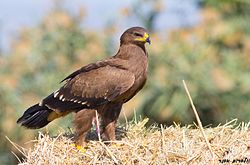
Juvenile
Note white spots on wings
and white V on rump
Scientific classification Edit this classification
Kingdom: Animalia
Phylum: Chordata
Class: Aves
Order: Accipitriformes
Family: Accipitridae
Genus: Clanga
Species:
C. pomarina
Binomial name
Clanga pomarina
(Brehm, CL, 1831)
Range of C. pomarina
  Breeding
  Non-breeding
  Passage
Synonyms

Aquila pomarina

The lesser spotted eagle (Clanga pomarina) is a large Eastern European bird of prey. Like all typical eagles, it belongs to the family Accipitridae. The typical eagles are often united with the buteos, sea eagles, and other more heavy-set Accipitridae, but more recently it appears as if they are less distinct from the more slender accipitrine hawks than believed.

Description

[edit]
Adult in flight; white wing spots are lost while mature; only white V on rump remains

This is a medium-sized eagle, about 60 cm (24 in) in length and with a wingspan of 150 cm (59 in).[2] Its head and wing coverts are pale brown and contrast with the generally dark plumage. The head and bill are small for an eagle.[3] Usually, a white patch occurs on the upper wings, and even adults retain a clearly marked white "V" on the rump; the wing markings are absent and the white "V" is not well-defined in the greater spotted eagle.

The juvenile has less contrast in the wings, but the remiges bear prominent white spots. It differs from greater spotted eagle juveniles by a lack of wing covert spotting and the presence of a cream-colored neck patch.

The call is a dog-like yip.

Taxonomy and evolution

[edit]
A drawing of a lesser spotted eagle

The birds formerly considered to be the resident Indian subspecies are now considered a separate species, the Indian spotted eagle (Clanga hastata), quite distinct and readily separable by morphological, behavioral, ecological, and DNA sequence data. The European taxon is actually closer to the greater spotted eagle; their common ancestor seems to have diverged around the middle Pliocene, perhaps some 3.6 million years ago,[4] from the ancestors of the Indian birds. The "proto-spotted eagle" probably lived in the general region of Afghanistan, being split into a northern and a southern lineage when both glaciers and deserts advanced in Central Asia as the last ice age began. The northern lineage subsequently separated into the eastern (greater) and western (lesser) species of today, probably around the Pliocene-Pleistocene boundary not quite 2 million years ago.[5][6][7]

The present species hybridizes occasionally with the greater spotted eagle. Hybrid birds are almost impossible to identify if not seen up close.[8]

Distribution and habitat

[edit]
Adult in Belarus

The lesser spotted eagle breeds in Central and Eastern Europe and southeastward to Turkey and Armenia;[9] and winters in Africa. This is a very wary species of open or lightly wooded country, in which it hunts small mammals (especially voles, ground squirrels, rats, and mice) and similar terrestrial prey, such as small birds, amphibians, reptiles, and occasionally insects (including termites).[citation needed][10][11] It is known to occasionally feed on carrion.[12]

Behaviour and ecology

[edit]
A two-egg clutch in nest

The lesser spotted eagle uses regularly spaced territories consistently between years in the north-western part of its distribution. The distances between territories vary across the region, although this was not found to be related to breeding success. Synchronous variation in breeding success across the region indicates that the eagles are instead influenced by large-scale factors such as fluctuations in climate or prey availability.[13] The lesser spotted eagle lays one to three white, buff-spotted eggs in a tree nest. As usual for eagles, only in breeding seasons with very abundant prey does more than one young fledge, but the female starts incubating when the first egg has been laid, thus the first young to hatch usually outgrows its clutch mate(s) and will kill and even eat them sooner or later.[citation needed]

References

[edit]

Further reading

[edit]
[edit]
Revisions and contributorsEdit on WikipediaRead on Wikipedia
from Grokipedia
The lesser spotted eagle (Clanga pomarina) is a medium-sized in the family , measuring 55–67 cm in length with a of 143–168 cm and weighing 1.2–1.75 kg. Adults exhibit pale brown plumage on the head and upperwing coverts, contrasting with darker brown flight feathers and a white V-shaped patch on the rump visible in flight, while juveniles show white spots on the upperparts and bold white bars on the wings and back. This compact eagle, with its relatively small head and bill, is the smallest species in its and closely resembles the (Clanga clanga) but is paler and more uniformly brown overall. Native to eastern Europe and western , the lesser spotted eagle breeds in a range spanning from and eastward to , favoring habitats at forest edges, moist woodlands, wetlands, and adjacent open grasslands or farmlands up to 2,200 m elevation. It is a long-distance migrant, with the entire population wintering in , particularly in dry savannas and grasslands of southern and eastern regions like and , undertaking migrations via routes through the and . During the breeding season, pairs construct large stick nests in tall trees near water or clearings, laying a clutch of typically two eggs that incubate for 38–41 days, with fledging occurring after about 56 days. The is carnivorous, primarily hunting small mammals such as voles, along with birds, reptiles, amphibians, and , often by perching prominently and making short glides or walks to capture prey. Its global population is estimated at 40,000–60,000 mature individuals and remains stable, leading to a of Least Concern on the , though regional declines occur due to loss from and agricultural intensification, illegal hunting, on power lines, and collisions with wind turbines. Conservation efforts, including protected areas and LIFE projects in countries like and , focus on management and reducing human-induced mortality to support this territorial and solitary breeder.

Taxonomy and systematics

Classification

The lesser spotted eagle (Clanga pomarina) belongs to the kingdom Animalia, Chordata, class Aves, order Accipitriformes, Accipitridae, genus Clanga, and Clanga pomarina. This placement reflects its status as a diurnal within the diverse hawk and eagle Accipitridae, which encompasses over 250 of raptors worldwide. The genus Clanga was resurrected in 2012, changing the binomial name from Aquila pomarina to Clanga pomarina, based on molecular and morphological analyses that distinguished the spotted eagles as a separate lineage from true Aquila eagles. Prior to this, it was known as Aquila pomarina since its description by Christian Ludwig Brehm in 1831. The genus Clanga now includes the lesser spotted eagle and its close relatives, emphasizing their unique adaptations compared to other eagles. The is considered monotypic, represented solely by the nominate C. p. pomarina, which breeds across and western . Historically, populations in the were treated as a C. p. hastata, but genetic evidence led to their recognition as a distinct , the Indian spotted eagle (Clanga hastata), in 2002. This separation highlights subtle but significant differences in , vocalizations, and between the two forms.

Phylogenetic relationships

The lesser spotted eagle (Clanga pomarina) is placed within the genus Clanga alongside the greater spotted eagle (C. clanga) and the Indian spotted eagle (C. hastata), forming a monophyletic clade of spotted eagles distinct from the typical Aquila eagles such as the steppe eagle (A. nipalensis). Molecular phylogenetic analyses using mitochondrial and nuclear DNA sequences confirm that the spotted eagles represent a well-supported sister group to other booted eagle lineages, including Ictinaetus and Lophaetus, resolving the paraphyly of the traditional Aquila genus by resurrecting Clanga for these species. Within this clade, the lesser spotted eagle diverged from the greater spotted eagle approximately 1 million years ago, as estimated from cytochrome b mitochondrial DNA sequences calibrated against avian mutation rates. Evidence of hybridization between the lesser and greater spotted eagles is documented in regions of distributional overlap, such as , where mixed pairs produce exhibiting intermediate morphological traits that complicate field identification. Genetic studies reveal asymmetrical mitochondrial , primarily from greater to lesser spotted eagle lineages, with nuclear markers indicating limited but ongoing that has not erased species-level differentiation.

Physical description

Morphology

The lesser spotted eagle (Clanga pomarina) is a medium-sized raptor measuring 55–67 cm in body length, with a of 146–168 cm and a weight of 1.0–2.2 kg. Females exhibit , being larger and heavier than males, with female masses reaching up to 2.2 kg compared to 1.4 kg for males. This species possesses a compact build suited to its lifestyle, featuring broad, rounded wings that facilitate efficient soaring flight over long distances. Its tail is short and rounded relative to body length, aiding in maneuverability during aerial pursuits. The eagle has a relatively small head and bill for its size among eagles, with the hooked bill adapted for tearing prey. Its legs are strong and densely feathered, appearing long and thin, while the sharp talons are used for grasping and securing quarry.

Plumage and identification

The adult lesser spotted eagle exhibits a distinctive two-toned , with a pale brown head and wing coverts contrasting sharply against darker , while a prominent "V" mark adorns the uppertail coverts. The iris is yellowish-brown, and the cere is yellow, aiding in close-range identification. shows no significant , with both males and females sharing this pattern. Juveniles are overall browner and lack the adult's contrasts, featuring conspicuous white spots on the wings—responsible for the species' common name—and bold white bars across the back, wings, and pale uppertail. The iris is brownish, and these spots typically fade following the first molt into subadult plumage. In contrast to juveniles, lesser spotted eagle young display more uniform spotting without a distinct cream-colored patch. Vocalizations consist of a series of dog-like or barks, often delivered in flight, though the is generally silent outside the breeding and less vocal than many other eagles. In flight, the lesser spotted eagle shows broad wings with fingered primaries and a more uniform underwing pattern; it differs from the by lacking a neck patch and featuring double white "commas" at the underwing rather than a single mark. Hybrids between lesser and greater spotted eagles may exhibit intermediate traits, complicating field identification.

Distribution and habitat

Geographic range

The lesser spotted eagle (Clanga pomarina) has a breeding range spanning including , extending southeastward to and . Core populations are concentrated in the (, , and ), , , , and the (including and ), with additional breeding occurrences in , , , the , and the region. During the non-breeding season, the species winters in , primarily in eastern and southern regions such as , , , , and , with scattered records extending northward to . The lesser spotted eagle is a long-distance migrant, following southeastern flyways that pass through the , the Strait, the , and the , including key bottlenecks like the . Individuals typically depart breeding grounds from to and return to them from March to April, completing round-trip migrations of approximately 19,000–20,000 km. The global population is estimated at 40,000–60,000 mature individuals (2012), with holding approximately 76% of this total; the ' population trend remains (as of 2020).

Habitat preferences

The lesser spotted eagle primarily breeds in moist woodlands adjacent to forest edges, favoring open areas with scattered mature trees for nesting while avoiding dense interiors. These habitats often include lowland forests near wetlands, valleys, and forest-steppes, where the can access both nesting sites and nearby foraging grounds. Breeding occurs predominantly in lowlands, though it extends to elevations up to 2,200 m in montane regions. For , the selects moist grasslands, marshes, floodplains, and agricultural fields that support high prey densities, such as temperate grasslands and clearings. These areas provide essential hunting opportunities during the breeding season, with the eagle often exploiting open, wet landscapes up to 1,500 m in . Its habitat choices overlap with its breeding range across into western . Nest site selection emphasizes tall, mature trees, typically species like oaks or such as pines, positioned 12–15 m above ground near forest edges for optimal visibility and proximity to foraging areas. Territories encompass 10–20 km², allowing pairs to defend resources effectively, and nests are frequently reused across multiple breeding seasons due to strong site fidelity. The thrives in temperate to continental climates characterized by warm summers and moderate , which sustain the moist conditions vital for its preferred habitats. It shows sensitivity to environmental changes like , which fragments nesting woodlands, and wetland drainage, which diminishes wetlands and prey availability.

Behavior and ecology

Migration and movements

The lesser spotted eagle (Clanga pomarina) is a full migrant, undertaking annual round-trip migrations of approximately 19,000 km between breeding grounds in and wintering areas in . Individuals exhibit high route fidelity, with adults often following nearly identical paths in successive years along the eastern , passing through key bottlenecks such as the Strait and . Post-breeding departure typically occurs in late summer, with adults and native juveniles leaving breeding sites around mid-September and completing the outward journey in about 7.5 weeks, arriving at wintering grounds by late . The return migration begins in late , taking a similar duration and culminating in mid-April arrivals synchronized with increasing prey availability in northern breeding areas. During migration, the species relies on thermal soaring over land, achieving average daily distances of 166 km, with congregations forming at narrow passages like the , where counts can reach tens of thousands annually, including peaks exceeding 2,500 individuals in a single day. Juveniles often wander locally post-fledging, remaining in the vicinity of natal areas for weeks while developing flight skills before embarking on their first migration, which mirrors adult routes due to innate orientation and potential social learning. Adults maintain strong site fidelity to breeding territories, returning to the same locations annually, which supports consistent migratory timing and path selection.

Foraging and diet

The lesser spotted eagle (Clanga pomarina) is an opportunistic predator with a diet dominated by small vertebrates, varying by and season according to prey availability. In Central European breeding grounds, small mammals such as voles (Microtus spp.) and mice form the primary component, comprising 40–85% of the diet by number or , supplemented by amphibians (up to 42% in humid lowlands), birds (around 7–30%), reptiles (up to 43% in Mediterranean areas), and (about 10%). Reptiles like grass snakes (Natrix natrix) and dice snakes predominate in wetland habitats of , while amphibians such as common frogs (Rana temporaria) increase during wetter periods. The species occasionally consumes carrion, though this is rare and not a staple. Foraging typically occurs within defended breeding territories, where pairs maintain exclusive hunting grounds encompassing open grasslands, forest edges, and wetlands to ensure prey access during the nesting period. The eagle employs multiple hunting techniques suited to its habitats: it soars at heights of 50–100 m to scan for movement before stooping in a steep dive to capture prey, perches on trees, poles, or elevated structures for still-hunting and observation, or walks on the ground in denser vegetation. Hovering is infrequent, unlike in some other raptors. These methods allow efficient exploitation of patchy resources, with territorial defense preventing intrusion by conspecifics and maintaining foraging efficiency. Daily food intake averages 150–250 g for adults, sufficient to meet energetic demands during active periods, though this can fluctuate with prey size and seasonal abundance. In wetter seasons or regions, the diet shifts toward more amphibians and reptiles, reflecting heightened availability in flooded meadows, while drier periods emphasize mammals and birds. Such adaptability underscores the ' reliance on diverse, structurally varied habitats for sustained success.

Reproduction and breeding

The lesser spotted eagle is monogamous, forming long-term pair bonds often lasting multiple breeding seasons, with high site fidelity to breeding territories that are defended aggressively. Pairs exhibit strong territorial , reusing the same nesting areas annually, which contributes to their slowly reproducing, k-selected life history . Nesting occurs in tall trees, typically in crotches near edges, where pairs construct or renovate large platform nests from sticks, often adding fresh material each year over 3–6 weeks before egg-laying. Clutch size is usually 1–3 eggs, most commonly 2, laid asynchronously from late to early May following pair arrival in . Incubation lasts 35–40 days (typically 39 days), shared by both parents but primarily by the , with the provisioning during this period. Eggs hatch asynchronously in early to mid-June, leading to frequent siblicide where the older chick often kills the younger one, resulting in typically only one survivor per . Nestlings are altricial and brooded by the female initially, with both parents delivering prey; the nestling period spans 56–63 days (about 60 days on average), and fledging occurs in late to early . extends 1–2 months post-fledging, during which juveniles remain dependent on adults for food while learning to hunt. Breeding success varies regionally but averages 0.5–1 fledgling per pair annually, with about 70% of pairs attempting to each year and 78% of attempts succeeding in hatching at least one chick. is influenced by environmental factors, including warm spring temperatures that boost breeding frequency, abundant small prey like voles that support higher fledging rates, and wet conditions in the prior that enhance availability for early provisioning. In high-vole years, rare cases of two fledglings occur, but and weather extremes often limit output to one.

Conservation status

The global population of the lesser spotted eagle (Clanga pomarina) is estimated at 40,000–60,000 mature individuals, with holding the majority at approximately 34,200–46,200 mature individuals. Overall, the population is considered stable, though regional declines have occurred in , such as a 25% reduction in since the . In core breeding areas, such as , population densities range from 1–5 pairs per 100 km², reflecting concentrations in optimal forested wetlands. Monitoring efforts rely on nest surveys in over eight European countries and tracking to assess breeding success and movements, providing data on annual and . Demographic factors contribute to stability, with low mortality rates (apparent of 0.76–0.88 annually) supporting up to 26 years in the wild. Recruitment remains limited by obligate , where the elder chick typically kills its sibling, resulting in usually only one fledgling per nest. As of 2024, populations in show stability, with no significant long-term changes in breeding parameters in regions like from 2015 onward. Slight increases have been noted in protected areas through habitat restoration initiatives, such as those under projects enhancing breeding territories.

Threats and measures

The lesser spotted eagle faces several primary threats across its range, including habitat loss due to and the intensification of , which degrade breeding and areas such as wetlands and grasslands. on power lines poses a significant risk, particularly during migration and on wintering grounds in . Illegal shooting remains a major issue, with thousands of individuals killed annually along migration routes, especially in the such as and ; as of October 2025, a poaching crisis in has decimated passing flocks during autumn migration. Additional risks include , which may exacerbate degradation and alter prey availability by shifting seasonal cycles. Pesticide accumulation in the can impact reproduction by affecting prey populations and leading to toxic buildup in the eagles, though ecological factors like diet selection may mitigate some effects in certain regions. Hybridization with the in overlap zones, facilitated by alterations, dilutes genetic purity and complicates . Conservation efforts include legal protections under the EU Birds Directive Annex I and the Bern Convention Appendix II, which mandate habitat safeguards and prohibit deliberate killing. The species is also listed on Appendix II and CMS Appendix II to regulate and promote migratory protections. Key breeding and migration sites are incorporated into the network, covering a significant portion of important bird and biodiversity areas (IBAs/KBAs). Reintroduction and reinforcement programs, such as the adoption of hand-raised chicks from into German wild nests between 2007 and 2011, aim to bolster peripheral populations. These measures have contributed to successes, including population stabilization classified as Least Concern by the IUCN (assessed 2021), with slight increases observed in . In Bulgaria, a major stronghold, LIFE-funded projects from 2015 to 2025 have stabilized breeding performance through nest guarding, wetland restoration, and habitat management, monitoring over 479 territories and discovering new pairs without long-term declines in productivity.

References

Add your contribution
Related Hubs
User Avatar
No comments yet.