Hubbry Logo
Lexus SCLexus SCMain
Open search
Lexus SC
Community hub
Lexus SC
logo
8 pages, 0 posts
0 subscribers
Be the first to start a discussion here.
Contribute something
Lexus SC
Lexus SC
from Wikipedia

Lexus SC
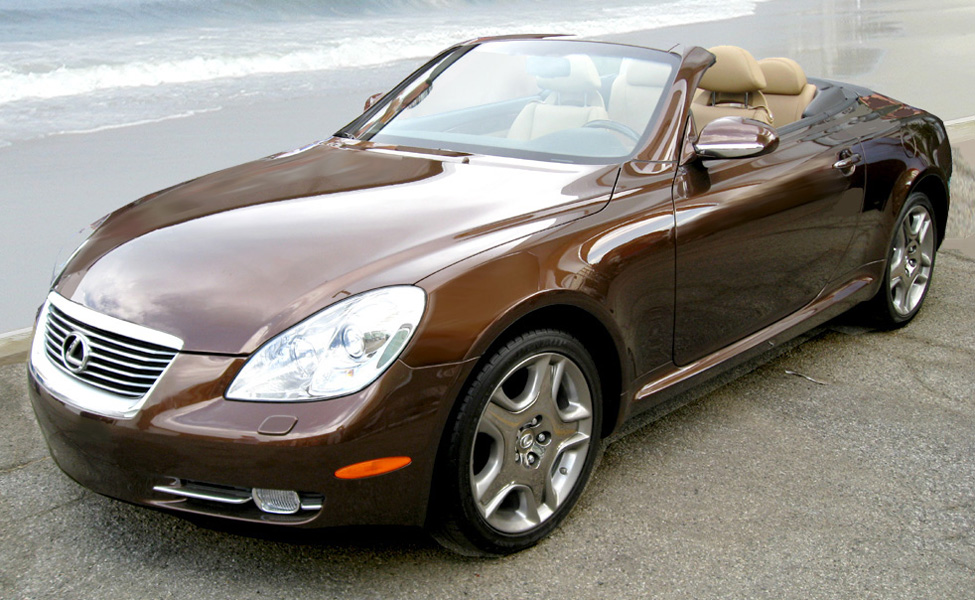
2008 Lexus SC 430
Overview
ManufacturerToyota
Also calledToyota Soarer (Japan, 1991–2005)
ProductionApril 1991–2010
Model years1992–2010
Body and chassis
Class
LayoutFront-engine, rear-wheel-drive
Chronology
PredecessorToyota Soarer (Z20)
SuccessorLexus LC

The Lexus SC (Japanese: レクサス・SC, Rekusasu SC) is a two-door four passenger, front-engine, rear-drive grand touring coupe manufactured by Toyota and marketed by its luxury division, Lexus, for model years 1991–2010 across two generations. The first-generation SC debuted as the V8-powered SC 400 in 1991, and the I6-powered SC 300 was added in 1992, both manufactured until 2000. The second-generation model, the SC 430, went into production in 2001, as a retractable hardtop convertible coupe with a V8 engine. The first-generation SC was largely styled in California at Calty, and the second-generation SC was mainly conceived at design studios in Europe.

In Japan, the related third-generation Toyota Soarer, with which the first-generation SC originally shared body design and multiple components, featured a separate line-up of vehicle configurations and different powertrains. The third generation Soarer sport coupe, largely identical to the SC 430, was superseded by its Lexus counterpart in Japan when the Lexus marque débuted there in 2005. The SC was the sole coupé in the Lexus lineup until the arrival of the IS C.[1] According to Lexus, the SC designation stands for Sport Coupe.[2] The LC replaced the SC lineup in 2017.

First generation (Z30; 1991)

[edit]
First generation (Z30)
1992 Lexus SC 400
Overview
Also calledToyota Soarer
Production21 April 1991 – 7 July 2000[3]
Model years1992–2000
Assembly
DesignerErwin Lui and Denis Campbell (1988–1989)
Body and chassis
Body style2-door coupé
RelatedToyota Supra (A80)
Powertrain
Engine
Transmission
Dimensions
Wheelbase105.9 in (2,690 mm)
Length
  • 191.3 in (4,859 mm) (1992–97)
  • 192.5 in (4,890 mm) (1998–00)
Width
  • 70.5 in (1,791 mm) (1992–97)
  • 70.9 in (1,801 mm) (1998–00)
Height
  • 52.4 in (1,331 mm) (1992–94 SC 300)
  • 52.6 in (1,336 mm) (1995–97 SC 300 & 1992–97 SC 400)
  • 53.2 in (1,351 mm) (1998–00 SC 300/400)
Curb weight
  • 3,485 lb (1,581 kg) (1992 SC 300 manual)[5]
  • 3,505 lb (1,590 kg) (1992 SC 300 automatic)
  • 3,604 lb (1,635 kg) (1992 SC 400)

1991–2000

[edit]

In the early 1990s,[6] following the début of Lexus, automotive press reports indicated a forthcoming Full-size Lexus coupé to compete with other luxury GT coupés of other marques, including the Mercedes-Benz CL, Acura Legend coupe and later the Acura CL, Mazda Eunos Cosmo, Buick Riviera, Cadillac Eldorado, Lincoln Mark VIII, Jaguar XJS, Bentley Continental, Maserati Shamal/Ghibli, Ferrari 456 and BMW 8 Series coupe. At that point, Toyota's luxury coupé was the Soarer. A coupe would complement the successful Lexus flagship model, the V8-powered, rear-wheel drive LS 400 sedan.[6] The coupé would target the American market,[7] and the development effort for its exterior design was given to the Calty Design Research center in California in 1987.[6]

1994–1996 Lexus SC 300

The American Calty design team took an unusual approach to designing the car,[8] using plaster molding shapes to study body forms,[6] and working in three rather than two dimensions.[6] As described by design chiefs Denis Campbell and Erwin Lui,[6] the result was a car that was based on "emotion and feeling" rather than linear aesthetics. The resulting design possessed few straight edges and produced a drag coefficient of Cd=0.31.[6][9] The production design concept by Lui was approved at the beginning of 1989, and Lui was sent back to Japan for four months to assist in completion of the production design.[10] According to automotive journalist Bill Russ, the SC design was considered influential among automotive designs of the time.[7] A distinctive feature was the articulating door hinges: when the doors opened, the hinges moved out and forward, allowing easier entry and exit in tight spaces.

Production of the Soarer started in April 1991 at the Motomachi plant in Toyota, Aichi,[3] with the Lexus SC produced alongside the Soarer at a second Higashi Fuji plant at Susono, Shizuoka.[4] Motomachi-sourced cars lasted until April 1997.[3] The Lexus SC platform was used to develop Toyota's next generation Supra, both vehicles were manufactured in the same plant.[11] From 1990-1996 the previously installed TEMS active suspension system was replaced with Toyota Active Control Suspension as an optional upgrade.

The SC 400 débuted on 1 June 1991 in the United States as a 1992 model. The SC 400's 4.0 L V8 1UZ-FE, the same engine as used in the LS 400, was reported to have cost over US$400,000,000 in research and development.[12] The engine sits behind the front axles, which makes it a front mid engine rear wheel drive vehicle. The SC 400 was honored as the Motor Trend Import Car of the Year for 1992. It also made Car and Driver magazine's Ten Best list from 1992 through 1996.

Interior

In July 1992, the SC 300, a smaller-engined version of the SC 400, premiered in the United States. The SC 300 was equipped with a 3.0 L inline 6 2JZ-GE.[13] Lexus' traction control system, TRAC, was offered as an option.[13]

The first-generation SC lasted in production until 7 July 2000, over nine years,[2] with only minor exterior changes, including revised tail lighting and a modified spoiler as part of the mid-cycle refresh. A front grille was added in 1996, along with a redesigned front bumper, side skirts and rocker panels. The SC 400 produced 250 hp (186 kW)/260 lb⋅ft (353 N⋅m) from 1991 to 1995.[14] The original 1991–1997 engines for the 2JZ-GE-powered SC 300 were rated at 225 hp (168 kW)/210 lb⋅ft (285 N⋅m). The output of the SC 300 was 5 horsepower more than the equivalent engine used in the Toyota Supra.[15]

In 1996, the SC 400's 1UZ-FE engine design was upgraded to 260 hp (194 kW) from 250 hp (186 kW). These engines were coupled with a 4-speed automatic transmission on both the SC 300 and SC 400 models. A 5-speed manual transmission was only offered on the SC 300 from its debut until 1997.

By the end of the decade, North American SC sales began dwindling due to the lack of significant design updates since the car's introduction and marketplace changes that led to loss of interest in coupes.

1998 Lexus SC 400

In 1997 (1998 model year), both the SC 300 and 400 were upgraded with VVT-i and thus the ratings were raised to 290 hp (216 kW)/300 lb⋅ft (407 N⋅m) of torque for the SC 400 and 225 hp (168 kW)/220 lb⋅ft (298 N⋅m) of torque for the SC 300. Tests conducted on the new engines showed an acceleration for the SC 400 for years 1992–1995 of 0–60 mph in 6.9 seconds, years 1996–1997 in 6.7 seconds, and years 1998–2000 in 6.1 seconds. For the SC 300 an acceleration 0–60 mph in 6.8 seconds with the 5-speed manual and 7.2 seconds with the 4-speed automatic for all years.[16] This 1997 upgrade included the replacement of the four-speed automatic on the SC 400 to a five-speed unit. With the replacement of the five-speed unit those models also got a new differential with a final drive of 3.27 improving both fuel economy and top speed.

Sales of the automatic transmission SC 300 and SC 400 models formed the vast majority of models purchased.[17] The Lexus SC 400 was never officially sold in the British Isles, but many examples found their way across the Atlantic as personal imports.[18]

Second generation (Z40; 2001)

[edit]
Second generation (Z40)
2001–2005 Lexus SC 430
Overview
Also calledToyota Soarer (Japan, 2001–2005)
ProductionJanuary 2001[19][20] – July 2010[4]
Model years2001–2010
AssemblyJapan: Susono, Shizuoka (Higashi Fuji plant)[4]
DesignerSotiris Kovos[21] (1997–1998)
Body and chassis
Body style2-door coupé convertible
Powertrain
Engine4.3 L 3UZ-FE V8
Transmission
Dimensions
Wheelbase103.1 in (2,619 mm)
Length
  • 177.8 in (4,516 mm) (2002–05)
  • 178.5 in (4,534 mm) (2006–10)
Width72.0 in (1,829 mm)
Height53.1 in (1,349 mm)
Curb weight3,840 lb (1,742 kg)

2001–2005

[edit]

At the 1999 Tokyo Motor Show, Lexus displayed its Sport Coupe concept, a V8-powered convertible, signifying its plans for a replacement for the first-generation SC 300/400.[2] The production version of its new sports coupe-convertible, the SC 430, debuted at the New York Auto Show in April 2000.[22] The car was scheduled to go on sale in the second quarter of the following year.[23] Power was provided by a 4.3 L 3UZ-FE V8 engine with variable valve timing (VVT-i) mated to a five-speed automatic transmission. This engine was the same model as that found in the UCF30 Lexus LS. The SC 430's V8 could produce 288 hp (215 kW) and 430 N⋅m (317 lb⋅ft) of torque, allowing the coupe to go from 0–60 mph in 6.2 seconds.[24]

2001–2005 Lexus SC 430

In contrast with the previous generation model, the redesigned Lexus SC was intended as a convertible from its inception.[25] The development team was led by chief engineer Yasushi Nakagawa from 1996 to 2000. Lexus designers from Europe and Japan worked together to create a streamlined design. A design theme was chosen in 1997 developed by Sotiris Kovos, who in return was named chief designer. Led by Kovos, designers travelled to the Côte d'Azur to develop the vehicle's exterior shape, and studied the region's architecture, lifestyle, and harbors.[23] The resulting convertible of 1998 received character lines similar to the region's yachts, in contrast with traditional waveform lines.[26] The vehicle's side profile, the product of extensive wind tunnel testing, was intended to channel air around the passenger compartment at high speed during top-down driving. Design patents were filed in Japan, at the Japan Patent Office on 14 June 1999 under patent number 1095312.[26]

The SC 430 chassis featured a double-wishbone setup for both the front and rear wheels.[25] The vehicle platform shared elements with the GS 430 sport sedan, including variable-assist power rack-and-pinion steering.[26] Safety systems ranged from traction control to vehicle stability control.[25] The convertible received a ULEV emissions certification rating.[25]

Interior, 2005–2010 Lexus SC 430 (Japan)

The SC 430 featured a retractable aluminium hardtop, all-leather interior with brushed-aluminum accents, navigation screen with folding wood panel, and 18-inch aluminium wheels.[26] Chrome Lexus emblems were mounted on the back of the front seat headrests.[25] The coupe has four seat belts and could technically seat four, but rear-seat space is limited.[27] The hardtop fully retracts in 25 seconds.[25] Standard luxury features include Burl Walnut or Bird's Eye Maple wood trim, a Mark Levinson premium sound system, DVD-based navigation system, and headlamp washers. For additional trunk space, as an option the SC 430 could be equipped with run-flat tires.[25]

At its launch, the SC 430 was marketed as the "jewel of Lexus", and as the marque's first convertible, was intended as a more ostentatious addition to the Lexus lineup.[25] Reviewers from Car and Driver magazine praised the SC 430 for 2002 as "an unqualified success", calling it "comfortable, fast, smooth, and quiet" with "all of the virtues expected in a patrician roadster."[28]

In 2003, for the 2004 model year, Lexus unveiled the Lexus SC "Pebble Beach Edition", a limited-production model of the SC for the US market. The special edition SC featured a unique exterior and interior colour combination which changed each model year. This edition was offered for model years 2004 to 2009 and was limited to a small number of units each year (see table below for counts). Each Lexus SC Pebble Beach edition coupe exhibited: unique colours (changed each year), special badging (featuring the "Lone Cypress" logo) on the front fenders, centre console, and floor mats. In 2005, for the 2006 model year, a rear spoiler and spider alloy wheels was also included.[29][30]

In 2004 and 2005, J.D. Power and Associates' Initial Quality Survey awarded the SC 430 as the highest ranked premium luxury vehicle.[31][32] Kelley Blue Book gave the SC 430 its Best to Hold Value Award in 2002.[33] In June 2004, a custom-designed Carolina Herrera SC 430 was shown at the Madrid Motor Show.[34] The special edition SC 430 CH used a 'Testa di Moro' body color, with matching interior leather and carpeting, along with designer logos on the wheels and door sills.[35] A line of accessories was also developed for the vehicle.

In 2012, Top Gear presenters Jeremy Clarkson and James May chose the Lexus SC 430 as the worst car ever built in their film The Worst Car in the History of the World. They criticized its handling, ride and style, with May calling the ride "absolutely diabolical", and stated that a big manufacturer should have known better.

2005–2010 Lexus SC 430 (Germany)

2006–2010

[edit]

In 2005 for the 2006 model year, the SC 430 was updated, with changes that included redesigned alloy wheels and the introduction of Bluetooth capability. In late 2005, the SC 430 premiered along with the Lexus marque in Japan; it was manufactured at the Kanji (Kanto Jidosha) assembly site in Japan.[36] The SC 430 was sold in North America, Europe, Oceania, and Asia; unlike its predecessor, the SC 430 was officially imported to the British Isles;[37] the old SC 400 had been a popular personal grey import.[18]

In 2010, a final special edition model for Japan, the SC 430 Eternal Jewel edition, was produced, limited to 200 units.[38] The 2010 model was the last automobile from any major manufacturer in the United States to ship with a cassette tape deck.[39]

Production of the second-generation SC ended in July 2010 after nine years of production, but Lexus was still using them in the Super GT until the 2013 season ended.[40]

Replacement

[edit]

In July 2008, Edmunds InsideLine had reported that Lexus had cancelled the next generation SC due to slowing sales.[41] A company spokesman did not confirm or deny the rumors, but called the report in the possible replacement with the introduction of the Lexus LFA as "unfounded speculation".[42] Lexus subsequently announced the production of the SC 430 model for 2009,[43] and in 2010.

Lexus LF-LC concept at the 2012 Geneva Auto Show

Designated LF-LC for Lexus Future-Luxury Coupe, the concept two-door vehicle premiered in January 2012 at the North American International Auto Show. The vehicle's exterior and interior styling was created by the Calty Design Research center in Newport Beach, California, which previously developed the exterior styling of the first-generation Lexus SC coupe.[44]

The LF-LC features a front-engine, rear-wheel drive drivetrain layout, which incorporates a next-generation Advanced Lexus Hybrid Drive system.[45] The interior features a remote touchscreen control system linked to two liquid crystal display (LCD) screens that measure 12.3 inches (310 mm) in width.[45] Smartphone-size touchscreens are placed on the door armrests for additional controls.[46]

The LF-LC was produced as a design study for a driver-focused vehicle at the direction of the Lexus Center in Japan, and work began on the concept in May 2010.[44] The exterior appearance of the LF-LC was inadvertently leaked by Road & Track magazine several weeks prior to its scheduled auto show debut, when a preview of its February 2012 issue with the LF-LC on its cover (under the headline "Stunning! New Lexus Super Coupe") was posted to YouTube.[47]

A series production model inspired by the 2012 LF-LC Concept is being developed under the Toyota 950A development program. Introduced at the 2016 North American International Auto Show, it went on sale as the Lexus LC 500 in early 2017, based on the new Toyota GA-L modular rear-wheel drive platform and the fifth generation LS flagship.[48]

Motorsport

[edit]
SC 430 ENEOS Super GT racer

In 2006 the SC 430 was entered in the (Super GT) race series in the GT500 class (cars with approximately 500 horsepower). Extensively modified from the factory car, the engine used is a modified version of the SC 430's 3UZ-FE V8 that was also used in the Toyota Supra racing car from previous years.

The new SC 430 based race cars were immediately competitive with former GT500 champion Juichi Wakisaka and no. 2 driver André Lotterer driving the Open Interface TOM's SC to victory at the opening round at Suzuka giving the SC 430 its first victory on its debut race.[49] Juichi Wakisaka and Andre Lotterer also won the GT500 class championship during the same year. In 2007, the Lexus SC fully replaced Supras in the Toyota side, a Zent Cerumo SC 430 driven by Yuji Tachikawa was victorious in the GT500 opening round race.[50]

SC 430 Petronas GT500 racer

In 2008, a Zent Cerumo SC 430 driven by Yuji Tachikawa and Richard Lyons won the Fuji 500 race, round 3 of the Autobacs Super GT at Fuji Speedway.[51] In 2009, five SC 430s were entered in Super GT racing in the GT500 class, including the Petronas TOM's SC 430 driven by Juichi Wakisaka and André Lotterer, along with the Eneos SC 430, Kraft SC 430, Dunlop Sard SC 430, and Zent Cerumo SC 430.[52]

In 2009, the Lexus Team Petronas TOM's SC 430 driven by André Lotterer and Juichi Wakisaka was the championship winner in the GT500 series,[53] also the SC 430 was victorious in early rounds at the Suzuka Circuit.[54] In 2010, the SC 430 continued in Super GT competition, where the MJ Kraft SC 430 and other Lexus Team Kraft SC 430s won victories at the 2010 Autobacs Super GT at Fuji Speedway.[55] Starting from 2009 until 2013, the SC 430s used Toyota's 3.4L RV8KG V8 engine.

In the 2012 Formula Drift season, Daigo Saito drove a 2JZ-powered Lexus SC430.[citation needed]

Sales and production

[edit]

Sales and production data for the first and second generations, based on manufacturer's data:

Chassis code Model no(s). Calendar year Total sales, U.S. Production figures
SC 400 AT SC 300 AT (MT) Total
UZZ30/JZZ31 SC 400/300 1992 20,677[56][57] 19,212 7,074 (1,601) 27,887[58]
1993 16,075[56] 9,809 6,036 (910) 16,755[59]
1994 11,929[56] 3,675 1,978 (227) 5,880[59]
1995 7,906[56] 9,750 5,329 (793) 15,872[59]
1996 5,047[56] 2,413 2,118 (232) 4,763[59]
1997 5,041[56] 2,261 2,509 (226) 4,890[59]
1998 3,009[56] 1,189 1,582 2,771[59]
1999 2,557[56] 905 1,910 2,815[59]
2000 631[60] 324 581 905[59]
Chassis code Model no(s). Calendar year Total sales, U.S. Total sales, Japan Production figures
SC 430 AT
UZZ40
SC 430 2001 14,333[61]

100 Neiman Marcus[62]

not sold n/a
2002 14,462[61] not sold 25,427[59]
2003 10,298[63] not sold 10,755[59]
2004 9,708[64]

400 Pebble Beach[65]

not sold 9,848[59]
2005 8,360[66]

600 Pebble Beach[65]

539[67] 8,941[59]
2006 5,847[66]

500 Pebble Beach[65]

1,532[67] 8,051[67]
2007 3,927[68]

400 Pebble Beach[65]

872[69] 5,673[70]
2008 1,986[68]

360 Pebble Beach[65]

621[71] 2,756[72]
2009 720[73]

300 Pebble Beach[65]

256[74] 333[75]
2010 328[76] not sold n/a
2011 18[77] not sold n/a
2012 2[77] not sold n/a

Technical specifications

[edit]
Drivetrain specifications by generation
Model year(s) Model no. Chassis code(s) Engine type Engine code Transmission(s) Power Torque
1991–1995 SC 400 UZZ31 4.0 L V8 1UZ-FE 4-speed AT 250 hp (186 kW)[58] 260 ft⋅lbf (350 N⋅m) @4400 rpm[58]
1996–1997 SC 400 UZZ31 4.0 L V8 1UZ-FE 4-speed AT 260 hp (194 kW)[59] 270 ft⋅lbf (370 N⋅m) @4800 rpm[59]
1998–2001 SC 400 UZZ31 4.0 L V8 1UZ-FE 5-speed AT 290 hp (216 kW)[59] 300 ft⋅lbf (410 N⋅m) @4000 rpm[59]
1992–1997 SC 300 JZZ31 3.0 L I6 2JZ-GE 4-AT/5-MT 225 hp (168 kW)[58] 210 ft⋅lbf (280 N⋅m) @4800 rpm[58]
1998–2001 SC 300 JZZ31 3.0 L I6 2JZ-GE 4-speed AT 225 hp (168 kW)[59] 220 ft⋅lbf (300 N⋅m) @4000 rpm[59]
2002–2005 SC 430 UZZ40 4.3 L V8 3UZ-FE 5-speed AT 300 hp (224 kW)[59] 325 ft⋅lbf (441 N⋅m) @3400 rpm[59]
2006–2010 SC 430 UZZ40 4.3 L V8 3UZ-FE 6-speed AT 288 hp (215 kW)[78] 317 ft⋅lbf (430 N⋅m) @3400 rpm[78]

References

[edit]
[edit]
Revisions and contributorsEdit on WikipediaRead on Wikipedia
from Grokipedia
The Lexus SC is a two-door luxury manufactured by , the premium brand of , spanning two generations from 1991 to 2010. Introduced as one of Lexus's earliest models alongside the LS flagship sedan, the SC emphasized refined performance, advanced engineering, and opulent interiors targeted at affluent buyers seeking a blend of sportiness and comfort. The first-generation SC, produced from 1991 to 2000, was offered as the SC 300 with a naturally aspirated 3.0-liter inline-six engine delivering 225 horsepower and 220 pound-feet of torque, or the SC 400 equipped with a 4.0-liter V8 producing 250 horsepower and 260 pound-feet of torque. Both variants featured , a five-speed (with a manual option briefly available for the SC 300 in select markets), and a sleek, aerodynamic body designed by for exceptional wind resistance and visual appeal. This generation earned acclaim for its smooth power delivery, quiet cabin, and reliability, securing spots on Car and Driver's 10Best list from 1992 to 1995, though it prioritized grand touring poise over outright agility. The second-generation SC 430, launched in 2001 and continuing until production ended in July 2010, transformed the model into a convertible with a power-folding aluminum that operated in about 25 seconds. Powered exclusively by a 4.3-liter —initially rated at 300 horsepower and 325 pound-feet of torque before a 2006 revision to 288 horsepower and 317 pound-feet due to updated SAE testing procedures—it was initially paired with a five-speed , which was replaced by a six-speed unit starting with the 2006 model year. Retaining and Lexus's signature luxury features like leather upholstery, adaptive suspension, and advanced audio systems, the SC 430 appealed to convertible enthusiasts but saw declining sales toward the end, peaking at over 14,000 units in 2002 before dropping below 1,000 annually by 2009.

First generation (Z30; 1991–2000)

SC 300

The Lexus SC 300 was introduced in July 1992 as a 1993 vehicle, featuring the 2JZ-GE 3.0-liter inline-six that delivered 225 horsepower at 6,000 rpm and 220 lb-ft of at 4,800 rpm. It offered transmission choices of a standard five-speed manual or an optional four-speed automatic, paired with a rear-wheel-drive configuration for enhanced driver engagement. Performance included acceleration from in approximately 7.0 seconds with the manual transmission and a top speed of around 145 mph, balancing sportiness with everyday usability. The suspension employed an independent double-wishbone design at both front and rear axles, calibrated to provide responsive handling alongside a refined luxury ride quality suitable for grand touring. The SC 300 utilized the same 2JZ-GE engine as the non-turbocharged , adapted with a luxury-oriented tuning emphasis, and appealed to driving enthusiasts through its available and lighter curb weight of approximately 3,500 pounds. Fuel economy for the manual variant was rated at 18 city and 24 highway by the EPA. As the inline-six counterpart to the V8-equipped SC 400, the SC 300 shared the underlying platform while prioritizing agility for performance-minded buyers.

SC 400

The Lexus SC 400 debuted in the United States in June 1991 as a 1992 vehicle, marking the introduction of Lexus's first V8-powered . It was powered by the 1UZ-FE, a 4.0-liter all-aluminum producing 250 horsepower and 260 pound-feet of torque, derived from the powerplant in the flagship LS 400 sedan. This engine emphasized refined, seamless power delivery, contributing to the model's positioning as a luxury rather than a pure , with a focus on a serene cabin experience insulated from road and wind noise. The SC 400 featured a rear-wheel-drive layout paired exclusively with a four-speed automatic transmission, achieving a curb weight of approximately 3,655 pounds. Performance metrics included acceleration from 0 to 60 mph in 7.3 seconds and an electronically limited top speed of 143 mph, balancing effortless cruising capability with composed handling suitable for long-distance travel. At launch, the base MSRP was set at $38,000, positioning it as a direct competitor to European luxury coupes such as the BMW 8 Series, while offering superior reliability and lower operating costs. Production of the SC 400 began in April 1991 at Toyota's Motomachi Plant in , with assembly shared alongside the related model; the Lexus variant's total first-generation output was supplemented later by the inline-six-equipped SC 300. The SC 400 shared its platform with the and the contemporary sedan, enabling cost efficiencies in development while maintaining distinct luxury tuning for the North American market.

Design and engineering

The first-generation Lexus SC (Z30) was built on Toyota's dedicated Z30 platform, employing a with a 105.9-inch that contributed to its balanced proportions and grand touring character. This architecture provided a stable foundation for the coupe's handling while accommodating luxury-oriented packaging, including seating for four passengers and a 9.3-cubic-foot trunk. The unibody construction enhanced structural rigidity, supporting the vehicle's overall refinement and safety performance. Exterior styling originated from Calty Design Research in , led by designers Erwin Lui and Dennis Campbell, resulting in a sleek profile with pop-up headlights and smooth, curved lines that minimized straight edges for aerodynamic efficiency. The design measured 191.1 inches in length and 70.5 inches in width, achieving a of 0.32, which aided fuel efficiency and high-speed stability. This aesthetic emphasized subtlety and elegance, distinguishing the SC as a personal luxury rather than an overt sports car. Inside, the cabin featured leather-trimmed , analog , and 8-way power-adjustable front seats for enhanced comfort on long drives. A standard Pioneer audio system with cassette and optional complemented the high build quality, while extensive noise insulation materials reduced road and wind intrusion, creating a serene environment. advancements included standard anti-lock disc brakes from launch, with optional available on select models and an optional CD-based navigation system introduced in 1997. For safety, the SC offered a driver standard from launch, with front-passenger added for the 1993 model year, along with a reinforced structure designed to meet early federal crash standards.

Second generation (Z40; 2001–2010)

Development and launch

The development of the second-generation Lexus SC, known as the SC 430, began in 1996 under the leadership of chief engineer Yasushi Nakagawa, with the goal of creating a luxury that combined the and acoustic insulation of a fixed-roof with the open-air appeal of a . Nakagawa's team designed the vehicle from the ground up around an innovative system, drawing on earlier work from but focusing on enhanced torsional stiffness to maintain coupe-like handling and refinement when the roof was deployed. This approach addressed key engineering challenges in convertible design, such as wind noise and chassis flex, by integrating the folding mechanism into the body's architecture from the outset. The mechanism represented a significant technological achievement for , featuring a lightweight aluminum structure that folds into the trunk in approximately 25 seconds via five electric motors, rather than traditional , for smoother and more reliable operation. The system, which weighs around 250 pounds, was subjected to extensive durability testing, including over 100,000 open-and-close cycles to ensure long-term performance equivalent to 10 years of typical use. Powertrain development centered on the proven 3UZ-FE 4.3-liter borrowed from the 430, delivering 300 horsepower and 325 pound-feet of torque, mated to a five-speed for seamless grand touring capability. The SC 430 made its world premiere as a production model at the 2000 in April, marking Lexus's entry into the segment. Sales commenced in the United States in late spring 2001 for the 2002 model year, with a base price of $58,455, positioning it as a premium competitor to European rivals like the SLK. The vehicle rolled out primarily in and —where it was marketed as the —with more limited availability in and other markets to target affluent buyers seeking refined open-top luxury.

SC 430 features

The Lexus SC 430 is a 2+2 featuring a power-operated retractable aluminum that folds into the trunk in approximately 25 seconds, preserving coupe-like through reinforced body sills and A-pillars. This design allows for seamless transitions between open-air motoring and enclosed grand touring, with the mechanism engineered to minimize intrusion into usable cargo space. The body incorporates aluminum panels for the hood and doors to optimize weight distribution and handling balance, contributing to its refined grand touring character. On the exterior, the SC 430 boasts a longer of 103.1 inches compared to its predecessor, enhancing stability and ride comfort, while standard 18-inch wheels support its poised stance. The front grille design serves as an early precursor to Lexus's iconic spindle grille motif, blending elegant curves with a bold presence that underscores its luxury positioning. With a curb weight of approximately 3,840 pounds, the vehicle achieves a balanced 53/47 percent front/rear weight distribution, aided by the aluminum components. Performance is powered by a 4.3-liter shared with the contemporary LS 430 sedan, delivering smooth acceleration with a 0-60 mph time of about 6.0 seconds and an electronically limited top speed of 155 mph. The powertrain pairs with a five-speed , emphasizing effortless cruising over aggressive sportiness. Complementing this is the standard Adaptive Variable Suspension (AVS) system, which offers selectable comfort and sport modes to adjust for varied driving conditions, balancing plush highway refinement with composed cornering. Inside, the SC 430 provides a luxurious cabin with standard heated and ventilated leather seats for front occupants, dual-zone automatic climate control, and an optional Mark Levinson premium audio system featuring nine speakers and a six-disc CD changer for immersive sound quality. The 2+2 seating arrangement prioritizes front comfort with limited rear space suitable for occasional use, while the trunk offers 8.8 cubic feet of capacity even with the roof stowed, thanks to efficient packaging of the folding mechanism. Fuel economy is rated at 16 city and 23 highway, reflecting the V8's focus on torque-rich performance rather than peak efficiency, with a 19.8-gallon enabling extended range for long-distance travel.

Mid-cycle updates

In 2006, the Lexus SC 430 received a mid-cycle refresh that updated its exterior styling to align with the brand's evolving L-finesse . The front was revised with a more angular grille featuring a thicker chrome surround and larger emblem, paired with projector HID headlights and L-shaped fog lights integrated into a pronounced bumper. At the rear, new LED taillights were introduced for a more modern, high-tech appearance, while 18-inch alloy wheels adopted a fresh nine-spoke design. These changes aimed to enhance the vehicle's visual presence without altering its overall proportions. Interior refinements focused on improved connectivity and usability. The standard DVD-based navigation system was upgraded with voice command functionality and a wider-format display for better integration with the vehicle's luxury cabin. capability for hands-free phone use became standard, building on the feature's introduction in the prior and reflecting growing consumer demand for wireless technology. Under the hood, the 4.3-liter retained its displacement but underwent a minor ECU recalibration to achieve Ultra Low Emissions Vehicle (ULEV) compliance, maintaining output at 288 horsepower and 317 lb-ft of . This tuning ensured adherence to stricter environmental standards while preserving the powertrain's smooth character. The most notable mechanical update was the replacement of the five-speed with a new six-speed unit offering sequential manual shift mode, which improved shift responsiveness and . Safety and convenience features were expanded for the 2006 . All-season run-flat tires on 245/40ZR18 became standard equipment, providing better year-round usability compared to the previous summer-only run-flats, with no needed due to the reinforced sidewalls. The integrated management (VDIM) system, which combined variable gear-ratio with enhanced stability control, was made available as an option to further refine handling. Subsequent minor updates occurred in the later years of production. For 2008, Lexus introduced the Pebble Beach Edition, one of several annual limited editions produced from 2004 to 2009 with approximately 400 units for 2008, featuring exclusive Smoky Granite Mica or Twilight Blue paint, two-tone Saddle/Black leather upholstery with embroidered headrests, unique badging, a wood-and-leather shift knob, a rear spoiler, and dark gray nine-spoke 18-inch wheels. This special edition honored the model's heritage and the Pebble Beach . Production of the second-generation SC 430 concluded in July 2010 after nine years, with the final units incorporating no major changes beyond ongoing refinements to audio and navigation systems.

Production and market

Manufacturing details

The Lexus SC was manufactured exclusively at Toyota's Motomachi Plant in Toyota City, , , for both the first and second generations, emphasizing hand-assembly techniques to achieve high levels of precision and aligned with Lexus's zero-defect philosophy. This facility, one of Toyota's oldest, integrated skilled labor with automated processes to produce the SC's complex body structures, including the curvaceous of the Z30 series and the mechanism of the Z40 SC 430. Production of the first-generation SC (Z30) ran from 1991 to 2000, yielding approximately 49,500 units of the V8-powered SC 400 and 33,000 units of the inline-six SC 300, with assembly focusing on manual fitting to ensure structural integrity and aesthetic perfection. For the second generation (Z40), manufacturing occurred from 2001 to 2010, resulting in around 72,000 SC 430 units; the convertible hardtop required specialized robotic assistance for alignment and sealing after initial hand-assembly phases to handle its intricate folding mechanics. Engines for both generations, such as the 1UZ-FE V8 and 3UZ-FE V8 variants, were supplied from Toyota's Tahara Plant, which specialized in high-performance powertrains for models. Vehicle bodies underwent advanced electrostatic painting processes at the Motomachi facility, where charged paint particles were attracted to the grounded metal surfaces for uniform coverage and enhanced resistance, contributing to the SC's long-term durability. Interiors were fitted by skilled craftsmen, often drawing on Takumi-level expertise for leather upholstery and trim installation, which bolstered 's reputation for reliability and refinement. Finished vehicles were primarily exported to the , accounting for about 90 percent of production volume, while Japan-market Soarer variants shared the same platform and assembly standards but featured localized specifications.

Sales figures and reception

The first-generation Lexus SC reached peak U.S. sales of 27,887 units in 1992, its strongest year on the market. Sales declined steadily thereafter, dropping to just 905 units by 2000, with total U.S. volume reaching 82,538 units across the SC 300 and SC 400 variants. Globally, including sales of the related Toyota Soarer in Japan, production totaled approximately 115,000 units. The model was widely praised for its exceptional reliability and established Lexus as a luxury benchmark, earning inclusion on Car and Driver's 10Best list in 1992. The SC 400 specifically received Motor Trend's Import Car of the Year award that same year. However, reviewers often critiqued its soft suspension tuning, which prioritized comfort over sporty handling. The second-generation SC 430 posted more modest U.S. sales, peaking at 14,462 units in before averaging around 3,000 units annually and totaling approximately 30,000 units over its run. The convertible was lauded for its refined engineering and groundbreaking mechanism, with highlighting its seamless luxury in 2002 reviews. It also set a record in 's 2004 Initial Quality Study, scoring a best-ever 44 problems per 100 vehicles. Despite strong reliability ratings of 4.5 out of 5 in surveys, sales suffered from the model's high pricing—starting over $60,000—and intensifying competition from rivals like the SL and 911. U.S. figures declined sharply after the 2005 recession, amid a broader market shift toward SUVs that further eroded demand for personal luxury coupes.

Motorsport and variants

Racing applications

The Lexus SC's racing heritage is primarily associated with the second-generation SC 430, which served as the platform for Toyota's entry in Japan's series from 2006 to 2010. Introduced to replace the aging in the premier GT500 class, the SC 430 was extensively modified to comply with series regulations, transforming the luxury into a high-performance prototype racer. These modifications included a reinforced for enhanced rigidity, a sequential gearbox for rapid shifts, and lightweight carbon fiber body panels to reduce weight while maintaining aerodynamic efficiency. The production 4.3-liter 3UZ-FE was re-engineered into a 3.4-liter version producing approximately 500 horsepower, paired with advanced suspension and braking systems tuned for circuit demands. In its debut season of 2006, the SC 430 demonstrated immediate competitiveness, with the entry securing victory in the opening round at Suzuka Circuit and clinching the overall GT500 drivers' and teams' championships. This success marked Lexus's first title in the series and established the model's reputation for reliability and speed on demanding Japanese tracks. Over the subsequent years, SC 430 variants fielded by teams like , Cerumo, and accumulated multiple race wins, including podium finishes at high-profile events like the Suzuka 300 km and rounds, contributing significantly to Toyota's dominance in GT500. The car's balanced handling and powerful V8 propulsion allowed it to challenge rivals from and , underscoring Lexus's growing credibility in professional . The SC 430's racing involvement concluded at the end of the 2010 season, paving the way for the as the next GT500 platform. During its five-year run, the model not only achieved class victories but also influenced road car engineering through technology transfers, such as improved and . This era solidified the SC lineage's role in Lexus's foundation, bridging luxury production vehicles with elite competition.

Special editions

The first-generation Lexus SC included a rare manual-transmission variant in the SC 300 model for 1997, the final year it was offered, with production limited to approximately 120 units exclusively for the U.S. market. This configuration paired the 3.0-liter inline-six with an R154 five-speed , emphasizing the model's sporting credentials in an otherwise automatic-dominated lineup. These manual SC 300s have become sought-after collector items due to their , contributing to the overall production of just 3,883 manual-equipped SC 300 examples across the 1992–2000 model run. The second-generation SC 430 introduced several limited-run special editions, beginning with the 2004 Pebble Beach Edition, which honored Lexus's partnership with the through distinctive Azure Pearl exterior paint, quilted leather upholstery in a two-tone scheme, embroidered floor mats, and unique fender badging. Available starting in late August 2003, this edition enhanced the standard SC 430's luxury with vintage-inspired interior accents while maintaining the 4.3-liter V8 and five-speed automatic powertrain. Subsequent Pebble Beach Editions followed annually through 2009, each with exclusive color schemes like Black Diamond Pearl (2005) and Smoky Granite Mica (2008), limited quilted leather interiors, and commemorative plaques, typically produced in runs of 360 to 500 units per year. In , where the SC 430 was marketed as the Z40 until 2005, special editions included the Noble Color Edition with premium metallic finishes and enhanced audio systems, alongside the 2010 Eternal Jewel variant—a farewell model limited to 200 units featuring unique chrome accents, dedicated alloy wheels, and upgraded navigation. Priced at around $83,061, the Eternal Jewel commanded a premium of approximately $19,000 over the base SC 430, reflecting added exclusivity in its final-year enhancements. While rumors circulated of a 2009 Final Edition for global markets, no official version materialized, with the Eternal Jewel serving as the production endpoint. Factory customization options for the SC series included sport-oriented packages with stiffer suspension tuning for improved handling, though these were optional enhancements rather than standalone editions. Aftermarket offerings, such as Wald International's Executive Line body kits for the SC 430, provided aerodynamic add-ons like front and rear spoilers and side skirts in FRP material, often paired with adjustable coilovers for a more aggressive stance. Special editions generally carried pricing premiums of $5,000 to $20,000 over base models, underscoring their appeal to enthusiasts seeking rarity and bespoke features.

Legacy and future

Discontinuation and successors

The second-generation Lexus SC 430 ended production in July 2010 after nine years on the market, primarily due to plummeting sales volumes that had fallen to under 1,000 units annually in the United States by 2009. Lexus attributed the discontinuation to evolving consumer preferences toward crossovers and SUVs amid economic challenges and shifting automotive trends, as noted in contemporary reports on the model's market . Over the entire 19-year run of the SC series—from the first-generation SC 300 and SC 400 starting in 1991 to the SC 430—the lineup achieved significant production volumes globally. There was no direct replacement for the SC 430, as Lexus shifted its development focus toward sedans and SUVs to align with broader market demands, leaving a noticeable gap in the luxury coupe and convertible segment at the SC's price point. However, the SC 430's innovative technology influenced subsequent models, including the 2009 C convertible, which became Lexus's second hardtop convertible offering and built upon the engineering advancements pioneered by the SC. The 2017 Lexus LC 500 emerged as the spiritual successor to the SC, reviving the grand tourer ethos with a 5.0-liter producing 471 horsepower and emphasizing luxurious, performance-oriented design. While the LC 500 incorporates elements of the SC's philosophy in its available variant, it features a soft top rather than a . The 2014 Lexus coupe partially addressed the market gap left by the SC but positioned itself as a sportier, more compact alternative rather than a direct luxury heir.

Collectibility and modern relevance

The first-generation Lexus SC has emerged as a collectible by 2025, particularly the SC 300 manual transmission variants and SC 400 models, which appeal to enthusiasts for their blend of reliability and luxury styling. Recent sales data indicate values for SC 300 examples typically range from $10,000 to $24,000, with a 1992 model fetching around $23,000 in September 2025. Similarly, SC 400 prices span $9,000 to $33,750, as evidenced by a 1993 model's high sale of $33,750 in July 2025 and various 1995–2000 examples averaging under $17,000. Low-mileage specimens in excellent condition show steady appreciation, driven by their relative rarity and the growing market for luxury coupes, with collectors valuing the SC's craftsmanship and first-generation production exceeding 100,000 units in the alone, plus additional global volumes. Maintenance for the SC remains straightforward and cost-effective, underscoring its enduring appeal for long-term ownership. The models exhibit high reliability, with average annual repair costs around $425–$550 depending on the generation, mostly limited to electronic components rather than major mechanical failures. Parts availability is strong through 's extensive network, as many components are shared with other and vehicles. Enthusiast communities, including the Lexus Owners Club of North America, provide resources for restoration and technical support, fostering a dedicated following. In modern contexts, the Lexus SC retains cultural relevance through its appearances in films such as Together and Primitive War, where the SC 400's elegant lines symbolize sophistication. Ownership trends reflect careful preservation, with many examples accumulating under 5,000 miles annually to maintain value, primarily attracting baby boomer and drivers who prioritize timeless design over daily use. Emerging electric conversion kits for classic coupes offer a pathway to update the SC for contemporary regulations, though specific SC adaptations remain niche. The 2025 Lexus Sport Concept, debuted at the Japan Mobility Show, evokes the SC's grand touring heritage with its low-profile coupe form and immersive cabin focused on sensory engagement, suggesting ongoing evolution in Lexus's coupe lineup without a direct SC revival. Meanwhile, the series carries forward elements of the SC's coupe legacy through refined V8 performance and aesthetic cues.

References

Add your contribution
Related Hubs
Contribute something
User Avatar
No comments yet.