
,_front_3.24.23.jpg/250px-2018_Lexus_LX_570_(facelift),_front_3.24.23.jpg)


,_front_3.24.23.jpg/2000px-2018_Lexus_LX_570_(facelift),_front_3.24.23.jpg)
Community hub
Recent from talks
Contribute something
Nothing was collected or created yet.
Lexus LX
View on Wikipedia| Lexus LX | |
|---|---|
,_front_3.24.23.jpg) 2018 Lexus LX 570 (URJ201, US) | |
| Overview | |
| Manufacturer | Toyota |
| Also called | Toyota Land Cruiser |
| Production | November 1995 – present |
| Model years | 1996–present |
| Assembly | Japan: Toyota City, Aichi (Yoshiwara plant)[1] |
| Body and chassis | |
| Class | Full-size luxury SUV |
| Body style | 5-door SUV |
| Layout | Front-engine, four-wheel-drive |
The Lexus LX (Japanese: レクサス・LX, Hepburn: Rekusasu LX) is a full-size luxury SUV sold by Lexus, a luxury division of Toyota since January 1996, having entered manufacturing in November 1995. As the flagship SUV from Lexus, it is the company's largest and most expensive SUV. Four generations have been produced, all based heavily on the long-running Toyota Land Cruiser SUVs. The first-generation LX 450 started production in 1995 as Lexus' first entry into the SUV market. Its successor, the LX 470, premiered in 1998 and was manufactured until 2007. The third-generation LX debuted at the New York International Auto Show in April 2007. The fourth-generation LX debuted in October 2021.
The first-generation LX 450 had a straight-six engine and seats for seven passengers. The second and third-generations had a V8 engine powertrain, a welded steel body-shell combined with full-size steel ladder frame (body-on-frame construction), and seats for eight passengers. The fourth-generation model has a twin-turbocharged V6 engine powertrain and seats for seven passengers as standard and four passengers as an option. The second-generation LX 470 shared exterior styling with the Japanese domestic market Land Cruiser Cygnus.
According to Lexus, the "LX" name stands for "Luxury Crossover".[2] However, some Lexus importers use the backronymic name, "Luxury Four Wheel Drive".[3]
First generation (J80; 1995)
[edit]| First generation | |
|---|---|
 | |
| Overview | |
| Model code | J80 |
| Also called | Toyota Land Cruiser (J80) |
| Production | November 1995 – December 1997 |
| Model years | 1996–1997 |
| Body and chassis | |
| Related | Toyota Land Cruiser (J80) |
| Powertrain | |
| Engine | |
| Transmission | 4-speed A343F automatic |
| Dimensions | |
| Wheelbase | 2,850 mm (112.2 in) |
| Length | 4,821 mm (189.8 in) |
| Width | 1,930 mm (76.0 in) |
| Height | 1,869 mm (73.6 in) |
1995–1997
[edit]Rapidly developed in the mid-1990s as a result of threatening US trade sanctions on Japanese luxury cars, the LX 450 started production in November 1995[4] and was released to the US in January 1996 as a 1996 model; Canada received the LX from 1997. The LX 450 was Lexus's first SUV and was almost entirely based on the sixth generation Toyota Land Cruiser (J80). Differences lay in a restyled, more luxurious interior and softer suspension settings. The first LX 450 rolled off the production line in December 1995.[5]

The LX 450 was powered by a 4.5-liter, twin-cam, four-valve inline-six engine that produced 160 kW (215 hp) and 373 N⋅m (275 lb⋅ft) of torque. Both front and rear axles were solid. Externally, the LX 450 was identical to the J80 series Land Cruiser, with the exception of the grille, side body cladding, and wheels.[5] Side running boards give step-up access.[5] The vehicle had additional sound-absorbing insulation.[5]
Amenities included leather seats and seating for seven passengers in three rows,[5] the third row accessed by tilting the second row bench seat forward. The third row could be folded to the side and the second row folded down for further space.[5] The vehicle was pre-wired for the Lexus remote telephone system, and had a remote entry key system.[5] The three options consisted of a console-mounted 6-disc CD changer, electronic front and rear locking differentials, and a power moonroof.[5] At the time of its sales debut in early 1996, the LX 450 was listed in the US at a suggested base price of $47,995,[5] an approximately $7,000 premium over the Land Cruiser, with a base price of $40,678 in 1996,[5] but a similarly optioned Land Cruiser would cost $46,968.[6]

Targeted against luxury SUV competitors such as Range Rover, the LX 450 sold over 5,000 units in 1996 and over 9,000 units in 1997. At its launch it sold out its initial production allocation, resulting in a two-month wait list, surpassing initial expectations which had called for 4,000 units that year.[5] It was brought to market as US buyers showed greater interest in large SUVs, which had grown popular because of their high driver's vantage point and truck-like characteristics.[5] Lexus customer research revealed that one in six owners were purchasing large SUVs to add to their garages.[5] An additional factor was the US-Japan trade war of the mid-1990s. The US government threatened to place 100 percent tariffs on all Japanese luxury import cars, but not including SUVs. The LX 450 was produced as a rebadged model (in contrast with other Lexus efforts which were independently or divergently developed from Toyota vehicles), giving a model that was exempt from the tariff.[7] Ultimately a gentlemen's agreement was reached and the threatened tariffs did not materialize.
The LX 450 replaced the Land Cruiser in the Canadian market starting after 1996, reducing internal competition (big expensive SUVs have traditionally faced a difficult market in Canada) and avoiding the issue of selling a rebadged model (except for GM, Ford and Chrysler, rebadged models in Canada have not met with success). For a 5,000 lb (2,300 kg) vehicle, the LX 450 was regarded by some critics as underpowered,[8] leading to the shortening of its model cycle (despite sales increases) and replacement with a V8-powered successor.
The LX 450 was the top-ranked full-size SUV in J.D. Power and Associates' Initial Quality Survey, with the lowest number of problems during the first three months of ownership.
Engines
[edit]| Model | Engine | Power | Max. Torque | Region | Years |
|---|---|---|---|---|---|
| LX 450 | 1FZ-FE I6 4,477 cc (273.2 cu in) | 160 kW (215 hp) at 4,600 rpm | 373 N⋅m (275 lbf⋅ft) at 3,200 rpm | 1995-1997 |
Second generation (J100; 1998)
[edit]| Second generation | |
|---|---|
 2002–2005 Lexus LX 470 | |
| Overview | |
| Model code | J100 |
| Also called | Toyota Land Cruiser Cygnus (J100) |
| Production | January 1998 – October 2007 |
| Model years | 1998–2007 |
| Designer | Hiroya Kitazumi (1995, facelift: 2000, second facelift: 2003) |
| Body and chassis | |
| Related | Toyota Land Cruiser (J100) |
| Powertrain | |
| Engine | |
| Transmission | |
| Dimensions | |
| Wheelbase | 2,850 mm (112.2 in) |
| Length | 4,890 mm (192.5 in) |
| Width | 1,941 mm (76.4 in) |
| Height | 1,849 mm (72.8 in) |
1998–2002
[edit]In the mid-1990s, work started on a Lexus variant of the Toyota Land Cruiser (J100), the LX (J100). The final design by Hiroya Kitazumi was approved in 1995, with updates by Kitazumi approved in 2001 and 2004.[9][10] Testing was conducted from the mid-1990s till late 1997. In December 1997, the second generation LX 470 debuted at the Los Angeles Auto Show, going on sale in the second quarter of 1998. It shared the floor pan and most body panels with the equivalent Land Cruiser, and differed in its front appearance and had a more luxurious interior. Exterior design differences included a quad-headlamp forward fascia with larger grille and different wheels. It was powered by a LEV-certified 4.7-liter V8 engine, which initially produced 172 kW (230 hp), later upgraded to 175 kW (235 hp), then 200 kW (268 hp). The final torque value was 445 N⋅m (328 lb⋅ft). It was rated to tow 2,900 kg (6,500 lb) with the tow package installed.

_wagon_04.jpg)
The front gained independent suspension, and the optional electronic locking front and rear differentials were dropped – although the rear locking differential was still available in Canada in 1998–1999. Suspension included Adjustable Height Control (AHC) hydraulic suspension and Adaptive Variable Suspension (AVS). The AHC could raise the vehicle for off-roading and return to a normal driving height reducing the center of gravity and wind resistance. The lowest setting for when the vehicle was stopped allowed for easier entry, exit and loading. AVS alters shock absorber firmness in under 2.5 milliseconds at each wheel, individually selecting from a range of 64 settings depending on road conditions and driver input such as steering-wheel activity, braking and acceleration. The AVS system used a switch for the driver's preferences including "normal", "comfort" and "sport" modes.
Nakamichi stereo with in-dash six-disc CD changer was optional from 1998, and became standard in 2000. A DVD-based navigation system was offered starting in 2001 with the brand new standard Mark Levinson sound system. The navigation system would become standard from 2002. Electrochromic power folding side mirrors, and a smog sensor for the HVAC system were offered.[11] For 2000 models, Vehicle Stability Control and brake assist were made standard, along with Toyota's new A-TRAC (Active Traction Control System).
2002–2005
[edit]During 2002 for the 2003 model year, Lexus introduced minor tweaks to the exterior, a 5-speed transmission[citation needed] including larger standard 18-inch wheels, a new front bumper, etc. The interior was substantially overhauled, adopting the corresponding updates to the Land Cruiser's interior, and with Bluetooth and a backup camera now available. In the US, both were optional with the camera coupled with the navigation system, due to the shared screen. Lexus increased power from 172 kW (230 hp) to 175 kW (235 hp). The updated engine now met CARB ULEV-II emission standards. Lexus added front row side torso airbags and side curtain airbags, electronic brakeforce distribution and rain-sensing windshield wipers as standard. An 11-speaker Mark Levinson premium sound system and a DVD Rear-Seat Entertainment System (RSES) were made optional. Other new features included Lexus Link, an emergency service similar to GM's Onstar, in North America.
The Night View infrared camera safety system was offered as an option in 2002, projecting information on the windshield using a head-up display; the driver could vary brightness using a dimmer knob. The 2003 LX 470 came with Variable Gear Ratio Steering (VGRS) system, varying steering ratios from 12.4 to 1 to 18.0 to 1 (previously fixed at 19.8 to 1), allowing the driver to apply less steering input to maneuver in tight places such as parking lots. By changing the ratio on the highway, minor adjustments made by the driver would not create excessive vehicular movement.
2005–2007
[edit]_wagon_(2010-06-21)_01.jpg)
_wagon_(2010-12-28).jpg)
In 2005 for the 2006 model year, a refresher included LED tail lamps, adding VVT-i to the engine and increasing its power to 205 kW (275 hp). During 2006, for the final model year, 2007, Lexus produced 400 "Limited Edition" LX 470s with Black Onyx paint, stone leather interior, and specialized badging and scuff plates.
Several awards were made for the J100 series:
- The LX 470 was named by J.D. Power and Associates as the best luxury SUV in initial quality in 2000, 2002, and 2004.[12][13]
- Kelley Blue Book gave the LX 470 its Best to Hold Value Award in 1998, 1999, and 2000.[14]
- In a 2000 Edmunds.com comparison with four other premium SUVs, the LX 470 took first place.[15]
- In a 2003 Edmunds.com comparison, the LX 470's Mark Levinson audio system and navigation system were the highest rated in their respective categories.[16]
- In 2005, J.D. Power named the LX 470 the most reliable luxury SUV over a three-year period in its Vehicle Dependability Study.[17]
Gallery
[edit]-
 1998-2002 Toyota Land Cruiser Cygnus
 -
 1998-2002 Toyota Land Cruiser Cygnus
 -
 2005–2007 Toyota Land Cruiser Cygnus (Japan)
 -
 2005–2007 Toyota Land Cruiser Cygnus (Japan)
 -
 1998–2002 Lexus LX 470 interior
_(100_Cygnus)_(front),_Serdang.jpg)
_(100_Cygnus)_(rear),_Serdang.jpg)


_wagon_(2010-07-13).jpg)
Engines
[edit]| Model | Engine | Power | Max. Torque | Region | Years |
|---|---|---|---|---|---|
| LX 470 | 2UZ-FE V8 4,663 cc (284.6 cu in) | 175–200 kW (235–268 hp) at 4,800 rpm | 445 N⋅m (328 lbf⋅ft) at 3,400 rpm | 1998-2005 |
Third generation (J200; 2007)
[edit]| Third generation | |
|---|---|
_Sports_Luxury_wagon_(2011-04-28)_01.jpg) 2010 Lexus LX 570 Sport (Australia) | |
| Overview | |
| Model code | J200 |
| Production | November 2007 – October 2021 |
| Model years | 2008–2021 |
| Designer |
|
| Body and chassis | |
| Platform | Toyota F1 |
| Related | |
| Powertrain | |
| Engine | |
| Transmission | |
| Dimensions | |
| Wheelbase | 2,850 mm (112.2 in) |
| Length | 5,005 mm (197.0 in) |
| Width | 1,970 mm (77.6 in) |
| Height | 1,865 mm (73.4 in) |
| Curb weight | 2,685–2,750 kg (5,919–6,063 lb) |
2007–2010
[edit]On April 4, 2007, Lexus debuted the 2008 model year LX 570 at the New York International Auto Show. It was a complete redesign, and the first version to be debuted before its expected Land Cruiser counterpart. The design by Shinichi Hiranaka was approved in 2004, who also did the design update approved in 2010.[19][18][20] It has a new UL EV-II certified 5.7 L 3UR-FE V8 engine.[21] Power output is 286 kW (383 hp) with 546 N⋅m (403 lb⋅ft) of torque. The more powerful engine helps give an increased towing capacity of up to 3,900 kg (8,500 lb). The engine is tied to a six-speed sequential-shift automatic transmission with an all-new 4WD system which uses a Torsen center differential.[22] Development began on both the Land Cruiser (J200) and Lexus LX equivalent in 2002. The final design was approved in 2004, with testing being conducted into early 2007 on development prototypes and late 2007 on pre-production models. The final design patent for the J200 series Lexus LX was filed on March 27, 2007.[citation needed]
_Sports_Luxury_wagon_(2011-04-28)_03.jpg)
The LX 570 is 102 mm (4 in) longer overall and 25 mm (1 in) wider, while retaining the same wheelbase. It loses the plastic lower body side cladding leaving the paint exposed. A third of the frame's body mass is made from high-tensile steel, along with the entire B-pillar, and all three crossmembers are hydroformed steel. Like the Toyota Tundra the tow hitch is integrated into the frame. The front suspension now uses double wishbones, replacing the torsion beam, which gives 230 mm (9 in) of suspension travel, while the rear continues to use a multi-link suspension with a solid rear axle for strength and durability. The LX platform has logged 240,000 test kilometers through subtropical forests, the Australian Outback and American deserts.[23]
The LX 570 comes standard with 20-inch wheels, a four-wheel electro-hydraulic suspension with an updated six-setting AHC system that can raise the vehicle by 76 mm (3 in) or lower it by 51 mm (2 in) from its normal ride height using a knob in the center console. The front suspension's air bag spring rates are variable, but not continuously like a fully active suspension arrangement. The AVS provides more immediate damper firmness adjustments that are diagonally cross-linked through a mechanical system using hydraulic fluid, similar to the 4Runner's X-REAS system.
Other performance features include a Crawl Control (more advanced version of Downhill Assist Control) system that negotiates off-road obstacles in both forward and reverse at low speeds by automatically providing throttle and braking inputs for less experienced off-road drivers: an interior lever allows the driver to reduce speed. A multi-terrain anti-lock braking system gives shorter stopping distances on surfaces such as sand or gravel. Hill-start Assist Control (HAC) prevents rolling backwards on hills or slippery surfaces.[22]
The interior includes amenities, standard and optional, featured in the 2007 LS 460, such as semi-aniline leather seats, four-zone climate control, a 19-speaker 450 Watt Mark Levinson surround-sound stereo system with hard-drive memory storage, a hard-drive-based navigation system, XM satellite radio with NavTraffic as standard, a two-piece power liftgate/tailgate and Lexus Intuitive Park Assist, sonar parking assistance. Other features include Bubinga wood trim, a center console cooler for storage of cold drinks, power sliding rear seats, power third row seats, and a 229 millimetres (9 in) DVD rear-seat entertainment system.[22]
It also has the updated Lexus fifth-generation hard-drive-based navigation system with an 8-inch high-resolution VGA display. Lexus' keyless SmartAccess with an ultra-thin "smart card" key is standard with 10 airbags including knee airbags for driver and front passenger and second row side torso airbags, and the Adaptive Front-lighting System (AFS) is standard, while the Pre-Collision System (PCS) and Dynamic Radar Cruise Control systems are options.[22] Active front headrests debut this Lexus safety feature for the first time on an SUV in the U.S. A new Wide-view Front and Side Monitor system uses a camera mounted on the grille giving a 180-degree view in front and a camera mounted on the passenger side of the side mirror helps eliminate blind spots at low speeds useful in parking lots or off-road adventures. Night View was discontinued.
In 2009, the LX 570 received J.D. Power's top score in its Initial Quality Study.[24]
2010–2012
[edit]In 2010 for the 2011 model year, Lexus introduced a mild facelift with a new front bumper, and for sports models a stick-on body kit on the front and rear bumpers. The new front bumper gave the effect of the new Lexus "spindle" grille without redesigning any of the major bodywork components. This was the first year to have the heated steering wheel option.
2012–2015
[edit]A more substantial facelift arrived in 2012 for the 2013 model year, characterized by a new grille, bumpers, headlamps, tail lamp lenses and miscellaneous trim changes such as new wheel designs.
2015–2021
[edit]Another facelift was unveiled in August 2015 at the US Pebble Beach Concours d'Elegance.[25][26] The update brought significant changes with an all-new interior, and the only exterior panels carried over were the doors and the roof.[27]
Gallery
[edit]-
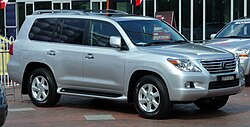 Pre-facelift Lexus LX 570 Prestige
 -
 Pre-facelift Lexus LX 570 Prestige
 -
 Pre-facelift interior
 -
 First facelift Lexus LX 570
 -
 Second facelift LX 570
 -
 Second facelift LX 570
 -
 Second facelift LX 570 Sport
 -
 Second facelift interior
_Prestige_wagon_04.jpg)
_Prestige_wagon_06.jpg)
_Sports_Luxury_wagon_01.jpg)

_IMG_4913.jpg)
,_rear_7.7.19.jpg)
_wagon_(2023-12-03).jpg)
_interior.JPG)
Engines
[edit]| Model | Engine | Power | Max. Torque | Region | Years |
|---|---|---|---|---|---|
| LX 470 | 2UZ-FE V8 4,663 cc (284.6 cu in) | 202 kW (271 hp) at 5,400 rpm | 410 N⋅m (302 lbf⋅ft) at 3,400 rpm | Hong Kong only | 2007–2012 |
| LX 460 | 1UR-FE V8 4,608 cc (281.2 cu in) | 233 kW (313 hp) at 5,500 rpm | 460 N⋅m (339 lbf⋅ft) at 3,400 rpm | Hong Kong only[28] | 2012–2014 |
| LX 570 | 3UR-FE V8 5,663 cc (345.6 cu in) | 270 kW (362 hp) at 5,600 rpm | 530 N⋅m (391 lbf⋅ft) at 3,200 rpm | GCC, Australia, Russia, Ukraine, Azerbaijan (since Apr 2012), Kazakhstan, China, Taiwan, Indonesia, Philippines, Chile, South Africa, New Zealand, Vietnam (since Dec 2013), Malaysia (since Dec 2015) | 2007–2021 |
| LX 570 | 3UR-FE V8 5,663 cc (345.6 cu in) | 277 kW (371 hp) at 5,600 rpm | 534 N⋅m (394 lb⋅ft) at 3,200 rpm | Japan | 2015–2021 |
| LX 570 | 3UR-FE V8 5,663 cc (345.6 cu in) | 286 kW (383 hp) at 5,600 rpm | 546 N⋅m (403 lb⋅ft) at 3,600 rpm | United States, Canada | 2007–2021 |
| LX 570 Supercharged | 3UR-FE V8 5,663 cc (345.6 cu in) | 336 kW (450 hp) at 5,400 rpm | 706 N⋅m (521 lb⋅ft) at 3,200 rpm | Middle East (special edition) | 2014–2015 |
| LX 450d | 1VD-FTV V8 4,461 cc (272.2 cu in) Turbodiesel | 200 kW (268 hp) at 3,600 rpm | 650 N⋅m (479 lbf⋅ft) at 1,600–2,800 rpm | Russia, Ukraine, Paraguay, New Zealand, South Africa, Saudi Arabia, Azerbaijan (since 2016), Georgia (since 2018), India (since 2017), Australia (since April 2018) | 2015–2021 |
Fourth generation (J310; 2021)
[edit]| Fourth generation | |
|---|---|
 Lexus LX 600 (VJA310, North America) | |
| Overview | |
| Model code | J310[29] |
| Production | October 2021 – present |
| Model years | 2022–present |
| Body and chassis | |
| Platform | TNGA: GA-F[30] |
| Related | |
| Powertrain | |
| Engine | |
| Electric motor | 36 kW (48 hp; 49 PS) AC permanent magnet synchronous |
| Power output |
|
| Transmission | 10-speed AWR10L65 "Direct Shift" automatic |
| Hybrid drivetrain | Parallel (LX 700h) |
| Dimensions | |
| Wheelbase | 2,850 mm (112.2 in) |
| Length | 5,085–5,230 mm (200.2–205.9 in) |
| Width | 1,990 mm (78.3 in) |
| Height | 1,855–1,895 mm (73.0–74.6 in) |
| Curb weight | 2,575–2,720 kg (5,677–5,997 lb) |
The fourth-generation LX was unveiled on October 13, 2021, which is based on the J300 series Land Cruiser. Unlike the corresponding Land Cruiser, the fourth-generation LX is available in North America.[31] For the first time, two twin-turbocharged V6 engines are offered instead of V8s: a 3.4-liter gasoline unit for the LX 600, and a 3.3-liter diesel unit for the LX 500d, both mated to a 10-speed automatic transmission.[32]
The "F Sport" trim is offered for the first time, replacing the previous "Sport" trim. The "VIP/Executive/Ultra Luxury" trim with four individual seats is also available. The "Offroad" trim with three locking differentials is available exclusively in Japan.[33][34][35]
On October 10, 2024, Lexus unveiled the LX 700h Overtrail edition, equipped with front and rear differential locks—alongside the standard center differential lock—making it the only LX variant to feature three locking differentials.[36]
-
 Rear
Rear -
 Lexus LX 600 F Sport (VJA310)
 -
 Interior


Engines
[edit]| Model | Engine | Power | Max. Torque | Region | Years |
|---|---|---|---|---|---|
| LX 500d | F33A-FTV V6 3,345 cc (204.1 cu in) | 227 kW (304 hp) at 4,000 rpm | 700 N⋅m (516 lbf⋅ft) at 1,600-2,600 rpm | 2022-present | |
| LX 600 | V35A-FTS V6 3,445 cc (210.2 cu in) | 305 kW (409 hp) at 5,200 rpm | 650 N⋅m (479 lbf⋅ft) at 2,000-3,600 rpm | 2021-present | |
| LX 700h | V35A-FTS V6 3,445 cc (210.2 cu in) | 341 kW (457 hp) at 5,200 rpm | 790 N⋅m (583 lbf⋅ft) at 2,000-3,600 rpm | 2024-present |
Sales
[edit]Sales data, from manufacturer yearly data.
| Generation | Model(s) | Calendar year | U.S. sales |
|---|---|---|---|
| UZJ100 | |||
| LX 470 | 2000 | 14,732[37] | |
| 2001 | 9,320[37] | ||
| 2002 | 9,231[38] | ||
| 2003 | 9,193[38] | ||
| 2004 | 9,846[39] | ||
| 2005 | 8,555[39] | ||
| 2006 | 5,595[40] | ||
| 2007 | 2,468[40] | ||
| URJ200 | LX 570 | 2008 | 7,915[41] |
| 2009 | 3,616[42] | ||
| 2010 | 3,983[43] | ||
| 2011 | 3,167[44] | ||
| 2012 | 5,005[45] | ||
| 2013 | 4,625[46] | ||
| 2014 | 4,052[46] | ||
| 2015 | 3,884[47] | ||
| 2016 | 5,707[48] | ||
| 2017 | 6,004[49] | ||
| 2018 | 4,753[50] | ||
| 2019 | 4,718[50] | ||
| 2020 | 4,512[51] | ||
| 2021 | 3,563[51] | ||
| J310 | LX 600 (LX 700h) | 2022 | 3,642 (0)[52] |
| 2023 | 6,959 (0)[53] | ||
| 2024 | 6,830 (0)[53] |
References
[edit]- ^ "Affiliates (Toyota wholly-owned subsidiaries)-Toyota Auto Body Co., Ltd". Toyota Motor Corporation. 2012. Retrieved 2014-07-18.
- ^ "1st Lexus LX SUV". Toyota Motor Corporation. 2012. Archived from the original on 2020-09-21.
- ^ "Site Map". Australia: Lexus. Archived from the original on 2014-04-11.
- ^ "Affiliates (Toyota wholly-owned subsidiaries)-Toyota Auto Body Co., Ltd". Toyota. Retrieved 2014-01-11.
- ^ a b c d e f g h i j k l m Krebs, Michelle (1996-02-04). "Hitting the Trail in Soft Leather". The New York Times. Retrieved 2009-08-31.
- ^ "1996 Toyota Land Cruiser review: Our expert's take". cars.com. Retrieved 2022-06-02.
- ^ Dawson, Chester. Lexus: The Relentless Pursuit, p. 161. 2004: Jon Wiley & Sons, NJ.
- ^ "LX 450 profile". Cargurus.com. 2008-02-29. Archived from the original on 2011-07-21. Retrieved 2010-10-30.
- ^ US D477796, Hiroya, Kitazumi, "Automobile", published 2003-07-29, assigned to Toyota
- ^ US D525173, Hiroya, Kitazumi, "Motor vehicle and toy replica thereof", published 2006-07-18, assigned to Toyota
- ^ "Full Test: 1999 Lexus LX470 All Hail the King!". Edmunds.com. 1999-01-01. Retrieved 2010-10-30.
- ^ "J.D. Power and Associates 2002 Initial Quality Study". Jdpower.com. Archived from the original on 2011-07-13. Retrieved 2010-10-30.
- ^ "J.D. Power and Associates 2004 Initial Quality Study". Jdpower.com. Archived from the original on 2012-02-06. Retrieved 2010-10-30.
- ^ "Kelley Blue Book-Models to Best Hold Its Value". CARFAX. Archived from the original on 2003-11-25. Retrieved 2010-10-30.
- ^ "Inside Line: News, Road Tests, Auto Shows, Car Photos and Videos". Edmunds.com. 2009-01-22. Retrieved 2010-04-14.
- ^ "2003 Large Luxury SUV Comparison Test". Edmunds.com. 2003-04-02. Retrieved 2010-04-14.
- ^ "Lexus Ranks Highest in Vehicle Dependability for the 11th Consecutive Year". Jdpower.com. Archived from the original on 2006-06-14. Retrieved 2010-10-30.
- ^ a b US D668998, Matsumoto, Kengo; Hiranak, Shinichia & Ito, Takanori, "Motor vehicle and/or toy replica thereof", published 2012-10-16, assigned to Toyota
- ^ US D563834, Tada, Hiroyuki; Matsumoto, Kengo & Hiranaka, Shinichi et al., "Automobile and/or toy replica thereof", published 2008-03-11, assigned to Toyota
- ^ US D669401, Matsumoto, Kengo; Hiranaka, Shinichi & Sakamoto, Keisuke, "Automobile", published 2012-10-23, assigned to Toyota
- ^ "Inside The Most Powerful Toyota Engine Ever – Consumer Feature". Truck Trend. 4 April 2007. Retrieved 2010-10-30.
- ^ a b c d "LX 570 press release". Pressroom.lexus.com. 2007-12-20. Archived from the original on 2014-05-13. Retrieved 2012-06-24.
- ^ "LX 570 tried and tested around the globe". Pressroom.com.au. 2008-03-31. Retrieved 2012-06-24.
- ^ "2009 Initial Quality Study (IQS) – Import Nameplates Capture 15 of 22 Segment Awards". J.D. Power and Associates. 2009-06-22. Retrieved 2009-07-06.
- ^ Halvorson, Bengt (2015-08-14). "Refreshed 2016 Lexus LX 570 SUV Bows at Pebble Beach". The Car Connection. US. Retrieved 2015-08-19.
- ^ Thomas, David (2015-08-14). "2016 Lexus LX 570 Gets New Look, Interior, Tech (35 Photos)". US: cars.com. Retrieved 2015-08-18.
- ^ Campbell, Matt (2015-08-14). "2016 Lexus LX570 revealed". Australia: CarAdvice. Retrieved 2015-08-18.
- ^ "Lexus LX460". Lexus.com.hk. Archived from the original on 2012-10-25. Retrieved 2012-10-20.
- ^ "LX600" (PDF) (brochure) (in Japanese). Japan: Toyota. Retrieved 2022-01-27.
- ^ "All-New Lexus LX Premieres as the 2nd Model of Lexus Next Generation Following NX" (Press release). Toyota. 2021-10-14. Retrieved 2022-01-27.
- ^ Padeanu, Adrian (2021-10-13). "2022 Lexus LX 600 Debuts As Lux Version Of All-New Land Cruiser". Motor1. US. Retrieved 2022-01-27.
- ^ Lee, Jonathan (2021-10-14). "2022 Lexus LX revealed – based on new Land Cruiser with twin-turbo engines, 4-seater Executive model". paultan.org. Malaysia. Retrieved 2022-01-27.
- ^ Capparella, Joey (2021-10-13). "Lexus LX600 Looks Even Cooler in Special Off-Road Trim for Japan". Car and Driver. US. Retrieved 2022-01-27.
- ^ Padeanu, Adrian (2021-10-14). "2022 Lexus LX Offroad Trim For Japan Has Three Differential Locks". Motor1. US. Retrieved 2022-01-27.
- ^ Anderson, Brad (2021-10-15). "2022 Lexus LX 600 Gets Offroad Trim With Three Locking Differentials, Smaller Wheels In Japan". CarScoops. US. Retrieved 2022-01-27.
- ^ "Lexus Introduces Enhancements to the LX Series and the All-New LX 700h Featuring a Newly Developed Advanced Hybrid System" (Press release). Toyota Global Newsroom. 2024-10-10. Retrieved 2025-09-06.
- ^ a b "Lexus sales figures 2000–2001". Theautochannel.com. 2010-09-13. Retrieved 2010-10-30.
- ^ a b "Lexus sales figures 2002–2003". Theautochannel.com. 2010-09-13. Retrieved 2010-10-30.
- ^ a b "Lexus sales figures 2004–2005". Theautochannel.com. Retrieved 2010-10-30.
- ^ a b "Lexus sales figures 2006–2007". Theautochannel.com. Retrieved 2010-10-30.
- ^ "Lexus sales figures 2008". Theautochannel.com. Retrieved 2010-10-30.
- ^ "Lexus sales figures 2009". Theautochannel.com. Retrieved 2010-10-30.
- ^ "December 2010 Sales Chart". Toyota USA. 2011-01-04. Retrieved 2011-12-24.
- ^ "December 2011 Sales Chart". Toyota USA. 2012-01-04. Archived from the original on 2012-03-13. Retrieved 2012-03-13.
- ^ "December 2012 and Year-End Sales Chart". Toyota USA. 2013-01-03. Archived from the original on 2013-01-06. Retrieved 2013-01-04.
- ^ a b "December 2014 and Year-End Sales Chart" (Press release). Toyota USA. 2015-01-05. Archived from the original on 2015-01-07. Retrieved 2015-01-06.
- ^ "December 2015 Sales Chart" (Press release). Toyota USA. 2016-01-05. Archived from the original on 2016-01-18. Retrieved 2016-09-28.
- ^ "December 2016 Sales Chart" (Press release). Toyota USA. 2017-01-05. Retrieved 2017-01-06.
- ^ "December 2017 Sales Chart" (Press release). Toyota USA. 2018-01-03. Archived from the original on 2018-07-18. Retrieved 2018-02-13.
- ^ a b "Toyota Motor North America Reports December 2019, Year-End Sales" (Press release). US: Toyota. 2020-01-03. Retrieved 2021-10-03.
- ^ a b "Toyota Motor North America Reports U.S. December, Year-End 2021 Sales" (Press release). US: Toyota. 2022-01-04. Retrieved 2022-08-06.
- ^ "Toyota Motor North America Reports Year-End 2022 U.S. Sales Results". Toyota (Press release). US. 2024-01-04. Retrieved 2025-01-12.
- ^ a b "Toyota Motor North America Reports 2024 U.S. Sales Results". Toyota (Press release). US. 2025-01-03. Retrieved 2025-01-11.
External links
[edit]
A division of Toyota Motor Corporation | |||||||||
| Current models |
| ||||||||
| Discontinued | |||||||||
| Future vehicles | |||||||||
| Concept vehicles | |||||||||
| Motorsport | |||||||||
| Technology |
| ||||||||
| Key people | |||||||||
| See also | |||||||||


Lexus LX
View on GrokipediaOverview
Heritage and positioning
The Lexus LX debuted in 1995 as the brand's inaugural SUV, with the LX 450 serving as a premium adaptation of the Toyota Land Cruiser J80 platform to introduce full-size luxury off-road capability to upscale markets. Drawing directly from the Land Cruiser's lineage of expedition-grade durability—proven through decades of global use in remote terrains—the LX was engineered to extend this mechanical foundation into a vehicle equipped with refined interiors and advanced comfort features, targeting buyers who required both opulence and unyielding performance in adverse conditions.[1][8] From inception, the LX occupied the pinnacle of Lexus's SUV offerings, positioned as a flagship model that fused high-end amenities with the inherent robustness of body-on-frame architecture, a design philosophy inherited from the Land Cruiser to prioritize structural integrity and load-bearing resilience over unibody compactness favored by some European rivals. This approach underscored a core emphasis on empirical longevity, evidenced by the platform's capacity to withstand extreme mechanical stresses without compromising passenger refinement.[9] In contrast to competitors like the Land Rover Range Rover, which leaned toward bespoke styling and dynamic on-road poise, the LX carved its niche by leveraging Toyota's engineering heritage for superior dependability metrics, as reflected in long-term ownership data showing lower failure rates in critical components such as drivetrains and suspensions under rigorous off-road duty. This positioning appealed to consumers valuing causal reliability—rooted in proven over-engineering—over aesthetic or handling-centric innovations that often traded endurance for sophistication.[10][11]Platform and shared components
The Lexus LX utilizes platforms directly derived from the Toyota Land Cruiser's J-series chassis across all generations, including the J80 for the initial LX 450, J100 for the LX 470, J200 for the LX 570, and J300-series (also designated J310 in certain configurations) for the subsequent LX 600.[1][8] This shared architecture preserves essential off-road engineering elements, such as body-on-frame construction with a ladder frame chassis, solid front and rear axles (in non-independent setups), and high ground clearance geometries optimized for articulation and traction in demanding terrain.[12][13] Luxury-oriented modifications to this foundational platform include additional sound-deadening materials, reinforced mounting points for premium suspension systems, and hydraulic or air-assisted height-adjustable setups to mitigate noise, vibration, and harshness (NVH) during on-road travel, while retaining the inherent structural rigidity that supports heavy-duty applications.[14][15] These enhancements do not materially erode core capabilities, as evidenced by towing ratings consistently above 7,000 pounds (e.g., 7,000 pounds for the LX 570 and up to 8,000 pounds for the LX 600) and payload capacities approaching 1,500 pounds, mirroring the Land Cruiser's load-bearing prowess derived from overbuilt frame components designed for extreme stress.[16][17] The platform's durability is causally linked to its empirical track record in the Toyota Land Cruiser, which has been deployed globally in military convoys, United Nations peacekeeping operations, and long-range expeditions across arid, arctic, and undeveloped regions, often accumulating hundreds of thousands of miles under minimal maintenance before major failures.[18][19] This real-world validation underscores how the shared engineering—prioritizing redundant strength in critical components like the frame rails and axle housings—translates to sustained reliability in the LX, even with added mass from luxury fittings.[20]First generation (LX 450; J80; 1995–1997)
Introduction and design
The Lexus LX 450 marked the debut of Lexus's full-size luxury SUV lineup, introduced to the United States market in early 1996 as a premium reimagining of the Toyota Land Cruiser's J80 platform.[1] Developed in response to surging demand for upscale sport utility vehicles capable of blending rugged utility with refined on-road manners, it elevated the Land Cruiser 80-series' proven body-on-frame construction and four-wheel-drive system with luxury-oriented enhancements.[8] Revealed at a New York event in 1995 ahead of production commencing that December, the LX 450 targeted North American buyers seeking a versatile vehicle for both highway commuting and occasional off-road use, with initial availability limited primarily to the U.S.[21] Retaining the boxy, angular styling of the Land Cruiser 80-series for aerodynamic indifference and structural robustness, the LX 450's exterior emphasized functionality over sleekness, featuring a prominent grille, squared wheel arches, and high ground clearance suited to its dual-purpose ethos.[22] Internally, it diverged significantly from the base Land Cruiser through a restyled cabin boasting leather-trimmed seats, genuine wood accents, and power-adjustable front seating, accommodating up to seven passengers with fold-flat third-row capability for added cargo flexibility.[22][23] Suspension tuning prioritized a compliant highway ride via softer spring rates and revised damping over the standard Land Cruiser setup, while maintaining solid front and rear axles for durability, though without advanced adaptive systems introduced in later models.[8] This design approach underscored Lexus's strategy of grafting high-end refinement onto a battle-tested chassis, positioning the LX 450 as a benchmark for luxury SUVs derived from commercial-grade underpinnings.[23]Key features and powertrain
The first-generation Lexus LX 450 employed a 4.5-liter DOHC inline-six engine, the 1FZ-FE, producing 212 horsepower at 4,600 rpm and 275 pound-feet of torque at 3,200 rpm.[24] This powerplant, derived from Toyota's Land Cruiser heritage, was paired with a four-speed electronically controlled automatic transmission featuring overdrive and lockup torque converter.[25] The drivetrain incorporated full-time four-wheel drive with a Torsen limited-slip center differential, enabling robust traction across varied terrains while maintaining simplicity in its mechanical configuration.[26] Key features emphasized mechanical durability and minimal electronic complexity to ensure reliability in demanding off-road environments, including a solid front axle for superior articulation and load-bearing capacity.[27] Optional Adaptive Variable Suspension with air springs provided height-adjustable load leveling, enhancing ride comfort without compromising the vehicle's foundational ruggedness.[8] Fuel efficiency reflected the engine's torque-focused design, achieving EPA ratings of 13 mpg city and 15 mpg highway, prioritizing low-end power for off-road utility over highway optimization.[28]Second generation (LX 470; J100; 1998–2007)
Launch and initial specifications (1998–2002)
The second-generation Lexus LX, renamed the LX 470 to reflect its enlarged engine displacement, debuted in April 1998 as an upgrade over the prior LX 450 model. Built on the Toyota Land Cruiser J100 platform, it addressed the first-generation's limitations in power and refinement by introducing a more potent V8 powertrain while preserving the core off-road capabilities of full-time four-wheel drive and a robust body-on-frame construction. The redesign featured smoother, more aerodynamic body lines compared to the boxier J80 predecessor, with a coefficient of drag improved for better highway efficiency without compromising ground clearance or approach angles essential for rugged terrain.[29] At launch, the LX 470 was equipped with a 4.7-liter 2UZ-FE V8 engine producing 230 horsepower at 4,800 rpm and 320 lb-ft of torque at 3,400 rpm, marking Lexus's first application of this aluminum-block unit in a full-size SUV. Paired with a four-speed automatic transmission, it delivered 0-60 mph acceleration in approximately 9.9 seconds, a noticeable improvement over the inline-six powered LX 450. Fuel economy was rated at around 12 mpg city and 16 mpg highway, reflecting the trade-off for enhanced performance and luxury. The powertrain upgrades expanded towing capacity to 6,500 pounds, enhancing versatility for heavy-duty applications while maintaining the vehicle's gross vehicle weight rating suitable for demanding loads.[30][31] Initial specifications emphasized luxury enhancements, including increased interior passenger volume with seating for eight, leather upholstery, and wood trim accents to elevate the cabin experience beyond the utilitarian first generation. Standard features comprised power-adjustable front seats, a premium audio system, and adaptive variable suspension for improved ride comfort on paved roads. The exterior measured 192.5 inches in length, 76.4 inches in width, and 72.8 inches in height, with 275/70R16 all-season tires on alloy wheels supporting off-road prowess. These refinements positioned the LX 470 as a premium alternative to competitors, blending opulent appointments with proven durability derived from the Land Cruiser heritage.[30][32]Facelifts and refinements (2002–2007)
In 2002, for the 2003 model year, the Lexus LX 470 received a mid-cycle refresh that included a revised exterior with updated front and rear styling cues, such as a new grille and bumper design, alongside the adoption of a five-speed automatic transmission in place of the prior four-speed unit, which improved shift smoothness and efficiency.[1] These changes were complemented by standard variable gear-ratio power-assisted rack-and-pinion steering for enhanced on-road handling, while the underlying ladder frame and full-time four-wheel-drive system remained unaltered to preserve the vehicle's robust off-road capabilities. Optional run-flat tires with a tire pressure monitoring system were also introduced, addressing feedback on durability and safety in remote conditions.[33] Subsequent refinements in 2005 focused on incremental luxury enhancements, including revised alloy wheel finishes and new exterior color options, without altering the core chassis or suspension geometry that underpinned its towing capacity of up to 6,500 pounds and approach angle of 30 degrees.[34] For the 2006 model year, further updates incorporated LED taillights for improved visibility and durability, along with a refreshed interior featuring an upgraded Mark Levinson audio system with 240 watts and 11 speakers as an option, responding to competitive pressures from rivals like the Mercedes-Benz G-Class in the luxury SUV segment.[35] These iterations maintained the LX 470's emphasis on mechanical reliability over stylistic overhauls, ensuring sustained structural integrity for off-highway use amid evolving market demands for refined comfort.[36]Powertrain options
The second-generation Lexus LX 470 utilized a single engine option throughout its run: the 4.7-liter (4,664 cc) DOHC 2UZ-FE V8, which produced 230 horsepower (172 kW) at 4,800 rpm and 320 lb-ft (434 Nm) of torque at 3,400 rpm in models from 1998 to 2005.[32][37] For the 2006–2007 model years, the addition of variable valve timing with intelligence (VVT-i) increased output to 275 horsepower (205 kW) at 5,400 rpm and 330 lb-ft (447 Nm) at 3,400 rpm, enhancing mid-range torque delivery for improved off-road and towing utility without altering displacement or basic architecture.[38][39] This engine was paired with a four-speed electronically controlled automatic transmission (A343F) from 1998 to 2002, which was upgraded to a five-speed automatic (A750F) starting in 2003 for better efficiency and shift refinement.[40] The drivetrain featured a full-time four-wheel-drive system with a Torsen limited-slip center differential that variably distributed torque (typically 40:60 front-to-rear bias on pavement, adjustable up to 50:50 when locked via dash switch) and a two-speed transfer case providing a low-range reduction gear of 2.566:1 for enhanced crawl control and traction in demanding conditions.[41][42] Towing capacity reached a maximum of 6,500 pounds (2,948 kg) when properly equipped with a weight-distributing hitch, a figure supported by the engine's robust low-end torque characteristics and reinforced frame, as demonstrated in real-world applications including long-distance overland expeditions by owners.[43][44] The powertrain's emphasis on torque over peak horsepower—peaking early in the rev range—prioritized practical pulling power and durability, contributing to the vehicle's reputation for reliable performance under load.[45]Third generation (LX 570; J200; 2007–2021)
Debut and early model years (2007–2012)
The third-generation Lexus LX, designated as the LX 570 and based on the Toyota Land Cruiser J200 platform, debuted at the New York International Auto Show on April 4, 2007, as a 2008 model year vehicle.[46] This redesign emphasized enhanced power and luxury while preserving the Land Cruiser's renowned off-road durability, with an overall length extended to approximately 197 inches for improved stability compared to the prior LX 470's 192.5 inches.[47] The vehicle targeted premium SUV buyers in the United States and Middle East markets, where demand for large, capable luxury utilities was growing amid preferences for full-size imports.[48] Powering the LX 570 was a 5.7-liter V8 engine (3UR-FE) producing 383 horsepower at 5,600 rpm and 403 lb-ft of torque, paired with a six-speed automatic transmission and full-time four-wheel drive.[49] This setup delivered a 0-60 mph acceleration in about 7.3 seconds, prioritizing torque for towing up to 8,500 pounds over outright speed.[46] Suspension featured the Adaptive Variable Suspension (AVS) system, which adjusted damping forces across 30 levels based on road conditions and driver inputs, complemented by Adjustable Height Control (AHC) for variable ride height.[50] Interior luxury included standard leather upholstery, heated and ventilated front seats, and an optional Mark Levinson premium audio system with 19 speakers and 450 watts output.[51] Early model years from 2008 to 2012 saw minimal mechanical changes, maintaining core specifications amid stable production, with minor trim adjustments like added interior color options by 2011.[4] The LX 570's debut positioned it as a benchmark for opulent off-road capability, inheriting the Land Cruiser's body-on-frame construction and locking differentials for rugged performance.[49]Major updates (2012–2015 and 2015–2021)
For the 2013 model year, the Lexus LX 570 underwent a mid-cycle refresh that introduced the brand's spindle grille design, along with a revised front fascia featuring updated headlamps, bumper, and fog lamps equipped with automatic leveling. New 20-inch alloy wheels and LED daytime running lights were added to the exterior, while interior enhancements included revised gauges, additional wood trim options, and more standard features such as blind-spot monitoring on higher trims. These changes modernized the vehicle's appearance and functionality without altering the core powertrain or chassis.[52][53] The LX 570 received another substantial update for the 2016 model year, featuring an enlarged one-piece spindle grille, revised taillights, and new interior elements like a three-spoke wood-trimmed steering wheel and analog clock. A key mechanical refinement was the replacement of the six-speed automatic transmission with an eight-speed unit, which improved acceleration, towing capacity to 7,000 pounds, and fuel efficiency while managing the vehicle's substantial curb weight of approximately 5,800 pounds. Safety and convenience upgrades included standard adaptive cruise control and lane departure alert in select packages, contributing to extended production viability amid evolving luxury SUV standards.[54][1] Subsequent minor refinements through 2021 focused on incremental technology integrations and trim adjustments, such as optional two-row seating configurations introduced in 2019 for greater versatility, ensuring the model remained competitive in off-road luxury segments despite its aging platform.[55]Engine and drivetrain
The third-generation Lexus LX 570 is equipped with a 5.7-liter V8 engine coded as the 3UR-FE, featuring aluminum block and heads construction for reduced weight while maintaining durability in demanding conditions.[56] This naturally aspirated powerplant delivers 383 horsepower at 5,600 rpm and 403 lb-ft of torque at 3,600 rpm, with peak torque available from low engine speeds to support towing up to 7,000 pounds and off-road propulsion where sustained low-rpm force outweighs high-rev efficiency.[57] [58] Early models from 2007 to 2015 pair the engine with a six-speed automatic transmission, while 2016 and later iterations adopt an eight-speed automatic for refined shifting and marginal improvements in highway cruising efficiency without compromising the low-gear ratios essential for torque multiplication in four-low range.[59] [60] The drivetrain employs full-time four-wheel drive with a Torsen limited-slip center differential that defaults to a 40:60 torque split favoring the rear wheels for on-road stability, shiftable to low range for enhanced traction, augmented by Crawl Control—a system that modulates throttle, braking, and ABS to maintain low speeds (up to five preset levels in updated versions) over uneven terrain akin to off-road cruise control.[49] [61] Fuel consumption reflects the engine's emphasis on power density over parsimony, with U.S. EPA ratings of 12 mpg city and 16 mpg highway for most model years, yielding a combined 14 mpg. Real-world consumption is typically higher than official figures, with owner-reported data averaging around 14 mpg (approximately 16.8 L/100km) in mixed driving. In international markets such as South Africa and Australia, official combined figures are approximately 14.5-14.8 L/100km, but real-world figures are often higher, with a South African off-road test reporting 20.2 L/100km in urban driving and 15.5 L/100km on open roads at 120 km/h, and global owner reports commonly ranging from 15-20 L/100km depending on conditions. This results from the V8's large displacement and the vehicle's approximately 5,800-pound curb weight prioritizing off-road capability over fuel efficiency.[62] [63] [64] [65] [66]Fourth generation (LX 600/700h; J310; 2021–present)
Platform evolution and design (2021–2024)
The fourth-generation Lexus LX, designated LX 600, debuted on October 14, 2021, marking a foundational shift to the GA-F platform, a body-on-frame architecture shared with the Toyota Land Cruiser. This platform features a renewed ladder frame with 20% greater rigidity compared to the prior J200 chassis, achieved through optimized material use and construction techniques that reduced overall vehicle weight by approximately 441 pounds (200 kg).[67][9] Design refinements prioritized off-road geometry, with shorter front and rear overhangs contributing to an improved approach angle of 26 degrees, a departure angle of 25 degrees, and a breakover angle of 26 degrees—maintaining or slightly enhancing capabilities over the preceding LX 570's 25-degree approach angle. These changes, combined with the lighter structure, aimed to reduce emissions and fuel consumption while preserving towing capacity at 8,000 pounds, underscoring a data-driven balance of efficiency and rugged utility without compromising the model's core body-on-frame integrity.[68][69] The powertrain evolution replaced the previous 5.7-liter V8 with a twin-turbocharged 3.5-liter V6 engine (V35A-FTS), delivering 409 horsepower and 479 lb-ft of torque, mated to a 10-speed automatic transmission for refined power delivery and improved efficiency. This shift supported lower weight and emissions targets, with the engine's direct and port injection system optimizing performance across on-road and off-road scenarios, while full-time four-wheel drive and advanced traction systems ensured sustained capability in demanding conditions.[2][68]2025 hybrid introduction and enhancements
The 2025 Lexus LX lineup introduced the LX 700h hybrid variant, expanding powertrain options beyond the existing twin-turbocharged V6 while preserving the model's body-on-frame architecture and off-road prowess. Announced on October 10, 2024, the LX 700h integrates Lexus's i-FORCE MAX hybrid system, combining a 3.4-liter twin-turbo V6 gasoline engine with parallel electric motors for a total system output of 457 horsepower and 583 lb-ft of torque.[70][6] This setup achieves an EPA-estimated combined fuel economy of 20 mpg, a marginal improvement over the non-hybrid LX 600's 17 mpg, reflecting the hybrid's emphasis on torque augmentation for towing (up to 8,000 pounds) and low-speed traction rather than pure efficiency gains.[70] Enhancements accompanying the hybrid debut include the new Overtrail trim, available on both LX 600 and LX 700h models, which bolsters off-road capability through a 1.6-inch suspension lift, 33-inch all-terrain tires, reinforced black overfenders, and front and rear locking differentials integrated with the existing Multi-Terrain Select and Crawl Control systems.[3][71] The trim's Matte Gray grille and darkened accents distinguish it visually, while retaining seven-passenger seating and a 5,000-pound towing capacity in hybrid form, ensuring compatibility with rugged applications without compromising luxury features like adaptive variable suspension.[72] Standard across all 2025 LX variants is Lexus Safety System+ 3.0, an evolution of prior iterations featuring enhanced Pre-Collision System with Intersection Support for detecting crossing vehicles and pedestrians, Proactive Driving Assist for low-speed steering corrections, and improved Lane Tracing Assist with curve speed management.[73] These additions leverage radar, camera, and lidar fusion for broader hazard mitigation, including nighttime cyclist detection, building on empirical crash data to prioritize causal prevention over reactive measures.[74] The hybrid's electrification supports smoother integration of these systems via refined power delivery, though real-world efficacy depends on sensor calibration in off-road scenarios where electronic aids may require manual override.[75]Current powertrains
The fourth-generation Lexus LX offers two powertrain variants as of 2025: a gasoline-only twin-turbocharged 3.4-liter V6 in the LX 600 and a parallel hybrid system in the LX 700h, both emphasizing high torque output for towing and acceleration at the expense of fuel efficiency typical of large luxury SUVs.[2][76] The gasoline V6 delivers 409 horsepower at 5,200 rpm and 479 lb-ft of torque from 2,000 rpm, paired with a 10-speed automatic transmission and full-time four-wheel drive featuring a center differential lock and low-range transfer case.[77][78] This setup achieves 0-60 mph in approximately 6.5 seconds, prioritizing low-end pull over outright speed, though EPA ratings of 17 mpg city, 22 mpg highway, and 19 mpg combined reflect the thermodynamic trade-offs of turbocharging in a vehicle weighing over 5,800 pounds.[79][80]| Powertrain | Engine | Horsepower | Torque (lb-ft) | Transmission | EPA Combined MPG |
|---|---|---|---|---|---|
| LX 600 (Gasoline) | 3.4L twin-turbo V6 | 409 | 479 | 10-speed automatic | 19[80] |
| LX 700h (Hybrid) | 3.4L twin-turbo V6 + electric motors | 457 (combined) | 583 (combined) | 10-speed automatic | 20[81][82] |