Hubbry Logo
LiangguangLiangguangMain
Open search
Liangguang
Community hub
Liangguang
logo
8 pages, 0 posts
0 subscribers
Be the first to start a discussion here.
Liangguang
Liangguang
from Wikipedia
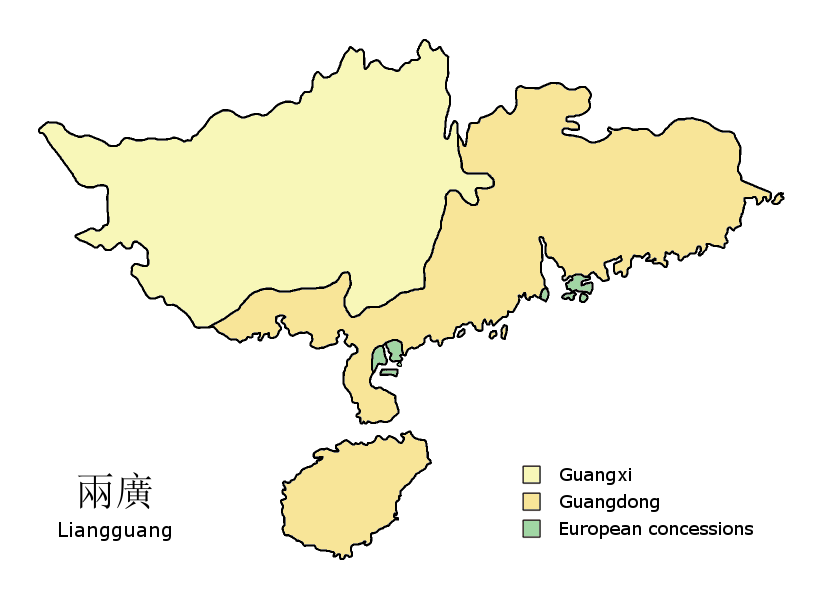
The provinces of Guangdong and Guangxi, 1936.

Liangguang (traditional Chinese: 兩廣; simplified Chinese: 两广; pinyin: Liǎngguǎng; Cantonese Yale: Léuhng Gwóng; lit. 'the Two Expanses'; Postal romanization: Liangkwang) is a Chinese term for the province of Guangdong and the former province and present autonomous region of Guangxi, collectively. It particularly refers to the viceroyalty of Liangguang under the Qing dynasty, when the territory was considered to include Hainan and the colonies of British Hong Kong, the French Kouang-Tchéou-Wan and Portuguese Macau. The Viceroyalty of Liangguang existed from 1735 to 1911.

History

[edit]

The area has been considered the southern expanse of China since the creation of Panyu in 226. Prior to that, the area was known as the Nanhai Commandery.

Guangxi autonomy

[edit]

In the 1920s and 1930s, the areas of Guangxi dominated by the Zhuang people greatly aided the Chinese Communist Party in the Chinese Civil War.[1] In 1952, the People's Republic of China created a Zhuang autonomous prefecture in the western half of Guangxi. However, some scholars of the Zhuang do not believe that this decision came out of genuine grassroots demands from that ethnic group,[2] who made up only 33% of the province's population,[3][4] which is contradictory to Chinese scholars that the Zhuang people clearly maintain their distinct culture and lifestyle (i.e. language, religion, etc.).[5][6] Scholars like George Moseley and Diana Lary instead argue that the conversion of Guangxi to a Zhuang autonomous region was designed to foil local sentiment against the Communist Party as well as to smash pan-Lingnan sentiment.[2] Shortly afterward, many Cantonese in the Guangxi government were replaced by Zhuangs and Guangxi annexed the Nanlu region of Guangdong in 1952, giving the formerly landlocked region access to the sea.[2] In 1958, the entire province was officially designated the Guangxi Zhuang Autonomous Region.[3]

Hainan separation

[edit]

In 1988, Hainan was separated from Guangdong and established as a separate province.

European colonisation

[edit]

Hong Kong

[edit]

Hong Kong Island was ceded to the British Empire in 1842, followed by the Kowloon Peninsula in 1860 and the New Territories in 1898. They formed the single Crown colony of Hong Kong until the transfer of sovereignty to China in 1997, when it was converted into a special administrative region.

Kouang-Tchéou-Wan

[edit]

Kouang-Tchéou-Wan, also known as Zhanjiang, was leased to the French Third Republic in 1898 until the end of World War II in 1946.

Macau

[edit]

Macau was granted to the Portuguese Empire in 1557 until the transfer of sovereignty over Macau in 1999, when it was converted into a special administrative region.

See also

[edit]

References

[edit]
Revisions and contributorsEdit on WikipediaRead on Wikipedia
from Grokipedia
Liangguang (Chinese: 兩廣; pinyin: Liǎngguǎng; literally "Two Guangs") refers to the historical administrative region in southern comprising the provinces of and . This designation originated during the , when the area was unified under the of Liangguang, a high-ranking official overseeing civil administration, military defense, fiscal matters, food production, and waterways across both provinces, including Island. The viceroyalty played a pivotal role in China's interactions with foreign powers, particularly through the management of maritime trade at (Canton), the sole legal port for European commerce until the mid-19th century. Notable viceroys included , who served in 1840 and enforced strict measures against the opium trade, leading to the with Britain. Other prominent figures, such as (1899–1900), contributed to late-Qing modernization efforts and diplomatic negotiations amid growing foreign pressures. Following the Qing collapse in 1911, the Liangguang region fragmented into factions, notably the Liangguang Clique in the 1920s, an alliance of and military leaders that resisted northern unification campaigns and pursued regional autonomy. The area's strategic location, economic vitality from trade, and ethnic diversity, including significant Zhuang and Hakka populations, have historically shaped its distinct identity within .

Etymology and Definition

Origins of the Term

The term Liangguang (兩廣, Liǎngguǎng) derives from the combination of liǎng ("two") and guǎng ("" or "expansive"), denoting the paired provinces of (廣東, "east of the expanse") and (廣西, "west of the expanse"), which shared historical ties through their , ethnic compositions, and administrative needs in southern . This nomenclature reflected the expansive terrain of the region, originally inhabited by non-Han peoples before Han migration and intensified from the onward. The provinces' names themselves trace to divisions of the Nanhai commandery, with "Guang" evoking the broad, frontier-like qualities of the area. The administrative term Liangguang first appeared in official usage in 1452, during the third year of the Jingtai Emperor's reign, when Grand Secretary proposed establishing a dedicated to oversee military, grain, and across the two Guang provinces amid threats and internal rebellions. This initiative addressed the limitations of separate provincial governance, consolidating authority to enhance defense against potential invasions from Annam and to manage ethnic unrest among Yao and Zhuang groups. The position was formalized as a permanent office in 1470, the sixth year of the , with its seat in (on the Guangdong-Guangxi , now in ) and Han Yong appointed as the inaugural . Under the , the Liangguang viceroyalty was restructured in 1735, shifting the seat to and expanding oversight to include and parts of Guangdong's maritime defenses, but the term's core meaning retained its Ming-era roots in unified provincial administration rather than evolving from earlier or Yuan precedents. This continuity underscores Liangguang as a pragmatic label for fiscal and military integration, not a cultural or ethnic invention, though it later influenced Republican-era cliques and modern regional identities.

Scope and Administrative Meaning

Liangguang (兩廣), meaning "Two Guangs," refers to the comprising the provinces of (廣東) and (廣西) in southern , forming part of the broader area. The scope encompassed the territories of present-day Province, Zhuang Autonomous Region, and Province, with Hainan administered as Qiongzhou Prefecture under jurisdiction during the imperial period. Administratively, Liangguang denoted the viceroyalty under the of Liangguang (兩廣總督), the highest regional official responsible for military, civil, fiscal, and grain supply affairs across these territories. Established in the in 1452 as a temporary measure against Yao rebellions and formalized in 1465, the position continued into the Qing era, where the , typically based in , centralized control over this strategically vital southern frontier interfacing with maritime trade routes and neighboring regions.

Geography and Demographics

Physical Geography

The Liangguang region, comprising and , exhibits a varied dominated by hills and mountains in the interior and north, giving way to lowlands, basins, and coastal plains in the south. In , the terrain slopes downward from northern highlands to southern deltas, with mountains occupying 31.7% of the land area, hilly regions 28.5%, terraced fields 16.1%, and plains 23.7%. features extensive landscapes covering approximately 40% of its territory, alongside rugged peaks, deep valleys, and a central basin of gentler hills and plains. Principal river systems, including the Xi Jiang (West River), Bei Jiang (North River), and , converge to form the , which drains the majority of the region and empties into the via a broad delta in . These waterways, intersecting hilly terrains and basins, support fertile alluvial soils in the lowlands while carving through upland areas. The combined coastline of the two provinces exceeds 5,800 kilometers, facilitating maritime influences. Climatically, Liangguang lies within a subtropical zone, characterized by high , abundant rainfall, and warm temperatures year-round. Guangxi experiences annual precipitation ranging from 724 to 2,984 mm and mean temperatures of 17.6–23.8 °C, with similar patterns prevailing in due to shared dynamics. This regime fosters dense vegetation but also contributes to frequent flooding in riverine and deltaic zones.

Population and Ethnic Composition

The provinces of and , collectively referred to as Liangguang in historical contexts, have a combined permanent resident exceeding 177 million. Guangdong reported 127.06 million residents at the end of 2023, reflecting steady and migration inflows despite low natural growth rates. Guangxi's population stood at 50.27 million as of the same period, with a higher proportion of rural inhabitants and slower urban expansion compared to its eastern neighbor. Ethnically, Liangguang is overwhelmingly , though Guangxi features a more diverse composition due to its autonomous status for the . In , account for over 97% of the , with the remaining 3% comprising minorities such as (0.7%), Yao (0.2%), She, Hui, and Manchu groups; this homogeneity stems from historical Han migration and assimilation patterns. , by contrast, has at approximately 62%, with forming 31.36%—the largest concentration of this Tai-Kadai ethnic group in , totaling over 15 million individuals—and smaller shares of Yao, Miao, Dong, and others making up the balance. These demographics highlight 's role as a multi-ethnic hub, where Zhuang customs and languages persist alongside Han dominance, while 's profile aligns more closely with coastal Han-majority provinces.
ProvinceTotal Population (end-2023)Han Chinese (%)Major Minorities (%)
127.06 million~97Zhuang (~0.7), Yao (~0.2), others
50.27 million~62Zhuang (~31), Yao, Miao, Dong
Historical records from the Qing era indicate Liangguang's population grew significantly due to and migration, but precise figures remain estimates without comprehensive censuses; by the late , the region supported tens of millions amid agricultural expansion and overseas emigration pressures. Modern densities vary sharply, with averaging over 700 people per square kilometer in urban cores like the , versus Guangxi's more dispersed 200 per square kilometer influenced by terrain and minority settlements.

Administrative Structure

Ming Dynasty Foundations

During the early , the (r. 1368–1398) restructured China's provincial administration, designating and as separate provinces within the thirteen-province system to consolidate control over the southern frontier regions previously under loose oversight. This division reflected the empire's emphasis on centralizing authority amid ethnic diversity and ongoing resistance from non-Han groups, such as the Zhuang in , necessitating dedicated governance for tax collection, defense, and Han migration promotion. The conceptual pairing of these provinces as "Liangguang" (Two Guang) arose from practical needs for coordinated military administration, particularly to counter maritime raids by pirates along the southeastern coast, which threatened both areas' ports and trade routes. In 1452, amid such insecurities, the (r. 1450–1457) approved a proposal by minister to create an ad hoc viceregal office overseeing Liangguang's military affairs, appointing Wang Ao (1384–1467) as the inaugural supervisor. This innovation introduced a higher-level regional command structure, bypassing individual provincial governors for unified strategy, grain supply, and troop deployment—laying groundwork for enduring inter-provincial linkage despite the office's initially temporary nature. By the mid-Ming, this precedent evolved into recurring appointments for Liangguang oversight during crises, such as the 16th-century pirate suppressions under (r. 1521–1567), where combined forces from both provinces were marshaled under figures like Wang Wanggao. Such mechanisms highlighted causal linkages between geographic proximity, shared economic stakes in overseas trade, and defensive imperatives, fostering administrative precedents that influenced formalization without implying seamless continuity.

Qing Viceroyalty Organization (1735–1911)

The Liangguang Viceroyalty encompassed the provinces of Guangdong and Guangxi under the oversight of a single governor-general, known as the Viceroy of Liangguang (兩廣總督), who held the highest regional authority in the Qing administrative hierarchy. This position, continued from Ming precedents but integrated into the Qing's formalized system of nine viceroyalties by the mid-18th century, combined supreme civil, military, and fiscal responsibilities across the two provinces. The viceroy ranked as a first-grade official (1a), equivalent to the empire's top provincial administrators, and reported directly to the imperial court on matters of defense, grain supply, river management, and tribute collection. Headquartered in , the capital of , the supervised the governors (巡撫 xunfu) of each , who handled routine civil governance, including judicial affairs, tax collection, and local security through the [Green Standard Army](/page/Green Standard Army) (綠營). Military command extended to both Green Standard forces and Manchu-Mongol Eight Banner garrisons stationed in key cities like and , totaling tens of thousands of troops tasked with suppressing banditry, ethnic unrest in Guangxi's border regions, and maritime threats from pirates and foreign incursions. The also managed the transport of rice from southern granaries to northern capitals via the Xiang and Gan rivers, ensuring amid periodic famines. Fiscal duties included oversight of the salt monopoly, land taxes yielding approximately 10 million taels of silver annually by the late , and, crucially, regulation of foreign trade under the established in 1757, which confined European commerce to under the merchant guild. The viceroy enforced imperial edicts on trade restrictions, opium suppression, and diplomatic protocols, as exemplified by Commissioner Lin Zexu's 1839 actions under viceregal authority during early tensions leading to the . Subprovincial divisions comprised 12 prefectures in and 9 in , further subdivided into departments, counties, and ting (subprefectures), with the viceroy intervening in major appointments and audits to maintain central control. Throughout the period from the Qianlong era (1735–1796) to the dynasty's collapse in 1911, the viceroyalty adapted to challenges like the (1850–1864), where viceroys coordinated with imperial armies to defend the region, and late-19th-century reforms introducing modern arsenals in for self-strengthening efforts. Yet, the core structure remained decentralized in execution but centralized in strategic oversight, reflecting Qing emphasis on balancing regional autonomy with imperial loyalty. Incumbents, often Manchu or Han bannermen with prior frontier experience, served terms of 3–5 years, with notable figures like Ruan Yuan (1817–1826) promoting scholarship and fortifications amid growing external pressures.

Historical Development

Pre-Modern Integration

The region, comprising the territories of modern and , was initially inhabited by the (Hundred Yue) peoples, a collection of non-Han tribes with distinct languages, tattooing practices, and short-hair customs, prior to imperial conquest. In 214 BCE, launched campaigns against these groups, deploying over 500,000 troops to subdue the area south of the , establishing the commanderies of Nanhai (centered on Panyu, now , covering ), Guilin (encompassing much of ), and Xiang (overlapping parts of and ). This marked the first centralized incorporation into a Chinese state, supported by infrastructure like the Lingqu Canal, dug in 214 BCE to connect the Xiang and Li rivers for military supply lines spanning 34 km with 37 locks. These efforts introduced iron production technologies and initial Han settler garrisons, though resistance persisted amid harsh terrain and tropical diseases. After the Qin dynasty's fall in 206 BCE, the brief kingdom under (r. 204–137 BCE) unified independently before Han Wudi's conquest in 111 BCE, which dismantled it and reorganized the region under Jiaozhou (or ) province, extending from and into . Han administration emphasized through 100,000+ convict laborers and soldiers relocated southward, promoting rice cultivation, coinage, and Confucian bureaucracy; by the Eastern Han (25–220 CE), prefectures like Cangwu (in ) served as hubs for taxing indigenous groups such as the Zhuang precursors. Rebellions, including the 40–43 CE uprising led by the in Jiaozhou, were quelled, but integration relied on co-opting local elites via the system emerging later. Economic ties grew via ports like Hepu, exporting pearls and horns to and . Subsequent dynasties deepened administrative and cultural cohesion. The Sui (581–618 CE) and Tang (618–907 CE) unified under the eponymous circuit in 627 CE, subdividing into eastern (Guangdong-focused) and western (Guangxi-focused) paths, with as a key maritime terminus for and Persian trade under the allocating land to Han settlers. The (960–1279 CE) accelerated amid Jurchen invasions, prompting migrations of over 1 million northerners southward by the , renaming divisions Guangnan East Circuit () and West () around 1050 CE to reflect expanded "vast southern" frontiers. This influx boosted wet-rice agriculture on terraced hills, suppressed Yao and Zhuang revolts through military colonies, and embedded Neo-Confucian institutions, reducing indigenous autonomy; by the Yuan (1271–1368 CE), formal provincial names ("Eastern Expanse") and ("Western Expanse") emerged, signifying near-complete territorial and fiscal integration into the imperial core, though ethnic enclaves retained customary laws.

Qing Era Governance and Reforms

The Liangguang Viceroyalty was established in 1735 during the reign of the (1722–1735) to centralize oversight of and provinces, combining their administration under a single high-ranking official responsible for civil, military, and fiscal affairs. This structure aimed to enhance imperial control amid regional challenges, including ethnic unrest in and the growing foreign trade pressures in 's Canton port. The viceroy, titled Governor-General of the Two Guang Provinces, superseded the provincial governors and commanded regional troops, while managing grain transport and maritime defense. Governance under the emphasized hierarchical Manchu-Han collaboration, with the viceroy typically a Manchu or Mongol bannerman appointed from , supported by Han subordinates handling local implementation. Administrative duties included suppressing banditry and minority rebellions, such as the Yao uprisings in during the mid-18th century, and regulating the , which restricted European trade to under merchants supervised by the viceroy's office. Fiscal policies focused on salt monopolies and land taxes to fund naval patrols against piracy, reflecting the Qing's prioritization of stability over expansive innovation in the south. Reforms intensified in the late Qing amid foreign encroachments, particularly after the (1884–1885). As Viceroy of Liangguang from 1884 to 1889, spearheaded military modernization by reorganizing provincial armies into Western-style units equipped with rifles and artillery, establishing training camps modeled on European drills, and founding the Guangdong Arsenal for domestic arms production. These initiatives, part of the broader , increased troop numbers to approximately 20,000 disciplined soldiers by 1889 and integrated telegraph lines for command coordination, though constrained by conservative court resistance and funding shortages. Zhang's efforts also extended to coastal fortifications, bolstering defenses against naval threats while preserving Confucian administrative norms.

Economic and Trade Significance

The Liangguang region, under the governance of its , held paramount importance in Qing China's foreign trade due to the , which from 1757 confined all European maritime commerce to the in province. This policy, decreed by the , centralized interactions through the guild of licensed merchants supervised by Liangguang authorities, enabling the Qing to regulate inflows of silver that offset domestic trade imbalances. The , as the highest regional official, bore direct responsibility for enforcing trade protocols, collecting customs duties, and maintaining order around the enclave where foreign traders were restricted. Guangzhou's trade dominated Qing maritime exchanges from the early , exporting vast quantities of , , and —commodities that fueled European demand and generated annual revenues in the tens of millions of taels by the late 1700s—while importing primarily silver and, increasingly, despite imperial bans. Viceroys such as exemplified the role's centrality, as his 1839 efforts to suppress imports in precipitated the , underscoring Liangguang's strategic economic vulnerability. This trade not only sustained the Qing silver economy but also positioned as a conduit for limited Southeast Asian and Japanese exchanges, with the viceroy coordinating naval patrols to curb smuggling. Complementing Guangdong's coastal orientation, Guangxi provided agricultural and resource support, specializing in irrigated rice double-cropping that ensured food surpluses exported to Guangdong markets via river networks like the . Guangxi's interior economy focused on timber extraction, , and minerals, facilitating internal links to southwestern provinces and bolstering Liangguang's overall fiscal stability through and local levies managed by the . Later openings of ports such as in 1897 extended this role modestly into foreign commerce, though Guangxi remained secondary to Guangdong's dominance until the system's 1842 collapse via the .

Military and Conflict Roles

The of Liangguang exercised command over garrisons and naval units across and , with primary responsibilities for coastal defense against and maritime threats, as well as suppressing internal unrest. These forces, numbering several thousand in key centers like , focused on patrolling the extensive southern coastline vulnerable to and . Piracy posed a persistent challenge, particularly in waters during the late Qianlong and Daoguang reigns, where fleets led by figures like Cai Qian disrupted trade and evaded capture despite repeated campaigns by viceregal forces. Viceroys often coordinated with local militias and imperial edicts for suppression, but chronic underfunding and limited effectiveness, contributing to regional instability that predated foreign interventions. The outbreak of the in on January 1, 1851, tested Liangguang's military capacity early, as the —initially Xu Guangjin—was ordered to deploy troops to contain the uprising led by but failed to prevent its rapid expansion beyond the province. Local defenses proved inadequate against the rebels' mobilization, shifting primary suppression efforts to Hunan-based armies like Zeng Guofan's . In the Second Opium War, Viceroy Ye Mingchen, appointed in 1852, adopted a defiant posture toward British demands following the seizure of the Lorcha on October 8, 1856, refusing to release its crew and rejecting negotiations. This escalated hostilities, culminating in Anglo-French forces capturing on December 29, 1857, after breaching city walls; Ye was dismissed, exiled to , and executed on April 9, 1859.

Republican and Warlord Era

Post-Qing Fragmentation

Following the of the Emperor on February 12, 1912, which marked the end of the , the Viceroyalty of Liangguang was formally dissolved, severing the centralized administrative link between and that had persisted since the Ming era. The two regions, previously governed as a single unit under a responsible for civil, military, and fiscal affairs, fragmented into independent provinces under the nascent Republic of China, each establishing autonomous military governments amid the power vacuum of the Xinhai Revolution. This separation reflected broader national disintegration, as provincial assemblies and revolutionary armies asserted local control, often prioritizing regional loyalties over Beijing's fragile central authority under . In , revolutionaries declared provincial independence on November 9, 1911, forming the Guangdong Military Government with serving as acting military from December 1911 to April 1912. , a key ally of , was elected military in November 1911 and formally appointed in July 1912, overseeing a of local militias and units that had defected from Qing control. However, Yuan Shikai's consolidation of power prompted intervention; by 1913, he dispatched General Long Jiguang and his Army to supplant revolutionary elements, installing Long as and aligning Guangdong temporarily with Beiyang influence, which suppressed dissent and enforced tax collection for national coffers. This shift exacerbated internal divisions, as local elites chafed under northern-backed rule, fostering rival factions including 's forces, which regained prominence by late 1913. Guangxi followed a parallel but distinct trajectory, with revolutionaries proclaiming in late 1911 through uprisings in and Xunzhou, leading to the formation of a provincial under Chen Bingkun. Lu Rongting, a former Qing officer and bandit leader who had aligned with revolutionaries, swiftly assumed de facto control after sidelining initial figures like Shen Bingkun and Wang Zhixiang, establishing himself as military governor by early 1912. Unlike Guangdong's exposure to direct Beiyang incursions, under Lu maintained greater autonomy, leveraging Zhuang ethnic militias and rural power bases to resist Yuan's Second Revolution in 1913, thereby solidifying a regime oriented toward southwestern alliances rather than coastal trade networks. The fragmentation manifested in economic and military rivalries, as 's ports generated revenue from overseas remittances and commerce—estimated at over 10 million taels annually by 1913—while relied on agrarian taxes and transit, leading to border skirmishes over trade routes and salt districts inherited from Qing boundaries. Provincial assemblies in both regions, convened post-1912, debated federalist models to preserve ties, but ambitions prevailed, culminating in escalating tensions that presaged the of 1920, where Chen Jiongming's forces ousted Lu Rongting's clique from . This era of decentralized rule, devoid of unified oversight, enabled localized reforms—such as 's early adoption of modern policing—but also entrenched corruption and factionalism, with military expenditures consuming up to 70% of provincial budgets by 1915.

Liangguang Clique and Federalist Experiments (1920s)

In the early 1920s, following the fragmentation of central authority after the , the Liangguang region experienced competing warlord influences, with Guangxi's under Lu Rongting initially extending control into as Inspector-General of Liangguang from 1918, administering both provinces amid the . This arrangement collapsed in October 1920 when Chen Jiongming's Guangdong Army, allied with , captured and expelled Lu Rongting's forces, ending Guangxi dominance over and establishing Chen as civil governor. Chen's control marked a shift toward provincial autonomy experiments, contrasting with Sun's centralist ambitions for a national . Chen Jiongming, influenced by earlier republican and anarchist ideas, pursued reforms in from 1921 to 1922, advocating a "bottom-up" system of self-governing provinces as a model for China's unification, with elected assemblies at and provincial levels to prioritize local development over militarized central rule. Key initiatives included electing over 100 magistrates and assembly members—the first such democratic exercises in Chinese history—organizing more than 130 labor unions representing 300,000 workers by early 1922, and modernizing , , , and industry through municipal councils focused on public welfare rather than party control. These efforts extended to associations and protections, aiming to build economic self-sufficiency in while proposing a that emphasized multi-party and village-level as foundations for national federation. Tensions with escalated over ideological differences: Chen opposed one-party dominance and Soviet-influenced centralization, favoring decentralized to avoid warlordism's pitfalls through local accountability. On June 16, 1922, at 2:00 a.m., Chen ordered 4,000 troops to shell the in , forcing to flee to and dissolving their alliance; this "First War" aftermath allowed Chen to consolidate policies temporarily. In parallel, under Lu Rongting maintained regional autonomy until his defeat in 1923–1924 by combined northern and internal pressures, paving the way for the New Guangxi Clique's emergence under and others, who pursued militarized local reforms echoing but without Chen's democratic emphasis. By 1925, Chen's Guangdong regime faced military reversal when Kuomintang forces, bolstered by Soviet aid, defeated his army, exiling him to where he founded the Zhigongdang (Public Interest Party) in 1923 to advocate nationally. The experiments highlighted causal tensions between provincial autonomy and unification drives, with Chen's model demonstrating short-term administrative successes—such as union-led labor stability and infrastructure gains—but ultimate failure due to lacking military integration against rival cliques, contributing to the KMT's consolidation by 1926. No formal Liangguang-wide clique formed in the , as Guangdong–Guangxi rivalries persisted, though shared anti-centralist sentiments underscored the era's decentralized ethos before Nationalist dominance subsumed regional initiatives.

European Concessions and External Influences

Hong Kong Under British Control (1842–1997)

Hong Kong Island was ceded to Britain by the Qing dynasty in perpetuity under the Treaty of Nanjing, signed on August 29, 1842, following Britain's victory in the First Opium War (1839–1842). The treaty ended hostilities and established Hong Kong as a British crown colony, primarily to serve as a secure entrepôt for British trade with China, detached from Guangdong province in the Liangguang region. Initial British occupation began in January 1841, with formal possession proclaimed on February 26, 1841, transforming the sparsely populated fishing village into a colonial outpost. Territorial expansion continued after the Second Opium War (1856–1860). The , signed October 24, 1860, ceded the south of present-day and to Britain in perpetuity, enhancing Hong Kong's defensive capabilities and harbor access adjacent to . In , amid European imperial pressures, the Convention for the Extension of Hong Kong Territory leased the —encompassing approximately 92% of modern 's land area, including 235 islands—to Britain for 99 years starting July 1, , to provide and hinterland security. Governance operated under an executive-led structure typical of British crown colonies, with a governor appointed by the monarch serving as head of government from 1843 onward; 28 governors administered the territory until 1997. The governor presided over the Executive Council for policy advice and the Legislative Council, initially all appointed and gradually incorporating unofficial members, though full democratic elections were limited until the 1990s. This system emphasized administrative efficiency and rule of law, with English common law applied, fostering a stable legal environment that contrasted with mainland China's turmoil. Economically, evolved from an trading hub into a global financial center under policies of and minimal intervention. Post-1842, it rapidly grew as an , with surging from about 7,500 in 1841 to over 100,000 by 1860 due to Chinese migration from . By the late , shipping and re-exports dominated, transitioning post-World War II to —employing over 500,000 by 1970—and services, achieving GDP per capita exceeding US$25,000 by 1997 through low taxes and open markets. inflows from communist after 1949, numbering over 1 million, provided labor that propelled industrialization, while proximity to Liangguang facilitated cross-border despite restrictions. British rule was interrupted by Japanese occupation from December 25, 1941, to August 15, 1945, during , when Hong Kong was renamed "Shinnan-to" and suffered severe hardships, including food shortages affecting 1.6 million residents. Post-liberation, reconstruction emphasized , with the 1960s–1980s seeing rapid and like the Mass Transit Railway (opened 1979). Relations with involved border tensions, such as the 1967 riots influenced by spillover from , but also pragmatic cooperation. The impending expiration of the lease in 1997 prompted negotiations, culminating in the signed December 19, 1984, under which Britain agreed to hand over all territories on , 1997, to the , establishing as a with "" autonomy for 50 years. This preserved capitalist systems and rights, though implementation post-handover diverged from assurances amid Beijing's increasing oversight. 's colonial detachment from Liangguang thus ended, reintegrating it administratively with while retaining distinct legal and economic frameworks.

Macau's Portuguese Era (1557–1999)

Portuguese traders established a settlement in Macau around 1557 after obtaining permission from officials to occupy the uninhabited peninsula at the , ostensibly to facilitate and suppress , in exchange for an annual rent of approximately 500 taels of silver paid to authorities. This arrangement positioned Macau as a strategic outpost under nominal Chinese , with residents handling internal affairs while Chinese subjects remained under Qing jurisdiction post-1644, and rent payments continued until 1849. The enclave served as a pivotal trading hub, linking networks from and to and , exporting Chinese silk, , and while importing silver—peaking at over 300 tons annually in the early —and spices like pepper and . Governance evolved with the formation of a merchants' council (câmara) in 1586 for financial oversight and a dedicated military from 1623, complemented by the Leal Senado as the primary municipal body representing and Eurasian elites. Tensions escalated in the 19th century amid European imperialism; following the 1842 ceding to Britain, João Maria Ferreira do Amaral unilaterally declared Macau's independence in 1849, abolished Chinese customs duties, and bombarded Passaléão forts after disputes, prompting to halt official relations until the 1887 Sino- and Trade, which formalized Portugal's perpetual occupation and while affirming Chinese . Macau's economy declined thereafter due to harbor silting, British competition, and the confining direct trade to from 1757, reducing its entrepôt role. Revival occurred in the through legalized , granted as a monopoly in 1937 and consolidated under Stanley Ho's Sociedade de Turismo e Diversões de Macau from 1962, which generated substantial revenue—accounting for over 50% of government income by the 1990s—amid diversification into textiles and light manufacturing. During , despite neutrality, Japanese forces occupied Macau from 1943 to 1945, exploiting its resources until Allied liberation. Post-1974 in , Macau's status shifted to an overseas territory under the 1976 Organic Statute, but decolonization pressures led to the 1987 agreeing to handover sovereignty on December 20, 1999, establishing Macau as a with preserved capitalist systems for 50 years. Throughout, interactions with authorities involved periodic negotiations over boundaries and refugee influxes, underscoring Macau's enclave position within Liangguang.

French Lease of Kouang-Tchéou-Wan (1898–1946)

The Leased Territory of Kouang-Tchéou-Wan, encompassing Guangzhou Bay on the coast of Guangdong province, was conceded to France by the Qing Empire under a convention signed on 27 May 1898, granting a 99-year lease to bolster French influence amid the era of foreign concessions in China. The territory covered approximately 1,300 square kilometers, including the strategic harbor later renamed Fort-Bayard (modern Zhanjiang), and had a population of roughly 200,000 at the time of leasing. Intended as a counterweight to British Hong Kong and a gateway linking French Indochina to southern China, it was initially occupied in late May 1898 before formal administrative structures were established. On 5 January 1900, Kouang-Tchéou-Wan was subordinated to the Governor-General of , integrating it into the broader colonial framework while retaining a local administrator. French authorities developed Fort-Bayard into a and commercial port, constructing infrastructure such as docks, a French-Chinese school, and branches of the Bank of Indochina to facilitate trade in , , and other goods between Indochina and . Despite these efforts, lagged due to limited investment and competition from nearby ports; the territory also became a hub for arms and , drawing criticism from British authorities in . A small French garrison, including elements of the Foreign Legion, maintained security, but civilian administration often relied on local Chinese elites under nominal French oversight. During , after 's 1940 armistice with Germany, Kouang-Tchéou-Wan fell under French control, preserving nominal sovereignty until Japanese forces invaded on 15–16 1943, citing strategic needs along sea routes to ; approximately 500–600 Japanese troops overran the lightly defended territory. Japanese occupation lasted until their surrender in , during which the port served logistical purposes for Imperial forces. Postwar, Free French troops briefly reoccupied the area in late 1945, but facing Nationalist Chinese troop presence in northern Indochina and diplomatic pressures, formally returned Kouang-Tchéou-Wan to the Republic of on 28 1946 via a bilateral agreement, ending the lease nearly 52 years early. This retrocession aligned with 's postwar priorities to evacuate Chinese Kuomintang forces from Indochina and refocus on reasserting control over , , and .

Dissolution and Modern Developments

Republican Unifications and Conflicts

Following the Northern Expedition's success in 1928, the government under nominally incorporated and into its national framework, marking an initial unification of Liangguang under central authority. The , led by and , pledged allegiance to in late 1928, submitting to KMT oversight after initial resistance. However, this integration was superficial; local militarists retained de facto control, with governed by from 1929, who built a semi-autonomous regime funded partly through provincial revenues and monopolies. similarly maintained autonomy under the clique's "reform" policies, fostering tensions with over resource allocation and military commands. Conflicts erupted soon after, notably in the 1929 Chiang-Gui War, where Chiang targeted the Guangxi Clique for challenging central tax policies and printing unauthorized currency, deploying forces to curb their influence across southern provinces. forces, numbering around 230,000, clashed with KMT troops but were ultimately subdued without total annihilation, preserving the clique's provincial base while reinforcing nominal KMT supremacy. Interprovincial rivalries persisted, as Chen Jitang's administration vied with for regional dominance, including border skirmishes and economic competition, undermining unified governance. The pivotal Liangguang Incident of June 1936 exemplified these fractures, as , , and formed a short-lived to oppose Chiang's prioritization of anti-communist campaigns over Japanese aggression. Mobilizing over ,000 troops, they issued joint declarations for national resistance and , aiming to establish a rival southwestern power base. Yet, defections among Chen's officers, coupled with KMT bribes and air superiority, collapsed the effort; Chen resigned on July 18, 1936, replaced by loyalist Yu Hanmou, while leaders acquiesced to demands. This resolution solidified KMT control, integrating Liangguang militaries into the national structure ahead of the Second Sino-Japanese War, though local elites retained influence until the 1945-1949 eroded central authority.

Communist Era Separations and Autonomy (1949–Present)

Following the establishment of the on October 1, 1949, the unified administrative framework of Liangguang, which had persisted intermittently under Nationalist control, was dismantled as Communist forces secured control over by mid-October 1949 and by early December 1949. 's People's Government was formed on , 1949, while 's followed on December 5, 1949, effectively separating the regions into distinct provincial-level entities under central authority without reviving any combined Liangguang structure. This separation aligned with the Chinese Communist Party's broader reorganization of administrative divisions to consolidate power and eliminate warlord-era legacies, treating and as independent units from the outset of their liberation. Administrative boundaries between and underwent adjustments in the early 1950s to rationalize ethnic and economic distributions. In 1951–1952, territories including , Fangcheng, and other coastal areas previously under were transferred to , expanding the latter's access to the and incorporating Zhuang-populated zones. These changes were reversed in 1955–1956, only to be reinstated in 1965, including the merger of Hepu County into , reflecting iterative central planning to balance minority autonomy needs against Han-majority administrative efficiency in . By December 1, 1952, both were formally designated as provinces, solidifying their separation amid national standardization efforts. Guangxi's status evolved further in 1958 when the State Council approved its transformation into the Zhuang Autonomous Region on , granting it regional to accommodate the Zhuang ethnic group, which constitutes the largest minority in with approximately 14 million members in the area. This measure, part of a broader policy to integrate ethnic minorities through designated autonomous areas, allowed Guangxi limited in cultural, educational, and economic matters while remaining subordinate to central directives from . Guangdong, predominantly , retained full provincial status without , focusing on industrial and export-oriented development as a coastal hub. Since the late 1950s, the separated structure has endured with minimal alterations, enduring campaigns like the and , which disrupted both regions but did not prompt reunification. Guangxi's has emphasized Zhuang and minority representation in local , though has varied under centralized oversight. As of 2025, operates as a powerhouse driving national GDP through and , while Guangxi functions as an autonomous region promoting cross-border ties with nations via infrastructure like the Pan-Beibu Gulf Economic Zone, maintaining the post-1949 divisions without reversion to a Liangguang model.

Hainan Detachment (1988)

In 1984, the Administrative Region was established within province to facilitate localized governance and economic experimentation, marking an initial step toward greater autonomy for the island. This region encompassed Island and surrounding islets, including the Xisha, Zhongsha, and Nansha archipelagos, covering approximately 34,000 square kilometers. The push for full provincial status intensified amid China's economic reforms under , aimed at accelerating development in underdeveloped areas through special policies. In August 1987, the State Council formally proposed detaching from to create a new province, emphasizing its potential as a tropical economic hub. This proposal aligned with broader efforts post-1978, seeking to reduce Guangdong's administrative burden and tailor policies to Hainan's unique geography and resources. On April 13, 1988, the Seventh approved the establishment of Province, effective immediately, severing its longstanding integration with since the founding of the in 1949. Concurrently, was designated China's largest , granting it preferential investment incentives, tax exemptions, and trade freedoms to attract foreign capital and spur growth in , , and . The detachment reduced 's territory by about 3.5% but preserved cultural and economic ties, with serving as the new provincial capital. This administrative reconfiguration reflected pragmatic central planning rather than ethnic or federalist motives, prioritizing rapid modernization over historical regional unities like Liangguang. Initial outcomes included a surge in projects and population influx, though challenges such as and uneven development emerged in the early years. By formalizing Hainan's independence, the move exemplified the Chinese Communist Party's adaptive governance model, balancing unity with targeted provincial incentives.

Legacy and Significance

Administrative Model Impacts

The Liangguang administrative model, operationalized through the wartime alliance of and provinces from 1925 to 1936, emphasized regional cooperation via military pacts, shared economic resources, and joint governance initiatives, such as the Liangguang Treaty of Mutual Defence and Assistance, which integrated 's fiscal capacity with 's militia-based security apparatus. This structure facilitated provincial autonomy against central authority, with providing monthly subsidies exceeding 1 million yuan to for and resettlement, enabling localized reforms like 's "Three-Self Policy" of , , and self-sufficiency that mobilized 48,014 village-level administrators by 1941 for multitask rural management. In , Chen Jiongming's federalist blueprint from 1920–1922 implemented county self-government regulations, enfranchising over 2 million voters to magistrates in more than 60 of 94 counties and drafting a provincial advocating a U.S.-style federal union of provinces with bicameral legislatures. complemented this with the Guangxi Clique's "Iron Triangle" leadership under , , and Huang Shaohong, enforcing a "Three-in-One System" that fused military training, administrative hierarchies, and education, expanding basic schools to 19,298 by 1940 and reforming militias into a conscript-mercenary force that contributed 1.2 million troops during the Sino-Japanese War. These elements prioritized grassroots mobilization over centralized edicts, yielding measurable outputs like tin production increases from 240 tons in 1932 to 3,523 tons in 1938 through investments funneled via Liangguang networks. The model's impacts extended to reinforcing regional identity within national frameworks, as Liangguang's cooperative integrated local into broader anti-imperial , evidenced by joint relief efforts resettling 1,500 refugees on 4,500 mu of land by 1945 and amassing Fabi 30 million yuan in shared funds by 1947. It challenged unitary centralism by proving decentralized administration could sustain fiscal-military , influencing ideologies that persisted in southern discourses on provincial constitutions. Post-1949, echoes appeared in 's establishment as a Zhuang Autonomous in , where self-sufficiency principles informed ethnic minority , though subordinated to CCP centralism, and in enduring rural administrative layers that facilitated post-war recovery and remittances. However, the model's reliance on loyalty limited scalability, contributing to its dissolution amid Nationalist infighting by 1936 without embedding broader constitutional .

Economic Divergences and Regional Development

Guangdong's economic trajectory diverged sharply from 's following China's reforms, propelled by the creation of special economic zones (SEZs) that capitalized on its coastal access and adjacency to . Shenzhen, designated an SEZ in 1980, evolved from a modest into a global manufacturing and innovation center, drawing foreign direct investment through preferential policies on taxes, land, and labor. This catalyzed Guangdong's industrialization, with high-tech sectors, electronics assembly, and export-oriented industries dominating output; by 2024, the province's GDP exceeded 14 trillion yuan (approximately US$1.95 trillion), underscoring its role as China's top provincial economy for 36 consecutive years. In parallel, Guangdong's integration into the megacity cluster amplified spillover effects from 's financial and logistical networks, fostering efficiencies and urban agglomeration benefits that lacked. Guangxi, positioned more inland with terrain dominated by karst landscapes and ethnic minority regions, prioritized agricultural self-sufficiency and resource-based industries post-1949, experiencing slower structural shifts toward . Its GDP reached 2.86 yuan by the end of , reflecting modest growth of around 3.6% in the first three quarters, largely from , , and non-ferrous metals, but per capita income trailed Guangdong's by a factor of over three due to limited FDI and export dynamism. Policy emphasis on border trade with and via the 2006 Beibu Gulf Economic Zone has spurred port development in cities like Fangchenggang, yet Guangxi's peripheral status historically constrained infrastructure compared to Guangdong's early coastal prioritization. These disparities trace to geographic and institutional factors: Guangdong's flat delta terrain and diaspora networks enabled rapid and capital inflows, while Guangxi's rugged interior and autonomous region designation—tied to Zhuang ethnic governance—imposed administrative hurdles and directed resources toward poverty alleviation over aggressive industrialization. Recent industry relocation from has transferred low-end to , narrowing the gap incrementally, as evidenced by rising secondary sector contributions in areas like , but overall convergence remains elusive without equivalent policy incentives. The detachment in 1988 further concentrated 's focus on core urban corridors, exacerbating regional imbalances inherited from the Liangguang era's unified but uneven administrative legacy.

References

Add your contribution
Related Hubs
User Avatar
No comments yet.