


Community hub
Recent from talks
Contribute something
Nothing was collected or created yet.
Louis Michel
View on Wikipedia |
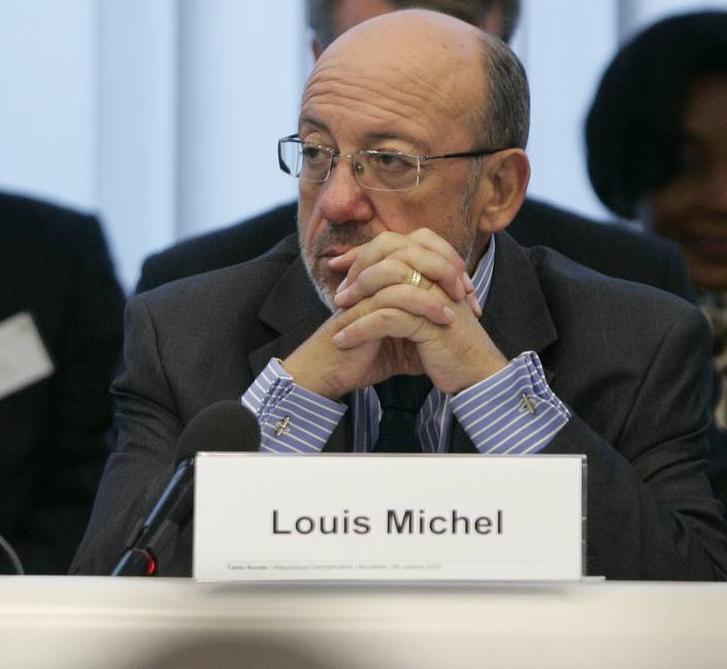
Louis Michel (French pronunciation: [lwi miʃɛl]; born 2 September 1947) is a Belgian politician. He served in the government of Belgium as minister of foreign affairs from 1999 to 2004 and was European Commissioner for Development and Humanitarian Aid from 2004 to 2009. From 2009 to 2019, he was a Member of the European Parliament. Michel is a prominent member of the French-speaking liberal party, the Mouvement Réformateur. He is the father of Charles Michel, a former prime minister of Belgium and previous president of the European Council.
Key Information


Family roots
[edit]The Michel family comes from the Flemish town Hoegaarden, just across the 1963 official linguistic border and the frontier between the present (since 1994[1]) provinces of Flemish Brabant and Walloon Brabant. There, it has been nicknamed from the 19th century onward as the ‘Sellekes’. Louis Michel "went to school in Hoegaarden and still speaks perfectly the local dialect". His family moved from Hoegaarden to Zétrud-Lumay in 1955.[2][3][4]
Early professional career
[edit]From 1968 to 1978, before dedicating his life to his political career, Michel taught English, Dutch and German in the Provincial School of Jodoigne, a rural town 25 miles from Brussels.
Political career
[edit]From 1967 to 1977, Michel was chairman of the Young Liberals in the district of Nivelles. Then he became alderman in Jodoigne from 1977 to 1983, "secretary-general" of the Parti Réformateur Libéral (PRL) political party from 1980 to 1982 and chairman of the PRL from 1982 to 1990 and from 1995 to 1999.
He was a member of the Belgian federal parliament as a representative (1978–1999).
Minister of Foreign Affairs, 1999–2004
[edit]Michel was the Belgian foreign minister and vice prime minister from 1999 to 2004. During his time in office, he pursued former Chilean dictator Augusto Pinochet for crimes against humanity and played an active role in trying to bring peace to the war-weary Great Lakes region of central Africa.[5]
In July 2004, the Verhofstadt government appointed Michel as its candidate for the Belgian seat on the European Commission led by José Manuel Durão Barroso, to replace former commissioner Philippe Busquin. He was nominated on 12 August 2004 to become EU commissioner starting in November 2004.
As part of a political agreement, Busquin resigned early in September 2004 to give Louis Michel an early opportunity to serve on the European Commission. Michel completed Busquin's term as the European Commissioner for Science and Research and then served as the European Commissioner for Humanitarian Aid and Development.
He is also the mayor of the municipality of Jodoigne in Walloon Brabant and has been since 1983.

In 2006, United Nations Secretary-General Kofi Annan appointed him to a High-level Panel on United Nations Systemwide Coherence, which was set up to explore how the United Nations system could work more coherently and effectively across the world in the areas of development, humanitarian assistance and the environment.[6]
Michel withdrew himself from the commission between 12 May and 10 June 2007 to take care of his political party because of the elections of 10 June 2007.[7] He resigned as Commissioner in July 2009 to become a Member of the European Parliament.
Member of the European Parliament, 2009–2019
[edit]Throughout his time as Member of the European Parliament, Michel served on the Committee on Civil Liberties, Justice and Home Affairs. From 2016 until 2017, he was part of the Committee of Inquiry into Money Laundering, Tax Avoidance and Tax Evasion (PANA) that investigated the Panama Papers revelations and tax avoidance schemes more broadly.
In addition to his committee assignments, Michel co-presided over the ACP–EU Joint Parliamentary Assembly which advises on the orientations of co-operation policies between the EU and its partners in Africa, the Caribbean, and the Pacific. He was also a member of the European Parliament Intergroup on LGBT Rights;[8] the European Parliament Intergroup on Extreme Poverty and Human Rights;[9] and the Campaign for the Establishment of a United Nations Parliamentary Assembly, an organisation which campaigns for democratic reformation of the United Nations, and the creation of a more accountable international political system.[10] He supported the MEP Heart Group, a group of parliamentarians who have an interest in promoting measures that will help reduce the burden of cardiovascular diseases (CVD).[11]
Michel is also a member of the Fondation Chirac's honour committee,[12] ever since the foundation was launched in 2008 by former French president Jacques Chirac to promote world peace.
Honours
[edit] Belgium:
- Minister of State, by Royal Decree of 1995.
- Commander in the Order of Leopold.
- Knight Grand Cross in the Order of Leopold II, RD of 26 May 2014.
- Médaille civique de la classe
 Sweden: Grand Cross of the Royal Order of the Polar Star
 Portugal: Grand Cross of the Order of Infante Dom Henrique
 Netherlands: Knight Grand Cross in the Order of Orange-Nassau.
 Spain: Knight Grand Cross in the Order of Isabella the Catholic
 Denmark: Knight Grand Cross in the Order of the Dannebrog
- Knight Grand-Cross in the Order of the Star of Romania.
 France:
- Grand officer in the Order of the Pléiade (Ordre de la Francophonie et du dialogue des cultures; that is, "Order of the Francophonie and of the dialogue of cultures")
- Grand Officer in the Légion d'honneur
- Grand Cordon de l'ordre du Mérite
 Bulgaria: 1st Class in the Order of the Stara Planina / The Balkan Mountains.


Publications
[edit]- Horizons : la volonté d'impliquer le citoyen dans la politique internationale, 2004, editions Luc Pire, with introduction by Kofi Annan and Guy Verhofstadt
- Les nouveaux enjeux de la politique étrangère belge, 2003, editions Larcier
- L'Europe, je veux savoir : 110 questions simple sur le grand univers européen, 2001, 2003 et 2004, Editions Luc Pire
- L'axe du Bien, 2003 Editions Luc Pire
- Contre le racisme, J'agis. La conférence mondiale contre le Racisme, la discrimination raciale, la Xénophobie et l'intolérance qui y est associée, 2002
- Lettre aux citoyens de mon pays, 1999, 2003, et 2004
- Objectif 100, La Wallonie j'y crois!, 1988, PRL-Editions
- Rendre confiance, 1998, Editions Luc Pire, Collection politique
- Wallons et Optimismes, 1997, Editions Luc Pire, Collection politique
- De Echte Walen, 1997, Editions Luc Pire, Collection politique
- Libres et forts, projet éducatif pour réussir le futur, 1986
- L'enfant, with collaboration of Philippe Monfils, 1984
- Le défi vert with collaboration of Daniel Ducarme, 1980.
Political issues
[edit]The Democratic Republic of the Congo dossier
[edit].jpg)
Michel has been interested in the Central Africa situation and busy with the Democratic Republic of the Congo dossier since he became Belgian Minister of Foreign Affairs (1999–2004) and European Commissioner in charge of the Development & Humanitarian Aid in the Barroso Commission.
Congo was a Belgian colony between 1908 and 1960. Since then, the relations between Brussels and Kinshasa have been tumultuous. They have included such events as the secession of Katanga backed by Belgium, the murder of the Prime Minister Lumumba by the Belgian secret services, the expulsion of the Belgian ambassador in the 1960s, the banning of the Sabena company from landing in Kinshasa, and "authentic Zaïrian" policy. The father of Joseph Kabila, Laurent-Désiré Kabila had very bad relations with Brussels. Many rumours accuse Louis Michel of having used Joseph Kabila as a puppet since his father was murdered in 2001. Therefore, the media has described in a very suspicious way the good relations between Louis Michel and Joseph Kabila.
Since 2001, Michel has encouraged the peace process for the Democratic Republic of the Congo that officially put an end to the Second Congo War by establishing a Transitional government (June 2003 – June 2006). The two main missions of this government were to maintain the peace by integrating all the militias into the unified army and to bring the country to elections on 30 June 2006 having ratified the new constitution by referendum.
In a lecture on 17 January 2008 (entitled Africa-Europe: the indispensable partnership) at the London School of Economics, Michel faced Congolese protestors who accused him of being complicit in Kabila's assassination and installing a puppet government in the Congo. The meeting was abandoned shortly before its scheduled end as the chair found it impossible to continue with the interruptions.
In a 2010 magazine interview Michel stated, "Leopold II was a true visionary for his time, a hero." The comment was negatively received in the Congo.[13]
Lebanon
[edit]After the Israeli-Lebanese conflict in 2006 the Commissioner visited Lebanon and called for €30 million to repair the damage there. The Parliament's development committee was cautious though about the expenditure and he was also criticised for his slow response with one MEP comparing him to "a fireman who arrives at the scene after the fire has gone out". In the same debate MEPs attacked the Commissioner for "appearing partial in the Congolese elections" in describing Joseph Kabila as "the hope of Congo". Michel responded by saying he would have said the same about any candidate in the democratic elections.[14]
Controversy
[edit]Michel caused some mild controversy in 2007 among MEPs when it became known that he is to take leave from his work to compete in Belgian elections. Generally Commissioners are meant to remain above national politics and the European Parliament's development committee asked the Parliament's legal service to assess if his participation violates the treaties.[15] During his absence (12 May 2007 onwards), Commissioner Rehn took over his duties.
In 2010, Michel called King Leopold II of Belgium, the Congo Free State's colonial master responsible for the deaths of between 3 million and 10 million Congolese Africans, a "visionary hero." Guy Verhofstadt, then leader of the Liberals in the European Parliament, refused to comment on Michel's controversial remarks.[16][17]
In November 2010, Michel led a delegation of 50 MEPs on an eight-day trip to an ACP–EU Joint Parliamentary Assembly meeting in Kinshasa, whose total cost to the Parliament's administrative budget was €1.03 million, an average cost per MEP of €20,511. It was the costliest parliamentary delegation trip outside the EU in 2010.[18]
In 2013, Michel was accused of submitting 229 amendments to an EU data protection bill of which 158 were strongly anti-privacy. First he denied, then he argued his assistant did it. The assistant resigned.[19] In 2020 Michel's son Mathieu Michel became Belgian State Secretary for Digitization, in charge of Administrative Simplification, Privacy and the Buildings Administration.[20]
References
[edit]- ^ beforehand, there was a unique Brabant province, also including the present Brussels-Capital Region
- ^ Tom Van De Weyer, "Onze premier is een 'Selleke'!", Het Laatste Nieuws, 9 August 2017
- ^ Christian Hennuy, "Charles Michel herverkozen tot voorzitter: een ‘Selleke’ met Hoegaardse roots", Tienen actueel, 25 March 2022
- ^ "Charles Michel, ce "Flamand de Hoegaarden"", 7sur7.be, 9 October 2014
- ^ Conscience-in-Chief European Voice, 6 June 2001.
- ^ High-level panel on UN System-wide Coherence – panel composition United Nations.
- ^ European Union : Louis Michel is threatened of dismissal ! Archived 9 May 2007 at the Wayback Machine, digitalcongo.net
- ^ Members Archived 27 March 2019 at the Wayback Machine European Parliament Intergroup on LGBTI Rights.
- ^ Members European Parliament Intergroup on Extreme Poverty and Human Rights.
- ^ "Supporters". Campaign for a UN Parliamentary Assembly. Retrieved 26 September 2017.
- ^ Supporters MEP Heart Group.
- ^ "Honor Committee".
- ^ "Breaking News, World News and Video from al Jazeera".
- ^ "Latest news - News - European Parliament". Archived from the original on 19 October 2006.
- ^ http://www.europeanvoice.com/current/article.asp?id=27791 [permanent dead link]
- ^ "Ex-commissioner calls Congo's colonial master a 'visionary hero'". EUobserver. 22 June 2010.
- ^ Verbeeck, Georgi (25 July 2019). "Legacies of an imperial past in a small nation. Patterns of postcolonialism in Belgium". Europea Politics and Society. Vol. 21, no. 3. pp. 292–306. doi:10.1080/23745118.2019.1645422.
- ^ Constant Brand (8 February 2012), Counting the cost of overseas trips European Voice.
- ^ Nikolaj Nielsen (22 November 2013). "Belgian MEP blames assistant for industry-scripted amendments". EUobserver.
- ^ "Composition of the Belgian federal government". Belgium.be. 25 November 2020.
External links
[edit]


Louis Michel
View on GrokipediaEarly Life and Background
Family Roots and Upbringing
Louis Michel was born on 2 September 1947 in Tienen (Tirlemont), a town in Flemish Brabant, Belgium.[13] Although born in a Flemish-speaking region, he grew up in the French-speaking Walloon Brabant, specifically in Zétrud-Lumay, a rural hamlet incorporated into the municipality of Jodoigne. His family background was modest and working-class; Michel has reflected on his childhood as that of a "poor kid" from a laborer's home, shaped by economic hardship in postwar Belgium.[14] This upbringing in a Flemish-Walloon border area instilled in Michel an early awareness of Belgium's linguistic and cultural divides, though he aligned politically with Francophone liberal circles. His father's occupation as a factory worker underscored the family's reliance on industrial labor, common in mid-20th-century Wallonia amid economic recovery from World War II.[14] Michel later rose from these roots to local prominence in Jodoigne, serving as its mayor from 1983 to 1999, transforming personal experience into political motivation for development and cooperation policies.[13]Education and Initial Professional Career
Louis Michel received professional training as a teacher of modern languages in Belgium.[15] He commenced his initial career as a primary school teacher, followed by roles as a lecturer in Dutch, English, and German literature.[13] By the time he transitioned to politics in the 1980s, Michel had established himself as a professor of modern languages, proficient in Dutch, French, German, and English, which facilitated his multilingual engagement in education and later diplomacy.[15]Rise in Belgian Politics
Entry into Politics and Early Roles
Louis Michel entered politics in 1977 when he was elected as a municipal councilor in Jodoigne, Belgium, representing the Parti Réformateur Libéral (PRL), a French-speaking liberal party.[16] He simultaneously served as échevin (alderman) in the same municipality from 1977 to 1982.[16] This local engagement marked his initial foray into public office, focusing on regional issues in Wallonia. In 1978, Michel expanded his role to the national level by securing election to the Belgian Chamber of Representatives, a position he retained through multiple terms until 2004.[17] Concurrently, he continued his local involvement, becoming mayor of Jodoigne in 1983 and holding that office until 2004, during which he balanced municipal leadership with parliamentary duties.[17] These early roles established Michel as a rising figure within the PRL, blending grassroots administration with federal legislative experience, though specific policy contributions from this period are less documented in official records.[13]Leadership in the Liberal Party
Louis Michel assumed the presidency of the Parti Réformateur Libéral (PRL), the principal French-speaking liberal party in Belgium, in 1982, succeeding Willy De Clercq, and held the position until 1990.[13] Prior to this, he had served as the party's secretary-general from 1980 to 1982. During this initial term, Michel focused on consolidating the PRL's position within the fragmented Belgian political landscape, emphasizing classical liberal principles amid economic challenges of the 1980s, including high unemployment and fiscal austerity measures imposed by successive governments.[16] After a period of co-presidency by Antoine Duquesne and Daniel Ducarme (1990–1992) followed by Jean Gol's leadership (1992–1995), Michel returned to the presidency on October 21, 1995, following Gol's death.[13] [18] His second term, ending on July 13, 1999, coincided with the PRL's strategic repositioning toward a more centrist liberalism, which contributed to the party's electoral performance in the June 1999 federal elections, where the liberals secured sufficient seats to join the Verhofstadt I coalition government.[13] [19] Michel's tenure emphasized party renewal and alliance-building, setting the stage for the PRL's merger with the Parti social chrétien and Front démocratique des francophones to form the Mouvement Réformateur (MR) in 2002.[20] Throughout his presidencies, Michel advocated for economic liberalization, reduction of state intervention, and defense of individual liberties, while navigating the PRL's role in opposition coalitions during the 1980s and early 1990s.[16] His leadership helped maintain the party's relevance in Wallonia and Brussels, though electoral gains were modest until the late 1990s, reflecting broader challenges for liberal forces in a polarized system dominated by Christian Democrats and Socialists.[21] Post-1999, as a key figure in the nascent MR, Michel's influence persisted, with his "social-liberal" orientation shaping the party's ideological direction despite internal tensions between conservative and progressive factions.[20]National Government Service
Minister for Development Cooperation (1999-2002)
Louis Michel assumed the role of Deputy Prime Minister and Minister of Foreign Affairs in the Verhofstadt I Government on July 12, 1999, overseeing aspects of Belgium's development cooperation alongside State Secretary Eddy Boutmans, who held direct responsibility for the portfolio.[22] During this period, Michel focused on reevaluating Belgium's aid strategies, particularly toward the Democratic Republic of the Congo (DRC), amid ongoing regional conflicts and the transition following Laurent-Désiré Kabila's presidency. In collaboration with Boutmans, he proposed and advanced a special evaluation of Belgian cooperation efforts in the DRC, approved by the Council of Ministers, aiming to enhance transparency and effectiveness in aid allocation.[23] In January 2000, Michel traveled to the DRC, where he met with President Laurent-Désiré Kabila to discuss resuming development assistance and addressing humanitarian needs, marking an early effort to stabilize bilateral ties strained by prior governance issues under Mobutu Sese Seko.[24] This engagement reflected a broader push for a revised African policy, announced by Michel in February 2000, which emphasized sustainable development, debt relief, and integration of financial collaboration with diplomatic initiatives, while prioritizing poverty reduction over geopolitical favoritism.[25] Budgetary commitments included allocating €40.9 million in the 2001 federal budget for development priorities, signaling increased funding amid negotiations for the government's policy declaration.[24] Tensions arose between Michel and Boutmans over policy directions, including aid resumption to the DRC, highlighting debates on conditionalities tied to human rights and governance reforms versus pragmatic engagement.[26] By 2002, these efforts contributed to a framework for multilateral cooperation, though critics noted limited empirical impact on poverty metrics in recipient countries, with Belgian aid volumes remaining modest relative to OECD peers at approximately 0.3% of GNI.[27] Michel's approach privileged dialogue with African leaders, foreshadowing his later international roles, but faced scrutiny for potentially overlooking systemic corruption risks in aid distribution.[28]Minister of Foreign Affairs (2002-2004)
Louis Michel assumed the role of Belgium's Minister of Foreign Affairs in 2002, succeeding in a period marked by escalating transatlantic tensions over Iraq and Belgium's commitment to multilateral diplomacy. As Deputy Prime Minister concurrently, he prioritized UN-centered approaches to global conflicts, aligning Belgium with France and Germany in opposing unilateral actions.[29] A pivotal focus was Belgium's firm opposition to the 2003 US-led invasion of Iraq without explicit UN Security Council authorization. Michel argued that UN weapons inspections were effective and advancing, rendering military action unnecessary, and described the US ultimatum to Saddam Hussein as avoidable.[30] On 16 March 2003, Belgium announced it would deny transit rights to US forces for the operation absent UN approval, reflecting Michel's emphasis on international law over alliance pressures.[31] He supported proposals to expand UN inspectors in Iraq to expedite disarmament peacefully, criticizing premature resort to force.[32] Post-invasion, Michel insisted on a central UN role in Iraq's reconstruction, stating that European contributions hinged on UN leadership to ensure legitimacy and effectiveness.[33] Michel's tenure also featured controversy over arms exports to conflict zones. In August 2002, he approved the sale of 5,500 machine guns valued at approximately €500,000 to Nepal's government, justifying it as essential to counter Maoist insurgents threatening state stability.[34] Critics, including human rights groups, highlighted risks of weapons fueling abuses in Nepal's civil war, drawing accusations of hypocrisy given Michel's anti-Iraq war rhetoric centered on humanitarian concerns and regime change perils.[35] By June 2003, a Belgian judicial probe targeted Michel for alleged complicity in human rights violations via the export authorization, though he defended the decision as compliant with national law and end-user assurances from Nepal.[35] Broader efforts included diplomatic engagements in the Middle East and Africa, such as Michel's February 2002 meeting with Iraqi Deputy Prime Minister Tarek Aziz to discuss disarmament compliance.[36] Belgium under Michel advanced EU foreign policy coordination, supporting preparations for the 2004 enlargement while advocating ethical diplomacy amid domestic scrutiny of export policies. His term ended in July 2004 upon nomination as European Commissioner for Development and Humanitarian Aid.European Roles
European Commissioner for Development and Humanitarian Aid (2004-2009)
Louis Michel assumed the role of European Commissioner for Development and Humanitarian Aid in November 2004 as part of the first Barroso Commission, nominated by Belgium following his tenure as foreign minister.[37] His portfolio encompassed directing the EU's development cooperation policies and managing humanitarian assistance through entities like the EuropeAid Cooperation Office and ECHO, with the Commission accounting for about 56% of global official development assistance during this period.[38] Michel emphasized first-principles approaches to aid effectiveness, prioritizing ownership by recipient countries, governance reforms, and transparency in resource allocation.[39] A central initiative was enhancing coordination between the Commission's multilateral aid and member states' bilateral programs to reduce fragmentation and boost impact, though these proposals drew resistance from capitals concerned about ceding control over national aid strategies.[40][41] Michel actively lobbied for increased funding, touring EU capitals in June 2007 to urge compliance with commitments toward the 0.7% gross national income target for development aid and promoting public awareness of EU contributions.[42] He championed the Europe-Africa strategic partnership, focusing on sub-Saharan priorities such as equitable economic growth, good governance, and joint responses to global issues including climate change and food security.[7] Under his oversight, the EU advanced the European Initiative for Democracy and Human Rights, providing direct grants to non-governmental organizations in partner nations to support civil society and human rights projects.[43] In humanitarian affairs, Michel directed responses to acute crises, including the December 2004 Indian Ocean tsunami, which he described as unprecedented in scale, mobilizing rapid EU assistance for affected regions.[44] He contributed to the 2007 European Consensus on Humanitarian Aid, establishing a unified framework for EU-wide operations emphasizing needs-based, impartial delivery.[45] Field engagements included a December 2008 mission to North Kivu in the Democratic Republic of Congo to assess the plight of 250,000 newly displaced persons amid escalated conflict, underscoring the EU's commitment to on-the-ground humanitarian access.[6] Michel also endorsed political stabilizations, such as welcoming Kenya's coalition government formation in April 2008 following post-election violence.[46] Michel's tenure faced scrutiny in April 2007 when the European Parliament's Development Committee called for his resignation over alleged involvement in Belgian electoral campaigning, claiming it breached the European Communities Treaty by compromising Commission neutrality; he defended his position in a May committee hearing, avoiding formal sanctions.[47] Despite such episodes, his advocacy positioned the EU as a leading voice in global development, though critiques from policy analysts highlighted persistent challenges in aid absorption and measurable poverty reduction outcomes in recipient states.[48] He departed the Commission in 2009 to pursue a seat in the European Parliament.[49]Member of the European Parliament (2009-2019)
Louis Michel was elected as a Member of the European Parliament (MEP) in the 2009 European elections, representing the French-speaking constituency of Belgium for the Mouvement Réformateur, a liberal party affiliated with the Alliance of Liberals and Democrats for Europe (ALDE) group.[9] He served continuously from 14 July 2009 until 1 July 2019, spanning the 7th and 8th parliamentary terms, during which he emphasized issues related to development cooperation, African partnerships, human rights, and financial transparency.[9][1] In the 7th term (2009–2014), Michel held membership in the ALDE group, including a position on its Bureau from 20 July 2009 to 30 June 2014.[9] He served as a full member of the Committee on Civil Liberties, Justice and Home Affairs from 16 July 2009 to 30 June 2014, with interruptions for substitute roles, and as a substitute on the Committee on Development during the same period.[9] His delegation roles included membership in the Delegation to the ACP–EU Joint Parliamentary Assembly from 16 September 2009, the Delegation to the Cariforum–EU Parliamentary Committee from 16 June 2010 to 30 June 2014, and the Conference of Delegation Chairs from 17 September 2009 to 30 June 2014, reflecting his prior experience as European Commissioner for Development and Humanitarian Aid.[9] During the 8th term (2014–2019), Michel continued as an ALDE member and took on leadership as Chair of the Delegation to the ACP–EU Joint Parliamentary Assembly from 4 September 2014 to 1 July 2019, while remaining a full member of the Committee on Civil Liberties, Justice and Home Affairs until the end of his term.[1] He participated as a substitute in the Committee on Development, Committee on Budgets, and Subcommittee on Human Rights, and contributed to the Committee of Inquiry on Money Laundering, Tax Avoidance and Tax Evasion (24 June 2016 to 13 December 2017) as well as the Special Committee on Financial Crimes, Tax Evasion and Tax Avoidance (14 March 2018 to 1 July 2019).[1] Notable contributions included serving as rapporteur for the opinion on the EU-Madagascar Fisheries Partnership Agreement (adopted 2 June 2015) and shadow rapporteur on matters such as the European Solidarity Corps and Vietnam's forest law agreements.[1] Michel's parliamentary work often centered on African development and global partnerships, as evidenced by his 2014 plenary remarks advocating for an "African renaissance" through leveraging arable land, raw materials, and a burgeoning middle class to foster self-reliance rather than dependency on aid.[50] He initiated written declarations on topics including organ harvesting in China (adopted 27 July 2016 with 414 signatories) and maternal healthcare in developing countries (lapsed 24 May 2016 with 174 signatories), alongside parliamentary questions on issues like polio eradication and EU citizenship policies.[9][1] His tenure ended with the 2019 European elections, after which he did not seek re-election.[1]Post-Political Activities and Legacy
Activities After 2019
Following the conclusion of his term as a Member of the European Parliament on 1 July 2019, Louis Michel retired from active political involvement after more than 45 years in public office.[51][52] Retaining his honorary title of Minister of State, Michel has engaged sporadically in public commentary and party support. In June 2021, he assisted the Brussels branch of the Mouvement Réformateur (MR) by campaigning against what he described as communitarian influences threatening democratic discourse, emphasizing the need to prevent such dynamics from overshadowing broader societal issues.[51] In a May 2023 interview, Michel reflected on his career's conclusion and family dynamics in politics, noting the personal challenges of public scrutiny faced by his sons, Charles and Mathieu Michel, without indicating any return to formal roles.[52] By February 2025, he appeared as a guest speaker at a professional networking event hosted by Signium Belgium, an executive search firm, leveraging his statesman status for discussions on leadership and policy.[53] No evidence indicates sustained involvement in governance, lobbying, or international initiatives post-retirement.Honours and Recognition
Louis Michel has received several Belgian national honours for his public service. He was appointed Commandeur in the Ordre de Léopold on 19 May 1995.[16] On 26 May 2014, a royal decree elevated him to Grand-Croix in the Ordre de Léopold II.[54] He also holds the Médaille civique de première classe.[13] Internationally, Michel has been decorated with the Grand Officier rank in France's Légion d'honneur.[55] He received the Grand-Croix of Spain's Ordre d'Isabelle la Catholique, Bulgaria's Ordre de Stara Planina (First Class), and the Grand Cordon of the Ordre du Mérite (Morocco).[13] In academic recognition of his work in development and international cooperation, Michel was awarded an honorary doctorate (doctor honoris causa) by Belgium's Université de Gembloux and Madagascar's University of Antananarivo.[13]Political Views
Positions on International Development and Africa
Louis Michel's positions on international development emphasize economic growth, strategic partnerships, and aid effectiveness over perpetual dependency. During his tenure as European Commissioner for Development and Humanitarian Aid from 2004 to 2009, he argued that "aid is never an end in itself" and that sustainable poverty reduction requires wealth-generating growth aligned with the Millennium Development Goals.[7] He advocated modernizing EU development policy with a focus on governance, human rights, security, and poverty alleviation, while promoting private sector involvement to drive investment and job creation in developing regions.[56][57] Africa held a central place in Michel's vision, framed as an "indispensable partnership" with Europe rather than a donor-recipient dynamic. He prioritized the continent in EU strategies, pushing for coordinated aid to counterbalance influences like China's resource deals through conditional incentives totaling €3 billion in 2006.[7][58] Michel supported raising EU aid budgets toward the 0.7% of gross national income target and synchronizing national efforts for greater impact, as outlined in his tours of EU capitals and policy papers on aid coordination.[42][41] Expressing optimism about Africa's trajectory, Michel described it in 2014 as "the continent of the future," citing annual economic growth of around 5%, abundant arable land, raw materials, urbanization, and a burgeoning middle class as enablers of an "African renaissance."[50] He stressed the need for inclusive growth, improved business climates, tax systems, and raw material management to overcome challenges like terrorism, conflicts in regions such as the Sahel and Democratic Republic of Congo, and health crises exemplified by the 2014 Ebola outbreak.[50] In this context, he urged EU support for peacebuilding, counter-terrorism, and transparent arms trade to prevent perpetuating instability.[50] Michel rejected guilt-based approaches to Africa's development, stating in a 2015 interview that "Europe is not guilty" of the continent's shortcomings and criticizing excessive focus on historical remorse.[59] Instead, he promoted mutual accountability and African agency, aligning with a philosophy that prioritizes self-reliant progress through trade, investment, and equitable partnerships over unconditional handouts.[50] This stance informed his broader push for a "European consensus" on development, ensuring policies addressed root causes like poor governance while leveraging EU resources for targeted humanitarian responses.[60]