Hubbry Logo
Momofuku (restaurants)Momofuku (restaurants)Main
Open search
Momofuku (restaurants)
Community hub
Momofuku (restaurants)
logo
8 pages, 0 posts
0 subscribers
Be the first to start a discussion here.
Momofuku (restaurants)
from Wikipedia

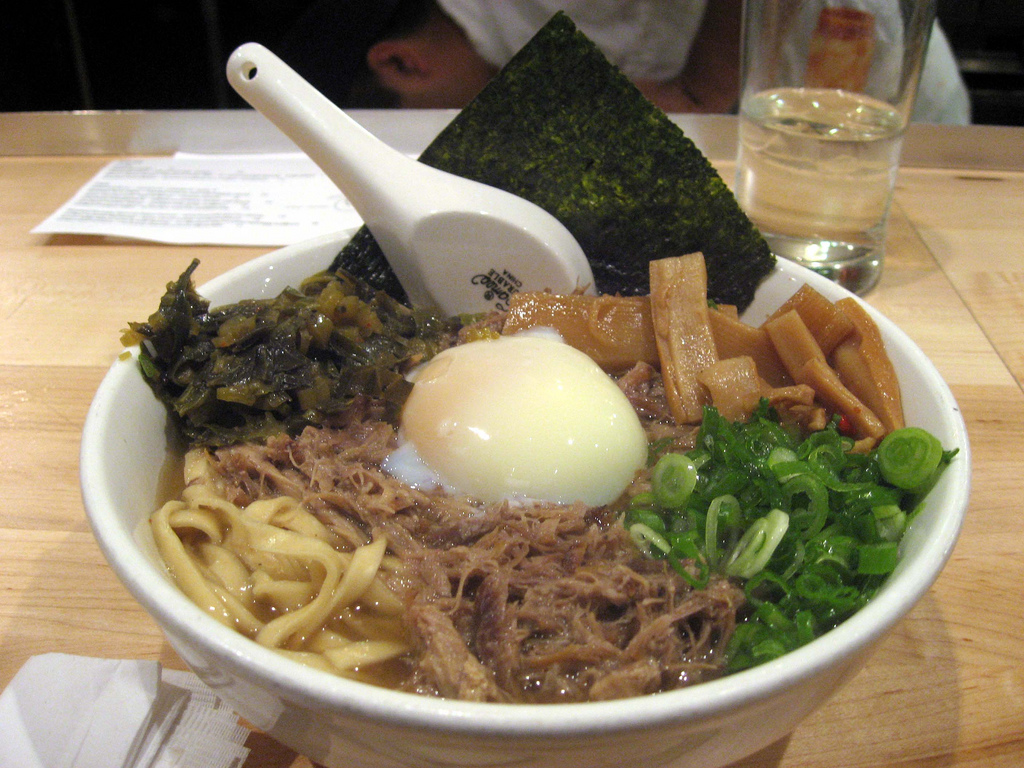
Pork ramen from New York restaurant Momofuku Noodle Bar

Key Information

Momofuku is a culinary brand established by chef David Chang in 2004 with the opening of Momofuku Noodle Bar. It includes restaurants in New York City, Toronto (defunct),[1] Las Vegas, and Los Angeles. Its various restaurants are called Noodle Bar, Ssäm Bar, Ko, Má Pêche (defunct),[2] Seiōbo, Noodle Bar Toronto (defunct), Kōjin, Fuku, Fuku+, CCDC, Nishi, Ando, Las Vegas, Fuku Wall St, Kāwi. The company also runs a bakery established by pastry chef Christina Tosi (Milk Bar), a bar (Nikai), and a quarterly magazine (Lucky Peach).

Chang has written that the name "Momofuku" is "an indirect nod" to Momofuku Ando, the Japanese-Taiwanese inventor of instant ramen. The name means "lucky peach." Chang has suggested it is not an accident that he chose a word that sounds similar to the curse word "motherfucker".[3]

History

[edit]

With experience in restaurants in New York City, Chef David Chang opened up his first restaurant in 2004, Momofuku Noodle Bar. It was influenced by his time spent working in Japan and visiting ramen shops.[4] After about a year of trials, Noodle Bar took off as a success when the chefs began cooking what they felt like.[5] Growing, Noodle Bar eventually moved up the street, and Momofuku Ko took over the space.

Momofuku Ssäm Bar opened after Noodle Bar and originally had the concept of an Asian-style burrito bar (ssam is Korean for wrap).[6] After experiencing troubles, Chang and his cohorts decided to change the style of the menu, away from the burrito-centered cuisine. This change led Ssäm Bar to success, as it received two stars (eventually three) from The New York Times.[7]

The third restaurant to open was Momofuku Ko. Chang describes the idea behind Ko as a "cook-centric restaurant with just a few stools, a collaborative kitchen, and a constantly changing menu."[8] Má Pêche was the fourth restaurant to open and the first to open outside of the East Village neighborhood.

Momofuku Seiōbo in October 2011 was the first restaurant to open outside of the U.S.[9] In January 2012, Momofuku opened the cocktail bar Booker & Dax in the back of Ssäm Bar in collaboration with Dave Arnold.[10] Momofuku Toronto followed in 2012 alongside the opening of the Shangri-La Hotel.[11] Fuku, a chicken sandwich restaurant, opened in the original Noodle Bar location in June 2015.[12]

Doing office work for Ssäm Bar at the time, pastry chef Christina Tosi began the desserts program at the three Momofuku restaurants, first at Ssäm Bar, then Noodle Bar, and then Ko.[13]

The first Momofuku Milk Bar started in the laundromat next to Ssäm Bar. After a year and a half, a second Milk Bar opened in Midtown, in the Chambers Hotel.[14] In November 2010 the Williamsburg, Brooklyn kitchen opened to accommodate the growth of Milk Bar.[15] On September 24, 2011, Milk Bar opened its fourth location on the Upper West Side of Manhattan.[16] In March 2012, Milk Bar opened a fifth location in Carroll Gardens, Brooklyn, and its most recent, sixth, location opened in SOHO in September 2014.[17]

In April 2018, Momofuku signed a deal with Kraft Heinz to start selling their chili sauce in American grocery stores.[18]

Restaurants

[edit]
Momofuku's signature Gua bao dish

Momofuku Noodle Bar[19] was the first Momofuku restaurant; it opened in August 2004. It serves ramen, seasonal dishes, and a variety of buns.[20]

Since opening in 2006, Momofuku Ssäm Bar[21] has been listed as one of The World's 50 Best Restaurants for 2009, 2010, 2011, 2012.[22] Weekday lunches feature an all-rotisserie duck menu.[23] Booker and Dax (the bar at Ssäm) is open late serving drinks.

Momofuku Ko[24] operated from March 2008 until November 2023.[25][26] At Momofuku Ko (ko means "child of"), guests sat along a kitchen counter and were served by the cooks. Dinner was a set tasting menu devised by the chef, Sean Gray, and his aides-de-cuisine. It was usually about 10 courses long;[27] at lunch the menu stretched out to 16 courses. Momofuku Ko has earned two Michelin stars in its first year, which it retained until it closed in 2023.[28][26] In 2010, Ko was number 70 on the San Pellegrino World's Best Restaurants list.[29] The closure of Momofuku Ko was announced in October 2023, with its last day in operation on November 4, 2023.[30]

Ma Pêche ("mother peach") is in Midtown Manhattan in the Chambers Hotel.[31] Má Pêche opened in 2010 with co-owner and executive chef, Tien Ho, with Chef Paul Carmichael taking the reins in October 2011.[32] This change prompted a shift in Má Pêche's cuisine from French-Vietnamese to American.[33] Má Pêche includes a midtown outpost of Christina Tosi's bakery, Momofuku Milk Bar.

Fuku is a casual chicken concept by Momofuku. Originally started as a fried chicken sandwich joint, Fuku has since grown to serve various chicken and seasonal offerings, along with beer, slushies, and more. Fuku has locations in the East Village, Wall St, Madison Square Garden, Citi Field, T-Mobile Park in Seattle, and the Seaport in South Boston.[34]

Seiōbo is Momofuku's first restaurant outside of New York City.[35] In Sydney, it opened at The Star Casino in late October 2011.[36] "Seiōbo" (Japanese: 西王母) is the Japanese pronunciation for the traditional Chinese "goddess of the West", who is known in mythical stories, such as Journey to the West, as owning the celestial peach orchards. Momofuku Seiōbo has two hats from The Sydney Morning Herald Good Food Guide and was named Best New Restaurant.[37]

Milk Bar Nolita sign

In 2012, David Chang opened Momofuku Toronto, Momofuku's first location in Canada.[38] It was located in a three-story glass cube on University Avenue in Downtown Toronto and was home to Noodle Bar, Nikai, Daishō and Shōtō.[39] Noodle Bar was on the ground floor and was a sister-restaurant to that of the same name in New York City. The menu featured bowls of ramen and a roster of dishes like steamed buns and rice cakes. The restaurant was home to a custom piece of art created by Steve Keene.[39] Nikai was a bar and lounge on the second floor of Momofuku Toronto. The menu featured cocktails, beer, wine, and sake. Guests could order items from both the Noodle Bar and Daishō menus.[39] Daishō was located on the third floor. The menu featured large-format meals meant for parties of 4–10 guests and an à la carte menu that included dishes to share.[39] Shōtō was in the Daishō dining room on the third floor. Shōtō served a roughly 10-course tasting menu that was based on market availability. Guests were seated along the counter and served by the chefs.[39] Momofuku Toronto closed permanently in 2022.[40][41]

Chang opened Momofuku CCDC, his first restaurant in the Washington, D.C. area in October 2015 in the downtown CityCenterDC development. The restaurant included a Milkbar location.[42] The location closed permanently in 2020 as part of a larger restructuring.[43]

Milk Bar Pie, a Momofuku Milk Bar original recipe that appears in its first cookbook[44]

Momofuku Milk Bar, under the direction of pastry chef Christina Tosi, is based in New York City and has several locations in the cities of Washington and Toronto.[45][46]

Momofuku Nishi (which means "west") opened in January 2016 and is Momofuku's first restaurant on the west side. In New York City's Chelsea neighborhood, guests can choose from à la carte offerings for lunch or dinner.

Momofuku Las Vegas is Momofuku's first restaurant in the western U.S. It is inside of The Cosmopolitan of Las Vegas. The menu draws influence from all over the world, including the U.S., Korea, and Japan. The constantly evolving menu features steamed buns, noodles, and meat and seafood meant for sharing.

Publications

[edit]

In 2009, David Chang, Peter Meehan, Gabriele Stabile and the Momofuku team produced the Momofuku cookbook. It features recipes and photographs from Momofuku Noodle Bar, Momofuku Ssam Bar, Momofuku Ko, and Milk Bar. The cookbook was a New York Times Best Seller.[47][48]

Written by Christina Tosi with a foreword by David Chang, the Momofuku Milk Bar cookbook was released in October 2011. Christina Tosi included her recipes for Cereal Milk, Crack Pie, the Compost Cookie, and other popular Milk Bar desserts.[13]

Scraps is a limited edition collection of outtakes and artwork from the Momofuku cookbook photographer, Gabriele Stabile.[49]

Lucky Peach

[edit]

From 2011 to November 2013, Lucky Peach,[50] a quarterly journal of food writing, was published by McSweeney's.[51][52] Since then, it has been self-published.[53] Lucky Peach was then created by David Chang, Peter Meehan, and Zero Point Zero production.

The first issue of Lucky Peach centered on ramen.[54] The second issue, "The Sweet Spot", included articles on the neurobiology of how the brain detects sweet foods. This issue was a New York Times Best Seller.[55][56][57] The third issue, "Chefs and Cooks", was also a New York Times Best Seller.[58][59]

The fourth issue of Lucky Peach was about American food.[60] The fifth issue was about Chinatown and was released in November 2012.[61] The sixth issue was centered on the theme of the apocalypse and was published in January 2013.[62] The seventh issue of Lucky Peach was about travel. Released in May 2013, the issue featured one of Christopher Boffoli's "Big Appetites" photographs as its cover image.[63] The eighth issue centered on the idea of gender in the food world.[64]

In March 2017, Lucky Peach announced it would cease publication after printing a double issue in the fall of 2017.[65] Meehan stated that the shuttering of the publication was due to its partners' differences in creative direction and financial strategy.[66]

Controversy

[edit]

In March 2024, Momofuku filed with the United States Patent and Trademark Office to trademark the phrases "chili crunch" and "chile crunch".[67] As of early April, the company has not been awarded the trademark.[67] Coinciding with the filing, Momofuku began issuing cease and desist letters to a variety of businesses, most of which are small, using the phrases.[67] This move was negatively received by a number of food businesses.[67] In a statement to the LA Times, Momofuku argued that the trademark was not intended to stifle any competition surrounding the sauces, stating that "When we created our product, we wanted a name we could own and intentionally picked ‘Chili Crunch’ to further differentiate it from the broader chili crisp category."[68] On April 12, Chang issued a public apology regarding the issue on his podcast, The Dave Chang Show, stating that Momofuku had not intended to upset with their legal actions, and noted that Momofuku would no longer attempt to enforce the trademark.[69]

Awards and honors

[edit]
  • 2009, 2010, 2011, 2012, 2013 San Pellegrino World's 50 Best Restaurants: Momofuku Ssam Bar[70]
  • 2011, 2012, 2013 San Pellegrino World's 50 Best Restaurants: Momofuku Ko[71][72][73]
  • 2011, 2012, 2013, 2014 Michelin Guide: Momofuku Ssäm Bar and Momofuku Noodle Bar, Michelin Bib Gourmands Guide to NYC[74][75][76][77]
  • 2008 James Beard Awards: David Chang (momofuku ssäm bar), Best Chef New York City[78]
  • 2009 New York Magazine Where to Eat[79] Momofuku Ko and Momofuku Milk Bar
  • 2009 James Beard Awards: Momofuku Ko, Best New Restaurant New York City[80]
  • 2009 Zagat Survey: Momofuku Ko, Best Newcomer[81]
  • 2009 Michelin Guide: Momofuku Ko, 2 Stars[82]
  • 2010 Time Out New York Eat Out Awards: Momofuku Noodle Bar, Best Fried Chicken[83]
  • 2011 Time Out New York Food and Drink Awards: David Chang, Empire Builder of the Year[84]
  • 2011 James Beard Awards: Christina Tosi (Momofuku Milk Bar), Rising Star Chef of the Year (nominated)[85]
  • 2011 New York Magazine: Momofuku Ko, The Five Most Influential Restaurants of the Past Six Years[86]
  • 2012 James Beard Awards: Christina Tosi (Momofuku Milk Bar), Rising Star Chef of the Year[87]
  • 2012 James Beard Awards: David Chang (Momofuku Ssäm Bar), Outstanding Chef (nominated)[88]
  • 2012 Time Out Sydney: Momofuku Seiōbo, Restaurant of the Year 2012[89]
  • 2013 James Beard Awards: David Chang (Momofuku Noodle Bar), Outstanding Chef[90]
  • 2013 Bon Appétit: Momofuku Restaurant Group, most important restaurant in America[91]
  • 2013 Toronto Life: Momofuku Shōtō, Best New Toronto Restaurants, #1[92]
  • 2013 Toronto Life: Momofuku Daishō, Best New Toronto Restaurants, #3[92]
  • 2013 Gourmet Traveller: Momofuku Seiōbō, Restaurant of the Year[93]
  • 2014 James Beard Awards: David Chang (Momofuku), Who's Who in Food & Beverage[94]

See also

[edit]

References

[edit]

Further reading

[edit]
[edit]
Revisions and contributorsEdit on WikipediaRead on Wikipedia
from Grokipedia
Momofuku is a culinary brand and restaurant group founded by chef in 2004 with the opening of Momofuku Noodle Bar in New York City's East Village. Specializing in innovative contemporary Asian-American , it gained acclaim for redefining the genre through bold flavors, casual dining, and dishes like pork buns and , earning Momofuku the title of "the most important restaurant in America" from . The group expanded rapidly from its New York origins, opening additional concepts such as Ssäm Bar and Ko in the city by 2008, and later venturing to international locations including (now defunct) before focusing on U.S. markets. As of 2025, Momofuku operates nine restaurants across , , and , featuring diverse formats like Noodle Bar outposts, Bāng Bar for Korean-inspired wraps, Majordōmo for vegetable-forward meals, and the recently opened Super Peach in , which emphasizes lively, elevated comfort food. Chang, a six-time Award winner, has been recognized by outlets like Esquire, , and Time for his influence on modern dining. Beyond restaurants, Momofuku extends its reach through Momofuku Goods, a line of pantry staples including chili crunch, , and instant kits available for home use, reflecting the brand's commitment to accessible Asian-American flavors. The group's evolution from a single shop to a multifaceted empire underscores its role in elevating immigrant-inspired cuisine while navigating challenges like closures during the and a strategic refocus on core U.S. operations.

Origins and History

Founding

, a Korean-American chef, pursued a culinary career after studying religion at Trinity College and briefly working in finance, driven by a growing dissatisfaction with his path and personal struggles with depression and that intensified during his early professional years. After graduating from the in 2000, he gained experience at notable New York kitchens, including Tom Colicchio's , where he honed his skills in modern American cuisine, and Wylie Dufresne's , exposing him to techniques that influenced his innovative approach. These experiences, combined with his entrepreneurial drive amid challenges, prompted Chang to take a significant risk by launching his own venture rather than continuing in established fine-dining environments. In 2004, Chang opened Momofuku Noodle Bar in New York City's East Village at 171 First Avenue, securing startup funding through a $130,000 from his father and associates after returning from a formative trip to . The modest 650-square-foot space featured limited seating in a casual setting, emphasizing accessibility over luxury to challenge the pretensions of high-end dining. The restaurant's initial concept centered on a ramen-focused menu inspired by , Japanese culture, and Chang's Korean heritage, blending affordable Asian-American fusion dishes with fresh, seasonal ingredients to create an approachable yet inventive dining experience. Operations began with a daily-changing menu that adapted to available ingredients, allowing for experimentation in a small kitchen while keeping prices low to attract a broad clientele. The name "Momofuku," meaning "lucky peach" in Japanese, served as a playful indirect nod to , the inventor of instant , reflecting Chang's reverence for the food that sustained him during tough times without facing early trademark complications. Momofuku Noodle Bar quickly gained traction through word-of-mouth in the East Village food scene, bolstered by a positive New York Times review in April 2005 that highlighted its evolution into a standout destination and amplified its buzz among diners seeking bold, unpretentious flavors.

Expansion and Closures

Momofuku's expansion began shortly after the 2004 opening of its flagship Noodle Bar in , with Ssäm Bar debuting in 2006 as the group's first dedicated venue for bo ssäm and other shared plates. This was followed by the 2008 launch of Momofuku Ko, a fine-dining tasting-menu restaurant that earned two stars and helped elevate the brand's prestige. In 2009, Má Pêche opened in , introducing a casual American with Asian influences, while the group ventured internationally with initial outposts starting in 2012. By 2012, Momofuku had established a presence in at The Cosmopolitan, featuring a multi-concept space including Noodle Bar and Ssäm Bar adaptations tailored for the casino environment. Further growth included the 2018 opening of Majordōmo in , led by chef , which focused on meat-centric dishes and marked the brand's West Coast foothold. At its peak around 2019, Momofuku operated approximately 15 to 18 restaurants worldwide, spanning New York City, Toronto, Sydney, Las Vegas, Los Angeles, and Washington, D.C. Expansion was driven by strategic adaptations to local markets, such as incorporating multicultural elements in Toronto to reflect the city's diverse population, and high-profile partnerships like the Las Vegas integration within a major resort. These moves allowed Momofuku to scale while maintaining its core identity of innovative Asian-American cuisine. The triggered a wave of closures starting in 2020, when all U.S. locations temporarily shuttered amid lockdowns. Permanent shutdowns followed, including Nishi and CCDC in , in May 2020 due to sustained revenue losses. Má Pêche had already closed in 2018 after eight years, citing lease challenges. Internationally, Sydney's Seiōbo ended operations in June 2021 after a decade, impacted by pandemic restrictions, while Toronto's multi-level complex shut in December 2022 following the lease expiration. In , two outposts—Majordōmo Meat & Fish and —closed in 2022 amid economic pressures, leaving two active sites: Momofuku Las Vegas and Bāng Bar. By 2023, further U.S. closures included Ssäm Bar in September and Ko in November, reducing the portfolio to six locations as the group navigated ongoing challenges. Chang cited personal burnout and operational strains in interviews, emphasizing a need for . Recent developments signal a cautious resurgence, with a 2024 announcement leading to the March 2025 opening of Kabawa and its companion Bar Kabawa in New York City's East Village, a Caribbean-focused prix-fixe restaurant and bar, respectively, in the former Ko space, helmed by chef Paul Carmichael. In October 2025, Super Peach debuted in at , representing a playful, all-day dining concept as the next evolution of Momofuku's casual offerings. As of November 2025, the brand operates nine active locations, prioritizing fewer, high-impact sites amid a broader shift toward focused growth.

Culinary Philosophy

Influences and Innovations

David Chang's culinary philosophy at Momofuku rejects rigid notions of authenticity in , viewing it instead as a restrictive force akin to a "totalitarian state" that stifles and . This perspective stems from his Korean heritage and American upbringing, where he experienced the tension between traditional expectations and the improvisational spirit of immigrant in the U.S., leading him to champion "" aesthetics—embracing imperfect, flavorful dishes that prioritize taste over visual polish or cultural purity. Over time, Chang has warmed to the term "fusion," advocating for boundary-blurring without gatekeeping, as a means to reflect the multicultural reality of modern dining. Key influences on Momofuku's approach include Japanese culture, which Chang encountered during travels to and which inspired his initial focus on bold, broth-driven dishes at the original Noodle Bar. He also drew from Southern U.S. techniques, adapting slow-cooked pork methods to create accessible, shareable formats that highlight smoky, tender meats. Additionally, the experimental French of Wylie Dufresne's restaurant shaped Chang's innovative edge, setting a standard for playful, technique-driven cooking that elevated everyday ingredients without pretension. Chang's broader intellectual influences encompass food writing by authors like , which informed his holistic view of cuisine as a cultural and sensory pursuit. Among Momofuku's innovations, the ssäm concept—featuring lettuce-wrapped meats served communally—emerged as a casual, interactive format that democratized fine ingredients, debuting with bo ssäm at Ssäm Bar in 2006. Chang further advanced umami-forward flavor profiles by openly incorporating ingredients like and MSG, challenging stigmas around these enhancers to amplify depth in dishes without apology. This countercultural ethos extended to a deliberate rejection of , favoring noisy, egalitarian spaces that made high-quality food approachable and fun, as seen in the group's early East Village outposts. Momofuku's evolution reflects Chang's growing emphasis on diversity and personal well-being, shifting from ramen-centric origins to multifaceted formats that integrate global elements, such as the Caribbean-inspired prix-fixe menu at Kabawa, which opened in 2025 in collaboration with chef Paul Carmichael. This expansion underscores Chang's advocacy for in the industry—detailed in his memoir —and inclusivity, by amplifying voices from underrepresented culinary traditions amid broader restaurant closures.

Signature Elements

Momofuku's signature elements revolve around a core set of dishes, techniques, and flavor combinations that emphasize bold, layered tastes inspired by Asian culinary traditions while incorporating innovative twists. These components appear consistently across locations, creating a cohesive brand identity that balances richness with freshness. Among the most iconic dishes are the pork buns, consisting of steamed bao filled with braised , , cucumber slices, and , which have become a staple since the early days of Momofuku Noodle Bar. Ramen variations, particularly the pork-based tonkotsu-style bowls featuring slow-cooked , soft-poached eggs, , and sheets, exemplify the restaurant's approach to comforting, broth-forward meals. Ssäm platters, such as bo ssäm—a slow-roasted shoulder served with lettuce wraps, steamed rice, oysters, , and various sauces—highlight communal, build-your-own formats that encourage sharing. Key techniques include dry-aging meats, as seen in offerings like the dry-aged beef at Momofuku Ko, where cuts are hung for up to 45 days at controlled temperatures to enhance tenderness and nutty flavors. In-house is another hallmark, with a rotating array of quick-pickled —such as cucumbers, radishes, and shiitakes—providing acidic contrast and used in everything from side dishes to bun accompaniments; these pickles often feature soy, , or bases for vibrant color and texture variety. Momofuku chefs prioritize heavy use of fats, like pork lard or , alongside acids such as or citrus, to achieve balance in dishes, preventing overly rich profiles while amplifying savoriness. "Crunchy" elements, including fried shallots, crisps, and chili crunch—a house-made with dehydrated chilis, shallots, and sesame seeds—add textural contrast to softer components like noodles or rice. Flavor profiles center on bold derived from ingredients like broths, paste, and elements such as oysters or , which infuse dishes with deep, savory depth. Sweet-savory contrasts are prevalent, as in the hoisin-glazed pork paired with pickled vegetables, creating harmonious bites. These profiles adapt slightly by location; for instance, menus incorporate spicier iterations, like the spicy with intensified chili heat to suit a bolder . In response to evolving diner preferences, Momofuku introduced more vegetarian options in the , including meat-free broths and noodle dishes like ginger scallion noodles, reflecting broader industry shifts toward plant-based alternatives. Allergen-aware adaptations, such as marked vegetarian items and detailed ingredient disclosures for common triggers like and , have been implemented based on customer feedback to enhance accessibility without compromising core flavors.

Restaurants

New York City

Momofuku's locations form the core of the restaurant group, anchoring its flagship presence in with a mix of casual and fine-dining concepts emphasizing innovative Asian-American and global influences. As of 2025, the active venues include the original Noodle Bar in the East Village, its Uptown counterpart, the Caribbean-inspired Kabawa and its attached bar, and the fast-casual Bāng Bar, all operating under the Momofuku umbrella with a focus on seasonal menus and accessible dining experiences. The Momofuku Noodle Bar in the East Village, opened in 2004 at 171 First Avenue, remains the group's foundational site, offering a casual counter-service experience centered on , buns, and daily specials in a compact, bustling space with 68 seats. It holds Bib Gourmand status for 2024 and 2025, recognizing its good quality at moderate prices, and operates late-night hours, including until 11:00 p.m. on Fridays and Saturdays. Momofuku Noodle Bar Uptown, which debuted in 2018 at 10 in Midtown, expands on the East Village original with a similar menu of noodles and but in a larger, more accommodating venue suitable for groups, featuring counter seating overlooking the open kitchen and private dining options for up to 125 guests. It also maintains Bib Gourmand recognition from for its value-driven approach. Kabawa, which opened in March 2025 in the former Momofuku Ko space at 8 Extra Place in the East Village, represents a departure with its Caribbean-inspired led by Barbados-born Paul Carmichael, featuring wood-fired dishes such as jerk chicken and plantains in a three-course prix fixe menu priced at $145. The elegant, mosaic-adorned room emphasizes seasonal New York produce alongside ingredients, served in an open-kitchen setting that fosters a sense of discovery. Adjacent to Kabawa, Bar Kabawa operates as a casual counterpart at 12 Extra Place, specializing in daiquiris, wines, and like patties and items that highlight tropical flavors in a speakeasy-like atmosphere open until midnight. It draws from Carmichael's heritage with rum-forward cocktails, including one served in a whole , and accommodates both reservations and walk-ins. Bāng Bar New York, located at 10 Columbus Circle since its 2018 debut, functions as a fast-casual outpost focused on rotisserie-style meats carved from vertical spits, wrapped in griddled flatbreads with Korean-American accents such as and elements, alongside bowls and sides like fries and salad. Positioned in the Shops at , it caters to quick meals with online ordering and combo options starting at $10. Across all locations, Momofuku prioritizes a blend of walk-in availability and advance reservations through platforms like , with capacities managed to ensure efficient turnover; post-pandemic, enhanced protocols include rigorous sanitation and contactless options where applicable.

Other U.S. Locations

Momofuku's presence outside expanded to and , with four operational sites as of November 2025 following earlier closures in other markets. In , Momofuku Las Vegas opened in January 2017 at The Cosmopolitan resort, offering an upscale dining experience with tasting menus featuring signature items like pork buns, , and large-format ssäm platters designed for sharing among groups. The venue adapts to the city's entertainment-driven environment by providing flexible dining options, including a casual Peach Bar for quick bites and drinks, alongside private rooms suitable for pre- or post-show gatherings. Complementing this, Bāng Bar Las Vegas launched in 2021 within the Block 16 Urban at the same resort, focusing on casual rotisserie-style service with spit-roasted meats served in wraps and rice bowls to accommodate fast-paced tourist traffic. Los Angeles hosts two venues reflecting regional influences while preserving Momofuku's umami-forward Asian-American ethos. Majordōmo debuted in January 2018 in a converted warehouse near , emphasizing meat-centric dishes with Southern-Asian fusion elements, such as braised short rib rice bowls and whole-animal preparations that highlight local sourcing and bold flavors. The restaurant incorporates farm-to-table practices, using seasonal produce to temper richer profiles suited to the area's milder climate. In October 2025, Super Peach opened at mall, introducing innovative casual dining with playful, approachable plates blending Korean staples like gochujang-glazed chicken and ssam-inspired , adapted for an all-day, mall-integrated format that emphasizes accessibility and vibrant energy. Across these locations, menus maintain core elements like fermented accents and shared plates but adjust for local contexts: offerings lean toward lighter, summery options amid the desert heat, while sites prioritize fresh, vegetable-forward adaptations drawing from regional agriculture.

Products

Momofuku Goods

Momofuku Goods, the consumer products arm of the Momofuku culinary brand, was launched in 2019 to extend its innovative flavors beyond restaurant walls through accessible, shelf-stable pantry essentials. Initially established as an online store at momofuku.com, it focused on sales to bridge the gap between professional and home cooking. By 2023, the division had expanded into major retail partnerships, including nationwide availability at , where its products quickly became top performers in the global flavors category. The core offerings emphasize high-quality, restaurant-inspired items such as soy-vinegar based sauces like Ssäm Sauce, spicy chili crunches, instant noodle varieties, and seasoned salts, all designed as convenient pantry staples for replicating Momofuku's bold, umami-driven profiles at home. These shelf-stable products draw briefly from signature restaurant elements, enabling consumers to recreate dishes like ssäms and noodle bowls with minimal effort. Momofuku Goods operates primarily through a direct-to-consumer model via its website, complemented by subscription boxes for recurring deliveries of noodles and sauces, which have fueled customer loyalty and steady growth. Following the 2020 onset of the , the division pivoted to accelerate production and distribution, achieving over $67 million in annual revenue by 2024 and providing essential financial support for the broader Momofuku restaurant ecosystem's sustainability.

Branded Items

Momofuku's branded items primarily revolve around pantry staples that extend the restaurant's flavors to home cooks, with Chili Crunch serving as the flagship product. Launched in 2020 amid the , this spicy-crunchy quickly became a , generating $1 million in sales during its first week and contributing to the broader success of Momofuku Goods, which reached $50 million in annual revenue by 2023. The product's formulation features grapeseed oil as the base, infused with puya chilis, japones chilis, and chili de arbol for heat, alongside for subtle sweetness, seeds for nuttiness, fried and shallots for crunch, onions, mushrooms, red pepper, salt, and spices. It contains allergens including and (a tree nut), with potential trace amounts of from , prompting recommendations for those with high gluten sensitivity to avoid it. Priced at approximately $13 per 5.5-ounce jar, Chili Crunch offers variations to suit different preferences, such as Extra Spicy for intensified heat, Mild Garlic for a gentler profile with added , , and mushroom powder, Black Truffle incorporating mushrooms and truffle essence, and Hot Honey blending the original with wildflower honey for a sweet-spicy twist. These options highlight Momofuku's emphasis on texture and , making the product versatile for topping eggs, noodles, or dumplings. The item's was amplified by its pandemic-era boom, as home cooking surged, leading to nationwide in fewer than 4,000 stores including Target, Whole Foods, and Wegmans as of 2023, expanding to approximately 11,000 stores as of 2025. Complementing Chili Crunch, Momofuku offers Instant Kits designed to replicate the bold profiles of its Noodle Bar restaurants, featuring air-dried (never fried) s with sauce packets in flavors like Soy & , Spicy Soy, and Tingly Chili. These kits, introduced in in with Taiwanese noodle brand A-Sha, cook in four minutes and include 20% more sauce per packet for enhanced flavor balance, with packs starting at $65 for 15 servings. Additionally, the lineup includes a kombu-steeped , crafted from organic ingredients for a richer suitable for marinades and braises, priced at $18 per bottle. Innovations in branded items include limited-edition releases and collaborations to expand accessibility for home cooking, such as the 2023 Chili Chocolate Crunch Bar with Raaka Chocolate and the 2024 Chili Crunch Super Crunch Cookies with , both incorporating the signature into formats. In October 2025, Momofuku reimagined its line with a chewier texture, enhanced sauce portions (20% more per packet), refreshed packaging, and the debut of a new flavor, while maintaining the four-minute cook time. Post-2022 developments emphasized bundled home kits, like the Starter Pack combining servings with Chili Crunch and sauces, catering to quick meal preparation while avoiding deeper involvement in disputes over the "chili crunch" name.

Media and Publications

Cookbooks

The cookbooks associated with and the Momofuku team blend culinary instruction with storytelling, drawing from the restaurants' innovative approaches to Asian-inspired . The inaugural title, Momofuku (2009, Clarkson Potter), authored by Chang with Peter Meehan, features recipes adapted from early locations like Noodle Bar and Ssäm Bar, including staples such as bo ssäm and components. This volume established the series' signature style, incorporating personal essays on Chang's culinary journey alongside detailed, step-by-step instructions, such as a basic for preparations using 1 , 1 cup salt, and 1/2 cup sugar. Photographs by Meehan throughout emphasize the tactile, ingredient-focused process. Subsequent releases expanded the scope while maintaining this narrative-driven format. Momofuku Milk Bar (2011, Clarkson Potter), written by Christina Tosi with a foreword by Chang, focuses on desserts and confections from the Milk Bar outposts, offering recipes for items like crack pie and cereal milk alongside essays on experimentation in baking. Compilations under the Lucky Peach imprint, co-founded by Chang, include Lucky Peach Presents 101 Easy Asian Recipes (2015, Clarkson Potter), curated by Peter Meehan and Chris Ying, which simplifies restaurant techniques for home use through accessible, illustrated steps. This was followed by Lucky Peach Presents Power Vegetables!: Turbocharged Recipes for Vegetables with Guts (2016, Clarkson Potter), edited by Rachel Khong, highlighting vegetable-centric dishes with bold flavors and personal anecdotes from the Momofuku ethos. By 2025, the portfolio encompassed five main titles, with the most recent being Cooking at Home: Or, How I Learned to Stop Worrying About Recipes (2022, Clarkson Potter), co-authored by Chang and Priya Krishna, which adapts Momofuku principles to everyday cooking with flexible, essay-interspersed recipes. These books achieved commercial success, with Momofuku becoming a New York Times bestseller and selling over 200,000 copies, influencing home cooks by demystifying professional techniques and encouraging improvisation with Asian pantry staples. Their reception underscores a shift toward approachable yet ambitious home cooking, as evidenced by widespread adoption of recipes like ginger-scallion sauce in domestic kitchens.

Lucky Peach

Lucky Peach was a quarterly food and culture magazine co-founded by Momofuku chef , writer Peter Meehan, and editor Chris Ying, and published by from 2011 to 2017. The publication released four issues per year, each exceeding 200 pages and retailing for around $16 at launch, emphasizing over . Over its six-year run, it produced 24 issues plus a final double retrospective volume, building a dedicated readership that peaked at a press run of over 74,000 copies, with more than 90 percent paid circulation. The magazine's content centered on explorations of food through essays, , , interviews, and illustrations, with each issue devoted to a specific theme that allowed for unconventional storytelling. Early examples include the inaugural issue in 2011, which delved into history and global variations, and the 2013 theme, examining urban immigrant . Later volumes, such as the issue focusing on poultry's cultural significance and the 2015 Kingdom edition highlighting botanical ingredients, featured contributions from prominent figures like , who provided essays and fiction blending culinary critique with personal narrative. Production emphasized high-quality printing on thick stock paper, incorporating fold-out spreads, custom illustrations, and experimental layouts to create a tactile, immersive experience distinct from . Chang and Ying served as primary editors, overseeing a collaborative team that included art directors like Walter Green and Rob Engvall, who crafted covers ranging from hand-drawn motifs to photographic assemblages tied to each theme. This artisanal approach, inspired by indie publications like , prioritized creative freedom and visual storytelling, often resulting in issues that doubled as collectible objects. The ceased in 2017 after 25 volumes, with the final double issue serving as a of standout pieces amid rising production costs and evolving media landscapes favoring online content. Staff layoffs were announced in , and the closure stemmed partly from internal creative tensions and unsustainable finances despite growing subscriptions. Digital archives of select articles, recipes, and videos are preserved on platforms like the , ensuring ongoing access. Lucky Peach's legacy endures in food journalism for elevating niche topics through bold, writer-driven narratives and influencing subsequent to blend culinary depth with artistic innovation.

Controversies

Trademark Disputes

In 2023, Momofuku acquired the registered trademark for "Chile Crunch" from Chile Colonial LLC through a six-figure settlement after the latter had accused Momofuku of infringement. The company had been selling its Chili Crunch product since 2020 and, in late March 2024, filed a trademark application with the U.S. Patent and Trademark Office for "Chili Crunch" to cover condiments, sauces, and seasonings. Between late 2023 and early 2024, Momofuku sent cease-and-desist letters to more than a dozen small businesses, primarily Asian American- and Pacific Islander-owned, demanding they cease using terms like "chili crunch" or "chile crunch" within 90 days to avoid legal action for alleged infringement. Notable recipients included Homiah, known for its Sambal Chili Crunch, and MìLà, producer of MìLà Chili Crunch, both of which described the letters as intimidating tactics that threatened their operations. The enforcement efforts sparked widespread backlash in April 2024, with social media users on platforms like and X (formerly ) accusing Momofuku of cultural appropriation and acting as a "trademark bully" by targeting immigrant and minority entrepreneurs over a term rooted in Asian culinary traditions. Critics highlighted the irony of Momofuku, founded by Korean American chef , seeking to control a descriptor for a long associated with Chinese and Southeast Asian cuisines, leading to calls for boycotts of the brand's products. Affected business owners, such as Homiah's Michelle Tew, expressed devastation, noting the emotional toll of receiving demands from a prominent figure in the AAPI food community. On April 12, 2024, addressed the controversy in an episode of his podcast, The Dave Chang Show, issuing a public apology to the AAPI community for the pain caused and acknowledging that the actions had unintended consequences. In a concurrent company statement, Momofuku announced it would cease enforcing the "Chile Crunch" and abandon pursuit of the "Chili Crunch" application, effectively open-sourcing the term to prevent division within the community and allow broader use by other producers. Although the "Chili Crunch" filing remained pending as of mid-2024, the decision not to enforce marked a full retreat from the legal campaign. The incident underscored key challenges in management within the , where descriptive terms for traditional or popular items risk becoming generic through widespread use, potentially leading to or loss if aggressively defended against small competitors. It highlighted the need for brands to assess cultural context and market ubiquity before initiating enforcement, as public backlash can amplify beyond legal gains.

Workplace and Public Issues

Momofuku's environment has faced criticism for fostering a high-pressure culture characterized by long hours exceeding 80 per week and widespread burnout among staff, as reported in anonymous employee reviews from 2018 to 2023. In 2021, a former Momofuku line cook published an detailing a "rage-fueled" dynamic under David Chang's , where explosive anger and contributed to toxic interpersonal relations and . These accounts highlighted broader issues in the restaurant industry, including casual use of racial slurs and sexist behavior masked as workplace humor, exacerbating staff turnover and mental strain. David Chang has publicly acknowledged his role in these challenges, admitting in a 2020 podcast interview that his workaholism—driven by relentless ambition—fueled personal crises, including , and flawed leadership that pressured teams excessively. In his 2020 memoir , Chang reflected on industry-wide toxicity, confessing to past behaviors that normalized abusive dynamics in his kitchens and expressing regret for not addressing his own vulnerabilities sooner, which he linked to broader patterns of chef burnout. These disclosures, drawn from excerpts and promotional discussions, underscored his evolution toward more empathetic management. Chang's public statements have occasionally sparked , such as his 2019 social media comments labeling supermarket "ethnic" aisles as "the last bastion of ," which ignited debates on cultural segregation in food retail and representation in culinary media. In 2022, his advocacy against the MSG stigma—framing it as rooted in anti-Asian bias—drew initial backlash from skeptics wary of health claims but ultimately bolstered broader efforts to destigmatize enhancers in Western cuisine. In response to these issues, Momofuku implemented post-2020 reforms, including access to no-cost mental health counseling for employees through expanded Employee Assistance Programs, aimed at mitigating burnout. The company also prioritized diversity in hiring, notably partnering with Barbadian chef Paul Carmichael in 2024 to launch Kabawa, a Caribbean-focused restaurant, with Carmichael elevated in 2025 to oversee all Momofuku operations, signaling commitments to inclusive leadership and improved staff retention through cultural representation and operational stability.

Awards and Recognition

David Chang's Honors

David Chang has received numerous accolades recognizing his contributions to culinary innovation, media, and cultural advocacy. He has won six Awards, including the Rising Star Chef of the Year in 2007 for his early work at Momofuku Noodle Bar, Best Chef: in 2008 for Momofuku Ssäm Bar, and Best New Restaurant in 2009 for Momofuku Ko. In 2013, he shared the Outstanding Chef award with Paul Kahan, highlighting his influence on American dining. He was inducted into the Foundation's Who's Who of Food & Beverage in America in 2014, and in 2019, he received the Outstanding Reporting award for his work on "Deep Dive and Food for Thought: 2018 PyeongChang Winter Olympics." Early in his career, from 2007 to 2012, Chang's awards emphasized his innovative approach to Asian-American cuisine and restaurant concepts, such as reimagining and ssäm dishes that challenged traditional norms. Later honors in the shifted toward his broader impact, including advocacy for Korean-American representation and in the industry. In 2020, he received the Inspire Award from the Council of Korean Americans for advancing and reputation of the Korean-American community through his culinary and media platforms. Chang's media ventures have also garnered recognition. His Netflix series Ugly Delicious (2018) was nominated for a Primetime Emmy Award for Outstanding Hosted Series in 2020, praised for exploring food's cultural and social dimensions. Additionally, he was named GQ's Man of the Year in 2007 for revolutionizing casual dining, included in Time magazine's 100 Most Influential People in 2010, and listed among Esquire's 75 Most Influential People of the in 2008.

Restaurant Accolades

Momofuku Ko, the flagship fine-dining restaurant in New York City's East Village, earned two stars in the 2009 guide, a distinction it maintained annually through the 2023 edition until its closure later that year. The praised Ko for its innovative tasting menus that blended Asian influences with modern techniques, marking it as one of only a handful of New York establishments to achieve and sustain this level of recognition. Momofuku Noodle Bar and Momofuku Ssäm Bar, both in New York, have received Bib Gourmand designations from the for their high-quality, value-driven cuisine, with Noodle Bar earning the honor starting in the 2011 edition and Ssäm Bar in 2011 until its closure in 2023; Noodle Bar's designation continues through the 2025 guide. These awards highlight the restaurants' focus on accessible yet inventive dishes, such as and ssäm wraps, without the formality of starred establishments. In 2025, the newly opened Kabawa in New York was added to the Guide's selection of restaurants under consideration for stars or Bib Gourmand awards, recognizing its elevated as a fresh addition to the city's dining scene. Momofuku Ssäm Bar achieved international prominence on list, ranking 40th in 2011 and 37th in 2012, celebrated for its casual yet boundary-pushing approach to pork-centric dishes and large-format feasts. In , Momofuku restaurants consistently ranked among Survey's top spots from 2007 to 2015, with Ko named Best Newcomer in the 2009 edition for its immediate impact on the local scene. The awarded Momofuku Ko the Best New Restaurant title in in 2009, acknowledging its role in redefining contemporary tasting experiences shortly after its 2008 debut. Momofuku's Las Vegas outpost at The Cosmopolitan was nominated in Eater's 2017 awards for Most Stunning , reflecting its bold and adaptations to the Strip's high-energy environment, with ongoing acclaim through 2019 for its ramen and . Following the closure of several locations, legacy honors persist; for instance, the original Momofuku sites, now defunct, were highly acclaimed upon their 2012 opening, including 4 stars for Shōtō from , while Kabawa earned a spot at number 4 on ' list of the 100 Best Restaurants in in 2025.

References

Add your contribution
Related Hubs
User Avatar
No comments yet.