


Community hub
Recent from talks
Contribute something
Nothing was collected or created yet.
Macao Special Administrative Region passport
View on Wikipedia| Macao Special Administrative Region passport 澳門特別行政區護照 | |
|---|---|
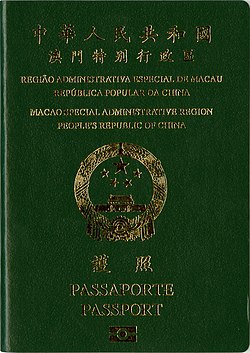
 The front cover of the Macao SAR ePassport issued since September 2009 | |
| Type | Passport |
| Issued by |  Identification Services Bureau Identification Services Bureau |
| First issued | 1999 (first version) September 2009 (second version) December 2019 (third version) |
| Eligibility | Chinese citizens who are permanent residents of Macao |
| Expiration | 10 years (over 18 years old) 5 years (under 18 years old) |
| Cost | MOP$430 |
The Macao Special Administrative Region passport (Chinese: 澳門特別行政區護照; Portuguese: Passaporte da Região Administrativa Especial de Macau) is a passport issued to Chinese citizens who are permanent residents of the Chinese Special Administrative Region of Macau. While both "Macao" and "Macau" are used interchangeably, "Macao" is the officially adopted English-language spelling for the SAR's government and its official documents,[1] including the passport.
In accordance with Macau Basic Law, this passport has been issued by the Identification Services Bureau (under the Secretariat for Administration and Justice) of the government of Macau since the handover of Macau on 20 December 1999. This is done under the prerogative of the Central People's Government of the People's Republic of China.
As Portuguese and Chinese are the official languages of Macao, all text within the passport appears in Traditional Chinese characters, Portuguese and English.
Historical background
[edit]In accordance with the nationality law of the People's Republic of China and the explanations provided by the Standing Committee of the National People's Congress for Macao, any Macao permanent resident holding Chinese nationality can apply for the Macao SAR passport.
First Version (1999-2009): The Inaugural Machine-Readable Document
[edit]The first version of the Macao SAR passport was introduced on 20 December 1999, following the formal establishment of the Macao SAR. This initial version was a non-biometric, standard machine-readable passport, designed in accordance with the international standards set by the International Civil Aviation Organization (ICAO) Document 9303. Security features typical of that era included laminated data pages, guilloché patterns, and watermarks. The internal pages featured simple, monochromatic designs with a lotus flower watermark, serving as a security element and as a symbol of the SAR.
Second Version (2009-2019): The Biometric ePassport Era
[edit]The second version, a biometric passport, was introduced in September 2009, replacing the previous non-biometric, machine-readable type. This upgrade reflected the global shift towards enhanced passport security and the increasing adoption of biometric technology for travel documents, driven by international standards set by organisations such as ICAO.
The most notable feature of this version is the embedded contactless chip, located within the passport's back cover, which securely stores the holder's personal data. An electronic travel document symbol is prominently displayed on the cover to indicate the presence of the chip. The biodata page was upgraded to a durable polycarbonate material, with the holder's personal information and photo engraved using multi-laser technology. A supplemental page also included the holder's photo and right index fingerprint.[2]
In addition to its technical enhancements, the internal pages of the passport were designed to reflect Macao's unique cultural identity. The illustrations feature prominent landmarks from Macao's UNESCO World Heritage sites, including the Ruins of St. Paul's, the Guia Lighthouse, and A-Ma Temple, alongside the city's three main bridges and the lotus flower, the official emblem of the Macao SAR.[3] The bottom of each page also displays connected patterns of the Great Wall of China and lotus flowers.These design elements highlight the harmonious blend of Chinese and Western cultures and symbolise Macao's role as a cultural bridge between East and West.
Third Version (2019-Present): Enhanced Security and Design Refinements
[edit]The third and most recent version of the Macao SAR Passport was introduced for applications submitted on and after 3 December 2019.[4] This update aimed to modernise the passport's anti-counterfeiting features and design, as the previous version had been in use for a decade, and to align with the evolving international security standards.[2]
While this version retains the same core materials and anti-forgery design principles of its predecessor, it incorporates enhanced technologies to further strengthen document integrity. A key improvement is the upgraded cryptographic chip, which offers more robust encryption to protect the holder's personal data.[4] The biodata page includes tactile elements such as raised printing of Macao's emblem—the lotus flower—providing an additional layer of physical security.
The internal pages now feature enhanced colour ultraviolet (UV) printing techniques. Under UV light, instead of the basic four-colour patterns used in the previous version, vivid full-colour night views of Macao appear, contrasting with the original daytime architectural imagery. This creates a dynamic day-and-night visual effect.[2]
Physical features
[edit]Front cover
[edit]
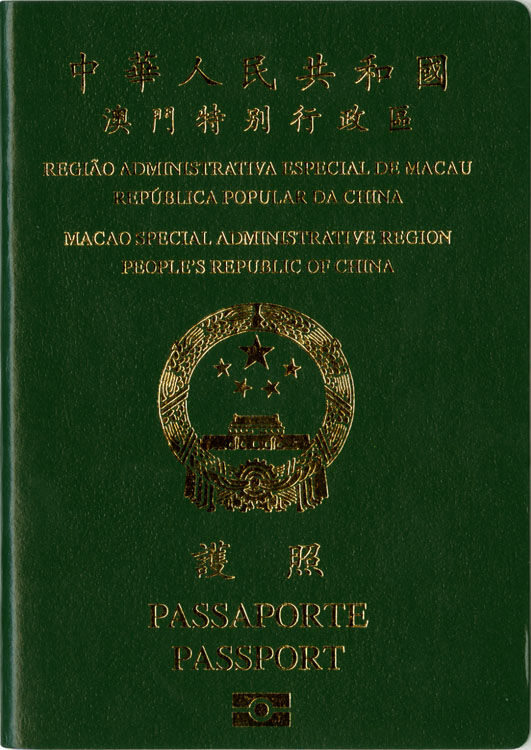
The cover of the passport is coloured bottle green with the National Emblem of the People's Republic of China emblazoned centermost at the front. The passport's front cover is inscribed with the titles of the PRC and the SAR in Chinese: 中華人民共和國澳門特別行政區護照, in Portuguese: Região Administrativa Especial de Macau, República Popular da China, Passaporte, and in English: Macao Special Administrative Region, People's Republic of China, Passport. Each passport consists of 48 numbered pages of size 125 mm × 88 mm (4.9 in × 3.5 in) emprinted with artistic designs featuring Macao's world culture heritage sites.[5]
Inside front cover
[edit]
The passport note appears on the second page in Chinese, Portuguese, and English:
中華人民共和國外交部請各國軍政機關對持照人予以通行的便利和必要的協助
O MINISTÉRIO DOS NEGÓCIOS ESTRANGEIROS DA REPÚBLICA POPULAR DA CHINA SOLICITA A TODAS AS AUTORIDADES CIVIS E MILITARES DOS PAÍSES ESTRANGEIROS QUE DEIXEM PASSAR LIVREMENTE O TITULAR DESTE PASSAPORTE E LHE DISPENSEM AUXÍLIO EM CASO DE NECESSIDADE
THE MINISTRY OF FOREIGN AFFAIRS OF THE PEOPLE'S REPUBLIC OF CHINA REQUESTS ALL CIVIL AND MILITARY AUTHORITIES OF FOREIGN COUNTRIES TO ALLOW THE BEARER OF THIS PASSPORT TO PASS FREELY AND AFFORD ASSISTANCE IN CASE OF NEED
Biodata page
[edit]
The biodata page of the passport includes:
- Passport type: P
- Code of Issuing State: CHN (People's Republic of China)
- Passport number (A valid Macao passport number consists of nine characters: two uppercase letters, followed by seven digits)
- Surname and Given Names: in traditional Chinese and English/Portuguese
- Nationality: "CHINESE" (Pre-printed, the nationality code is CHN as shown in the machine readable zone)
- Sex: denoted as "M" (male) or "F" (female)
- Place of birth: if born in China, name of the province/autonomous region/municipality; if born in Hong Kong or Macao, 'HONG KONG' or 'MACAO'; if born in other countries, name of country. (In capitals and in English)
- Dates of birth, issue and expiry: displayed in the format DD-MMM-YYYY (e.g. 01 JAN 1970)
- Authority (of issue): "澳門特別行政區身份證明局", "DIRECÇÃO DOS SERVIÇOS DE IDENTIFICAÇÃO DA REGIÃO ADMINISTRATIVA ESPECIAL DE MACAU", "IDENTIFICATION SERVICES BUREAU, MACAO SPECIAL ADMINISTRATIVE REGION"
Besides personal data, the supplemental page of passport is printed with the picture and fingerprint of that holder.
Explanatory notes
[edit]The passport's explanatory notes are located on pages 45, 46, and 47 of the passport. The following text is pre-printed on the passport explanatory notes page in Chinese, Portuguese, and English:
- The issuance, replacement, reissuance and endorsement of this passport shall be effected by the Government of the Macao Special Administrative Region of the People's Republic of China, diplomatic and consular missions of the People's Republic of China in foreign countries, or other Chinese authorities in foreign countries under the entrustment of the Ministry of Foreign Affairs of the People's Republic of China.
- The bearer of this passport is a Chinese citizen who is a permanent resident of the Macao Special Administrative Region, and has the right of abode in and the right to return to the Region.
- This passport is valid for ten years, unless otherwise stated. But it is normally valid for five years if issued to a child under eighteen years of age. This passport shall be replaced by a new one when its validity period expires or it has no further space for visas.
- This passport is an important document of identity which shall be kept carefully and used properly. It shall not be mutilated, tampered with, or transferred to another person for unlawful use. Any case of loss or destruction should be immediately reported to the nearest issuing authority and the local police or public security authorities.
_of_a_Macau_ePassport.jpg)
Application procedure
[edit]Macao SAR passports are only issued by the Identification Services Bureau in Macao.[6] An applicant must fill out an application form, possess a Macao SAR Permanent Resident Identity Card and two recent 1½-inch colour photos along with (if replacing an old passport) their prior Macao SAR passport.
Qualified applicants can apply in Macao or overseas if necessary.
Usage and visa requirements
[edit]Mainland China
[edit]
Despite being endorsed by the Chinese government, the Macao SAR passport is not accepted by China's Ministry of Public Security for travel between mainland China and Macao. This is because both mainland and Macao authorities have agreed that using a passport for 'domestic' travel is deemed 'unnecessary' and 'inappropriate'.
Macao residents eligible for a Macao SAR passport are also eligible to apply for a Mainland Travel Permit for Hong Kong and Macao Residents (colloquially known as a "Home Return Permit"). Issued by the National Immigration Administration of China, this serves as the primary travel document for Chinese citizens who are Macao permanent residents to enter mainland China. The issuance of a Home Return Permit is entirely at the discretion of the National Immigration Administration of China and is represented in Macao by the China Travel Service. It is important to note that possession of a Macao SAR passport does not necessarily guarantee the issuance of a Home Return Permit.
Macao residents travelling to mainland China from a third country without a Home Return Permit may obtain a Chinese Travel Document from an overseas Chinese embassy or consulate prior to their departure from that country.
Hong Kong
[edit]Regardless of their citizenship status, Macao permanent residents do not require a passport to enter Hong Kong. Instead, they can use their permanent ID card, which grants them 180-day visa-free access. Non-permanent residents can use a Visit Permit for Residents of Macao to Hong Kong SAR for visa-free entry for up to 30 days.
When Macao residents travel abroad via Hong Kong, such residents can use their MSAR passports to enter Hong Kong and stay 7 days visa-free.
Macao SAR permanent residents may use the "Macao One Account" mobile application's QR Code for e-Channel entry into Hong Kong, though carrying their physical Macao identity cards remains a requirement when crossing the border. Eligibility for this service requires individuals to be aged 11 or above, hold a valid Macao permanent identity card, and have successfully enrolled for e-Channel service in the Hong Kong SAR.[7]
Taiwan
[edit]Macao SAR passport holders can enter Taiwan under a special entry-permit regime managed by Taiwan's National Immigration Agency, rather than requiring a traditional visa. This regime offers simplified entry procedures.
Holders born in Macao (or those who have previously entered Taiwan at least once as a Macao permanent resident) have two primary options:
- Online Registration: Applicants can register online in advance via the National Immigration Agency's website. Upon approval, the permit must be printed and presented at the border checkpoint. Online registration is free of charge..
- Entry Permit on Arrival: Alternatively, eligible holders can obtain an Entry Permit upon arrival at major ports of entry by paying a fee of NT$300.[8]
Both the online registration and the on-arrival options grant a single entry with a maximum stay of up to 30 days.[9] Travellers must present a valid Macao SAR passport with at least three months' validity remaining at the border checkpoint.[10]
Overseas
[edit]
As of 27 July 2025, Macao SAR passport holders enjoy visa-free or visa-on-arrival access to 148 countries and territories worldwide. This includes all Member States of the European Union, Brazil, Japan, Malaysia, Russia, Singapore, South Africa and South Korea.[11] In 2025, the Henley Passport Index ranked the Macao SAR passport as the 31st most powerful passport globally. In comparison, the Hong Kong SAR passport was ranked 18th, while the PRC passport was ranked 60th.[12]
As Chinese citizens, holders of a Macao Special Administrative Region passport are entitled to full consular protection by Chinese foreign missions abroad.
Macao SAR passport holders may undertake a paid activity (i.e. work) visa-free for a maximum of 90 days within a 180-day period in the Schengen Agreement signatory states of Belgium, Denmark, Iceland, Lithuania, Luxembourg, the Netherlands, Norway, Slovenia and Sweden (though not in Portugal).[13] In Switzerland, another Schengen signatory state, Macao SAR passport holders can apply for a permit for "gainful occupation" of maximum 8 days in a calendar year during their visa-exempt stay without needing to apply for a work visa;[14] however, this 8-day exemption does not cover occupation in the primary or secondary construction industry, civil engineering, catering and hotel services, industrial and private cleaning industries, surveillance and security services, and sex industry. Alternatively, if in possession of a long term residence permit issued by any other Schengen member state, a Macao SAR passport holder may undertake gainful occupation for up to 3 months visa-free in Switzerland without any of the aforementioned industry restrictions. In Croatia (a European Union member state which acceded to the Schengen agreement on 1st Jan 2024), Macao SAR passport holders may undertake a paid activity (i.e. work) visa-free for a maximum of 90 days within a 180-day period.[13]
Macao SAR passport holders aged between 18 and 30 are eligible to apply under the Working Holiday Scheme by the New Zealand Government.[15] If successful, a visa is issued which permits the holder to spend up to 12 months in New Zealand for the primary purpose of travel but allowing for supplementary short-term employment or study. The scheme is highly competitive as applicants from Macao and mainland China are subject to a quota of 1000 visas annually (there is a separate quota for Hong Kong applicants).
Automated immigration clearance systems
[edit]Holders of the Macao SAR ePassport benefit from access to automated immigration clearance systems in several countries, streamlining their entry and exit processes. These systems, which typically utilise biometric technology such as facial recognition and fingerprint scanning, are designed to enhance efficiency and security at borders.
As of 27 July 2025, six countries offering such facilities to Macao SAR ePassport holders are Australia (SmartGates),[16] the Republic of Korea (Smart Entry Service),[17] Japan (Trusted Traveler Program),[18] New Zealand (eGates),[19] Singapore (Automated Clearance Initiative),[20] and the United Kingdom (ePassport gates as a Registered Traveller).[21] Eligibility for these systems may involve specific age restrictions or pre-registration, varying by country.
See also
[edit]

- Chinese passport
- Hong Kong Special Administrative Region passport
- Portuguese passport
- Portuguese nationality law
- Macao Special Administrative Region Travel Permit
- Visit Permit for Residents of Macao to HKSAR
- Chinese nationality law
- Mainland Travel Permit for Hong Kong and Macao Residents
- Mainland Travel Permit for Taiwan Residents
- Hong Kong Special Administrative Region passport
- Visa requirements for Chinese citizens of Macau
References
[edit]- ^ "Then & Now | Macao vs Macau: what's in a name? More than you might think". South China Morning Post. 2023-11-13. Retrieved 2025-07-27.
- ^ a b c "NEWS GOV-MO: 第三代澳門特區旅行證件 智•慧齊升". NEWS GOV-MO (in Traditional Chinese). Retrieved 2025-07-28.
- ^ "完善防偽和便民功能 持續發展智能式證件". 澳門特別行政區政府入口網站 (in Traditional Chinese). 2009-09-01. Retrieved 2025-07-28.
- ^ a b Reporter, Staff (2019-10-17). "New passports & travel documents to be launched on Dec 3". Macao News. Retrieved 2025-07-28.
- ^ "About Electronic Travel Documents" (PDF) (Press release). dsi.gov.mo. 29 June 2009. Archived from the original (PDF) on 4 December 2010.
- ^ refer to the web site of DSI [1] Archived December 10, 2005, at the Wayback Machine
- ^ "e-Channel Service for Residents | Immigration Department". www.immd.gov.hk. Retrieved 2025-07-28.
- ^ 台北經濟文化辦事處(澳門) (7 April 2025). "一、香港、澳門永久居民申請入出境證". 台北經濟文化辦事處 (澳門辦事處). Retrieved 27 July 2025.
- ^ 大陆委员会 (2024-02-22). "中华民国大陆委员会". 大陆委员会 (in Chinese (China)). Archived from the original on 2024-04-15. Retrieved 2025-07-27.
- ^ "港澳居民赴臺入境時護照效期放寬為3個月以上". 澳門辦事處 (in Chinese (Taiwan)). 2017-11-07. Archived from the original on 2024-06-21. Retrieved 2025-07-27.
- ^ "DSI". www.dsi.gov.mo. Retrieved 2025-07-27.
- ^ "The Official Passport Index Ranking". Henley & Partners. Retrieved 2025-07-27.
- ^ a b "Regulation (EU) 2018/1806 of the European Parliament and of the Council of 14 November 2018 Listing the Third Countries Whose Nationals Must Be in Possession of Visas When Crossing the External Borders and Those Whose Nationals Are Exempt from That Requirement". Retrieved 2021-03-14 – via eur-lex.europa.eu.
- ^ "Federal Office of Migration: List 1: Overview of ID and visa provisions according to nationality (version of 4 December 2011)" (PDF). admin.ch. Archived from the original (PDF) on 14 February 2012. Retrieved 11 April 2018.
- ^ "China Working Holiday Scheme". Immigration.govt.nz. Retrieved 2011-12-06.
- ^ "Australian Border Force Website". Australian Border Force Website. Archived from the original on 2025-06-19. Retrieved 2025-07-27.
- ^ "한·마카오(SeS-APC) info < 하이코리아". www.hikorea.go.kr. Retrieved 2025-07-27.
- ^ "トラスティド・トラベラー・プログラムの概要 | 出入国在留管理庁". www.moj.go.jp. Retrieved 2025-07-27.
- ^ "eGate". www.customs.govt.nz. Retrieved 2025-07-27.
- ^ "ICA | Automated Clearance Initiative". ICA. Retrieved 2025-07-27.
- ^ "Registered Traveller: faster entry through the UK border". GOV.UK. Retrieved 2025-07-27.
External links
[edit]| Macau-related identity and travel documents | |||||||||
|---|---|---|---|---|---|---|---|---|---|
| Issued by Macau |
| ||||||||
| Issued by China |
| ||||||||
| Issued by Portugal |
| ||||||||
| |||||||||||||||||||||||
| |||||||||||||||||||||||
| |||||||||||||||||||||||
| |||||||||||||||||||||||


Macao Special Administrative Region passport
View on GrokipediaLegal Framework and Eligibility
Constitutional and Legal Basis
The Basic Law of the Macao Special Administrative Region, promulgated by the National People's Congress on March 31, 1993, and effective from December 20, 1999, serves as the constitutional foundation for the issuance of Macao SAR passports. Enacted pursuant to Article 31 of the Constitution of the People's Republic of China, which authorizes the establishment of special administrative regions with a high degree of autonomy, the Basic Law vests the Macao SAR with independent executive, legislative, and judicial powers, including authority over immigration control and the issuance of travel documents to its residents.[6][7] Articles 33 and 34 of the Basic Law explicitly affirm residents' rights to freedom of movement within the SAR, freedom of emigration, and the right to obtain travel documents in accordance with law, while permitting departure without special authorization for holders of valid travel documents unless restrained by legislation. These provisions underpin the SAR's capacity to issue passports as a means of facilitating international travel for eligible Chinese nationals who are permanent residents, defined under Article 24 as those holding right of abode through birth, continuous residence, or other specified criteria. The Central People's Government recognizes these documents as valid PRC-issued passports, reflecting the "one country, two systems" framework that delegates such matters to SAR autonomy while maintaining national sovereignty over foreign affairs and defense.[7][6] The operational legal framework is established by Law No. 8/2009 of July 23, which approves the "Scheme of Macao Special Administrative Region Travel Documents," regulating the types, issuance, validity, and security features of passports and related permits. This law, supplemented by Administrative Regulation No. 20/2009, mandates biometric elements and aligns issuance with permanent residency status under Law No. 8/1999 on the Right of Abode, ensuring passports are granted only to Chinese citizens with Macao permanent identity cards. The Identification Services Bureau, under the Secretariat for Administration and Justice, executes these powers, with oversight ensuring compliance with both SAR legislation and Basic Law principles.[8][9]Issuance Authority and Eligibility Criteria
The Macao Special Administrative Region passport is issued by the Identification Services Bureau (DSI) of the Macao SAR Government, which operates under the regional administration's authority to manage identity documents and travel credentials for eligible residents.[1][2] This bureau handles applications, processing, and issuance, ensuring compliance with the Basic Law of the Macao SAR and national regulations on Chinese nationality.[1] Eligibility for the Macao SAR passport is restricted to Chinese nationals who hold permanent resident status in the region and possess a valid Macao SAR Permanent Resident Identity Card.[1][2] Applicants must be at least five years old as of the issuance date of their Resident Identity Card, with those under 18 years requiring accompaniment or written authorization from both parents or a legal guardian.[1] Non-permanent residents with Chinese nationality are ineligible for the passport and instead qualify for the Macao SAR Travel Permit, a distinct document for limited international travel.[2] This criterion aligns with the "one country, two systems" framework, granting SAR-specific travel documents to permanent residents while upholding Chinese sovereignty over nationality.[1]Application and Renewal Procedures
Applications for the Macao SAR passport are handled by the Identification Services Bureau (DSI) and are available to Chinese nationals holding a valid Macao SAR Permanent Resident Identity Card, with eligibility extending to children aged 5 years and above.[10] Procedures encompass both first-time issuances and renewals, which follow largely identical steps, though renewals require submission of the prior passport if it remains valid or has recently expired.[1] Applicants may submit via self-service kiosks, the Macao One Account mobile application (requiring facial recognition verification), or in-person at DSI counters after obtaining a queue number through online booking, telephone, or on-site ticketing.[10] Overseas applicants outside Mainland China and Hong Kong can use postal services by accessing the DSI's online system to generate an application number, printing the form, and mailing required documents with payment.[1] Required documents include the applicant's Macao SAR Permanent Resident Identity Card, a recent 1.5-inch color photograph on a plain white background (taken within 6 months, or sourced from the app's "My Photos" feature), and for renewals, the original previous passport.[10] First-time applicants need not provide a prior travel document, while lost passports necessitate a police loss report and incur additional fees.[1] Minors under 18 must be accompanied by a parent or guardian, who provides identification and written authorization; unaccompanied minors cannot use self-service options.[10] Applications for passports expiring within 9 months are prioritized for renewal to avoid travel disruptions.[1] Service locations comprise the DSI Headquarters in Macao Peninsula, branches at Macao Government Services Centres in Venceslau de Morais and the Islands District, and multiple self-service kiosks across Macao and Hengqin.[10] Counters operate Monday to Friday from 09:00 to 18:00, excluding public holidays and weekends, with kiosks available extended hours for self-service submissions.[10] Fees for standard applications or renewals total MOP 430, with an urgent processing surcharge of MOP 150; lost or damaged passports add tiered penalties from MOP 150 to MOP 2,400 based on prior incidents.[1] Payments accept cash, credit/debit cards, UnionPay, Macau Pass, or digital methods like MPay and GovPay.[10] Processing times are 10 working days for standard requests and 2 working days for urgent ones, excluding mailing delays for overseas applications; collection occurs in person at DSI facilities, with electronic notifications for status updates.[10] Self-service kiosks facilitate streamlined renewals for eligible adults using their identity card for authentication, reflecting DSI's efforts to simplify processes since 2020.[1]Historical Evolution
Pre-Handover Travel Documents
Prior to the transfer of sovereignty over Macao from Portugal to the People's Republic of China on December 20, 1999, travel documents for residents were issued under Portuguese colonial administration.[11] These documents facilitated international mobility, though access varied by residency status and nationality. Portuguese authorities managed issuance through local civil registry offices, with requirements including proof of identity, residency, and, for citizens, allegiance to Portugal.[12] Portuguese nationals, including ethnic Portuguese, Macanese (Eurasian) descendants, and a limited number of naturalized individuals, received standard Portuguese passports. These burgundy-colored booklets, compliant with International Civil Aviation Organization standards, bore the inscription "República Portuguesa" and granted visa-free or visa-on-arrival access to destinations aligned with Portugal's diplomatic ties, such as much of Europe and former colonies. Eligibility for citizenship—and thus these passports—was restricted; estimates indicate only about 25% of Macao's residents qualified, primarily through birthright or parental nationality prior to legal changes in the 1980s and 1990s that tightened naturalization.[13][14] The ethnic Chinese majority, who comprised over 90% of the population and generally lacked Portuguese citizenship, were issued non-passport travel documents by Portuguese authorities, often termed "Portuguese travel documents." These were simpler laissez-passer-style permits designed for one-way or limited international travel, requiring separate visas for most destinations and lacking the full diplomatic protections of passports. Issuance was tied to local identity cards (Bilhete de Identidade), with validity typically short-term and renewable upon demonstration of residency. Such documents enabled travel to regional hubs like Hong Kong or Portugal but faced restrictions elsewhere due to their provisional nature.[12][15] These pre-handover arrangements reflected Macao's status as a Portuguese overseas province since 1557, with travel policies emphasizing administrative control over mass emigration amid Sino-Portuguese negotiations. Post-1987 Joint Declaration provisions anticipated the phase-out of Portuguese issuance, allowing holders of these documents to continue limited use after 1999 if they opted for Portuguese nationality over Chinese.[16]Inaugural SAR Passport (1999-2009)
The inaugural Macao Special Administrative Region passport was introduced on 20 December 1999, coinciding with the establishment of the SAR upon the handover of sovereignty from Portugal to the People's Republic of China.[17] This document marked the transition from Portuguese-issued travel papers to those under Chinese sovereignty, specifically for permanent residents of Macao holding Chinese nationality.[18] Issued by the Identification Services Bureau (Direcção dos Serviços de Identificação), it served as the primary travel document for international journeys, while existing Portuguese passports held by residents remained valid until their expiry dates.[12] Designed as a machine-readable passport (MRP) compliant with International Civil Aviation Organization (ICAO) standards, the inaugural version featured a burgundy cover emblazoned with the words "MACAO SPECIAL ADMINISTRATIVE REGION" in English and Chinese, alongside the regional emblem.[13] Interior security elements included tamper-resistant printing and basic anti-forgery measures typical of late-1990s passports, such as watermarks, microprinting, and holographic overlays, aimed at preventing counterfeiting amid the post-handover transition.[13] The biodata page contained standard fields for personal details, photograph, and machine-readable zone (MRZ) at the bottom, facilitating automated border processing. Valid for up to 10 years for adults and shorter periods for minors, the passport enabled visa-free or visa-on-arrival access to a growing number of destinations, reflecting Macao's unique "one country, two systems" status.[2] It was produced with enhanced durability compared to pre-handover documents, incorporating polycarbonate elements in key pages to resist alteration. This version remained the standard until June 2009, when it was phased out in favor of a biometric e-passport with embedded contactless chips and upgraded security features.[19]Biometric Introduction (2009-2019)
The biometric version of the Macao Special Administrative Region (SAR) passport, designated as an electronic passport or e-passport, was launched on 1 September 2009, succeeding the non-biometric machine-readable passport introduced in 1999.[20] This upgrade aligned Macao's travel document with global standards set by the International Civil Aviation Organization (ICAO) for biometric passports, incorporating an embedded radiofrequency identification (RFID) chip to store digitized personal and biometric data. The initiative was announced by the Identification Services Bureau in June 2009 as part of efforts to enhance document security and international interoperability.[19] The e-passport's biometric chip primarily encoded the holder's facial image as the core biometric identifier, along with biographical details matching the printed biodata page, enabling contactless reading at e-gates and border checkpoints for automated verification. Security features included public key infrastructure (PKI) for digital signatures, ensuring data integrity and authenticity against tampering or counterfeiting. Validity periods remained consistent with prior versions: 10 years for adults aged 18 and above, 5 years for those under 16, and 3 years for children under 11, applicable to Chinese nationals holding permanent residency in Macao.[8] From 2009 to 2019, the biometric passport facilitated visa-free or visa-on-arrival access to approximately 140 destinations for Macao SAR passport holders, reflecting its recognition under international agreements despite the document's issuance by a special administrative region of China. No major design overhauls occurred during this decade, though issuance volumes increased with rising outbound travel from Macao's tourism-driven economy. The version was phased out in 2019 in favor of an enhanced iteration with additional polycarbonate elements and expanded biometric capabilities.[20]Current Enhanced Version (2019-Present)
The enhanced version of the Macao Special Administrative Region (SAR) passport was introduced for applications submitted on or after December 3, 2019, replacing the prior biometric model issued between 2009 and 2019.[21][22] This update aimed to incorporate advanced anti-counterfeiting measures and align with evolving International Civil Aviation Organization (ICAO) standards for travel document security.[21] The Identification Services Bureau of Macao began issuing these passports to eligible Chinese nationals with right of abode in the SAR, maintaining the document's status as a biometric ePassport with an embedded contactless chip in the back cover.[1][23] A primary enhancement is the use of laser perforation technology on the polycarbonate personal data page, creating a latent image of the holder's portrait, the Macao SAR emblem, and a lotus flower pattern visible under transmitted light.[21][24] The electronic chip features upgraded encryption protocols to strengthen data integrity and resistance to tampering, storing the holder's biometric facial image and personal particulars for automated verification at border controls.[21][23] Additional optically variable devices and UV-reactive inks further deter forgery, building on the foundational security elements of the 2009 introduction.[21] Design refinements include refined interior printing with intricate guilloche patterns and microtext integrated into the visa pages, while the exterior retains the traditional burgundy cover emblazoned with the SAR coat of arms and "Macao Special Administrative Region Passport" in English, Chinese, and Portuguese.[24] These passports remain valid for up to 10 years for adults, with issuance fees structured progressively higher for frequent replacements to discourage unnecessary renewals.[25] As of 2025, this version continues in circulation, supporting visa-free access to over 140 destinations and facilitating seamless electronic gate processing worldwide.[23]Design and Security Elements
Exterior and Cover Design
The exterior of the Macao Special Administrative Region (SAR) passport features a flexible single booklet constructed with a plastic cover in green.[26] The front cover displays the National Emblem of the People's Republic of China centered, applied via hot foil stamping, flanked by inscriptions in Chinese, Portuguese, and English reading "Macao Special Administrative Region" and "People's Republic of China."[26] The back cover bears similar textual elements without the emblem.[26] Since the inaugural issuance on December 20, 1999, the cover design has remained consistent, with the addition of an international symbol denoting electronic travel documents introduced in the biometric version launched on June 30, 2009.[8] Subsequent enhancements, including the 2019 version, preserved the front and back covers without alteration. This stability reflects adherence to established SAR identity protocols under the "one country, two systems" framework.Interior Layout and Biodata Page
The interior of the Macao Special Administrative Region (SAR) passport consists of 48 numbered pages measuring 125 mm by 88 mm, featuring artistic designs that depict Macao's world cultural heritage sites and landmarks, such as the Ruins of Saint Paul's and the Guia Lighthouse.[18] These visa pages incorporate multi-color UV printing and tactile patterns of elements like Macao's emblem and lotus flowers for enhanced security and aesthetic appeal.[21] The biodata page is integrated into the inner side of the back cover of this single booklet design.[26] It displays the holder's color photograph alongside personal details in Chinese, English, and Portuguese, adhering to ICAO standards for machine-readable travel documents. Key fields include passport type designated as "P", issuing state code "CHN" for the People's Republic of China, a nine-character alphanumeric passport number, surname, given names, nationality as "Chinese", date of birth, sex, place of birth, date of issue, date of expiry, issuing authority identified as the Identification Services Bureau of Macao SAR, and the holder's signature. The page features a machine-readable zone (MRZ) at the bottom, with the issuing country reiterated as "CHN" in both the visual inspection zone and MRZ.[26][27] Security elements on the biodata page include repeated microprinting of "MACAOSARMACAOSAR" and a substrate lacking optical brighteners visible under UV light, contributing to anti-forgery measures.[26] These features align with the biometric e-passport format introduced in 2009 and enhanced in the 2019 version.[21]Anti-Counterfeiting Technologies
The 2019 version of the Macao SAR passport incorporates laser perforation technology on the personal data page, creating arrays of minute holes that form the holder's photograph, identification number, regional emblem, and lotus flower motif; these perforations are verifiable by backlighting and provide a tactile element for manual authentication.[21][24] Tactile printing techniques apply raised intaglio patterns replicating the Macao SAR emblem and lotus flower, enabling detection through touch and resistance to reproduction by standard scanning or printing methods.[28][29] Interior visa pages feature multi-color ultraviolet (UV) printing, which remains invisible under normal light but reveals intricate designs of Macao's emblem and lotus motifs when exposed to UV illumination, enhancing verification against forgery attempts that overlook reactive inks.[21] The document's embedded cryptographic chip employs enhanced encryption protocols to secure biometric and personal data, preventing unauthorized alterations or cloning that could facilitate counterfeiting; this electronic safeguard complements physical features by cross-verifying holder identity at inspection points.[21] These measures align with international standards for machine-readable travel documents, prioritizing layered overt and covert elements to deter replication while maintaining usability for border officials.[21] Earlier iterations, such as the 2009 biometric introduction, relied on basic laminated pages and guilloché patterns, but the 2019 enhancements addressed evolving threats from digital reproduction technologies.[19]Biometric and Electronic Features
The Macao Special Administrative Region (SAR) passport incorporates biometric and electronic features in line with International Civil Aviation Organization (ICAO) standards for electronic machine-readable travel documents (eMRTDs). These features were first introduced on 1 September 2009, marking the transition to electronic passports equipped with a contactless integrated circuit chip.[3] The chip stores the holder's personal particulars, a digitized facial photograph, and a fingerprint image, enabling biometric verification through facial recognition and fingerprint matching at automated border control systems.[3] The electronic chip utilizes radio-frequency identification (RFID) technology for non-contact data reading and employs security protocols such as Basic Access Control (BAC) to prevent unauthorized skimming or eavesdropping. Data integrity is maintained via digital signatures based on public key infrastructure (PKI), ensuring that any alterations to the stored information can be detected. The biometric data page, typically constructed from polycarbonate material, features laser engraving of the holder's details and integrates the chip's antenna, providing resistance to tampering and forgery.[18] An updated version of the biometric passport was issued starting 3 December 2019, incorporating enhanced security elements while retaining the core electronic and biometric functionalities of the chip.[23] This iteration includes over 14 security features in total, with advancements in the chip's authentication mechanisms to counter evolving counterfeiting threats.[18] The ePassport symbol—a rectangle with a circle indicating the chip's location—is displayed on the cover to signify these capabilities.[30] These features facilitate interoperability with global eGate systems, supporting seamless immigration processing where compatible.[31]Travel Mobility and Visa Arrangements
Overall Visa-Free Access and Global Ranking
The Macao Special Administrative Region (SAR) passport enables holders to travel to 144 countries and territories without a prior visa, including visa-free entry or visa on arrival, as per the Henley Passport Index ranking updated in July 2025. This positions the Macao SAR passport 31st globally out of 199 passports evaluated, based on access to 227 possible destinations derived from International Air Transport Association (IATA) data.[32] Singapore maintains the leading rank with access to 195 destinations in the same index.[33] Alternative assessments yield slightly varying figures; for instance, the Passport Index places the Macao SAR passport at 23rd worldwide with a mobility score of 143, encompassing 93 visa-free countries, 43 visa-on-arrival options, and 7 electronic travel authorizations.[34] These rankings reflect the passport's relatively strong travel mobility, particularly for a document issued under Chinese sovereignty, outperforming the mainland People's Republic of China ordinary passport, which ranks around 60th with access to fewer than 80 destinations.[33] The index scores have shown incremental improvements over recent years, attributed to Macao's diplomatic engagements and bilateral agreements expanding visa waivers, especially within Asia, Europe, and Latin America. However, access remains restricted to major destinations like the United States, Canada, and Australia, where visas are required.[4]Access to Mainland China
Holders of the Macao Special Administrative Region (SAR) passport, which is issued only to Chinese nationals possessing permanent residency in Macao, cannot utilize the passport itself for entry into Mainland China.[35] Instead, they must obtain the Mainland Travel Permit for Hong Kong and Macao Residents, commonly referred to as the Home Return Permit (港澳居民来往内地通行证).[36] This permit functions as the requisite entry document and establishes proof of Chinese nationality for immigration purposes within the Mainland.[36] Administered by China's National Immigration Administration through authorized outlets such as the China Travel Service in Macao, the Home Return Permit enables multiple entries without additional visas.[37] It is typically valid for five years for children under 16 and ten years for adults, featuring biometric elements including fingerprints and digital photographs.[36] Endorsements specify permissible activities and durations: the "S" endorsement for private affairs like tourism or visiting relatives allows stays up to 90 days per entry, while "G" endorsements facilitate group business travel with similar limits. Extensions beyond standard stays require separate applications at local public security bureaus in the Mainland. Application for the permit necessitates submission of the Macao SAR permanent identity card, photographs, and fees—approximately HKD 260 for initial issuance in Macao—via pre-booked appointments at designated service centers.[38] Holders must carry both the permit and identity card during travel, as the SAR passport serves no role in Mainland border controls.[39] This arrangement underscores the distinct immigration frameworks under the "one country, two systems" principle, prioritizing the Home Return Permit to regulate cross-border movement of SAR residents.[36]Relations with Hong Kong and Taiwan
Holders of Macao SAR passports, who are Chinese nationals residing in Macao, enjoy visa-free access to Hong Kong for short-term visits, typically up to 30 days, provided they meet standard immigration criteria such as proof of onward travel and sufficient funds.[40] However, Macao permanent residents more commonly utilize their electronic Macao SAR Permanent Resident Identity Card for entry into Hong Kong as visitors, bypassing the need for a passport altogether, which facilitates seamless cross-border movement reflective of the close economic and administrative ties between the two Special Administrative Regions.[41] This arrangement stems from the "one country, two systems" framework, allowing reciprocal recognition of resident identity documents without formal visa requirements, though stays exceeding permitted durations necessitate an extension application.[42] In contrast, entry into Taiwan with a Macao SAR passport requires prior approval via an Entry and Exit Permit issued by Taiwan's Bureau of Consular Affairs, rather than visa-free access.[43] Applicants must submit documentation including a valid passport with at least three months' validity, proof of purpose (e.g., tourism, business, or family reunion), and may face additional scrutiny if born in mainland China, with processing times varying from days to weeks depending on quotas and political considerations.[44] This permit system, distinct from Taiwan's visa-exempt policies for many foreign nationals, reflects ongoing cross-strait tensions and Taiwan's restrictions on travel by Chinese nationals from SARs to prevent unauthorized migration or security risks, limiting spontaneous travel and requiring online or in-person applications through Taiwan's overseas offices.[45] Temporary entry permits are available for eligible Macao-born residents, but overall mobility remains more constrained than to Hong Kong, with no automatic reciprocity for holders of Taiwan passports seeking entry to Macao.[46]International Visa Policies and Recent Expansions
Holders of the Macao Special Administrative Region (SAR) passport enjoy visa-free or visa-on-arrival access to 146 countries and territories worldwide, excluding arrangements specific to mainland China, Hong Kong, and Taiwan, with permitted stay durations typically ranging from 14 days to 6 months depending on the destination and subject to conditions such as proof of onward travel or sufficient funds.[47] This access reflects bilateral agreements negotiated by Macao authorities, often mirroring or exceeding privileges extended to mainland Chinese passports due to Macao's distinct international status under the "one country, two systems" framework.[47] In Europe, 41 countries grant visa-free entry, including all Schengen Area states for up to 90 days within any 180-day period and the United Kingdom for up to 6 months.[47] Asia provides access to 21 destinations, such as Japan (90 days) and Singapore (30 days), while the Americas cover 33 countries like Brazil (90 days) and Mexico (90 days); Africa 20, including South Africa (30 days); and Oceania 13, such as New Zealand (3 months).[47] Visa-on-arrival or electronic visa options further extend mobility to additional territories, though requirements like pre-approval electronic travel authorizations (ETAs) apply in select cases, such as for Australia or certain Pacific islands.[47] Recent policy adjustments include the extension of Korea's exemption from the K-ETA (Korea Electronic Travel Authorization) for Macao SAR passport holders until December 31, 2025, easing short-term travel without prior online registration.[47] However, new ETA mandates have been introduced elsewhere, such as the United Kingdom's scheme effective January 8, 2025, and Israel's ETA-IL requirement from January 1, 2025, which impose nominal fees and digital pre-screening but do not revoke underlying visa-free status.[47] No major new bilateral visa-free agreements were concluded in 2024 or 2025, though ongoing diplomatic efforts continue to pursue expansions amid global mobility rankings that position the Macao SAR passport competitively.[47]Immigration Processing and Infrastructure
Automated Clearance Systems in Macao
Macao's immigration checkpoints, managed by the Public Security Police Force, feature e-Channels as the primary automated passenger clearance system, enabling eligible travelers to bypass manual counters through self-service biometric verification. These systems, operational at ports including Macao International Airport, Outer Harbour Ferry Terminal, Taipa Ferry Terminal, and land borders like Qingmao Port and the Hong Kong-Zhuhai-Macao Bridge, utilize facial recognition, passport chip scanning, or QR code authentication to verify identity and travel documents. Macao Special Administrative Region (SAR) passport holders, who are typically Macao residents, access these channels upon presenting their biometric e-passport alongside their Resident Identity Card (BIR), with clearance times reduced to under 10 seconds per user in optimal conditions.[48][49] Eligibility for e-Channels requires Macao residents to be aged 7 or above and possess a valid smart BIR card, which links to the e-passport's biometric data for seamless verification; children under 7 or those below 1.2 meters in height must use manual lanes. Registration involves binding an Electronic Identity via the Macao One Account app, generating a QR code for initial or fallback use, particularly beneficial for cross-border travel. Foreign nationals holding Macao SAR passports (dual nationals) or e-passports with valid residence permits exceeding six months can also register on-site at checkpoints, free of charge, provided they meet visa conditions. Joint inspection automated channels at mainland-adjacent ports, such as Hengqin, further expedite clearance for residents holding Mainland Travel Permits, integrating e-Channel tech with PRC border controls.[50][51] Recent enhancements include iris scanning introduced in June 2025 for registered Hong Kong permanent residents entering Macao, and mutual QR code recognition with Hong Kong's e-Channels since July 2024, allowing enrolled Macao SAR permanent residents aged 11 and above to clear immigration reciprocally without physical document presentation in many cases. These measures, aimed at reducing congestion amid high tourism volumes exceeding 30 million visitors annually pre-COVID, rely on the e-passport's ICAO-compliant chip for data matching against Interpol databases and local records. However, users must proceed singly through channels to prevent errors, and evasion attempts trigger alerts. Non-compliance, such as using prohibited items or failing biometrics, results in redirection to manual processing.[52][53][54]Compatibility with Global Systems
The Macao Special Administrative Region (SAR) passport functions as an electronic passport compliant with International Civil Aviation Organization (ICAO) Doc 9303 standards for machine-readable travel documents, incorporating a contactless integrated circuit chip for data storage and verification.[8] This design ensures interoperability with global passport reading equipment, including automated kiosks and border control scanners that process ICAO-compliant e-passports.[55] The embedded biometric chip contains the holder's digitized facial image, personal particulars, and digital signatures, facilitating secure authentication via public key infrastructure (PKI) systems shared through ICAO's Public Key Directory (PKD).[18] This enables compatibility with international biometric verification protocols, allowing for facial recognition matching against the chip data at equipped entry points worldwide.[56] Holders of the Macao SAR e-passport can access automated passenger clearance systems (e-gates) in six countries as of June 2025: Australia, Japan, the Republic of Korea, New Zealand, Singapore, and the United Kingdom.[57] These systems verify identity through chip reading and biometric scans, reducing manual processing times; for instance, access to Australia's SmartGate was enabled in June 2016, Japan's system in March 2017, and New Zealand's eGate in June 2025.[56][58][59] Under the "one country, two systems" principle, the Macao SAR passport maintains distinct issuance and recognition separate from mainland Chinese passports, ensuring its biometric and electronic features are treated independently in global immigration databases and systems.[18] This separation supports reliable processing at international borders without conflation with mainland-issued documents.Global Recognition and Comparative Analysis
Passport Power Rankings and Mobility Scores
The Macao Special Administrative Region (SAR) passport holds a mid-tier position in global passport power rankings, primarily evaluated by the number of destinations accessible without a prior visa, including visa-free entry and visa on arrival. In the 2025 Henley Passport Index, which draws on International Air Transport Association (IATA) data for 199 passports and 227 destinations, the Macao SAR passport ranks 35th, granting holders access to 142 such destinations.[33] This score reflects negotiated bilateral agreements emphasizing tourism, business, and regional ties, though it lags behind Hong Kong SAR's 18th ranking with 170 destinations and exceeds mainland China's 64th position with 82.[33] Alternative indices yield varying mobility scores due to differences in counting visa on arrival, electronic visas, and real-time updates. The Arton Capital Passport Index, updated dynamically with visa policy changes, assigns the Macao SAR passport a visa-free score of approximately 143 destinations, placing it around 23rd globally in some assessments, though strict visa-free entries number fewer at about 43, with additional access via 7 visa-on-arrival options and 55 eVisa/eTA pathways.[34] These rankings underscore the passport's utility for short-term travel to Europe, Southeast Asia, and select Americas, but highlight limitations in broader global reach compared to passports from sovereign states with extensive diplomatic networks. Official Macao government lists, maintained by the Public Security Police Force's Identification Services Bureau, confirm visa-free or visa-on-arrival access to over 140 territories as of October 2025, aligning closely with Henley metrics.[47]Comparison to Mainland Chinese and Other SAR Passports
The Macao Special Administrative Region (SAR) passport affords significantly greater international travel mobility than the ordinary passport of the People's Republic of China (PRC), which is issued to mainland residents. According to the 2025 Henley Passport Index, the Macao SAR passport ranks 35th globally, granting visa-free or visa-on-arrival access to 142 destinations, compared to the PRC passport's 64th ranking and access to only 82 destinations.[33] This disparity arises from the "one country, two systems" framework under which Macao maintains distinct immigration and foreign relations practices, allowing it to negotiate separate visa agreements independent of mainland China's geopolitical constraints, such as limited reciprocity with Western nations due to human rights concerns and territorial disputes.[5] However, the Macao SAR passport does not permit direct entry to mainland China; holders who are Chinese nationals must obtain a separate Mainland Travel Permit for Hong Kong and Macao Residents (commonly known as the Home Return Permit), valid for five years and required for all crossings into the mainland.[38] In comparison to the Hong Kong SAR passport, the Macao SAR document offers similar but slightly inferior travel freedom, reflecting Hong Kong's longer history of international integration under British administration prior to 1997. The Hong Kong SAR passport ranks 18th on the 2025 Henley Passport Index with access to 170 destinations, exceeding Macao's by 28, including visa-free entry to additional European and Asian countries like certain Schengen states and Japan under more favorable terms.[33] Both passports are biometric e-passports issued exclusively to residents with right of abode in their respective SARs, feature 10-year validity for adults, and bear the SAR's coat of arms rather than the mainland's national emblem, emphasizing their autonomous issuance by local authorities.[5] Like the Macao version, the Hong Kong SAR passport requires a Home Return Permit for mainland China entry, underscoring the internal border controls that treat SARs as distinct territories despite shared Chinese nationality.[38]| Passport | Henley Rank (2025) | Visa-Free/Visa-on-Arrival Destinations |
|---|---|---|
| Macao SAR | 35th | 142[33] |
| Hong Kong SAR | 18th | 170[33] |
| PRC (Mainland) | 64th | 82[33] |