


Community hub
Recent from talks
Contribute something
Nothing was collected or created yet.
Canadian passport
View on Wikipedia
| |
|---|---|
 Front cover of a Canadian passport | |
 | |
| Type | Passport |
| Issued by |  Service Canada Centre of Employment and Social Development Canada Immigration, Refugees and Citizenship Canada Service Canada Centre of Employment and Social Development Canada Immigration, Refugees and Citizenship Canada |
| First issued |
|
| In circulation | 24.6 million[1] |
| Purpose | Identification |
| Valid in | Worldwide |
| Eligibility | Canadian Citizenship |
| Expiration | 5 or 10 years after acquisition for adults (age 16 years and older), and 5 years for children under 16[2] |
| Cost | Adult (10 years) [3]
Child [3]
|
| Part of a series on |
| Canadian citizenship |
|---|
 |
.svg) Canada portal Canada portal |
 |
|---|
 Category Category |

A Canadian passport (French: passeport canadien) is a passport issued to citizens of Canada. It enables the bearer to enter or re-enter Canada freely; travel to and from other countries in accordance with visa requirements; facilitates the process of securing assistance from Canadian consular officials abroad, if necessary; and requests protection for the bearer while abroad.[4][5]
All Canadian passports are issued through the Passport Program of Immigration, Refugees and Citizenship Canada (IRCC).[6] Prior to 1 July 2013, Canadian passports were issued through Passport Canada, an independent operating agency of Foreign Affairs and International Trade Canada.[7] Passports are normally valid for five or ten years for persons 16 years of age and older, and five years for children under 16.[2] In 2022, 70% of Canadians had passports, with over 24.6 million passports in circulation.[1] Although held by individual citizens, all Canadian passports legally remain the property of the Crown and must be returned to the Passport Program upon request.[8][9]
Canada is a member of the Five Nations Passport Group, an international forum for cooperation between the passport issuing authorities of Canada, Australia, New Zealand, the United Kingdom, and the United States in order to "share best practices and discuss innovations related to the development of passport policies, products and practices".[10]
Canada began issuing biometric passports to Canadian citizens on 1 July 2013.[4] Historically, the Canadian passport has been a target of counterfeiters and other misuse.
The newest passport became available on June 18, 2023. It received backlash over the removal of historic national symbols and imagery.
As of 2025[update], the Canadian passport ranks eighth in the world in terms of the number of destinations that their holders can access without a prior visa according to the Henley Passport Index.[11]
Application and issuance
[edit]The issuance of passports falls under the Royal Prerogative. They are issued, in the name of the reigning Canadian monarch (as expressed in the passport note), according to the Canadian Passport Order.[7] This Order in Council specifies grounds for which Immigration, Refugees and Citizenship Canada (IRCC) can issue or renew a passport.
De facto requirement to enter Canada
[edit]Under the Canadian Charter of Rights and Freedoms, all Canadian citizens have the right to enter Canada. Since 10 November 2016, under the new visa regulations all visa-free passport holders (except for U.S. citizens, U.S. nationals and U.S. permanent residents) are required to apply for an Electronic Travel Authorization (eTA) before boarding a flight to Canada. This means there is now a de facto requirement for Canadian citizens to use a Canadian passport when travelling to or transiting through Canada by air, unless a special authorization is obtained within 10 days of travel.
As the eTA is used for the sole purpose of immigration screening for non-Canadian visitors entering Canada on a temporary basis, all Canadian citizens are automatically barred from applying for an eTA. Hence a passport requirement is effectively in place, because a Canadian citizen who travels on a visa-free, non-Canadian passport will be prevented from boarding the commercial flight to Canada unless the passenger can present a valid Canadian passport during check-in.[12]
The only exceptions to this rule are for a Canadian citizen who
- is travelling on a U.S. passport or with a U.S. permanent resident card, and therefore exempt from the requirement to hold an eTA to enter Canada,
- arrives in a private conveyance or on foot, or
- as the holder of a visa-exempt passport, enters Canada by sea or through one of the land ports of entry from the U.S., or possesses a special authorization[13] (which is free and available to anyone who has previously held a Canadian passport or Canadian citizenship certificate).
If a Canadian citizen arrives at the Canadian border, whether or not they possess a Canadian passport, they must be allowed to proceed. There is no penalty for Canadians who enter Canada without a Canadian passport, provided they report as required under the Customs Act.
Application
[edit]Canadians in Canada can submit their applications in person through a passport office, a Service Canada location, or can submit their applications by mail. Canadians in the U.S. or Bermuda can apply only by mail. Canadians living in other countries or territories are required to apply through the nearest Canadian diplomatic posts abroad. Expedited services (urgent, express and standard pick-ups) are only available through a passport office in Canada.
Guarantor of identity
[edit]The Canadian passport issuing system is modelled after the United Kingdom, where all first-time passport applications are required to be "countersigned" by a person who has known the applicant for a minimum of 2 years.[14] Australia and New Zealand have similar policies. The use of a guarantor is to serve "as a security measure in the entitlement process and as a point of departure for the future investigation of statements made on the application form".[15]
Rules regarding the eligibility of guarantors were last updated on 12 August 2013. For passport applicants in Canada, only a Canadian passport holder can be a guarantor. For Canadian citizens living abroad who do not have a Canadian guarantor, a non-Canadian guarantor who works in a licensed profession may be used for application, such as a dentist, medical doctor, judge, lawyer, notary public, pharmacist, police officer, veterinarian, or sitting officer for a financial institution.
Passport fees
[edit]The fee (since 1 July 2013) for a standard adult passport issued in Canada is $120 for a five-year passport or $160 for a ten-year passport, and outside of Canada is $190 and $260 respectively. The fee for a five-year passport for a child under 16 is $57 if issued in Canada, and $100 outside of Canada. Additional fees are levied for urgent service or replacement of a lost or stolen passport. All fees are payable in Canadian dollars.
Refusal and revocation of passports
[edit]IRCC may revoke a passport or refuse to issue or renew a passport on grounds set out in the Canadian Passport Order, including such grounds as failure to submit a complete application, misrepresentation in obtaining a passport, and criminality. However, whether a Canadian passport may be revoked or refused on the basis of national security concerns has been questioned.
Types of passports
[edit]


Before 1947, there were two types of passports: those issued to people who were born British subjects (navy blue cover) and those issued to people naturalized as British subjects.
Regular passport (navy blue cover). These documents are issued to citizens for occasional travel, such as vacations and business trips. They contain 38 pages (33 pages available for visa labels and stamps). They can be issued to adults (age 16 years and older) with a validity of 5 or 10 years or children under 16 with a validity of 5 years.
Diplomatic passport (maroon cover): These are issued pursuant to the Diplomatic and Special Passports Order[16] to Canadian diplomats, high-ranking government officials (including lieutenant governors and commissioners of territories),[17] diplomatic couriers, and private citizens nominated as official diplomatic delegates. Immediate family members of the aforementioned individuals (except diplomatic couriers) who reside with them may be also issued diplomatic passports. Since 2009, diplomatic passports have been issued as electronic passports, in preparation of the full implementation of the ePassport program.[18] Per the Diplomatic and Special Passports Order, only the Governor General and Prime Minister and their immediate family members may use their diplomatic passports for all types of travel (i.e. official or personal)
Special passport (green cover): These are issued pursuant to the Diplomatic and Special Passports Order[16] to people representing the Canadian government on official business, including Privy Councillors, Members of Parliament, provincial cabinet members, public servants, citizens nominated as official non-diplomatic delegates[19] and Canadian Forces members who are posted abroad.[20] Since January 2009 special passports have been issued as electronic passports, in preparation of the full implementation of the ePassport program.[18]
Temporary passport (white cover)
These are issued to Canadian citizens outside Canada who require passports but their regular passport application is being processed. This passport contains 8 pages and is valid between six months and one year.[21]
Emergency travel document (light blue and grey gradient cover)
Emergency travel documents are one-use documents issued to Canadians for direct return to their home country, or to the nearest Canadian diplomatic mission where full passport services are offered. The document (which bears similar resemblance to a normal passport) contains details of the person, photo, travel details and expiry date of the document.[21]
Refugee Travel Document (blue cover)
These documents are issued to refugees in Canada in accordance to the 1951 Convention Relating to the Status of Refugees. Because many refugees are unable to acquire travel documents from their respective state of nationality (from which they have sought asylum) they are eligible to acquire this document so that international travel can be accessible
Certificate of Identity (grey cover)
These documents are issued to individuals in Canada in accordance to the 1954 Convention Relating to the Status of Stateless Persons, which grants individuals who are stateless or permanent residents of Canada to obtain a national passport or travel document.
Physical appearance
[edit].jpg)
Regular passports are deep navy blue in colour, with the Royal Coat of Arms of Canada and a Canadian maple leaf emblazoned on the bottom left. The words "PASSPORT•PASSEPORT" are inscribed above the coat of arms, with "CANADA" above. and the international e-passport symbol ( ) is located on the bottom right corner. The bilingual cover is indicative of the textual portions of Canadian passports being printed in both English and French, Canada's two official languages. The new standard passport contains 38 pages, with 33 available for entry/exit stamps and visas, compared to 29 stampable pages in the 2013-2023 series passport.[22] The size dimensions of a closed Canadian passport are 8.89 cm (3.5") by 12.7 cm (5").
New security features, similar to those on banknotes, have been added with increasing frequency since 2001. Microprinting, holographic images, UV-visible imaging, watermarks and other details have been implemented, particularly on the photo page. As well, the photo is now digitally printed directly on the paper (in both standard and UV-reactive ink); previously, the actual photo had been laminated inside the document.
Data page
[edit]- Photo of the passport holder
- Type (Type): PP
- Issuing Country (Pays émetteur): listed as "CAN" for "Canada"
- Passport No. (Nº de passeport): 1 letter, 6 numbers, and 2 letters
- Surname (Nom)
- Given names (Prénoms)
- Nationality (Nationalité): Canadian nationality marked as "Canadian/Canadienne" in both English and French
- Date of birth (Date de naissance)
- Sex (Sexe): "F" for female, "M" for male, "X" for another gender
- Place of birth (Lieu de naissance): the city and three-letter country code are listed, even if born inside Canada
- Note: Province or State is required on the application form, if applicable, but is not listed in the passport.
- Date of issue (Date de délivrance)
- Date of expiry (Date d'expiration)
- Authority (Autorité)
The information page ends with the Machine Readable Zone.
Signature
[edit]From 2002 until May 2015, all Canadian passports contained two signature spaces: one is on the data page where a scanned signature is printed along with other personal details, the other is a blank signature block on page 3. After the applicants have received the passport, those over 16 must also sign in the signature block in ink.[23]
Since May 2015, the passport bearer's scanned signature has not been printed on the data page. Adult applicants, however, must still sign page 3 in the passport book when they receive it.[24]
Sex
[edit]On 24 August 2017 the Canadian government announced that it would implement procedures for Canadians who wish to have their sex given as X (unspecified) on Canadian passports, which is one of the three permitted sex designations for machine-readable passports along with M (male) and F (female) specified by the International Civil Aviation Organization.[25][26] As an interim measure until IRCC became able to print passports with X sex designations, effective 31 August 2017 IRCC offered passports with a note on the Observations page indicating that the passport holder should be identified as X rather than the printed sex designation on the data page.[27] Since 11 July 2019, the X designation has been printed on the data page, although travellers are warned that other countries may insist on a male or female designation.[28]
Passport note
[edit]The passports contain a note from the issuing authority addressed to the authorities of all other states, identifying the bearer as a citizen of that state and requesting that they be allowed to pass and be treated according to international norms. The textual portions of Canadian passports are printed in English and French, the official languages of Canada. The note inside of Canadian passports states, in English:
- The Minister of Foreign Affairs of Canada requests, in the name of His Majesty the King, all those whom it may concern to allow the bearer to pass freely, without delay or hindrance, and to afford the bearer such assistance and protection as may be necessary.
And in French:
- Le ministre des Affaires étrangères du Canada, au nom de Sa Majesté le Roi, prie les autorités intéressées de bien vouloir laisser passer le titulaire librement, sans délai ou entrave, de même que lui prêter l'aide et la protection dont il aurait besoin.
Passports issued before May 2023 in the name of Queen Elizabeth II will remain valid until they expire.
Place of birth
[edit]The place of birth is inscribed under the following format: CITYNAME UTO, where "UTO" is the ISO 3166-1 alpha-3 country code of the country of birth. The first-level administrative country subdivision of birth, such as the Canadian province (or the U.S. state), is not mentioned as a part of place of birth. So Canadian citizens born in Richmond, British Columbia; Richmond, Quebec; or Richmond, Nova Scotia would have the same inscription as place of birth, RICHMOND CAN; a Canadian citizen born in Portland, Maine or Portland, Oregon would both have PORTLAND USA. Exceptions to this format are listed below.
A passport applicant may request, in writing, that IRCC not list the place of birth (city and country)—or country of birth—on their data page, by filling out PPTC 077. The applicant must indicate his or her awareness that omitting this information could cause difficulties at international entry points or when applying for visas.[29]
Hong Kong, Macau, and Taiwan
[edit]In response to the Chinese government's modification of requirements for the issuance of visas to Canadian citizens born in Hong Kong, Macau or Taiwan, Canadian passports issued to Canadians born in Hong Kong, Macau or Taiwan are now issued only with the place of birth and not the three-letter country code. Chinese visas will no longer be issued to Canadian passport holders whose place of birth is inscribed as Hong Kong HKG, Macau MAC, or TWN.[30]
Jerusalem and Palestine
[edit]Since April 1976, the policy has been that Canadian citizens born in Jerusalem have their birthplace identified only by the city's name, with no national designation, due to the unresolved legal status of Jerusalem.[31] However, Canadian citizens born prior to 14 May 1948 may have their birthplace identified as Palestine if they were born in what was the British Mandate of Palestine (including Jerusalem).[32]
Changes
[edit]Official languages
[edit]In September 2003, Le Devoir printed a letter calling on Passport Canada to give individual Canadians the choice of which official language appeared first in their passports, English or French.[33] The Passport Office claimed that this was not allowed under international norms, but it was shown that Belgian passport applications asked Belgian citizens which of their country's three official languages (Dutch, French or German) should appear first in their passports.[34][35]
ePassport
[edit]In 2008, Passport Canada announced that it would be issuing electronic passports to Canadian travellers starting in 2012. The e-passport will have an electronic chip encoded with the bearer's name, gender, and date and place of birth and a digital portrait of their face.
On 7 April 2010, Passport Canada announced that in 2012, Canada will begin issuing electronic passports, or ePassports, to all its citizens. Passport Canada states that "the use of ePassports will allow Canada to follow international standards in the field of passport security to protect the nation's borders and maintain the ease of international travel that Canadians currently enjoy. At the same time, Passport Canada will start offering the option of a 10-year validity period as well as the current 5-year validity period."[36]
In September 2011, Passport Canada announced that the electronic passport would be ready by the end of 2012; however, this was pushed back to 2013 when the organisation found significant delay because of an increase in passport applications for revised entry policies to the United States in the late 2000s and a lengthy consultation process was needed to survey public reactions to the new passport changes.[37]
All Canadian passports issued on or after 1 July 2013 have been ePassports.[4]
All ePassports are now issued with 38 pages. From 2013 to 2023 they had 36 pages, and there had previously been a choice of 24 or 48 pages with the machine-readable passports.
Proposed online application process
[edit]In 2015, IRCC (then known as CIC) planned to modify the passport renewal system by integrating the passport issuance platform with its Global Case Management System (GCMS), a consolidated IT system for citizenship and immigration applications.[38] Under the proposed system modelled after New Zealand, passport holders would no longer need to return their old passports to CIC for cancellation, but can instead apply for a new passport online while keeping the old documents before they receive the new ones. Instead of returning the old passports, applicants would be asked to cut the corners of these documents "through an honour system".[39] The new process was expected to be available in November 2015; however, the plan was cancelled in October when the use of GCMS for passport applications was temporarily suspended due to numerous security glitches in the system.[40] IRCC permanently suspended the use of GCMS for passport applications in February 2016 following an internal audit. GCMS will not be used for passport applications until all risks, which include "Passport Program business requirements", are identified and secured.[41][42]
New design
[edit]On May 10, 2023, the government of Canada announced a new design for the Canadian passport. Printing of the new passport started in summer 2023 and it became available on June 18, 2023.[43] The new passport "features a host of advanced security features and a significant graphic rework that largely eliminates references to the country’s history."[44]
Criticism of new passport's physical quality
[edit]There has been criticism that the new passports are prone to bending, risking their acceptability or validity to border personnel. Immigration, Refugees and Citizenship Canada (IRCC) responded that the new passports are more sensitive to heat and humidity due to their manufacturing, but this doesn't affect their functionality.[45][46]
Proof of Canadian citizenship
[edit]A Canadian passport serves as the proof of holder's identity and nationality status outside Canada. Contrary to popular belief, however, a Canadian passport itself, be it valid or invalid, is only a prima facie proof of Canadian citizenship. Conclusive proof of Canadian citizenship, as dictated by the IRCC, only includes the following documents:[47]
- Canadian citizenship certificate;
- Canadian citizenship card;
- Birth certificate from a Canadian province or territory;
- Naturalisation certificate as a British subject in Canada (issued before 1 January 1947);
- Registration of birth abroad certificate (issued between 1 January 1947 and 14 February 1977); and,
- Certificates of retention (issued between 1 January 1947 and 14 February 1977)
Although the provincial or territorial birth certificate is accepted by IRCC as valid proof of citizenship, Section 3(2) of the Citizenship Act declares that a child born in Canada to a diplomatic or consular officer or other representative of a foreign country, or an employee in the service of such person, is not a Canadian citizen if neither parent was a Canadian citizen or Canadian permanent resident at time of the child's birth. Such persons may be issued Canadian passports, as their provincial or territorial birth certificate are considered as proof of citizenship. Under the Act, however, they are legally not Canadian citizens even if they hold a valid Canadian passport.
The ambiguity on the enforcement of the Act can create hardship for Canadian passport holders who assumed they were Canadian citizens. Deepan Budlakoti, a stateless man born in Ottawa to Indian parents who were employed by the Indian High Commission at the time of his birth, was twice issued a Canadian passport under the assumption that he was a Canadian citizen by virtue of being born in Canada.[48] His Canadian passport, however, was cancelled after his criminal convictions in 2010 brought the investigation by Citizenship and Immigration Canada, which concluded in 2011 that he was not a Canadian citizen, but a permanent resident. His request for judicial review in the Federal Court, and subsequent appeals up to the Supreme Court of Canada, to recognize him as a Canadian citizen were denied.[49] The Indian government claims that he had lost his Indian citizenship by obtaining a Canadian passport, as Rule 3 of Schedule III of the Citizenship Rules, 1956 of India states that "the fact that a citizen of India has obtained on any date a passport from the Government of any other country shall be conclusive proof of his/her having voluntarily acquired the citizenship of that country before that date".[49] Budlakoti, therefore, is stateless, regardless of the fact that he had held a Canadian passport.
Visa requirements map
[edit]
Visa requirements for Canadian citizens are administrative entry restrictions by the authorities of other states placed on citizens of Canada. According to the 2024 Henley Passport Index as of February 2024, holders of a Canadian passport can visit 189 countries and territories without a visa or with a visa on arrival, ranking the Canadian passport 6th in the world (tied with the Czech Republic, Hungary, Poland and the United States).[50]
Visa-free access to the United States
[edit]Prior to 2007, Canadians could enter the United States by presenting a birth certificate (or other proof of Canadian citizenship) along with a form of photo identification (such as a driver's licence). In many cases United States border agents would accept a verbal declaration of citizenship.
Under the United States Western Hemisphere Travel Initiative, since 23 January 2007, all Canadians entering the United States via air have been required to present a valid passport or NEXUS card.[51] Since 1 June 2009, the United States has required all Canadian citizens (16 years or older) to present a passport, NEXUS card, enhanced driver's licence, or Free and Secure Trade (FAST) card to enter the U.S. via land or water.[51]
In most circumstances, Canadian citizens do not require visitor, business, transit or other visas to enter the United States, either from Canada or from other countries. Moreover, Canadian citizens are generally granted a stay in the U.S. for up to six months at the time of entry. Visa requirements only apply to Canadians who fall under visa categories, and they must apply for a visa before entry in the same manner as other nationalities:[52][53]
- E (investors)
- K (fiancé(e)s or spouses and their children of U.S. citizens)
- V (spouses and children of Lawful Permanent Residents)
- S (informants)
- A (Canadian government officials travelling on official business),
- G (Canadian diplomats working for international organizations in the U.S.)
- NATO (Canadians working specifically for the NATO)
- Canadians intending to settle permanently in the United States require Immigrant Visas
Canadian students are exempted from the visa requirements if they hold a valid form I-20 or DS-2019 and have paid their SEVIS registration fees, which enables them to travel to the U.S. under F-1 or J-1 statuses.[54]
Lawfully working in the United States
[edit]Under the United States–Mexico–Canada Agreement (USMCA), Canadian citizens can legally work in the U.S. under simplified procedure, known as TN status, if their professions are under USMCA regulations and they have a prearranged full-time or part-time job with a U.S. employer. Obtaining TN status does not involve getting a physical visa, instead the applicant is required to apply and receive TN status with U.S. Customs and Border Protection (CBP) at a U.S. port of entry. The TN status is good for three years once approved and can be renewed indefinitely if working for the same employer, however it may be reviewed and possibly revoked each time the applicant enters the U.S. TN status also does not facilitate the process of obtaining lawful U.S. permanent residency and cannot be used to live in the U.S. permanently.[55]
Canadians who want to work in the U.S. with intention to immigrate to the U.S., or who are ineligible for TN status, can also work under the H-1B status. Unlike other nationalities, they are exempted from obtaining the physical visa from a U.S. embassy or consulate. Apart from the visa exemption, other procedures are the same with all foreign nationals.[56]
First Nations
[edit]Under the Jay Treaty signed by the U.S. and Great Britain in 1794, all First Nations born in Canada are entitled to freely enter the U.S. for employment, education, retirement, investing, or immigration. In order to qualify, all eligible persons must provide documentation of their First Nations background at the port of entry. The documentation must be sufficient to show the bearer is "at least 50% of the American Indian race".[57][58]
History
[edit]The first Canadian passports were issued in 1862 following the outbreak of the American Civil War, when the United States demanded more secure identification from Canadians wishing to cross the border. They took the form of a "Letter of Request" from the Governor General of Canada. These documents remained in use until 1915, when Canadian passports were first issued in the British format, a ten-section single-sheet folder.[59]
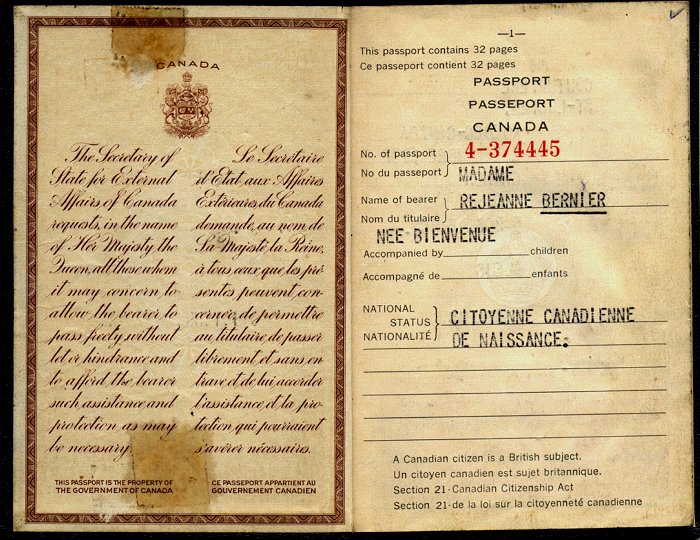
The modern form of the Canadian passport came about in 1921. At that time, Canadians were British subjects, and Canada shared a common nationality with the United Kingdom; thus, Canadian passports were issued to those British subjects resident in or connected to Canada. This arrangement ended in 1947, when the Canadian Citizenship Act was granted Royal Assent and the designation of Canadian citizenship was created. Beginning in July the following year, Canadian passports were issued to Canadian citizens only.[60] However, the first page of Canadian Passports still declared that "A Canadian Citizen is a British Subject", as such was a main clause of the Citizenship Act 1946. This would remain until the Act was overhauled and replaced by the Citizenship Act 1976, after which the phrase on the first page of Canadian Passports was changed to read: "The bearer of this passport is a Canadian citizen."[61][62][63][64][65]
Between 1947 and 1970, Canadian citizens could only apply for passports by mail to Ottawa. Requirements were simple, and applicants claiming birth in Canada did not have to provide proof of birth. The relaxed security led to numerous cases of misuse of the passport, which made the need to tighten the application requirements evident. In 1970, the first three Passport Canada offices were opened in Montreal, Toronto, and Vancouver.[4]
The size dimensions of a closed Canadian passport were originally much larger. This changed in the early 1980s in the lead up to the introduction of Machine-Readable Passports (MRP) when the smaller sized booklet was first introduced.[66]
In 1985, the first version of MRPs was issued, in accordance with International Civil Aviation Organization standards. An amended version came into circulation in 1991, with additional security features and more stringent processing requirements. By 1993, a newer version of MRP was introduced, which contained unique features to prevent replication or alteration.[4]
Since 11 December 2001, children have not been included in parents' passports, and passports have been issued for one person only.[21]
In 2002, Passport Canada began to issue an updated version within Canada, which includes the digitally printed photo of the bearer embedded into the identification page of the booklet, holographic images, bar-coded serial number, and a second hidden photo of the bearer that could only be viewed under ultraviolet light. Canadian diplomatic missions abroad adopted this version in 2006.[4] In March 2010, the passport was upgraded to include a new design of the identification page and more anti-counterfeit elements, such as the new colours of Optically Variable Ink and addition of laser perforated number. The cover, watermark, personalisation technique and holographic laminate are same with the 2002 version. The 2010 version was also the last revision of MRP prior to the release of e-passports.[21]
In the 2008 federal budget, Jim Flaherty, Minister of Finance, announced that biometric passports (or "e-passports") would be introduced by 2011.[67] A pilot project began in 2009, with e-passports being issued to special and diplomatic passport applicants.[68] The e-passport roll-out was pushed back to 1 July 2013. On the same day, the issuing authority of Canadian passports was shifted from Foreign Affairs and International Trade Canada to Citizenship and Immigration Canada (CIC), now known as IRCC.[7]
A newly designed passport featuring a polycarbonate data page, new security features, and artwork was rolled out in summer 2023.[69]
Incidents
[edit]Misuse
[edit]
Historically, the Canadian passport has been a target of counterfeiters, criminals, fugitives, and agents of foreign governments. The reasons for such high number of misuses include the relative lax issuance process, the lack of anti-counterfeit security features in early non-MRP versions, the Canadian passport's high number of visa-free countries, the general unassuming nature of the country and its citizens, and access to the United States.[4][70][71][72][73][74]
As of 2015, a fake or altered Canadian passport could cost as much as US$3,000 on the black market, almost three times higher than fake or altered EU passports at the time.[75] In 2014, CBC News wrote that "criminals are willing to spend $5,000 to $20,000" for a genuine Canadian passport "issued under an assumed name."[73]
- In 1940, Ramón Mercader, a Spanish national, travelled to Mexico City on a fraudulent Canadian passport to assassinate Leon Trotsky.[76]
- In 1961, KGB officer Konon Molody used a fraudulently obtained passport of deceased Canadian Arnold Lonsdale. Using this identity he engaged in espionage activities in the United Kingdom.[76]
- In 1962, three American fugitives who were convicted with narcotics-related charges obtained Canadian passports to escape to Spain. At the same time, Australian government officials also uncovered a Soviet spy ring that was using Canadian passports.[76]
- In 1968, James Earl Ray, the man who assassinated Martin Luther King, Jr., used a Canadian passport, which was obtained with a forged baptismal certificate in the name of "Ramon George Sneyd", to temporarily escape capture following his completed assassination.[76] He was in possession of two Canadian passports at the time of his arrest at London Heathrow Airport.[76] Before Ray's arrest, he was able to turn his passport in, which has incorrectly spelled his fake last name as "Sneya", to the Canadian Embassy in Portugal, for a replacement under his correct alias. The arrest of Ray triggered an investigation launched by the Royal Commission on Security in 1969, which recommended much more stringent application requirements and the establishment of Passport Canada offices.[4]
- In 1973, Mossad agents in Norway accidentally killed a waiter in Lillehammer in the mistaken belief that he was a senior operative for Black September. The use of false Canadian passports by the killers prompted a diplomatic crisis in relations between Canada and Israel, resulting in a commitment by Israel not to misuse Canadian passports in the future. It also resulted in a redesign of the Canadian passport to improve its security features.[77]
- In 1997, Israeli secret service personnel again botched an assassination bid while using Canadian passports. The attempt against Khaled Mashal in Jordan resulted in the arrest of the would-be killers. The Foreign Affairs Minister Lloyd Axworthy eventually received an apology and a written by the Israeli government, assuring that the Mossad would desist from using Canadian passports.[78]
- Ahmed Ressam, the Algerian al-Qaeda Millennium Bomber who attempted to blow up Los Angeles International Airport on New Year's Eve 1999/2000, evaded deportation by Canada and travelled freely to and from Canada by using a Canadian passport he obtained in March 1998 by submitting a fraudulent baptismal certificate; he used a stolen blank certificate, filling it in with a fictitious name.[79]
- In 2007, a former Canadian bureaucrat pleaded guilty to selling at least 10 fraudulent passports to individuals overseas.[80]
- A Russian spy involved in the Illegals Program used a Canadian passport to travel to the United States to deliver payment to Russian sleeper agents. The passport was issued to a man known as Christopher Metsos. However, following the public revelation of the spy ring in 2010, Passport Canada revoked the document, saying it had been issued by the Canadian High Commission in Johannesburg, South Africa to a man assuming the identity of a deceased Canadian child.[81]
- The TV show The Americans was inspired by the 2010 FBI bust of Elena Vavilova and Andrey Bezrukov, both of whom held Canadian passports under the names Tracey Foley and Donald Heathfield. Their exposure put their two Canadian-born sons into a legal battle for Canadian citizenship.[82][74]
While not a case of misuse as it was conducted with secret approval of the Canadian government, six American diplomats were smuggled out of Iran using authentic Canadian passports containing forged Iranian visas in 1980.
Denial of passports to Abdurahman Khadr and Fateh Kamel
[edit]In July 2004, Abdurahman Khadr was denied a Canadian passport by Governor General Adrienne Clarkson on the explicit advice of her Foreign Affairs Minister, Bill Graham, who stated the decision was "in the interest of the national security of Canada and the protection of Canadian troops in Afghanistan". The government invoked Royal Prerogative in order to deny Khadr's passport, as national security was not at that time listed in the Canadian Passport Order as a ground for refusal. Shortly thereafter, on 22 September 2004, section 10.1 was added to the order, which allowed the minister to revoke or refuse a passport due to national security concerns.[83] Khadr sought judicial review of the minister's decision to refuse his passport and,[84] on 8 June of the following year, the Federal Court ruled that the government did not have the power to refuse to issue Khadr's passport in the absence of specific authority set out in the Canadian Passport Order, but stated in obiter dicta that if the order were to be amended, Khadr would likely not be able to challenge the revocation.[85] In 2006, the Minister of Foreign Affairs, then Peter MacKay, again denied Khadr's application, this time invoking section 10.1 of the amended Canadian Passport Order.[86]
Section 10.1 was later challenged in Federal Court by Fateh Kamel, whose passport had also been refused for national security reasons. On 13 March 2008, the Federal Court declared section 10.1 of the Canadian Passport Order to be unconstitutional and therefore invalid,[87][88] though the court suspended its declaration of invalidity for six months in order to allow the government time to amend the order. The federal government launched an appeal at the Federal Court of Appeal and a ruling handed down on 29 January 2009 overturned the lower court decision. The court unanimously agreed the denial of passport service on national security grounds is in compliance with the Charter of Rights and Freedoms, citing the limitation clause Section One as its main decision point.[89][90] Kamel launched an appeal in 2009 to the Supreme Court of Canada but the court declined to hear his case and thus ended the legality challenge to the Canadian Passport Order.[91] In 2010, Kamel attempted to re-apply for a Canadian passport but was once again refused by the minister on grounds of national security. He sought judicial review but was dismissed by the Federal Court and subsequently by the Federal Court of Appeal in 2013.[92] Kamel did not appeal the decision of the Federal Court of Appeal to the Supreme Court of Canada.
2023 redesign controversy
[edit]There was backlash against the removal of historic national and Indigenous symbols in the new passport design.[93][94][95][96] Images commemorating Canadian sacrifices in war, such as the Vimy Ridge Memorial and National War Memorial, as well as iconic Canadians like Terry Fox, women's suffrage activist Nellie McClung, and Billy Bishop were removed from the passport. The Vimy Foundation, the Royal Canadian Legion, and then mayor of Terry Fox's hometown, Brad West, released statements voicing their disappointment about the respective removals of images with which they are associated.[93][44][95][96]
Other symbols that were removed include the HMCS Sackville, the Grey Cup and Stanley Cup, the Bluenose, Pier 21, the North-West Mounted Police and RCMP, the Last Spike, Centre Block of Parliament, Niagara Falls, Old Quebec, and Cape Spear. Indigenous symbols removed include the Inuit Inukshuk, the First Nations' eagle feather, and the Métis infinity symbol. Other people removed include the Fathers of Confederation, Samuel de Champlain 'Father of New France', and Joseph-Elzéar Bernier. Quotes from John A. MacDonald, Georges-Étienne Cartier, John Diefenbaker and Wilfred Laurier were also removed.[97][98][95][44][99]
CTV News described the new images as "Scenes of people swimming, canoeing and animals". Tristin Hopper of the National Post described the new images as "stylized scenes inhabited by faceless geometric figures", and Taylor C. Noakes of the Toronto Star called the new imagery "meaningless."[95] Writing in The Globe and Mail, Jen Gerson likened the new design to the Corporate Memphis art style.[100] Then Minister of Immigration, Refugees and Citizenship, Sean Fraser said feedback received in passport design consultations included a desire to "celebrate our diversity and inclusion", and to "celebrate our natural environment".[101]
Noakes called the passport backlash "fake outrage", arguing in the Toronto Star that national symbols change, and that the removed images and symbols were "increasingly irrelevant". Referring to the passport, the article stated "If we want history in it, we’ll have to talk honestly about our past and what we value from it." Noakes also argued "The current government’s lack of leadership on national symbols, as shown in the new passport, is as problematic as the last government’s excessive focus on a narrow set of overused European-Canadian-centric symbols." He noted that both the old and new passports lack representation of visible minorities and LGBTQ+ peoples, and that the old passport had only one woman. Noakes also advocated for discussions on whether national symbols like The Last Spike, Terry Fox, and Vimy Ridge still matter to Canadians, how they relate to us, "and what complications may arise from assuming they matter to Canadians in the first place."[102]
Foreign travel statistics
[edit]According to the statistics these are the numbers of Canadian visitors to various countries per annum in 2015 (unless otherwise noted):


See also
[edit]
Notes
[edit]- ^ a b c d e f g h i j k l m n o p q r s t u v w x y z aa ab ac ad ae af ag Data for 2016
- ^ a b c d e f g h i j k l m n o p q r s t u v w x y z aa ab ac ad ae af ag ah ai aj ak al am an ao ap aq ar as at au av aw ax ay az ba bb bc bd be Data for 2017
- ^ a b c d e f g h Data for 2014
- ^ a b c d e f g h i j k l m Counting only guests in tourist accommodation establishments.
- ^ a b c d Data for 2013
- ^ a b Data for 2011
- ^ a b c d Data for arrivals by air only.
- ^ Data for 2012
- ^ Excluding one-day visits
- ^ a b c d Data for 2010
- ^ Data for 2007
- ^ a b c Data for 2009
- ^ Total number includes tourists, business travelers, students, exchange visitors, temporary workers and families, diplomats and other representatives and all other classes of nonimmigrant admissions (I-94).
References
[edit]- ^ a b "IRCC Minister Transition Binder 2021: Passport Program". canada.ca. 25 January 2022. Retrieved 6 May 2022.
- ^ a b Immigration, Refugees and Citizenship Canada (28 May 2015). "Passports in general". Canada.ca. Government of Canada.
- ^ a b c Immigration, Refugees and Citizenship Canada (28 May 2015). "Pay your passport fee in Canada". Canada.ca. Government of Canada.
- ^ a b c d e f g h "History of passports". Government of Canada. 10 April 2014. Retrieved 31 March 2016.
- ^ "Merriam Webster Dictionary: Passport; Merriam-Webster, Incorporated; 2005". Merriam-webster.com. 13 August 2010. Retrieved 3 June 2011.
- ^ "Passport Program Annual Report for 2016 – 2017". Immigration, Refugees and Citizenship Canada. Retrieved 11 March 2018. (See p. 8 for percentage figure and p. 15 for number of travel documents in circulation.)
- ^ a b c Canadian Passport Order, SI/81-86 .
- ^ Branch, Legislative Services (29 May 2019). "Consolidated federal laws of canada, Canadian Passport Order". laws-lois.justice.gc.ca. Retrieved 9 September 2020.
- ^ "Refusal, revocation, cancellation and suspension of Canadian passports". Immigration, Refugees and Citizenship Canada. 14 June 2006. Retrieved 17 July 2018.
Canadian passports are the property of the Government of Canada. If a person is requested to return a passport, the passport must be provided to the Passport Program without delay or by the date indicated.
- ^ "International Comparison of Passport Issuing Authorities" (PDF). Passport Canada. 1 March 2012. Archived from the original (PDF) on 5 January 2017. Retrieved 30 March 2016.
- ^ "Henley Passport Index | Global Passport Ranking". Retrieved 20 August 2025.
- ^ Branch, Government of Canada, Immigration, Refugees and Citizenship Canada, Communications (25 March 2021). "Dual Canadian citizens need a valid Canadian passport". cic.gc.ca.
{{cite web}}: CS1 maint: multiple names: authors list (link) - ^ "Notice – Special Authorization for dual Canadian citizens extended". 27 January 2017.
- ^ "Countersigning passport applications and photos: When you must get a signature and what to do". Government of the United Kingdom.
- ^ Canada, Global Affairs; Canada, Affaires mondiales (26 June 2013). "Global Affairs Canada". Archived from the original on 25 March 2016. Retrieved 1 April 2016.
- ^ a b Immigration, Refugees and Citizenship Canada (2 January 2020). "Special or diplomatic passport (adult): Who can apply". Canada.ca (Apply for (or renew) a special or diplomatic passport: adults, 2nd page.). Government of Canada. Section "Read the Diplomatic and Special Passports Order—administrative version". Retrieved 1 April 2020.
- ^ "Commissioners of the Territories". Indigenous and Northern Affairs Canada. February 2, 2009. Archived from the original on April 11, 2016. Retrieved March 30, 2016.
- ^ a b "Official Travel", Special and diplomatic ePassports, Government of Canada, retrieved 30 March 2016
- ^ "Passport Canada Business Plan 2006–2009" (PDF). Retrieved 3 June 2011.
- ^ "Requisition form for diplomatic or special passport issuance to department of national defence members" (PDF). Government of Canada. Retrieved 30 March 2016.
- ^ a b c d "BSF5023 – Guide for Transporters – Obligations under the Immigration and Refugee Protection Act". Canada Border Services Agency. April 4, 2012. Archived from the original on April 13, 2016. Retrieved March 31, 2016.
- ^ "7 things about the new Canadian passport that are way different from the old one (PHOTOS)". 20 August 2024.
- ^ Branch, Government of Canada, Immigration, Refugees and Citizenship Canada, Communications (28 May 2015). "Pick-up and final steps – travel documents". cic.gc.ca.
{{cite web}}: CS1 maint: multiple names: authors list (link) - ^ Branch, Government of Canada, Immigration, Refugees and Citizenship Canada, Communications (9 March 2015). "Notice – Passport requirements in effect May 9, 2015". cic.gc.ca.
{{cite web}}: CS1 maint: multiple names: authors list (link) - ^ Zimonjic, Peter; Allen, Bonnie (24 August 2017). "Canadians will soon be able to ID gender as 'X' on their passports". CBC News. Retrieved 29 August 2017.
- ^ Chokshi, Niraj (25 August 2017). "Canada Introduces 'X' as a Third Sex Category for Passport Holders". The New York Times. Retrieved 29 August 2017.
- ^ "Minister Hussen announces major step forward in gender equality by making changes to passports and immigration documents". News. Immigration, Refugees and Citizenship Canada. 24 August 2017. Retrieved 29 August 2017.
- ^ "Choose or update the gender identifier on your passport or travel document". 11 July 2019. Retrieved 16 July 2019.
- ^ Branch, Government of Canada, Immigration, Refugees and Citizenship Canada, Communications (28 May 2015). "Omission of place of birth". cic.gc.ca.
{{cite web}}: CS1 maint: multiple names: authors list (link) - ^ "Canadians Born in Hong Kong or Macao". 6 December 2012.
- ^ Veffer v. Canada (Minister of Foreign Affairs), 2007 FCA 247 at par. 6–12, [2008] 1 FCR 641 (25 June 2007)
- ^ Paul Koring (20 September 2011). "Palestine exists for a select few Canadians". The Globe and Mail. Retrieved 21 November 2014.
- ^ Lettres: Sourire dans sa langue... sur son passeport, Le Devoir, 5 September 2003
- ^ Demande de Passeport
- ^ Aanvraag tot afgifte van een Paspoort
- ^ "The ePassport". 5 September 2014.
- ^ "Biometric passports to be ready by end of 2012". Ottawa Citizen. 14 September 2011.[permanent dead link]
- ^ Branch, Government of Canada, Immigration, Refugees and Citizenship Canada, Communications (10 February 2012). "Privacy Impact Assessment Summary – Global Case Management System (GCMS) – Phase II". cic.gc.ca.
{{cite web}}: CS1 maint: multiple names: authors list (link) - ^ "Planned online passport renewal called 'reckless' security risk".
- ^ "New passport processing system suspended after glitches, security gaps revealed".
- ^ Branch, Government of Canada, Immigration, Refugees and Citizenship Canada, Communications (30 May 2016). "Internal Audit of Passport Integration with the Global Case Management System". cic.gc.ca.
{{cite web}}: CS1 maint: multiple names: authors list (link) - ^ "New passport processing system was exposed to security gaps".
- ^ Immigration, Refugees and Citizenship Canada (10 May 2023). "Features of Canada's new passport". www.canada.ca. Retrieved 24 July 2023.
- ^ a b c Nardi, Christopher (11 May 2023). "Why Canada's new passport features old Queen's crown instead of new snowflake design". Archived from the original on 11 May 2023.
- ^ Flaviis, Sissi De (28 August 2023). "Canadian government admits new passports susceptible to curling". CTVNews. Retrieved 1 April 2025.
- ^ Knight, Chris (29 August 2023). "Canadians frustrated as new passports prone to bending: 'something coming out of a washing machine'".
- ^ Branch, Government of Canada, Immigration, Refugees and Citizenship Canada, Communications (30 September 2015). "Documents we accept as proof of citizenship". cic.gc.ca.
{{cite web}}: CS1 maint: multiple names: authors list (link) - ^ Brean, Joseph (15 June 2014). "'I can't be stateless': Born-in-Canada criminal fighting deportation after Ottawa decides citizenship not valid". The National Post.
- ^ a b "Supreme Court dismisses Ottawa man's appeal to be declared Canadian citizen". CBC News. 28 January 2016.
- ^ "Global Passport Ranking | Passport Index 2024". Henley & Partners — Global Rankings. Retrieved 16 January 2024.
- ^ a b "Western Hemisphere Travel Initiative". U.S. Customs and Border Protection. Retrieved 30 March 2016.
- ^ "Canadians Requiring Visas". U.S. Embassy and Consulates in Canada. Retrieved 30 March 2016.
- ^ "Visa exemptions for Canadians and certain landed immigrants". americanlaw.com. Retrieved 25 February 2011.
- ^ "Canadian Students". U.S. Embassy and Consulates in Canada. Retrieved 30 March 2016.
- ^ "Visas for Canadian and Mexican NAFTA Professional Workers". U.S. Department of State. Archived from the original on 2 April 2016. Retrieved 30 March 2016.
- ^ "H-1B Visa". CanadiansInUSA.com. Retrieved 30 March 2016.
- ^ "First Nations and Native Americans". U.S. Embassy and Consulates in Canada. Retrieved 30 March 2016.
- ^ "Frequently Asked Questions About Aboriginal Peoples". Archived from the original on October 5, 2016.
- ^ Wagner, Jonathan (2006). A History of Migration from Germany to Canada, 1850–1939. UBC Press. p. 163. ISBN 978-0-7748-1216-0. Retrieved 2 February 2010.
- ^ "THE HISTORY OF CANADIAN PASSPORTS". IMMIgroup. 12 April 2013. Retrieved 31 March 2016.
- ^ Saunders, Doug (1 January 2017). "In 1967, change in Canada could no longer be stopped". The Globe and Mail. Globe and Mail Newspaper. Retrieved 21 April 2020.
- ^ Parasram, Ajay (June 2010). "Us and Them: The Plumbing and Poetry of Citizenship Policy and the Canadians Abroad" (PDF). www.asiapacific.ca. Retrieved 20 April 2020.
"Until the second Citizenship Act in 1977, passports still proclaimed, "A Canadian citizen is a British subject"
- ^ Military Communications and Electronics Museum; http://www.c-and-e-museum.org/marville/photos/support/pma-123.jpg
- ^ First page of old Canadian passport, issued to Mr. Glen Herbert Gould "(image). Library and Archives Canada.
- ^ "First page of old Canadian Passport" (image). Shelby County Register of Deeds.
- ^ Strauss, Stephen (8 February 1984). "New Passports to be scanned by Machines". The Globe and Mail. p. 20.
- ^ "Budget 2008: Responsible Leadership for Uncertain Times" (PDF).
- ^ "Canadian diplomatic and special passports fact file". CTV Television Network. 10 September 2014. Retrieved 31 March 2016.
- ^ "Canada unveils new passport design with state-of-the-art security features". 10 May 2023.
- ^ FITSANAKIS, JOSEPH (6 February 2013). "Canadian passports still highly coveted by spies and terrorists". intelNews.org. Retrieved 2 April 2025.
- ^ Koring, Paul (5 February 2013). "Canadian passports: The disguise of choice for international dirty deeds". The Globe and Mail. Retrieved 2 April 2025.
- ^ Thomas, Gary (11 July 2010). "US-Russian Spy Case Raises Alarms in Canada". Voice of America. Retrieved 2 April 2025.
- ^ a b Seglins, Dave; Nicol, John (15 May 2014). "RCMP bust passport fraud scheme tied to Canada's 'most wanted'". CBC News.
- ^ a b Friscolanti, Michael (11 August 2017). "We Were Raised By Russian Spies". Chatelaine. Maclean's. Retrieved 2 April 2025.
- ^ "Chute radicale des saisies de faux passeports canadiens". La Presse. 9 July 2015. Retrieved 31 March 2016.
- ^ a b c d e "James Earl Ray's fake Canadian passport". CBC News. 28 October 2009. Retrieved 31 March 2016.
- ^ Mueller, Karl P. (2006). Karl P. Mueller (ed.). Striking first: preemptive and preventive attack in U.S. national security policy. Rand Corporation monograph series. Vol. 375 of MG. Rand Corporation. p. 228. ISBN 978-0-8330-3881-4. Retrieved 19 February 2010.
- ^ Singer, David (1998). Ruth R. Seldin (ed.). American Jewish year book, 1998. Vol. 98. Verlag für die Deutsche Wirtschaft AG. pp. 192, 193. ISBN 978-0-87495-113-4. Retrieved 19 February 2010.
- ^ "Government's Sentencing Memorandum; U.S. v. Ressam" (PDF). 20 April 2005. Retrieved 28 February 2010.[permanent dead link]
- ^ "Former government worker forged passports". CBC News. 16 May 2007. Retrieved 31 March 2016.
- ^ "Canada cancels passport of accused Russian spy". CBC News. July 26, 2010. Archived from the original on July 30, 2010. Retrieved October 20, 2010.
- ^ Goodnough, Abby (30 June 2010). "Suspect in Spy Case Cultivated Friends Made at Harvard". The New York Times. ISSN 0362-4331. Retrieved 2 April 2025.
- ^ Order amending the Canadian Passport Order, SI/2004-113
- ^ "CTV News: Khadr lawyer says passport denial violates rights; 6 December 2005". Ctv.ca. 6 December 2005. Archived from the original on 13 March 2007. Retrieved 3 June 2011.
- ^ "Khadr v. Attorney General of Canada". Decisions.fct-cf.gc.ca. Retrieved 3 June 2011.
- ^ "CTV News: Ottawa again denies Khadr's passport application; 30 August 2006". Ctv.ca. 30 August 2006. Archived from the original on 6 June 2009. Retrieved 3 June 2011.
- ^ "Department of Justice Canada: Canadian Passport Order". Laws.justice.gc.ca. Retrieved 3 June 2011.
- ^ Sean Gordon Quebec Bureau Chief (14 March 2008). "Gordon, Sean; Toronto Star: Can't deny terrorist's bid for a passport, judge rules; 14 March 2008". Toronto Star. Retrieved 3 June 2011.
- ^ Kamel v. Canada (Attorney General), 2009 FCA 21, [2009] 4 FCR 449 (23 January 2009)
- ^ No passport for terrorist, court rules
- ^ Fateh Kamel c. Procureur général du Canada, 2009 CanLII 44619 (20 August 2009), Supreme Court (Canada)
- ^ Kamel v. Canada (Attorney General), 2013 FCA 103 (16 April 2013)
- ^ a b CBC Kids News (11 May 2023). "Backlash after Terry Fox, other images removed from Canadian passports".
- ^ MacInnis, Jonathan (12 May 2023). "Design controversy: New passport design not sitting well with Maritimers". CTVNews. Retrieved 1 April 2025.
- ^ a b c d Hopper, Tristin (11 May 2023). "Terry Fox vs. a wheelbarrow: Look inside the old vs. new Canadian passports". Archived from the original on 11 May 2023.
- ^ a b "Canada's new passport design already has people furious". www.blogto.com. Retrieved 1 April 2025.
- ^ Levitz, Stephanie (7 March 2025). "Pierre Poilievre trashes Justin Trudeau's 'egotistical' redesign of Canadian passport, says he'd scrap it". Toronto Star. Retrieved 1 April 2025.
- ^ Carrigg, David (10 May 2023). "Six things to know about Canada's new passport". vancouversun. Archived from the original on 11 May 2023. Retrieved 1 April 2025.
- ^ Nerenberg, Karl (15 May 2023). "The new, bland passport will still work as a travel document". rabble.ca. Retrieved 1 April 2025.
- ^ Gerson, Jen (12 May 2023). "Opinion: Yes, Canada's new passport really is that bad". The Globe and Mail. Archived from the original on 15 May 2023. Retrieved 1 April 2025.
- ^ ICI.Radio-Canada.ca, Zone Politique- (10 May 2023). "Canada's new passport to show more nature and less history". Radio-Canada.ca (in Canadian French). Retrieved 1 April 2025.
- ^ Noakes, Taylor C. (19 July 2023). "Fake outrage over new passport keeps Canadians from the debate we really need". Toronto Star. Archived from the original on 14 January 2024. Retrieved 1 April 2025.
- ^ "Statistical Yearbook – Department of Commerce". Archived from the original on 11 February 2017. Retrieved 9 February 2017.
- ^ "Anuário de Estatística do Turismo". Archived from the original on 13 June 2017. Retrieved 15 October 2017.
- ^ "Visitor Arrivals by Country of Residence".
- ^ "Tourism Statistics – IAATO". iaato.org. Archived from the original on 14 April 2018. Retrieved 27 February 2017.
- ^ "Arrivals by country". members.antiguahotels.org. 2018.
- ^ "Number of Stayover Visitors by Market".
- ^ "Arrivals – Year ended 31 December 2017" (PDF). Tourism Australia. Retrieved 11 June 2018.
- ^ "Österreich Werbung" (PDF). Österreich Werbung. Archived from the original (PDF) on February 14, 2017.
- ^ "Number of foreign citizens arrived to Azerbaijan by countries".
- ^ "Stopovers by Country" (PDF).
- ^ "barbados Annual Statistical Report" (PDF). Barbados Tourism Marketing. 2016. Retrieved 11 June 2018.
- ^ "Visitor Statistics". gotobermuda.com. 22 August 2016. Retrieved 21 March 2018.
- ^ "Tourisme selon pays de provenance 2016". Archived from the original on 20 August 2017. Retrieved 20 August 2017.
- ^ "Tourism and Travel Digest" (PDF). belizetourismboard.org. 2017. Archived from the original (PDF) on 7 February 2018. Retrieved 6 February 2018.
- ^ Namgay, Phunstho. "Annual Reports – Tourism Council of Bhutan". tourism.gov.bt. Archived from the original on 12 June 2018. Retrieved 12 June 2018.
- ^ "INE – Instituto Nacional de Estadística – Turismo".
- ^ "TOURISM STATISTICS Cumulative data, January – December 2017" (PDF). Archived from the original (PDF) on 29 May 2019. Retrieved 20 May 2018.
- ^ "Tourism Statistics Annual Report 2015" (PDF).
- ^ "Anuário Estatístico de Turismo - 2018" (in Portuguese). Archived from the original on 7 August 2018.
- ^ "Visitor data" (PDF). bvi.gov.vg.
- ^ "Brunei Darussalam Tourism Report 2011" (PDF).
- ^ "Data". nsi.bg.
- ^ "Abstract of Statistics. Chapitre 19 Statistiques du tourismep. 280" (PDF). Archived from the original (PDF) on 28 July 2020. Retrieved 23 June 2018.
- ^ "Tourism Statistics Report". tourismcambodia.org.
- ^ "Tourism Statistics Edition 2015, table 17". Archived from the original on 6 August 2017. Retrieved 12 February 2017.
- ^ CIDOT. "Welcome to the Cayman Islands Department of Tourism (CIDOT) Destination Statistics Website". caymanislands.ky.
- ^ "Estadísticas".
- ^ "China Inbound Tourism Statistics in 2015". travelchinaguide.com.
- ^ Most important countries of origin of foreign tourists in China in 2016
- ^ "Tourism data" (PDF). apicongo.org. 2012. Archived from the original (PDF) on 22 May 2017. Retrieved 6 January 2017.
- ^ "Tourism statistics" (PDF). mfem.gov.ck. 2016. Archived from the original (PDF) on 8 February 2017. Retrieved 7 February 2017.
- ^ "Informes Estadísticos – Instituto Costarricense de Turismo – ICT". ict.go.cr.
- ^ "TOURIST ARRIVALS AND NIGHTS IN 2017". Archived from the original on 21 May 2018. Retrieved 20 May 2018.
- ^ "Statistical Service – Services – Tourism – Key Figures". mof.gov.cy.
- ^ "Data" (PDF). one.cu. Archived from the original (PDF) on 5 June 2019. Retrieved 28 March 2016.
- ^ "Monthly Statistics".
- ^ "2015 Visitors Statistics Report" (PDF).
- ^ "BCRD – Estadísticas Económicas". bancentral.gov.do. Archived from the original on 3 February 2017. Retrieved 15 February 2017.
- ^ "Statistics Netherlands".
- ^ "Anuario 2010-2014 - Portal Servicios MINTUR". Archived from the original on 16 April 2016. Retrieved 2 April 2016.
- ^ "Portal de Transparencia – El Salvador". publica.gobiernoabierto.gob.sv. Archived from the original on 25 March 2017. Retrieved 24 March 2017.
- ^ "ACCOMMODATED TOURISTS BY COUNTY AND COUNTRY OF RESIDENCE (MONTHS)". pub.stat.ee.
- ^ Amitesh. "PROVISIONAL VISITOR ARRIVALS – 2017 – Fiji Bureau of Statistics". statsfiji.gov.fj. Archived from the original on 22 September 2018. Retrieved 25 January 2018.
- ^ "Data" (PDF). stat.fi. 2014.
- ^ "Statistics". entreprises.gouv.fr. 2016.
- ^ "Données détaillées". ispf.pf. Archived from the original on 14 November 2017. Retrieved 20 June 2016.
- ^ "International arrivals 2017". Archived from the original on 7 January 2018. Retrieved 7 January 2018.
- ^ Tourismus in Zahlen 2016, Statistisches Bundesamt
- ^ "Statistics". statistics.gr.
- ^ "PX-Web – Select variable and values". Bank.stat.gl. 28 November 2012. Retrieved 26 July 2018.[dead link]
- ^ "Video: 2017 Records Over 10,000 More Stayover Visitors Than 2016". 25 January 2018. Archived from the original on 1 February 2018. Retrieved 31 January 2018.
- ^ "Visitor Arrival Statistics – Research – Research and Reports". guamvisitorsbureau.com. Archived from the original on 7 July 2018. Retrieved 19 June 2016.
- ^ "Annual report" (PDF). inguat.gob.gt. 2014. Archived from the original (PDF) on 5 October 2018. Retrieved 28 March 2016.
- ^ "Tourist arrivals by country of origin" (PDF).
- ^ "Tourist arrivals by country of residence" (PDF).
- ^ "Monthly Report - Visitor Arrival Statistics" (PDF). www.discoverhongkong.com. December 2017. Archived from the original (PDF) on 31 January 2018. Retrieved 14 January 2022.
- ^ "TOURISM IN HUNGARY 2016". Archived from the original on 8 October 2017. Retrieved 4 March 2017.
- ^ "PX-Web – Select variable and values". Archived from the original on 10 March 2020. Retrieved 7 January 2016.
- ^ "Country figures". tourism.gov.in.
- ^ "Badan Pusat Statistik". Bps.go.id. Retrieved 26 July 2018.
- ^ "Overseas Visitors to Ireland January-December 2013-2016" (PDF).
- ^ TOURIST ARRIVALS TO ISRAEL (EXC. DAY VISITORS & CRUISE PASSENGERS) BY NATIONALITY, Ministry of Tourism
- ^ "IAGGIATORI STRANIERI NUMERO DI VIAGGIATORI". Archived from the original on 14 October 2017. Retrieved 13 June 2017.
- ^ Monthly Statistical Report December 2017 Vol xxvii No 12
- ^ "2017 Foreign Visitors & Japanese Departures" (PDF). Japan National Tourism Organization. Archived from the original (PDF) on 27 January 2018. Retrieved 21 January 2018.
- ^ "Tourist Overnight and Same Day Visitors By Nationality during". Archived from the original on 29 September 2018. Retrieved 30 April 2016.
- ^ "Туризм Казахстана. 2.4 Количество посетителей по въездному туризму". Archived from the original on 21 December 2016. Retrieved 9 December 2016.
- ^ "Statistical Reports on Tourism in Laos". Archived from the original on 4 December 2018. Retrieved 28 November 2018.
- ^ "TUG02. Visitors staying in hotels and other accommodation establishments by country of residence-PX-Web".
- ^ "Arrivals according to nationality during year 2016".
- ^ "2013 International Arrivals Statistics" (PDF). Archived from the original (PDF) on September 5, 2015. Retrieved May 1, 2016.
- ^ "Number of guests and overnights in Lithuanian accommodation establishments. '000. All markets. 2015-2016".
- ^ "Arrivals by touristic region and country of residence (all types of accommodation) 2011–2016". statistiques.public.lu.
- ^ "DSEC – Statistics Database". dsec.gov.mo.
- ^ "Publications – Statistiques". 27 May 2015. Archived from the original on 6 January 2017. Retrieved 5 January 2017.
- ^ a b "December 2017 – Ministry of Tourism". tourism.gov.mv.
- ^ "TOURIST ARRIVALS TO MALAYSIA BY COUNTRY OF NATIONALITY DECEMBER 2017" (PDF). Archived from the original (PDF) on 5 March 2018. Retrieved 7 March 2018.
- ^ "National Statistical Office of Malawi" (PDF). nsomalawi.mw.[permanent dead link]
- ^ "ANNUAIRE 2014". Archived from the original on 7 January 2017. Retrieved 6 January 2017.
- ^ "Jamaica - Visitor Arrival Summary" (PDF). www.onecaribbean.org. Archived from the original (PDF) on 7 May 2012. Retrieved 14 January 2022.
- ^ "Visitantes internacionales por vía aérea por principal nacionalidad".
- ^ "Annual International Visitor Arrivals of Non-FSM Citizens by Purpose of Visit and Country/Region of Citizenship, FSM: 2006-20151". Archived from the original (XLSX) on October 1, 2016. Retrieved October 22, 2016.
- ^ Statistică, Biroul Naţional de (12 February 2018). "// Comunicate de presă". statistica.md. Retrieved 17 June 2018.
- ^ "Info" (PDF). tourism.ub.gov.mn. 2017.
- ^ "Data" (PDF). monstat.org.
- ^ "Tourist arrivals by country of residence" (PDF).
- ^ "Myanmar Tourism Statistics – Ministry of Hotels and Tourism, Myanmar". Archived from the original on 14 July 2017. Retrieved 14 October 2017.
- ^ "Tourist stats" (PDF). namibia-tourism.com. Archived from the original (PDF) on 29 October 2016. Retrieved 28 October 2016.
- ^ "Tourism Statistics 2015 p.30" (PDF). Archived from the original (PDF) on January 31, 2017.
- ^ "Toerisme in perspectief 2018". Archived from the original on 29 January 2018. Retrieved 28 January 2018.
- ^ "International travel and migration: December 2017". Statistics New Zealand. Retrieved 2 February 2018.
- ^ "Visitors arrival by country of residence and year". Archived from the original on 18 September 2016. Retrieved 13 June 2016.
- ^ Estadísticas de Turismo
- ^ "Stats" (PDF). stat.gov.mk.
- ^ "Number of Tourists to Oman from 2011-2017". Archived from the original (XLSX) on 20 October 2018.
- ^ Pakistan Statistical Year Book 2012 20.31
- ^ "Data" (PDF). atp.gob.pa. 2015. Archived from the original (PDF) on 27 November 2016. Retrieved 26 November 2016.
- ^ "Annual arrivals" (PDF). tpa.papuanewguinea.travel. 2016. Archived from the original (PDF) on 4 March 2017. Retrieved 4 March 2017.
- ^ "Ranking de turistas a Paraguay, por año, según nacionalidad. Período: 2010–2015" (PDF). Archived from the original (PDF) on 6 January 2017. Retrieved 5 January 2017.
- ^ Estadistica de Turismo – Turistas internacionales, según país de residencia permanente
- ^ "Stats" (PDF). e-services.tourism.gov.ph:8080. 2017. Archived from the original (PDF) on 10 February 2018. Retrieved 7 March 2018.
- ^ "Annual report". /www.insse.ro. 2016.[permanent dead link]
- ^ "Въезд иностранных граждан в РФ". Fedstat.ru. 18 October 2017. Archived from the original on 18 October 2017. Retrieved 18 October 2017.
- ^ "TOURISM - Sector Performance". Archived from the original on 24 April 2016. Retrieved 12 June 2016.
- ^ "Tourism statistics" (PDF). discoversvg.com. Archived from the original (PDF) on 27 February 2021. Retrieved 12 June 2016.
- ^ "Data". sbs.gov.ws. Archived from the original on 19 October 2016. Retrieved 29 October 2016.
- ^ "Tourist turnover – December 2017" (PDF).
- ^ "VISITOR ARRIVALS BY COUNTRY OF RESIDENCE AND MODE OF TRANSPORT". Archived from the original (XLSX) on 14 January 2016. Retrieved 12 September 2015.
- ^ "Visitor Arrivals". stb.gov.sg. Archived from the original on 22 January 2017. Retrieved 6 March 2018.
- ^ "Tourist arrivals by country of nationality" (PDF).
- ^ "Info". slovak.statistics.sk.
- ^ "Table: Tourist arrivals and overnight stays by countries, municipalities, Slovenia, monthly". pxweb.stat.si. Archived from the original on 1 February 2018. Retrieved 18 November 2018.
- ^ Visitor Statistics, 2015-2017
- ^ "Annual Report" (PDF). statssa.gov.za. 2015.
- ^ "Korea, Monthly Statistics of Tourism – key facts on tourism – Tourism Statistics". kto.visitkorea.or.kr.
- ^ "Tabla23984". ine.es.
- ^ "TOURIST ARRIVALS BY COUNTRY OF RESIDENCE 2017" (PDF). Archived from the original (PDF) on 3 February 2018. Retrieved 3 February 2018.
- ^ "Suriname Tourism Statistics" (PDF). surinametourism.sr. Archived from the original (PDF) on 12 June 2018. Retrieved 8 June 2018.
- ^ "Swaziland Tourism – Swaziland Safari – Swaziland Attractions – Useful Links – Research". thekingdomofswaziland.com.
- ^ "Visitor Arrivals by Nationality". Archived from the original on 24 March 2018. Retrieved 21 January 2018.
- ^ "The 2016 International Visitors' Exit Survey Report. International Tourist Arrivals. p. 73-77" (PDF). nbs.go.tz/. NBS Tanzania. Retrieved 18 December 2017.
- ^ "สถิติด้านการท่องเที่ยว ปี 2560 (Tourism Statistics 2017)". Ministry of Tourism & Sports. Archived from the original on 18 August 2017. Retrieved 16 January 2018.
- ^ Stats, Tonga. "Migration Statistics – Tonga Stats". tonga.prism.spc.int.
- ^ "T&T – Stopover Arrivals By Main Markets 1995-YTD" (PDF). Archived from the original (PDF) on January 14, 2016.
- ^ "NUMBER OF ARRIVING-DEPARTING VISITORS, FOREIGNERS AND CITIZENS December 2017".
- ^ "Tourism statistics" (PDF). turksandcaicostourism.com. 2015. Archived from the original (PDF) on 16 June 2016. Retrieved 12 June 2016.
- ^ Dev1. "Migration – Visitors by nationalities". tuvalu.prism.spc.int.
{{cite web}}: CS1 maint: numeric names: authors list (link) - ^ "MINISTRY OF TOURISM, WILDLIFE AND ANTIQUITIES SECTOR STATISTICAL ABSTRACT,2014". Archived from the original on May 7, 2016.
- ^ "Foreign citizens who visited Ukraine in 2017 year, by countries". ukrstat.gov.ua.
- ^ Statistics for the Emirate of Dubai
Dubai Statistics, Visitor by Nationality - ^ "Annual estimates on visits and spending in the UK by overseas residents, by purpose and region of visit". Office of National Statistics.
- ^ "Table 28 – Homeland Security". dhs.gov.
- ^ "ESTADÍSTICAS BÁSICAS DE LA ACTIVIDAD TURÍSTICA" (PDF) (in Spanish). Archived from the original (PDF) on 9 October 2016. Retrieved 27 March 2016.
- ^ International visitors to Viet Nam in December and 12 months of 2017
- ^ "Downloads". mota.gov.zm. Archived from the original on 1 July 2016. Retrieved 23 May 2016.
- ^ "Tourism Trends and Statistics 2015 Annual Report – Zimbabwe A World Of Wonders". zimbabwetourism.net. Archived from the original on 21 December 2016. Retrieved 11 December 2016.
External links
[edit]- Official site
- History of Canadian Passports
- Renewal of Canadian Passports
- Passport Guarantors Policy
- Travel Advice and Advisories – Global Affairs Canada
- Directory of Canadian Government Offices Abroad – Global Affairs Canada
- Canadian passport information on PRADO
| |||||||||||||||||||||||
| |||||||||||||||||||||||
| |||||||||||||||||||||||
| |||||||||||||||||||||||



Canadian passport
View on GrokipediaThe Canadian passport is an official booklet-form travel document issued exclusively to citizens of Canada by Immigration, Refugees and Citizenship Canada (IRCC), certifying the bearer's identity and nationality to facilitate international travel and re-entry to Canada.[1] It incorporates e-passport biometric chips for enhanced security and personal data verification at borders, with validity terms of five years for children under 16 and five or ten years for adults.[1][2] Introduced in its current biometric form in 2013 and redesigned in 2023 with a polycarbonate data page, laser-engraved details, and intricate holographic elements like a kinegram featuring national symbols such as the maple leaf, the passport emphasizes forgery resistance through multiple photo variants, metallic foils, and embedded digital printing.[2][3] Variants include regular, diplomatic, and special passports, alongside temporary documents like emergency travel documents for urgent needs.[1] As of 2025, it holds the ninth position on the Henley Passport Index, granting holders visa-free or visa-on-arrival access to 183 destinations worldwide based on International Air Transport Association (IATA) data, underscoring its utility in global mobility despite varying bilateral agreements that can shift access dynamically.[4][5]
Eligibility and Issuance
Proof of Canadian Citizenship
To apply for a Canadian passport, applicants must submit original documentary proof of their Canadian citizenship, as citizenship is a prerequisite for issuance.[6] Photocopies are generally not accepted, except for certain citizenship certificates issued on or after February 1, 2012, or those with numbers beginning with -K or -X; originals are verified by Passport Canada and returned to the applicant, typically within six weeks for mail applications or immediately for in-person submissions.[6] Laminated documents are acceptable only if the lamination was applied by the issuing government authority and the document is not marked "void if laminated."[6] For individuals born in Canada, an original long-form or short-form birth certificate issued by the vital statistics agency of the province or territory of birth constitutes valid proof, reflecting the principle of jus soli under the Citizenship Act whereby birth on Canadian soil generally confers citizenship, subject to exceptions such as birth to foreign diplomats.[6] Alternatively, an original citizenship certificate may be used: originals issued on or before January 31, 2012, or copies of those issued afterward or prefixed with -K or -X.[6] Applicants lacking a birth certificate must first obtain a citizenship certificate from Immigration, Refugees and Citizenship Canada (IRCC), which requires submitting evidence such as a birth registration or parental citizenship proofs.[7] For those born outside Canada, proof must demonstrate citizenship by descent or grant, typically via an original citizenship certificate (with the same original/copy rules as above), a certificate of naturalization, a certificate of registration of birth abroad (issued before 1977 for children of Canadian citizens), or a certificate of retention of Canadian citizenship (for those who would otherwise have lost it under prior laws).[6] These documents trace the citizenship lineage, as Canadian citizenship by descent is limited to the first generation born abroad unless registered or retained under specific provisions of the Citizenship Act amendments, such as those enacted in 2009 to restore rights lost due to "Lost Canadians" provisions.[7] If name or gender discrepancies exist between the citizenship proof and application, additional forms like PPTC 643 may be required for verification.[6]| Category | Acceptable Documents | Key Requirements |
|---|---|---|
| Born in Canada | Provincial/territorial birth certificate (original long- or short-form) Citizenship certificate (original pre-February 1, 2012; original or copy post-2012 or -K/-X prefixed) | Originals mandatory; birth certificate proves jus soli citizenship.[6] |
| Born Outside Canada | Citizenship certificate (same rules as above) Certificate of naturalization (original) Certificate of registration of birth abroad (original, pre-1977) Certificate of retention (original) | Must link to Canadian parent or naturalization; no birth certificate alone suffices.[6] |
Application Process
Canadian citizens apply for passports through the Passport Program, administered by Immigration, Refugees and Citizenship Canada and delivered via Service Canada.[1] The process distinguishes between new applications—for first-time applicants, those whose passports were lost, stolen, damaged, or expired over a year ago, or ineligible for renewal—and renewals, which streamline requirements for qualifying adults.[9][10] For a new adult passport, applicants complete the Adult General Passport Application (form PPTC 153), available for download from the official website.[11] Required items include proof of citizenship (e.g., long-form birth certificate issued after 1 April 1947 or citizenship certificate), two identical photographs (50 mm by 70 mm, taken within six months, showing a neutral expression and plain background, with one endorsed by the guarantor), and at least one supporting identity document (e.g., driver's licence or health card).[12] A guarantor—typically a professional like a dentist, engineer, or judge, or other Canadian citizen with a valid five- or ten-year passport issued within the last 15 years—must vouch for the applicant, having known them for at least two years, sign the form and one photo, and provide references if requested.[12] Applications submit with fees starting at $120 CAD for a five-year passport.[9] Submission options include online via the secure portal for eligible applicants (e.g., those with a previous undamaged passport), by mail to the regional processing office listed on the form (subject to delays from Canada Post labour disruptions as of October 2025), or in person at over 300 Service Canada locations for standard service or passport offices for express (2-9 business days) or urgent (next business day) processing with proof of imminent travel.[13][14] In-person urgent submissions require the applicant’s personal attendance; relatives or authorized third parties (aged 16+ with ID) may handle standard mail or in-person filings with written consent, but not expedited ones.[13] Child passports (for under-16s) follow a similar structure but use form PPTC 155, with applications filed by parents or guardians; all must sign, or provide consent and proof of authority (e.g., death certificate for a deceased parent).[15] These five-year documents are non-renewable, necessitating a new adult application at age 16 or expiry.[15] Adult renewals, available if the prior passport was issued within 15 years when the applicant was 16+, omit guarantor, citizenship proof, and ID requirements, requiring only the expired passport and form PPTC 054.[10][16] As of 2026, eligible applicants residing in Canada may renew online via the IRCC secure account portal for adult passports. Eligibility includes renewing one's own regular five- or ten-year blue passport issued when aged 16 or older within the last 15 years, with the passport expiring soon or already expired; no history of seizure, observations, name changes, or gender changes; and no urgent travel requiring fewer than 20 business days for processing. The steps are: check eligibility on the official site; register or sign in to the IRCC Portal at ircc-services.canada.ca; upload a compliant digital photo taken by a commercial photographer within six months; and submit the application, at which point the current passport is cancelled. Processing takes up to 20 business days plus mailing time, with the online service subject to daily limits; alternatives include in-person or mail submissions. Occasional maintenance downtimes apply, such as February 2-3, 2026.[17] Early renewal (more than one year before expiry) demands justification, such as a name change.[13] Status tracking occurs online post-submission.[18] For Canadian citizens residing in the United States seeking to renew an adult passport, a simplified mail-in process is available if the previous passport was issued when the applicant was aged 16 or older and there are no changes to name, date of birth, place of birth, or gender identifier.[19] This requires completing form PPTC 054, one passport photo meeting Canadian specifications (without guarantor endorsement), two references known to the applicant for at least two years (excluding family members), and inclusion of the old passport unless lost or stolen. Applications are mailed using traceable service to the Government of Canada Passport Program in Gatineau, Quebec. Fees are CAN$190 for a five-year passport or CAN$260 for a ten-year passport, with processing taking 20 business days plus mailing time. Online renewal is not available from the United States; for urgent needs, applicants should contact the nearest Government of Canada office, such as an embassy or consulate.[19]Fees, Processing Times, and Recent Innovations
The fees for regular Canadian passports applied for within Canada are structured by age and validity period. For adults aged 16 and older, a five-year passport costs CAN$120, while a ten-year passport costs CAN$160. For children under 16, the fee is CAN$57 for a passport valid up to five years.[20] Payments must be made in Canadian funds via credit or debit card, certified cheque, money order, or government cheque; cash and personal cheques are not accepted.[20] Processing times for passport applications begin upon receipt of a complete application, including fees and documents, and exclude mailing time. Under normal circumstances, the service standard for regular applications is approximately 20 business days.[21] Urgent in-person services at passport offices can reduce this to 2-9 business days, with additional fees, while express pickup options may take 3-4 business days at select locations.[21] Delays can occur due to incomplete applications, verification needs, or high volumes. In March 2025, the Government of Canada introduced a 30-business-day service guarantee for complete applications: if not processed within this period, fees are refunded.[22] Recent innovations include the rollout of a next-generation passport design starting in summer 2023, featuring enhanced security elements such as a laser-engraved polycarbonate data page resistant to tampering, a Kinegram overlay on the holder's photo, a transparent window with a secondary image, multiple photo variants to deter forgery, and metallic foil maple leaves in varied colors on the cover.[23] [2] These build on existing biometric ePassport chips while incorporating advanced anti-forgery measures. Processing innovations encompass the 2025 service guarantee and the introduction of online renewal applications to streamline submissions and reduce wait times.[22]Refusal, Revocation, and Legal Challenges
The Minister of Immigration, Refugees and Citizenship Canada may refuse to issue a Canadian passport under section 9 of the Canadian Passport Order if the applicant fails to submit a duly completed application or required supporting materials.[24] Refusal is also warranted if the applicant has been previously denied a passport on substantive grounds (excluding mere incompleteness) and those grounds persist, or if a prior revocation or refusal period remains in effect.[24] Additional grounds include an outstanding conviction for an indictable offence where the sentence, parole, or probation has not been fully served; being charged abroad with an offence equivalent to an indictable crime in Canada; involvement in child abduction or non-compliance with custody orders; an active arrest warrant or domestic charge for an indictable offence; or conviction for a sexual offence against a minor without completed sentence or probation.[24][25] Refusals extend to cases involving national security risks, such as suspected terrorism, organized crime, genocide, crimes against humanity, war crimes, human smuggling or trafficking, or misuse of travel documents through forgery or false information provided to government agencies.[25] Upon refusal, applicants may face a period of ineligibility for passport services, typically up to five years for serious offences like child sex crimes or terrorism-related activities, though shorter or no periods apply to administrative issues.[25] Passport revocation applies to issued documents under the same section 9 grounds as refusal, allowing the Minister to cancel validity if, for instance, the holder engages in prohibited activities post-issuance or new disqualifying information emerges.[24] Unlike routine cancellations for lost, stolen, or expired passports, revocation targets substantive misconduct and often triggers a refusal period; it may occur without prior notice in urgent national security cases to prevent terrorism or similar threats.[25] For expired passports, revocation is possible retroactively if grounds under section 10 existed at issuance.[26] Affected individuals may challenge refusals or revocations via judicial review in the Federal Court of Canada, with applications filed within 30 days of the decision.[25] Courts assess reasonableness under the Vavilov framework, quashing decisions lacking justification, transparency, or intelligible reasons; for example, a 2020 Federal Court ruling overturned a three-year passport services revocation for failing to demonstrate proportionality to the underlying child support arrears.[27] In Abdelrazik v. Canada (2009), the court addressed a Foreign Affairs Minister's denial of an emergency passport to a citizen stranded abroad, emphasizing procedural fairness despite security concerns.[28] Challenges grounded in Charter rights, such as mobility under section 6, have arisen in delays or blanket refusals, as in 2020 applications alleging unconstitutional processing halts during the COVID-19 pandemic, though outcomes varied by case specifics.[29]Types of Passports
Regular Passports
The regular passport serves as the primary travel document issued to Canadian citizens for routine international purposes, such as tourism, business, or family visits, and is available to all eligible applicants without restrictions tied to official government duties. It differs from special or diplomatic variants, which are limited to public servants or representatives traveling on official business, by being designated for general civilian use.[30][31] This passport booklet contains 38 pages, incorporating dedicated areas for entry and exit stamps alongside advanced security elements integrated throughout. All regular passports issued since February 2012 are biometric ePassports, embedding an electronic chip that stores the holder's facial image and personal details for enhanced verification at borders. The current design, introduced progressively from 2023, employs state-of-the-art anti-forgery measures while maintaining the navy blue cover standard for this category.[30][2][32] Validity durations vary by age at issuance: applicants aged 16 years or older may choose between a five-year or ten-year passport, with the longer option available only to adults to accommodate extended travel needs; children aged 14 years or younger receive a five-year passport exclusively, reflecting shorter-term requirements for minors. No extensions are possible beyond the printed expiry date, necessitating renewal for continued validity. Over 2.5 million regular passports were issued annually as of recent government reports, underscoring their prevalence in facilitating Canadian outbound travel.[30][33]Diplomatic, Official, and Emergency Passports
Canada issues two types of official passports—diplomatic and special—for government business, distinct from regular passports used for personal travel.[34] Diplomatic passports feature a maroon cover and are allocated to high-ranking federal officials, such as the Governor General, Prime Minister, and Chief Justice of Canada, as well as diplomats, representatives of international organizations where Canada participates, and diplomatic couriers conducting missions abroad.[35][31] These documents signify travel on official duties representing Canada and are prohibited for personal use unless explicitly authorized by the issuing authority.[36] Special passports, often designated for service or other non-diplomatic official purposes, are issued to federal employees traveling on government business who do not qualify for diplomatic status, with eligibility determined by Global Affairs Canada based on the nature of the assignment.[31][34] Both types require submission of specific forms, such as a Posting Confirmation Form for diplomatic applications, and are processed with a service standard of 15 business days under normal circumstances.[37][38] Immediate family members of eligible officials may also qualify, provided their travel aligns with the official's duties.[31] Emergency travel documents serve Canadians stranded abroad in urgent situations, such as when a regular passport is lost, stolen, or insufficient for immediate return to Canada or onward travel to a third country.[30] These single-use documents are issued exclusively by Canadian government offices overseas, including embassies and consulates, and hold limited validity tailored to the exigency, without extension options.[30][39] Unlike official passports, emergency documents do not confer diplomatic privileges and are not available for issuance within Canada.[30]Passports for Specific Groups
Canada issues specialized travel documents to permanent residents who lack access to national passports due to their status, enabling international travel while ensuring re-entry rights. These include the Refugee Travel Document for protected persons and the Certificate of Identity for stateless individuals or others unable to obtain a passport from their country of origin. Unlike regular passports reserved for citizens, these documents are not valid for travel to the holder's country of citizenship or former nationality, reflecting obligations under international conventions such as the 1951 Refugee Convention.[40][41] The Refugee Travel Document is available to permanent residents recognized as Convention refugees or persons in need of protection under Canadian law. It permits travel to countries other than the holder's country of citizenship and is typically valid for up to five years for adults, with child versions valid until age 16. Applications must be submitted from within Canada via mail to Immigration, Refugees and Citizenship Canada (IRCC), requiring proof of protected person status, identity documents, and photos meeting biometric standards. Fees are $120 for adults and $57 for children under 16 as of 2024. Failure to obtain this document before travel may result in inability to re-enter Canada without a Permanent Resident Travel Document applied for abroad.[40][41][42] The Certificate of Identity serves permanent residents who are not protected persons but are stateless or unable to secure a national passport, such as due to unresolved nationality issues or country-specific restrictions. Valid for one year generally, though extensions up to five years may be granted in exceptional cases, it facilitates travel excluding the holder's country of former nationality if applicable. Application processes mirror those for refugee documents, with fees set at $260 for adults and $141 for children under 16. These documents incorporate security features akin to passports, including biometric data, but their limited validity underscores their role as interim solutions pending citizenship or resolution of status barriers.[40][41][42][43]Physical Design and Security Features
Cover, Format, and General Appearance
The Canadian passport is issued as a booklet in the standard TD-1 format specified by the International Civil Aviation Organization (ICAO), with dimensions of 125 mm in height by 88 mm in width.[44] The regular passport contains 36 pages, of which 32 are designated for visas and entry/exit stamps.[32] The cover of the regular Canadian passport is navy blue, constructed from a flexible synthetic material resembling leather.[45] In the design introduced in 2023, the front and back covers incorporate multiple versions of metallic foil maple leaves in varying colors, along with a debossed maple leaf on the back cover, emphasizing national symbols over previous emblems like the royal coat of arms.[2] [46] The front cover prominently displays the word "CANADA" in large lettering, accompanied by "PASSPORT" and "PASSEPORT" in both official languages.[45] Overall, the passport's general appearance conveys durability and security, with the navy blue exterior providing a professional look consistent with many Western passports, while the updated maple leaf motifs reflect Canadian identity.[23] The booklet's spine allows it to open flat, facilitating use at border controls, and the ePassport symbol indicates the presence of an embedded biometric chip.[32]Data Page Details
The data page of a Canadian passport, also known as the biodata page, is located on the second page of the booklet and contains the holder's personal identification details in a standardized format compliant with International Civil Aviation Organization (ICAO) Doc 9303 specifications.[3] This page uses a durable polycarbonate material in passports issued since 2023, with personal information laser-engraved rather than ink-printed to enhance longevity and resistance to tampering.[23] The layout includes a high-resolution digital color photograph of the holder, approximately 35mm x 45mm, positioned on the left side, alongside fields for biographical data printed in English and French.[3] Key fields on the data page include the document type ("PP" for personal passport), issuing country code ("CAN"), a nine-digit passport number displayed prominently in red, the holder's surname and given names, nationality ("CANADIAN" / "CANADIEN"), date of birth in DD MMM YYYY format, sex (denoted as "M" for male, "F" for female, or "X" for unspecified/other since policy changes allowing non-binary designation), and place of birth specifying city, province or territory, and country.[3] Additional details encompass the date of issue, date of expiry (valid for 5 or 10 years depending on the holder's age), issuing authority (typically "GOVERNMENT OF CANADA" / "GOUVERNEMENT DU CANADA"), and the holder's signature.[30] A machine-readable zone (MRZ) at the bottom consists of two lines of alphanumeric characters encoding the same information for automated processing by border control systems.[3] Security features integrated into the data page include optically variable ink for certain elements, holographic overlays that reveal the holder's photo and date of birth when tilted under specific lighting, and microprinting along edges to deter forgery.[2] The embedded radio-frequency identification (RFID) chip, marked by the international ePassport symbol, stores a digital version of the photograph and biographical data, protected by Basic Access Control (BAC) or stronger encryption to prevent unauthorized reading.[47] These elements collectively ensure the page's integrity, with polycarbonate construction providing resistance to delamination and alteration attempts.[23]Internal Pages and Symbolic Elements
The internal pages of the Canadian passport, primarily used for visas and entry/exit stamps, feature intricate artwork that incorporates symbolic representations of national identity, landscapes, and cultural elements. In the current design series introduced in May 2023, these pages depict seasonal scenes drawn from Canada's natural environment, including winter imagery of children building snowmen and skating on frozen ponds, spring floral motifs, summer outdoor activities amid forests and lakes, and autumn harvest landscapes with falling leaves.[2][48] Wildlife symbols such as polar bears, narwhals, owls, and caribou are integrated to evoke biodiversity and indigenous connections to the land, while human figures in diverse attire engage in everyday activities, symbolizing multiculturalism and unity with nature.[23][49] These elements replace earlier historical motifs, shifting emphasis from built heritage to environmental and seasonal symbolism, with 33 such pages available in the 38-page regular booklet.[2] Symbolic motifs recur across pages, including stylized maple leaves as emblems of national endurance and the northern landscape, often rendered in optically variable inks that shift from red to green hues under different lighting angles for anti-counterfeiting.[2] The designs draw from Canada's geographic diversity, portraying Arctic tundras, Rocky Mountain vistas, and Atlantic coastlines to underscore territorial vastness and ecological stewardship.[50] Prior iterations, such as the 2013 series, incorporated more explicit historical symbols like the Centre Block of Parliament Hill, the Stanley Cup trophy representing sporting legacy, and the Last Spike of the Canadian Pacific Railway denoting confederation-era achievements, printed alongside intaglio patterns for tactile verification.[49] These internal elements blend symbolism with functionality, as the artwork embeds microprinting of Canadian landmarks and latent images visible under ultraviolet light, enhancing durability against wear from stamps while visually affirming core national traits like resilience and natural abundance.[2] The 2023 redesign's pivot toward nature-centric iconography has drawn commentary for de-emphasizing anthropogenic historical symbols in favor of abstracted environmental narratives, though official descriptions frame it as a celebration of "Canada’s connection to nature and the diversity of Canadians."[48][23]Biometric and Anti-Forgery Technologies
Canadian passports are equipped with biometric technology through an embedded electronic chip compliant with International Civil Aviation Organization (ICAO) standards, introduced in August 2013.[47] The chip, located in the back cover, is a contactless radio-frequency identification (RFID) device that stores the holder's digital facial image as the sole biometric data, along with personal details such as name, date of birth, nationality, and the machine-readable zone (MRZ).[47] This facial biometric enables automated border control systems to verify identity via facial recognition when compatible equipment is available.[32] Access to the chip's data is secured by public key infrastructure (PKI) and Basic Access Control (BAC), requiring physical scanning of the MRZ to activate, preventing unauthorized wireless reading.[47] To combat forgery, the data page utilizes a durable polycarbonate material with laser-engraved personal information, replacing traditional ink printing to resist tampering and alteration.[51] The holder's photograph is digitally printed and embedded within the page, incorporating multiple versions for verification under different lighting conditions.[3] Additional optically variable features include a Kinegram holographic overlay on the primary photo, a transparent window revealing a secondary image of the holder, and variable laser images that shift appearance when tilted.[23] Internal security elements further deter counterfeiting, such as intaglio printing for raised tactile patterns, microprinting legible only under magnification, and guilloché fine-line designs prone to distortion if reproduced.[3] Under ultraviolet light, hidden fluorescent images and threads become visible, including motifs of Canadian landscapes and symbols.[52] The thin-film laminate over the data page features embossed holographic images viewable by tilting, while color-shifting inks and heat-sensitive elements on visa pages add layers of verification.[3] These measures, enhanced in the next-generation design rolled out starting in 2023, embed the chip visibly through a cut-out window in the polycarbonate page, facilitating quick authenticity checks.[53]Historical Development
Origins and Early Issuance (Pre-1947)
Prior to the formal issuance of standardized passports, residents of British North America traveled internationally primarily as British subjects without dedicated travel documents, relying on letters of safe conduct or colonial authorizations for border crossings. The catalyst for systematic passport issuance occurred in 1862, during the American Civil War, when the United States implemented stricter entry requirements to identify Confederate sympathizers and spies crossing from Canada; in response, Governor General Viscount Monck centralized the process under federal authority, issuing initial documents as "letters of request" from the Governor General requesting safe passage for British subjects.[54][55][56] These early passports functioned more as diplomatic safe-conduct letters than modern booklets, hand-written or printed on single sheets, and were validated by the Governor General's office or provincial authorities until full centralization.[55] They remained in this rudimentary form for approximately 50 years, with issuance limited to wartime necessities or specific travel permissions, as international travel did not yet mandate passports universally. On May 13, 1893, the British Privy Council formally authorized the Canadian government to issue passports equivalent to those of the United Kingdom, aligning procedures with British standards while maintaining dominion oversight.[57] By 1915, following growing international standardization pressures, Canada transitioned to the British passport format: a single-sheet folder divided into ten sections, printed solely in English, which included personal details, photograph requirements (introduced sporadically post-World War I), and visa pages.[58][56] The Department of External Affairs, established in 1909 to handle foreign relations, assumed primary responsibility for issuance, processing applications through Ottawa with minimal security checks, often requiring only a birth claim and guarantor endorsement patterned after British practices.[59] League of Nations passport conferences in 1920 and 1926 influenced further refinements, promoting uniform formats, machine-readable elements precursors, and bilingual text to reflect Canada's linguistic duality; accordingly, bilingual (English-French) passports were introduced in 1926.[58][54] Prior to 1947, two categories prevailed: navy blue-covered passports for British subjects by birth in Canada, and differently colored variants (e.g., red or green) for naturalized British subjects, reflecting status distinctions under imperial law rather than distinct Canadian nationality, as no separate citizenship existed until the Canadian Citizenship Act of 1947.[57] Applications were typically mailed to Ottawa, with lax verification emphasizing convenience over fraud prevention.[60]Post-Confederation Standardization (1947–1990s)
Following the enactment of the Canadian Citizenship Act on January 1, 1947, which formally distinguished Canadian citizenship from British subject status, passports transitioned to a unified format for all citizens, replacing the pre-1947 dual system of navy blue covers for those born as British subjects and separate documents for naturalized individuals.[57] This standardization aligned with Canada's evolving national identity, as passports now exclusively bore the designation "Canadian Passport" without British endorsements, reflecting full sovereignty in travel documentation issuance. By July 1948, the single-type Canadian passport became the standard travel document, issued under federal authority to verify citizenship and facilitate international travel.[57] [58] The application process during this era emphasized centralization and simplicity to accommodate growing demand post-World War II. From 1947 to 1970, citizens applied exclusively by mail to the Passport Office in Ottawa, requiring minimal documentation such as proof of citizenship via birth certificate or prior naturalization papers, a photograph, and a fee; processing typically took two weeks.[58] This mail-only system standardized access nationwide but strained resources amid rising applications, prompting decentralization in the 1970s with the opening of regional offices in major cities, expanding to 28 locations by 1985 to reduce wait times and enhance verification efficiency.[58] Design and security features evolved incrementally to meet international norms established by conferences in 1920, 1926, and 1947, incorporating bilingual (English and French) text, personal descriptions, photographs, and signatures as mandatory elements by the mid-20th century.[58] Passports maintained a consistent booklet format with the royal coat of arms on the cover, 32 pages for visas, and validity periods initially limited to two years before extension to five years for adults in the 1960s, balancing durability with fraud prevention through basic watermarks and printing techniques. Toward the late 1980s and into the 1990s, preliminary anti-forgery measures like enhanced paper and inks were introduced, setting the stage for more advanced protections.[58]Modern Reforms and Security Upgrades (2000s–Present)
In response to heightened global security concerns following the September 11, 2001 attacks, Canada implemented digitized passport production incorporating enhanced security elements by 2001, including built-in digital features for verification.[61] This laid groundwork for further advancements, culminating in the nationwide rollout of electronic passports (ePassports) on July 1, 2013, which embed a contactless RFID microchip storing the holder's biometric data, such as facial image, in compliance with International Civil Aviation Organization (ICAO) standards.[47][62] The chip's data is protected by public key infrastructure encryption, accessible only via secure Basic Access Control or extended mechanisms, reducing risks of unauthorized skimming or cloning.[44] The 2013 ePassport introduction coincided with a redesigned booklet featuring 36 internal pages (expanded to 38 by 2023) adorned with historical vignettes—such as the Fathers of Confederation and Vimy Ridge—that double as optically variable inks and microprinting for forgery deterrence.[63] Adult ePassports were upgraded to a standard 10-year validity period, streamlining renewals while maintaining rigorous issuance protocols.[64] The data page employs laser engraving for personalization, with the holder's photograph digitally printed and fused into a polycarbonate substrate, embedding multiple photo variants at varying angles to thwart tampering.[3] Further reforms in 2023 unveiled a next-generation design emphasizing polycarbonate construction throughout the data page for superior durability and tamper-evidence, alongside metallic foil maple leaves in differing colors on covers and advanced laminate holograms.[23] These upgrades incorporate state-of-the-art optically variable devices and UV-reactive elements, enhancing machine readability and human inspection against counterfeiting.[2] All ePassports issued since 2013 integrate these biometric and physical safeguards, with the electronic chip's data mirroring visible information to enable automated border verification systems worldwide.[65] Despite these enhancements, isolated processing vulnerabilities emerged in 2015, prompting immediate audits and procedural tightenings to preserve integrity.[66]International Mobility and Policy Context
Visa-Free Access and Global Ranking
As of October 2025, the Canadian passport ranks 9th globally in the Henley Passport Index, granting holders visa-free or visa-on-arrival access to 183 destinations out of 227 worldwide.[4][67] This index, derived from International Air Transport Association (IATA) timetable data, measures mobility by counting countries where entry is permitted without a pre-arranged visa, including electronic travel authorizations (eTAs) and visas on arrival as accessible.[5][4] The ranking reflects Canada's extensive network of bilateral and multilateral agreements, enabling seamless travel to much of Europe (including the Schengen Area), the Americas, Oceania, and select Asian nations, though access remains restricted in parts of Africa, the Middle East, and Central Asia due to security, reciprocity, or diplomatic factors.[4] For instance, Canadian citizens enjoy indefinite visa-free stays in the United States under longstanding reciprocal arrangements, while requiring eTAs for short visits to Australia and New Zealand.[68] Recent declines in the score—from 185 destinations in prior years—stem from tightened policies in countries like China and Russia, where visa requirements have hardened amid geopolitical tensions.[69][70] Alternative indices, such as the Arton Capital Passport Index, place Canada slightly higher at 8th with access to approximately 169 strictly visa-free destinations (excluding visas on arrival), highlighting methodological variances in counting eVisas or landing permits.[71] Despite these fluctuations, the passport's strength underscores Canada's low-emigration risk profile and stable foreign relations, outperforming the United States (ranked lower at around 190 destinations in some metrics) due to fewer reciprocal restrictions.[72][73] This mobility facilitates over 30 million annual outbound trips by Canadians, bolstering economic ties through tourism and business.[67]Special Entry Provisions for the United States
Canadian citizens holding a valid passport are generally exempt from obtaining a nonimmigrant visa for temporary visits to the United States for tourism, business, or transit purposes, allowing stays of up to six months provided they demonstrate intent to depart and sufficient ties abroad.[74] This exemption stems from longstanding bilateral arrangements and U.S. immigration policy under 8 CFR 212.1, which waives visa requirements for most Canadian nationals except those seeking specific categories like E, K, S, or V nonimmigrant status.[75] Entry is contingent on approval by U.S. Customs and Border Protection (CBP) officers at the port of entry, who assess admissibility based on factors including criminal history and prior overstays.[76] For air travel, a valid Canadian passport is mandatory under the Western Hemisphere Travel Initiative (WHTI), implemented in 2009 to enhance border security post-9/11; alternative documents like a NEXUS card may substitute when using designated lanes.[77] Land and sea entries from Canada permit additional options such as enhanced provincial driver's licenses or trusted traveler cards, but a passport remains the most universally accepted proof of citizenship and facilitates smoother processing.[78] Canadian passport holders entering by land without an I-94 form (often issued at air/sea ports) must register with U.S. authorities if staying 30 days or longer, involving fingerprinting and address reporting to comply with alien registration laws.[79] The NEXUS program, a joint initiative of CBP and the Canada Border Services Agency launched in 2002, provides expedited clearance for pre-screened, low-risk Canadian passport holders at over 100 participating land, air, and marine ports along the shared border.[80] Membership, costing $50 for five years and requiring background checks, enables use of dedicated lanes and kiosks, reducing wait times by bypassing standard inspections; as of 2024, it supports frequent cross-border commuters with global entry benefits at U.S. preclearance facilities in Canada. Eligibility excludes those with felony convictions or ongoing customs violations, emphasizing risk-based facilitation over universal access.[81] Under the United States-Mexico-Canada Agreement (USMCA), effective July 1, 2020, Canadian professionals in designated occupations—such as engineers, scientists, and accountants—can obtain TN nonimmigrant status directly at U.S. ports of entry without a prior visa petition or consular interview, presenting a job offer letter, credentials, and proof of Canadian citizenship via passport.[82] Initial TN approvals grant up to three years, renewable indefinitely in three-year increments, facilitating temporary work in prearranged business activities; this streamlined process, unique to Canadians and Mexicans under USMCA Appendix 2, contrasts with requirements for other nationalities needing H-1B or similar visas.[76] Dependents receive TD status for accompanying family members, though they cannot work.[83]Travel Usage Statistics
In 2024, Canadian residents completed approximately 52 million trips abroad, with the United States receiving 39 million of these, equivalent to 75% of total outbound travel.[84] This dominance reflects geographic proximity and established cross-border mobility, though air travel to the US has required passports since 2007 under the Western Hemisphere Travel Initiative, while land and sea entries often utilize alternatives like NEXUS cards.[84] Overseas trips excluding the US numbered around 10.3 million in 2018 for comparison, indicating a historical baseline before pandemic disruptions and recent economic pressures.[85] Monthly return trips from abroad in 2025 exhibited declines amid inflation, currency fluctuations, and policy uncertainties. Canadian residents returned from 3.6 million trips in July 2025, down 24.2% from July 2024; 3.4 million in May 2025, a 22.5% decrease; and 4.3 million in March 2025, down 14.9%.[86][87][88] In contrast, the first quarter of 2025 recorded 4.2 million trips including overseas destinations, up 7.1% year-over-year, suggesting seasonal resilience in longer-haul travel.[89] These figures, derived from border clearance data, primarily capture air and sea arrivals requiring passports, though undercount land returns.[86] Top destinations beyond the US emphasize sun-seeking and cultural travel. Mexico, Cuba, and the Dominican Republic consistently rank high for winter escapes, driven by affordable all-inclusive resorts and direct flights. European countries like the United Kingdom, France, Italy, and Germany attract for heritage tourism, with Italy leading overseas visits at 318,600 during summer 2024, followed by France at 237,100.[90][91]| Rank | Destination | Notes on Popularity |
|---|---|---|
| 1 | United States | Proximity; 39 million trips in 2024[84] |
| 2 | Mexico | Beach resorts; top non-US choice[92] |
| 3 | Cuba | Affordable charters; winter focus[91] |
| 4 | Dominican Republic | All-inclusives; rising post-pandemic[92] |
| 5 | United Kingdom | Family ties, cities[91] |
| 6 | France | Culture, wine; 237,100 summer 2024 visits[90] |
| 7 | Italy | Heritage sites; 318,600 summer 2024 visits[90] |