


Community hub
Recent from talks
Contribute something
Nothing was collected or created yet.
Magirus
View on Wikipedia | This article needs additional citations for verification. (October 2018) |
Key Information

_logo.svg)

Magirus GmbH[1] was a truck and bus manufacturer based in Ulm, Germany, founded by Conrad Dietrich Magirus (1824–1895). It was formerly part of the Klöckner-Humboldt-Deutz AG (KHD), maker of the Deutz engines, so the brand commonly used was Magirus-Deutz, and for a short time before Klöckner. Most trucks and buses from Magirus were known as Magirus-Deutz. The logo of Magirus-Deutz was a stylised M with a sharp, long centre point to represent the spire of Ulm Minster.
Magirus is one of the largest manufacturers of fire fighting equipment. Its fire trucks are now primarily based upon chassis and engines from Iveco, but occasionally also uses platforms from other truck manufacturers.
IVECO, owner of Magirus since 1980, sold the business in 2024, and Magirus is now an independent business, owned by investment company Mutares SE.
History
[edit]The company Magirus began manufacturing fire-fighting vehicles in 1866. In the late 1910s, it started the production of trucks and buses. These vehicles developed a reputation for high engineering standards, able to operate under the most arduous conditions. The company also invented the turntable ladder, as Magirus Leiter, which quickly became an essential item of fire brigade equipment worldwide.
Magirus had an involvement in World War II including supplying vehicles for the Wehrmacht. Magirus supplied ladders for mobile V-2 rocket launch sites. The factory used forced labourers, mostly from the Netherlands and Soviet Union, since 1942, and in 1945, also hosted a forced labour subcamp of the Dachau concentration camp, which held Italians, Poles, Czechs, Ukrainians and one German.[2] Magirus was responsible for delivery of chassis for building vans used to Gas murdered of Jews by the Germans during World War 2 at Chelmno death camp situated 50km North of Lodz in Poland.
In 1975, Magirus became part of Iveco, which continued producing some Magirus trucks for a short while under the name "IVECO Magirus" before abandoning it completely in most countries. KHD's collaboration with FIAT ended abruptly and less than harmoniously in 1979, leaving FIAT as owner of the Magirus brand.[3] However, IVECO trucks with aircooled engines were sold under the Magirus brand in Germany and other European and Middle Eastern markets until the end of the 1980s.
Today, the Magirus brand is only used for the company's firefighting equipment section, not for the whole fleet of manufactured trucks.
Airship ladders
[edit]The Magirus company produced many of the early, movable ladders used in the construction of large, rigid airships in Germany and the United States. The multi-extension, wooden ladders were mounted on massively constructed, wooden carriage frames with a fifth wheel-style, forward axle assembly. Although it appeared to be designed for horses, the ladders could be easily moved by two men. The carriage was equipped with four, hand screw-type "outriggers" that would resist the ladder from tipping. The ladder did not swivel on the carriage. It was elevated and extended only towards the front of the carriage. In the "working" position, the ladder had to be elevated to about an 80° angle to allow full extension to 85 feet (26 m). (The maximum extended length of the largest wooden Magirus ladder is unknown, but the ones used during the erection of the Goodyear-Zeppelin Corporation's USS Akron and USS Macon reached to 85 feet (26 m).)
Trucks for the Soviet Union
[edit]In 1974, the firm was awarded a contract (called the Delta Project) for delivery in 1975/1976 of about 9,500 dumper and flatbed trucks (Magirus-Deutz М232 D19 and M290 D26) to the Soviet Union to work on the construction of the Baikal–Amur Mainline (BAM).[4][5] This order was the largest in the company's history. These models were export-only options KHD products that were not offered on the domestic market in Germany. By January 1, 1975, for the first batch of Magirus-Deutz trucks for BAM construction was ready to be sent to the Soviet Union. Largely because of this single order, in 1975, export products accounted for 70% of total production by Magirus-Deutz, and the firm took the second place among the German truck manufacturers.[citation needed]
In 1982, Magirus-Deutz erstwhile owners KHD sold the licensing rights for Soviet production of up to 25,000 Series 413 diesel engines. These were meant to be installed in heavy USSR trucks and other vehicles.[3]
Acquisition by Mutares
[edit]Iveco decided to sell the loss-making Magirus business in 2024 to Mutares SE, a transaction which was finalised in January 2025[6]. The entire Magirus business was sold along with the Magirus brand.
Products
[edit]Current products
[edit]- Iveco Magirus Eurocargo
- Iveco Magirus Stralis
- Iveco Magirus Trakker
- Iveco Magirus Dragon
Gallery
[edit]-
 Magirus 1 C (1922-1928)
 -
 Magirus Fire Engine Model "Bayern" 1923
 -
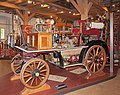 Horse drawn fire engine, 1926
 -
 Magirus-Deutz Fire Engine 1961
 -
 Magirus-Deutz in Kokchetav (now Kokshetau), Kazakh SSR
 -
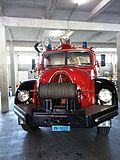 Magirus-Deutz Muni from 1957
 -
 IVECO Magirus fire engine
 -
 Volvo Magirus fire engine
 -
 Japanese Fire Service Hino Motors Magirus fire engine
 -
 Italian Fire Service vehicles with an Astra crane on the left and a Magirus turntable ladder on the right, Army Parade in Rome, 2 June 2006
 -
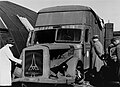 Magirus-Deutz truck - Chelmo Gas Van used for killing hundreds of thousands of Jews during World War 2
 -
 Magirus ladder on floor at front of USS Macon
 -
 Several Magirus ladders in use on the construction of a rigid airship. (Notice men at the very top of several ladders.)
 -
 An IVECO Magirus Daily 65C15 van of the Vatican fire brigade.
 -
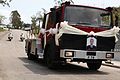 A retired IVECO 140-25 turntable ladder from Hong Kong Fire Services Department
.jpg)


.jpg)

Timeline
[edit]- 1864 - Founded by Conrad Dietrich Magirus
- 1872 - 1872 2-wheel hand ladder climbable when free-standing, model »Ulmer Ladder«
- 1892 - First horse-pulled rotating ladder 25 m
- 1904 - First steam powered self-propelled “fire engine”
- 1916 - First fully automatic drive turn table ladder in the world
- 1917 - Production of Magirus motor vehicles
- 1931 - First turn table ladder with steel ladder set
- 1936 - Fusion with Humboldt-Deutz Motorenfabrik
- 1951 - Made the highest turntable ladder in the world 52 m
- 1953 - First turntable ladder with hydraulic drive
- 1965 - First forward control truck chassis
- 1971 - First rescue vehicle RW-rail for subway and local railway operation
- 1972 - First large airport crash tender
- 1980 - First turntable ladder »low-design«
- 1986 - First computer controlled turntable ladder
- 1987 - Take over of previous Bachert production plant in Weisweil, Germany
- 1992 - Iveco Mezzi Speciali, Brescia, Italy
- 1994 - First articulated ladder DLK 23-12 GL CC
- 1996 - Production start of light pumper vehicles in Görlitz/Germany
- 1997 - Lohr-Magirus in Graz/Austria
- 2000 - First oscillation-free turntable ladder (Computer Stabilized)
- 2005 - „Firework of Novelties“ at the Interschutz in Hannover
- 2007 - New modular bodywork generation AluFire 3
- 2010 - Presentation of the models M 32 L-AT, M 33 P, SuperDragon 2, MultiStar2 at the Interschutz in Leipzig
- 2015 - World's highest turntable ladder, 68 meters
See also
[edit]

References
[edit]- ^ "Die wichtigsten Unternehmen des Jahres 2009 - Welt Online". Top500.welt.de. 2011-07-05. Archived from the original on 2012-03-24. Retrieved 2012-01-26.
- ^ Megargee, Geoffrey P. (2009). The United States Holocaust Memorial Museum Encyclopedia of Camps and Ghettos 1933–1945. Volume I. Indiana University Press, United States Holocaust Memorial Museum. p. 554. ISBN 978-0-253-35328-3.
- ^ a b Kacher, Georg (September 1982). Kennett, Pat (ed.). "Intertruck: Germany". Truck. London, UK: FF Publishing Ltd: 21.
- ^ "MAGIRUS DEUTZ - die Geschichte 5. Teil". Archived from the original on 2014-07-28. Retrieved 2014-07-24. see 1974- das "Delta-Projekt" (deutsch)
- ^ "Magirus — непростая история" (in Russian). June 25, 2012. Retrieved 2019-07-30.
- ^ "Mutares has completed the acquisition of Magirus GmbH from Iveco Group". 7 January 2025.
External links
[edit]
Magirus
View on GrokipediaHistory
Founding and Early Innovations (1864–1914)
Conrad Dietrich Magirus established the company in Ulm, Germany, in 1864, initially focusing on the production of advanced firefighting ladders and equipment to improve emergency response capabilities. As a local firefighter, Magirus aimed to address limitations in existing tools by emphasizing mobility and stability in designs.[1][6] A pivotal early innovation came in 1872 with the introduction of the Ulmer Ladder, a two-wheeled extension ladder reaching up to 14 meters in height, which could be climbed while free-standing and maneuvered when extended. This design represented the first mobile, freestanding firefighting ladder, revolutionizing access to elevated structures by eliminating the need for fixed supports or additional manpower for positioning. The Ulmer Ladder earned recognition at international exhibitions, including a gold medal at the Vienna World's Fair, underscoring its practical superiority over prior rigid or wall-dependent ladders.[8][9][1] Between 1870 and 1895, Magirus expanded its portfolio with the Elevator-Patent-Ladder, an erection mechanism using a winch for efficient deployment, and horse-drawn petroleum-motor pumps, which enhanced water delivery reliability in urban fires. These developments contributed to the company securing approximately 50 awards, including gold, silver, and bronze medals, for technological advancements in fire suppression tools.[1] Following Conrad Dietrich Magirus's death on June 26, 1895, at age 70, his three sons assumed control, guiding the firm toward further refinements in ladder systems and pumps amid growing demand by the early 20th century. By the turn of the century, the company, operating as Vereinigte Feuerwehrgerätefabrik GmbH, employed around 300 workers and continued innovating horse-drawn apparatus, laying groundwork for motorized transitions before 1914.[1][10]World Wars and Interwar Period (1914–1945)
During World War I, Magirus shifted production toward military needs, manufacturing lorries for the German Army starting in 1916 to support logistics on the Western Front.[4] The company also supplied specialized equipment, including carriages for large periscopes used in artillery observation.[11] In the interwar period, Magirus continued developing commercial and firefighting vehicles amid economic recovery and rearmament in Germany, producing models such as trucks and buses while maintaining its focus on turntable ladders.[4] In 1936, the firm was acquired by Humboldt-Deutz AG (KHD), which expanded its truck manufacturing capabilities in preparation for escalating military demands.[4] World War II saw Magirus-Deutz heavily involved in Wehrmacht supply, producing over 16,000 units of the A3000 3-ton 4x4 cargo truck from 1940 to 1944, which became one of the most widely used German military vehicles due to its reliability across terrains, including a half-tracked Maultier variant for the Eastern Front.[4] [12] From February 1943, the Ulm plant manufactured Raupenschlepper Ost (R.SO.) tracked tractors classified as essential war production.[13] Additionally, Magirus-Deutz vans with Deutz diesel engines served as chassis for mobile gas chambers at the Chełmno extermination camp, where exhaust fumes were piped into sealed cargo areas to murder hundreds of thousands of Jews between 1941 and 1945.[14] [15]Post-War Reconstruction and Expansion (1945–1980s)
Following the end of World War II in 1945, Magirus, operating as part of Klöckner-Humboldt-Deutz AG (KHD) since its acquisition in 1936, faced severe infrastructure damage in Ulm but rapidly recommenced limited production of trucks and fire apparatus using pre-war derivatives adapted for civilian needs.[5] Initial output focused on essential repair and reconstruction vehicles, leveraging Deutz air-cooled diesel engines for reliability in resource-scarce conditions, with early post-war models retaining 1930s chassis designs modified for reduced material use.[16] By the early 1950s, Magirus expanded into modern truck series, introducing the 5-tonne Mercur model in 1951 for general haulage and the Eckhauber conventional cab-over series in 1953, which featured robust 6x6 and 6x4 configurations powered by Deutz V6 and V8 air-cooled engines producing up to 200 horsepower. Wait, no Wiki. From [web:49] but it's wiki, skip. Use [web:23] https://www.curbsideclassic.com/blog/truck-stop-classics-1971-and-1975-magirus-deutz-eckhauber-6x6/ for Eckhauber 1953-1971. For Mercur, [web:49] is wiki, so find alternative. From searches, it's mentioned in [web:41] early 1950s new models. Firefighting vehicle production also revived, with the "Omnibus" series launched around 1950 featuring rounded cabs for improved crew protection and the Muni model in 1957 incorporating Deutz engines for urban response units.[17] Turntable ladders reached new heights, with models extending to 30 meters by the late 1950s, emphasizing lightweight aluminum construction for faster deployment.[18] But fandom not reputable? Skip or use. In the 1960s, Magirus scaled production for military and export markets, delivering the Jupiter 7-tonne 6x6 truck to the Bundeswehr starting in 1960, with approximately 7,800 units built by 1967 equipped with Deutz air-cooled V8 engines offering 150 horsepower and off-road capability.[19] This period saw expansion into specialized fire engines like the Sirius 90L in 1962 and increased international sales, with vehicles exported to regions including the Middle East and Asia for their durability in extreme climates.[20] Domestic growth included factory modernization in Ulm, boosting annual output to thousands of chassis for custom fire apparatus. Through the 1970s, Magirus-Deutz reorganized in 1974 as an AG, enhancing its focus on heavy-duty trucks and aerial platforms while integrating Deutz engine advancements for emissions compliance.[21] The decade marked peak expansion with Eckhauber models continuing production until 1971 and subsequent series like the square-cab variants achieving global distribution, though economic pressures led to the truck division's integration into the IVECO joint venture in 1975, allowing Magirus to retain branding for firefighting specialization into the 1980s.[22] This shift supported sustained innovation, such as advanced turntable ladders used in construction and emergency services worldwide, amid West Germany's economic miracle.[16]Licensing Agreements and International Ventures (e.g., Soviet Union)
Magirus-Deutz engaged in notable international ventures with the Soviet Union during the Cold War era, focusing on the supply of specialized trucks for demanding infrastructure projects. In 1974, the company secured the "Delta Project" contract to provide around 9,500 units of the M 232 D 19 model dumpers and flatbed trucks, equipped with air-cooled Deutz diesel engines, for the Baikal-Amur Mainline (BAM) railway construction spanning 1975–1976.[23] The initial shipment of these 6x6 off-road vehicles was prepared by January 1, 1975, enabling operations in extreme Siberian terrains including permafrost and heavy snow.[23] These trucks, noted for their durability and lack of radiator-related failures in sub-zero conditions, symbolized foreign technological input into Soviet mega-projects and remained in service long after delivery.[24] Licensing agreements further extended Magirus-Deutz's reach into Soviet manufacturing. In the 1960s, the firm licensed production of its buses to Otokar in Turkey, marking an early example of technology transfer for commercial vehicles in emerging markets, though direct Soviet engine licensing specifics remain tied to later Deutz series adaptations.[25] By 1982, under Klöckner-Humboldt-Deutz ownership, rights were granted for Soviet assembly of up to 25,000 FL 413 series air-cooled diesel engines, intended for integration into local heavy machinery and trucks to bolster industrial capacity amid resource constraints.[23] Such arrangements underscored pragmatic East-West economic exchanges, prioritizing functional reliability over ideological barriers, with the engines' proven performance in rugged applications facilitating adoption in Soviet construction and mining sectors.Integration into Iveco Group (1990s–2024)
In the 1990s, IVECO Magirus concentrated on refining its firefighting specialization amid broader Iveco Group rationalization efforts, which had phased out general truck production by the late 1980s. In 1992, the company acquired a production facility in Brescia, Italy, to support expanded manufacturing of fire apparatus components.[26] This move aligned with Iveco's strategy to leverage Magirus's expertise in superstructures while integrating standardized chassis from the group's truck divisions.[27] A pivotal restructuring occurred on November 22, 1996, when IVECO Magirus AG spun off its Fire Safety Engineering Division into the independent IVECO Magirus Brandschutztechnik GmbH, enabling focused operations on firefighting vehicles and equipment.[26] Concurrently, the acquisition of Brandschutztechnik Görlitz (BTG) in Saxony, Germany, strengthened capabilities in custom superstructures.[26] In 1997, IVECO established Eurofire (Holding) GmbH as a joint venture with IVECO Italy, IVECO Magirus AG, and Renault V.I., incorporating a Chambéry, France, factory to enhance European production and distribution of integrated fire solutions; the entity was renamed IVECO Magirus in 2004.[26] From the 2000s through the 2010s, the entity—renamed Magirus GmbH on September 26, 2013—developed advanced turntable ladders and vehicles, primarily built on Iveco chassis, establishing leadership in aerial platforms with global deployments.[26] Facilities in Ulm (Germany), Brescia (Italy), and Chambéry (France) formed the core network, while BTG was divested via management buy-out on January 1, 2013.[26] This period emphasized modular designs for customer customization and technological innovations in rescue operations, supported by Iveco's supply chain efficiencies.[28] By 2024, Magirus remained integral to Iveco Group's specialized vehicle portfolio, producing over 2,000 units annually across a range from 2.8 to 52 tons GVW, with a focus on high-reach ladders exceeding 60 meters.[8] The integration facilitated synergies in engineering and logistics, though operational independence allowed Magirus to preserve its heritage in fire engineering amid Iveco's commercial truck emphasis.[27]Acquisition by Mutares and Ongoing Transformations (2025–Present)
In January 2025, Mutares SE & Co. KGaA completed the acquisition of Magirus GmbH and its firefighting-focused affiliates from Iveco Group, with the transfer effective from January 3, 2025, granting Mutares full ownership.[29][30] This followed an agreement signed in March 2024, positioning Magirus as an independent entity outside Iveco's commercial vehicle operations, with Thomas Hilse retained as interim CEO to ensure operational continuity.[31][32] Under Mutares' ownership, Magirus initiated a 10-point transformation program in May 2025, emphasizing operational efficiency, strategic realignment, and international expansion to double annual revenues to over €750 million by 2030.[33][34] Key elements included cost optimization, enhanced innovation in firefighting technologies, and strengthened global market presence, unveiled by Chief Restructuring Officer Fatmir Veselaj and CEO Thomas Hilse.[35] By June 2025, these efforts yielded a record order book nearing €800 million, reflecting improved commercial performance and early transformation gains, including supply chain refinements and customer-focused product adaptations.[35] Management transitioned further on July 1, 2025, with Veselaj assuming expanded leadership responsibilities alongside Hilse to drive the program's execution.[36] In October 2025, Magirus expanded its portfolio through an agreement to acquire Achleitner Fahrzeugbau GmbH, an Austrian manufacturer of military and special vehicles, aiming to bolster its defense sector capabilities; the deal is slated for closure in the fourth quarter of 2025.[37][38] This move aligns with Mutares' turnaround strategy, leveraging Magirus' expertise in specialized chassis for diversified revenue streams beyond core firefighting applications.[37]Products and Technologies
Firefighting Vehicles and Chassis
Magirus began producing firefighting vehicles in the late 19th century, initially focusing on horse-drawn apparatus equipped with innovative pumps and ladders. The company introduced its first petrol-powered fire vehicle in 1906, marking the transition to motorized equipment.[5] By 1921, Magirus launched the Bayernspritze, a light pumper mounted on a 1.5-ton chassis designed for rapid urban response.[1] Post-World War II development emphasized durable chassis from Magirus-Deutz, featuring air-cooled engines and off-road capabilities suitable for mounting firefighting superstructures. These included multi-axle configurations for heavy loads, with early diesel models offering 7.5-liter displacements.[5] Integration into the Iveco Group in the 1980s shifted production to Iveco-sourced chassis, enhancing reliability through shared components like Cursor engines delivering up to 560 horsepower in Euro 5 compliant variants.[39] Contemporary Magirus firefighting vehicles utilize 2-, 3-, or 4-axle chassis with tonnages ranging from light-duty classes under 10 tons to heavy variants exceeding 40 tons, supporting diverse superstructures such as tank pumpers and rescue units.[40] Chassis designs incorporate variable frame adjustments for axle load distribution and special configurations for industrial or airport applications, often with rigid-axle suspension and widths up to 3 meters.[41] Pumpers are categorized into light, medium, heavy, industrial, and forest types, each optimized with in-house proportioning systems and ergonomic Team Cab modules for crew safety.[42] Key models include the (H)LF 10 series on Iveco Eurocargo 4x2 chassis powered by compressed natural gas for reduced emissions, and the IMPACT X4 airport vehicles on custom 4x4 or 6x6 chassis with dual-motor setups for high-performance pumping up to 10,000 liters per minute.[43] [44] These chassis prioritize modularity, allowing integration of advanced extinguishing agents and telescopic booms while meeting international standards for stability and maneuverability.[42]Turntable Ladders and Aerial Platforms
Magirus turntable ladders originated with the company's founding in 1864, when Conrad Dietrich Magirus developed early mobile ladder designs, including the 1872 Ulm Ladder—a two-wheeled, free-standing extension ladder reaching 14 meters.[1] By 1892, Magirus produced the world's first horse-drawn 25-meter turntable ladder, marking the beginning of mechanized aerial access for firefighting.[45] Prior to 1970, the firm introduced the first welded steel ladder unit for a five-part turntable ladder achieving 34.8 meters, the tallest of its era.[1] In 1994, Magirus launched the world's first articulated turntable ladder at the Interschutz trade fair, featuring a 4.7-meter articulated arm inclinable up to 75 degrees for enhanced maneuverability in confined spaces.[1] This innovation evolved with the 2000 introduction of CS (Computer Stabilised) oscillation damping technology, eliminating ladder sway during operations.[1] Further advancements include the 2010 Single-Extension articulated ladder and the 2012 42-meter articulated model, then the global height leader.[1] Recent developments encompass the VARIO jacking system, adjustable from 2,400 to 5,200 mm with up to 700 mm leveling compensation, and the 2024 SmartControl system for intuitive, computer-assisted operation.[46] Magirus turntable ladders integrate aerial platforms via RC300 and RC400 rescue cages, supporting payloads of 300 kg (3 persons) and 400 kg (4 persons), respectively, each equipped with a 2,500 l/min water monitor.[46] The M series offers working heights from 27 m (M27L) to 68 m (M68L, the world's tallest), with articulated variants like M32L-AS and M42L-AS for superior reach.[9] These platforms mount on two- to four-axle chassis up to 34 tons, prioritizing stability, rapid deployment, and safety features such as remote diagnostics and thermal imaging.[47] Low-profile models, available since 1980, facilitate urban navigation while maintaining full functionality.[48]