


Community hub
Recent from talks
Contribute something
Nothing was collected or created yet.
Maitree Express
View on Wikipedia
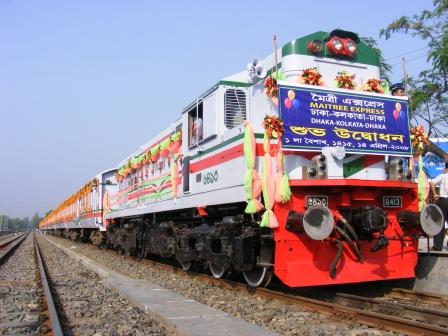
 Inauguration of Maitree Express train of the Bangladesh Railway on 14 April 2008 | ||||||||||||||||||||||||||||||||||||||||||||||||||||||||
| Overview | ||||||||||||||||||||||||||||||||||||||||||||||||||||||||
|---|---|---|---|---|---|---|---|---|---|---|---|---|---|---|---|---|---|---|---|---|---|---|---|---|---|---|---|---|---|---|---|---|---|---|---|---|---|---|---|---|---|---|---|---|---|---|---|---|---|---|---|---|---|---|---|---|
| Service type | AC Express | |||||||||||||||||||||||||||||||||||||||||||||||||||||||
| Status | Temporarily non-operational | |||||||||||||||||||||||||||||||||||||||||||||||||||||||
| First service | 14 April 2008 | |||||||||||||||||||||||||||||||||||||||||||||||||||||||
| Last service | 19 July 2024 | |||||||||||||||||||||||||||||||||||||||||||||||||||||||
| Current operators | Eastern (West Bengal) Railway zone of Indian Railways & Bangladesh Railway | |||||||||||||||||||||||||||||||||||||||||||||||||||||||
| Route | ||||||||||||||||||||||||||||||||||||||||||||||||||||||||
| Termini | Kolkata (KOAA) Dhaka Cantonment (DHCA) | |||||||||||||||||||||||||||||||||||||||||||||||||||||||
| Stops | 3 | |||||||||||||||||||||||||||||||||||||||||||||||||||||||
| Distance travelled | 400 kilometres (250 mi) | |||||||||||||||||||||||||||||||||||||||||||||||||||||||
| Average journey time | 8 hours 50 minutes | |||||||||||||||||||||||||||||||||||||||||||||||||||||||
| Service frequency | 5 days | |||||||||||||||||||||||||||||||||||||||||||||||||||||||
| Train number | 13107/13108/13109/13110 | |||||||||||||||||||||||||||||||||||||||||||||||||||||||
| On-board services | ||||||||||||||||||||||||||||||||||||||||||||||||||||||||
| Classes | 1st AC (1A) AC Chair Car (CC) | |||||||||||||||||||||||||||||||||||||||||||||||||||||||
| Seating arrangements | Yes | |||||||||||||||||||||||||||||||||||||||||||||||||||||||
| Sleeping arrangements | Yes | |||||||||||||||||||||||||||||||||||||||||||||||||||||||
| Catering facilities | Yes | |||||||||||||||||||||||||||||||||||||||||||||||||||||||
| Entertainment facilities | No | |||||||||||||||||||||||||||||||||||||||||||||||||||||||
| Technical | ||||||||||||||||||||||||||||||||||||||||||||||||||||||||
| Rolling stock | 2 LHB rakes. 1 rake each of Indian & 1 Bangladeshi type | |||||||||||||||||||||||||||||||||||||||||||||||||||||||
| Track gauge | broad gauge(1,676 mm (5 ft 6 in)) | |||||||||||||||||||||||||||||||||||||||||||||||||||||||
| Operating speed | 45 kilometres per hour (28 mph) | |||||||||||||||||||||||||||||||||||||||||||||||||||||||
| ||||||||||||||||||||||||||||||||||||||||||||||||||||||||


The Maitree Express (13109/13110) train (Bengali: মৈত্রী এক্সপ্রেস), often pronounced Moitree Express, was the first express train service connecting Dhaka in Bangladesh to Kolkata in the Indian state of West Bengal. The Bengali name Maitree Express means Friendship Express when translated to English, denoting the significance of the train service to the friendly foreign relations between India and Bangladesh.[1] Previously train services between the two countries existed before the partition of India by the British and the Maitree Express re-established this connection between Dhaka and Kolkata in 2008 after being closed for 43 years.[2] In 2017, a second train service, the Bandhan Express, was inaugurated connecting Kolkata with the Bangladeshi city of Khulna, recreating the previous Barisal Express train route.[3][4] A valid visa and passport is required beforehand to purchase a ticket for the Maitree Express train. Tickets are available at Dhaka Cantonment railway station in Bangladesh and at Chitpur Station in Kolkata, India. Together with the Bandhan Express train and the Mitali Express train, the Maitree Express train is one of three modern day fully air conditioned passenger train links between India and Bangladesh.
The commercial run of this train was suspended in the wake of the global COVID-19 pandemic since March 2020. However, the train resumed its service again from 29 May 2022.[5][6] Since 19 July 2024, the service was suspended indefinitely due to political unrest in Bangladesh.[7]
Background
[edit]
The Partition of India in 1947 disrupted rail links in the province of Bengal, which was divided into the Indian state of West Bengal and the Pakistani province of East Bengal (later renamed East Pakistan in 1956). During British rule over the undivided land, regular over-night trains connected Kolkata, Goalanda, Dhaka and Narayanganj. In addition pre-partition, Darjeeling Mail connecting Kolkata (Sealdah Station) with Siliguri ran through what became East Pakistan via Gede–Darshana and Chilahati–Haldibari. Three train services from Sealdah—East Bengal Mail to Parbatipur Junction via Gede-Darshana, East Bengal Express to Goalundo Ghat via Gede-Darshana, and the Barisal Express to Khulna via Benapole–Petrapole—continued operation between the two countries until 1965, when the outbreak of the Indo-Pakistani Conflict of 1965 led to the closure of all passenger train links.[2] The Bangladesh Liberation War resulted in the independence of East Pakistan as the nation-state of Bangladesh. The Maitree Express follows the same route as the first two trains above via Gede-Darshana.
Revival
[edit]
In 2001, the two national governments agreed upon the railway train scheme during bilateral talks. The train service concept got a major boost during the visit of the then Indian Foreign Minister, Pranab Mukherjee, to Dhaka in February 2007. On 8 July 2007, the first train ran from Kolkata to Dhaka in a test run, carrying Indian government officials who were to meet their Bangladeshi counterparts to finalise train schedules.[8] In response to Indian security demands, a "box-fencing" system was to be erected on either side on the no-man's land between the two countries.[9] The inauguration of the train service was held on the occasion of the Bengali New Year (Bengali: পহেলা বৈশাখ) 14 April 2008.[10]

Inauguration
[edit]On 14 April 2008, on the occasion of the Bengali New Year, the train service was launched with much fanfare. The flag-off ceremony for the first train leaving Kolkata from the Kolkata railway station in Chitpur was attended by dignitaries such as the Indian Railway Minister Lalu Prasad Yadav; Information and Broadcasting Minister Priya Ranjan Dasmunsi; the Governor of West Bengal Gopalkrishna Gandhi; and the Bangladesh High Commissioner to India Liquat Ali Chowdhury. The Indian Foreign Minister Pranab Mukherjee officially flagged-off the inaugural train from Kolkata, bound for Dhaka.[2][9] Another train departed at the same time carrying passengers from Dhaka to Kolkata. But the 360-seater Calcutta to Dhaka express train was carrying barely 65 passengers, including journalists and politicians, on its inaugural run. Indian Railways officials stated that the train service was launched hurriedly, and that when information would spread there would be a greater response and passenger numbers.[1] An official statement from the Indian Ministry of External Affairs said, "The agreement will strengthen bilateral relations and provide an alternative mode of passenger transport."[9]
Public perception
[edit]The inauguration of the train service evoked mixed public responses in both countries.[1] Thousands of people gathered along the train route from Kolkata up to the border crossing point in Gede to cheer the inaugural train. However, a group representing Hindu refugees from Bangladesh, the Nikhil Banga Nagarik Sangha (All Bengal Citizens Committee) protested the launching of the train service, citing persecution of Hindus in Bangladesh; possible terrorist infiltration into India; and demanding the rehabilitation of Bangladeshi Hindu refugees.[11][12] Police reports stated that 87 people (including 11 women) had been arrested for blocking the train by squatting on the tracks and refusing to move.[1][11][12] Police blamed the group for planting three crude bombs on the route, which were defused a day before the launch on 13 April 2008.[1][12] After this initial incident, this train service has been incident free so far.
Maitree Express route and operations
[edit]The Maitree Express runs five days a week. The train travels around 400 kilometres (250 mi) to reach Dhaka from Kolkata. Earlier there were two stops for immigration checks in Kolkata and Dhaka. One in Gede on the Indian side and the other in Dorshona on the Bangladeshi side. Since November 2017 immigration and customs are completed at Dhaka and Kolkata. This has reduced travel time by two and half hours.
It takes around 8 hours 50 minutes to cover the entire stretch. The entire stretch is covered by broad-gauge diesel locomotives. A change of crew and locomotives takes place at Dorshona in Bangladesh. There are two major river crossings, the 100 year old Hardinge Bridge over the Padma River and the Bangabandhu Bridge over the Jamuna River. Both river crossings occur in Bangladesh. Since Pahela Boishakh 2017 (Bengali: পহেলা বৈশাখ), 14 April 2017, all coaches have been changed to air conditioned LHB coach thus enhancing the travel experience. From February 2020 the service was made five days a week, instead of four days a week till then, with additional run with BR Rake every Tuesday and Wednesday from Dhaka and Kolkata respectively.[13]
Train schedule
[edit]Regular train departures are as follows:[14]
| Route | Day | Train No. | Rake |
|---|---|---|---|
| Dhaka to Kolkata | Friday | 13107 | BR |
| Saturday | 13110 | IR | |
| Sunday | 13107 | BR | |
| Tuesday | 13107 | BR | |
| Wednesday | 13110 | IR |
| Route | Day | Train No. | Rake |
|---|---|---|---|
| Kolkata to Dhaka | Saturday | 13108 | BR |
| Monday | 13108 | BR | |
| Tuesday | 13109 | IR | |
| Wednesday | 13108 | BR | |
| Friday | 13109 | IR |
The train starts from Kolkata at 07:15 IST and reaches Dhaka at 16:05 BST the same day. Similarly, it starts from Dhaka at 08:15 BST and reaches Kolkata at 16:00 IST the same day. This train's route does not involve any lengthy ferry-crossing pauses or border checks. It is also less costly than the Kolkata to Dhaka air conditioned luxury bus services. Terminal points are Dhaka Cantonment and Kolkata (Chitpur) stations respectively. While Kolkata is a true terminal station, it is possible to continue by local train onwards to Dhaka's main station in Kamalapur from Dhaka Cantonment station. The nearest Metro station from Kolkata is Shyambazar – a distance of 2.0 kilometres (1.2 mi). There is a public bus terminal right outside Kolkata railway station with connectivity to various parts of the city.[14]
Frequency
[edit]In February 2020, the train's frequency was increased to five days a week. From Kolkata it runs on Monday, Tuesday, Wednesday, Friday and Saturday while the train leaves Dhaka Cantonment on Sunday, Tuesday, Wednesday, Friday and Saturday.[15]
Diplomacy
[edit]The development of the Kolkata–Dhaka train service is akin to that of the Samjhauta Express (meaning "Understanding" or "Accord" Express), which connects the Indian capital Delhi to Lahore in Pakistan. Both train services were opened to revive rail links between the countries that were disrupted by the partition of India by the British in 1947. Both have been used as symbols of goodwill and cooperation between India and Bangladesh, in the case of the Maitree Express, and India and Pakistan in the case of the Samjhauta Express.
Challenges
[edit]Earlier the Maitree Express was said to be running at 50% occupancy in 2011. With increase in runs to five days a week, this service has gained popularity. Better publicity in local media at both terminal cities also could help raise patronage leading to the train becoming a daily service. Despite this, in 2018 patronage has increased and average occupancy is around 90%.
Booking
[edit]Unlike most of the Indian trains, online booking through the IRCTC website is not available for this train. Tickets are only available in local currency at the booking counters of Chitpur Station in Kolkata and a valid Bangladeshi visa in the passport is mandatory before purchasing a ticket. The valid visa and passport has to be shown when purchasing the train ticket. While applying for a visa it was earlier essential to specify the port of entry as "By rail-Gede" (for an Indian visa) or "By rail-Darshana"(for a Bangladeshi visa). Tickets will be issued only after issue of the visa. Valid passports must be shown while booking. In case all passengers are not present, an authorisation is required while booking tickets. After both countries started issuing an e-Visa, mentioning specific port and mode of transport is no longer required. Since this is a highly popular train, tickets need to be booked at least 5 or 6 days in advance. As of 18 June 2014, return tickets are available on a predefined number of seats, for up-to two weeks before the date of journey, excluding the journey date. The return tickets have to be validated by going to the station two hours before the departure of the train. The return fare includes only the base fare and all other taxes and service charges have to be paid during the validation of the ticket. This is applicable for return journeys from both Dhaka as well as Kolkata.
Tickets are available in Dhaka from the Main Reservation Counter of Kamalapur railway station. The counter at Dhaka Cantonment is open everyday from 0900 to 1900. A valid visa and passport has to be shown when purchasing the train ticket. In Kolkata tickets may be purchased from the International Ticket Booking Counter at Fairlie Place, Dalhousie Square, and also at Chitpur Station in Kolkata on the day of arrival of the train from Dhaka.[14]
Coach composition
[edit]The train consisting the number 13109/10, is operated by Indian Railways rake which are purely LHB coach in red-grey (used by Rajdhani Express trains) and sky blue-grey (used by Shatabdi Express trains).
While the train consisting the number 13107/08 is operated using Bangladesh Railway rake, which are also LHB coach in dark green livery with white horizontal line.
The train has 10 coaches. 4 AC Executive Class, 4 AC Chair Car and 2 power car brake vans.
- Legends
| LRM/GD/EOG/SLR | H- | C- |
|---|---|---|
| Generator cum luggage van | First AC Sleeper Coach | AC Chair Car (CC) |
- Indian rakes
| Loco | 1 | 2 | 3 | 4 | 5 | 6 | 7 | 8 | 9 | 10 |
|---|---|---|---|---|---|---|---|---|---|---|
 |
EOG | H1 | H2 | H3 | H4 | C1 | C2 | C3 | C4 | EOG |
- while 13110 Dhaka to Kolkata has reverse rake composition of 13109.
- Bangladeshi rake
| Loco | 1 | 2 | 3 | 4 | 5 | 6 | 7 | 8 | 9 | 10 |
|---|---|---|---|---|---|---|---|---|---|---|
|
EOG | A1 | A2 | A3 | A4 | B1 | B2 | B3 | B4 | EOG |
- while 13108 Kolkata to Dhaka has reverse rake composition of 13107.
See also
[edit]References
[edit]- ^ a b c d e "Dhaka-Calcutta train link resumes". BBC News. 14 April 2008. Retrieved 17 April 2008.
- ^ a b c "Kolkata–Dhaka Moitree Express flagged off". The Times of India. 14 April 2008. Archived from the original on 20 October 2012. Retrieved 17 April 2008.
- ^ "Maitree Express-II chugged across India, Bangladesh border amid cheers, applause". Indo-Asian News Service. 8 April 2017. Retrieved 13 April 2017.
- ^ "Sheikh Hasina visit: Maitree Express to be made fully AC, new passenger service to be announced". The Indian Express. 7 April 2017. Retrieved 13 April 2017.
- ^ "Bangladesh bound Maitree, Bandhan Express to resume soon: Check details". NEWS9LIVE. 21 May 2022. Archived from the original on 29 June 2022. Retrieved 28 May 2022.
- ^ "Passenger Train Services Between India and Bangladesh to Resume from May 29; Check Details". News18. 19 May 2022. Retrieved 28 May 2022.
- ^ "India suspends train services to Bangladesh indefinitely". The Indian Express. 5 August 2024. Retrieved 1 July 2025.
- ^ Sudworth, John (8 July 2007). "First India–Bangladesh train link". BBC News. Retrieved 17 April 2008.
- ^ a b c "Kolkata–Dhaka train service to resume on Bengali New Year". The Times of India. 12 April 2008. Archived from the original on 20 October 2012. Retrieved 17 April 2008.
- ^ "A Report from Dhaka to Kolkata on the first operation day". BBC News, watching available by Windows Media Player. Retrieved 20 April 2008.
- ^ a b Bhaumik, Subir (9 April 2008). "Excitement mounts over train link". BBC News. Retrieved 17 April 2008.
- ^ a b c "Moitree Express resumes journey after brief halt". The Times of India. 14 April 2008. Archived from the original on 20 October 2012. Retrieved 17 April 2008.
- ^ "4554352-0: Increase in frequency of Kolkata Dhaka M 13108/Maitree Express BR – Railway Enquiry".
- ^ a b c "Maitree Express Schedule". Bangladesh Railway.
- ^ মৈত্রী ও বন্ধন ট্রেনের যাত্রার সংখ্যা এক দিন বাড়ল. Prothom Alo (in Bengali). 5 February 2020. Retrieved 20 February 2020.
External links
[edit] Media related to Maitree Express at Wikimedia Commons
- Bangladesh Railway - Maitree Express Schedule মৈত্রী এক্সপ্রেস ট্রেনের সময়সূচি এবং ভাড়া
- Map of India-Bangladesh border links


Maitree Express
View on GrokipediaHistorical Development
Origins in the Early Post-Partition Era
Following the partition of British India on August 15, 1947, which divided the region into the Dominion of India and Dominion of Pakistan (with East Bengal becoming part of the latter), existing rail networks spanning the new international border faced immediate logistical challenges, including customs formalities and track gauge compatibility issues. Despite these disruptions, cross-border passenger and freight services were quickly reestablished to support economic ties, family reunifications, and trade between West Bengal and East Bengal, reflecting pragmatic bilateral agreements amid the chaos of mass migrations and communal violence that displaced millions. Early operations involved border checkpoints at key stations such as Gede in India and Darshana in East Pakistan, where passengers underwent immigration and customs inspections, often causing delays but enabling continuity of pre-partition routes.[8][9] Trains like the East Bengal Mail and East Bengal Express emerged as primary links in this era, connecting Kolkata's Sealdah or Chitpur stations to destinations in East Pakistan, such as Parbatipur or further inland, covering distances of up to 256 kilometers with travel times around 5-6 hours under normal conditions. These services, numbering among three regular international trains, carried passengers across the border until escalating tensions led to suspensions; for instance, the East Bengal Express utilized the Gede-Darshana crossing and included slip coaches for branching routes. Operations relied on meter-gauge tracks shared between the Eastern Railway (India) and Pakistan Eastern Railway (renamed from Eastern Bengal Railway in 1961), with locomotives and rolling stock interchanged at border points to adhere to national protocols.[10][11] By the late 1950s, amid efforts to normalize relations strained by water-sharing disputes and refugee issues, India and Pakistan pursued symbolic gestures of cooperation, culminating in the introduction of the Maitree Express on February 1, 1961, as a dedicated passenger service between Kolkata and Khulna to foster people-to-people contacts. Named "Maitree" (friendship in Bengali), the train operated weekly, emphasizing bilateral goodwill during a period of relative diplomatic thaw before the 1965 war; it traversed approximately 176 kilometers, with about 80 kilometers in India, using existing infrastructure upgraded for international use. This initiative built on the foundational post-partition rail resilience but marked a deliberate step toward structured connectivity, though services remained vulnerable to geopolitical shifts.[8][12]Initial Operations and Suspension (1961-1965)
The passenger train service linking Calcutta (now Kolkata) to Dacca (now Dhaka), then part of East Pakistan, operated through the early 1960s as one of the primary cross-border transportation options post-partition. This service facilitated travel between the economic hubs of West Bengal and East Pakistan, though infrastructure constraints necessitated a combination of rail segments and a ferry crossing over the Padma River at Goalundo Ghat to reach Narayanganj before continuing to Dacca. Operations during 1961-1965 proceeded without major interruptions until escalating border tensions culminated in suspension. The service concluded its final run on September 6, 1965, amid the outbreak of the Indo-Pakistani War, which prompted the halt of all passenger rail links between India and East Pakistan. The war, fought from August to September 1965, severed connectivity due to security concerns and hostilities, with no restoration until decades later. This suspension persisted for over 40 years, reflecting broader geopolitical strains in the region.[13]Prolonged Hiatus and Revival Negotiations (1965-2008)
The Maitree Express passenger rail service between Kolkata and Dhaka was suspended on September 6, 1965, following the outbreak of the Indo-Pakistani War, during which the territory of present-day Bangladesh formed part of Pakistan as East Pakistan.[11] This conflict severed the direct rail connectivity that had been established shortly after the 1947 partition, with the final pre-suspension services operating under the broader East Bengal Express framework.[8] The suspension persisted through the 1971 Bangladesh Liberation War, which resulted in independence from Pakistan with Indian military support, yet no immediate restoration of the Kolkata-Dhaka passenger link occurred amid post-independence political instability, including the 1975 assassination of Sheikh Mujibur Rahman and subsequent military regimes.[14] Over the ensuing decades, the hiatus reflected broader strains in Indo-Bangladeshi relations, exacerbated by issues such as border enclaves, river water-sharing disputes like the Ganges Treaty, and differing geopolitical alignments, with Bangladesh's governments under Ziaur Rahman, Hussain Muhammad Ershad, and later BNP-led administrations maintaining cooler ties with India compared to the initial 1972 Indo-Bangladeshi Treaty of Friendship.[13] Direct passenger rail services remained absent, though limited freight and special pilgrimage trains operated intermittently on other routes, underscoring the symbolic and practical barriers to full revival.[8] Revival negotiations intensified in the mid-2000s amid improving bilateral dynamics, particularly following discussions on connectivity and trade enhancement. On April 10, 2008, Bangladesh's Communication Secretary Mahbub ur Rahman and India's High Commissioner to Bangladesh Pinaki Chakravarty signed an agreement in Dhaka to restore the passenger rail link, capping years of diplomatic efforts to reconnect the capitals after 43 years of disruption.[15] This pact addressed logistical coordination, including gauge compatibility and border protocols, paving the way for the service's relaunch later that month as a twice-weekly express.[13]Relaunch and Inauguration (2008)
The Maitree Express was relaunched on 14 April 2008, reviving a passenger rail service between Kolkata, India, and Dhaka, Bangladesh, that had been suspended for 43 years following the 1965 Indo-Pakistani War. The revival stemmed from bilateral negotiations concluded in 2007, which addressed infrastructure upgrades, border protocols, and operational agreements to facilitate cross-border travel. This initiative aligned with efforts to bolster economic cooperation and people-to-people exchanges amid improving diplomatic ties under Bangladesh's Awami League government led by Prime Minister Sheikh Hasina and India's United Progressive Alliance administration.[16][17] The inauguration coincided with Poila Boishakh, the Bengali New Year, and featured ceremonial flag-off events at both termini to underscore the symbolic importance of the "friendship" train—Maitree deriving from the Sanskrit and Bengali term for amity. In Kolkata, External Affairs Minister Pranab Mukherjee officiated the flag-off from Chitpur Station (now Kolkata Station), with dignitaries including railway officials and local leaders present. On the Dhaka side, Bangladesh Railway authorities conducted a parallel ceremony at Dhaka Cantonment Station, emphasizing enhanced security along the route and at the Gede-Darshana border crossing. The events highlighted mutual commitments to seamless connectivity, though initial operations incorporated mandatory halts for immigration and customs clearance.[18][19][20] Operationally, the relaunched service deployed a six-coach fully air-conditioned trainset, departing Kolkata at 07:10 on 15 April 2008 for its inaugural run, traversing approximately 393 kilometers in about 15 hours to Dhaka Cantonment. The bi-weekly schedule—initially Tuesdays and Thursdays from Kolkata, with reciprocal services from Dhaka—catered to AC-class passengers only, reflecting the premium nature of the international link. This resumption filled a longstanding gap in direct rail passenger transport, previously reliant on bus or air alternatives, and was positioned as a practical conduit for trade and tourism despite anticipated delays from border formalities.[16][21]Route and Technical Operations
Route Specifications and Infrastructure
The Maitree Express runs on a broad gauge (1,676 mm) route connecting Kolkata Chitpur railway station in India to Dhaka Cantonment railway station in Bangladesh, covering a total distance of approximately 393 kilometers.[22][23] The Indian portion spans 114 kilometers to Gede, followed by the border crossing into Darshana, with the remaining distance through Bangladesh including stops at Ishwardi Junction before terminating in Dhaka.[24] The route crosses the international border exclusively via the Gede-Darshana rail link, a dedicated railway crossing without road or other transport integration, where trains halt for customs and immigration formalities, contributing to an average journey speed of 44 km/h despite maximum permissible speeds up to 110 km/h on select Indian segments.[25][22] Infrastructure on the Indian side is fully electrified, enabling electric locomotive haulage from Kolkata to Gede, while the Bangladesh section relies primarily on diesel traction due to incomplete electrification.[26] Ongoing enhancements include the doubling of broad gauge tracks on the Bangladesh side, such as the Khulna-Darshana line, to increase capacity and reduce transit times for both passenger and freight services utilizing the same corridor.[23] These upgrades support higher volumes, with recent years seeing hundreds of freight trains exchanged annually at Gede alongside passenger operations.[27]Train Composition and Capacity
The Maitree Express employs distinct rakes from Indian Railways (IR) and Bangladesh Railway (BR), exchanged at the border stations of Gede (India) and Darshana (Bangladesh) to facilitate cross-border operations. Each rake is hauled by a dedicated locomotive, with power supplied via End-on-Generator (EOG) cars integrated into the formation.[28][29] Following its conversion on April 20, 2017, the train utilizes fully air-conditioned Linke-Hofmann-Busch (LHB) coaches across both rakes, replacing older conventional stock to improve passenger safety through anti-telescoping features and crashworthiness. The IR rake consists of two EOG cars, four AC Executive Class coaches (H1–H4, offering reclining seats in a 2+2 configuration), and four AC Chair Car coaches (C1–C4, in a 2+3 seating arrangement), yielding a total capacity of 469 seats.[30][31][28] The BR rake mirrors this structure with two EOG cars, four premium AC coaches (A1–A4), and four standard AC Chair Car coaches (B1–B4), accommodating 418 passengers in total. Locomotives vary by section: electric traction (e.g., WAP-class) on the Indian side up to Gede, transitioning to diesel (e.g., WDM-3A or equivalent) in Bangladesh due to differing electrification standards.[29][29][32]Schedule, Frequency, and Travel Logistics
The Maitree Express provides bidirectional service between Kolkata Chitpur railway station in India and Dhaka Cantonment railway station in Bangladesh, with a total route distance of approximately 393 kilometers. In the Kolkata-to-Dhaka direction (train number 13109), the train departs Kolkata at 07:10 and arrives in Dhaka at 16:05, yielding a scheduled running time of about 9 hours; the reverse journey (train number 13107 or 13110) departs Dhaka at 08:15 and arrives in Kolkata at 16:00.[33] These timings account for minimal intermediate halts, primarily at Gede on the Indian side and Darshana on the Bangladeshi side for border formalities, where the train pauses for 10-30 minutes each to facilitate immigration and customs inspections.[24]| Direction | Train No. | Origin | Departure | Destination | Arrival | Scheduled Running Time |
|---|---|---|---|---|---|---|
| Kolkata to Dhaka | 13109 | Kolkata (KOAA) | 07:10 | Dhaka (DAKA) | 16:05 | ~9 hours |
| Dhaka to Kolkata | 13107 | Dhaka (DAKA) | 08:15 | Kolkata (KOAA) | 16:00 | ~8 hours |