


Community hub
Recent from talks
Contribute something
Nothing was collected or created yet.
Samjhauta Express
View on Wikipedia
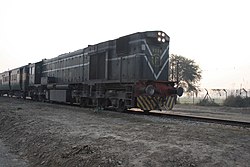
 Pakistan Railways rake of the Samjhauta Express | |||||||||||||||||||||||||||||||||||||||||||||||||||||||||||||||||||||||||||||||||||||||||||||||||||||||||
| Overview | |||||||||||||||||||||||||||||||||||||||||||||||||||||||||||||||||||||||||||||||||||||||||||||||||||||||||
|---|---|---|---|---|---|---|---|---|---|---|---|---|---|---|---|---|---|---|---|---|---|---|---|---|---|---|---|---|---|---|---|---|---|---|---|---|---|---|---|---|---|---|---|---|---|---|---|---|---|---|---|---|---|---|---|---|---|---|---|---|---|---|---|---|---|---|---|---|---|---|---|---|---|---|---|---|---|---|---|---|---|---|---|---|---|---|---|---|---|---|---|---|---|---|---|---|---|---|---|---|---|---|---|---|---|
| Service type | Inter-city rail | ||||||||||||||||||||||||||||||||||||||||||||||||||||||||||||||||||||||||||||||||||||||||||||||||||||||||
| Locale | India Pakistan | ||||||||||||||||||||||||||||||||||||||||||||||||||||||||||||||||||||||||||||||||||||||||||||||||||||||||
| First service | 22 July 1976 | ||||||||||||||||||||||||||||||||||||||||||||||||||||||||||||||||||||||||||||||||||||||||||||||||||||||||
| Last service | 8 August 2019 | ||||||||||||||||||||||||||||||||||||||||||||||||||||||||||||||||||||||||||||||||||||||||||||||||||||||||
| Current operators | Indian Railways's Northern Railway Zone Pakistan Railways | ||||||||||||||||||||||||||||||||||||||||||||||||||||||||||||||||||||||||||||||||||||||||||||||||||||||||
| Route | |||||||||||||||||||||||||||||||||||||||||||||||||||||||||||||||||||||||||||||||||||||||||||||||||||||||||
| Termini | Delhi Junction Lahore Junction | ||||||||||||||||||||||||||||||||||||||||||||||||||||||||||||||||||||||||||||||||||||||||||||||||||||||||
| Stops | Attari Sham Singh Wagah | ||||||||||||||||||||||||||||||||||||||||||||||||||||||||||||||||||||||||||||||||||||||||||||||||||||||||
| Distance travelled | 502 kilometres (312 mi) | ||||||||||||||||||||||||||||||||||||||||||||||||||||||||||||||||||||||||||||||||||||||||||||||||||||||||
| Average journey time | 11 hours, 42 minutes | ||||||||||||||||||||||||||||||||||||||||||||||||||||||||||||||||||||||||||||||||||||||||||||||||||||||||
| Service frequency | Bi-weekly | ||||||||||||||||||||||||||||||||||||||||||||||||||||||||||||||||||||||||||||||||||||||||||||||||||||||||
| Technical | |||||||||||||||||||||||||||||||||||||||||||||||||||||||||||||||||||||||||||||||||||||||||||||||||||||||||
| Track gauge | 1,676 mm (5 ft 6 in) | ||||||||||||||||||||||||||||||||||||||||||||||||||||||||||||||||||||||||||||||||||||||||||||||||||||||||
| |||||||||||||||||||||||||||||||||||||||||||||||||||||||||||||||||||||||||||||||||||||||||||||||||||||||||


.jpg)
The Samjhauta Express (transl. Agreement Express) was a twice-weekly train, Thursday and Monday, that ran between Delhi and Attari in India and Lahore in Pakistan.[1] In Hindustani (Hindi-Urdu), the word "समझौता/سمجھوتا" (samjhauta) means an "agreement" or an "accord", especially one arising out of a compromise.
Until the reopening of the Thar Express, this was the only rail connection between the two countries. The train was started on 22 July 1976 following the Simla Agreement and ran between Amritsar and Lahore, a distance of about 50.2 km.[1] Following disturbances in Punjab in the late 1980s, due to security reasons Indian Railways decided to terminate the service at Attari, where customs and immigration clearances take place. On 14 April 2000, in an agreement between Indian Railways and Pakistan Railways (PR), the distance was revised to cover just under three km.
History
[edit]An earlier train ran between Amritsar and Lahore and vice versa and carried 8,239 persons from India to Pakistan and 10,360 from Pakistan to India from 28 October 1954 to 30 November 1954.[2]
Samjhauta Express was a daily train when the service started in 1976 and changed to a twice-weekly schedule in 1994. Earlier the rakes were returned to the home country the same day but later in 2000 the rake remained overnight at that location.
The train's first break of service was when it was discontinued on 1 January 2002 in the wake of the terrorist attack on the Indian Parliament on 13 December 2001. Service resumed on 15 January 2004. Service was also suspended following the 27 December 2007, assassination of Benazir Bhutto as a preventive measure to deny militants a "high-value target" that was of great symbolic importance to both India and Pakistan.[3]
On 8 October 2012, police recovered about 100 kg of contraband heroin and more than 500 rounds of bullet ammunition at Wagah border on the train heading for Delhi.[4][5]
On 28 February 2019, the service was suspended following the 2019 India–Pakistan standoff. A spokesman for the Pakistan Foreign Office said that service was suspended "in view of the prevailing tensions between Pakistan and India" while it was reported that India has suspended the running of the train on its side, due to "drastic decline in occupancy" and "the suspension of services from across the border".[6][7]
On 8 August 2019, the service was suspended by Pakistan following the revocation of Article 370 in Jammu and Kashmir.[8]
Route
[edit]Its termini were Lahore in Pakistan and Delhi in India. The border crossing took place between Wagah in Pakistan and Attari in India. Initially, this was a thorough service with the same rake going all the way between the termini; later the Pakistani rake stopped at Attari at which point passengers had to change trains.
Now there was a train from Delhi to Attari where all passengers alighted for customs and immigration. This train did not have any commercial stops between Delhi and Attari. It is incorrectly referred to as the Samjhauta Express and it is officially known as the Delhi–Attari or Attari–Delhi Express. The actual Samjhauta Express ran from Attari to Lahore, although the passengers were checked at Wagah, the first station on the Pakistani side. The train service was set up with an agreement between Indian Railways (IR) and Pakistan Railways (PR) to alternately use an Indian and a Pakistani rake and locomotive for the train, six months at a time.
The train usually had between four and eight coaches. The rake supplied by Pakistan was usually hauled by an Alco DL-543 class ALU20 diesel locomotive (Lahore shed), with the entire train in the standard dark green livery of PR.
Incidents
[edit]2007 bombing
[edit]In the early hours of 18 February 2007, 70 people (mostly Pakistani civilians and a few Indian military guarding the train) were killed and scores more injured in a terrorist attack on the Delhi–Attari Express.[9][10] The attack occurred at Diwana station near the Indian city of Panipat, Haryana. Officials found evidence of improvised explosive devices (IEDs) made with RDX, containing fragmentation and flammable material, including three unexploded IEDs. The National Investigation Agency suspected that the blasts were masterminded by Swami Aseemanand, which was dismissed later for lack of evidence.[11]
On 1 July 2009, the US Department of Treasury designated Arif Qasmani of the Lashkar-e Tayyiba as a person involved in terrorism, citing among other things his involvement in the Samjhauta Express bombing.[12]
On 30 December 2010, India's National Investigation Agency claimed that they had solid evidence that Swami Aseemanand was the mastermind behind the blasts. He had taken help from his friend Sandeep Dange, an engineering graduate and has done higher study in physics, and Ramji Kalsangra, an electrician, to build the improvised explosive devices used in the blasts.[11] On 8 January 2011, Aseemanand allegedly confessed the bombing of Samjhauta express,[13] a statement later found to be obtained under duress.[14] Later the Hindu nationalist group RSS (Rashtriya Swayamsevak Sangh) sent a legal notice to CBI (Central Bureau of Investigation) accusing it of deliberately leaking Swami Aseemanand's confession in the media. RSS spokesman Ram Madhav called the investigation maligning of organizations and individuals.[15]
References
[edit]- ^ a b "International Rail Connections". irfca. Retrieved 16 September 2023.
- ^ "Lok Sabha Debates" (PDF). Parliament Digital Library. Lok Sabha Secretariat. 15 December 1954.
- ^ The Telegraph - Calcutta (Kolkata) | Frontpage | India waits, steps up Pak vigil
- ^ Rs.505 crore drug bust from India-bound Samjhauta Express Vikas Kahol, Mail Today, Chandigarh, 8 October 2012, indiatoday.intoday.in
- ^ Heroine worth R 505 crore, ammunition seized from Samjhauta Express, Chandigarh, 8 October 2012, Dailybhaskar.com
- ^ Siddiqui, Naveed (28 February 2019). "Samjhota Express operations suspended: FO". Dawn. Retrieved 28 February 2019.
- ^ "India cancels Samjhauta Express operations on its end, lack of occupancy behind decision". The Times of India. 28 February 2019. Retrieved 28 February 2019.
- ^ "Pakistan suspends Samjhauta Express, train stranded at Wagah". Zee News. 8 August 2019. Retrieved 8 August 2019.
- ^ "66 die in 'terror attack' on Samjhauta Express : HindustanTimes.com". Archived from the original on 21 February 2007. Retrieved 19 February 2007.
- ^ Zee News - Passengers recount horror on blast-hit train
- ^ a b "Direct hand of Aseemanand in Samjhauta blasts: NIA". Hindustan Times. 30 December 2010. Archived from the original on 22 January 2011. Retrieved 5 February 2012.
- ^ Arif Qasmani is the chief coordinator for Lashkar-e Tayyiba's (LET) dealings with outside organizations and has provided significant support for LET terrorist operations. Qasmani has worked with LET to facilitate terrorist attacks, including the July 2006 train bombing in Mumbai, India, and the February 2007 Samjota Express bombing in Panipat, India. "Treasury Targets Al Qaida and Lashkar-E Tayyiba Networks in Pakistan". Treasury.gov. Retrieved 5 February 2012.
- ^ Vishwa Mohan; Abantika Ghosh (8 January 2011). "Aseemanand owns up to strike on Mecca Masjid". The Times of India. Archived from the original on 28 September 2011. Retrieved 8 January 2011.
- ^ Swami Aseemanand 'confessed' under duress Times of India – 10 January 2011
- ^ Iyer, Shekhar (8 January 2011). "Indresh lawyers issue notice to CBI for statement 'leak'". Hindustan Times. Archived from the original on 20 October 2012. Retrieved 8 January 2011.
External links
[edit]- "India–Pakistan rail link reopens". BBC. 18 February 2006.

Named international passenger trains from  India India | |||||
|---|---|---|---|---|---|
 Bangladesh Bangladesh |
| ||||
 Nepal Nepal | |||||
 Pakistan Pakistan |
| ||||
 Sri Lanka Sri Lanka | Boat Mail (now runs till Rameshwaram) | ||||


Samjhauta Express
View on GrokipediaOrigins and Historical Development
Inception Post-Partition
The partition of British India in August 1947 severed direct rail connections between the newly independent dominions of India and Pakistan amid widespread communal violence and territorial disputes, with no regular cross-border passenger train services operating for nearly three decades thereafter due to ensuing wars in 1947–1948 and 1965.[3] The Simla Agreement, signed on July 2, 1972, between Indian Prime Minister Indira Gandhi and Pakistani President Zulfikar Ali Bhutto following Pakistan's defeat in the 1971 Indo-Pakistani War, established a framework for bilateral peace and normalization, including provisions for improved transport links to foster people-to-people contact.[8] The Samjhauta Express—named after the Hindi/Urdu word for "agreement," referencing the Simla Accord—was launched on July 22, 1976, as the first direct rail link post-partition, initially operating as a daily service between Amritsar in India and Lahore in Pakistan over a distance of approximately 50 kilometers via the Attari–Wagah border crossing.[2][9] This short shuttle service facilitated travel primarily for families divided by the 1947 partition, carrying passengers who underwent customs and immigration checks at the border, with the train hauled by locomotives from each side on their respective territories.[3] Initial operations emphasized security and reciprocity, with joint flag-hoisting ceremonies at the border symbolizing bilateral cooperation, though the service's limited scope reflected ongoing mistrust, as broader extensions to major cities like Delhi were deferred amid periodic diplomatic strains.[10] By providing a tangible conduit for humanitarian reunions—estimated at thousands of passengers in the early years—it served as a modest confidence-building measure, though volumes remained low compared to pre-partition cross-border traffic due to visa restrictions and political volatility.[9]Formal Agreements and Initial Operations (1976 Onward)
The bilateral India-Pakistan rail communication agreement was signed on June 28, 1976, enabling the resumption of cross-border rail services for both passenger and freight traffic via the Attari-Wagah border post, following the 1972 Simla Agreement's framework for normalizing relations after the 1971 war.[11][12] This pact, initially valid for three years with provisions for renewal, marked the formal re-establishment of direct rail links suspended since the 1947 partition, prioritizing people-to-people contact amid ongoing geopolitical tensions.[13] In implementation, the Samjhauta Express passenger service launched on July 22, 1976, as a daily train connecting Amritsar in India to Lahore in Pakistan, covering approximately 40 kilometers with a journey time of about 5-6 hours, including customs and immigration procedures at the border.[2][1] The train, operated jointly with rakes provided by both nations' railways, initially transported around 200-300 passengers per trip, primarily divided families, traders, and pilgrims seeking reunions without visa complexities for the service.[3] Border protocols involved halts at Attari and Wagah for security checks, flag-lowering ceremonies, and locomotive swaps, reflecting mutual distrust despite the symbolic "agreement" nomenclature.[14] Early operations faced logistical hurdles, including gauge differences (India's broad gauge versus Pakistan's initially mismatched sections, later harmonized) and sporadic delays from bilateral frictions, yet the service ran uninterrupted through 1979, fostering limited economic ties via accompanying freight runs.[15] Renewals in 1979 and beyond extended the framework, with the train's extension to Delhi from the Indian side occurring later in 1994 to enhance accessibility, though core Amritsar-Lahore runs persisted as the foundational link.[3][16] Passenger volumes averaged 100-150 daily by the early 1980s, underscoring its niche role amid air and bus alternatives, while underscoring the agreement's emphasis on verifiable cross-border verification over unrestricted travel.[9]Periods of Suspension and Restoration Pre-2000s
The Samjhauta Express faced its initial significant disruption in the late 1980s amid the Punjab insurgency, when militant activities and security threats prompted Indian authorities to suspend cross-border operations. The service, originally linking Amritsar and Lahore since its inception in 1976, was halted to mitigate risks of attacks or infiltration along the Punjab route, reflecting broader concerns over regional instability.[17][18] Operations were restored as the security environment in Punjab improved, enabling the resumption of limited service terminating at Attari for customs and immigration processing, rather than full extension into Pakistan's territory. This adjustment persisted until further bilateral agreements in the 1990s and early 2000s facilitated route expansions, such as the extension to Delhi-Lahore by 2000. No additional full suspensions occurred in the 1990s, though discussions arose post-Kargil conflict in 1999 regarding potential misuse for smuggling, without leading to halts.[3][19]Route, Operations, and Technical Details
Current Route and Border Crossing Procedures
The Samjhauta Express has been indefinitely suspended since August 2019, following Pakistan's decision to halt operations in response to India's revocation of Jammu and Kashmir's special status under Article 370, with India subsequently canceling services on its side due to lack of coordination and low occupancy.[20][21] No restoration has occurred as of October 2025, despite occasional diplomatic discussions, rendering the route non-operational amid ongoing bilateral security concerns.[22] Prior to suspension, the train operated bi-weekly on Mondays and Thursdays, linking Old Delhi railway station in India to Lahore Junction in Pakistan over a roughly 74-hour journey spanning about 1,450 kilometers. The Indian segment ran from Delhi through key stops including Panipat, Ambala Cantonment, Ludhiana, and Jalandhar City, terminating at Attari station near Amritsar, approximately 3 kilometers from the international border. From Attari, the route crossed into Pakistan at the Wagah checkpoint, covering the short border segment before reaching Wagah station and continuing onward to Lahore via basic infrastructure without additional major intermediate halts.[1][23] Border crossing procedures, when active, emphasized stringent security and documentation to mitigate risks from past terror incidents. Passengers—restricted primarily to those with family ties or specific permissions—required valid passports and visas issued by the destination country's authorities, with tickets issued only upon verification at originating stations like Delhi or Lahore. At Attari, Indian immigration and customs officials conducted comprehensive checks, including baggage scans, biometric verification, and questioning, often detaining the train for several hours; Pakistani counterparts performed reciprocal inspections at Wagah. The physical handover involved detaching the Indian locomotive, attaching a Pakistani one, and escorting the consist across the zero line under joint armed surveillance, with no passenger disembarkation permitted mid-crossing to prevent unauthorized movement. These protocols, enforced by both nations' border security forces, reflected heightened vigilance post-2007 bombings, though critics noted inefficiencies like prolonged delays averaging 4-6 hours.[23][1][24]Schedule, Fares, and Passenger Facilities
The Samjhauta Express service has been suspended since August 2019, following India's revocation of Jammu and Kashmir's special status, with no resumption as of October 2025 despite occasional bilateral discussions.[4] Prior to suspension, it operated bi-weekly on Mondays and Thursdays, departing Old Delhi Junction (DLI) at 23:50 IST as train number 14001, covering 1,531 km to Attari border station by approximately 08:00 IST the next day, where Indian coaches were detached for Pakistani counterparts to continue to Lahore Junction.[25] The return leg, train number 14002, departed Attari at 16:25 IST after border formalities, arriving at Old Delhi by 23:55 IST.[26] Pakistani segments from Wagah to Lahore typically took 4 hours, with departures aligned post-immigration checks.[27] Fares on the Indian side, applicable until suspension, varied by class for the Delhi-Attari leg: second class at approximately ₹275, AC 3-tier at ₹740, and AC 2-tier higher, excluding dynamic pricing or surcharges, with advance booking limited to 15 days.[28][1] Pakistani fares for Wagah-Lahore were nominal, around 16 Pakistani rupees for basic class, handled separately via Pakistan Railways ticketing.[29] Tickets required valid passports and visas, with no refunds for cancellations due to bilateral issues, and fares did not include cross-border taxes or immigration fees.[1] Passenger facilities emphasized security over comfort, featuring air-conditioned 2-tier and 3-tier coaches on both sides, but no pantry cars or e-catering; meals were self-arranged or unavailable during border halts lasting 6-10 hours for customs, immigration, and vehicle swaps.[26] Luggage limits stood at 35 kg per adult with strict inspections prohibiting commercial goods, electronics beyond personal use, or perishables.[30] Amenities included basic toilets and fans in non-AC sections (pre-2010s upgrades), with priority seating for families and elderly, though occupancy averaged 70% amid security protocols like pre-departure verification by intelligence agencies.[31] Wheelchair access was limited, and no onboard medical facilities existed, relying on station aid at Attari and Wagah.[32]Train Composition and Cross-Border Logistics
The Samjhauta Express typically comprised nine coaches, including one AC 3-tier coach for air-conditioned travel, six sleeper class coaches providing berths for overnight journeys, and additional general second-class seating coaches along with guard-cum-luggage vans.[25][33] These configurations accommodated passengers traveling between Delhi and Lahore, with capacities varying slightly based on operational needs.[34] Rake management involved biannual exchanges between Indian and Pakistani railways to facilitate cross-border service continuity. Pakistan supplied the coaches from January to June, while India provided them from July to December, with the handover occurring at the Attari-Wagah border post-completion of the respective period.[35] This arrangement ensured equitable usage and maintenance responsibilities, though exchanges occasionally faced delays due to bilateral tensions.[36] Cross-border logistics centered on the Attari-Wagah rail link, spanning approximately 3 kilometers, where the service transitioned between national networks. Passengers on the Indian leg from Delhi to Attari underwent exit immigration and customs inspections at Attari station before crossing to Wagah for Pakistani entry formalities, after which they continued to Lahore.[1][2] The process required valid visas obtainable only through respective diplomatic channels, with tickets issued post-verification to prevent unauthorized travel.[37] Security protocols included thorough inspections of the rake by joint teams, reflecting the heightened vigilance necessitated by the train's geopolitical significance.[3]Security Incidents and Suspensions
Pre-2007 Disruptions Due to Bilateral Tensions
The Samjhauta Express experienced a major suspension from January 1, 2002, to January 22, 2004, triggered by acute bilateral tensions following the December 13, 2001, terrorist attack on the Indian Parliament in New Delhi, which killed nine people and was attributed by Indian authorities to Pakistan-based groups Lashkar-e-Taiba and Jaish-e-Mohammed.[38][3] India viewed the assault as an act of war, prompting the mobilization of over 500,000 troops along the Line of Control and international border in Operation Parakram, a standoff that lasted nearly a year and raised fears of nuclear escalation between the two nations.[39] Pakistan denied involvement, but the crisis led to the halt of cross-border transport links, including the Samjhauta Express, as a measure to isolate diplomatic and civilian exchanges amid heightened security risks and mutual accusations of sponsoring terrorism.[3] The suspension marked the longest pre-2007 interruption explicitly tied to interstate conflict, severing the sole direct rail connection for families divided by partition and traders reliant on the route, with no alternative overland options available until later bus services. Restoration occurred as part of broader confidence-building measures post-standoff, including diplomatic dialogues under the Composite Dialogue Process initiated in 2004, reflecting pragmatic efforts to normalize relations despite unresolved disputes over Kashmir and terrorism.[6] During the hiatus, Pakistani rakes remained idle at Lahore, while Indian operations ceased entirely, underscoring the train's vulnerability to geopolitical volatility.[3] Earlier fluctuations in service, such as extensions of run frequency or route adjustments in the 1980s and 1990s, were primarily influenced by domestic security concerns in India like Punjab militancy rather than direct bilateral ruptures, though underlying Indo-Pakistani frictions over Siachen and Kashmir contributed to operational caution. The 2001-2004 episode highlighted the train's role as a barometer of relations, with suspensions often preceding or accompanying military posturing, yet its reinstatement demonstrated resilience in bilateral mechanisms forged post-1971 war.[17]2007 Bombings: Event and Immediate Aftermath
On the night of 18 February 2007, around midnight, two suitcase bombs containing low-intensity improvised explosive devices and incendiary materials detonated aboard the Samjhauta Express near Panipat in Haryana state, India, approximately 80 kilometers north of Delhi.[40][41] The train, en route from Old Delhi to Attari on the India-Pakistan border as part of its bi-weekly service to Lahore, had two coaches engulfed in flames, with the blasts designed primarily to ignite fires rather than cause structural damage.[40][41] Additional unexploded devices were later recovered and defused from the site.[41] The attack resulted in 68 deaths, including at least 42 Pakistani nationals, with victims succumbing mainly to burns and smoke inhalation; around 13 survivors sustained injuries, many in critical condition.[5][41] Initial reports from the scene indicated that some passengers jumped from the moving train to escape the inferno, while others were trapped inside the burning compartments.[40] Immediate rescue operations were hampered by the remote location and intensity of the fire, which took fire engines approximately two hours to fully extinguish after local villagers initially attempted to douse the flames with buckets of water.[40][41] The injured were transported to Panipat Civil Hospital and later to facilities in Delhi for treatment, while forensic teams and crash investigators secured the site, examining charred remains and bomb fragments.[40][41] Indian authorities, including Prime Minister Manmohan Singh and Home Minister Shivraj Patil, condemned the incident as a terrorist act aimed at sabotaging bilateral peace efforts and pledged swift action to identify and prosecute those responsible.[41] Pakistani officials, such as Railways Minister Sheikh Rashid Ahmed, expressed outrage, offered condolences to the victims' families, requested the passenger manifest, and reiterated that the attack would not derail ongoing dialogue between the two nations.[41] The Indian Railway Ministry suspended the train service temporarily pending security reviews, marking an abrupt halt to the cross-border link symbolizing reconciliation.[40]Post-2007 Suspensions Linked to Terrorism and Political Crises
Following the assassination of Benazir Bhutto on December 27, 2007, which triggered widespread violence and political instability across Pakistan, the Samjhauta Express service was suspended as a precautionary measure to prevent potential militant attacks on the train, viewed as a high-value target amid the chaos.[42] The suspension lasted three days, with operations resuming on December 30, 2007, after Pakistani authorities restored order sufficiently for safe cross-border travel.[43] This brief halt underscored the train's vulnerability during acute political crises in either country, where disruptions in one nation directly impacted bilateral connectivity. In response to the Uri terror attack on September 18, 2016, which killed 19 Indian soldiers and was attributed by India to Pakistan-based militants, New Delhi suspended the Samjhauta Express as part of retaliatory diplomatic measures against Islamabad, including reduced high-level contacts and cultural exchanges.[44] The service was halted to signal India's stance on cross-border terrorism, reflecting heightened security concerns and bilateral tensions that made continued operations untenable without concessions on terror safe havens. Restoration occurred after de-escalation efforts, though exact resumption dates varied with fluctuating relations, highlighting how terrorist incidents originating from Pakistan often prompted unilateral Indian actions to pressure for accountability.[44] The Pulwama suicide bombing on February 14, 2019, which claimed 40 Indian paramilitary lives and was linked by Indian authorities to Pakistan-supported Jaish-e-Mohammed, led to another suspension when India halted operations on its side effective March 4, 2019, citing a sharp drop in passenger occupancy amid public outrage and security risks.[45] Pakistan reciprocated by suspending the train on February 28, 2019, exacerbating the standoff, but services briefly resumed on March 4, 2019, following partial diplomatic thawing after India's Balakot airstrikes.[46] This episode illustrated the pattern where Islamist terror attacks traced to Pakistani soil provoke immediate halts, with restorations contingent on perceived reductions in immediate threats, though underlying distrust persisted. The most enduring post-2007 suspension began on August 8, 2019, when Pakistan indefinitely halted the Samjhauta Express in retaliation for India's revocation of Jammu and Kashmir's special status under Article 370 on August 5, 2019, framing the move as altering the disputed region's demographics and violating bilateral agreements.[47] Citing security concerns amid the ensuing diplomatic downgrade, including visa suspensions and airspace closures, Pakistan's decision effectively terminated operations, with India escorting the final Pakistani segment back and canceling reciprocal runs.[48] As of 2024, the service remains non-operational, emblematic of how political crises over Kashmir—often intertwined with terrorism accusations—can lead to prolonged breakdowns in people-to-people links, prioritizing sovereignty claims over economic or humanitarian connectivity.[4] These suspensions, frequently initiated by the aggrieved party, reveal a causal link between unresolved terror sponsorship allegations and the fragility of cross-border infrastructure.Controversies Surrounding the 2007 Bombings
Official Investigations and Attributions in India
The National Investigation Agency (NIA), established in 2009, took over the investigation into the February 18, 2007, Samjhauta Express bombings from state police and the Central Bureau of Investigation, classifying it as a case of cross-border terrorism involving improvised explosive devices placed in suitcases on the train near Panipat, Haryana, which killed 68 people and injured over 100, predominantly Pakistani nationals.[49] The NIA's probe linked the attack to a conspiracy by Hindu nationalist elements, identifying similarities in bomb design—using ammonium nitrate, timer devices, and incendiary materials—to other incidents like the 2007 Mecca Masjid and Malegaon blasts.[49] In June 2011, the NIA filed a chargesheet against eight individuals under the Unlawful Activities (Prevention) Act, naming Swami Aseemanand (real name Naba Kumar Sarkar, a former Rashtriya Swayamsevak Sangh pracharak) as a key conspirator who provided ideological motivation and partial funding, alongside suspects including the deceased Sunil Joshi, absconders Ram Chandra Kalsangra and Sandeep Dange, and others like Lokesh Sharma, Kamal Chauhan, and Rajender Chaudhary.[50] Aseemanand's confessional statement, recorded under Section 164 of the Code of Criminal Procedure on January 15, 2011, before a magistrate, implicated himself and RSS-affiliated figures in a retaliatory "bomb-for-bomb" strategy against Islamist terror, but he retracted it shortly after, claiming coercion by investigating officers and lack of voluntary disclosure.[51] The NIA attributed the plot's execution to Joshi procuring explosives and recruiting locals, with Aseemanand's role centered on planning rather than direct planting of the devices, which were fueled by liquefied petroleum gas cylinders to maximize fire damage in two coaches.[50] Official findings emphasized forensic matches, such as detonator residues and witness accounts of suspicious suitcase handling at Old Delhi station, to support the charges of murder, conspiracy, and waging war against India.[49] In the trial before a special NIA court in Panchkula, Haryana, the prosecution relied on circumstantial evidence, ballistic reports, and Aseemanand's initial confession, but faced setbacks as key witnesses turned hostile and material evidence, including parts of the retracted confession, was deemed inadmissible or missing.[52] On March 20, 2019, the court acquitted the four tried accused—Aseemanand, Sharma, Chauhan, and Chaudhary—ruling that the NIA failed to establish guilt beyond reasonable doubt, citing insufficient proof of conspiracy involvement, unreliable forensic linkages, and investigative lapses such as unsigned applications for evidence collection.[53][54] The verdict highlighted gaps in attributing the blasts exclusively to the charged group, with the judge noting that while explosions occurred via planted explosives, the evidence did not conclusively tie the accused to their fabrication or placement.[55] Absconders Kalsangra and Dange remain wanted, and the NIA did not appeal the acquittals, leaving the case's attribution unresolved in judicial terms despite initial official claims of Hindu extremist orchestration.[56]Pakistani Perspectives and Claims of Indian Involvement
Pakistani officials initially condemned the February 18, 2007, bombings on the Samjhauta Express, which killed 68 people including at least 43 Pakistani nationals, as an act of terrorism aimed at derailing bilateral peace efforts.[41][57] The Pakistani Foreign Ministry described the attack as sabotage by "elements opposed to peace" between India and Pakistan, and offered cooperation in the investigation while expressing condolences to victims' families.[41] As India's National Investigation Agency (NIA) shifted focus from Islamist groups like Lashkar-e-Taiba to Hindu extremist networks in 2010–2011, Pakistani authorities welcomed the development, viewing it as validation that the blasts were not perpetrated by Pakistan-based militants.[58] Pakistan's Foreign Office summoned the Indian deputy high commissioner in January 2011 to seek updates on the probe following confessions by suspects like Swami Aseemanand, a Rashtriya Swayamsevak Sangh (RSS) affiliate, and reiterated demands for accountability.[58][59] Following the 2019 acquittal of four Hindu nationalists charged in the case due to insufficient evidence, Pakistan's Foreign Secretary termed it a "historical injustice" and summoned the Indian envoy, accusing India of politicizing the probe and shielding perpetrators to deny justice to Pakistani victims.[60][59] Pakistani state media and officials have since framed the incident as evidence of "Hindu terror" enabled by Indian right-wing elements, with some analysts alleging it was a false-flag operation staged by Indian intelligence or extremists to sabotage the Composite Dialogue peace process underway at the time.[61][62] These claims persist in Pakistani discourse, often citing the acquittals and earlier Indian attributions to Pakistani groups as proof of manipulated narratives, though official Pakistani statements emphasize victim compensation and extradition of suspects rather than direct state-level Indian complicity.[57][63] In 2022 and 2024 commemorations, Pakistan reiterated that the attack's unresolved status undermines cross-border trust, with demands for an impartial international inquiry into alleged Indian cover-ups.[64][63]Alternative Theories, Acquittals, and Evidence Gaps
In the immediate aftermath of the February 18, 2007, bombings, Indian investigators, including the Haryana Police and Central Bureau of Investigation (CBI), attributed the attack to Pakistan-based Islamist militants, specifically Harkat-ul-Jihad-al-Islami (HUJI) with possible support from Lashkar-e-Taiba (LeT) and Inter-Services Intelligence (ISI) involvement, citing suitcase bombs bearing Pakistani markings and the use of RDX explosive, which was scarce in India and linked to cross-border smuggling.[49] This theory posited the blasts as sabotage against Indo-Pak peace efforts, with claims of foreign-made detonators and witness accounts of suspicious Pakistani passengers.[5] Under the Congress-led United Progressive Alliance (UPA) government, the National Investigation Agency (NIA), established in 2009, shifted focus in 2010–2011 to a domestic "Hindu terror" network, charging Rashtriya Swayamsevak Sangh (RSS)-linked figures including Swami Aseemanand (Naba Kumar Sarkar), alleging the blasts were retaliatory against Islamist attacks like the 2006 Varanasi bombings. Aseemanand's confessional statement under Section 164 of the Indian Penal Code claimed ideological motivation to counter perceived Muslim violence, but he retracted it in 2011, asserting coercion by investigators amid political pressure to implicate Hindu groups and balance narratives of Islamist terrorism.[56][53] On March 20, 2019, a special NIA court in Panchkula acquitted Aseemanand and three co-accused—Lokesh Sharma, Kamal Chauhan, and Rajinder Chaudhary—ruling that the prosecution failed to establish guilt beyond reasonable doubt, as evidence was predominantly circumstantial, reliant on retracted confessions, and lacked forensic or direct witness corroboration linking them to bomb procurement or placement.[53][56] The court noted inconsistencies in call records, alibi evidence for the accused, and failure to trace bomb components definitively, with no recovery of unexploded devices for matching. Pakistan's Foreign Ministry condemned the verdict as a "historical injustice," reiterating demands for accountability while denying ISI involvement and suggesting Indian agencies revisit cross-border terror leads.[59] Persistent evidence gaps include the unresolved origin of the RDX (approximately 15–20 kg used), potentially smuggled from Pakistan despite India's denials of domestic production adequacy, and the absence of convictions in parallel probes into Pakistani suspects like HUJI operative Arif Qasmani, whom the U.S. Treasury designated in 2009 for financing LeT-linked attacks but not specifically tied by Indian courts to Samjhauta.[49] Investigations under the subsequent National Democratic Alliance (NDA) government de-emphasized the Hindu angle, highlighting investigative lapses under UPA, such as delayed NIA takeover and potential fabrication risks in confessions, underscoring systemic issues in attributing complex cross-border attacks amid bilateral distrust. No alternative perpetrator has been conclusively prosecuted, leaving the case's causality ambiguous between Islamist export or fringe domestic retaliation theories.[65]Symbolic Role and Broader Impact
As a Symbol of Indo-Pak Reconciliation Efforts
The Samjhauta Express was inaugurated on July 22, 1976, as a direct outcome of the 1972 Simla Agreement between India and Pakistan, aimed at normalizing relations following the 1971 war that led to Bangladesh's independence.[1][16] The train's name, meaning "agreement" in Hindi and Urdu, underscored its role as a confidence-building measure to promote people-to-people contacts across the border, facilitating travel primarily for families divided by partition and bilateral tensions.[66] Initially operating between Amritsar and Lahore before extending to Delhi, it symbolized a tentative step toward reconciliation by maintaining a physical link between the two nations amid ongoing disputes over Kashmir and other issues.[1] Throughout its history, the train's operations have been closely tied to fluctuations in Indo-Pak diplomatic engagement, resuming during periods of dialogue and suspending amid escalations. For instance, after suspension during the 1999 Kargil conflict, service restarted on January 15, 2004, coinciding with renewed composite dialogue processes that sought to address bilateral concerns through sustained talks. Similarly, brief suspensions in 2019 following the Pulwama attack and India's revocation of Jammu and Kashmir's special status were followed by temporary restorations, reflecting efforts to preserve cross-border connectivity as a gesture of de-escalation.[31] These cycles highlight the train's function beyond mere transport, serving as a barometer of political will for reconciliation and a platform for informal diplomacy.[33] Despite persistent security challenges, including the 2007 bombings that killed 68 passengers mostly from Pakistan, the Samjhauta Express has endured as an emblem of hope for normalized relations, often described as the "Friendship Express" or "Train of Love" in media accounts.[4] Its twice-weekly runs, even with low occupancy—prioritizing symbolic over commercial value—underscore commitments to bilateral peace initiatives, though repeated halts, such as the indefinite suspension since August 2019, reveal the fragility of such efforts against underlying geopolitical frictions.[33][67]Economic and Social Contributions to Cross-Border Travel
The Samjhauta Express facilitated cross-border travel by operating a bi-weekly passenger rail service between New Delhi, India, and Lahore, Pakistan, via the Attari-Wagah border crossing, providing a direct land link amid limited bilateral connectivity options.[68] This service, which ran on Mondays and Thursdays until its suspension in 2019, accommodated up to 750 passengers per trip following capacity enhancements in 2007, enabling efficient movement for traders, families, and other travelers despite gauge differences requiring bogie exchanges at the border.[69][23] Economically, the train contributed to bilateral trade by attaching six to ten parcel wagons for goods alongside passenger coaches, though its limited capacity meant most rail cargo relied on separate interchange trains; this supported the transport of commodities and reduced reliance on longer sea or air routes for select items.[68][70] Passengers could carry personal baggage valued at up to USD 133-166, facilitating informal trade in high-value goods like jewelry, which supplemented official channels and lowered transaction costs for small-scale cross-border commerce between natural trading partners sharing a land border.[71][72] By enlarging accessible markets and enabling quicker goods movement compared to alternative modes, the service indirectly bolstered economic ties, though overall India-Pakistan trade volumes remained constrained by non-tariff barriers and political tensions.[73] Socially, the Samjhauta Express served as a lifeline for partition-divided families, allowing reunions and visits that sustained interpersonal bonds across the border, while also enabling pilgrimages, business networking, and cultural exchanges through people-to-people contact.[23] Its operation underscored efforts at confidence-building, fostering goodwill amid hostilities by providing a tangible avenue for ordinary citizens to traverse the divide, though security concerns and suspensions periodically disrupted these interactions.[68]