Hubbry Logo
ManduriaManduriaMain
Open search
Manduria
Community hub
Manduria
logo
8 pages, 0 posts
0 subscribers
Be the first to start a discussion here.
Manduria
Manduria
from Wikipedia

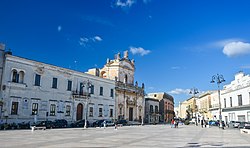
Manduria is a city and comune of Apulia, Italy, in the province of Taranto. With c. 32,000 inhabitants (2013), it is located 35 kilometres (22 mi) east of Taranto.

Key Information

Etymology

[edit]

The name Manduria is thought to derive from a Proto-Indo-European stem *mond-/*mend- or *mando-, meaning 'foal'. The toponym would, then, be of Messapic origin, and related to the semantic field of 'horses', also seen in Illyrian theonym Iuppiter Menzanas and Albanian mëz-i 'foal'.[3][4][5]

History

[edit]

It was an important stronghold of the Messapii against Taras. Archidamus III, king of Sparta, fell beneath its walls in 338 BC, while leading the army of the latter (Manduria is also referred to as "Mandonion" in works by the Greek and Roman historian Plutarch). Manduria revolted against Hannibal, but was taken in 209 BC.

Pliny the Elder mentions Manduria in Natural History. He describes a well with a strangely constant water level. No matter how much water was taken out the water level never changed. The well also features an almond tree growing right from the middle of the well shaft. The well may still be seen today.

The town was destroyed by the Saracens in the 10th century. The inhabitants rebuilt on the site of the present town, which they renamed Casalnuovo. In 1700 they took back the ancient name of Manduria.

Main sights

[edit]

The modern city is close to the site of the ancient Manduria, considerable remains of the defences of which can still be seen; they consisted of a double line of wall built of rectangular blocks of stone, without mortar, and with a broad ditch in front. Ancient tombs with gold ornaments were found in 1886.

The symbol of the city is a well with an almond tree growing from the center, which was mentioned by the Roman author Pliny the Elder in Naturalis Historia, a work published in the 1st century AD. The well (named Fonte Pliniano after Pliny the Elder) can still be seen today exactly as it was described some 2,000 years ago, with the almond tree still rising out of the center. Other sights include:

  • Chiesa Madre (or Collegiata) of medieval origin but renovated in the 16th century.
  • Church of San Pietro Mandurino, probably a Hellenistic hall tomb adapted as a church in the 8th-9th century. Is opened to visits by the public only during certain celebrations.
  • Church of the Holy Trinity (11th/12th centuries). It has a façade with three Renaissance portals and a rose window. The 15th-century bell tower is decorated by large masks of unknown origin.
  • Church of SS. Rosario.
  • Church of SS. Immacolata.
  • Church of Santa Lucia (1540)
  • Medieval Jewish Ghetto.
  • Castle, which was the seat of the Imperiali princes from 1719.
  • Archaeological Park
  • Arch of Sant'Angelo, gateway to the historical center

Primitivo di Manduria DOC

[edit]

The local Primitivo di Manduria DOC wine is made from 100% Primitivo grapes [citation needed]. This wine is also characterized by an unusually high alcohol by volume percentage - around 14%. Wines made from Primitivo have notes of plum and spice, like Zinfandel, but because of different growing soils and climate, the fruit character is less jammy, the structure more akin to old world wines, with rustic notes of earth and spice, as well as tamed fruit flavors.

Cuisine

[edit]

In addition to Primitivo di Manduria, other typical recognised food of the city are Uva di Puglia PGI, "Terra d'Otranto" extra-virgin olive, an ecotype of carosello and the tomato Pomodorino di Manduria.

References

[edit]
Revisions and contributorsEdit on WikipediaRead on Wikipedia
from Grokipedia
Manduria is a and town in the , in the region of southeastern , situated at coordinates 40°24′N 17°38′E and covering an area of fertile plains and coastal zones approximately 35 kilometers east of the provincial capital, . With a population of 29,623 residents as of January 1, 2025, it serves as a key agricultural and cultural hub in the peninsula, renowned for its ancient Messapian archaeological sites and as the epicenter of Primitivo di Manduria wine production. The town's history traces back to the pre-Roman Messapian civilization, where it functioned as one of the twelve principal cities (Dodecapolis) of the Messapii, an Illyrian-related people who inhabited the region from the . Manduria's most prominent ancient feature is its extensive megalithic defensive walls, constructed around the , which enclose an area of about 15 hectares and represent one of the best-preserved examples of Messapian and fortification in . These walls, along with nearby necropolises and the Archaeological Park of the Messapian Walls, highlight the site's role as a thriving center of trade, agriculture, and resistance against Greek and later Roman incursions, with evidence of continuous habitation through the Roman, medieval, and modern eras. Economically, Manduria's landscape is dominated by and olive cultivation, with over 3,140 hectares dedicated to Primitivo grapes under the Primitivo di Manduria —the largest such zone in Puglia—producing robust, full-bodied red wines noted for their dark fruit, spice, and aging potential. The cooperative Produttori di Manduria, established in 1928, exemplifies the area's tradition, sourcing from ancient bush-trained vines that contribute to the region's output of high-quality, terroir-driven varietals. Complementing agriculture, draws visitors to its Blue Flag-awarded beaches like those in the Eastern Taranto Coastline Nature Reserve, accessible cultural sites, and sustainable initiatives such as Bandiera Lilla for inclusive , fostering a balanced economy rooted in heritage preservation and environmental stewardship.

Geography

Location and Physical Features

Manduria is situated in the within the region of southeastern , at coordinates 40°24′N 17°38′E. The town lies approximately 35 kilometers east of and is positioned near the coast, contributing to its transitional landscape between inland plains and coastal zones. It borders several neighboring municipalities, including Avetrana to the west, Oria to the north, to the south, and Erchie and Maruggio nearby, forming part of a broader network of communities in the peninsula's northern edge. The municipality covers a surface area of 180.41 km², encompassing a mix of rural and semi-urban terrains. Elevations range from sea level along the coast to around 79 meters above sea level in the town center, with the highest point reaching approximately 128 meters in the interior. The physical landscape features flat to gently undulating terrain as an extension of the Murge plateau, characterized by broad plains that facilitate agricultural activities. These plains gradually descend toward the Ionian coastline, where they meet sandy dunes and wetland areas. Soils in the region predominantly consist of clay-loam compositions, enriched with and sandy components, which provide fertile ground supporting local vegetation and . This profile contributes to the area's environmental stability and . Manduria's territory includes proximity to notable natural features, such as the Bosco Cuturi, a protected holm oak reserve spanning about 35 hectares, which preserves Mediterranean maquis and serves as a amid the surrounding plains. The transition to coastal dunes highlights the diverse ecological gradients within the municipality.

Climate

Manduria experiences a hot-summer classified as Köppen Csa, characterized by hot, dry summers and mild, wet winters. This climate type is typical of the Puglia region, where seasonal contrasts drive distinct weather patterns, with prolonged sunshine and limited rainfall supporting a temperate environment overall. The annual average temperature in Manduria is approximately 17.4°C, reflecting its position in southern Italy's . Summers, from to , are particularly warm, with average highs reaching 30-35°C and peaking in July at around 31°C (88°F), while nighttime lows remain mild at about 20°C. Winters, spanning December to February, are cooler but seldom severe, with average lows between 5-10°C and daytime highs around 14-16°C in . These temperature ranges are moderated by the region's flat terrain, which contributes to heat retention during the day. Precipitation totals about 620-628 mm annually, concentrated primarily in the autumn and winter months, with and November often seeing the heaviest rains. Summers are notably dry, with low humidity levels below 60% and minimal rainfall, averaging less than 20 mm per month. This seasonal distribution aligns with the Mediterranean pattern, where dry conditions prevail from May to . Manduria's climate is influenced by its proximity to the , approximately 11 km to the east, which tempers extreme temperatures through sea breezes and higher humidity during transitional seasons. Occasionally, winds originating from bring hot, dry air masses, intensifying summer heat and occasionally carrying across the Mediterranean basin. These winds can elevate temperatures by several degrees and reduce visibility, particularly in late spring and early autumn. Recent climate observations indicate mild warming trends in the Puglia region, including Manduria, with average annual temperatures showing a gradual increase of about 0.18°C per decade since the mid-20th century, accelerating in recent decades. Data through 2024 reveal heightened heat stress, with southeastern Europe, including southern Italy, experiencing record numbers of strong heat stress days in summer 2024 compared to historical norms. This warming is consistent with broader Mediterranean patterns driven by anthropogenic climate change.

History

Ancient and Classical Periods

Manduria, known in antiquity as Mandonion, emerged as a prominent settlement of the Messapii, an Iapygian tribe likely originating from Illyrian migrants who arrived in the region of southeastern during the late to early transition, with urban development accelerating around the . As a major stronghold and political center for the Messapii, it functioned as one of their principal urban hubs, reflecting the tribe's organized territorial control amid interactions with neighboring Greek colonies like Tarentum. The city's defenses featured imposing megalithic walls constructed primarily from large blocks, extending approximately three kilometers in length and enclosing about 69 hectares, which underscored its strategic importance in the pre-Roman landscape. A pivotal event in Manduria's early history occurred in 338 BC, when Spartan king Archidamus III, leading mercenaries to support Tarentum against aggressive Italic neighbors including the Messapii and , suffered defeat and death beneath the city's walls, marking a notable clash between Greek military intervention and local resistance. Roman forces incorporated Manduria into their expanding dominion during the 3rd century BC, as part of the broader conquest of the Salentine peninsula following victories over and subsequent campaigns against the Iapygian tribes around 266 BC. During the Second Punic War, the city initially allied with after his 212 BC occupation of but soon revolted, prompting its forcible retaking by Carthaginian troops in 209 BC under the command of Hannibal's brother Mago, as documented in contemporary accounts of allied defections. Notable artifacts from Manduria's classical era include ornaments unearthed from Messapian in 1886, attesting to the elite's access to precious metals through networks with Greek and Etruscan influences. The Fonte Pliniano, a perennial spring within a pagan , exemplifies the site's ritual significance; described it in his Natural History (Book II) as a well in the Salentine district of Manduria that maintains a constant water level regardless of extraction or addition, attributing this to natural or divine constancy. Following the Roman conquest, Manduria came under Roman control, blending Messapian traditions with imperial administration while preserving elements of its indigenous heritage into the early imperial period. In September 2025, excavations during sewer installation uncovered a Hellenistic dating to approximately 400 BC, featuring signs of ancient tampering and highlighting local funerary influenced by Greek elements.

Medieval and Modern Periods

Following the decline of the , Manduria endured repeated invasions and destructions, culminating in its sack by raiders in 977, which left the settlement largely abandoned. The town was subsequently rebuilt toward the end of the by Norman conquerors, who renamed it Casalnuovo and fortified it as part of their consolidation of under leaders like . This reconstruction marked a period of relative stability, with the integrating the site into their feudal system, leveraging its strategic position near ancient Messapian walls for defense against further incursions. Over the subsequent centuries, Manduria—still known as Casalnuovo—passed through the hands of successive rulers, including the under Frederick II and the Angevins after the Sicilian Vespers of 1282. Growth accelerated during Aragonese rule in the , as the town benefited from royal policies promoting agricultural development and trade in the Kingdom of . Under Spanish Habsburg dominion from the late , Casalnuovo became a of the Genoese Imperiali family, who held it for over two centuries, fostering economic expansion through land reforms and viticulture while maintaining feudal obligations. A Jewish community, documented from the , thrived in commerce and crafts until the 17th century, when Filippo Bianchetti established a formal in 1648, confining the population to a walled quarter opposite the main church, in line with papal decrees like . In 1789, during the , the town reclaimed its ancient Messapian name, Manduria, symbolizing a revival of local identity amid Enlightenment influences. The Risorgimento era brought further transformation with Italy's unification in 1861, abolishing remaining feudal ties and shifting the economy toward intensive agriculture, particularly olive and grape cultivation, as land redistribution empowered smallholders over baronial estates. World War II had limited direct impact on Manduria, spared major combat due to its inland location, though Allied bombings affected nearby . Post-war recovery was marred by widespread emigration from the 1950s onward, driven by rural poverty and industrial opportunities elsewhere in and , causing population stagnation around 28,000 residents through the 1970s. Administrative reconfiguration in 1923 integrated Manduria into the newly formed , detaching it from and aligning it with regional industrial hubs for better infrastructure development. By the late , emigration slowed, leading to stabilization near 31,000 by the 2000s, supported by agricultural modernization and . Since 2000, structural funds have supported restorations, including over €3.8 million allocated in recent years for the archaeological area, enhancing preservation of medieval and earlier sites amid broader Puglia heritage initiatives.

Demographics

As of January 1, 2025, Manduria had a resident of 29,623. The municipality's stands at 164.1 inhabitants per square kilometer, based on its 180.44 km² area. Historically, Manduria's peaked at 31,721 on , 2013, before experiencing a slight decline to 29,941 by 2022. This downward trend, averaging -0.44% annually from 2018 to 2023, stems primarily from an aging and patterns that trace back to post-World War II economic challenges. In 2023, Manduria recorded 171 births, reflecting a of 5.7 per 1,000 inhabitants. The death rate was higher at 12.5 per 1,000, resulting in a negative natural balance of approximately -204 individuals. However, a positive migration rate of 2.4 per 1,000 has helped stabilize the overall . The municipality comprises 13,389 families, with an average household size of about 2.2 persons. projections suggest stability through 2030.

Social Composition

Manduria's exhibits a slight majority, with 51.3% females and 48.7% males as of , 2024. The average age stands at 47.2 years, reflecting an aging demographic profile typical of . A significant portion of residents, approximately 26.3%, are aged 65 and older, underscoring the town's elderly and associated social service needs. The ethnic and linguistic composition is predominantly Italian, with the local Apulian widely spoken alongside standard Italian. Foreign-born residents constitute about 3.4% of the population, forming small immigrant communities primarily from (such as and ) and (including and ). Education levels are high, with adult rates approaching 99%, and attainment being common among working-age residents. The regional unemployment rate in Puglia, which includes Manduria, was approximately 11.6% in 2023, with notably higher at around 22-23%. Family structures in Manduria remain traditional, centered on nuclear families influenced by strong Catholic norms prevalent in the region. rates are low, aligning with southern Italy's cultural emphasis on marital stability, where the crude rate is below the national average of about 1.6 per 1,000 inhabitants.

Economy

Agriculture and Viticulture

Agriculture in Manduria centers on traditional Mediterranean crops, with olives, tomatoes, and grapes forming the backbone of local farming. The region produces high-quality extra virgin from local cultivars such as Ogliarola and Cellina di , contributing significantly to Puglia's agricultural output, with the region producing about 40% of Italy's olive oil. Tomatoes, particularly the small, flavorful Pomodorino di Manduria variety—a traditional product (PAT) harvested from late to early —support both fresh consumption and industries. Grapes, especially Primitivo, dominate , while employs a notable share of the local workforce, reflecting Manduria's rural character. Viticulture in Manduria is epitomized by the Primitivo di Manduria , established in 1974 to protect this iconic red wine from Puglia's peninsula. The wine is produced primarily from Primitivo grapes (the Italian counterpart to ), with regulations requiring a minimum of 85% Primitivo, typically reaching 14% , with characteristic aromas of ripe , black cherry, and subtle spice notes derived from the grape's intense fruit profile. The denomination spans approximately 4,000 hectares of vineyards, primarily in the provinces of and . Farming practices in Manduria leverage the area's clay-loam soils, which provide excellent drainage and richness ideal for deep-rooted vines, supplemented by modern systems to combat seasonal dryness. Since the early , there has been a notable shift toward organic , driven by regional trends in Puglia where organic farmland expanded by over 50% between 2010 and 2020, emphasizing reduced chemical inputs and sustainable soil management. This transition supports high-quality Primitivo production through bush-trained (alberello) vines and controlled yields. Manduria's agriculture faces challenges from , including prolonged droughts and rising temperatures that have reduced and yields by up to 20% in recent years across Puglia. To address these, the provides subsidies through the (CAP), allocating funds for sustainable practices like water-efficient irrigation and organic conversion, helping farmers adapt while maintaining production resilience.

Tourism and Other Sectors

Manduria's tourism sector has experienced notable growth in recent years, driven by its , proximity to pristine , and burgeoning offerings centered on Primitivo wine experiences. Visitors are drawn to the town's ancient Messapian and historic landmarks, which complement destinations along the , while wine tours at local cooperatives and estates like Produttori di Manduria provide immersive insights into the region's viticultural traditions. has risen in popularity, with guided visits and tastings appealing to those seeking authentic rural experiences, supported by a network of over 400 active listings that report an average occupancy rate of 56% and stays of about 5.8 days. As of 2025, initiatives like the Blue Flag award for local beaches and the Bandiera Lilla for accessible tourism continue to boost visitor numbers. Beyond , Manduria's includes small-scale , particularly in tied to local agricultural outputs and limited production, reflecting broader trends in Puglia's industrial districts. The services sector encompasses retail outlets serving both residents and visitors, as well as educational institutions contributing to . Post-2020, funds, including those from the NextGenerationEU recovery plan and the SURE instrument, have aided reduction efforts in , including Puglia, by supporting job preservation and economic diversification in areas like Manduria, with ongoing initiatives promoting sustainable growth through 2030. Infrastructure enhancements, such as access to the nearby coastal town of with its 17 kilometers of beaches and marine protected areas, facilitate tourism by providing convenient seaside options just 10 kilometers away. Looking ahead, initiatives like the Manduria d'aMARE association promote models, emphasizing eco-friendly practices, heritage preservation, and community involvement to balance growth with environmental protection in line with regional EU-backed strategies.

Culture and Society

Festivals and Traditions

Manduria's festivals and traditions reflect its deep-rooted agricultural heritage, ancient Messapian influences, and vibrant community spirit, often centered around wine production and religious observances. These events draw locals and visitors alike, fostering a sense of continuity between past and present customs. One of the most prominent celebrations is the Festa del Vino Primitivo, held annually in , which honors the region's signature Primitivo wine through tastings, musical performances, and festive parades showcasing local culture. The Carnevale di Manduria in February adds a playful dimension, with processions of masked groups, allegorical floats, and street performances that embody pre-Lenten revelry and communal joy. Religious traditions hold significant place, particularly the Festa Patronale di San Gregorio Magno in early September, Manduria's feast, which includes solemn processions through the streets, evening concerts, and bustling markets that highlight local craftsmanship and gatherings. observances, known as rites of , feature community processions depicting Christ's passion and , along with traditions of sharing symbolic items among families and neighbors, reinforcing bonds during the spring renewal. Beyond major festivals, customs tied to Manduria's heritage include communal grape harvest events in September, where participants engage in picking and celebrations that echo ancient viticultural practices influenced by the nearby , infusing tales of bountiful lands and maritime blessings into songs and stories. Messapian heritage is evoked through interpretive events at the archaeological park, such as guided recreations of daily life within the ancient walls, connecting modern residents to their pre-Roman ancestors. In recent years, particularly post-2020, these traditions have seen increased youth involvement, with younger generations organizing hybrid events that incorporate and digital promotion into classic formats, ensuring the festivals evolve while preserving core elements like wine-centric rituals.

Cuisine and Local Products

Manduria's cuisine emphasizes fresh, seasonal ingredients rooted in the region's fertile lands, showcasing simple yet flavorful preparations that highlight local produce. Signature dishes often feature made from the Pomodorino di Manduria, a small, oval recognized as a since 2018 for its intense flavor and thin skin. This tomato is central to preparations like orecchiette con sugo di pomodoro, where handmade ear-shaped is tossed in a vibrant, uncooked sauce of crushed Pomodorino, , , and extra-virgin , allowing the fruit's sweetness to shine without overpowering acidity. Similarly, olive oil-based antipasti abound, such as marinated or artichokes preserved in the area's renowned extra-virgin , served with rustic friselle—twice-baked ring-shaped breads softened in and topped with tomatoes and for a classic jatedda salad. Taralli, Manduria's iconic ring-shaped biscuits, bridge savory and sweet traditions, often integral to social rituals. Savory versions, flavored with fennel seeds, pepper, or olives and made from , , and , are boiled then baked for a crisp texture, commonly enjoyed as an aperitivo with local cheeses or during family gatherings. Sweet , incorporating sugar, eggs, and accents like anise or zest, are glazed and reserved for holidays, symbolizing unity and shared goodwill in communal settings. These biscuits appear briefly in local festivals, enhancing celebratory spreads. Wine integration elevates Manduria's table, with Primitivo di Manduria DOC—protected since 1974—pairing seamlessly with hearty fare due to its bold tannins, dark fruit notes, and spice. It complements meats like braciole (stuffed beef rolls in ) or bombette (grilled skewers), as well as aged cheeses, balancing their richness. For , it enhances with cime di rapa (bitter wild turnip greens sautéed with anchovies and chili) or simple tomato ragùs. Other products include the Carosello melon, a crisp, unripe variety harvested in summer and eaten fresh as a refreshing snack or alongside bean purées and Pomodorino sauces, prized for its high water content and subtle scent and included in Slow Food's . Rustic breads like friselle provide a sturdy base for these elements, while seasonal incorporates wild herbs such as and capers into antipasti and sauces. Uva di Puglia PGI table grapes, with their sweetness, feature in desserts like fruit flans or puddings, adding aromatic freshness. The evolution of Manduria's culinary landscape reflects a shift toward preservation and quality, with DOC protections for Primitivo established in 1974 and the Dolce Naturale variant elevated to DOCG status in 2011, ensuring authenticity in pairings and production standards. The movement has emphasized sustainable practices since around 2010, incorporating products like Pomodorino and into presidia and the to safeguard biodiversity and traditional uses against industrialization.

Main Sights

Archaeological Sites

Manduria's archaeological landscape is dominated by remnants of the Messapian civilization, an ancient Italic people who inhabited the region from the until Roman conquest. The Messapian walls, a defining feature, consist of three concentric circuits enclosing the ancient urban center, constructed primarily between the 5th and 3rd centuries BC using large blocks in a megalithic style. The inner circuit measures approximately 2.2 kilometers in perimeter with a diameter of 842 meters, while the overall system spans over 3 kilometers, incorporating defensive fossati and elevated sections up to 5 meters high. These fortifications, among the best-preserved Messapian defenses in Puglia, featured strategic gates and possibly towers for surveillance, reflecting the city's role as a fortified settlement amid regional conflicts with Greek colonies like Tarentum. The surrounding the ancient city provides insight into Messapian burial practices, with over 1,200 excavated mainly between 1955 and 1960 under archaeologist . These , often simple rectangular pits covered by stone slabs and dating from the 6th to 2nd centuries BC, occasionally include hypogea—rock-cut chambers—some adorned with frescoes depicting funerary scenes or geometric motifs. Artifacts from these burials, including and jewelry, are housed in the local Museo Archeologico “Manduria, Terra di Messapi,” highlighting the ' cultural ties to Illyrian influences. A notable discovery in the late included gold items from the necropolis, now part of the collections at the National Archaeological Museum of , underscoring the wealth of elite burials. The Fonte Pliniano, an ancient well-sanctuary within the archaeological park, exemplifies and possible ritual significance. Described by in his Naturalis Historia as a perennial spring, it is accessed via a descending into a semi-natural approximately 18 meters in diameter, where collects in a central basin. An iconic tree grows nearby, symbolizing renewal and featured in Manduria's civic emblem as an almond within a well; local legends link it to pagan water cults, suggesting the site served as a for among the . The well's depth reaches significant subterranean levels, historically probed to access the , though exact measurements vary in ancient accounts. These sites are accessible to the public through the Parco Archeologico delle Mura Messapiche, a 15-hectare area opened after restorations in the late 20th and early 21st centuries, including a major 2024 intervention that enhanced pathways and lighting. While not yet on UNESCO's World Heritage List, the ensemble contributes to Italy's tentative nominations for ancient Italic landscapes. Recent excavations in the , such as a 4th-century BC Hellenistic uncovered during sewer works in September 2025, have revealed additional artifacts like and skeletal remains, expanding knowledge of Messapian-Greek interactions and prompting further preservation efforts by local authorities.

Historic Buildings and Landmarks

Manduria's historic buildings and landmarks reflect its layered from through the , showcasing a blend of religious, noble, and defensive architecture in the town's compact centro storico. The structures, often centered around Piazza Garibaldi and adjacent streets, highlight the influence of Norman, Aragonese, and local noble families, with many featuring ornate portals, coats of arms, and intricate facades that underscore the town's . Among the most prominent religious buildings is the Chiesa Madre, also known as the di Manduria or Collegiata di Santissima Trinità, which originated as a Norman chapel in the medieval period and was extensively renovated in the . Its facade exemplifies a rare Gothic-Renaissance style, adorned with a decorated , lion statues flanking the portal, and a above the entrance; the interior houses altars and artworks from the 17th and 18th centuries. Nearby, the Chiesa di Santa Maria di Costantinopoli, constructed between 1664 and 1718, represents Salento's tradition with its two-tiered facade, polychrome tiled dome, and an altarpiece depicting the . Civil architecture is epitomized by noble palaces that served as residences for prominent families. The Palazzo Imperiali, built in the 18th century (after 1717) as a hunting lodge for the Imperiali princes of Francavilla Fontana on the site of a former Norman castle, features an imposing portal with the family's Spinola-Imperiali coats of arms, an elegant balcony with wrought-iron railings, and unfinished wings due to the line's extinction. Similarly, the Palazzo Giannuzzi Corcioli, dating to the , boasts a concave full-arch entrance portal surmounted by the Giannuzzi family crest and has undergone multiple renovations, later functioning as a school in the before partial conversion to commercial use. These palaces illustrate the architectural patronage in Manduria, with stonework and heraldic elements emphasizing feudal status. Defensive and commemorative landmarks add to the town's historic fabric. The Arco di Sant’Angelo, also called Porta Napoli, erected in 1664–1665 as the sole surviving gate of the medieval walls, spans Via Roma and was built to invoke protection against plagues and earthquakes, featuring a simple arched design integrated into the urban layout. The Torre dell’Orologio, constructed at the end of the in the Borgo Porticella district, marks the historic entrance to the city and serves as a neoclassical sentinel with its and . Additionally, the former Jewish in the central square, part of the 13th–17th-century quarter, was repurposed as a private manor following the 1510 expulsions; its portal retains a carved menorah and floral motifs, symbolizing Manduria's medieval Jewish community.

References

Add your contribution
Related Hubs
User Avatar
No comments yet.