Hubbry Logo
Heliocentric orbitHeliocentric orbitMain
Open search
Heliocentric orbit
Community hub
Heliocentric orbit
logo
8 pages, 0 posts
0 subscribers
Be the first to start a discussion here.
Heliocentric orbit
Heliocentric orbit
from Wikipedia
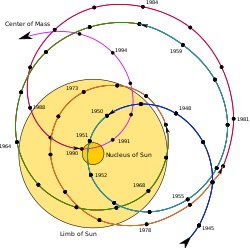
Motion of the Solar System's barycenter relative to the Sun

A heliocentric orbit (also called circumsolar orbit) is an orbit around the barycenter of the Solar System, which is usually located within or very near the surface of the Sun. All planets, comets, and asteroids in the Solar System, and the Sun itself are in such orbits, as are many artificial probes and pieces of debris. The moons of planets in the Solar System, by contrast, are not in heliocentric orbits, as they orbit their respective planet (although the Moon has a convex orbit around the Sun).

The barycenter of the Solar System, while always very near the Sun, moves through space as time passes, depending on where other large bodies in the Solar System, such as Jupiter and other large gas giants, are located at that time. A similar phenomenon allows the detection of exoplanets by way of the radial-velocity method.

The helio- prefix is derived from the Greek word "ἥλιος", meaning "Sun", and also Helios, the personification of the Sun in Greek mythology.[1]

The first spacecraft to be put in a heliocentric orbit was Luna 1 in 1959. An incorrectly timed upper-stage burn caused it to miss its planned impact on the Moon.[2]

Trans-Mars injection

[edit]
Trans-Mars injection diagram.
A = Hohmann transfer orbit. B = Conjunction mission. C = Opposition mission

A trans-Mars injection (TMI) is a heliocentric orbit in which a propulsive maneuver is used to set a spacecraft on a trajectory, also known as Mars transfer orbit, which will place it as far as Mars orbit.

Every two years, low-energy transfer windows open up, which allow movement between the two planets with the lowest possible energy requirements. Transfer injections can place spacecraft into either a Hohmann transfer orbit or bi-elliptic transfer orbit. Trans-Mars injections can be either a single maneuver burn, such as that used by the NASA MAVEN orbiter in 2013, or a series of perigee kicks, such as that used by the ISRO Mars Orbiter Mission in 2013.[3][4]

See also

[edit]

References

[edit]
Revisions and contributorsEdit on WikipediaRead on Wikipedia
from Grokipedia
A heliocentric orbit is an orbit around the barycenter of the Solar System, which serves as the center of mass and is located within or very near the center of the Sun due to its overwhelming mass compared to other bodies. These orbits are followed by , dwarf planets, asteroids, comets, and various , distinguishing them from geocentric orbits around or other planetary systems. The concept of heliocentric orbits emerged from the heliocentric model proposed by in 1543, which posited the Sun as the center of the Solar System rather than Earth, challenging the long-dominant geocentric view. This model gained empirical support through observations by in 1610, who noted the and the , providing evidence that not all celestial bodies revolved around Earth. further refined the understanding in the early by formulating three laws of planetary motion based on precise data from , describing how bodies in heliocentric orbits behave. Kepler's first law states that planets orbit the Sun in elliptical paths with the Sun at one focus, rather than perfect circles, explaining variations in and distance. The second law, known as the law of equal areas, indicates that a line connecting a to the Sun sweeps out equal areas in equal intervals of time, meaning planets move faster when closer to the Sun (at perihelion) and slower when farther away (at aphelion). The third law relates the to the semi-major axis, asserting that the square of the is proportional to the cube of the average distance from the Sun, allowing predictions of orbital durations for different bodies—such as Mercury's 88-day orbit versus Saturn's approximately 29-year orbit. In the , heliocentric orbits are crucial for interplanetary exploration, with achieving them by reaching from to follow independent paths around the Sun. Notable examples include the ESA's , which studies the Sun from distances as close as 42 million kilometers and is planned to reach inclinations up to 33 degrees relative to the solar equator during its extended mission, and the mission, which used a heliocentric to rendezvous with 67P/Churyumov-Gerasimenko. These orbits enable detailed observations of solar system dynamics, from planetary formation to behavior, underscoring their role in advancing astronomical and space science.

Fundamentals

Definition

A heliocentric orbit is the path followed by a celestial body or as it revolves under the influence of its gravitational attraction, with the orbit described in a reference frame centered at the Sun's center. This positions the Sun at the origin, allowing positions and velocities to be expressed relative to the central star. Key characteristics of heliocentric orbits include their shapes—either closed (elliptical) or open (parabolic or hyperbolic)—which are primarily determined by the Sun's gravity, following qualitative principles such as . In first-order approximations, perturbations from other solar system bodies are considered negligible, making the two-body Sun-object interaction a valid model for most dynamics within the system. This simplifies analysis for scales typical of planetary and interplanetary trajectories. Heliocentric orbits differ from geocentric orbits, which center on , and barycentric frames, which use the solar system's as the origin; the heliocentric approximation is sufficiently accurate for most solar system applications due to the Sun's dominant . The type of —bound or unbound—is determined by the total specific ϵ\epsilon, given by ϵ=v22μr,\epsilon = \frac{v^2}{2} - \frac{\mu}{r}, where vv is the speed relative to the Sun, rr is the heliocentric distance, and μ\mu is the Sun's gravitational parameter (μ=GM1.327×1020\mu = GM_\odot \approx 1.327 \times 10^{20} m³ s⁻²). Negative ϵ\epsilon indicates a bound (closed) , while positive ϵ\epsilon signifies an unbound (open) trajectory.

Historical Context

The concept of a heliocentric universe, with celestial bodies orbiting the Sun, traces its earliest known articulation to the ancient Greek astronomer in the 3rd century BCE, who proposed a model placing the Sun at the center of the cosmos and the Earth in motion around it. This idea, however, was overshadowed by the prevailing geocentric model, which positioned Earth at the 's center and dominated astronomical thought for centuries due to philosophical and observational preferences of the time. The heliocentric model gained renewed prominence during the in the 16th century, when published De revolutionibus orbium coelestium in 1543, systematically describing a Sun-centered system where planets, including , follow circular paths around the Sun. Copernicus's work revived and formalized the heliocentric hypothesis, arguing it simplified explanations of planetary retrogrades and seasonal variations compared to geocentric alternatives. Building on this foundation, advanced the theory in the early by analyzing precise observations from , publishing his first two laws of planetary motion in in 1609 and the third in Harmonices mundi in 1619. Kepler's specifically established that planets trace elliptical orbits with the Sun at one focus, departing from Copernicus's circular assumptions and providing a more accurate description of heliocentric paths. Isaac Newton's Philosophiæ Naturalis Principia Mathematica in 1687 synthesized these developments by introducing the law of universal gravitation as an inverse-square force, offering a physical mechanism that explained and unified heliocentric motion under a single mathematical framework applicable to all celestial bodies. In the 18th and 19th centuries, refinements addressed perturbations—small deviations in orbits caused by mutual gravitational influences among bodies—with Joseph-Louis Lagrange's work in the late 1700s developing analytical methods to model these effects in , enabling more precise predictions of heliocentric trajectories. The brought empirical confirmations through space-age missions, as like Voyager followed predicted heliocentric orbits with high accuracy, validating the model's foundational principles against direct observational data.

Orbital Mechanics

Keplerian Elements

The six classical Keplerian elements fully specify the orientation, shape, and size of a in the two-body approximation, where the Sun is treated as the central mass and the orbiting body follows an elliptical path governed by Kepler's first law. These elements are derived from observations and provide a standardized framework for describing orbits relative to a reference plane, typically the , which is the plane of around the Sun. The elements consist of the semi-major axis (a), eccentricity (e), inclination (i), (Ω), argument of perihelion (ω), and (ν). The semi-major axis (a) measures the size of the orbit, defined as half the length of the major axis of the ellipse; it relates directly to the orbital period via Kepler's third law. The eccentricity (e) describes the shape, with e = 0 indicating a circular orbit and 0 < e < 1 for bound elliptical orbits, where e approaches 1 for highly elongated paths. The inclination (i) quantifies the tilt of the orbital plane relative to the ecliptic, ranging from 0° for coplanar orbits to values up to 180° for retrograde motion. The longitude of the ascending node (Ω) specifies the orientation of the orbital plane by giving the angle from the vernal equinox to the point where the orbit crosses the ecliptic from south to north, measured along the ecliptic. The argument of perihelion (ω) locates the perihelion (closest point to the Sun) within the orbital plane, measured eastward from the ascending node to the perihelion. Finally, the true anomaly (ν) indicates the instantaneous angular position of the body along the orbit, measured from the perihelion to the current position. Geometrically, these elements define the ellipse's position and orientation in three-dimensional space relative to the Sun and the ecliptic reference. The semi-major axis and eccentricity establish the ellipse's scale and elongation, with the focus at the Sun. Inclination and the longitude of the ascending node rotate the orbital plane about the ecliptic's north pole and around the Sun, respectively, while the argument of perihelion further orients the major axis within that plane; the true anomaly then pinpoints the body's location on the ellipse at a given time. This configuration allows visualization of the orbit as an inclined, rotated ellipse centered on the Sun, with the reference frame aligned to the vernal equinox and ecliptic pole. Orbital elements are determined from astronomical observations, such as right ascension and declination, using methods like Gauss's preliminary orbit determination, which requires at least three observations to compute an initial set of elements, or least-squares fitting for refined estimates from multiple data points. involves solving for the heliocentric distances and positions that best match the observed angular separations, often iteratively to minimize residuals. Least-squares optimization adjusts the elements to achieve the closest fit to all observations, accounting for measurement uncertainties. Standard units and conventions ensure consistency across astronomical applications: the semi-major axis is expressed in astronomical units (AU), where 1 AU is the mean Earth-Sun distance of approximately 149.6 million kilometers; angular elements (i, Ω, ω, ν) are measured in degrees; and elements are typically referenced to the J2000.0 epoch, corresponding to January 1, 2000, at 12:00 Terrestrial Time, to account for precession and other secular changes.

Equations of Motion

In the two-body problem central to heliocentric orbits, the motion of a smaller body around the Sun is governed by the gravitational parameter μ = GM, where G is the gravitational constant and M is the Sun's mass. The vis-viva equation provides the speed v at any radial distance r from the Sun, derived from the conservation of total mechanical energy in the system. The specific total energy ε is constant and given by ε = v²/2 - μ/r, which equals -μ/(2a) for elliptical orbits, where a is the semi-major axis. Substituting and solving for v yields the vis-viva equation: v=μ(2r1a)v = \sqrt{\mu \left( \frac{2}{r} - \frac{1}{a} \right)}
Add your contribution
Related Hubs
User Avatar
No comments yet.