Hubbry Logo
search
logo
2121462

Mass gap

logo
Community Hub0 Subscribers
Read side by side
from Wikipedia

In quantum field theory, the mass gap is the difference in energy between the lowest energy state, the vacuum, and the next lowest energy state. The energy of the vacuum is zero by definition, and assuming that all energy states can be thought of as particles in plane-waves, the mass gap is the mass of the lightest particle.

Since the energies of exact (i.e. nonperturbative) energy eigenstates are spread out and therefore are not technically eigenstates, a more precise definition is that the mass gap is the greatest lower bound of the energy of any state which is orthogonal to the vacuum.

The analog of a mass gap in many-body physics on a discrete lattice arises from a gapped Hamiltonian.

Mathematical definitions

[edit]

For a given real-valued quantum field , where , we can say that the theory has a mass gap if the two-point function has the property

with being the lowest energy value in the spectrum of the Hamiltonian and thus the mass gap. This quantity, easy to generalize to other fields, is what is generally measured in lattice computations. It was proved in this way that Yang–Mills theory develops a mass gap on a lattice.[1][2] The corresponding time-ordered value, the propagator, will have the property

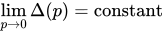
with the constant being finite. A typical example is offered by a free massive particle and, in this case, the constant has the value 1/m2. In the same limit, the propagator for a massless particle is singular.

Examples from classical theories

[edit]

An example of mass gap arising for massless theories, already at the classical level, can be seen in spontaneous breaking of symmetry or the Higgs mechanism. In the former case, one has to cope[how?] with the appearance of massless excitations, Goldstone bosons, that are removed in the latter case due to gauge freedom. Quantization preserves this gauge freedom property.

A quartic massless scalar field theory develops a mass gap already at classical level[clarification needed]. Consider the equation
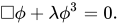
This equation has the exact solution

—where and are integration constants, and sn is a Jacobi elliptic function—provided
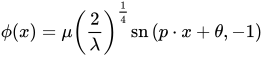
At the classical level, a mass gap appears while, at quantum level, one has a tower of excitations, and this property of the theory is preserved after quantization in the limit of momenta going to zero.[3]

Yang–Mills theory

[edit]

While lattice computations have suggested that Yang–Mills theory indeed has a mass gap and a tower of excitations, a theoretical proof is still missing. This is one of the Clay Institute Millennium problems and it remains an open problem. Such states for Yang–Mills theory should be physical states, named glueballs, and should be observable in the laboratory.

Källén–Lehmann representation

[edit]

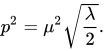
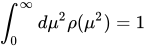
If Källén–Lehmann spectral representation holds, at this stage we exclude gauge theories, the spectral density function can take a very simple form with a discrete spectrum starting with a mass gap

being the contribution from multi-particle part of the spectrum. In this case, the propagator will take the simple form


being approximatively the starting point of the multi-particle sector. Now, using the fact that

we arrive at the following conclusion for the constants in the spectral density

.
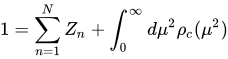
This could not be true in a gauge theory. Rather it must be proved that a Källén–Lehmann representation for the propagator holds also for this case. Absence of multi-particle contributions implies that the theory is trivial, as no bound states appear in the theory and so there is no interaction, even if the theory has a mass gap. In this case we have immediately the propagator just setting in the formulas above.

See also

[edit]

References

[edit]
[edit]
Revisions and contributorsEdit on WikipediaRead on Wikipedia
from Grokipedia
In quantum field theory, the mass gap refers to a positive lower bound Δ > 0 on the energy spectrum of the Hamiltonian above the vacuum state, meaning there are no physical states with energies in the interval (0, Δ), which implies the absence of massless particles and the presence of massive excitations in the theory.[1] This phenomenon is crucial for understanding short-range fundamental forces, such as the strong nuclear force, where classical descriptions predict massless gauge bosons, but quantum effects generate effective masses through mechanisms like confinement.[1] The mass gap gained prominence through the Yang–Mills existence and mass gap problem, one of the seven Millennium Prize Problems posed by the Clay Mathematics Institute in 2000, offering a $1 million prize for its solution.[2] The problem requires proving that, for any compact simple gauge group G (such as SU(3) for quantum chromodynamics), a non-trivial quantum Yang–Mills theory exists on four-dimensional Minkowski spacetime ℝ⁴, satisfies standard axiomatic properties (at least as strong as the Wightman or Osterwalder-Schrader axioms), and possesses a mass gap Δ > 0.[1] Additionally, the theory must reproduce predictions from perturbative renormalization and asymptotic freedom, ensuring consistency with experimental observations in particle physics.[1] Yang–Mills theories, introduced by Chen Ning Yang and Robert Mills in 1954 as non-Abelian generalizations of Maxwell's electromagnetism, underpin the gauge sector of the Standard Model, describing the weak and strong interactions alongside the Abelian U(1) theory of electromagnetism.[1] In quantum chromodynamics (QCD), lattice simulations and experiments at facilities like CERN confirm a mass gap, linking it to quark confinement where color-charged particles cannot exist freely, but a rigorous mathematical proof eludes theorists despite decades of effort.[1] Resolving the problem would provide a foundational rigorous framework for quantum field theories beyond perturbation theory, bridging mathematics and high-energy physics.[1]

Fundamental Concepts

Definition in Quantum Field Theory

In quantum field theory, the mass gap Δ>0\Delta > 0 is defined as the infimum of the energy spectrum of the Hamiltonian HH above the vacuum state, where the vacuum Ω\Omega satisfies HΩ=0H \Omega = 0 and the spectrum of HH lies in [0,)[0, \infty) by the positive energy axiom. Mathematically, Δ=inf{EE>0,Espec(H)}\Delta = \inf \{ E \mid E > 0, \, E \in \operatorname{spec}(H) \}, ensuring no continuous spectrum in the interval (0,Δ)(0, \Delta). This gap implies that all excitations require a minimum energy Δ\Delta to create, distinguishing gapped theories from those with massless modes, such as free massless fields where Δ=0\Delta = 0. The mass gap manifests in the particle spectrum, where all physical particles possess rest masses mΔ>0m \geq \Delta > 0, precluding massless excitations like photons or gluons in the absence of interactions. The mass operator M=H2P2M = \sqrt{H^2 - \mathbf{P}^2}, with P\mathbf{P} the spatial momentum operator, has its spectrum starting at Δ\Delta, labeling the invariant masses of one-particle states as isolated eigenvalues above this threshold. In theories without a mass gap, the spectrum of MM includes zero-mass particles, leading to long-range forces, whereas a positive Δ\Delta supports short-range interactions. Under the Wightman axioms, the joint spectrum of the energy-momentum operators (H,P)(H, \mathbf{P}) is contained in the forward light cone V+={(E,p)Ep,E0}V^+ = \{ (E, \mathbf{p}) \mid E \geq |\mathbf{p}|, \, E \geq 0 \}, and a mass gap requires this spectrum to lie in {0}{pV+p2Δ2}\{0\} \cup \{ p \in V^+ \mid p^2 \geq \Delta^2 \}, excluding the massless light cone except at the origin. The Osterwalder-Schrader axioms, formulated in Euclidean space and reconstructible to Minkowski via analytic continuation, impose reflection positivity and Euclidean invariance, yielding the same spectral condition upon reconstruction to ensure the gap. A key consequence is the exponential decay of the two-point correlation function for large separations: ϕ(x)ϕ(0)eΔx\langle \phi(x) \phi(0) \rangle \sim e^{-\Delta |x|} as x|x| \to \infty, reflecting the absence of low-energy modes and cluster properties. Proving Δ>0\Delta > 0 in non-abelian gauge theories like Yang-Mills remains a central open problem. [1][3][4]

Physical Significance

The mass gap plays a crucial role in ensuring the stability of the vacuum state in quantum field theories by requiring that all excitations above the vacuum possess a minimum energy bounded below by a positive constant Δ > 0, thereby preventing the existence of arbitrarily low-energy modes that could destabilize the ground state.[1] This condition aligns with the spectrum condition in axiomatic quantum field theory, which posits a unique, stable vacuum separated from the continuum of excited states by an energy gap.[5] Furthermore, the presence of a mass gap mitigates infrared divergences in scattering amplitudes, as the exponential decay of correlation functions in gapped theories avoids the long-range interactions associated with massless particles that lead to singular behaviors in perturbative expansions. In quantum field theories without spontaneous symmetry breaking of continuous symmetries, a positive mass gap Δ > 0 directly implies the absence of zero-mass modes, such as Goldstone bosons, which would otherwise arise as a consequence of the Goldstone theorem when a symmetry is spontaneously broken.[6] The theorem dictates that each broken generator of a continuous symmetry produces a massless Nambu–Goldstone boson, but in gapped theories lacking such breaking, the spectrum starts at a finite mass scale, ensuring no massless excitations disrupt the particle content.[6] This connection underscores the mass gap's role in maintaining a discrete, massive particle spectrum devoid of gapless modes. The mass gap is integral to the renormalization process and asymptotic freedom in non-Abelian gauge theories like quantum chromodynamics (QCD), where it facilitates control over the renormalization group flow by providing a natural infrared cutoff that complements the ultraviolet behavior governed by the coupling's decrease at high energies.[1] In lattice simulations of these theories, the mass gap enables a well-defined continuum limit, as the finite correlation length associated with the gap allows reliable extrapolation from discrete lattice spacings to the continuous spacetime while respecting asymptotic freedom to avoid critical slowing down at weak couplings. This interplay ensures that non-perturbative effects, such as the generation of the gap, can be numerically probed without divergences plaguing the infinite-volume limit.[7] Experimentally, the mass gap manifests in QCD through the hadron spectrum, where the lightest observed particles—the pions—have masses around 140 MeV, with all other hadrons exhibiting significantly higher masses, indicating an effective lower bound on excitation energies despite the near-masslessness of pions as pseudo-Goldstone bosons from approximate chiral symmetry breaking.[7] This spectral structure supports the physical realization of a mass gap in the low-energy effective theory, aligning lattice QCD predictions with empirical data from particle accelerators and consistent with the absence of massless degrees of freedom in the confined phase.

Classical Analogues

Scalar and Electromagnetic Theories

In classical scalar field theory, the Klein-Gordon equation governs the dynamics of a massive scalar field ϕ\phi, given by
(+m2)ϕ=0, (\square + m^2) \phi = 0,
where =μμ\square = \partial^\mu \partial_\mu is the d'Alembertian operator and m>0m > 0 is the mass parameter that introduces a mass gap.[8] This equation admits plane-wave solutions of the form ϕeipx\phi \sim e^{-i p \cdot x}, leading to the dispersion relation
E2=p2+m2 E^2 = \mathbf{p}^2 + m^2
in natural units, where EE is the energy and p\mathbf{p} is the momentum. The presence of the m2m^2 term ensures a minimum energy Emin=mE_{\min} = m at p=0\mathbf{p} = 0, prohibiting zero-energy excitations and thereby establishing the mass gap, which manifests as a cutoff in the spectrum of allowed frequencies for propagating waves.[9] The propagator, or Green's function, for the Klein-Gordon operator provides insight into this gapped structure. It satisfies the inhomogeneous equation
(+m2)G(xy)=δ(4)(xy), (\square + m^2) G(x - y) = -\delta^{(4)}(x - y),
and in momentum space, via Fourier transform, yields
G(p)=1p2m2, G(p) = \frac{1}{p^2 - m^2},
where p2=pμpμp^2 = p^\mu p_\mu. The denominator's pole occurs at p2=m2p^2 = m^2, corresponding to the mass scale mm, which reflects the absence of low-energy modes below the gap; in contrast, the massless case (m=0m = 0) places the pole at p2=0p^2 = 0, allowing massless propagation.[10] Classical electromagnetism, described by Maxwell's equations,
E=ρ,B=0,×E=Bt,×B=J+Et, \nabla \cdot \mathbf{E} = \rho, \quad \nabla \cdot \mathbf{B} = 0, \quad \nabla \times \mathbf{E} = -\frac{\partial \mathbf{B}}{\partial t}, \quad \nabla \times \mathbf{B} = \mathbf{J} + \frac{\partial \mathbf{E}}{\partial t},
exhibits no such mass gap due to the massless nature of the photon field. In the source-free limit, the equations support transverse wave solutions with dispersion relation E=pE = |\mathbf{p}|, implying zero rest mass for the excitations and enabling long-range forces, such as the 1/r21/r^2 Coulomb interaction between charges.[11] This absence of a gap contrasts sharply with massive scalar theories, as the massless pole in the electromagnetic propagator at p2=0p^2 = 0 permits infinite-range interactions.[12] A key historical development addressing mass generation in coupled scalar-electromagnetic systems is the Higgs mechanism, first articulated in 1964 by Peter Higgs and independently by François Englert and Robert Brout, building on earlier ideas from Philip Anderson on symmetry breaking in superconductors. This mechanism dynamically induces a mass gap for gauge fields through spontaneous symmetry breaking in a scalar-electromagnetic theory, where the scalar field's vacuum expectation value couples to the massless photon-like field, effectively "eating" a Goldstone mode to generate massive vector excitations without explicit mass terms.[13]

Vector and Gauge Theories

In classical field theory, massive vector fields are described by the Proca equations, which incorporate a mass term that introduces a mass gap in the spectrum. The Proca equation for the vector potential AμA_\mu reads
(+m2)Aμμ(A)=0, (\square + m^2) A_\mu - \partial_\mu (\partial \cdot A) = 0,
where =νν\square = \partial^\nu \partial_\nu is the d'Alembertian operator and m>0m > 0 is the mass parameter.[14] This equation governs the propagation of a spin-1 particle with three independent polarization states: two transverse and one longitudinal, corresponding to the three degrees of freedom of a massive vector boson.[15] In contrast, the massless Maxwell case yields only two transverse helicity states, allowing propagation without a frequency cutoff below the light speed, whereas the Proca mass term enforces a dispersion relation ω2=k2+m2\omega^2 = \mathbf{k}^2 + m^2, establishing a gap mm that prevents zero-mass excitations.[15] Gauge theories, particularly non-Abelian Yang-Mills theories, provide a framework where vector fields are inherently massless in their classical formulation, lacking a built-in mass gap. The classical Yang-Mills action is given by
S=14d4xTr(FμνFμν), S = -\frac{1}{4} \int d^4x \, \operatorname{Tr}(F_{\mu\nu} F^{\mu\nu}),
with the field strength tensor
Fμν=μAννAμ+[Aμ,Aν], F_{\mu\nu} = \partial_\mu A_\nu - \partial_\nu A_\mu + [A_\mu, A_\nu],
where AμA_\mu takes values in the Lie algebra of the gauge group, such as SU(3) for gluons.[16] The absence of a mass term in this action implies that the gauge bosons (gluons) propagate at the speed of light, with a continuous spectrum starting from zero energy, analogous to photons in electromagnetism but with self-interactions due to the non-Abelian commutator.[16] A mass gap can be introduced in gauge theories through spontaneous symmetry breaking via the Higgs mechanism, which generates effective masses for the gauge bosons without violating gauge invariance. In the non-Abelian case, a scalar field in the fundamental representation acquires a vacuum expectation value, leading to a mass term for the gauge fields proportional to the coupling strength and the vev, as realized in the electroweak sector where W and Z bosons gain masses around 80 and 91 GeV, respectively. This mechanism contrasts with the Proca theory by preserving the two transverse polarizations while "eating" the would-be Goldstone modes to form the longitudinal components, resulting in three massive degrees of freedom per boson. Topological configurations, such as instantons in classical Yang-Mills theory, represent non-perturbative solutions that contribute to the vacuum structure but do not induce a mass gap in the linear spectrum of small fluctuations around the trivial vacuum. These self-dual or anti-self-dual solutions to the equations of motion, classified by the topological charge, affect tunneling between vacua but leave the perturbative gluon modes massless, with the spectrum remaining gapless at the classical level.

The Yang-Mills Mass Gap Problem

Formulation and Requirements

The Yang-Mills mass gap problem, as formulated by the Clay Mathematics Institute, requires proving that for any compact simple gauge group $ G $, a quantum Yang-Mills theory exists on $ \mathbb{R}^4 $ with a mass gap $ \Delta > 0 $.[1] This theory must be non-trivial and defined by local quantum field operators corresponding to gauge-invariant polynomials in the curvature $ F $ and its covariant derivatives, such as $ \operatorname{Tr} F_{ij} F_{kl}(x) $.[1] The quantum theory must be constructed on a Hilbert space that carries a unitary representation of the Poincaré group with positive energy, where the self-adjoint Hamiltonian $ H $, generating time translations, has spectrum in $ [0, \infty) $.[1] It includes a unique Poincaré-invariant vacuum vector $ |\Omega\rangle $ satisfying $ H |\Omega\rangle = 0 $, and the spectrum of $ H $ contains no eigenvalues in the interval $ (0, \Delta) $ for some $ \Delta > 0 $, ensuring all particle excitations have mass at least $ \Delta $.[1] The theory must satisfy axioms at least as strong as the Wightman axioms or the Osterwalder-Schrader axioms, providing a rigorous framework for quantum field theories.[1] This construction is inherently non-perturbative, as perturbative expansions in Yang-Mills theory suffer from infrared divergences that prevent capturing the long-distance quantum behavior and the emergence of the mass gap.[1] Classical Yang-Mills theory, serving as the starting point, describes massless gluon fields without a gap, but quantization demands methods like lattice gauge theory or constructive quantum field theory to resolve these issues.[1] While the problem is stated generally for any compact simple Lie group $ G $, a solution for $ G = \mathrm{SU}(3) $ would advance the mathematical foundation of quantum chromodynamics.[1]

Connections to Confinement and QCD

In quantum chromodynamics (QCD), the presence of a mass gap Δ in the spectrum of excitations implies the confinement of quarks into color-neutral hadrons, such as mesons and baryons, with masses bounded below by approximately Δ ≈ 100–200 MeV. This scale arises from the non-perturbative dynamics of the strong interaction at low energies, governed by the QCD scale parameter Λ_QCD ≈ 350 MeV for three light flavors, ensuring that free quarks or gluons cannot propagate over long distances as massless or near-massless particles. Observational evidence supports this, as no free quarks have been detected in experiments, with all observed hadrons exhibiting masses well above the current quark masses of a few MeV for up and down quarks.[17] A key conceptual framework linking the mass gap to confinement is the dual superconductivity model, which posits that the QCD vacuum behaves as a dual superconductor. In this analogy, the condensation of magnetic monopoles (arising from the compact nature of the gauge group) expels color-electric fields, leading to magnetic confinement of quarks—contrasting with the electric confinement of magnetic fields in ordinary superconductors via Cooper pair condensation. This mechanism generates flux tubes between quark-antiquark pairs, resulting in a linear confining potential V(R) = σR, where the string tension σ satisfies σ ∼ Δ² and is estimated around (420 MeV)² from lattice studies, providing the scale for the mass gap's role in binding quarks.[18] Lattice QCD simulations offer numerical evidence for a positive mass gap in the Yang-Mills sector of QCD, manifesting as massive glueball states—the lightest scalar (0^{++}) glueball having a mass of approximately 1.65–1.71 GeV in quenched approximations. These computations, performed on fine lattices with improved actions, confirm the absence of massless gluon excitations and support confinement through the positive energy gap between the vacuum and the lowest glueball, with full QCD including dynamical quarks showing consistent results for heavier states.[19] Importantly, the mass gap in QCD is distinct from the mechanism of chiral symmetry breaking, which spontaneously breaks SU(3)_L × SU(3)_R invariance and generates constituent quark masses around 300 MeV, but produces nearly massless Goldstone bosons like the pion (m_π ≈ 140 MeV). The pion's small but positive mass stems from explicit breaking by current quark masses (m_u + m_d ≈ 10 MeV), whereas the mass gap enforces a fundamental infrared scale via dimensional transmutation, independent of chiral dynamics and ensuring overall confinement.[17]

Mathematical Frameworks

Axiomatic Approaches

Axiomatic approaches to quantum field theory (QFT) provide a rigorous mathematical framework for defining and analyzing the mass gap, ensuring that the theory's spectrum exhibits a positive lower bound above the vacuum energy. The Wightman axioms, formulated in the Minkowski spacetime, form one such foundational set, requiring the theory to consist of a Hilbert space H\mathcal{H} with a unitary representation of the Poincaré group, a unique vacuum vector Ω\Omega invariant under translations, and field operators ϕ(x)\phi(x) satisfying several conditions.[1] Central among these are the positivity axiom, which mandates that the sesquilinear form defined by vacuum expectation values is positive definite, ensuring a well-defined inner product on the space of states; relativistic invariance, under which field operators transform covariantly under Poincaré transformations; and the spectrum condition, which restricts the joint spectrum of the translation generators (the four-momentum operator PμP^\mu) to the forward light cone V+\overline{V_+}, excluding the origin except for the vacuum.[20] This spectrum condition implies the possibility of a mass gap Δ>0\Delta > 0, as it allows the excitation spectrum to lie in {0}[m2,)\{0\} \cup [m^2, \infty) for some mΔ1/2m \geq \Delta^{1/2}, preventing massless particles and enabling the isolation of the vacuum sector.[21] In constructive QFT, such as weakly coupled ϕ34\phi^4_3 models, these axioms have been verified, confirming a positive mass gap through spectral analysis and cluster expansions.[20] The Osterwalder-Schrader (OS) axioms offer an alternative Euclidean formulation, facilitating constructive proofs by working with positive-definite correlation functions on R4\mathbb{R}^4 rather than operator algebras. These axioms include Euclidean invariance under translations and rotations, regularity of distributions, and crucially, reflection positivity, which states that for any function ff supported in the positive half-space {x40}\{x_4 \geq 0\}, the expectation E[f(θx)f(x)]0\mathbb{E}[f(\theta x) f(x)] \geq 0, where θ\theta reflects across the x4=0x_4 = 0 hyperplane.[1] Reflection positivity enables the reconstruction of a Minkowski-space Hilbert space via the OS theorem, yielding a theory satisfying the Wightman axioms, and plays a key role in establishing a mass gap by ensuring the transfer matrix T=eaHT = e^{-aH} (with HH the Hamiltonian) is positivity-preserving, leading to a gapped spectrum above the ground state.[1] This framework has been instrumental in proving mass gaps for scalar theories like ϕ34\phi^4_3 in three dimensions, where Euclidean methods control infrared divergences and confirm the absence of zero-mass excitations.[20] The cluster decomposition property further constrains axiomatic QFTs by requiring that vacuum correlations factorize at large spacelike separations: for local operators O1(x)O_1(x) and O2(y)O_2(y) with xy|x - y| \to \infty, ΩO1(x)O2(y)ΩΩO1(x)ΩΩO2(y)Ω\langle \Omega | O_1(x) O_2(y) | \Omega \rangle \to \langle \Omega | O_1(x) | \Omega \rangle \langle \Omega | O_2(y) | \Omega \rangle.[1] This property enforces a positive mass gap Δ>0\Delta > 0 to prevent long-range order or massless modes, as violations would imply non-decaying correlations incompatible with locality in gapped systems; in theories with Δ>0\Delta > 0, correlations decay exponentially as ΩO(x)O(y)ΩCeΔxy/2|\langle \Omega | O(x) O(y) | \Omega \rangle| \leq C e^{-\Delta |x-y|/2}.[22] Cluster decomposition is a consequence of the Wightman spectrum condition and reflection positivity in OS theories, ensuring the independence of distant subsystems.[1] The Reeh-Schlieder theorem complements these axioms by asserting that, in a theory satisfying the Wightman conditions, the vacuum Ω\Omega is cyclic and separating for the algebra of observables A(O)\mathcal{A}(\mathcal{O}) localized in any open bounded region O\mathcal{O}: the closure of A(O)Ω\mathcal{A}(\mathcal{O}) \Omega is dense in H\mathcal{H}, and no non-zero vector is annihilated by all elements of A(O)\mathcal{A}(\mathcal{O}).[23] In gapped theories with a unique vacuum, this theorem implies vacuum uniqueness by combining with cluster decomposition; local excitations cannot produce states orthogonal to Ω\Omega without incurring the energy cost of the gap, preventing degenerate ground states or spontaneous symmetry breaking without Goldstone modes. Thus, Reeh-Schlieder ensures that the vacuum is the sole translationally invariant state in the zero-mass sector for gapped QFTs. These axiomatic tools underpin efforts to resolve the Yang-Mills mass gap problem by providing criteria for a complete, non-perturbative construction.[1]

Källén–Lehmann Spectral Representation

The Källén–Lehmann spectral representation provides a foundational non-perturbative expression for the two-point correlation function in quantum field theory, linking the structure of propagators to the spectrum of particle states. For a scalar field, the time-ordered two-point function Δ(x)\Delta(x) in position space is given by
Δ(x)=0dρ(μ)Δμ(x), \Delta(x) = \int_0^\infty d\rho(\mu) \, \Delta_\mu(x),
where Δμ(x)\Delta_\mu(x) is the propagator for a free massive Klein-Gordon field of mass μ\sqrt{\mu}, and ρ(μ)\rho(\mu) is a positive spectral measure encoding the contributions from all possible intermediate states.[24] This representation arises within axiomatic quantum field theory frameworks that assume microcausality and the existence of a Poincaré-invariant vacuum.[25] A key implication for the mass gap concerns the support of the spectral measure ρ(μ)\rho(\mu). The presence of a mass gap Δ>0\Delta > 0 requires that ρ(μ)=0\rho(\mu) = 0 for 0μ<Δ20 \leq \mu < \Delta^2, ensuring no massless particles contribute to the spectrum. This condition eliminates a pole at zero mass in the propagator, leading to exponential decay in the position-space correlation function Δ(x)eΔx\Delta(x) \sim e^{-\Delta |x|} for large spacelike separations, which reflects cluster decomposition and the absence of long-range massless interactions.[24] The derivation of this representation relies on the Lehmann-Symanzik-Zimmermann (LSZ) reduction formula and the completeness of the Hilbert space of one-particle states. Inserting a complete set of states between field operators in the two-point function and applying LSZ to relate correlation functions to S-matrix elements yields the momentum-space form
Δ~(p2)=0dμ(m2)ρ(m2)p2+m2+iϵ, \tilde{\Delta}(p^2) = \int_0^\infty d\mu(m^2) \frac{\rho(m^2)}{p^2 + m^2 + i\epsilon},
where the integral over the spectral density ρ(m2)\rho(m^2) captures the discontinuities across the branch cut for timelike momenta, consistent with unitarity and the optical theorem.[24] For gauge fields, the representation extends to vector propagators while preserving gauge invariance through transverse projectors. The two-point function decomposes into transverse components, with the spectral measure weighted by projectors such as (gμνpμpνp2)\left( g_{\mu\nu} - \frac{p_\mu p_\nu}{p^2} \right) in the Landau gauge, ensuring the form remains transverse for all momenta and the mass gap condition applies to physical degrees of freedom without longitudinal artifacts.[24] This adaptation is crucial for non-Abelian gauge theories, where the spectral support starting above zero aligns with expectations of confinement and massive gluon excitations.[25]

Historical Context and Current Status

Origins and Key Developments

The concept of the mass gap in quantum field theory (QFT) emerged in the early development of the field as physicists grappled with infinities and the structure of particle spectra. In the 1930s and 1940s, Werner Heisenberg and Wolfgang Pauli formulated the foundational equations of QFT while addressing divergences in quantum electrodynamics (QED), proposing regularization techniques such as introducing a fundamental length scale to cut off ultraviolet infinities, which naturally led to considerations of massive particles and avoided zero-mass excitations in the theory.[26] Their work on the quantum theory of wave fields emphasized the need for finite physical observables, paving the way for massive theories that could resolve these issues without ad hoc subtractions.[27] By the 1950s, the mass gap was more rigorously formalized through spectral representations of correlation functions. Gunnar Källén and Harry Lehmann developed the Källén–Lehmann spectral representation, which expresses the two-point propagator as an integral over a positive spectral density supported on the mass spectrum, enabling the identification of a mass gap as the lowest positive energy above the vacuum in scalar and fermionic theories. This axiomatic approach, building on earlier renormalization insights, provided a non-perturbative framework to characterize the excitation spectrum and exclude massless particles unless explicitly present. In the 1960s and 1970s, Julian Schwinger and collaborators deepened the understanding of renormalization in quantum field theories, demonstrating how it yields finite physical masses for particles despite bare divergences. In QED, this applies to charged particles like electrons, though the theory includes massless photons. Schwinger's source theory formalism further illustrated dynamical mass generation and confinement-like phenomena in models like the Schwinger model (1+1-dimensional QED), where a mass gap arises non-perturbatively.[28] Concurrently, Sheldon Glashow's 1961 formulation proposed a gauge model of weak interactions based on SU(2) × U(1) symmetry, unifying aspects of weak and electromagnetic forces; this laid the groundwork for the electroweak theory, where gauge boson masses are generated via the Higgs mechanism. The 1970s marked a computational turn with Kenneth Wilson's introduction of lattice gauge theory, discretizing spacetime to simulate non-abelian gauge theories and numerically probe the mass gap through correlation functions and string tensions, offering evidence for confinement and positive masses in QCD-like systems. This approach complemented analytical efforts by providing verifiable paths to confirm gaps without relying on continuum approximations.[29]

Millennium Prize Problem and Recent Progress

In 2000, the Clay Mathematics Institute selected the Yang–Mills existence and mass gap problem as one of seven Millennium Prize Problems, offering a $1 million prize for a correct solution. The official description, authored by Arthur Jaffe and Edward Witten, requires proving that for any compact simple gauge group GG, a non-trivial quantum Yang–Mills theory exists on R4\mathbb{R}^4 satisfying the Wightman axioms (or a suitable substitute) and possesses a mass gap Δ>0\Delta > 0, meaning the Hamiltonian has a spectral gap above the ground state energy. This formulation emphasizes the need for a non-perturbative construction, as perturbative methods fail to capture the full quantum dynamics essential for phenomena like confinement.[1] Significant progress toward understanding the mass gap has come from numerical and constructive approaches, though a full analytic proof remains elusive. Lattice quantum chromodynamics (QCD) simulations, developed extensively since the 1990s, provide strong numerical evidence for a mass gap in SU(3) Yang–Mills theory coupled to quarks, with computations of hadron spectra showing positive excitation energies consistent with experimental observations. For instance, lattice results for light hadron masses demonstrate a clear gap between the vacuum and the lowest-lying states, supporting the physical relevance of the problem in quantum chromodynamics. Earlier constructive quantum field theory efforts by James Glimm and Arthur Jaffe in the 1980s established rigorous existence for simpler models, such as the ϕ34\phi^4_3 theory in three dimensions and P(ϕ\phi)_2 theories in two dimensions, using functional integral methods and cluster expansions; these techniques laid foundational tools but have not yet extended to four-dimensional non-Abelian Yang–Mills theories.[7][3] As of 2025, the problem remains unsolved, with no solution verified by the Clay Mathematics Institute. Several preprints from 2025 claim proofs using innovative frameworks, such as quantum virtue operators to establish spectral properties or structural stability principles to derive the mass gap from gauge invariance, but these have not undergone peer review sufficient for acceptance or prize consideration. Ongoing research explores indirect approaches, including string theory duals like AdS/CFT correspondence, which model confining Yang–Mills theories with built-in mass gaps, and epsilon-regime analyses in chiral perturbation theory, which probe low-energy QCD dynamics to infer gap-related symmetries. Key challenges persist, including the absence of an analytic non-perturbative construction and conceptual overlaps with other Millennium problems, such as the Navier–Stokes existence and smoothness, where both demand rigorous existence proofs for solutions to nonlinear equations modeling physical systems.[2][30][31]

References

User Avatar
No comments yet.