Hubbry Logo
Mass gapMass gapMain
Open search
Mass gap
Community hub
Mass gap
logo
8 pages, 0 posts
0 subscribers
Be the first to start a discussion here.
Mass gap
Mass gap
from Wikipedia

In quantum field theory, the mass gap is the difference in energy between the lowest energy state, the vacuum, and the next lowest energy state. The energy of the vacuum is zero by definition, and assuming that all energy states can be thought of as particles in plane-waves, the mass gap is the mass of the lightest particle.

Since the energies of exact (i.e. nonperturbative) energy eigenstates are spread out and therefore are not technically eigenstates, a more precise definition is that the mass gap is the greatest lower bound of the energy of any state which is orthogonal to the vacuum.

The analog of a mass gap in many-body physics on a discrete lattice arises from a gapped Hamiltonian.

Mathematical definitions

[edit]

For a given real-valued quantum field , where , we can say that the theory has a mass gap if the two-point function has the property

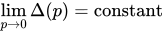
with being the lowest energy value in the spectrum of the Hamiltonian and thus the mass gap. This quantity, easy to generalize to other fields, is what is generally measured in lattice computations. It was proved in this way that Yang–Mills theory develops a mass gap on a lattice.[1][2] The corresponding time-ordered value, the propagator, will have the property

with the constant being finite. A typical example is offered by a free massive particle and, in this case, the constant has the value 1/m2. In the same limit, the propagator for a massless particle is singular.

Examples from classical theories

[edit]

An example of mass gap arising for massless theories, already at the classical level, can be seen in spontaneous breaking of symmetry or the Higgs mechanism. In the former case, one has to cope[how?] with the appearance of massless excitations, Goldstone bosons, that are removed in the latter case due to gauge freedom. Quantization preserves this gauge freedom property.

A quartic massless scalar field theory develops a mass gap already at classical level[clarification needed]. Consider the equation

This equation has the exact solution

—where and are integration constants, and sn is a Jacobi elliptic function—provided

At the classical level, a mass gap appears while, at quantum level, one has a tower of excitations, and this property of the theory is preserved after quantization in the limit of momenta going to zero.[3]

Yang–Mills theory

[edit]

While lattice computations have suggested that Yang–Mills theory indeed has a mass gap and a tower of excitations, a theoretical proof is still missing. This is one of the Clay Institute Millennium problems and it remains an open problem. Such states for Yang–Mills theory should be physical states, named glueballs, and should be observable in the laboratory.

Källén–Lehmann representation

[edit]

If Källén–Lehmann spectral representation holds, at this stage we exclude gauge theories, the spectral density function can take a very simple form with a discrete spectrum starting with a mass gap

being the contribution from multi-particle part of the spectrum. In this case, the propagator will take the simple form

being approximatively the starting point of the multi-particle sector. Now, using the fact that

we arrive at the following conclusion for the constants in the spectral density

.

This could not be true in a gauge theory. Rather it must be proved that a Källén–Lehmann representation for the propagator holds also for this case. Absence of multi-particle contributions implies that the theory is trivial, as no bound states appear in the theory and so there is no interaction, even if the theory has a mass gap. In this case we have immediately the propagator just setting in the formulas above.

See also

[edit]

References

[edit]
[edit]
Revisions and contributorsEdit on WikipediaRead on Wikipedia
from Grokipedia
In , the mass gap refers to a positive lower bound Δ > 0 on the energy spectrum of the Hamiltonian above the vacuum state, meaning there are no physical states with energies in the interval (0, Δ), which implies the absence of massless particles and the presence of massive excitations in the theory. This phenomenon is crucial for understanding short-range fundamental forces, such as the strong , where classical descriptions predict massless gauge bosons, but quantum effects generate effective masses through mechanisms like confinement. The mass gap gained prominence through the , one of the seven posed by the in 2000, offering a $1 million prize for its solution. The problem requires proving that, for any compact simple gauge group G (such as SU(3) for ), a non-trivial quantum exists on four-dimensional Minkowski ℝ⁴, satisfies standard axiomatic properties (at least as strong as the Wightman or Osterwalder-Schrader axioms), and possesses a mass gap Δ > 0. Additionally, the theory must reproduce predictions from perturbative and , ensuring consistency with experimental observations in . Yang–Mills theories, introduced by Chen Ning Yang and Robert Mills in as non-Abelian generalizations of Maxwell's , underpin the gauge sector of the , describing the weak and strong interactions alongside the Abelian U(1) theory of . In quantum (QCD), lattice simulations and experiments at facilities like confirm a mass gap, linking it to quark confinement where color-charged particles cannot exist freely, but a rigorous eludes theorists despite decades of effort. Resolving the problem would provide a foundational rigorous framework for quantum field theories beyond , bridging mathematics and high-energy physics.

Fundamental Concepts

Definition in Quantum Field Theory

In quantum field theory, the mass gap Δ>0\Delta > 0 is defined as the infimum of the energy spectrum of the Hamiltonian HH above the vacuum state, where the vacuum Ω\Omega satisfies HΩ=0H \Omega = 0 and the spectrum of HH lies in [0,)[0, \infty) by the positive energy axiom. Mathematically, Δ=inf{EE>0,Espec(H)}\Delta = \inf \{ E \mid E > 0, \, E \in \operatorname{spec}(H) \}, ensuring no continuous spectrum in the interval (0,Δ)(0, \Delta). This gap implies that all excitations require a minimum energy Δ\Delta to create, distinguishing gapped theories from those with massless modes, such as free massless fields where Δ=0\Delta = 0. The mass gap manifests in the particle spectrum, where all physical particles possess rest masses mΔ>0m \geq \Delta > 0, precluding massless excitations like photons or gluons in the absence of interactions. The mass operator M=H2P2M = \sqrt{H^2 - \mathbf{P}^2}
Add your contribution
Related Hubs
User Avatar
No comments yet.