


Community hub
Recent from talks
Contribute something
Nothing was collected or created yet.
Mea Shearim
View on Wikipedia
Key Information


Mea Shearim (Hebrew: מאה שערים, lit., "hundred gates"; contextually, "a hundred fold", Ashkenazi Hebrew and Yiddish pronunciation: Meye Shorim) is a neighborhood in West Jerusalem. It is one of the oldest Ashkenazi neighborhoods in Jerusalem outside of the Old City. It is populated by Ashkenazi Haredi Jews, and was built by members of the Old Yishuv.
Name
[edit]The name Mea Shearim is derived from a verse from Genesis, which happened to be part of the weekly Torah portion that was read the week the settlement was founded: "Isaac sowed in that land, and in that year, he reaped a hundredfold (מאה שערים, mea shearim); God had blessed him" (Genesis 26:12). According to a tradition, the community originally had 100 gates, another meaning of Mea Shearim.[1]
History
[edit]Meir Auerbach, the chief Ashkenazi rabbi of Jerusalem, was one of the founders of the neighborhood.[2] Conrad Schick, a German Protestant architect, drew up the first blueprint for Mea Shearim in 1846. Mea Shearim, one of the earliest Jewish settlements outside the walls of the Old City, was established in 1874 by a building society of 100 shareholders.[3] Pooling their resources, the society members purchased a tract of land outside the walled city, which was severely over-crowded and plagued by poor sanitation, and built a new neighborhood with the goal of improving their standards of living.
Yosef Rivlin, one of the heads of the Jewish community in Jerusalem, and a Christian Arab from Bethlehem were the contractors. The work was carried out by both Jewish and non-Jewish workers.[4]

Mea Shearim was structured as a courtyard neighborhood. It was surrounded by a wall, with gates that were locked every evening. By October 1880, 100 apartments were ready for occupancy, and a lottery was held to assign them to families. By the turn of the century, there were 300 houses, a flour mill, and a bakery. Conrad Schick planned for open green space in each courtyard, but cowsheds were built instead. Mea Shearim was the first quarter in Jerusalem to have street lights.[4]
Haredi lifestyle
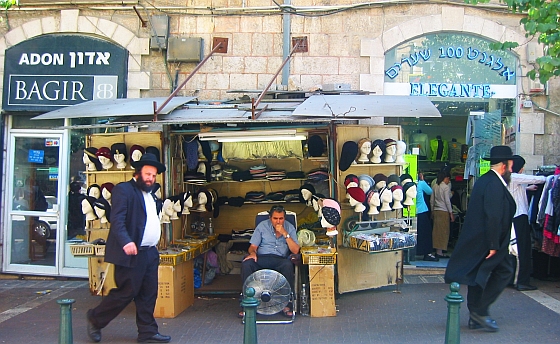
[edit]Today, Mea Shearim remains an insular neighbourhood in the heart of Jerusalem.[4] With its Haredi, and overwhelmingly Hasidic, population, the streets retain the characteristics of a pre-war Eastern European shtetl.[1] Life revolves around strict adherence to Jewish law, prayer, and the study of Jewish religious texts. Traditions in dress include black frock coats and black hats for men (although there are some other clothing styles, depending on the religious sub-group to which they belong), and long-sleeved, modest clothing for women. In some Hasidic groups, the women wear thick black stockings all year long, even in summer. Married women wear a variety of hair coverings, from wigs to scarves, snoods, hats, and berets. The men have beards, and many grow long sidecurls, called peyos. Many residents speak Yiddish in their daily lives, and use Hebrew only for prayer and religious study, as they believe Hebrew to be a sacred language, only to be used for religious purposes.[5]

Hasidic groups with a large number of followers in Mea Shearim include: Breslov, Slonim, Toldos Aharon, Toldos Avraham Yitzhak, Mishkenos HoRoim, and Satmar. The Pinsk-Karlin dynasty also has its center here. The Edah HaChareidis, which supervises kashrut certification and runs a Jewish religious court, has its headquarters at the western end of Mea Shearim. Mea Shearim is the stronghold of both factions of the Neturei Karta movement, which opposes Zionism, as well as the movement from whence they sprang – the descendants of the original Perushim community, also known as "Yerushalmis". Some Neturei Karta members have asked to live under Arab rule.[6] The late Rabbi Yosef Shalom Eliashiv, the leading posek of Litvish / Yeshivish Jewry, made his home here.
The oldest Sephardic Haredi dynasty, Levi Kahana of Spain, has a religious cultural center in the neighborhood.[citation needed]
Neighborhood regulations
[edit]

"Modesty" posters in Hebrew and English are hung at every entrance to Mea Shearim. When visiting the neighborhood, women and girls are urged to wear what is deemed to be modest dress (knee-length skirts or longer, no plunging necklines or midriff tops, no sleeveless or short-sleeved blouses or bare shoulders); men and boys are urged to avoid wearing shorts and sleeveless shirts; tourists are requested not to arrive in large, conspicuous groups; and in some of the older signs, even non-Jewish men are requested to wear kippas. During Shabbat (from Friday night at sundown to Saturday night at sundown), visitors are asked to refrain from smoking, photography, driving, or using mobile phones. When entering synagogues, men are asked to cover their heads.[7]
Incidents in the neighborhood
[edit]
Some residents have been criticized for attacking police, and other government officials entering the area, with stones, and blocking the streets, or setting fire to rubbish when they try to do so (otherwise known as Hafganahs).[8]
A small, violent group called "The Sikrikim", of less than 100 families, enforce censorship on bookshops, causing over 250,000 NIS damage to a shop that resisted their demands.[9]

On 24 June 2010, politicians Uri Maklev and Moshe Gafni of the Haredi party United Torah Judaism were attacked in Mea Shearim, after they had visited the Slonim rabbi and had entered his synagogue to pray. When they emerged, they were set upon by young men affiliated with Neturei Karta who spat at them and physically assaulted them.[10]
In April 2015, an IDF officer was attacked by men and women of Mea Shearim who allegedly threatened to kill him, while children blocked his exit. The incident received national attention. The attack was condemned by Prime Minister Benjamin Netanyahu as "outrageous", and by Shas leader Aryeh Deri as "an act of terror".[11]
See also
[edit]Further reading
[edit]- Yosef Yoel Rivlin, Mea Shearim, Jerusalem: The Department of Youth Affairs - The Religious Section of the Zionist Organization, 1947 (Hebrew).
- Gabriel Barkay and Eli Schiller (eds.), Mea Shearim and Its Surroundings, Ariel, 163-164, 2004, pp. 121–135 (Hebrew).
- Binyamin Kluger, My Mea Shearim, 2016 (Hebrew).
- Binyamin Kluger, Mea Shearim and Its Neighboring Quarters: The Neighborhoods That Built New Jerusalem, published by HaModia, 2016 (Hebrew).
- Binyamin Kluger, Mea Shearim – Its Establishment and Development, published by HaModia, 2022 (Hebrew).
References
[edit]- ^ a b Eisenberg, Ronald L. (2006). The Streets of Jerusalem: Who, what, why. Devora Publishing. p. 250. ISBN 1-932687-54-8.
- ^ Encyclopedia Judaica, vol. 3, p. 848, Meir Ben Isaac Auerbach
- ^ "About Meah Shearim". Illustrated Israel. Archived from the original on 2007-06-13.
- ^ a b c Eylon, Lili (2011). "Jerusalem: Architecture in the late Ottoman Period". Jewish Virtual Library. Archived from the original on 2011-07-17. Retrieved 28 August 2011.
- ^ ?למה החרדים במאה שערים מדברים אידיש Archived 2013-10-05 at the Wayback Machine (in Hebrew)
- ^ The Jerusalem Quarterly, Issues 17-20. Middle East Institute. 1981. p. 58.
On the other hand, the leaders of the sect have recently published a manifesto calling for "the laws of the autonomy in Arab territories to be applied in our neighbourhood (Me'a Shearim) too, without dependence on the Zionist regime".
- ^ Sapir-Witz, Karmit (17 December 2006). "A step away, another world". Ynetnews. Archived from the original on 2010-09-01. Retrieved 28 August 2011.
- ^ Shahar Ilan (May 11, 2010). "The Mea She'arim mob". Haaretz. Archived from the original on 2012-12-26. Retrieved 2012-11-19.
- ^ Melanie Lidman (November 30, 2011). "Mea She'arim shop accedes to vandalist demands". JPost. Archived from the original on 2012-09-28. Retrieved 2012-11-19.
- ^ "Haredi MKs attacked in Mea Shearim". The Jerusalem Post. 24 June 2010. Retrieved 1 November 2019.
- ^ IDF officer attacked in Jerusalem’s Mea Shearim Archived 2015-04-25 at the Wayback Machine The Times of Israel, 24 April 2015
Further reading
[edit]- Halper, Jeff (1991). Between Redemption and Revival: The Jewish Yishuv of Jerusalem in the Nineteenth Century. Westview Press. ISBN 0-8133-7855-9.
External links
[edit]
| International | |
|---|---|
| National | |
| Other | |

Mea Shearim
View on GrokipediaEtymology and Origins
Name and Biblical Significance
The name Mea Shearim (Hebrew: מֵאָה שְׁעָרִים, romanized: Meʾa Šeʿarim) translates literally as "hundredfold" or, in some interpretations, "a hundred gates," but its primary derivation stems from Genesis 26:12 in the Hebrew Bible, which recounts Isaac's agricultural prosperity: "And Isaac sowed in that land, and found in the same year a hundredfold; and the LORD blessed him" (וַיִּזְרַע יִצְחָק בָּאָרֶץ הַהִיא וַיִּמְצָא בַּשָּׁנָה הַהִיא מֵאָה שְׁעָרִים וַיְבָרְכֵהוּ יְהוָה).[6][4] In the verse, me'ah she'arim denotes the multiplicative yield of Isaac's harvest, symbolizing divine blessing and abundance amid adversity, as Isaac had faced famine and conflict in the Philistine region of Gerar.[7] This biblical reference held particular resonance for the neighborhood's founders, who selected the name during the week of the Torah reading (parashah) that included Genesis 26:12, invoking hopes of similar prosperity and communal flourishing for their nascent settlement in the arid outskirts of 19th-century Jerusalem.[8][9] The choice reflected a theological optimism rooted in scriptural precedent, equating the pioneers' efforts to till and build upon challenging land with Isaac's rewarded diligence, rather than any literal architectural feature like gates.[10] While secondary folk etymologies link she'arim to "gates" (as in city entrances), the canonical usage in Genesis emphasizes exponential growth, aligning with the community's aspirations for demographic and spiritual expansion.[7]Founding in 1874
Mea Shearim was established in 1874 as the fifth Jewish neighborhood outside the walls of Jerusalem's Old City, initiated by a building society known as the "Mea Shearim Company," comprising approximately 100 shareholders from the Perushim community.[1][2] These shareholders, many of modest means, pooled personal funds supplemented by charitable donations to purchase a tract of barren land northwest of the city, addressing the severe overcrowding, poor sanitation, and limited housing within the Old City's confines.[1][9] Yosef Rivlin, a prominent Jerusalemite and grandson of a disciple of the Vilna Gaon, served as a central leader in the endeavor, leveraging his experience from prior neighborhood projects like Nahalat Shiva.[1][2] The company's formation occurred in the Hebrew month of Kislev (corresponding to November–December 1874), with Rivlin reportedly coining the neighborhood's name from Genesis 26:12—"And Isaac sowed in that land, and found in the same year a hundredfold: for the Lord blessed him"—symbolizing hopes of prosperity and divine favor for the new settlement.[9][2] Initial development focused on basic infrastructure, including water cisterns and simple stone dwellings, funded through shareholder contributions and external philanthropy from European Jewish donors.[1] By late 1874, preliminary land preparation had begun, marking a pioneering effort by Old City residents to expand Jewish habitation amid Ottoman rule, though construction of the first homes extended into 1875.[2][9] This venture reflected broader late-19th-century trends among Jerusalem's Ashkenazi Jews to alleviate urban pressures while preserving religious communal life.[2]Historical Evolution
Early Settlement and Expansion (1874–1948)
Mea Shearim was founded in Kislev 1874 (corresponding to December) during the Ottoman era as the fifth Jewish neighborhood outside Jerusalem's Old City walls, initiated by the "Mea Shearim" building company to address overcrowding and exorbitant rents in the Old City.[1] The project was led by members of the Perushim community, disciples of the Vilna Gaon, with Yosef Rivlin as a key figure among the founders, who were primarily poor Ashkenazi Jews seeking affordable housing.[2] The name derives from Genesis 26:12—"Isaac sowed in that land, and in that year reaped me'ah shearim (a hundredfold)"—the Torah portion read during the week of establishment.[4] Land was purchased north of the city, and the neighborhood was designed as a walled courtyard compound with locked gates for security against potential Arab attacks, reflecting the era's vulnerabilities outside the fortified Old City.[11] Construction proceeded under the guidance of German architect Conrad Schick, who planned the layout with multi-family dwellings around central courtyards, emphasizing communal living for the religiously observant settlers.[12] Initial development was cautious due to the site's isolation and fears of raids, but by October 1880, approximately 100 dwellings were completed, each allocated with garden plots to support self-sufficiency amid economic hardship.[11] The early population consisted mainly of Eastern European Jewish immigrants adhering to strict Torah observance, establishing synagogues and basic institutions that fostered a distinct Haredi character from inception.[2] Through the late Ottoman period and into the British Mandate (1917–1948), Mea Shearim expanded incrementally as immigration waves brought more Orthodox families, transforming it from a peripheral outpost into Jerusalem's largest Jewish neighborhood outside the walls by the early 20th century.[2] The British era saw improved infrastructure, including roads and utilities, yet the community resisted secular influences, prioritizing religious study and isolation; it withstood events like the 1929 riots through self-defense organized by residents.[13] By 1948, the neighborhood had solidified as a bastion of Ashkenazi Haredi life, with dense housing and yeshivas accommodating a growing populace amid the turmoil of the Mandate's end and the ensuing war, during which it endured sieges but remained under Jewish control.[2]Post-Independence Challenges and Preservation (1948–Present)
Following Israel's declaration of independence on May 14, 1948, Mea Shearim faced immediate tensions as a bastion of Haredi Judaism within a nascent secular-majority state emphasizing military service and modernization. Prime Minister David Ben-Gurion, seeking political support from the Agudat Yisrael party, granted exemptions from compulsory military service to approximately 400 full-time yeshiva students in October 1948, allowing them to defer enlistment for Torah study—a provision rooted in preserving religious scholarship amid wartime needs but initially limited in scope.[14][15] This arrangement, while stabilizing coalition dynamics, sowed seeds for future disputes as the Haredi population in Mea Shearim and beyond expanded rapidly, with exemptions extending informally to growing numbers of students, reaching thousands by the 1950s and fueling perceptions of inequity in national defense burdens.[16] Clashes between Mea Shearim residents and state authorities intensified over subsequent decades, particularly around enforcement of conscription and perceived encroachments on religious norms. Police raids in the neighborhood to arrest draft evaders provoked violent protests, as seen in recurring demonstrations where residents hurled stones and blocked roads, viewing state intervention as an assault on spiritual autonomy; such incidents escalated in the 1970s and beyond, including opposition to archaeological digs near the neighborhood interpreted as desecrating Jewish sites.[17][18] Additional flashpoints included Sabbath violations, such as municipal parking lots operating on holy days, and cultural impositions like advertisements featuring women, leading to arsons and standoffs that highlighted irreconcilable visions of public space.[19] These conflicts underscored causal tensions: Haredi prioritization of ritual observance clashed with statist demands for uniformity, often resulting in negotiated "status quo" compromises that preserved exemptions but perpetuated dependency on state welfare amid low workforce participation rates hovering below 50% for Haredi men. Demographic pressures compounded these challenges, with Mea Shearim's population surging due to high fertility rates—averaging 6-7 children per Haredi family—leading to severe overcrowding in its aging 19th-century structures and entrenched poverty, as limited secular education curtailed economic integration.[20] By the late 20th century, the neighborhood's density exacerbated sanitation issues and housing shortages, prompting incremental state interventions like welfare expansions, yet residents resisted core curriculum mandates in schools to safeguard insularity.[21] Preservation of Mea Shearim's distinct character persisted through communal self-regulation and opposition to urban encroachment, maintaining its courtyard-based layout and Eastern European-style shtetl aesthetics amid Jerusalem's broader modernization. Community-enforced norms, including modesty codes and Sabbath observance via warning posters and patrols, insulated residents from external influences, while limited architectural interventions—such as the 2011 preservation registry by the Jerusalem Institute for Policy Research—protected historic facades without altering core fabric.[22] This resilience, driven by rejection of Zionism's secular ethos, ensured cultural continuity, though at the cost of isolation and periodic state friction.[4][1]Physical and Demographic Profile
Geography and Urban Layout
Mea Shearim occupies a position in the northern part of central West Jerusalem, roughly 1 kilometer north of the Old City walls, adjacent to neighborhoods such as Geula and Beit Yisrael.[1] Its current boundaries are demarcated to the west by Nathan Strauss Street, to the south by Bnei Brith Street and Rabbi Shmuel Slonim Street, and to the east by Shivtei Yisrael Street.[1] The area lies on relatively flat land within Jerusalem's otherwise hilly topography, which has facilitated dense construction since its inception.[23] The neighborhood's urban layout was planned in 1874 by German architect and missionary Conrad Schick, who envisioned a self-contained settlement with a perimeter wall formed by rows of attached houses to enclose the community.[6] [24] Internal organization centers on communal courtyards surrounded by housing blocks, originally designed to include open green spaces but subsequently repurposed for utilitarian functions like livestock sheds. This structure fosters narrow, winding streets and alleys optimized for pedestrian traffic, minimizing vehicular access and emphasizing communal insularity.[8] Architecture predominantly features two- to three-story buildings constructed from local Jerusalem limestone, reflecting late Ottoman-era styles with flat roofs and minimal ornamentation.[11] The dense configuration, with courtyards serving multiple families, has preserved the original footprint despite population pressures, resulting in one of Jerusalem's most compact urban enclaves.[25]Population Composition and Growth
Mea Shearim's population stood at approximately 12,300 residents as of 2023, with Haredi Jews comprising over 93% (11,500 individuals) of the total, reflecting the neighborhood's near-total homogeneity as an ultra-Orthodox enclave.[26] The remaining minority consists primarily of non-Haredi or marginally observant Jews, though such residents face social pressures to conform to communal norms. This demographic profile underscores the area's insularity, with minimal influx from outside groups due to high property costs, strict internal regulations, and cultural barriers.[26] The population is overwhelmingly Ashkenazi Haredi, divided among Hasidic dynasties and non-Hasidic (Litvish or yeshivish) subgroups, with no significant Sephardic presence compared to broader Jerusalem Haredi demographics (where Sephardim constitute about 20%).[26] Prominent Hasidic factions include Toldos Aharon, the neighborhood's largest group with roots in early 20th-century Hungarian Hasidism and known for its stringent isolationism; Toldos Avraham Yitzchak (a splinter from Toldos Aharon); Satmar; Breslov; and Slonim.[27] Non-Hasidic elements, such as Perushim yeshivas descended from pre-Zionist Old Yishuv traditions, also maintain a foothold, fostering a patchwork of sects that coexist amid occasional tensions over customs and authority.[1] Population growth in Mea Shearim mirrors broader Haredi trends, driven almost exclusively by natural increase rather than migration, with an annual rate of approximately 4% sustained by fertility levels averaging 6.6 children per woman among ultra-Orthodox women as of 2020.[28][29] This high fecundity, rooted in religious imperatives prioritizing large families and Torah study over secular pursuits, has transformed the neighborhood from a modest 818 residents in 1916 to its current size, exacerbating spatial constraints within fixed 19th-century boundaries.[2] Projections for Israel's Haredi sector, applicable here given local parallels, anticipate doubling every 18-20 years absent policy shifts.[30] ![Toldos Aharon children preparing for Shabbat in Mea Shearim, highlighting the neighborhood's youth-heavy demographic driven by high birth rates]float-rightCore Institutions and Practices
Religious Education and Yeshivas
Religious education forms the cornerstone of life in Mea Shearim, where Haredi institutions prioritize intensive Torah study as the primary vocation for males, embodying the principle of Torato ummanuto—Torah study as one's profession. Boys typically begin in cheders (elementary religious schools) around age three, progressing through structured stages: initial memorization of prayers, Chumash (Pentateuch), and basic Hebrew, followed by immersion in Gemara (Talmud) and rabbinic commentaries by ages 10–12.[31] This curriculum centers on textual analysis of core Jewish texts, including Halakha (Jewish law), ethical teachings from mussar literature, and prophetic writings, with daily schedules often exceeding 10 hours of study to foster scholarly rigor and piety.[31] Secular subjects, such as mathematics, science, or English, are frequently minimized or omitted in boys' institutions, reflecting a deliberate communal choice to insulate against modern influences deemed antithetical to strict observance; Israeli law mandates core curriculum, yet enforcement remains lax, with most Haredi boys' elementary schools non-compliant and facing rare sanctions.[32] Adolescent and adult males advance to yeshivot ketanot (post-elementary academies) and then full yeshivot gedolot or kollels (institutes for married scholars), where paired or group study (chavrusa) dominates, emphasizing dialectical debate over vocational training. In Mea Shearim's insular environment, these yeshivas—often affiliated with Litvish, Hasidic, or Sephardic subgroups—reinforce communal cohesion by producing rabbis, teachers, and ritual slaughterers, though this focus correlates with high poverty rates due to deferred workforce entry.[33] Enrollment in such full-time Torah study has surged nationally among Haredim, from 97,000 yeshiva and kollel students in 2014 to over 145,000 by 2022, a trend amplified in dense enclaves like Mea Shearim where nearly the entire male population adheres to this path.[34] Critics from secular perspectives argue this system hampers economic integration, but Haredi advocates maintain it preserves authentic Judaism against assimilation, prioritizing spiritual over material outcomes.[32] For girls, education occurs in Bais Yaakov-style seminaries emphasizing practical piety, homemaking skills, and select vocational training like teaching or childcare, with limited secular content to align with gender roles of family support.[33] These institutions, while less insular than boys' yeshivas, still subordinate general studies to religious instruction, preparing women for roles that sustain male scholars; national data show Haredi girls outperforming boys in basic literacy but facing similar curricular gaps in advanced sciences.[32] Funding derives mainly from private donations and state allocations, which, despite controversies over accountability, underscore the system's resilience in fostering a Torah-centric society amid broader Israeli debates on integration.[34]Synagogues and Community Centers
Mea Shearim hosts numerous small synagogues and study halls, often termed shtieblach, which are tightly linked to the Hasidic sects and ultra-Orthodox subgroups dominating the neighborhood's population. Each faction maintains its own dedicated prayer and study spaces, reflecting the community's sectarian divisions and emphasis on preserved Eastern European Jewish traditions. These venues facilitate thrice-daily prayers, Torah study sessions, and tish gatherings led by rebbes, accommodating the dense residential layout where multiple families share courtyards.[1][2] Key Hasidic groups with prominent synagogues include Toldos Aharon, whose headquarters and beit midrash are situated near the intersection of Shivtei Yisrael and Mea Shearim Streets, serving thousands of adherents known for their gold-embroidered bekishes and anti-Zionist stance.[35] Toldos Avraham Yitzchak, a splinter from Toldos Aharon founded in 1928, operates parallel facilities emphasizing similar litvish-Hasidic customs. Satmar Hasidim, aligned with the Hungarian dynasty's Jerusalem branch, conduct services in dedicated halls, maintaining separation from Zionist influences as per their rebbe's directives. Other sects like Slonim, Breslov, Gur, Belz, Viznitz, Munkatch, Karlin, and Boyan also claim synagogue spaces, with Breslov's often featuring ecstatic prayer styles distinct from the more structured services of Lithuanian-influenced groups.[36][2] These synagogues double as de facto community centers, hosting welfare distributions, holiday preparations, and dispute resolutions under rabbinic oversight, given the scarcity of secular institutions in this insular enclave. The Eda HaChareidis, representing many anti-Zionist factions since its 1918 founding, coordinates broader communal standards but leaves operational control to sect-specific bodies, ensuring conformity to non-recognition of the State of Israel in religious matters. Formal community centers are minimal, as social cohesion relies on familial and synagogue networks rather than centralized facilities, with activities like charitable aid channeled through gemachs (free loan societies) embedded in these religious sites.[36][2]Daily Life and Norms
Haredi Dress and Modesty Standards
In Mea Shearim, Haredi dress standards embody the principle of tzniut (modesty), interpreted stringently from Talmudic sources to cover the body and avoid ostentation, reflecting religious devotion and separation from secular influences.[37] Men's attire typically includes black suits or frock coats (bekishes), white shirts without ties, black hats or fur shtreimels on holidays, uncut sidelocks (payot), and beards, drawing from 18th-19th century Eastern European Jewish customs adapted as uniform markers of piety.[38] [39] Women adhere to long skirts extending below the knees, blouses with high necklines covering the collarbone and sleeves past the elbows, opaque stockings, and no trousers, with married women covering all hair using kerchiefs rather than wigs in sects like Toldos Aharon to ensure complete modesty.[37] [40] These standards vary slightly by subgroup, with Toldos Aharon and Satmar Hasidim—prominent in Mea Shearim—enforcing the most austere forms, including dark, simple fabrics for women to minimize attention and black stockings year-round.[40] Community signs and occasional patrols reinforce compliance, warning visitors against immodest clothing like shorts or bare arms to preserve the neighborhood's religious ambiance, though such measures have sparked external criticism for restricting access.[41] [37] The uniformity fosters group identity amid Jerusalem's diverse population, with deviations rare and often met with social pressure rather than formal penalties.[42]Family Structure and Gender Roles
In Mea Shearim, families adhere to traditional Haredi norms emphasizing pronatalism, with households commonly comprising six or more children as a fulfillment of religious commandments to "be fruitful and multiply." The total fertility rate among ultra-Orthodox Jewish women in Israel, including those in Jerusalem's Haredi enclaves like Mea Shearim, averages 6.4 children per woman, significantly exceeding the national Jewish average of 3.0.[28] [43] This structure stems from doctrinal interpretations prioritizing large families to sustain community growth and Torah scholarship across generations. Marriages are typically arranged through parental or matchmaker involvement, with the average age at first marriage for Haredi women around 22 and for men 23 as of 2021, though customs in stricter sects like those prevalent in Mea Shearim often encourage unions shortly after religious maturity at 18.[44] [45] Gender roles exhibit a pronounced division of labor rooted in halakhic (Jewish legal) distinctions between male spiritual authority and female domestic stewardship. Men in Mea Shearim prioritize full-time Torah study in yeshivas, viewing it as the family's core vocation and a pathway to divine favor, which often delays or limits their secular employment.[46] Women, conversely, shoulder primary responsibility for child-rearing, homemaking, and maintaining ritual purity, while increasingly entering the workforce— with Haredi female labor participation reaching 80% by 2020—to subsidize household needs amid men's scholarly pursuits.[47] [48] This economic reversal, where women serve as principal breadwinners, coexists with reinforced gender segregation in public spaces, education, and social interactions, as observed in Mea Shearim's daily routines of separate sidewalks, schools, and communal events.[49] [50] Such roles are internalized as divinely ordained and optimal for familial harmony within the community, with Haredi women in studies expressing preference for perpetuating these patterns for their daughters due to beliefs in their spiritual and practical efficacy.[51] External critiques, including from Israeli media and courts, highlight tensions over women's public visibility and economic undervaluation—Haredi women often earn 30-40% less than peers in similar roles—but community leaders maintain that these arrangements preserve modesty and Torah-centric life against secular influences.[52][53]Sabbath and Holiday Observances
![Toldos Aharon children preparing for Shabbat in Mea Shearim]float-right Residents of Mea Shearim observe the Sabbath (Shabbat) with rigorous adherence to halakhic prohibitions against the 39 categories of creative labor (melachot), commencing at sundown on Friday and concluding at nightfall on Saturday.[54] Commercial activities cease well before sunset, transforming the bustling streets into a realm of quietude dedicated to prayer, Torah study, and familial repose.[55] Preparations on Friday afternoon include baking challah, cooking elaborate meals, and children assisting in household readiness, as seen among sects like Toldos Aharon. Shabbat observance features three festive meals—beginning with candle lighting and Kiddush on Friday evening, followed by midday and late afternoon seudot—accompanied by zemirot (Sabbath songs) and discussions of religious texts. Men attend synagogue services multiple times daily, while women manage home-based rituals; the community maintains an atmosphere insulated from external disturbances, enforcing norms against public violations such as driving or electronic use.[54] This strictness extends to reliance on pre-set timers for lights and avoidance of non-essential interactions, reflecting the neighborhood's commitment to preserving traditional Ashkenazi practices amid urban proximity.[56] Jewish holidays in Mea Shearim amplify halakhic requirements with communal fervor, often centered in synagogues and homes. During Sukkot, families erect sukkot (booths) on rooftops or balconies for required meals, symbolizing the Israelites' desert wanderings, with ultra-Orthodox residents visibly integrating the lulav and etrog in processions.[57] Purim involves costumed celebrations recalling the Purim story, including megillah readings, mishloach manot (food gifts), and modest public festivities in the streets, though eschewing secular excesses.[58] Simchat Torah features all-night dancing with Torah scrolls, culminating in hakafot circuits, underscoring the neighborhood's insular yet vibrant ritual life.[59] These observances prioritize scriptural fidelity over national holidays, with groups like Toldos Aharon maintaining distinctive customs such as heightened gender separation during festivities.Governance and Self-Regulation
Internal Community Authority
The internal authority in Mea Shearim operates through a decentralized structure dominated by the rabbinical courts and leaders of its predominant Haredi sects, supplemented by communal bodies that enforce halakhic (Jewish legal) norms. The Edah HaChareidis, an anti-Zionist umbrella organization founded in 1921, holds significant sway over much of the neighborhood, providing centralized services such as its Badatz kashrut certification, which supervises food production and imports to ensure strict observance, and a beit din (religious court) for resolving civil disputes, divorces, and conversions among affiliated members.[60] This court derives its legitimacy from voluntary adherence by community members, who prioritize rabbinic guidance over state institutions.[61] Sect-specific rebbes exercise direct authority over their followers, issuing directives on daily conduct, marriage arrangements, and excommunications for deviations from group customs. For instance, the Toldos Aharon Hasidic dynasty, one of the largest groups in Mea Shearim with thousands of adherents, is led by Rebbe Dovid Kohn, who succeeded in 1996 following a lineage tracing to founder Rabbi Aharon Roth in 1921; his rulings govern education, dress codes, and social interactions within the sect, often emphasizing isolation from external influences.[27] Similarly, groups like Toldos Avrohom Yitzchok and Satmar maintain parallel hierarchies, where loyalty to the rebbe supersedes formal state law in personal and familial matters. These leaders convene through the Edah's framework for broader decisions, such as neighborhood preservation via the Council to Guard Mea Shearim, which monitors zoning and visitor conduct to maintain religious purity.[61] Enforcement relies on informal networks of community volunteers and shomrim (watchmen) rather than elected officials, with rabbis issuing pashkevilim (public posters) to decree bans or warnings, as seen in directives against secular media or inter-sect marriages. Disputes are adjudicated internally to avoid civil courts, preserving autonomy; for example, the Edah's marriage registry handles getin (divorce documents) exclusively for its constituency, rejecting state-recognized ones if they conflict with halakha. This system fosters high compliance due to social pressures and fear of ostracism, though it can lead to tensions when individual rabbis' fatwas diverge, as in rare schisms within dynasties.[60][27]Enforcement of Regulations
Enforcement of regulations in Mea Shearim primarily occurs through informal community mechanisms rather than formal legal structures, involving volunteer patrols and social pressures exerted by ultra-Orthodox groups such as Neturei Karta. These patrols, often referred to as "modesty guards," monitor public spaces to ensure adherence to strict codes of dress, gender separation, and Sabbath observance, targeting perceived violations like immodest attire among women or outsiders.[37][62] Vigilante actions have included harassment, spitting, and physical assaults on non-compliant individuals, with reports of such incidents dating back decades but persisting into the 2000s. For instance, in 2008, ultra-Orthodox patrols in Jerusalem neighborhoods including Mea Shearim were linked to a series of violent attacks aimed at enforcing community norms, prompting police investigations that highlighted failures in curbing these groups.[63][64] Earlier efforts by Neturei Karta, founded in the 1930s, established modesty patrols under Rabbi Amram Blau to maintain street modesty, evolving into broader self-policing against secular influences.[37] Community leaders and rabbinical courts also play a role by issuing edicts and imposing social sanctions, such as ostracism or excommunication, on violators within the neighborhood. Attempts to formalize segregation, like proposing women-only streets in 2010, were overruled by courts as illegal, underscoring tensions between internal enforcement and state authority.[65] Signs posted throughout Mea Shearim warn visitors of required modest dress—long skirts, covered elbows and collarbones for women—to preempt violations and signal the community's expectation of compliance.[62] These practices reflect a reliance on collective vigilance to preserve religious purity, though they have drawn criticism for infringing on personal freedoms and occasionally escalating to property damage, such as the 2008 torching of a store selling MP4 players over fears of pornography access.[64] Despite occasional police interventions, enforcement remains largely self-regulated, with limited external oversight in the densely Haredi enclave.[63]Socioeconomic Realities
Employment Patterns and Poverty Rates
In Mea Shearim, a predominantly Lithuanian Haredi neighborhood, male employment patterns are characterized by limited participation in the secular workforce, with many men aged 18-64 prioritizing full-time study in yeshivas over paid labor, often supported by modest stipends, charitable contributions, and government child allowances.[66][67] This cultural norm, rooted in the ideal of lifelong Torah scholarship, results in part-time or irregular employment for a significant portion of working men, such as in religious occupations or small-scale trades, with overall Haredi male employment rates hovering around 54% as of the second quarter of 2024.[68] In contrast, Haredi women in the community exhibit higher labor force involvement, typically at rates of 74-80%, often in low-wage sectors like elementary education, childcare, or garment production to sustain large households averaging seven children per family.[69][70] These patterns contribute to elevated poverty rates, with Haredi households facing multidimensional deprivation due to low incomes, high fertility, and restricted access to higher education or vocational training aligned with secular job markets. National data for the Haredi sector, reflective of strict communities like Mea Shearim, indicate poverty rates of approximately 39-44% in recent years, triple the rate among non-Haredi Jews, exacerbated by men's average monthly earnings being about half those of non-Haredi Jewish men.[71][72] Jerusalem's Haredi neighborhoods, including Mea Shearim, show even higher concentrations of poverty, with over 90% Haredi residency correlating with dependency on communal welfare networks rather than broad economic integration.[26]| Demographic Group | Employment Rate (Recent) | Key Factors |
|---|---|---|
| Haredi Men | 54% (Q2 2024) | Yeshiva study, part-time religious roles[68] |
| Haredi Women | 80% (Q2 2024) | Family support roles, lower wages[69] |
| Overall Haredi Poverty Rate | 39-44% (2022-2019) | Large families, low male participation[71][72] |
Welfare Dependency and Charitable Networks
Residents of Mea Shearim, as part of Jerusalem's Haredi population, exhibit high rates of socioeconomic disadvantage, with approximately 40% of Haredi households living below the poverty line in 2022, compared to 11% among non-Haredi Jewish households.[73] This stems from structural factors including large average family sizes of over five members and low male employment rates of 54% among Haredi men aged 25-66, as many prioritize full-time Torah study in yeshivas over secular workforce participation.[74] [73] Consequently, average Haredi household incomes reached NIS 15,324 per month in 2024, constituting 58% of non-Haredi Jewish household incomes, with government transfers and subsidies accounting for 24% of Haredi income (NIS 3,640 monthly), over twice the proportion for non-Haredi Jews.[73] [75] Welfare dependency in the community is sustained by state programs such as child allowances, housing subsidies, and yeshiva student stipends, which collectively comprised 26% of Haredi household income in recent assessments.[75] While female employment rates at 80% provide a partial buffer through roles in education and small-scale commerce, the overall reliance on public funds highlights a causal link between cultural norms favoring religious scholarship and economic self-sufficiency challenges.[74] Reports indicate a gradual decline in poverty from 37% in 2015 to 34% by 2022, attributed to rising female labor participation, though dependency remains elevated relative to the broader population.[74] Complementing state support, Mea Shearim's Haredi residents maintain robust internal charitable networks rooted in the halakhic obligation of tzedakah (charity). Households donate an average of NIS 537 monthly—five times the non-Haredi Jewish average—funding community welfare through collection boxes, synagogue appeals, and organized funds for food, medical aid, and housing assistance.[73] Gemachs (gemilut chasadim funds), prevalent in the neighborhood, operate as interest-free loan societies for essentials like wedding attire, books, and appliances, with larger ones extending to real estate purchases via pooled community donations.[76] These volunteer-run systems foster mutual aid but primarily address immediate needs rather than structural poverty, as evidenced by their role in sustaining large families amid high child poverty rates of 47-48%.[73] Such networks reinforce communal cohesion while underscoring the limits of private charity in offsetting systemic economic pressures.Interactions and Tensions
Relations with Secular Society and State
Residents of Mea Shearim maintain a deliberate separation from secular Israeli society, enforcing community norms through prominent signage that requests visitors to adhere to standards of modesty, refrain from photography, and avoid public displays of affection or non-kosher items. These measures reflect a broader Haredi commitment to preserving religious purity amid perceived secular encroachments, with police maintaining a low profile in the neighborhood to minimize confrontations. Tensions occasionally erupt into violence, as seen in September 2019 when a crowd of ultra-Orthodox Jews attacked an IDF soldier walking through the area, hurling objects and requiring police intervention to extract him. Such incidents underscore the community's resistance to symbols of the secular state, including military personnel, viewed as incompatible with their insulated lifestyle.[77][78] In Mea Shearim, interactions with the Israeli state are marked by ideological rejection of government funding for institutions like yeshivas, influenced by anti-Zionist groups such as Edah HaChareidis and Neturei Karta, which rely on private donations; individuals, however, often access welfare support including child allowances, alongside friction over integration mandates. Since Israel's establishment in 1948, full-time yeshiva students in Mea Shearim and similar communities have received exemptions from mandatory military service, justified as deferment for Torah study, a policy enabling the growth of Haredi populations but fueling resentment among secular citizens bearing the conscription burden. This arrangement persisted through political coalitions until the Supreme Court's June 25, 2024, ruling declared the blanket exemptions discriminatory and voided the underlying law, prompting immediate enforcement of draft notices. In response, thousands gathered in Mea Shearim streets in July 2024 for protests against conscription, with some residents vowing non-compliance and labeling state efforts as coercive threats to religious autonomy.[79][80] Broader state-community relations involve disputes over public policy alignment, such as resistance to secular education curricula in Haredi schools and opposition to public transportation on the Sabbath, which have led to sporadic clashes and legal battles. While individuals benefit from certain state welfare programs, Mea Shearim institutions, under the influence of the Edah HaChareidis, largely forgo state subsidies for education and social services to avoid state legitimacy, relying instead on private donations unlike broader Haredi society; this approach is critiqued by secular observers as enabling isolation and economic dependency, straining national resources amid Israel's security challenges. Empirical data from government reports indicate that Haredi exemption rates hover near 100% for men in full-time study, contributing to a widening societal divide where secular Israelis, comprising over 75% of the Jewish population, increasingly question the sustainability of such arrangements.[81][82]Anti-Zionist Elements and Ideological Stances
Mea Shearim serves as a primary enclave for anti-Zionist Haredi factions in Jerusalem, particularly those under the Eda HaChareidis umbrella organization, which coordinates opposition to the State of Israel among several insular communities.[36] This group, comprising sects like Neturei Karta—established in 1938—and Hasidic dynasties such as Toldos Aharon, maintains that the establishment of Jewish political sovereignty before the arrival of the Messiah constitutes a theological violation, interpreting Zionism as an idolatrous substitution of human agency for divine will.[83][84] Members adhere to this stance by abstaining from electoral participation, refusing government funding, military service, and recognition of state symbols, such as the Israeli flag or national anthem, which they view as emblematic of secular heresy.[85][86] The ideological foundation draws from traditional rabbinic interpretations, including oaths in the Talmud prohibiting collective Jewish return to the Land of Israel or rebellion against gentile nations until messianic redemption, positions articulated by pre-Zionist Haredi leaders like the Chofetz Chaim and Rabbi Avrohom Yeshaya Karelitz (Chazon Ish).[87] In practice, this manifests in annual protests during Israel's Independence Day (Yom Ha'atzmaut), where residents of Mea Shearim mourn the state's founding as a calamity, often burning flags or effigies to symbolize rejection of Zionist legitimacy.[88] Toldos Aharon, with thousands of adherents concentrated in the neighborhood's core, enforces these views through communal edicts, including bans on children reciting state-mandated pledges or displaying Zionist insignia, reinforcing isolation from broader Israeli society.[86] While not all Haredim in Mea Shearim share this absolutist rejection—some factions adopt pragmatic non-Zionism, accepting state welfare without ideological endorsement—the anti-Zionist core influences neighborhood signage declaring "non-Zionist" status and occasional alliances with external critics of Israel, though such engagements remain marginal and controversial even within Haredi circles.[36] This stance persists amid demographic growth, with Eda HaChareidis-affiliated populations expanding to around 40,000 in central Jerusalem areas by the early 2020s, sustaining ideological purity through yeshiva education that prioritizes Torah study over civic integration.[36]Controversies and Conflicts
Major Incidents and Clashes
In 2009, protests in Mea Shearim escalated into riots over the opening of a municipal parking lot on the Sabbath, which residents viewed as a desecration; demonstrators blocked roads, set fires, and clashed with police, leading to dozens of arrests and injuries on both sides.[89] Similar unrest occurred in 2006 when word spread of a court-approved police action, prompting haredi crowds to hurl stones at officers and damage property in the neighborhood.[90] Clashes intensified around military conscription issues, including on May 20, 2013, when residents assaulted haredi soldiers in uniform, shouting abuse and pelting them with objects amid broader protests against enlistment plans.[91] In April 2017, further arrests followed attacks on ultra-Orthodox IDF soldiers, with locals verbally harassing and physically confronting them for serving. These incidents reflect ongoing tensions over perceived betrayal of communal norms against Zionism and military service. More recently, on August 8, 2017, ultra-Orthodox rioters in Mea Shearim attacked police during a raid on an anti-Zionist office, throwing rocks that struck an eight-year-old girl in the head; three arrests were made, and Defense Minister Avigdor Liberman condemned the violence.[92][93] On July 1, 2024, thousands protesting a Supreme Court ruling to end draft exemptions marched from Mea Shearim toward central Jerusalem, where the demonstration turned violent with rocks thrown at police and officers attacked, resulting in multiple injuries and arrests.[94][95] Violence has also targeted outsiders perceived as violating local dress codes or missionary activities, though specific large-scale clashes remain sporadic; for instance, reports from the 1980s noted an uptick in ultra-Orthodox assaults on non-conformists in Jerusalem holy sites, including Mea Shearim.[96] Internal turf disputes over housing have occasionally led to brawls among factions claiming greater piety.[97] These events underscore causal links between rigid self-regulation and friction with external authorities, often amplified by the neighborhood's insularity.Resistance to Military Conscription
In the ultra-Orthodox community of Mea Shearim, resistance to mandatory military conscription in the Israel Defense Forces (IDF) stems primarily from the prioritization of full-time Torah study and religious observance, which residents view as a divine imperative superseding secular national duties. This stance is particularly pronounced among anti-Zionist sects like Neturei Karta and certain Hasidic groups such as Toldos Aharon, who reject the legitimacy of the State of Israel itself and thus any participation in its institutions, including the military.[84][98] Historically, a 1948 arrangement exempted around 400 yeshiva students from service to preserve religious scholarship, but this evolved into a de facto blanket exemption for tens of thousands of Haredi men annually, amid low enlistment rates—fewer than 1,200 Haredi men served voluntarily as of 2024 out of roughly 13,000 draft-eligible annually.[80][99] Israel's Supreme Court ruling on June 25, 2024, declared the exemption policy unlawful, mandating the enlistment of ultra-Orthodox men and triggering vows of mass defiance from Mea Shearim residents, who framed compliance as a betrayal of faith.[100] Protests intensified in the neighborhood, with thousands gathering in Jerusalem on June 30, 2024, to decry the decision, blowing shofars and displaying signs proclaiming opposition to forced service.[101] By October 2025, following a reported "wave of arrests" of draft evaders attempting to flee the country or evade summonses, demonstrators in Mea Shearim blocked neighborhood entrances and major roads like Bar-Ilan Street, leading to clashes with police that injured at least two officers on October 19, 2025.[102][103][104] Such resistance often manifests in organized evasion tactics, including hiding summons notices or seeking rabbinical guidance to prioritize study over enlistment, with community leaders equating draft enforcement to a "war on Torah students."[105] The IDF prepared approximately 250-300 jail spots for Haredi draft dodgers by July 2025, signaling anticipation of widespread non-compliance, though Mea Shearim's insular dynamics—enforced by internal regulations—amplify local defiance compared to less cohesive Haredi areas.[106] Critics within broader Israeli society argue this burdens non-Haredi citizens amid ongoing security needs, yet residents maintain that spiritual contributions through prayer and scholarship provide equivalent value to physical service.[107]Public Health Disputes (e.g., COVID-19)
During the COVID-19 pandemic, Mea Shearim residents, reflecting broader ultra-Orthodox patterns, frequently resisted Israeli government restrictions on gatherings, prioritizing religious observances such as daily prayers, weddings, and funerals over health mandates, which led to superspreader events and infection rates up to eight times higher than in the general population.[108] This non-compliance stemmed from rabbinical guidance emphasizing communal worship as a divine imperative, often viewing state interventions as encroachments on religious autonomy, though some Haredi leaders eventually endorsed partial measures.[109][110] Police enforcement in Mea Shearim escalated amid repeated violations; on March 22, 2020, officers dispersed large assemblies in the neighborhood, encountering hostility that underscored tensions between secular authorities and insular sects like Satmar Hasidim.[109] By January 28, 2021, violent resistance peaked when Mea Shearim worshippers pelted police with rocks during an attempt to shut down overcrowded synagogues, damaging vehicles and injuring officers, as part of broader clashes involving slurs and property destruction.[111][112] Similar defiance included unauthorized funerals drawing hundreds, prompting intensified patrols and arrests.[113] Vaccination hesitancy compounded disputes, with anonymous red posters plastered across Mea Shearim in early 2021 calling for boycotts, framing shots as threats to religious purity or efficacy doubts rooted in prior infection waves; this contributed to the ultra-Orthodox sector recording Israel's highest morbidity but lowest initial uptake, around 20-55% in Hasidic subgroups versus national averages exceeding 70%.[112][114][115] Refusals extended to children, with reports by mid-2024 of unvaccinated infants suffering severe complications or deaths amid ongoing community skepticism, despite eventual upticks in adult immunization reducing localized rates below national means by March 2021.[116][117] These frictions highlighted systemic challenges in aligning public health enforcement with Haredi insularity, exacerbating national surges while exposing gaps in trust toward state institutions.[118]Assessments and Impacts
Strengths: Cohesion, Low Crime, and Cultural Preservation
![Toldos Aharon kids prepare for Shabbat, Mea Shearim, Jerusalem][float-right] Mea Shearim's Haredi residents demonstrate high social cohesion rooted in shared religious commitments and communal structures. Daily life revolves around collective observance of halakha, including Shabbat preparations and synagogue attendance, which reinforce interpersonal bonds and collective identity. Family units remain extended and central, with high birth rates—averaging 6-7 children per woman in ultra-Orthodox communities—sustaining demographic vitality and intergenerational continuity.[120] Mutual aid societies provide welfare without heavy reliance on state systems, fostering self-reliance and trust within the community.[53] Crime rates in Mea Shearim and similar Haredi enclaves remain notably low, particularly for violent offenses. Israel Police officials have stated that Haredi areas experience fewer murders and hard-drug related issues compared to secular or Arab sectors, attributing this to stringent communal norms against deviance. A 2013 analysis indicated Haredi youth crime at approximately 4% of secular rates, reflecting effective internal social controls. While isolated incidents of intra-communal unrest occur, overall property and street crimes are minimal, contrasting with Jerusalem's broader urban challenges.[121][122] The neighborhood excels in cultural preservation by maintaining 19th-century Eastern European Jewish customs amid surrounding modernization. Yiddish persists as a primary vernacular, used in homes, yeshivas, and markets, safeguarding linguistic heritage from assimilation. Traditional attire—such as black hats, sidelocks for men, and modest dress for women—signals unwavering adherence to ancestral practices established since the area's founding in 1874. Resistance to secular influences, including limited exposure to mass media and technology, ensures rituals like outdoor Hanukkah lamp lighting and street markets endure intact.[123][8][124]Criticisms: Isolation, Educational Gaps, and Economic Burdens
The insular nature of Mea Shearim's ultra-Orthodox residents has drawn criticism for fostering social isolation and periodic clashes with outsiders, as the neighborhood enforces strict communal norms that deter integration with broader Israeli society. Signs and verbal confrontations often target visitors deemed immodestly dressed, contributing to a perception of hostility toward secular influences and limiting everyday interactions.[125][126] This separation is seen as self-imposed, with the community prioritizing preservation of traditional practices over civic engagement, which critics argue exacerbates mutual distrust and hinders national cohesion.[50] Educational practices in Mea Shearim and similar Haredi enclaves emphasize Torah study at the expense of secular subjects, resulting in significant gaps in core competencies. In ultra-Orthodox boys' schools, which dominate the neighborhood's institutions, mathematics, English, and sciences are often minimally taught or omitted, with only a fraction of such schools facing sanctions for non-compliance with state curriculum requirements.[32] Among Haredi men aged 25-44, just 7.5% hold academic degrees, reflecting declining higher education rates and a post-eighth-grade shift toward full-time yeshiva study.[127] These deficiencies contribute to low science literacy at the community level and high dropout rates—around 58%—in academic programs for those who attempt them.[128][129] Economically, the neighborhood's large families—averaging over six children per household—and low male labor participation impose burdens on public resources, with Haredi poverty rates reaching approximately 40-56% compared to much lower figures in the general population.[130][131] Male employment has stagnated, with only 3.5% in high-tech sectors versus 20% of non-Haredi men, while reliance on state subsidies and charity sustains a lifestyle centered on religious scholarship rather than workforce contribution.[132] Critics, including economic analysts, contend this dependency strains Israel's budget, as non-Haredi taxpayers shoulder disproportionate fiscal loads amid Haredi households' below-poverty-line status affecting over half of families.[133][134] Such patterns, prevalent in Mea Shearim, are projected to intensify with the community's rapid growth, potentially overwhelming welfare systems without reforms.[135]References
- https://wikitravel.org/wiki/en/index.php?title=Jerusalem/Chareidi
- ./assets/Toldos_Aharon_kids_prepare_for_Shabbat%252C_Mea_Shearim%252C_Jerusalem.jpg