


Community hub
Recent from talks
Contribute something
Nothing was collected or created yet.
Micro Four Thirds system
View on Wikipedia
The Micro Four Thirds system (MFT or M4/3 or M43) (マイクロフォーサーズシステム, Maikuro Fō Sāzu Shisutemu) is a standard released by Olympus Imaging Corporation and Panasonic in 2008,[1] for the design and development of mirrorless interchangeable lens digital cameras, camcorders and lenses.[2] Camera bodies are available from Blackmagic, DJI, JVC, Kodak, Olympus, OM System, Panasonic, Sharp, Logitech Mevo and Xiaomi. MFT lenses are produced by Cosina Voigtländer, Kowa, Kodak, Mitakon, Olympus, Panasonic, Samyang, Sharp, Sigma, SLR Magic, Tamron, Tokina, TTArtisan, Veydra, Xiaomi, Laowa, Yongnuo, Zonlai, Lensbaby, Venus Optics and 7artisans amongst others.
The specifications of the MFT system inherit the original sensor format of the Four Thirds system, designed for DSLRs. However, unlike Four Thirds, the MFT system design specification does not require lens telecentricity, a parameter which accommodated for the inaccurate sensitivity to off-angle light due to the geometry of the photodetectors of contemporary image sensors. Later improvements in manufacturing capabilities enabled the production of sensors with a lower stack height, improving sensitivity to off-angle light, eliminating the necessity of telecentricity and decreasing the distance from the image sensor at which a lens's rear element could be positioned without compromising light detection.[3] Such a lens, however, would eliminate the room necessary to accommodate the mirror box of the single-lens reflex camera design, and would be incompatible with SLR Four Thirds bodies.
Micro Four Thirds reduced the specified flange focal distance from 38.67mm to 19.25mm. This reduction facilitates smaller body and lens designs, and enables the use of adapters to fit almost any lens ever made for a camera with a flange distance larger than 19.25mm to a MFT camera body. Still-camera lenses produced by Canon, Leica, Minolta, Nikon, Pentax and Zeiss have all been successfully adapted for MFT use, as well as lenses produced for cinema, e.g., PL mount or C mount.
Comparison with other systems
[edit]
For comparison of the original Four Thirds with competing DSLR system see Four Thirds system#Advantages, disadvantages and other considerations
Compared to inexpensive digital compact cameras and many bridge cameras, MFT cameras have better, larger sensors, and interchangeable lenses. There are many lenses available. On top of this, a large number of other lenses (even from the analogue film era) can be fitted using an adapter. Different lenses yield greater creative possibilities. However, Micro Four Thirds cameras also tend to be slightly larger, heavier and more expensive than compact cameras.
Compared to most digital SLRs, the Micro Four Thirds system (body and lenses) is smaller and lighter. However, their sensors are smaller than full-frame or even APS-C systems. The small lenses do not allow the noise depth-of-field tradeoffs of larger lenses in other systems. Many, but not all Micro Four Thirds cameras use an electronic viewfinder. Resolutions and refresh speeds on these EVF displays were originally compared negatively to optical viewfinders, but today's EVF systems are faster, brighter and much higher resolution than the original displays. Original Micro Four Thirds cameras used a contrast-detection autofocus system, slower than the phase-detect autofocus that is standard on DSLRs. To this day, most Micro Four Thirds cameras continue to use a contrast-based focusing system. Although some current models, such as the Olympus OM-D E-M1 Mark II, feature a hybrid phase-detect/contrast detect system, Panasonic Lumix cameras continued to use a contrast-based system called DFD (Depth from Defocus) until the release of the G9 II in 2023. Both systems today provide focusing speeds to rival or even surpass many current DSLRs.
Sensor size and aspect ratio
[edit]
The image sensor of Four Thirds and MFT measures 18 mm × 13.5 mm (22.5 mm diagonal), with an imaging area of 17.3 mm × 13.0 mm (21.63 mm diagonal), comparable to the frame size of 110 film.[4] Its area, ca. 220 mm2, is approximately 30% less than the APS-C sensors used in other manufacturers' DSLRs; it is around 9 times larger than the 1/2.3" sensors typically used in compact digital cameras.
The Four Thirds system uses a 4:3 image aspect ratio, like compact digital cameras. In comparison, DSLRs usually adhere to the 3:2 aspect ratio of the traditional 35 mm format. Thus, "Four Thirds" refers to both the size and the aspect ratio of the sensor.[5] However, the chip diagonal is shorter than 4/3 of an inch; the 4/3 inch designation for this size of sensor dates back to the 1950s and vidicon tubes, when the external diameter of the camera tube was measured, not the active area.
The MFT design standard also specifies multiple aspect ratios: 4:3, 3:2, 16:9 (the native HD video format specification), and 1:1 (a square format). With the exception of a few MFT cameras,[6][7][8] most MFT cameras record in a native 4:3 format image aspect ratio, and through cropping of the 4:3 image, can record in 16:9, 3:2 and 1:1 formats.
| Sensor | Specifications | ISO | Dynamic range | Camera models | PDAF | IBIS | Features | Released |
|---|---|---|---|---|---|---|---|---|
| 12 Mpx Gen 1 | 13 Mpx, 4000x3000 effective | 100-3200 | 8EV (-5.0/+3.0) | Panasonic G1, G2, G10, GF1, GF2; Olympus E-P1, E-P2, E-P3, E-PL1, E-PL2, E-PL3, E-PM1 | No | Olympus only | SSWF | September 2008 (Panasonic G1) |
| 12 Mpx Gen 2 "multi-aspect" | 14 Mpx, 4000x3000 effective | 100-3200 | 7.8EV (-4.8/+3.0) | Panasonic GH1 | No | No | SSWF, multi-aspect | March 2009 |
| 16 Mpx Gen 1 "multi-aspect" | 18.3 Mpx, 4608x3456 effective | 160-12800 | 11.3EV | Panasonic GH2, G5, G6 | No | No | SSWF, multi-aspect (GH2 only) | September 2010 (Panasonic GH2) |
| 16 Mpx Gen 2 "Sony" | 17 Mpx, 4608x3456 effective | 200-12800 | 12.3EV | Olympus E-M5, E-P5, E-PL5, E-PM2; Panasonic GH3 | No | Olympus only | SSWF | February 2011 (Olympus E-M5) |
| 16 Mpx Gen 3 | 16.6 Mpx, 4592x3448 effective | 160-12800 | 10.5EV | Panasonic GX1, GF6, G3 | No | No | SSWF | May 2011 (Panasonic G3) |
| 12 Mpx Gen 3 | 13 Mpx, 4000x3000 effective | 160-6400 | 10.1EV | Panasonic GF3, GF5 | No | No | SSWF | June 2011 (Panasonic GF3) |
| 16 Mpx Gen 4 | 17 Mpx, 4608x3456 effective | 200-25600 | 12.7EV | Panasonic GH4, G7, G80, GX7; Olympus E-M1, E-M5II, E-M10, E-M10II, E-M10III | EM1 only | Yes (except GH4 and G7) | SSWF, No AA filter (G80) | March 2013 (Olympus PEN E-PL5) |
| 20 Mpx Gen 5 | 22 Mpx, 5184x3888 effective | 200-25600 | 12.5EV | Panasonic G9, G90, GX8
Olympus E-M1 II, E-M1 III, E-M5 III, PEN-F, OM-System OM-5 |
Olympus EM1, EM5 and OM-5 Only | Yes | SSWF | July 2015 (Panasonic GX8) |
| 25 Mpx Gen 6
25 Mpx (Rev.2) Gen 6 |
27 Mpx, 5776x4336 effective | 100-25600 | 13EV | Panasonic GH6
Panasonic G9 II (Rev.2) |
G9 II Only | Yes | SSWF | February 2022 (Panasonic GH6)
September 2023 (Panasonic G9 II) |
| 20 Mpx "BSI" Gen 6 | 23 Mpx, 5184x3888 effective | 200-25600 | 12.5EV | OM-System OM-1 | Yes | Yes | SSWF | March 2022 |
Lens mount
[edit]
The MFT system design specifies a bayonet type lens mount with a flange focal distance of 19.25 mm. By avoiding internal mirrors, the MFT standard allows a much thinner camera body.
Viewfinding
[edit]Viewing is achieved on all models by live view on electronic displays with LCD screens. In addition, some models feature a built-in electronic viewfinder (EVF), while others may offer optional detachable electronic viewfinders. An independent optical viewfinder typically matched to a particular non-zoom prime lens is also an option.[9]
Backward compatibility
[edit]The throat diameter is about 38 mm, 6 mm less than that of the Four Thirds system. Electrically, MFT uses an 11-contact connector between lens and camera, adding to the nine contacts in the Four Thirds system design specification. Olympus claims full backward compatibility for many of its existing Four Thirds lenses on MFT bodies, using a purpose built adapter with both mechanical and electrical interfaces.[10]
Adapters to other lens mounts
[edit]The shallow but wide MFT lens mount also allows the use of existing lenses including Leica M, Leica R, and Olympus OM system lenses, via Panasonic and Olympus adapters. Aftermarket adapters include Leica Screw Mount, Contax G, C mount, Arri PL mount, Praktica, Canon, Nikon, and Pentax, amongst others.[11] In fact, almost any still camera, movie or video camera interchangeable lens that has a flange focal distance greater than or marginally less than 20 mm can often be used on MFT bodies via an adapter. While MFT cameras can use many of these "legacy" lenses only with manual focus and manual aperture control mode, hundreds of lenses are available, even those designed for cameras no longer in production.
While lens manufacturers seldom publish lens mount specifications, the MFT mount has been reverse-engineered by enthusiasts, with CAD files available.[12]
Autofocus design
[edit]Until 2013, MFT cameras exclusively used contrast-detection autofocus (CDAF), a common autofocus system for mirrorless compact or "point-and-shoot". By comparison, DSLRs use phase-detection autofocus (PDAF). The use of separate PDAF sensors has been favored in DSLR systems because of mirror box and pentaprism design, along with better performance for fast-moving subjects.
The (non-Micro) Four Thirds system design standard specifies a 40 mm flange focal length distance, which allowed for using a single lens reflex design, with mirror box and pentaprism. Four Thirds DSLR cameras designed by Olympus and Panasonic initially used exclusively PDAF focusing systems. Olympus then introduced the first live view DSLR camera, which incorporated both traditional DSLR phase focus and also optional contrast detection focus. As a result, newer Four Thirds system lenses were designed both for PDAF and contrast focus. Several of the Four Thirds lenses focus on Micro Four Thirds proficiently when an electrically compatible adapter is used on the Micro Four Thirds cameras, and they focus on Micro Four Thirds cameras much quicker than earlier generation Four Thirds lenses can.
Some MFT cameras, beginning with the Olympus OM-D E-M1 in 2013, incorporate phase-detection hardware on the sensor. Besides offering faster autofocus speed, these camera bodies perform better with legacy lenses (e.g. focus performance of the 150mm f/2 and 300mm f/2.8 lenses are as quick and accurate as a native Four Thirds body). The Panasonic G9 II is the first micro four thirds camera from Panasonic which has phase detect autofocus.
Flange focal distance and crop factor
[edit]The much shorter flange focal distance enabled by the removal of the mirror allows normal and wide angle lenses to be significantly smaller because they do not have to use strongly retrofocal designs.
The Four Thirds sensor format used in MFT cameras is equivalent to a 2.0 crop factor when compared to a 35 mm film (full frame) camera. This means that the field of view of an MFT lens is the same as a full frame lens with twice the focal length. For example, a 50 mm lens on a MFT body would have a field of view equivalent to a 100 mm lens on a full frame camera. For this reason, MFT lenses can be smaller and lighter because to achieve the equivalent 35 mm film camera field of view, the MFT focal length is much shorter. See the table of lenses below to understand the differences better. For comparison, typical DSLR sensors, such as Canon's APS-C sensors, have a crop factor of 1.6.
Equivalents
[edit]Equivalent images are made by photographing the same angle of view, with the same depth of field and the same Angular resolution due to diffraction limitation (which requires different f-stops on different focal length lenses), the same motion blur (requires the same shutter speed), therefore the ISO setting must differ to compensate for the f-stop difference. The use of this is only to let us compare the effectiveness of the sensors given the same amount of light hitting them. In normal photography with any one camera, equivalence is not necessarily an issue: there are several lenses faster than f/2.4 for Micro Four Thirds (see the tables under Fixed Focal Length Lenses, below), and there are certainly many lenses faster than f/4.8 for full frame. Although they can have shallower depth of field than a Nikon 1 at f/1.7, it can be seen as advantageous. However, a further aspect of image resolution is limitation by optical aberration, which can be compensated the better the smaller the focal lengths of a lens is.[13] Lenses designed for mirrorless camera systems such as Nikon 1 or Micro Four Thirds often use image-space telecentric lens designs,[14] which reduce shading and therefore light loss and blurring at the microlenses of the image sensor.[15] Furthermore, in low light conditions by using low f-numbers a too-shallow depth of field can lead to less satisfying image results, especially in videography, when the object being filmed by the camera or the camera itself is moving.
Equivalent focal lengths are given, if the angle of view is identical.[16]
The depth of field is identical, if angle of view and absolute aperture width are identical. Also the relative diameters of the Airy disks representing the limitation by diffraction are identical. Therefore, the equivalent f-numbers are varying.[17]
In this case, i.e., with the same luminous flux within the lens, the illuminance quadratically decreases and the luminous intensity quadratically increases with the image size. Therefore, all systems detect the same luminances and the same exposure values in the image plane. As a consequence, the equivalent exposure indexes (respectively equivalent ISO speeds) are different in order to get the identical shutter speeds (i.e., exposure times) with the same levels of motion blur and image stabilisation.[18] Furthermore, for a given guide number of a photoflash device all systems have the same exposure at the same flash-to-subject distance.
The following table shows a few identical image parameters for some popular image sensor classes compared to Micro Four Thirds.[19] The smaller the focal length, the smaller the displacement in the image space between the last principal plane of the lens and the image sensor needed to focus a certain object. Therefore, the energy needed for focusing as well as the appropriate delay for shifting the focusing lens system are shorter, the smaller the focal length is.
| Image sensor class | Equivalent focal length at wide angle (diagonal angle of view ≈ 75°) | Equivalent focal length at normal angle (diagonal angle of view ≈ 47°) | Equivalent focal length at tele angle (diagonal angle of view ≈ 29°) | Equivalent f-number at identical depth of field and identical diffraction-limited resolution | Equivalent exposure index at identical exposure time and flash range | Displacement in image space when focusing from infinite to one metre in object space at normal angle |
|---|---|---|---|---|---|---|
| Nikon 1 | 10 mm | 18 mm | 31 mm | 1.7 | 100 | 0.33 mm |
| Four Thirds | 14 mm | 25 mm | 42.5 mm | 2.4 | 200 | 0.64 mm |
| APS-C | 18 mm | 33 mm | 57 mm | 3.2 | 360 | 1.1 mm |
| Full-frame | 28 mm | 50 mm | 85 mm | 4.8 | 800 | 2.6 mm |
Advantages of Micro Four Thirds over DSLR cameras
[edit]
Micro Four Thirds has several advantages over larger format cameras and lenses:
- Cameras and lenses are generally smaller and lighter, making them easier to carry and more discreet.
- The shorter flange focal distance means that most manual lenses can be adapted for use, though C-mount lenses have a slightly shorter flange focal distance and are trickier to adapt.
- The shorter flange focal distance allows for smaller, lighter, and less expensive lenses, particularly with wide angle lenses.
- Contrast-detection autofocus is not prone to systematic front- or back-focusing errors which may occur with phase-detection autofocus on DSLRs, eliminating the need to individually calibrate focusing for each lens to each camera.
- The absence of a mirror eliminates the need for an additional precision assembly, along with its "mirror slap" noise and resultant camera vibration/movement.
- The smaller sensor generates less heat and can be cooled more easily, reducing image noise when shooting long exposure and videography.
- Because of the reduced sensor-flange distance, the sensor is easier to clean than with a DSLR, which also have delicate mirror mechanisms attached.
- The smaller sensor (2× crop factor) allows for longer telephoto reach with smaller and lighter lenses.
- The smaller sensor size gives deeper depth-of-field for the same field of view and equivalent f-number. This can be desirable in some situations, such as landscape and macro shooting as well as video shooting in low light conditions.
- Some models are equipped with electronic viewfinders, which have certain advantages over conventional optical viewfinders (see below).
Advantages of the electronic viewfinder
[edit]
Though many DSLRs also have "live view" functionality, these often function relatively poorly compared to a Micro Four Thirds electronic viewfinder (EVF), which has the following advantages:
- Real-time preview of exposure, white balance, and tone.
- Can show a low-light scene brighter than it is.
- The viewfinder can provide a zoomed preview, allowing for more precise manual focus.
- The viewfinder can be used while shooting videos. On a DSLR, the mirror must be flipped up to shoot video, which prevents use of the optical viewfinder.
- The viewfinder displays how the sensor sees the potential picture, rather than an optical view, which may differ.
- The view can appear larger than some optical viewfinders, especially on lower-end DSLRs, whose viewfinders often have a tunnel-like view.
- Not reliant on a moving mirror and shutter, which otherwise adds noise, weight, design complexity, and cost.
- No weight or size penalty for better quality of materials and design. Optical viewfinder quality varies greatly across all DSLRs.[20]
Olympus and Panasonic approached the implementation of electronic viewfinders in two ways: the built-in EVF, and the optional hotshoe add-on EVF.
Until the introduction of the OM-D E-M5 in February 2012, none of the Olympus designs included a built-in EVF. Olympus has four available add-on hotshoe viewfinders. The Olympus VF-1 is an optical viewfinder with an angle of view of 65 degrees, equivalent to the 17mm pancake lens field of view, and was designed primarily for the EP-1. Olympus has since introduced the high resolution VF-2 EVF,[21] and a newer, less expensive, slightly lower resolution VF-3[22] for use in all its MFT cameras after the Olympus EP-1. These EVF's not only slip into the accessory hotshoe, but also plug into a dedicated proprietary port for power and communication with Olympus cameras only. Both the VF-2 and VF-3 may also be used on high-end Olympus compact point and shoot cameras such as the Olympus XZ-1. Olympus announced the VF-4 in May 2013, along with the fourth generation PEN flagship, the E-P5.
As of mid-2011, Panasonic G and GH series cameras have built in EVF's, while two of the three GF models are able to use the add-on LVF1[23] hotshoe EVF. The LVF1 must also plug into a proprietary port built into the camera for power and communication. This proprietary port and the accessory is omitted in the Panasonic Lumix DMC-GF3 design. Similar to Olympus, the LVF1 is usable on high-end Panasonic compact point and shoot cameras, such as the Panasonic Lumix DMC-LX5.
Disadvantages of Micro Four Thirds compared to DSLRs
[edit]

- The Four Thirds sensor (2.0× crop factor) is 68% the size of Canon APS-C (1.6x crop factor), 61% the size of Nikon/Sony APS-C (1.5x crop factor), and 25% the size of a full frame sensor (1.0× crop factor, 35 mm equivalent). This can mean lower image quality when all other variables are the same, including poorer color transitions and more noise at identical ISO settings, especially in low light, when compared with the larger sensors.[24]
- Contrast-detection autofocus systems such as those used in Micro Four Thirds cameras were initially slower than the phase-detection systems used in DSLRs. Note that this disadvantage has mostly been eliminated, at least for static subjects; the Olympus OM-D E-M5 (2012) compares favorably with DSLRs in single AF.[25] Contrast detection also tends to perform poorly when tracking moving subjects, though cameras with on-sensor phase detection autofocus, introduced in the Olympus OM-D E-M1 in 2013, can perform comparably to DSLRs in continuous AF mode. The Panasonic G9 II has phase detect autofocus. The Olympus OM-D E-M1X and the Panasonic G9 II both use technology trained by artificial intelligence in order to predict the area of interest and its behaviour.[26]
- Due to the absence of a mirror and prism mechanism, there is no ability to use a through-the-lens optical viewfinder. A through-the-lens electronic viewfinder, an attachable not-through-the-lens optical viewfinder (similar to a rangefinder or TLR), or the universally supplied LCD screen must be used instead.
- Theoretically, changing lenses can expose the sensor to more dust in a "mirrorless" camera design, compared to DSLRs that have both a mirror and a closed shutter protecting the sensor. Mirrorless cameras have dust-removal systems that try to minimize this problem, and in practice they experience fewer dust problems than a DSLR.[27] Many Micro Four Thirds users report never having found dust on the sensor at all.[28]
- A larger crop factor (2× multiplier, versus 1.5× or 1.6× on APS-C) means greater depth-of-field for the same equivalent field of view and f/stop when compared with APS-C and especially full frame cameras. This can be a disadvantage when a photographer wants to blur a background, such as when shooting portraits.[29]
- Some Micro Four Thirds cameras and lenses are very small, which can result in relatively poor ergonomics for users with larger hands. This applies especially to handling, the depth of the right-hand grip, and the size and placement of buttons and dials.
- Micro Four Thirds lenses cannot be focused to infinity on 35 mm equivalent *(full-frame) and APS-C cameras unless the flange distance is the same or less, and they will be susceptible to lens vignetting. In any case a lens adapter is needed.
- Older cameras can be prone to "shutter shock" at slower shutter speeds. In a DSLR, the shutter opens and closes, while a Micro Four Thirds camera has to close the shutter, open-close it, then open it again whenever a photo is taken.[citation needed]
Advantages of Micro Four Thirds over compact digital cameras
[edit]- Greatly increased sensor size (5–9 times larger area) gives much better image quality, e.g. low light performance and greater dynamic range, with reduced noise.
- Interchangeable lenses allow more optical choices including niche, legacy, and future lenses.
- Shallower depth of field possible (e.g. for portraits and bokeh).
- Sharper images at slower shutter speeds as a result of IBIS (In-Body Image Stabilization) common in Panasonic and Olympus Micro Four Thirds cameras.
Disadvantages of Micro Four Thirds compared to compact digital cameras
[edit]- Increased physical size and weight (camera and lenses are both larger due to increased sensor size).
- Extreme zoom lenses available on compacts (such as 30× to 120× models) are more expensive or simply not available on large sensor cameras due to physical size, cost, and practicality considerations.
- Similarly, larger sensors and shallow depth-of-field make bundled macro capability and close focusing more difficult, often requiring separate, specialized lenses.
- Higher cost.
Popularity with adapted/legacy lenses
[edit]
edited.jpg)
Due to the short native flange distance of the Micro Four Thirds System, the usage of adapted lenses from practically all formats has become widely popular. Because lenses can be used from old and abandoned camera systems, adapted lenses typically represent good value for the money. Adapters ranging from low- to high-quality are readily available for purchase online. Canon FD, Nikon F (G lenses require special adapters), MD/MC, Leica M, M42 Screw Mount, and C-mount Cine lenses are all easily adaptable to the Micro Four Thirds system with glassless adapters, resulting in no induced loss of light or sharpness.
Adapted lenses retain their native focal lengths but field of view is reduced by half —i.e., an adapted 50mm lens is still a 50mm lens in terms of focal length but has a narrower FOV equivalent to a 100mm lens due to the Micro Four Thirds System 2x crop factor. Therefore, most adapted glass from the 35mm film era and current DSLR lineups provide effective fields of view varying from normal to extreme telephoto. Wide angles are generally not practical for adapted use from both an image quality and value point of view.
Using older adapted lenses on Micro Four Thirds sometimes leads to a slight losses in image quality. This is the result of placing high resolution demands on the center crop of decade old 35mm lenses. Therefore, 100% crops from the lenses do not usually represent the same level of pixel-level sharpness as they would on their native formats. Another slight disadvantage of using adapted lenses can be size. By using a 35mm film lens, one would be using a lens that casts an image circle that is far larger than what is required by Micro Four Thirds Sensors.
The main disadvantage of using adapted lenses however, is that focus is manual even with natively autofocus lenses. Full metering functionality is maintained however, as are some automated shooting modes (aperture priority). A further disadvantage with some LM and LTM lenses is that lenses with significant rear protrusions simply do not fit inside the camera body and risk damaging lens or body.[citation needed] An example is the Biogon type of lens.
Overall, the ability to use adapted lenses gives Micro Four Thirds a great advantage in overall versatility and the practice has gained a somewhat cult following. Image samples can be found readily online, and in particular on the MU-43 adapted lenses forum.
Micro Four Thirds system cameras
[edit]
As of June 2012[update], Olympus, Panasonic, Cosina Voigtländer, Carl Zeiss AG, Jos. Schneider Optische Werke GmbH, Komamura Corporation, Sigma Corporation, Tamron,[30] Astrodesign,[30] Yasuhara,[31] and Blackmagic Design[32] have a commitment to the Micro Four Thirds system.
The first Micro Four Thirds system camera was Panasonic Lumix DMC-G1, which was launched in Japan in October 2008.[33] In April 2009, Panasonic Lumix DMC-GH1 with HD video recording added to it.[34] The first Olympus model, the Olympus PEN E-P1, was shipped in July 2009.
Blackmagic Design sells cameras made for cinematography, some of which use the MFT lens mount. Their first MFT camera was the Blackmagic Pocket Cinema Camera (BPCC), which was announced in April 2013 with 1080HD recording.[35]
In August 2013, SVS Vistek GmbH in Seefeld, Germany introduced the first high-speed industrial camera with a MFT lens mount, using 4/3" sensors from Truesense Imaging, Inc (formerly Kodak sensors, now part of ON Semiconductor). The SVS Vistek Evo "Tracer" cameras have resolution-dependent shutter speeds, ranging from 147 frames per second (fps) at 1 megapixel (model evo1050 TR) to 22 fps at 8 megapixels (model evo8051 TR).[36][37]
In 2014, JK Imaging Ltd., which holds the Kodak brand, released its first Micro Four Thirds camera, the Kodak Pixpro S-1;[38] several lenses and niche camera makers have products made for the standard. In 2015, DJI released the Zenmuse X5 and X5R, which are gimbal-mounted cameras with a MFT lens mount, as optional upgrades for its Inspire drone line. Both cameras can capture 16MP stills and up to 4K/30fps video using one of four interchangeable lenses, ranging from 12mm to 17mm.[39] In 2016, Xiaoyi introduced the YI M1, a 20MP MFT camera with 4K video capability.[40] Also in 2016, Z-Camera released the E1, designed to shoot still and video with an MFT lens mount.[41]
Micro Four Thirds lenses
[edit] | This article contains weasel words: vague phrasing that often accompanies biased or unverifiable information. (April 2017) |
Because the flange focal distance of Micro Four Thirds cameras are shorter than DSLRs, most lenses are smaller and cheaper.[citation needed]
Of particular interest in illustrating this fact are the Panasonic 7–14 mm ultra-wide angle (equivalent to 14–28 mm in the 35 mm film format) and the Olympus M.Zuiko Digital ED 9–18 mm ultra wide-angle lens (equivalent to an 18–36 mm zoom lens in the 35 mm film format). This feature also permitted the lens designers to develop the world's fastest fisheye lens with autofocus, the Olympus ED 8 mm f/1.8.
On the telephoto end, the Panasonic 100–300 mm or the Leica DG 100-400 mm as well as the Olympus 75–300 mm zooms show how small and light extreme telephotos can be made. The 400 mm focal length in Micro Four Thirds has the same angle of view as an 800 mm focal length in full frame cameras.
When compared to a full frame camera lens providing a similar angle of view, rather than weighing a few kilograms (several pounds) and generally having a length exceeding 60 cm (24 in) end to end, the optically stabilized Panasonic Lumix G Vario 100–300 mm lens weighs just 520 g (18 oz), is only 126 mm (5.0 in) long, and uses a relatively petite 67 mm filter size.[42] As a point of comparison, the Nikkor-P 600 mm f5.6 telephoto introduced for the 1964 Summer Olympics in Tokyo weighs 3,600 g (130 oz), is 516.5 mm (20.33 in) in length and uses a 122 mm filter.[43]
- Selected MFT lenses
-

-
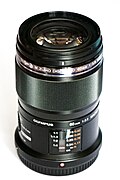 Olympus M.Zuiko Digital ED 60mm f/2.8 Macro
 -
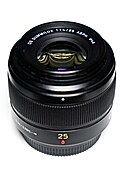 Panasonic Leica DG Summilux 25mm f/1.4
 -
 Telephoto zoom lens Leica DG 100-400 mm


Image stabilization approaches
[edit]Olympus and Panasonic have both produced cameras with sensor-based stabilization, and lenses with stabilization. However, the lens stabilization will only work together with body stabilization for cameras of the same brand. Before 2013, Olympus and Panasonic approached image stabilization (IS) differently. Olympus used sensor-shift image stabilization only, which it calls IBIS (In-Body Image Stabilization), a feature included all of its cameras. Until 2013, Panasonic used lens-based stabilization only, called Mega OIS or Power OIS (Optical Image Stabilization). These stabilize the image by shifting a small optical block within the lens.
In 2013, Panasonic began including sensor-based stabilization in its cameras, beginning with the Lumix DMC-GX7. Panasonic called the combination of lens and body stabilization "Dual IS," and this function won an award of the European Imaging and Sound Association (EISA) in the category Photo Innovation 2016–2017.[44] In 2016, Olympus added lens-based stabilization to the M. Zuiko 300mm f/4.0 Pro telephoto prime lens and the M. Zuiko 12-100mm f/4.0 IS Pro lens.
Panasonic claims that OIS is more accurate because the stabilization system can be designed for the particular optical characteristics of each lens. A disadvantage of this approach is that the OIS motor and shift mechanism must be built into each lens, making lenses more expensive than comparable non-OIS lenses. Of all Panasonic lenses only few with short focal lengths, and therefore wide angles of view and low susceptibility to image shaking, are not image stabilized, including the 8 mm fisheye, 7–14 mm wide angle zoom, 14 mm prime, the 15 mm prime, the 20 mm prime and the 25 mm prime.
The advantage of in-body IS is that even unstabilized lenses can make use of the in-body stabilization.
Mount adaptability
[edit]Since most Micro Four Thirds lenses have neither a mechanical focusing ring nor an aperture ring, adapting these lenses for other camera mounts is impossible or compromised. A variety of companies manufacture adapters to use lenses from nearly any legacy lens mount[11] (such lenses, of course, support no automatic functions.) For the Four Third lenses that can be mounted on MFT bodies, see Four Thirds system lenses. For the Four Third lenses that support AF, see the Olympus website.[45] For those that support fast AF (Imager AF), see the Olympus website.[46]
3D
[edit]On July 27, 2010, Panasonic announced the development of a three-dimensional optic solution for the Micro Four Thirds system. A specially designed lens allows it to capture stereo images compatible with VIERA 3D-TV-sets and Blu-ray 3D Disc Players.[47]
See also
[edit]References
[edit]- ^ Butler, Richard (August 5, 2008). "Olympus / Panasonic announce Micro Four Thirds". Digital Photography Review. Archived from the original on 2014-08-17. Retrieved 2021-09-14.
- ^ "Panasonic introduces AG-AF100" (press release). Panasonic. Archived from the original on 2012-04-27. Retrieved 2012-05-19.
- ^ Johnston, Mike (2011-08-11). "The Online Photographer: Micro Four-Thirds and Telecentricity". The Online Photographer. Retrieved 2024-01-11.
- ^ "No more compromises: The Four Thirds Standard". Olympus Europe. Archived from the original on 2011-07-14. Retrieved 2007-11-09.
- ^ Knaur (October 1, 2002). "Interview". A Digital Eye. Archived from the original on December 5, 2002.
- ^ "Panasonic Lumix DMC-GH1 Review". Digital Photography Review. Retrieved 2012-05-19.
- ^ "Panasonic DMC-GH2 Review". Digital Photography Review. Retrieved 2012-05-19.
- ^ "JK Imaging, Blackmagic Design and others join Micro Four Thirds". Digital Photography Review. 2013-01-21. Retrieved 2015-06-24.
- ^ andreritchie (2019-04-27). "Olympus VF-1 Viewfinder". Measuring Light. Retrieved 2025-06-26.
- ^ "M adapter", MFT products, Four Thirds consortium, archived from the original on 2009-02-21, retrieved 2009-02-24.
- ^ a b "Adapters for Micro Four Thirds Cameras". Novoflex. Archived from the original on 2012-06-19. Retrieved 2012-05-19.
- ^ "Micro Four Thirds Mount Technical Drawing and CAD". Retrieved 2022-12-25.
- ^ Interchangeable Lenses – Chromatic Aberration Compensation - Essential technologies of lens designs that enhance resolving power Archived 2016-10-21 at the Wayback Machine, nikon.com, August 2014, retrieved 13. September 2016
- ^ Ashton Acton: Refractive Errors—Advances in Research and Treatment, page 40, Scholarly Editions, 2013, ISBN 9781481692076
- ^ Why is the Micro Four Thirds sensor so sharp in spite of its small size, four-thirds.org, retrieved 13. September 2016
- ^ Äquivalente Brennweite, Wikibook Digitale bildgebende Verfahren, Kapitel Bildaufnahme, retrieved 17. Januar 2016
- ^ Äquivalente Blendenzahl, Wikibook Digitale bildgebende Verfahren, Kapitel Bildaufnahme, retrieved 17. Januar 2016
- ^ Äquivalente Lichtempfindlichkeit, Wikibook Digitale bildgebende Verfahren, Kapitel Bildaufnahme, retrieved 17. Januar 2016
- ^ What is equivalence and why should I care?, dpreview.com, 7 July 2014, retrieved 17. January 2016
- ^ "Optical Viewfinders (OVFs) vs. Electronic Viewfinders (EVFs)". Discover Digital Photography. Retrieved 19 February 2015.
- ^ "Olympus Press Pass: Press Release". Olympus America. Retrieved 2012-05-19.
- ^ "Swing Into Action! Olympus Unleashes The Highly Anticipated PEN E-PL3 Camera Featuring Tilting LCD And The New VF-3 Electronic Viewfinder". Olympus America CCS Department. 2011-07-27. Retrieved 2012-05-19.
- ^ "Pressroom". Panasonic USA. Archived from the original on 2012-03-18. Retrieved 2012-05-19.
- ^ Northrup, Tony (2013). Photography Buying Guide: How to Choose a Camera, Lens, Tripod, Flash & More. Waterford, CT: Mason Press. p. 52. ISBN 978-0-98826342-0. Retrieved 27 December 2014.
- ^ "Olympus E-M5 Review", Digital Photography Review.
- ^ William Brawley, Mike Tomkins, Dave Pardue, Jeremy Gray and Zig Weidelich: Olympus E-M1X Review, Imaging Resource, 24 January 2019. Retrieved 21 August 2019
- ^ Mansurov, Nasim. "Mirrorless vs DSLR". Photography Life. Retrieved 19 February 2015.
- ^ Hicks, Laura. "Migrating to Mirrorless: Death of the DSLR". Digital Camera Review. Retrieved 19 February 2015.
- ^ M-Zuiko Digital ED 45mm f/1.8, Olympus.
- ^ a b Astrodesign, Olympus, 2012, archived from the original on 2012-06-26
- ^ Yasuhara, archived from the original on 2012-05-29
- ^ "JK Imaging, Blackmagic Design and others join Micro Four Thirds". Digital Photography Review. 2013-01-21. Retrieved 2015-06-24.
- ^ "Panasonic Lumix G1 reviewed". Digital Photography Review.
- ^ "Panasonic premieres DMC-GH1 with HD video recording". Digital Photography Review. 2009-03-03. Retrieved 2009-03-11.
- ^ "Blackmagic Design Announces Blackmagic Pocket Cinema Camera" (Press release). Blackmagic Design. April 8, 2013. Retrieved 9 January 2024.
- ^ "evo8051CFLGEC67TR". SVS-Vistek. Retrieved 9 January 2024.
- ^ "Industrial Cameras: SVCam-Product Line made by SVS-VISTEK" (PDF). Alliance Vision. January 2016. Retrieved 9 January 2024.
- ^ Westlake, Andy. "Kodak Pixpro S-1 First Impressions Review". Digital Photography Review. Retrieved September 30, 2014.
- ^ Tarantola, Andrew (11 September 2015). "DJI unveils custom aerial Micro Four Thirds camera". Retrieved September 11, 2015.
- ^ "小蚁微单相机M1". www.xiaoyi.com. Archived from the original on 2016-12-01. Retrieved 2016-09-26.
- ^ Audonis, Ty (February 11, 2016). "Z-Camera E1 Review". Videomaker. Retrieved 9 January 2024.
- ^ "Digital Interchangeable Lenses". Lumix Digital Camera. Panasonic. Retrieved 2012-05-19.
- ^ "600 mm f5.6 Nikkor-P Auto Telephoto Lens". MY: Mir. Retrieved 2012-05-19.
- ^ EISA Awards Photography Archived 2016-10-27 at the Wayback Machine, eisa.eu, retrieved 12 November 2016
- ^ "Archived copy" (PDF). Archived from the original (PDF) on 2011-07-14. Retrieved 2011-02-22.
{{cite web}}: CS1 maint: archived copy as title (link) - ^ "Archived copy" (PDF). Archived from the original (PDF) on 2011-05-16. Retrieved 2011-02-22.
{{cite web}}: CS1 maint: archived copy as title (link) - ^ Panasonic announces development of world's first interchangeable 3D lens for Lumix G Micro system Archived 2010-07-30 at the Wayback Machine, Panasonic
External links
[edit]
- The Micro Four Thirds Standard official pages.
- Complete Micro 4/3 Lens List.
- Panasonic Lumix G family of lenses
- Olympus PEN system lenses Archived 2012-09-22 at the Wayback Machine
- Cosina Voigtländer Nokton MFT mount product page
- Noktor Hyperprime MFT mount product page
- Samyang Fisheye product page
| Subsidiaries |
| ||||||
|---|---|---|---|---|---|---|---|
| Brands | |||||||
| Products |
| ||||||
| Formats and standards | |||||||
| People | |||||||
| Other | |||||||

Micro Four Thirds system
View on GrokipediaIntroduction and History
Origins and Development
The Micro Four Thirds system was established in 2008 through a collaboration between Olympus Imaging Corporation and Panasonic Corporation, aiming to develop a new standard for mirrorless interchangeable-lens cameras that leveraged the existing Four Thirds sensor format. This partnership built on the sensor size heritage of the earlier Four Thirds system, introduced by Olympus in 2003, but sought to eliminate the optical viewfinder and mirror mechanism to enable more compact designs. The standard was formally announced at a joint press conference on August 5, 2008, with further details and concept demonstrations showcased at the photokina trade fair in Cologne, Germany, from September 16 to 21, 2008.[2][6][7] The primary goals of the Micro Four Thirds system were to significantly reduce the size and weight of camera bodies and lenses compared to traditional digital single-lens reflex (DSLR) cameras, while preserving the image quality benefits of the Four Thirds sensor, such as its 4:3 aspect ratio and controlled depth of field. This was achieved by shortening the flange focal distance from 38.67 mm in the Four Thirds system to 19.25 mm, allowing for shallower camera bodies without compromising lens performance or compatibility with adapted optics. As an open standard governed by the Micro Four Thirds joint committee, the system was designed from the outset to encourage adoption by third-party manufacturers, fostering a broader ecosystem of cameras and lenses beyond the founding partners.[6] The first production camera adhering to the Micro Four Thirds standard was the Panasonic Lumix DMC-G1, released in October 2008. This was followed by the Olympus PEN E-P1 in July 2009, a compact rangefinder-style model without a built-in viewfinder, and the Panasonic Lumix DMC-GF1 in September 2009, which offered a similar portable form factor with optional accessories. These initial releases marked the system's transition from concept to market, emphasizing portability for everyday photography and videography. The open nature of the standard quickly attracted third-party involvement, including cinema-focused bodies from Blackmagic Design, such as the Pocket Cinema Camera series starting in 2013, and gimbals and lenses from DJI for aerial and stabilized applications; following Olympus's imaging division spin-off in 2021, OM Digital Solutions continued development of Micro Four Thirds cameras under the OM System brand.[8][9] By the early 2010s, the system evolved to incorporate advanced video capabilities, exemplified by the Panasonic Lumix DMC-GH1 in 2009, which introduced full-time autofocus during 720p HD recording, and computational photography features like in-camera art filters and multiple exposure modes in Olympus PEN models. These enhancements expanded the platform's appeal to hybrid shooters, integrating electronic viewfinders, improved stabilization, and higher-resolution sensors while maintaining its core focus on compactness and versatility.Key Milestones and Collaborations
In 2010, Panasonic advanced the video capabilities of the Micro Four Thirds system with the release of the Lumix DMC-GH2, which introduced enhanced hybrid stills-and-video functionality including 1080p recording and creative video modes.[10] That same year, Olympus launched the PEN E-PL series, exemplified by the E-PL1, prioritizing portability through its compact, lightweight design suitable for everyday carry.[11] By 2012, Olympus elevated the system's performance with the OM-D E-M5, the first Micro Four Thirds camera to incorporate 5-axis in-body image stabilization (IBIS) and a weather-sealed magnesium alloy body, setting a precedent for rugged, professional-grade mirrorless designs.[12] From 2014 to 2018, the ecosystem expanded with high-end professional lenses, including Panasonic's updated Lumix G X Vario 12-35mm f/2.8 II (2017) for versatile constant-aperture zoom performance and Olympus's M.Zuiko Digital ED 12-100mm f/4.0 IS PRO (2016), offering an extensive 24-200mm equivalent range with integrated stabilization.[13][14] During this period, Blackmagic Design entered the fray in 2013 with the Pocket Cinema Camera, adopting the Micro Four Thirds mount to enable cinema-grade 1080p RAW video recording in a compact form factor.[15] The years 2020 to 2025 brought significant corporate shifts and innovations; Olympus's imaging division was acquired by Japan Industrial Partners in January 2021, forming OM Digital Solutions to continue development.[16] This entity rebranded to OM System in February 2022, honoring the legacy of Olympus's OM film cameras while focusing on modern mirrorless advancements.[17] Key releases included the OM System OM-1 in February 2022, featuring computational photography modes like Live ND filters and handheld high-resolution shooting via its TruePic X processor.[18] Panasonic complemented this with the Lumix GH6 in March 2022, supporting 5.7K 60p video in Apple ProRes for professional content creation.[19] Updates through 2024 and 2025 emphasized specialized features, such as the OM System OM-5's 2022 enhancements for astrophotography, including Starry Sky autofocus and Live Composite for capturing star trails without a tripod.[20] In 2024, OM System released the OM-1 Mark II with doubled buffer memory and improved autofocus performance, while Panasonic introduced the Lumix GH7 with advanced video tools like internal ProRes RAW recording. In 2025, the OM System OM-3 debuted as a premium travel-oriented camera with retro styling and pro-grade features, and the OM-5 Mark II provided refined everyday usability with updated processing.[21][22][23] Throughout its evolution, the Micro Four Thirds system has thrived on collaborations; Panasonic partnered with Leica for co-developed lenses like the DG Summilux 15mm f/1.7 ASPH (2013), blending precision optics with native compatibility. Third-party manufacturers Sigma and Tamron provided native support with lenses such as Sigma's 16mm f/1.4 DC DN, expanding creative options. DJI integrated the mount into drone payloads like the Zenmuse X5 series, facilitating aerial cinematography with interchangeable Micro Four Thirds optics.Core Technical Specifications
Sensor Size and Aspect Ratio
The Micro Four Thirds sensor measures 17.3 mm × 13.0 mm, yielding a diagonal of 21.6 mm and an active imaging area of approximately 225 mm².[24] This dimensions result in a surface area roughly 60% that of typical APS-C sensors, which measure around 23.5 mm × 15.6 mm.[25] The relatively compact size facilitates the design of smaller and lighter lenses optimized for the format, as the image circle required is reduced compared to larger sensor systems.[25] Despite the smaller area, modern Micro Four Thirds sensors achieve a balance of high resolution and controlled noise through advancements in pixel technology and backside illumination, supporting detailed images suitable for professional use.[26] A defining feature of the Micro Four Thirds sensor is its native 4:3 aspect ratio, which stems from the original Four Thirds standard and optimizes the sensor for digital imaging workflows.[27] This ratio contrasts with the 3:2 aspect common in full-frame and APS-C DSLR sensors, providing more vertical space relative to width.[28] For video applications, the 4:3 format enables a straightforward crop to 16:9 widescreen without losing height resolution, preserving more of the sensor's output compared to cropping from a 3:2 sensor.[29] Sensor resolution in Micro Four Thirds systems has progressed markedly since the format's inception. Early models, including the Panasonic Lumix DMC-G1 (2008) and Olympus PEN E-P1 (2009), utilized 12-megapixel sensors to deliver sharp, portable imaging.[6] By 2025, 20-25 megapixel resolutions are standard, exemplified by the Panasonic Lumix GH7's 25.2-megapixel sensor for high-detail stills and video.[30] The OM System OM-1 (2022, with updates through 2025) incorporates a 20-megapixel stacked backside-illuminated (BSI) sensor, enabling rapid readout speeds up to 120 frames per second and improved low-light noise performance via its layered architecture.[26] These developments maintain the format's emphasis on computational efficiency and image quality within the fixed sensor footprint.[31]Lens Mount Design
The Micro Four Thirds lens mount employs a bayonet-style design that facilitates quick attachment and detachment of interchangeable lenses on mirrorless camera bodies. This mount has an inner diameter of 38 mm, which is 6 mm narrower than the preceding Four Thirds mount, contributing to the development of slimmer and more compact camera housings without compromising optical performance.[32][33] It integrates 11 electronic contacts arranged around the mount's rear flange, up from the 9 contacts in the Four Thirds system, to enable robust bidirectional communication between the lens and camera for precise autofocus control, aperture adjustments, and recording of EXIF metadata. These contacts support high-speed data protocols optimized for electronic focus-by-wire systems, which allow seamless manual focusing via lens rings, and power zoom functionality in compatible lenses, ensuring responsive operation during live view and video modes.[1][33] Lens attachment involves aligning the mount's alignment tabs with the camera body's index mark and rotating the lens clockwise until it locks with an audible click, a mechanism shared with many modern bayonet mounts for secure engagement. In professional-oriented models, the mount incorporates sealing gaskets and robust construction to provide dust- and splash-resistant protection, safeguarding internal components from environmental contaminants when paired with weather-sealed lenses.[34][35] The mount's short flange focal distance of 19.25 mm enhances overall system versatility by enabling effective use with adapted optics.[1]Flange Focal Distance and Crop Factor
The flange focal distance of the Micro Four Thirds system measures 19.25 mm from the lens mount to the image sensor plane.[36] This represents approximately half the 38.67 mm distance specified in the original Four Thirds system.[1] The shorter distance enables more compact camera bodies by eliminating the need for a mirror box and provides greater clearance for lens adapters, facilitating compatibility with a wide range of legacy optics.[1] The crop factor for Micro Four Thirds is 2× when compared to the 35 mm full-frame format, derived from the diagonal dimension ratio of the sensor formats.[35] This multiplier adjusts the field of view, such that a lens marked with a given focal length on Micro Four Thirds produces an angle of view equivalent to twice that focal length on full-frame. For example, a 25 mm Micro Four Thirds lens delivers a field of view comparable to a 50 mm lens on full-frame.[37] The equivalence formula for field of view is: effective focal length = Micro Four Thirds focal length × 2. This scaling also influences depth of field, where the smaller format inherently produces deeper focus at the same f-number and equivalent focal length. Specifically, the depth of field at a given aperture on Micro Four Thirds matches that of a full-frame system at an aperture two stops smaller; for instance, f/2 on Micro Four Thirds equates to f/4 depth of field on full-frame for lenses providing the same field of view.[38] Light gathering in the Micro Four Thirds system scales with the sensor's effective area, which is one-fourth that of full-frame due to the 2× linear crop factor, impacting total light capture and resultant image noise levels under equivalent exposure conditions.[39]Imaging and Functionality
Autofocus Mechanisms
The Micro Four Thirds system primarily employs on-sensor contrast detection autofocus (CDAF) for precise focusing in live view modes, leveraging the sensor to directly analyze image contrast for sharp results without dedicated AF sensors. This approach excels in delivering accurate focus for static subjects and integrates seamlessly with electronic viewfinders by providing real-time feedback. Early implementations, such as in the Panasonic Lumix GH1 released in 2009, relied solely on CDAF, which offered reliable performance in controlled lighting but could exhibit slower acquisition times due to iterative contrast hunting. Over time, the system evolved to incorporate hybrid autofocus combining CDAF with on-sensor phase detection autofocus (PDAF), enhancing speed for tracking moving subjects while maintaining contrast-based precision. Olympus pioneered on-sensor PDAF in Micro Four Thirds with the OM-D E-M1 in 2013, featuring 81 PDAF points alongside contrast detection for improved live view performance. Subsequent models advanced this further; for instance, the OM System OM-1 (2022) utilizes a Quad Pixel PDAF system with 1,053 all-cross-type points, enabling rapid subject acquisition across the frame. This hybrid design processes phase differences to predict focus direction, reducing the need for multiple CDAF iterations. Panasonic, historically focused on CDAF enhanced by Depth from Defocus (DFD) technology—which calculates distance by comparing defocused images from multiple sensor points—introduced phase detection in the Lumix G9 II (2023), marking the first PDAF implementation in its Micro Four Thirds lineup. Earlier Panasonic models like the Lumix GH5 II (2021) employed a 225-area CDAF system akin to Canon's Dual Pixel in its split-pixel contrast efficiency, supporting fast locking without phase elements. DFD allows for predictive adjustments, simulating phase-like speed in continuous autofocus.[40] Face and eye detection capabilities emerged in Micro Four Thirds around 2012, with Olympus's OM-D E-M5 introducing reliable face priority and initial eye detection for portrait work. These features use algorithmic recognition to prioritize human faces and eyes, locking focus even in crowds, and have since expanded to animal and bird eyes in advanced models like the OM-1. By 2025, subject recognition has matured to include deep learning-based detection for humans, animals, birds, vehicles, and aircraft, improving hit rates in dynamic scenarios.[41] In video applications, Micro Four Thirds autofocus supports continuous tracking with subject recognition, enabling smooth focus pulls during recording. The OM-1's AI-driven system, for example, maintains lock on detected subjects like birds or vehicles in 4K footage, with customizable sensitivity to avoid erratic shifts. Panasonic's G9 II extends this to real-time recognition of people, animals, and motorsports, achieving seamless transitions in low-contrast video scenes. These advancements allow for professional-grade video AF without manual intervention.[42] Flagship Micro Four Thirds cameras achieve autofocus acquisition speeds under 0.1 seconds, with the Panasonic GH5 II rated at 0.05 seconds for contrast detection in optimal conditions. Pre-2018 models, reliant on pure CDAF, faced limitations in low light, often requiring brighter illumination or slower hunting to achieve lock due to reduced contrast signals below -2 EV. Post-2018 hybrid systems, including PDAF, mitigate this by operating effectively down to -5 EV, though extreme low light still favors brighter apertures.[43]Viewfinding and Electronic Viewfinders
In the Micro Four Thirds system, viewfinding primarily relies on electronic viewfinders (EVFs) and rear LCD screens for composing shots and reviewing images, enabling a compact design without optical pentaprisms. These digital displays provide live previews directly from the sensor, facilitating precise composition in various lighting conditions.[5] The integration of EVFs in Micro Four Thirds cameras evolved significantly since the system's inception. The Panasonic Lumix G1, released in 2008 as the first Micro Four Thirds camera, featured a built-in 1.44-million-dot OLED EVF, marking an early adoption of electronic viewfinding in mirrorless designs. Early Olympus models, such as the PEN E-P1 in 2009, omitted built-in EVFs to prioritize portability, instead offering optional hotshoe-mounted accessories like the VF-2, which provided 1.44 million dots of resolution. By 2012, the Olympus OM-D E-M5 introduced integrated EVFs as standard in higher-end bodies, with resolutions advancing to 2.36 million dots in models like the OM System OM-5. Recent developments include higher resolutions and faster refresh rates; for instance, the OM System OM-1 (2022) employs a 5.76-million-dot OLED EVF with a 120 Hz refresh rate for smoother motion rendering, while many mid-range bodies maintain 2.36-million-dot panels operating at 60 Hz. Panasonic's Lumix G9 features a 3.68-million-dot OLED EVF supporting selectable 60 Hz or 120 Hz modes to balance performance and power efficiency. By 2025 models, such as the OM-1 Mark II and Panasonic Lumix GH7, EVFs have become ubiquitous with high-resolution integration, reflecting a shift from optional add-ons to essential, embedded components.[6][31][44][45][46] EVFs in Micro Four Thirds cameras offer key advantages for composition and exposure control, including real-time exposure preview through simulation modes that reflect settings like aperture and shutter speed on the live image. Focus peaking highlights in-focus areas with color overlays, aiding manual focus precision, while zebra patterns indicate overexposed highlights to prevent clipping. These features enhance usability for both stills and video, with refresh rates up to 120 Hz in advanced models reducing motion blur during tracking.[45][31] Rear LCD screens complement EVFs with 3-inch articulating touchscreens, typically resolving 1.04 to 1.84 million dots for clear image review and menu navigation. Models like the OM System OM-5 use a 1.04-million-dot vari-angle TFT LCD, while the Panasonic Lumix G9 and GH6 employ 1.84-million-dot free-angle panels that rotate fully for self-framing in vlogging or overhead shooting. Touch functionality supports intuitive controls, such as pinch-to-zoom during playback, and these displays often mirror EVF features like exposure simulation for versatile on-the-go monitoring.[44][45][46]Image Stabilization Techniques
The Micro Four Thirds system employs advanced image stabilization techniques that leverage its short flange focal distance of 19.25 mm, enabling compact camera bodies with effective in-body mechanisms without compromising lens compatibility. In-body image stabilization (IBIS), primarily developed by Olympus (now OM System), uses sensor-shift technology to counteract camera shake across five axes: yaw, pitch, roll, vertical shift, and horizontal shift. This approach was pioneered in the Olympus OM-D E-M5, released in 2012, marking the first implementation of 5-axis IBIS in a mirrorless camera and providing up to 5 stops of compensation according to CIPA standards.[47][12] The technology evolved with the OM-D E-M1 in 2013, refining 5-axis performance, and has since become standard in nearly all OM System bodies, with advancements reaching up to 8.5 stops of stabilization in the OM-1 Mark II (2024).[48] This sensor-shift method works independently of the lens, stabilizing both stills and video across the entire Micro Four Thirds ecosystem. Panasonic implements optical image stabilization (OIS) directly in many of its Micro Four Thirds lenses, such as primes and zooms like the Lumix G X Vario 12-35mm f/2.8, using elements within the lens to correct for pitch and yaw movements, typically offering 3-4 stops of correction. To enhance this, Panasonic introduced Dual I.S. in models like the Lumix G7 (2015), which synchronizes lens OIS with body-based 5-axis IBIS for hybrid correction, achieving up to 5 stops.[49] The upgraded Dual I.S. 2, featured in cameras such as the Lumix GH6 (2022) and G9 II (2023), extends this to 7.5 stops by improving gyro sensor integration and algorithmic compensation, particularly effective for telephoto shooting.[50][51] OM System's Sync I.S. similarly combines IBIS with compatible lens OIS—such as in the M.Zuiko Digital ED 12-100mm f/4.0 IS Pro—for additive stabilization, delivering up to 8 stops in the OM-1 series when paired appropriately.[48] Both manufacturers incorporate computational electronic image stabilization (e-IS) for video, which crops the frame slightly to apply digital corrections alongside mechanical systems, enabling smoother handheld footage at the cost of a minor field-of-view reduction.[52] These techniques collectively allow Micro Four Thirds users to achieve sharp results at shutter speeds as low as 1/0.4 second handheld, far surpassing traditional handheld limits.[12]Compatibility and Adaptability
Backward Compatibility with Four Thirds
The Micro Four Thirds system ensures backward compatibility with the original Four Thirds DSLR lenses via dedicated mount adapters, enabling photographers to utilize their legacy Zuiko Digital optics on newer mirrorless bodies without significant functional loss. This integration was a key design consideration from the system's 2008 launch, allowing seamless access to the established Four Thirds ecosystem.[3] The primary adapters, such as Olympus's MMF-1 (standard version) and MMF-3 (dust- and splash-proof variant), function as straightforward 19.25 mm extension tubes to bridge the flange focal distance difference between the Four Thirds mount (38.67 mm) and Micro Four Thirds mount (19.25 mm). These adapters incorporate electronic contacts that preserve essential functionalities, including contrast-detection autofocus and automatic exposure control, ensuring that compatible lenses operate with full communication to the camera body.[53][54][3] More than 20 Olympus Four Thirds lenses remain usable on Micro Four Thirds cameras through these adapters, providing a broad selection of high-quality optics originally developed for DSLR use. Representative examples include the Olympus Zuiko Digital ED 12-60mm f/2.8-4.0 SWD, a versatile standard zoom prized for its sharpness and weather resistance, which performs reliably in adapted configurations for landscapes and portraits.[55] Despite this compatibility, certain limitations persist: Micro Four Thirds in-body image stabilization (IBIS) lacks synergy with any built-in stabilization in Four Thirds lenses, requiring users to rely solely on the body-based system, and live view operation can exhibit reduced speed due to the inherently slower autofocus performance of legacy lenses on contrast-detection systems.[56] Following the Micro Four Thirds introduction, Olympus actively promoted the transition from Four Thirds DSLRs starting in 2009, as production of new Four Thirds cameras wound down by 2010, with lens production discontinued in 2017, while affirming ongoing support for adapted legacy lenses.[7][57]Adapters for Other Lens Mounts
The short flange focal distance of the Micro Four Thirds system, measuring 19.25 mm, enables the use of simple, non-optical adapters to mount lenses from camera systems with longer flange distances, such as Canon's EF mount at 44 mm (requiring a 24.75 mm adapter) and Nikon's F mount at 46.5 mm (requiring a 27.25 mm adapter).[58][58][58] Electronic adapters, such as those from Metabones and Vello, facilitate the use of Canon EF lenses on Micro Four Thirds bodies by preserving autofocus functionality, including phase-detect support in newer models, along with aperture control and electronic communication.[59][60] These adapters often incorporate speed booster optics to widen the field of view and increase light transmission by one stop, compensating partially for the system's 2x crop factor on adapted focal lengths. Manual adapters from manufacturers like Kipon and Fotodiox allow attachment of vintage lenses, such as those from Leica M and Contax systems, without requiring corrective optics due to the flange distance compatibility, enabling infinity focus and manual operation.[61][62] While vignetting is rare with full-frame lenses owing to the smaller Micro Four Thirds sensor size, autofocus performance can vary across adapters, with full-speed operation typically achieved on Canon EF setups but more limited support on other mounts like Nikon F.[59][60]Use with Legacy and Adapted Lenses
The short flange focal distance of the Micro Four Thirds mount facilitates the use of compact adapters for mounting legacy lenses from older systems, enabling photographers to expand their options without significant bulk.[6] Electronic viewfinders equipped with focus peaking highlight in-focus areas in real time, simplifying manual focusing for these typically non-autofocus optics and making them accessible even for users accustomed to modern autofocus.[63] Additionally, the system's 2x crop factor effectively doubles the equivalent focal length of adapted lenses, converting medium telephoto legacy glass into versatile normal or portrait options that deliver a natural field of view on full-frame terms.[64] Among the most popular legacy mounts for adaptation are M42 screw mount, Pentax K, and Minolta MD, each offering thousands of affordable vintage lenses from the film era that can be acquired cheaply on the used market.[65] For instance, M42 lenses like the Helios 44-2 provide distinctive swirly bokeh at a fraction of modern equivalents' cost, while Pentax K and Minolta MD options deliver sharp, high-contrast results with character suited to creative shooting.[65] These mounts' prevalence stems from their widespread use in 1970s–1980s SLRs, resulting in abundant, low-priced inventory that appeals to budget-conscious photographers seeking optical variety.[66] The Micro Four Thirds user base has fostered a vibrant interest in legacy lenses, with trends emphasizing their unique rendering—such as creamy bokeh and subtle aberrations—for street and portrait work, where the manual process encourages deliberate composition.[67] In street photography, the crop factor's reach extension pairs well with compact vintage primes to capture candid scenes discreetly, while portraits benefit from the lenses' flattering compression and nostalgic aesthetic without the need for expensive native alternatives.[68] As of 2025, the use of legacy and adapted lenses remains relevant within the Micro Four Thirds ecosystem, bolstered by in-camera computational tools like focus stacking that combine multiple exposures from manual lenses to achieve extended depth of field, particularly valuable in macro and product applications.[56] This integration enhances the practicality of vintage glass, allowing users to leverage its affordability and character alongside modern post-processing aids for professional-grade results.[69]Advantages and Comparisons
Benefits Over DSLR Systems
The Micro Four Thirds system's mirrorless architecture eliminates the bulky mirror box and pentaprism found in DSLRs, enabling camera bodies that are notably more compact and lightweight. For example, the OM System OM-1 has dimensions of 134.8 x 91.6 x 72.7 mm and weighs 599 g including the battery, in contrast to the Canon EOS 5D Mark IV's larger 150.7 x 116.4 x 75.9 mm profile and 890 g weight.[70][71] This design advantage reduces overall system bulk, making Micro Four Thirds setups easier to carry for travel, hiking, or street photography without compromising on professional-grade performance. Lenses for Micro Four Thirds are typically 30-50% less expensive than comparable full-frame DSLR optics, owing to the smaller sensor size that permits more efficient glass elements and smaller diameters. A representative case is the Panasonic Lumix G X Vario 12-35mm f/2.8 II, priced at approximately $1,000, versus the Nikon AF-S 24-70mm f/2.8E ED VR equivalent at over $2,000.[72] Entry-level kits further enhance affordability, with options like the Panasonic Lumix G7 bundled with a 14-42mm lens available for under $500, allowing beginners to access interchangeable-lens photography at a fraction of DSLR starter costs.[73] Key features in Micro Four Thirds cameras provide practical edges over DSLRs, starting with always-on live view via electronic viewfinders or rear screens, which delivers real-time exposure simulation, focus peaking, and composition aids without the need to activate a secondary mode.[74] Silent electronic shutters enable completely noise-free operation, avoiding the mechanical mirror slap in DSLRs that can disturb subjects in wildlife or concert settings.[75] Video performance stands out as well, with 4K at 60p becoming standard across models like the Panasonic Lumix GH7 and OM System OM-1, supporting 10-bit color and hybrid photo-video workflows that outpace many traditional DSLRs limited to 1080p.[30] The electronic viewfinders and in-body image stabilization complement these by offering lag-free previews and up to 8 stops of correction for sharper handheld results. Battery efficiency has advanced in recent Micro Four Thirds models, achieving over 500 shots per CIPA-rated charge in cameras like the OM System OM-1, progressively closing the endurance gap with DSLRs such as the Canon EOS 5D Mark IV's 900 shots.[26][71] Optimized power draw from electronic components and larger batteries contribute to this improvement, supporting longer sessions in 2025-era flagships without frequent recharges.Drawbacks Relative to DSLRs
Micro Four Thirds cameras generally offer shorter battery life compared to DSLRs, with CIPA-rated capacities typically ranging from 300 to 500 shots per charge, whereas many DSLRs achieve 800 to over 1,200 shots.[75][76] This disparity arises from the constant power demands of electronic viewfinders and processors in mirrorless designs, limiting extended shooting sessions without spare batteries. Additionally, some Micro Four Thirds models experience overheating during prolonged 4K video recording, restricting continuous operation to 20-30 minutes in warm conditions, while DSLRs rarely encounter such thermal limitations due to their mechanical architecture and larger chassis for heat dissipation.[77][78] Electronic viewfinders (EVFs) in Micro Four Thirds systems can introduce perceptible lag or blackout during high-speed burst shooting, disrupting the tracking of fast-moving subjects, in contrast to the real-time optical clarity provided by DSLR viewfinders.[79] Although modern EVFs have reduced latency to under 20 milliseconds in flagship models, the refresh rate limitations during bursts—often dropping frames or showing artifacts—make them less reliable for action photography than the lag-free optical path in DSLRs, where only brief mirror blackouts occur.[80] Ergonomic challenges in Micro Four Thirds cameras stem from their compact form factors, featuring smaller grips that may not accommodate larger hands comfortably during extended use, unlike the more substantial, contoured handles on DSLRs designed for prolonged handling.[81] This can lead to fatigue when paired with telephoto lenses, often requiring add-on grips for stability. Furthermore, the native lens ecosystem for Micro Four Thirds, comprising around 120 options from manufacturers like Olympus and Panasonic, is narrower than the extensive selections for DSLR mounts such as Canon EF (over 250 lenses) or Nikon F (over 400), limiting specialized professional choices like ultra-high-resolution primes or extreme telephotos without adapters.[82][83] In low-light conditions, Micro Four Thirds sensors exhibit higher noise at elevated ISOs due to their smaller size, with base ISO typically starting at 200 compared to 100 on many DSLRs, resulting in approximately one stop more noise at equivalent settings.[84] The 2x crop factor amplifies noise implications by concentrating light over a smaller area. However, advancements in 2025 sensors, such as those in the Olympus OM-1 Mark II, have mitigated this through improved back-illuminated stacked designs, narrowing the gap to within half a stop at ISO 6400 relative to APS-C DSLRs.[85][86]Comparisons with Full-Frame and APS-C Systems
The Micro Four Thirds (MFT) system features a 2x crop factor compared to full-frame, while APS-C sensors typically offer a 1.5x crop, resulting in similar field-of-view equivalence for wide-angle and normal lenses but with MFT providing a more pronounced telephoto reach.[24] Cameras and lenses in the MFT ecosystem are generally smaller and lighter than their APS-C counterparts; for instance, the Olympus M.Zuiko Digital 25mm f/1.8 lens, equivalent to 50mm on full-frame, weighs about 137g and retails for around $400, whereas the comparable Sony E 35mm f/1.8 OSS for APS-C (equivalent to 52.5mm) weighs 154g and costs approximately $598.[87][88] APS-C systems, however, provide superior low-light performance due to their larger sensor area—roughly 1.6 times that of MFT—allowing for better noise control and higher usable ISO levels in dim conditions.[25] In comparison to full-frame systems like the Sony A7 IV, MFT sensors capture about one-fourth the light due to their smaller area (17.3 x 13mm versus 35.9 x 24mm), which can limit overall image quality in challenging lighting.[24] This size difference also results in deeper depth of field (DoF) control on MFT for equivalent apertures; a 25mm f/1.8 lens on MFT yields a DoF similar to a 50mm f/3.6 on full-frame, making it advantageous for landscapes or macro work where foreground-to-background sharpness is desired.[39] Full-frame sensors excel in dynamic range, with the A7 IV achieving over 14 stops, compared to around 12 stops on high-end MFT bodies like the OM System OM-1, enabling better recovery of highlights and shadows in high-contrast scenes.[89][90] MFT shines in niche applications such as telephoto photography, where its 2x crop factor turns a 300mm lens into a 600mm equivalent while keeping weight low—often half that of full-frame equivalents—ideal for wildlife or sports without the bulk of larger systems.[30] By 2025, advancements like stacked BSI sensors in cameras such as the OM-1 have narrowed the performance gap, improving readout speeds, noise reduction, and dynamic range to better compete with larger formats in video and high-speed shooting.[91] In terms of market positioning, MFT accounted for less than 5% of the global mirrorless camera market in 2024, reflecting its specialized appeal, while full-frame systems captured around 40% share, driven by demand for premium image quality from brands like Sony and Canon.[92][93]Equipment Ecosystem
Available Cameras
The Micro Four Thirds system features a diverse range of camera bodies from primary manufacturers Olympus (now OM System) and Panasonic, alongside specialized third-party options, catering to categories from compact enthusiasts to professional hybrid and cinema use. Since the system's inception in 2008, over 85 distinct camera bodies have been released as of November 2025, providing options across entry-level, midrange, and flagship segments with shared mount compatibility for lenses.[94][95] OM System, the successor to Olympus's imaging division, continues to lead in compact and rugged Micro Four Thirds cameras. The flagship OM-1 Mark II, released in 2024, offers a 20.4MP stacked BSI Live MOS sensor, advanced computational features like Live ND, and up to 8.5 stops of in-body image stabilization, making it suitable for wildlife and action photography. The OM-3, released in February 2025, builds on this with the same 20MP stacked sensor, enhanced travel-oriented features like improved weather sealing and AI subject detection, ideal for portable professional use. The midrange OM-5 II, introduced in June 2025, updates the OM-5 (2022) with a 20.4MP sensor, 7.5-stop stabilization, and better video autofocus, emphasizing portability with weather sealing for travel and outdoor shooting. For compact users, the PEN E-P7 from 2021 delivers a lightweight 20.3MP body with 5-axis stabilization and creative filters, though no new PEN E-P model has been announced as of November 2025. Discontinued pre-2020 models like the OM-D E-M1X (2019) remain popular for their 20.4MP sensor and integrated vertical grip, supporting high-speed burst shooting up to 60fps. Panasonic's Lumix lineup focuses on hybrid photo-video capabilities within the G and GH series. The G9 II, launched in 2023, serves as a versatile hybrid with a 25.2MP sensor, phase-detect autofocus, and 5-axis dual I.S. 2 stabilization up to 8 stops, appealing to enthusiasts and pros for stills and 5.8K video. The GH7, released in 2024, targets cinema users with a 25.2MP sensor, internal ProRes RAW recording, and 5.7K 60p video, enhanced by active cooling for extended shoots, though it does not natively support 8K. Entry-level options include the GX9 (2018, still available), featuring a 20.3MP sensor, electronic viewfinder, and 4K photo modes in a rangefinder-style body. Panasonic introduced the G97 in early 2025 as a compact hybrid update to the G95, with a 20.4MP sensor, improved video autofocus, and weather resistance.[96] Earlier discontinued models, such as the GH5 (2017), continue to influence the ecosystem with their 20.3MP sensor and 4K 60p capabilities. Third-party manufacturers expand the system's utility for specialized applications. Blackmagic Design's Pocket Cinema Camera 6K Pro (2021, updated firmware in 2025) uses a Super 35 6K sensor adapted to Micro Four Thirds mount, delivering 13 stops of dynamic range and Blackmagic RAW recording for professional filmmakers.[97] The Yololiv YoloCam S7 (2025) provides a streaming-oriented body with 4K 60p video and low-light performance via a 10.7MP Micro Four Thirds sensor, optimized for vertical content like TikTok.[98] Note that devices like the DJI Osmo Pocket 3 (2023) feature a 1-inch sensor but lack interchangeable Micro Four Thirds mount compatibility, positioning it outside the core system despite vlogging similarities.[99]| Manufacturer | Category | Key Current Models | Key Discontinued Examples |
|---|---|---|---|
| OM System | Flagship | OM-1 Mark II (2024, 20.4MP stacked); OM-3 (2025, 20MP stacked) | OM-D E-M1X (2019, 20.4MP) |
| OM System | Midrange/Compact | OM-5 II (2025, 20.4MP); OM-5 (2022, 20.4MP); PEN E-P7 (2021, 20.3MP) | OM-D E-M5 Mark III (2019, 20.4MP) |
| Panasonic Lumix | Hybrid/Flagship | G9 II (2023, 25.2MP); GH7 (2024, 25.2MP) | GH5 (2017, 20.3MP) |
| Panasonic Lumix | Entry/Compact | GX9 (2018, 20.3MP); G97 (2025, 20.4MP) | G95 (2019, 20.3MP) |
| Third-Party | Cinema/Streaming | Blackmagic Pocket 6K Pro (2021/2025 FW, Super 35); YoloCam S7 (2025, 10.7MP) | N/A |