


Community hub
Recent from talks
Contribute something
Nothing was collected or created yet.
Midelt
View on WikipediaMidelt (Arabic: ميدلت) is a town in Morocco, in the high plains between the Middle Atlas and High Atlas mountain ranges. With a population of 55,304 recorded in the 2014 Moroccan census,[1] Midelt serves as the commercial center of a large agricultural hinterland. It is also one of Morocco's principal cities for the mining of several minerals.
Key Information


.jpg)
.jpg)


History
[edit]Before the French protectorate, Midelt was a cluster of qsur called Aoutat n-Ayt Izdeg. The modern town's name is a French corruption of the word timidelt (dish-cover) from a local hill.[2]
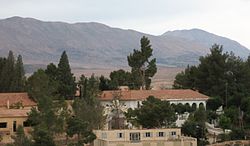
Midelt grew in the first half of the 20th century around a French administrative post by the same name. Previously, villages and ksour had dotted the fertile surroundings. The French established their post to facilitate the mining of lead, gypsum, other minerals, and fossils in the nearby Ahouli and Mibladen mines and elsewhere. The development of these mines led to the construction of a railroad from Midelt to the Mediterranean coast and the electrification of Midelt in 1930. In Morocco, only Casablanca received electricity earlier. The Franciscan Missionaries of Mary founded the Kasbah Miryam des Soeurs in 1926 which later would become the Priory of our Lady of the Atlas.[3]
After Moroccan independence in 1956, control reverted to the Moroccan government. Midelt is currently the provincial capital of Midelt Province.
Geography
[edit]Midelt is situated on the main road between Fes and Meknes to the north and Errachidia to the south. Geographically, it is situated in the high plains surrounding the Moulouya River, between the Middle and High Atlas mountain ranges.
The city's elevation is 1,508 metres (4,948 ft), making it one of the highest large towns in Morocco.
Climate
[edit]Midelt has a cold desert climate (Köppen: BWk). The elevation of Midelt and its relative proximity to the North Atlantic Ocean cools the daily temperatures to make Midelt one of the most temperate of the inland towns. However, many coastal towns have milder temperatures, warmer in winter and cooler in summer.
Every winter, when a cold damp air coming from the north west influence Western Europe and Morocco, temperatures can fall dramatically well below -10 degrees Celsius in Midelt. However, these extreme conditions don't last for more than 5 continuous days.
Temperature averages, from the years 1961 to 1990, yield daily maximum/minimum temperatures for January as 12.3 / 0.6 degrees Celsius and for July as 32.6 / 16.3 degrees Celsius.[4] Snow is common in winter, and precipitation continues throughout the year at moderate levels. However, the principal water source of the region is a spring at the foot of Jbel Ayachi, 10 kilometres (6 mi) south of Midelt.
A dam moderating the flow from the spring was destroyed by a flood in early 2006 following heavy snows the previous winter, damaging the nearby village of Tattiwin.
| Climate data for Midelt (1991–2020, extremes 1930–1963 and 1965–present)[a] | |||||||||||||
|---|---|---|---|---|---|---|---|---|---|---|---|---|---|
| Month | Jan | Feb | Mar | Apr | May | Jun | Jul | Aug | Sep | Oct | Nov | Dec | Year |
| Record high °C (°F) | 24.0 (75.2) |
26.1 (79.0) |
29.0 (84.2) |
32.0 (89.6) |
34.8 (94.6) |
37.7 (99.9) |
43.1 (109.6) |
43.2 (109.8) |
38.7 (101.7) |
31.9 (89.4) |
28.0 (82.4) |
24.0 (75.2) |
43.2 (109.8) |
| Mean daily maximum °C (°F) | 12.6 (54.7) |
14.0 (57.2) |
16.9 (62.4) |
20.0 (68.0) |
24.2 (75.6) |
29.7 (85.5) |
34.1 (93.4) |
33.1 (91.6) |
27.7 (81.9) |
22.4 (72.3) |
16.4 (61.5) |
13.5 (56.3) |
22.1 (71.8) |
| Daily mean °C (°F) | 6.7 (44.1) |
8.0 (46.4) |
10.7 (51.3) |
13.4 (56.1) |
17.2 (63.0) |
21.9 (71.4) |
25.9 (78.6) |
25.2 (77.4) |
20.7 (69.3) |
16.1 (61.0) |
10.7 (51.3) |
7.9 (46.2) |
15.4 (59.7) |
| Mean daily minimum °C (°F) | 0.9 (33.6) |
2.0 (35.6) |
4.4 (39.9) |
6.8 (44.2) |
10.2 (50.4) |
14.1 (57.4) |
17.7 (63.9) |
17.3 (63.1) |
13.6 (56.5) |
9.8 (49.6) |
5.0 (41.0) |
2.2 (36.0) |
8.7 (47.7) |
| Record low °C (°F) | −14.0 (6.8) |
−16.0 (3.2) |
−8.0 (17.6) |
−3.8 (25.2) |
−1.0 (30.2) |
3.0 (37.4) |
7.6 (45.7) |
2.8 (37.0) |
0.0 (32.0) |
−5.0 (23.0) |
−7.0 (19.4) |
−13.5 (7.7) |
−16.0 (3.2) |
| Average precipitation mm (inches) | 14.1 (0.56) |
13.1 (0.52) |
19.2 (0.76) |
15.9 (0.63) |
20.0 (0.79) |
10.8 (0.43) |
6.8 (0.27) |
15.5 (0.61) |
19.5 (0.77) |
22.1 (0.87) |
17.9 (0.70) |
10.9 (0.43) |
185.8 (7.31) |
| Average precipitation days (≥ 1.0) | 2.8 | 2.7 | 4.1 | 3.0 | 3.5 | 2.3 | 1.7 | 3.4 | 3.6 | 3.6 | 3.6 | 2.7 | 37.0 |
| Average relative humidity (%) | 73 | 71 | 74 | 76 | 73 | 67 | 58 | 56 | 69 | 72 | 76 | 70 | 70 |
| Mean monthly sunshine hours | 240.6 | 231.8 | 259.3 | 278.9 | 301.4 | 309.3 | 301.7 | 274.6 | 252.9 | 247.7 | 237.9 | 229.2 | 3,165.3 |
| Source 1: NOAA (sun 1981–2010)[5][6] | |||||||||||||
| Source 2: Deutscher Wetterdienst (record highs for February to March only, record lows, and humidity),[7] Meteo Climat (all other record highs and lows)[8] | |||||||||||||
People
[edit]
Midelt is a largely Berber city. Berber residents speak the Central Atlas Tamazight (Ait Ayache) language but most can also use the dialect of Darija. Educated residents also speak Standard Arabic as well as French, which are used throughout Morocco in mass media, education, and government.
Because Midelt is a new city, almost all Mideltis can trace their roots either to one of the nearby villages or to elsewhere in Morocco. The city also lacks the sharply defined neighborhood divisions and traditional souqs of older Moroccan cities.
Very few non-natives live in Midelt. Of these, the longest established are a community of Franciscan nuns and Cistercian monks (namely Trappists) living at the Priory of Our Lady of Atlas in a nearby village. The nuns work with local women and girls to develop handcrafts and teach hygiene, French language, and other skills.
Economy
[edit]
Midelt functions as the market for an agricultural area extending from the Moulouya River to Jbel Ayachi, bounded on the east and west by dry plains. This region is best known for apples; other produce includes walnuts, apricots, plums, pomegranates, wheat, corn, and a wide variety of garden vegetables.
Nomads and sedentary farmers from the surrounding area also raise sheep and goats for slaughter and for wool. Both of these are sold in Midelt, but largely for local consumption. Locally gathered evidence indicates that the local price of meat is inversely related to rainfall: in wet years, nomads can keep their herds alive through the summer and do not bring them to market; in dry years, animals are better sold than lost to draught.
Midelt's industrial sector is largely related to the nearby mines, of which only Mibladen continues to operate at high capacity. Lead, gypsum, and a host of lesser-known minerals are extracted for sale to industry and for household decorations.
Tourism continues to grow as an important source of revenue for Midelt. The climate attracts many visitors, mostly Moroccans from lower climes and émigrés to Europe. These support several small hotels as well as two larger establishments catering to Europeans. In addition to visitors, local handcrafts - especially carpets and blankets in the roughhewn nomadic style - are sold through cooperatives and merchants both locally and in Morocco's larger cities.
Notable people
[edit]- Khalid Skah, former runner
Notes
[edit]- ^ The record highs and lows are based on the Deutscher Wetterdienst link for the period 1930–1963 while records beyond 1965 come from the Meteo Climat link. As a result, the most extreme values from either source are used.
References
[edit]- ^ a b "POPULATION LÉGALE DES RÉGIONS, PROVINCES, PRÉFECTURES, MUNICIPALITÉS, ARRONDISSEMENTS ET COMMUNES DU ROYAUME D'APRÈS LES RÉSULTATS DU RGPH 2014" (in Arabic and French). High Commission for Planning, Morocco. 8 April 2015. Retrieved 29 September 2017.
- ^ Peyron, Michael (2020-10-29). The Berbers of Morocco: A History of Resistance. Bloomsbury Publishing. p. 201. ISBN 978-1-83860-375-5.
- ^ "Notre Dame of the Atlas (Our Lady of the Atlas)". Visit Draa Tafilalet. Regional tourism council of Draa Tafilalet. Retrieved 15 December 2023.
- ^ "Climatological Info. for Midelt, Morocco", Hong Kong Observatory, 2003, webpage: HKO-Midelt.
- ^ "Midelt Climate Normals for 1991–2020". National Oceanic and Atmospheric Administration. Archived from the original on 7 October 2023. Retrieved 7 October 2023.
- ^ "World Meteorological Organization Climate Normals for 1981–2010". National Oceanic and Atmospheric Administration. Retrieved 10 November 2021.
- ^ "Klimatafel von Midelt / Marokko" (PDF). Baseline climate means (1961–1990) from stations all over the world (in German). Deutscher Wetterdienst. Retrieved October 14, 2016.
- ^ "Station Midelt" (in French). Météo Climat. Retrieved October 14, 2016.
External links
[edit]Capital: Errachidia | ||
| Provinces |  | |
| Cities | ||
| National | |
|---|---|
| Other | |

Midelt
View on GrokipediaGeography
Location and Topography
Midelt is situated in central Morocco within the Drâa-Tafilalet region, at coordinates 32°40′48″N 4°43′48″W.[6] The town lies at an elevation of 1,521 meters (4,990 feet) above sea level, positioning it among the higher settlements in the country and contributing to its distinct environmental characteristics.[1] Geographically, Midelt occupies high plains wedged between the Middle Atlas and High Atlas mountain ranges, with the expansive Moulouya River flowing nearby and shaping the surrounding terrain through its fertile banks and valleys.[6] This location places the town in a transitional zone where rugged mountain landscapes gradually give way to semi-arid plains, featuring geological formations such as gorges and elevated plateaus that define the area's topography.[6] As a key gateway along the primary road connecting Fes and Meknes in the north to Errachidia in the south, Midelt functions as a vital commercial hub for the extensive agricultural hinterland, facilitating trade in local produce like apples from nearby orchards.[6] Notable geological features include the proximity of Jbel Ayachi, the highest peak in the Middle Atlas at 3,757 meters, located approximately 10 kilometers south of the town, which influences local hydrology by feeding springs and contributing to water resources in the upper Moulouya basin.[6]Climate
Midelt features a cold desert climate (Köppen: BWk), influenced by its high elevation of 1,521 meters, which moderates temperature extremes compared to lower-lying arid regions in Morocco.[7][1] This classification reflects the area's low annual precipitation and marked seasonal temperature contrasts, with cool, occasionally snowy winters and hot, dry summers.[7] Based on 1991–2020 climatological normals, average monthly temperatures illustrate these variations: in January, the average high reaches 12.3°C and the low 0.6°C, while July sees an average high of 32.6°C and low of 16.3°C. Annual precipitation totals 185.8 mm, concentrated primarily from October to April, with summer months experiencing near-total dryness and minimal rainfall often below 10 mm. Winters bring occasional snowfalls, especially in higher elevations around the city, contributing to the region's aridity despite the modest wet-season totals.[8] Extreme weather events underscore the climate's variability. Historical records from 1930–1963 and 1965–present indicate potential winter lows below -10°C, with documented cold snaps enabling frost and snow accumulation that can disrupt local conditions. On the opposite end, record highs have reached 41°C, as observed on August 10, 1939, highlighting the potential for intense summer heat waves. A significant flood event in early 2006, triggered by heavy winter snowmelt and spring rains, severely impacted regional water supply infrastructure.[9][10]| Month | Average High (°C) | Average Low (°C) | Precipitation (mm) |
|---|---|---|---|
| January | 12.3 | 0.6 | 14.1 |
| July | 32.6 | 16.3 | 5.0 |
| Annual | - | - | 185.8 |