


Community hub
Recent from talks
Contribute something
Nothing was collected or created yet.
Mishti doi
View on Wikipedia
 Mishti doi | |
| Alternative names | Mitha doi (Assamese), Meeṭhi dahi (Hindi), Miṭha dahi (Odia) |
|---|---|
| Type | Dahi (yogurt) |
| Course | Dessert |
| Place of origin | Indian subcontinent |
| Region or state | Bengal |
| Associated cuisine | India, Bangladesh |
| Main ingredients | Milk, Curd, Sugar, Jaggery |
| Variations | Nabadwip-er lal doi, Bograr Mishti doi |

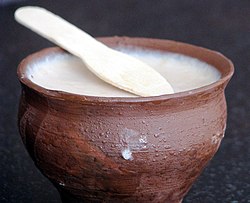
Mishti doi (Bengali: মিষ্টি দই; transl. Sweet curd) is a fermented sweet doi (yogurt) originating from the Bengal region of the Indian subcontinent[1] and common in the Indian states of West Bengal, Tripura, Assam's Barak Valley,[2] and in the nation of Bangladesh.[3][4] It is made with milk and sugar or jaggery. It differs from the plain yogurt because of the technique of preparation. There are many variations of mishti doi according to their popularity. Sweet curd of Nabadwip, Kolkata, Bogra, etc are very popular.[5]
Mishti doi is prepared by boiling milk until it is slightly thickened, sweetening it with sugar, either gura (brown sugar) or khejur gura (date molasses), and allowing the milk to ferment overnight.[6] Earthenware is always used as the container for making mitha dahi because the gradual evaporation of water through its porous walls not only further thickens the yoghurt,[7] but also produces the right temperature for the growth of the culture. Very often the yoghurt is delicately seasoned with a pinch of cardamom for fragrance. Baked yogurt is a similar preparation in the West.[citation needed]
Before the discovery of miracle drugs for typhoid, well-known alopathic physicians like Dr. B. C. Roy, Col. Denham White and Nilratan Sircar prescribed mishti doi for their patients which helps to accumulate Vitamin Bs.[8]
References
[edit]- ^ Tamang, Jyoti Prakash (5 August 2016). Ethnic Fermented Foods and Alcoholic Beverages of Asia. Springer. p. 20. ISBN 978-81-322-2800-4.
- ^ Mudgil, D.; Mudgil, S. B. (1 January 2015). Glossary of Dairy Technology. Scientific Publishers. p. 84. ISBN 978-93-86102-32-4.
- ^ Tamang, Jyoti Prakash; Kailasapathy, Kasipathy (1 July 2010). Fermented Foods and Beverages of the World. Boca Raton, Florida: CRC Press: Taylor & Francis Group. p. 17. ISBN 978-1-4200-9496-1.
- ^ Whyte, Mariam; Lin, Yong Jui (2010). Bangladesh. New York: Marshall Cavendish Benchmark. p. 144. ISBN 9780761444756.
- ^ Ruj, Subrata (2019). Mistanno Mitare: A Collection of Prose (in Bengali). Howrah: Sristisukh Prokashan LLP. p. 88. ISBN 978-93-88887-73-1.
- ^ Brien, Charmaine O' (15 December 2013). The Penguin Food Guide to India. Penguin UK. ISBN 978-93-5118-575-8.
- ^ Krondl, Michael (1 October 2011). Sweet Invention: A History of Dessert. Chicago: Chicago Review Press. pp. 59–60. ISBN 978-1-56976-954-6.
- ^ Dasgupta, M. (14 October 2000). Calcutta Cookbook: A Treasury of Recipes From Pavement to Place. Penguin UK. ISBN 978-93-5118-149-1.

| Main and side dishes |
| ||||||
|---|---|---|---|---|---|---|---|
| Snacks and sauces | |||||||
| Breads | |||||||
| Beverages | |||||||
| Sweetmeats | |||||||
| Bangladeshi diaspora | |||||||


 | This Bangladeshi cuisine–related article is a stub. You can help Wikipedia by expanding it. |
 | This Indian cuisine–related article is a stub. You can help Wikipedia by expanding it. |
Mishti doi
View on GrokipediaOrigins and History
Historical Background
Mishti doi, a fermented sweet yogurt integral to Bengali culinary heritage, emerged from the longstanding tradition of dairy fermentation in the Indian subcontinent, where plain yogurt known as dahi has been referenced in ancient Vedic texts dating back to the Vedic period of the Indian subcontinent (c. 1500–500 BCE).[7] These early practices involved curdling milk using natural starters, laying the foundation for various regional dairy products that utilized abundant local milk resources. The specific origins of mishti doi as a sweetened variant are traced to the Bengal Presidency, British India (now the Bogra district in present-day Bangladesh), where the contemporary form emerged in the 19th century, with credits often given to the Bose family of Sherpur or the Ghosh family of Bogra, both from the Bengali Hindu community. It gained prominence through patronage by figures like the Nawab of Bogra, Altaf Ali Chowdhury, who provided land to its producers.[4] This innovation likely arose in the context of Bengal's agrarian society, which historically supported high milk yields—as of 2023–24, West Bengal produces over 7 million tonnes annually—enabling the experimentation with enriched dairy preparations passed down through generations.[2][8] Over time, mishti doi evolved from basic fermented milk into a caramelized treat, primarily sweetened with jaggery or sugar, reflecting the region's access to tropical sweeteners like palm and cane jaggery that imparted a unique burnt-sugar aroma during the slow cooking process. This adaptation not only preserved milk surplus but also aligned with cultural preferences for mildly sweet, probiotic-rich foods in eastern India, including West Bengal, Bihar, and Assam.[2]Regional Development
Mishti doi, originating in the Bengal region of the Indian subcontinent, gradually spread to adjacent areas including Tripura, Assam's Barak Valley, and throughout Bangladesh, where it integrated into local culinary practices influenced by shared cultural and climatic factors.[9] Within West Bengal, India, mishti doi evolved into distinct local variants, notably Nabadwip-er lal doi in the Nabadwip area of Nadia district, a heritage site renowned for its Vaishnava temple traditions. This red-hued version achieves its characteristic color through extended milk reduction over 7-8 hours, followed by fermentation in earthen pots, often prepared as prasad for temple offerings. The variant's ties to Nabadwip's spiritual heritage underscore how regional religious customs shaped the dessert's production and cultural role. Colonial-era trade networks in the 19th and early 20th centuries expanded access to refined sugar imports, subtly altering mishti doi's preparation by enabling higher sweetness levels compared to traditional jaggery-based recipes. This shift, driven by increased availability of processed cane sugar through British-controlled ports, allowed for more consistent caramelization and broader commercialization by the 1920s, while preserving core fermentation techniques.[10]Cultural Significance
Role in Bengali Cuisine
Mishti doi occupies a central position in Bengali cuisine as a quintessential fermented sweet yogurt that exemplifies the region's deep-rooted affinity for dairy-based desserts. Synonymous with other iconic confections like roshogolla and sandesh, it represents a cornerstone of Bengal's sweet-making heritage, where milk serves as the primary base for household and commercial preparations.[11] This dessert integrates seamlessly into the broader culinary landscape, enhancing the balance between sweet and savory elements that defines traditional Bengali meals.[11] In a typical Bengali thali, mishti doi is frequently served as the concluding dish to offset the robust flavors of savory accompaniments, creating a harmonious contrast of creamy sweetness against tangy and spicy notes. This pairing underscores Bengal's culinary philosophy, where the "mishti" (sweet) component, embodied by mishti doi alongside treats like sandesh or rasgulla, tempers the intensity of savory staples, promoting a holistic dining experience that reflects cultural preferences for flavor equilibrium.[11] Beyond festive occasions, mishti doi features prominently in everyday consumption patterns, particularly in rural Bengal households where it is often prepared at home using fresh milk and enjoyed as a breakfast or afternoon snack. This practice not only fosters family traditions but also bolsters dairy intake in agrarian diets, aligning with Bengal's historical reliance on milk products for nutrition and sustenance.[11]Association with Festivals and Traditions
Mishti doi plays a central role in Bengali festivals, most notably Durga Puja and Kali Puja, where it is offered as prasad in temples across West Bengal and Bangladesh. During these celebrations, the dessert is prepared in large quantities and distributed as part of the bhog, symbolizing devotion and communal joy, with families in Kolkata and Dhaka sharing it at pandal feasts and home gatherings.[12][13][14] Beyond religious observances, mishti doi features prominently in lifecycle rituals, including wedding banquets, where it embodies prosperity and health in Bengali culture. At weddings, it is served during ceremonies like Dodhi Mangal, where the bride and groom consume a mixture of sweet curd with flattened rice, marking the union's auspicious start, and later in elaborate feasts to bless the couple's future abundance.[15][16][17] The dessert's prominence also ties to seasonal rhythms, peaking during the monsoon when abundant rainfall boosts milk production through lush pastures, making it ideal for fermentation in the warm, humid climate. This aligns with its inclusion in harvest celebrations like Nabanna, where mishti doi complements new rice dishes in feasts honoring agricultural bounty and gratitude.[18][19]Ingredients and Preparation
Essential Ingredients
The primary ingredient in traditional mishti doi is full-fat milk sourced from cows or buffaloes, which is boiled to reduce it to approximately half its volume, concentrating the solids to achieve the dessert's signature creamy texture. This reduction process enhances the milk's natural thickness and flavor, with buffalo milk often preferred in some regions for its higher fat content that contributes to a richer consistency.[20] Sweeteners play a crucial role in balancing the tanginess of fermentation, with traditional options including khajuri guda (date palm jaggery), which imparts distinctive caramel-like notes, or white sugar for a milder, cleaner sweetness.[21] The typical ratio is about 1 part sweetener to 4 parts milk by weight (approximately 15-20% by weight), ensuring the final product has a subtle sweetness without overpowering the yogurt's profile; date jaggery is especially valued in winter preparations for its seasonal availability and nutty undertones. The fermentation starter is plain curd (dahi) from a previous batch, typically added at 1-2% of the milk volume, which introduces bacteria such as Lactobacillus delbrueckii subsp. bulgaricus and Streptococcus thermophilus essential for the lactic acid fermentation that develops mishti doi's tangy flavor and smooth set. This natural culture ensures consistent acidification to around 0.7% during setting. Occasionally, a pinch of ground elaichi (cardamom) is incorporated into the mixture to enhance the aromatic profile without altering the core fermentation.[21]Traditional Fermentation Process
The traditional fermentation process of mishti doi relies on simple, low-tech methods passed down through generations in rural Bengal, utilizing natural earthenware for optimal microbial activity and flavor development. Full-cream cow's milk serves as the base, boiled slowly over a low flame in a wide-mouthed vessel to prevent scorching while stirring continuously with a wooden ladle.[1] This reduction continues until the milk thickens to a kheer-like consistency, typically halving its volume and concentrating the solids for a creamy texture. Once thickened, the milk is allowed to cool naturally to a lukewarm temperature, approximately 40°C, ensuring it remains suitable for introducing live cultures without killing beneficial bacteria.[1] At this stage, a sweetener such as palm jaggery or sugar—proportioned to about 15-20% of the milk weight—is stirred in until fully dissolved, followed by the addition of a small amount of plain curd (dahi) as the starter culture, usually 1-2% by volume, to initiate lactic acid fermentation. The added sucrose from the sugar remains mostly unfermented, providing the characteristic sweetness, while the lactic acid bacteria primarily ferment the lactose in the milk into lactic acid for tanginess and thickening. However, the high sugar concentration creates osmotic pressure that inhibits bacterial growth, slowing the fermentation process and often requiring adjustments like more starter culture for proper setting.[22][23] The mixture is gently blended to distribute the culture evenly, avoiding vigorous agitation that could disrupt the process. The prepared mixture is then poured into kulhad or matki—traditional unglazed earthen pots that provide breathability and subtle mineral infusion—filling them to about three-quarters capacity to allow for expansion. These pots are placed in a warm, dark location, such as a corner of the kitchen or near a mild heat source like a coal ember, covered loosely with a clean cloth to protect from contaminants while permitting air circulation.[1] Fermentation proceeds undisturbed for 8-12 hours at ambient temperatures of 30-35°C, during which Lactobacillus delbrueckii subsp. bulgaricus and Streptococcus thermophilus bacteria convert lactose to lactic acid, resulting in a firm, custard-like set without the need for ovens or other modern equipment. Upon completion, the doi is refrigerated briefly to halt further acidification and enhance firmness before consumption.[1]Modern Preparation Techniques
In contemporary home preparation, mishti doi can be made by mixing the base ingredients with a yogurt starter and baked at a low temperature of around 200°F (93°C) for approximately 2 hours to set the mixture, offering a controlled alternative to ambient setting.[24] This method suits urban kitchens lacking traditional earthenware, ensuring even heat distribution without overcooking. For even faster results, microwave steaming involves heating the mixture in a microwave-safe bowl for short intervals totaling about 2-4 minutes with periodic stirring to thicken it before allowing it to set, reducing preparation time significantly compared to conventional techniques.[25] Commercial production of mishti doi employs industrialized processes for scalability and safety, starting with pasteurized milk that is concentrated by heating, then blended with jaggery or sugar, followed by inoculation with a starter culture of Lactobacillus delbrueckii subsp. bulgaricus and Streptococcus thermophilus.[26] Fermentation occurs in sterile, temperature-controlled vats to maintain consistent quality and prevent contamination, typically lasting several hours under monitored conditions. The set product is cooled, portioned, and packaged in sealed plastic cups to extend shelf life and facilitate distribution. Notable examples include production by brands like Amul, which is developing a major facility in Kolkata capable of processing large volumes of mishti doi alongside other curd products as of February 2025.[27] Time-saving variations cater to busy households by blending evaporated milk with plain yogurt, condensed milk, and sugar to form the base, which is then baked at 350°F (175°C) for 30-45 minutes before chilling in the refrigerator for 2-3 hours to achieve a firm texture, bypassing extended warming steps.[28] This approach, while yielding a slightly different firmness than traditionally fermented versions, provides a convenient shortcut with minimal equipment.Characteristics and Variations
Flavor, Texture, and Appearance
Mishti doi exhibits a distinctive flavor profile characterized by caramelized sweetness derived from the addition of jaggery or caramelized sugar during preparation, complemented by tangy notes from lactic acid fermentation and a subtle nutty aroma often imparted by cardamom.[29][30] The fermentation process contributes to its sweet-acidic taste, with a post-fermentation pH typically ranging from 4.06 to 5.11, which balances the sweetness without overpowering acidity.[31] In terms of texture, mishti doi features a smooth, pudding-like consistency that is denser than plain yogurt due to the incorporation of milk solids and sweeteners, resulting in a firm yet creamy set curd without excessive graininess.[32][21] This velvety mouthfeel arises from the controlled fermentation, which promotes gel formation and enhances overall body.[29] The appearance of mishti doi ranges from pale creamish to a light reddish-brown hue, primarily resulting from the caramelization of sugar or jaggery, which imparts a warm, inviting tone.[32][21] It is traditionally presented in terracotta pots, which not only preserve its earthy undertones but also enhance its visual appeal through the rustic contrast of the container.[29] Nutritionally, mishti doi is rich in probiotics from beneficial bacteria like Lactobacillus species and provides around 190 mg of calcium per 100 g in some commercial varieties, supporting bone health and gut microbiota.[21][33]Regional and Commercial Variations
Several towns and cities of Bengal stand as the epicenter of mishti doi, such as Kolkata, Nabadwip, Hooghly district towns like Chinsurah and Serampore, and Krishnanagar in Nadia district, all of these centers are located in present-day West Bengal, India.[34][35] Mishti doi exhibits notable regional variations that reflect local ingredients and traditions. In Nabadwip, West Bengal, India, Nabadwip-er lal doi, also known as lal doi or chakku doi, is distinguished by its deeper red color resulting from prolonged cooking and a silkier, stickier texture achieved through prolonged reduction of whole milk mixed with sugar in a 4:3 volume ratio and jaggery for flavor, followed by fermentation in earthen pots.[2] This variant maintains a semisolid consistency with a smooth mouthfeel and moderate caramelized sweetness, setting it apart from the standard off-white mishti doi.[2] In Kolkata, West Bengal, mishti doi is an iconic dessert renowned for its popularity in traditional sweet shops. The Kolkata style often features a characteristic reddish hue derived from caramelizing sugar during the prolonged reduction of milk, resulting in a smooth, creamy texture with a rich caramel flavor and subtle tangy notes from fermentation. This variant highlights the city's vibrant sweet-making heritage and is commonly enjoyed as a chilled treat.[24][36] Across the border in Bogra, Bangladesh, Bograr mishti doi is renowned for its richer fat content, often derived from full-cream local cow milk boiled and reduced extensively before sweetening with sugar or date palm jaggery and fermenting in earthenware pots.[2] The result is a dense, creamy product with a caramel-colored surface, subtle smoky aroma, and balanced sweet-tangy profile that emphasizes regional milk quality for enhanced body and flavor depth.[37] Commercial productions of mishti doi have adapted traditional recipes for wider distribution, incorporating preservatives to extend shelf life beyond the typical 6-15 days of artisanal versions under refrigeration. Brands like Amul offer standardized mishti doi in pouches, focusing on consistent caramelized sweetness without regional tweaks, while some producers introduce flavored variants, including mango-infused mishti doi that blends fruit puree for a tropical twist on the classic profile.[38] These innovations prioritize convenience and variety, often using stabilizers alongside preservatives to maintain texture during transport and storage.[2]References
- https://commons.wikimedia.org/wiki/File:Mishti_doi_01.png