


Community hub
Recent from talks
Contribute something
Nothing was collected or created yet.
Darkness
View on Wikipedia
Darkness is the condition resulting from a lack of illumination, or an absence of visible light.
Human vision is unable to distinguish colors in conditions of very low luminance because the hue-sensitive photoreceptor cells on the retina are inactive when light levels are insufficient, in the range of visual perception referred to as scotopic vision.
The emotional response to darkness has led to metaphorical usages of the term in many cultures, often to convey feelings of unhappiness or forebording.
"Darkness" may also refer to night, which occurs when the Sun is more than 18° below the horizon.
Scientific
[edit]Perception
[edit]The perception of darkness differs from the mere absence of light that sometimes lead to afterimages. In perceiving, the eye is active, and the part of the retina that is unstimulated produces a complementary afterimage.[1]
Physics
[edit]In terms of physics, an object is said to be dark when it absorbs photons, causing it to appear dim compared to other objects. For example, matte black paint does not reflect much visible light and appears dark, whereas white paint reflects much light and appears bright.[2] For more information, see color. An object may appear dark, but it may be bright at a frequency that humans cannot perceive.
A dark area has limited light sources, making things hard to see. Exposure to alternating light and darkness (night and day) has caused several evolutionary adaptations to darkness. When a vertebrate, like a human, enters a dark area, its pupils dilate, allowing more light to enter the eye and improving night vision. Also, the light detecting cells in the human eye (rods and cones) will regenerate more unbleached rhodopsin when adapting to darkness.
One scientific measure of darkness is the Bortle scale, which indicates the night sky's and stars' brightness at a particular location, and the observability of celestial objects at that location.[3]
The material known as Vantablack is one of the darkest substances known, absorbing up to 99.965% of visible light (at 663 nm if the light is perpendicular to the material), and was developed by Surrey NanoSystems in the United Kingdom.[4][5] The name is a compound of the acronym VANTA (vertically aligned nanotube arrays) and the word black.[6]
Technical
[edit]The color of a point, on a standard 24-bit computer display, is defined by three RGB (red, green, blue) values, each ranging from 0–255. When the red, green, and blue components of a pixel are fully illuminated (255,255,255), the pixel appears white; when all three components are unilluminated (0,0,0), the pixel appears black.[7]
Cultural
[edit]Artistic
[edit].jpg)
 | This section has multiple issues. Please help improve it or discuss these issues on the talk page. (Learn how and when to remove these messages)
|

Artists use darkness to emphasize and contrast the presence of light. Darkness can be used as a counterpoint to areas of lightness to create leading lines and voids. Such shapes draw the eye around areas of the painting. Shadows add depth and perspective to a painting.
Color paints are mixed together to create darkness, because each color absorbs certain frequencies of light. Theoretically, mixing together the three primary colors, or the three secondary colors, will absorb all visible light and create black. In practice, it is difficult to prevent the mixture from taking on a brown tint.
Literature
[edit]As a poetic term in the Western world, darkness is used to connote the presence of shadows, evil, and foreboding,[8] or in modern parlance, to connote that a story is grim, heavy, and/or depressing.[9]
Religion
[edit]
The concept of light and darkness holds profound symbolic and theological significance across various religious traditions, serving as metaphors for creation, morality, and the nature of existence.
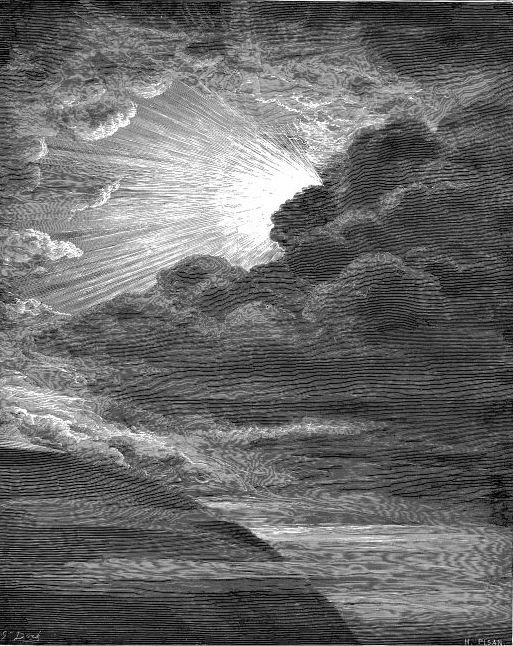
In the Judeo-Christian tradition, the first creation narrative begins with a void, described as "formless and empty," over which "darkness was over the surface of the deep" (Genesis 1:2). Into this void, God introduces light, declaring, "Let there be light" (Genesis 1:3), and separates this light from the darkness. This initial act of creation is distinct from the later creation of celestial bodies—the sun and moon—on the fourth day.
The symbolism of darkness and light in these traditions extends beyond the physical. Light is often associated with divine presence, knowledge, and goodness, while darkness symbolizes ignorance, separation from God, and sin. For example, in Exodus 10:21, darkness is described as "the second-to-last plague" inflicted upon Egypt, representing both physical and spiritual blindness. Similarly, in the New Testament, Jesus frequently contrasts light and darkness in his teachings. Darkness is the "outer realm" where there is "weeping and gnashing of teeth" (Matthew 8:12), symbolizing eternal separation from God.
In Islam, light (nūr) and darkness (ẓulumāt) are frequently invoked in both physical and spiritual contexts, reflecting profound moral and theological truths. The Quran begins its account of creation with Allah (or God) making the heavens and the earth and then creating "the darknesses and the light" (Quran 6:1). However, unlike some traditions where darkness is portrayed as inherently evil or chaotic, Islam emphasizes that both are under Allah's divine will and serve His purposes.
Light in the Quran often represents guidance, faith, and divine revelation, while darkness symbolizes misguidance, disbelief, and moral corruption. For instance, believers are often described as being "brought out from darkness into light" (Quran 2:257), a metaphor for their journey from ignorance to divine knowledge. This dichotomy underscores the moral framework of Islam, where both light and darkness are tools through which Allah tests and guides humanity.
In ancient Greek mythology, Erebus was a primordial deity representing the personification of darkness, particularly associated with the shadowy realm of death and the underworld. In Greek cosmology, darkness was often linked to the afterlife, where souls journeyed into the depths of the underworld, a place of shadow and obscurity.
Darkness in Greek cosmology was not merely an absence of light but a distinct and active force. The underworld, ruled by Hades, was a place of obscurity and shadow, reflecting the ambiguous fate of the human soul after death. In this tradition, darkness often signified the unknown and the eternal, as well as the boundaries between life and the afterlife.
Philosophy
[edit]In Chinese philosophy, yin is the complementary feminine part of the taijitu and is represented by a dark lobe.
Poetry
[edit]The use of darkness as a rhetorical device has a long-standing tradition. William Shakespeare, working in the 16th and 17th centuries, made a character called the "prince of darkness" (King Lear: III, iv) and gave darkness jaws with which to devour love. (A Midsummer Night's Dream: I, i)[10] Geoffrey Chaucer, a 14th-century Middle English writer of The Canterbury Tales, wrote that knights must cast away the "workes of darkness".[11] In Divine Comedy, Dante described hell as "solid darkness stain'd".[12]
Language
[edit]In Old English there were three words that could mean darkness: heolstor, genip, and sceadu.[13] Heolstor also meant "hiding-place" and became holster. Genip meant "mist" and fell out of use like many strong verbs. It is however still used in the Dutch saying "in het geniep" which means secretly. Sceadu meant "shadow" and remained in use. The word dark eventually evolved from the word deorc.[14]
See also
[edit]References
[edit]- ^ Horner, David T. (2000). Demonstrations of Color Perception and the Importance of Contours, Handbook for Teaching Introductory Psychology. Vol. 2. Texas: Psychology Press. p. 217. ISBN 9780805836547.
Afterimages are the complementary hue of the adapting stimulus and trichromatic theory fails to account for this fact
[permanent dead link] - ^ Mantese, Lucymarie (March 2000). "Photon-Driven Localization: How Materials Really Absorb Light". American Physical Society, Annual March Meeting. American Physical Society: E2.001. Bibcode:2000APS..MAR.E2001M.
- ^ Mizon, Bob (2016-07-04). Finding a Million-Star Hotel: An Astro-Tourist's Guide to Dark Sky Places. Springer. pp. 9–16. ISBN 978-3-319-33855-2.
- ^ Coldewey, Devin (15 July 2014). "Vantablack: U.K. Firm Shows Off 'World's Darkest Material'". NBC News. Archived from the original on 19 July 2014. Retrieved 19 July 2014.
- ^ Guinness World Records: Darkest manmade substance, 19 October 2015
- ^ Rossing, Thomas D.; Chiaverina, Christopher J. (2020-01-03). Light Science: Physics and the Visual Arts. Springer Nature. p. 172. ISBN 978-3-030-27103-9.
- ^ Kruegle, Herman (2011-03-15). CCTV Surveillance: Video Practices and Technology. Elsevier. p. 259. ISBN 978-0-08-046818-1.
- ^ Heart of Darkness: Literary Touchstone Classic. Prestwick House Inc. 31 December 2004. p. 6. ISBN 978-1-58049-812-8.
- ^ "Darkness". MacMillan Dictionary. Archived from the original on Dec 9, 2016. Retrieved 19 December 2022.
- ^ Shakespeare, William. "The Complete Works". The Tech, MIT.
- ^ Chaucer, Geoffrey. The Canterbury Tales, and Other Poems. The Second Nun's Tale.
- ^ Alighieri, Dante; Francis, Henry (trans.). The Divine Comedy.
- ^ Mitchell, Bruce; Fred C. Robinson (2001). A Guide to Old English. Glossary: Blackwell Publishing. pp. 332, 349, 363, 369. ISBN 978-0-631-22636-9.
- ^ Harper, Douglass (November 2001). "Dark". Online Etymology Dictionary. Retrieved 2007-01-18.
External links
[edit] The dictionary definition of darkness at Wiktionary
 Quotations related to Darkness at Wikiquote
 Media related to Darkness at Wikimedia Commons


| Authority control databases: National |
|---|

Darkness
View on GrokipediaPhysical Foundations
Physics of Light Absence
In physics, darkness is defined as the complete absence of photons in the visible electromagnetic spectrum, which corresponds to wavelengths between approximately 400 and 700 nanometers (nm). This range represents the portion of the electromagnetic spectrum detectable by the human eye, where photons carry sufficient energy to excite retinal photoreceptors without causing ionization. Without these photons, no visual perception occurs, resulting in the perceptual phenomenon of darkness.[12][13] The broader electromagnetic spectrum encompasses radiation beyond the visible range, including ultraviolet (below 400 nm) and infrared (above 700 nm), which do not contribute to illumination for human vision. Human photoreceptors, specifically cones and rods in the retina, are insensitive to these wavelengths; for instance, infrared radiation primarily manifests as thermal energy rather than visual light, and ultraviolet is absorbed by the eye's lens and cornea without triggering visual signals. Thus, an environment filled with non-visible radiation remains dark to human observers, as darkness pertains specifically to the lack of visible photons.[14][15] Light intensity from a point source diminishes according to the inverse square law, which describes how electromagnetic radiation spreads uniformly over the surface of an expanding sphere. The intensity at a distance from a source emitting power is given by where the denominator represents the surface area of the sphere. This law explains the rapid decay of light in empty space or dark environments, leading to darkness beyond a certain distance from any source, as the photon flux per unit area decreases quadratically.[16][17] In dark environments, objects approach thermal equilibrium through blackbody radiation, where they emit and absorb electromagnetic radiation based on their temperature. A blackbody, an idealized absorber and emitter, produces a continuous spectrum of radiation peaking at a wavelength inversely proportional to its temperature (Wien's displacement law), but in the absence of external visible light sources, this emission is typically in the infrared for room-temperature objects, maintaining darkness while balancing energy exchange. At thermal equilibrium, the rate of emission equals absorption, preventing net heating or cooling, though the radiation itself remains non-visible./University_Physics_III_-Optics_and_Modern_Physics(OpenStax)/06%3A_Photons_and_Matter_Waves/6.02%3A_Blackbody_Radiation)[18] The vacuum of space exemplifies ultimate darkness due to the near-total absence of matter, eliminating both scattering and local emission sources that could diffuse visible light. Without atmospheric particles or dense media, photons from distant stars travel unimpeded in straight lines, illuminating only direct lines of sight rather than filling the void. This lack of diffusion ensures that vast interstellar regions appear profoundly dark, with the cosmic microwave background providing only faint, non-visible microwave radiation.[19][20] Rayleigh scattering further illustrates the role of media in light propagation: in Earth's atmosphere, shorter-wavelength blue light (around 450 nm) scatters more efficiently off nitrogen and oxygen molecules—proportional to , where is wavelength—resulting in a blue sky during daylight. In the vacuum of space, however, no such molecules exist to scatter sunlight, so the sky appears black, with direct stellar light reaching observers only along unobstructed paths. This scattering dependence highlights why darkness prevails in the absence of both emitters and scatterers.[19][21]Astronomical Contexts
In astronomical observation, the darkness of the night sky is essential for detecting faint celestial objects such as stars, planets, and galaxies, as it provides the necessary contrast against which their light becomes visible. Without this ambient darkness, the glare from brighter sources would overwhelm subtler emissions, rendering distant astronomical features indistinguishable. For instance, measurements from spacecraft like New Horizons indicate that interplanetary space is profoundly dark, with the sky between stars appearing nearly black when viewed far from Earth's atmospheric interference and artificial lights.[22] Earth's rotation on its axis, completing one full turn approximately every 24 hours, produces the diurnal cycle of darkness by alternately exposing and shielding regions from sunlight, while the atmosphere scatters incoming solar radiation during daylight to create relative brightness, but allows near-total darkness at night when direct illumination ceases. This rotational dynamic, combined with the planet's 23.5-degree axial tilt, determines the duration and quality of nighttime darkness, which varies by latitude and season.[23] Even in the vast emptiness of space, the universe is not entirely devoid of radiation; the cosmic microwave background (CMB) represents a faint, uniform glow permeating the cosmos, originating as the cooled remnant of the hot plasma from roughly 380,000 years after the Big Bang, when the universe first became transparent to light. This relic radiation, now shifted to microwave wavelengths due to cosmic expansion, provides the dimmest "light" in an otherwise dark expanse, marking the transition from the opaque early universe to the star-filled era that followed hundreds of millions of years later.[24][25] Dark matter and dark energy dominate the universe's composition, together accounting for about 95% of its total energy density—dark matter comprising roughly 27% and dark energy 68%—yet both remain invisible because they do not interact with electromagnetic radiation, including light. Dark matter is inferred primarily through its gravitational influence on visible matter, such as the way it holds galaxies together by providing unseen mass that affects orbital speeds and the bending of light via gravitational lensing. Dark energy, meanwhile, drives the accelerated expansion of the universe, counteracting gravity on large scales without emitting or absorbing photons.[26][27][28] Eclipses exemplify temporary astronomical darkness, occurring when one celestial body passes into the shadow of another, such as a solar eclipse where the Moon blocks sunlight and casts an umbra (dark inner shadow) and penumbra (partial shadow) across Earth's surface, briefly plunging areas into twilight-like conditions. Lunar eclipses similarly darken the Moon as it enters Earth's shadow. These events highlight the geometry of orbital mechanics in producing localized darkness. Olbers' paradox, which questions why the night sky is dark in an infinite, static universe filled with stars, is resolved by the universe's finite age—approximately 13.8 billion years—limiting the distance light can travel to reach observers, and its ongoing expansion, which redshifts distant starlight to invisibility over vast scales.[29][30][31] The Hubble Deep Field observations, captured in 1995 by pointing the telescope at an apparently empty patch of sky in the constellation Ursa Major for 10 days, revealed over 3,000 galaxies in what seemed like dark void, demonstrating that such "empty" spaces are teeming with distant, ancient galaxies whose light has traveled billions of years to become visible. This image underscored how darkness in apparently barren regions actually conceals profound cosmic depth.[32] Human-induced light pollution severely compromises astronomical visibility by increasing sky brightness, washing out faint stars and galaxies; the Bortle scale classifies night sky quality from 1 (exceptional darkness, with the Milky Way vivid overhead) to 9 (inner-city glow, where only bright planets are discernible), quantifying how artificial lighting erodes the natural darkness essential for observation. Sites with Bortle class 1-3 skies, far from urban areas, remain critical for detecting dim cosmic phenomena.[33][34]Biological and Perceptual Dimensions
Sensory Perception
Human sensory perception of darkness primarily relies on the visual system, where the absence of light triggers adaptations in the retina's photoreceptor cells. The retina contains rod and cone cells, with rods specialized for low-light scotopic vision and cones for brighter photopic conditions. Rods are highly sensitive, functioning effectively at illuminance levels around 0.01 lux, enabling detection of faint light, while cones require higher intensities, typically above 10 lux, for color discrimination and detail perception.[35][36] Dark adaptation enhances visual sensitivity in darkness through physiological changes, including pupillary dilation, which occurs within seconds to allow more light entry, and the regeneration of photopigments like rhodopsin in rod cells. This process unfolds in phases: cone-mediated adaptation reaches near-maximum in about 10 minutes, but full rod sensitivity, dependent on rhodopsin renewal, takes 20-30 minutes. The absolute threshold for human vision is approximately cd/m², below which no light is perceivable, and in transitional low light, the Purkinje effect occurs, where sensitivity shifts toward shorter wavelengths, causing reds to appear dimmer first as cones desensitize.[37][38] In conditions impairing these mechanisms, such as nyctalopia or night blindness, individuals struggle with low-light vision due to vitamin A deficiency, which hinders rhodopsin production and is reversible with supplementation. Aging also affects perception, with dark adaptation slowing after age 40 due to delayed rhodopsin regeneration and reduced rod efficiency, prolonging the time needed for full sensitivity recovery.[39][40] Animals exhibit diverse adaptations for perceiving and navigating darkness beyond human capabilities. Nocturnal species like cats possess a tapetum lucidum, a reflective layer behind the retina that amplifies available light by redirecting it through photoreceptors, enhancing night vision by up to six times compared to humans. In contrast, bats rely on non-visual echolocation, emitting ultrasonic pulses and interpreting echoes to map environments in complete darkness, bypassing light-dependent perception entirely.[41][42]Physiological Impacts
Darkness plays a critical role in regulating human circadian rhythms through the promotion of melatonin production, a hormone synthesized by the pineal gland that peaks during periods of low light exposure and signals the body to prepare for sleep. This process is essential for maintaining sleep-wake cycles, as melatonin secretion is suppressed by exposure to light, particularly blue wavelengths greater than 460 nm, which activate intrinsically photosensitive retinal ganglion cells. Disruptions to this natural darkness-mediated rhythm, such as from artificial lighting, can lead to misalignment of internal clocks and associated health issues.[43][44] Prolonged darkness, as experienced in winter months at higher latitudes with reduced daylight, is linked to Seasonal Affective Disorder (SAD), a subtype of major depressive disorder characterized by symptoms including persistent low mood, fatigue, and loss of interest in activities. The condition arises from diminished sunlight exposure, which lowers serotonin levels and disrupts melatonin balance, exacerbating depressive episodes. Effective treatment often involves bright light therapy, which mimics natural daylight to restore circadian alignment and alleviate symptoms, with studies showing significant improvements in mood and energy levels.[45][46][47] Extended exposure to darkness also inhibits cutaneous vitamin D synthesis, as ultraviolet B radiation from sunlight is required to convert 7-dehydrocholesterol in the skin to previtamin D3; this leads to deficiencies that impair calcium absorption, bone health, and immune function. In evolutionary terms, populations at high latitudes adapted by developing lighter skin pigmentation to enhance vitamin D production under limited sunlight, balancing the need for sufficient synthesis against folate degradation risks. Such deficiencies remain prevalent in modern high-latitude regions with insufficient sun exposure.[48][49] Artificial light intrusion into natural darkness contributes to shift work sleep disorder, where irregular schedules suppress melatonin and desynchronize circadian rhythms, resulting in chronic insomnia, excessive daytime sleepiness, and increased risks for metabolic and cardiovascular conditions. In space environments, microgravity causes bone density loss at rates of up to 1-2% per month in weight-bearing bones, as indicated by analyses as of 2023; altered light-dark cycles contribute to circadian disruptions and irregular sleep, adding to overall physiological stresses.[50][51][52] Among animals, shortening days signal hibernation in bears, triggering hormonal shifts that reduce metabolism and promote fat storage for winter survival, allowing species like black bears to endure months without eating or drinking. In the dark ocean depths, where sunlight penetration is minimal below 1,000 meters, bioluminescent organisms such as anglerfish and lanternfish have evolved chemical light production via luciferase reactions to facilitate predation, communication, and camouflage against faint downwelling light.[53][54][55][56]Technological and Practical Uses
Detection and Measurement
Darkness, as the absence of light, is quantified through measurements of illuminance, which represents the amount of luminous flux incident on a surface. The primary unit for illuminance is the lux (lx), defined as one lumen per square meter (lm/m²), where the lumen measures luminous flux weighted by human visual sensitivity. Luminous intensity, a related quantity, is measured in candelas (cd), the SI base unit for the power emitted by a light source in a particular direction. Photometers and lux meters are standard instruments for assessing ambient light levels, employing photodetectors calibrated to the photopic vision curve to convert light energy into equivalent lux values, enabling precise evaluation of environmental darkness.[57][58] In astronomical contexts, darkness is often measured using sky quality meters, which quantify night sky brightness in magnitudes per square arcsecond (mag/arcsec²), a logarithmic scale where lower values indicate brighter skies and higher values denote darker conditions. These handheld devices, such as the Unihedron Sky Quality Meter, integrate light over a small field of view to provide readings typically ranging from about 16 mag/arcsec² in urban areas to over 22 mag/arcsec² in pristine dark sites. For comparison, illuminance under a full moon on a clear night reaches approximately 0.25 lx, while a starless or moonless night can drop to around 0.001 lx, highlighting the stark contrast in perceived darkness.[59][60] Absolute darkness is calibrated using radiometry techniques, where blackbody sources emit known spectral radiance based on temperature according to Planck's law, serving as references for zero-light conditions. Integrating spheres, coated with highly reflective diffusers, simulate uniform dark environments by averaging incident radiation, minimizing stray light and enabling precise calibration of detectors for low-light measurements. These tools are essential in laboratories for establishing baselines in photometry and spectroradiometry.[61] Environmental monitoring of darkness relies on satellite-based systems to map light pollution globally. The Visible Infrared Imaging Radiometer Suite (VIIRS) instrument aboard the Suomi National Polar-orbiting Partnership (Suomi NPP) satellite captures nighttime radiance data, producing composite maps that reveal artificial light emissions and their impact on natural darkness, with resolutions down to 500 meters. These datasets inform legal standards, such as those from the Illuminating Engineering Society (IES), which define lighting zones (LZ0 to LZ4) for dark sky preserves, recommending zero uplight in LZ0 areas to maintain natural sky conditions.[62][63] The dark-sky movement, formalized by the founding of DarkSky International (previously the International Dark-Sky Association) in 1988, has driven standardized measurements to combat light pollution, emphasizing quantifiable preservation of night skies. In cosmic scales, telescopes like the James Webb Space Telescope (JWST), launched in 2021, probe deep-space darkness by detecting faint infrared emissions from the early universe, revealing the distribution of matter against the cosmic background and advancing understanding of universal expansion.[64][65][66]Engineering Applications
Stealth technology in engineering leverages principles of darkness by minimizing detectability across electromagnetic spectra, particularly radar, through low-observable designs and radar-absorbent materials (RAM). The Lockheed F-117 Nighthawk, introduced in the 1980s, exemplifies this approach with its angular facets that scatter radar waves and a coating of RAM that absorbs rather than reflects signals, rendering the aircraft nearly invisible to enemy radar systems.[67] This design mimics optical darkness by reducing the radar cross-section to levels comparable to a small bird, enabling covert operations in low-light or contested environments.[68] Such technologies extend beyond visible light to infrared and other wavelengths, influencing modern aircraft like the F-35 with integrated RAM composites.[69] Night-vision devices engineer solutions to exploit ambient darkness by amplifying scarce photons or detecting non-visible emissions. Image intensification, the core of active night-vision systems, uses photocathodes to convert low-level visible and near-infrared light into electrons, which are accelerated and multiplied before striking a phosphor screen to produce a visible image, effectively turning starlight or moonlight into daylight-like visibility.[70] These devices have evolved through generations: Generation 1 (Gen 1), developed in the 1960s, relied on basic electron multiplication with image quality limited to about 1,000x amplification but required an infrared illuminator for optimal performance; Gen 2 introduced microchannel plates for higher gain and resolution; Gen 3 added gallium arsenide photocathodes for improved low-light sensitivity. Advanced Gen 3 variants incorporate filmless tubes, automatic gating, and enhanced signal-to-noise ratios for use in dynamic lighting conditions.[71][72] Thermal imaging complements this by passively detecting infrared radiation from heat sources, independent of visible light, using microbolometer sensors to form images based on temperature differences as small as 0.1°C, crucial for applications like military surveillance in total darkness.[70] In photography, darkrooms provide controlled darkness to preserve the latent image formed on photographic film during exposure. When light strikes silver halide crystals in the emulsion, it liberates electrons that reduce silver ions to metallic silver specks, creating an invisible latent image that requires total darkness (typically less than 1 lux) to prevent further exposure or fogging during handling and development.[73] Development in a darkroom involves immersing the film in a chemical reducer that amplifies these specks into visible grains, followed by fixing to remove unexposed halides, all under safelights that emit non-actinic wavelengths to maintain the latent structure.[74] This process, refined since the 19th century, ensures high-fidelity image reproduction by isolating the film from stray light, though digital alternatives have reduced its prevalence in modern workflows.[75] Energy-efficient lighting systems mitigate darkness selectively to conserve power and curb light pollution. Light-emitting diodes (LEDs) dominate due to their low energy draw—up to 80% less than incandescent bulbs—and integration with photocell sensors that activate illumination only when ambient light falls below thresholds like 10 lux, as in dusk-to-dawn fixtures for streets and security.[76] Smart grids enhance this by using IoT-enabled controls to dim or schedule lights based on real-time darkness levels, reducing urban skyglow by 20-50% in optimized deployments while maintaining safety.[77] LEDs with warm color temperatures (below 3000K) further minimize ecological disruption by directing light downward and avoiding blue-rich spectra that exacerbate light pollution.[78] Advanced materials like Vantablack, a 2014 nanomaterial from vertically aligned carbon nanotubes, absorb 99.965% of incident visible light by trapping photons in a "forest" structure, preventing reflection or scattering.[79] In engineering, it informs stealth coatings and precision optics, while simulated dark conditions using such absorbers test solar panels via dark I-V measurements, which isolate leakage currents without illumination to assess shunt resistance and overall module integrity under no-light scenarios.[80] These tests, conducted in controlled chambers, reveal defects like microcracks that manifest in darkness, ensuring photovoltaic reliability.[81]Cultural and Symbolic Interpretations
Religious and Mythological Roles
In Abrahamic traditions, particularly within Christianity, darkness features prominently in scriptural narratives as a symbol of primordial chaos and divine judgment. The Book of Genesis recounts that on the first day of creation, God commanded, "Let there be light," and subsequently separated the light from the darkness, naming the light "day" and the darkness "night," thereby imposing order on the formless void.[82] This act establishes darkness as the initial state of unformed existence, from which structured reality emerges through divine intervention. In the New Testament, "outer darkness" appears repeatedly as a metaphor for eschatological punishment, as in Matthew 8:12, where Jesus describes the fate of the unfaithful as being cast into outer darkness, accompanied by weeping and gnashing of teeth, evoking isolation and torment beyond the realm of light. Scholarly analysis of these passages interprets outer darkness not merely as physical absence of light but as a theological realm of separation from God's presence, reinforcing moral accountability. Norse mythology portrays darkness as an elemental force integral to both origins and apocalypse. The concept of Ginnungagap, the gaping void, depicts a primordial emptiness—a boundless, dark abyss between the realms of fire (Muspelheim) and ice (Niflheim)—where the first beings, Ymir and Audhumla, arose through the interaction of elemental extremes, marking the chaotic prelude to cosmic formation.[83] Academic examinations of Eddic texts emphasize Ginnungagap's role as a magical, power-laden void, embodying potentiality rather than mere nothingness, from which the ordered world of gods and humans differentiated.[83] In the cataclysmic event of Ragnarök, darkness culminates as the sun and moon are swallowed by wolves, plunging the world into eternal night, followed by the earth's submersion in the sea amid fire and flood, symbolizing the cyclical dissolution of order before a renewed creation.[84] This fatalistic eschatology, drawn from sources like the Poetic Edda, underscores darkness as an inevitable, transformative force in the Norse worldview, blending destruction with latent rebirth.[84] Within Hinduism, darkness manifests as a multifaceted principle of dissolution and inertia, embodied in deities and philosophical qualities. Kali, the fierce goddess often depicted with black skin, represents the devouring aspect of time (kala) and destruction, emerging from Durga's forehead in the Devi Mahatmya to annihilate the demon Raktabija by consuming his blood-spawned duplicates, thereby restoring cosmic balance through her dark, transformative power.[85] This narrative, part of the Markandeya Purana, positions Kali as the embodiment of the unknown and the annihilator of ego, her garland of skulls and protruding tongue signifying the inevitability of death and renewal.[85] Complementing this, the Bhagavad Gita delineates tamas as one of the three gunas (qualities of nature), characterized by darkness, delusion, inertia, and ignorance, which obscures knowledge and binds individuals to sloth and attachment, contrasting with the illuminating sattva and dynamic rajas.[86] Tamas, as the guna of primal obscurity, influences both material phenomena and human temperament, urging transcendence through disciplined action to overcome its veiling effects.[86] Indigenous traditions across diverse cultures invoke darkness as a sacred precursor to creation and a conduit for spiritual continuity. In Australian Aboriginal cosmologies, the Dreamtime—known as Alcheringa or "eternal dreamtime"—encompasses the timeless era when ancestral beings shaped the land, laws, and life forms from a pre-existent, formless state often evoked as an enveloping night or void, where all potential existed without differentiation.[87] This eternal night-like expanse, persisting in the present as "everywhen," links past creation to ongoing ancestral presence, guiding rituals and identity.[88] Similarly, in Yoruba mythology of West Africa, Orunmila, the orisha of wisdom and divination through the Ifa oracle, connects to ancestral spirits (egun) amid themes of obscurity, as consultations invoke the unseen realm of the dead, facilitating guidance from primordial forces that transcend visible light.[89] Orunmila's role as witness to creation underscores darkness as a medium for ancestral wisdom, bridging the living and the eternal.[89] Ancient Egyptian theology further illustrates darkness through Nun, the deified primeval waters embodying chaotic, inert obscurity before ordered existence. In the Pyramid Texts, Nun appears as the infinite, dark ocean surrounding the created world, from which the creator god Atum-Ra self-generated on the benben mound, separating light and form from its formless depths to establish maat (cosmic order).[90] These Old Kingdom inscriptions (c. 2400–2300 BCE) portray Nun as an eternal, shadowy reservoir of potentiality, ever-threatening to revert creation to undifferentiated chaos, yet sustaining the Nile's fertility and the sun's daily rebirth.[91] Nun's dual nature—as both destructive void and life-giving source—highlights darkness's theological ambiguity in Egyptian thought.[91]Philosophical and Psychological Aspects
In ancient Greek philosophy, Plato's Allegory of the Cave, presented in Book VII of The Republic, uses darkness as a metaphor for the state of ignorance in which most people dwell. Prisoners chained in a dark cave perceive only shadows cast by a fire behind them, mistaking these illusions for reality; the philosopher's ascent from the cave into the sunlight represents the painful journey from sensory deception to true enlightenment and knowledge of the Forms.[92] This allegory underscores the transformative potential of confronting darkness, portraying it not merely as absence but as a barrier to intellectual liberation that requires rigorous education to overcome.[92] Building on such themes, 19th-century philosopher Friedrich Nietzsche explored darkness through the metaphor of the abyss in Beyond Good and Evil (1886), warning that prolonged contemplation of profound existential voids risks reciprocal corruption: "He who fights with monsters should look to it that he himself does not become a monster. And if thou gaze long into an abyss, the abyss will also gaze into thee."[93] Nietzsche's aphorism highlights the psychological peril of delving into the "dark" unknowns of morality and human nature, suggesting that such engagement can erode one's ethical boundaries and foster nihilistic despair.[93] In 20th-century existentialism, Jean-Paul Sartre extended these ideas in Being and Nothingness (1943), framing human consciousness—or "being-for-itself"—as inherently free yet burdened by the absurdity of existence in a meaningless universe. This freedom manifests in a profound, disorienting void akin to darkness, where individuals must create their own values amid nausea-inducing contingency, as exemplified in Sartre's novel Nausea (1938), where the protagonist confronts the irrational "slimy" essence of things.[94] Sartre argued that authentic living demands embracing this absurd freedom without recourse to illusions, transforming existential darkness into a catalyst for radical responsibility.[94] From a psychological perspective, Carl Jung's concept of the shadow archetype, introduced in works like Aion (1951), represents the repressed, "dark" underbelly of the psyche—comprising instincts, weaknesses, and socially unacceptable traits that individuals deny to maintain a persona of wholeness. Jung viewed the shadow as an autonomous complex within the unconscious, often projected onto others, and emphasized its integration through analytical therapy to achieve individuation, cautioning that "one does not become enlightened by imagining figures of light, but by making the darkness conscious."[95] Therapeutic practices, such as active imagination or dream analysis, employ dark imagery—symbols like night or monsters—to confront and assimilate these aspects, reducing projections and enhancing psychic balance.[96] Nyctophobia, the intense fear of darkness, exemplifies how such psychological dynamics manifest clinically, affecting approximately 20-30% of children aged 4-12 with severe nighttime anxieties.[97] This phobia often stems from an evolutionary adaptation for predator avoidance, as ancestral humans faced heightened vulnerability in low-light conditions where threats like nocturnal hunters were harder to detect, priming the amygdala for hypervigilance in darkness.[98] In modern contexts, cognitive-behavioral interventions help by gradually exposing individuals to dark environments, reframing the fear as a vestige of survival instincts rather than an immediate danger.[98] Contemporary research further links chronic deprivation of natural darkness—exacerbated by urban light pollution—to elevated anxiety levels. A 2024 systematic review and meta-analysis of light at night (LAN) exposure found associations with worsened mental health outcomes, including heightened anxiety symptoms, as constant artificial illumination disrupts circadian rhythms and fosters a sense of perpetual unease.[99] This "darkness deficit" in urban settings may amplify existential isolation, echoing philosophical concerns while underscoring the need for restorative night environments to mitigate psychological strain.[99]Artistic and Literary Expressions
Visual and Performing Arts
In visual arts, the chiaroscuro technique employs dramatic contrasts between light and shadow to model forms, create depth, and evoke emotional intensity, a method pioneered by artists like Rembrandt van Rijn in his 1642 painting The Night Watch. Rembrandt's masterful use of this approach in The Night Watch illuminates key figures emerging from enveloping darkness, fostering a sense of movement and narrative drama within the militia group's composition.[100][101] Gothic architecture from the 12th century further harnessed darkness to inspire spiritual awe, with elongated naves designed to draw worshippers from shadowed entryways into progressively brighter spaces symbolizing enlightenment. At Notre-Dame Cathedral in Paris, begun in 1163, the vast, dimly lit nave heightens the mystical atmosphere, contrasting with radiant stained-glass windows that filter divine light, guiding the viewer's perceptual journey from obscurity to illumination.[102][103] Contemporary installations extend this interplay of darkness and perception, as seen in Yayoi Kusama's Infinity Mirrored Rooms, where darkened chambers lined with reflective surfaces and pulsing lights generate illusions of boundless voids and infinite repetition. Kusama's works, such as Infinity Mirrored Room – My Heart Is Dancing into the Universe (2018), immerse viewers in spatial disorientation, using shadow and reflection to dissolve boundaries between self and environment.[104][105] Similarly, Anish Kapoor's void sculptures, like Descent into Limbo (1992), confront audiences with stark abysses of blackness, evoking the sublime terror of emptiness and psychological introspection through matte, light-absorbing materials that mimic infinite depth.[106][107] In performing arts, theater leverages total darkness for immersive storytelling, particularly in black box stages—simple, black-painted spaces that eliminate distractions and allow lighting to sculpt the performance environment. These venues, with their absorbent walls and floors, enable directors to use spotlights to carve out focal areas from surrounding obscurity, intensifying emotional tension and spatial ambiguity in experimental productions.[108][109] Film noir, emerging in the 1940s, similarly deploys low-key lighting to cast elongated shadows that amplify moral ambiguity and suspense, as in Orson Welles's Citizen Kane (1941), where deep-focus cinematography merges foreground figures with receding dark backgrounds to underscore isolation and psychological depth.[110][111] Recent advancements in virtual reality (VR) exhibits build on these traditions by simulating sensory deprivation through programmed darkness, fostering altered states of awareness. In 2024, DARKFIELD's immersive experiences, such as those premiered at the Denver Center for the Performing Arts, enclosed participants in pitch-black containers with binaural audio and tactile effects, replicating void-like isolation to heighten narrative immersion without visual cues.[112][113] Meanwhile, VR cave simulations in archaeological research projects used controlled darkness to mimic prehistoric environments, inducing creative and perceptual shifts akin to ancient rituals.[114]Literature and Language
In literature, darkness frequently serves as a multifaceted motif symbolizing moral ambiguity, psychological turmoil, and existential voids. Joseph Conrad's Heart of Darkness (1899) exemplifies this through its portrayal of the Congo as a metaphorical moral abyss, critiquing European colonialism's dehumanizing effects and the inner corruption it fosters in individuals like Kurtz.[115] Similarly, in William Shakespeare's Macbeth (1606), darkness embodies the protagonists' overwhelming guilt, as seen in Lady Macbeth's invocation of "thick night" to cloak their regicidal ambitions, transforming literal obscurity into a pervasive symbol of ethical descent and madness.[116] Poetry has long harnessed darkness to evoke pre-creation chaos and sublime dread. John Milton's Paradise Lost (1667) opens with a depiction of primordial darkness as an unformed void preceding divine light, representing both cosmic disorder and Satan's rebellious domain in Hell.[117] Romantic poets expanded this tradition; Percy Bysshe Shelley's Mont Blanc (1817) employs the night's impenetrable gloom to convey the sublime terror of nature's vast, indifferent power, blending awe with the fear of annihilation.[118] Etymologically, the English term "dark" derives from Old English deorc, denoting absence of light or gloom, traceable to Proto-Germanic derkaz and ultimately Proto-Indo-European dʰer-, connoting dirtiness or obscurity.[119] In Latin, tenebrae similarly signifies shadows or thick darkness, from Proto-Indo-European temH-, evoking a sense of enveloping obscurity distinct from but parallel to Germanic roots. Darkness permeates linguistic expressions as a metaphor for ignorance and emotional isolation. The idiom "in the dark," emerging in the late 17th century, figuratively means lacking knowledge, drawing on the literal concealment provided by absence of light. Cross-culturally, Japanese kurayami (darkness) extends beyond physical dimness to imply profound emotional or psychological obscurity, often in literary contexts evoking despair or hidden truths.[121] Gothic literature prominently features dark settings to heighten atmosphere and explore the uncanny. Mary Shelley's Frankenstein (1818) utilizes stormy nights and shadowy laboratories to underscore themes of isolation and forbidden knowledge, with the creature's emergence amid lightning and gloom amplifying horror.[122] A 2024 analysis found that AI-generated poetry is often indistinguishable from human-written poetry and rated higher for qualities such as rhythm and accessibility, though some critiques note a potential lack of authentic emotional depth.[123]References
- https://en.[wiktionary](/page/Wiktionary).org/wiki/tenebrae