
.jpg/250px-Mulard_(1).jpg)


.jpg)
Community hub
Recent from talks
Contribute something
Nothing was collected or created yet.
Mulard
View on Wikipedia| Mulard | |
|---|---|
.jpg)
| |
Domesticated
| |
Scientific classification
| |
| Kingdom: | Animalia |
| Phylum: | Chordata |
| Class: | Aves |
| Order: | Anseriformes |
| Family: | Anatidae |
| Subfamily: | Anatinae |
| Hybrid: | Anas platyrhynchos × Cairina moschata |
The mulard (or moulard) is a hybrid between two different genera of domestic duck: the domestic Muscovy duck (derived from the Muscovy duck Cairina moschata) and the domestic duck (derived from the mallard Anas platyrhynchos). American Pekins and other domestic ducks are most commonly used to breed mulards due to the breed's high meat production. Like many interspecific F1 hybrids, mulards are sterile, giving them the nickname mule ducks. While it is possible to produce mulards naturally, artificial insemination is used more often with greater success. [1]
The term mulard or moulard is generally reserved for offspring where the parental drake is a Muscovy and the duck is a Pekin. When the drake is a Pekin, the offspring tend to be smaller and are called hinnies.
Husbandry and production
[edit]The mulard is commercially produced on farms for meat and foie gras. The White Muscovy and the Pekin are the two most common purebred, commercially farmed ducks. Hybrids of the two are hardier and calmer, in addition to exhibiting natural hybrid vigor.[2]
The incubation period of the hybrid eggs is between the mallard and Muscovy, with an average of 32 days. About half of the eggs hatch into mulard ducks.[citation needed] Mulards tend to combine certain traits of the parent breeds. Due to their Muscovy heritage, they produce leaner meat than Pekins; females tend to be raised for meat, while males are used for foie gras. Like Muscovy ducks, mulards have claws on their feet, but do not fly and perch; instead, they prefer to stay near water, as Pekins do.[3]
Traditionally, foie gras was primarily produced with geese, but by the 1960s the majority of farmers began to use mulards. Geese are more expensive to maintain than ducks (they are larger and more aggressive), and the more temperamental Muscovies did not accept the process of gavage (force feeding) as readily as Pekins, causing the quality of the foie gras to suffer.[3] This problem was avoided by the introduction of mulards. These hybrids have also become extremely common in countries where foie gras is not produced.[4]
Today in France, the leading foie gras producer and consumer, the use of hybrid ducks outnumbers the use of geese. In 2007, there were 35 million mulard ducks raised in the country, compared with only 800,000 geese.[2] In addition to Europe and the United States, mulards are widely raised throughout Southeast Asia.[4]
Gallery
[edit]-
 Muscovy duck
 -
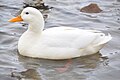 Pekin drake
 -
 Moulard Duck Foie Gras with Pickled Pear


See also
[edit]
References
[edit]- ^ Dohner, Janet (2001). The Encyclopedia of Historic and Endangered Livestock and Poultry Breeds. Yale University Press. p. 457. ISBN 978-0-300-08880-9. Retrieved 5 March 2019.
- ^ a b Caro, Mark (2009). The Foie Gras Wars. Simon & Schuster. ISBN 978-1-4165-5668-8.
- ^ a b "Committee on Animal Health and Animal Welfare on Welfare Aspects of the Production of Foie Gras in Ducks and Geese" (PDF). European Commission. December 1998. Archived from the original (PDF) on 2007-05-07. Retrieved 2009-09-26.
- ^ a b Daghir, N. (2008). Poultry Production in Hot Climates. CABI. ISBN 978-1-84593-258-9.
.png) | This duck article is a stub. You can help Wikipedia by adding missing information. |
Mulard
View on GrokipediaDefinition and Characteristics
Hybrid Origin
The mulard, also known as moulard or mule duck, is a sterile hybrid produced by crossing a male domestic Muscovy duck (Cairina moschata domestica) with a female Pekin duck (Anas platyrhynchos domesticus), two species from distinct genera within the Anatidae family.[1][7] This deliberate intergeneric hybridization leverages the Muscovy's larger body size, leaner meat, and propensity for fat accumulation in the liver, combined with the Pekin's rapid growth rate and white plumage.[2] The resulting offspring exhibit hybrid vigor (heterosis), achieving market weights of 7-8 kg in 10-12 weeks, faster than either parent breed alone.[8] Genetic incompatibility renders mulards sterile, as the Muscovy (80 chromosomes) and Pekin (derived from mallard with 78-80 chromosomes, but differing sex chromosome systems and evolutionary divergence of approximately 50 million years) produce gametes that fail to form viable zygotes in subsequent generations.[7][9] Mulards are almost exclusively produced via natural mating or artificial insemination, with the reverse cross (Pekin male × Muscovy female) yielding "hinny" ducks that are smaller and less commercially viable.[1] Approximately 60% of mulard progeny are male, which are preferred for meat production due to their bulkier frames.[7] The parental breeds trace distinct evolutionary paths: the Muscovy, native to Central and South America and domesticated by indigenous peoples for meat and pest control, features a caruncle-covered face and perching ability absent in Anas species; the Pekin, selectively bred in China from wild mallards (Anas platyrhynchos) since at least the 17th century for table use, provides the hybrid's calm temperament and foraging efficiency.[10] This cross originated in agricultural practices aimed at optimizing traits for intensive farming, particularly in foie gras production where mulards' enlarged livers (up to 10% of body weight under force-feeding) outperform purebreds.[2][8]Physical and Behavioral Traits
The Mulard duck, a hybrid of the male Muscovy (Cairina moschata) and female Pekin (Anas platyrhynchos domesticus), displays intermediate physical characteristics favoring commercial utility. It typically features white plumage derived from the Pekin parent, selected in production lines to ensure clean carcass presentation without residual dark pinfeathers. Some variants exhibit darker brown or black feathers with green or purple iridescent sheen, though white strains predominate for meat and foie gras markets. Mature Mulards attain larger sizes than Pekins, with males averaging 4-5 kg and females 3.5-4 kg at slaughter, boasting broader breasts, leaner dark red meat, and robust frames influenced by the Muscovy. They possess sharp claws on their webbed feet akin to Muscovy ducks, aiding in scratching but less utilized for perching.[11][2][12] Behaviorally, Mulards inherit a preference for water-based activities over the arboreal perching and flight common in Muscovy ducks, aligning more closely with Pekin tendencies for foraging and swimming. They demonstrate tolerance for confined rearing and force-feeding protocols, attributed to Muscovy resilience, yet exhibit hybrid-specific traits in stress responses. Research on mule ducks reveals heterosis effects, rendering them more fearful of humans than either parent breed, with pronounced avoidance behaviors, elevated tonic immobility, and heightened physiological stress indicators such as increased heterophil/lymphocyte ratios during handling tests at 10 weeks of age. This fearfulness, observed across multiple studies, may complicate management in open systems but suits controlled production environments. Feeding behaviors, including intake rates and meal patterns, show heritability influenced by both parental lines, supporting selective breeding for efficient foie gras yield.[2][13][14]Genetic and Reproductive Biology
The Mulard duck, also known as the mule duck, is an intergeneric first-generation (F1) hybrid produced by crossing a male Muscovy duck (Cairina moschata) with a female Pekin duck (Anas platyrhynchos domesticus).[15][16] This specific parental combination yields offspring with desirable traits such as rapid growth and high meat yield, but results in complete reproductive sterility in both sexes due to genetic incompatibilities between the divergent genera.[17][18] Both parental species share a diploid chromosome number of 80 (2n=80), with similarities in karyotype structure, yet hybrids exhibit chromosomal heterochromatin differences and meiotic disruptions that prevent gamete formation.[19][20] In male Mulards, sterility manifests as meiotic arrest during primary spermatocyte development, halting sperm production and resulting in azoospermia.[21] Transcriptomic studies of testicular tissues reveal downregulated expression of meiosis-related genes and upregulated stress response pathways, contributing to gonadal degeneration.[17][22] Female Mulards display underdeveloped ovaries with arrested follicular development and absence of ovulation, linked to disrupted sexual differentiation pathways during embryogenesis.[15][23] Genes such as Tsga10, Terb1, Stra8, Tex14, and Spam1 have been identified as candidates influencing this sterility across both sexes, based on comparative gonadal transcriptome profiling.[18] The sterility ensures that Mulard populations cannot be propagated through self-breeding, necessitating annual production via controlled crosses of purebred parental lines to maintain the hybrid lineage.[24][25] Experimental attempts at backcrossing or advanced-generation hybrids yield viable but infertile offspring, underscoring the post-zygotic barriers inherent to this intergeneric pairing.[26] This reproductive isolation aligns with Haldane's rule, where heterogametic sex (males in birds, ZZ/ZW system) experiences greater hybrid inviability or sterility.[21]History and Development
Early Hybridization Experiments
The earliest documented hybridization experiments yielding mulard ducks—sterile intergeneric hybrids between male Muscovy ducks (Cairina moschata) and female Pekin ducks (Anas platyrhynchos domesticus) or closely related strains—trace to Taiwan over 275 years ago. These crosses combined the Muscovy's lean carcass and high meat yield with the Pekin-derived female's prolific egg production (up to 250 eggs per year) and faster maturation, addressing limitations in pure Muscovy breeding such as low female fertility and slow growth rates. Early Taiwanese breeders used Kaiya females, a Pekin-Tsiaya cross, to produce mule ducks optimized for meat production, achieving body fat levels below 18% versus 30% in pure Pekins.[25] Natural interspecies mating proved inefficient due to ethological barriers, including size disparities and incompatible courtship behaviors, yielding fertility rates under 45% without intervention. Experimenters thus relied on hand-mating, where farmers physically facilitated copulations in ponds twice weekly to boost success. Incubation periods extended to 32-35 days for hybrid eggs, longer than the 28 days for Pekins, prompting refinements in hatching techniques. The hybrids' sterility, resulting from genetic divergence between genera separated for millions of years, ensured no viable offspring from mulards themselves, necessitating perpetual parental line maintenance—a trait leveraged for controlled meat production without population mixing.[25][7] These Taiwanese practices predated European adoption, where similar crosses emerged for fattening but lacked the scale of Asian systems until the mid-20th century. Limited records exist on precise inaugural experiments, but the focus remained empirical: selecting for white plumage via recessive traits in Tsiaya lines crossed with White Pekins to meet market preferences, while avoiding darker Muscovy influences. Such early efforts established mulards as viable for intensive rearing, though artificial insemination—introduced in Taiwan around the late 20th century—later supplanted manual methods for higher efficiency.[25][27]Commercialization in the 20th Century
The mulard duck, a sterile hybrid of the Muscovy drake (Cairina moschata) and Pekin hen (Anas platyrhynchos domesticus), emerged as a targeted innovation in French poultry breeding during the 1950s to enhance foie gras output. This crossbreeding capitalized on the Muscovy's robust carcass and fat deposition traits combined with the Pekin's rapid growth, yielding birds that fattened more efficiently than purebred ducks or geese, with males particularly responsive to overfeeding regimens for superior liver quality and yield.[28] The development aligned with post-World War II agricultural intensification in southwestern France, where maize abundance supported expanded palmiped farming, shifting foie gras production from labor-intensive geese toward scalable duck systems.[28] By the 1960s, mulards supplanted geese as the dominant species in foie gras manufacturing, comprising the bulk of duck-derived output due to lower rearing costs, shorter production cycles (typically 12-14 weeks to slaughter), and higher liver-to-body mass ratios—often exceeding 10% under controlled force-feeding.[29] Commercial adoption accelerated through selective line breeding and artificial insemination techniques, which overcame the low natural fertility (around 50-70%) of intergeneric matings, enabling consistent hybrid production without viable offspring that could complicate farm management.[29] French farms, concentrated in regions like Landes and Gers, scaled operations accordingly; by the late 1970s, mulard foie gras accounted for over 80% of national duck production, with annual outputs reaching millions of birds amid rising domestic and export demand.[29] This era marked mulards' transition from experimental crosses—noted sporadically since the early 1900s in small-scale trials—to industrialized staple, driven by economic imperatives for yield optimization rather than breed purity. Export markets in Europe and beyond further incentivized standardization, with French output dominating global foie gras supply by century's end, though initial commercialization faced logistical hurdles like hybrid uniformity before genetic stabilization.[28]Husbandry and Production
Breeding Practices
Mulards are produced through interspecific hybridization between a male Cairina moschata (Muscovy duck drake) and a female Anas platyrhynchos domesticus (Pekin duck hen), yielding offspring valued for their large size, lean carcass, and suitability for foie gras production.[1][2] The reciprocal cross—a Pekin drake with a Muscovy hen—produces smaller "hinny" ducks, which are less commercially viable and exhibit variable fertility, whereas the standard mulard cross consistently results in sterile F1 hybrids due to meiotic arrest in spermatocytes and disrupted gonadal development.[24][17] This sterility precludes true breeding lines or propagation from mulard stock, requiring commercial and backyard producers to repeatedly mate purebred parent lines for each cohort of ducklings.[1][30] In practice, parent flocks are maintained with ratios of one Muscovy drake to 4–6 Pekin hens to optimize mating success and fertility, with sexual maturity reached at 7–10 months for both breeds.[31] Natural mating occurs but yields lower fertilization rates compared to artificial insemination, which is prevalent in Europe and Asia for its precision in semen collection from Muscovy drakes and deposition into Pekin hens, achieving higher hatchability—often around 50–70% of fertilized eggs—while minimizing disease transmission.[1][2] Breeder management emphasizes biosecure housing with access to water for mating, controlled lighting to simulate photoperiods (avoiding natural long days from December to June to prevent premature reproductive activation), and nutritional regimens high in protein (18–20%) to support egg production from Pekin hens, which lay 200–300 eggs annually under optimal conditions.[32] Eggs are collected daily, stored at 10–15°C for up to 7 days, then incubated at 37.5°C with 55–70% humidity, hatching in 28–35 days depending on strain vigor.[33] Hybrid vigor in mulards confers hybrid sterility alongside heterosis benefits like rapid growth (reaching 4–5 kg in 8–10 weeks), but parent selection prioritizes disease-resistant, high-libido Muscovy drakes and prolific Pekin lines to sustain production efficiency.[1][17]Rearing and Management
Mulard ducklings, produced through controlled crosses between Muscovy drakes and Pekin hens, are commercially available as day-old hybrids from specialized hatcheries and are reared exclusively for meat or foie gras production due to their sterility.[24] Initial brooding requires temperatures of 32–35°C (90–95°F) for the first week, decreasing by 2–3°C weekly until ambient conditions are reached around 4–6 weeks, with adequate ventilation to prevent respiratory issues and ammonia buildup from wet litter.[34] Floor space allocation starts at 0.05 m² (0.5 sq ft) per duckling in the first two weeks, expanding to 0.1–0.2 m² (1–2 sq ft) by 4–7 weeks to accommodate rapid growth, often in deep-litter systems with straw or wood shavings changed regularly for hygiene.[35] Feeding regimens emphasize high-energy starter diets (22–24% protein) from hatch to 2 weeks, transitioning to grower feeds (16–18% protein) with consistent access to clean water via nipple systems to minimize mess and disease risk, as mulards exhibit efficient feed conversion comparable to Pekin ducks but with larger frames inherited from Muscovy parentage.[36] Management prioritizes biosecurity, including all-in-all-out systems, vaccinations against common pathogens like duck viral enteritis, and monitoring for cannibalism or stress in confined flocks of 1,000–10,000 birds per barn.[37] Mulards reach slaughter weights of 3–4 kg (6.6–8.8 lb) at 10–14 weeks, depending on market demands, with their calm temperament facilitating handling in intensive setups tolerant of warmer climates.[38][33]Force-Feeding Protocols
Force-feeding, or gavage, constitutes the terminal phase in Mulard duck production for foie gras, inducing hepatic steatosis through controlled overfeeding to enlarge the liver beyond 300 grams, the minimum threshold for legal classification as foie gras under EU regulations.[39][40] This process targets male Mulard hybrids, which are reared to approximately 11 weeks of age and 4.4 kilograms body weight prior to initiation, following a preparatory growing phase with feed restriction to enhance appetite and liver responsiveness.[39][41] The standard duration spans 12 to 15 days, though experimental protocols may shorten it to 9 to 12 days, delivering 22 to 24 total meals at a frequency of two per day to align with the duck's digestive capacity and minimize refusal.[39][41][42] Feed comprises a high-carbohydrate maize mash—typically 53% corn meal blended with 47% water, occasionally augmented with fats for palatability and energy density (lysine at 0.28%, methionine 0.22%)—administered in escalating portions starting at 200 grams per meal and incrementing by 20 grams daily to reach 400 grams per feeding, yielding daily intakes up to 800 grams.[39][42][41] Administration employs a 20- to 30-centimeter tube inserted via the beak into the esophagus and crop, often using manual funnels, auger mechanisms (45-60 seconds per session), or pneumatic systems (2-3 seconds), with ducks commonly restrained in individual cages (prevalent in 80% of duck operations) to facilitate handling and ensure complete intake.[39] Water access remains continuous, sometimes alkalized with sodium bicarbonate to support digestion. During this period, body weight advances to approximately 6.5 kilograms, driven by lipid accumulation primarily in the liver, which expands 6- to 10-fold from baseline levels of around 76 grams.[39][43] Variations in protocols include adjustments for feed consumption levels to optimize growth and carcass traits, as higher intakes correlate with greater liver yields but potential digestive strain, per controlled studies on male Mulards.[44] Mechanical feeding systems exhibit mortality rates of 1.7% to 3.6% during gavage, lower with pneumatic methods compared to manual.[39] These practices derive from empirical optimization in commercial settings, prioritizing liver fat content over 50% for product quality while adhering to species-specific tolerances observed in hybrid ducks.[43][40]Culinary and Economic Uses
Meat Production
Mulard ducks, hybrids of Muscovy drakes and Pekin ducks, are raised for meat production due to their rapid growth and high lean meat yield, achieving 70-80% of adult body weight by 10 weeks of age.[45] They are slaughtered typically between 10 and 12 weeks, yielding carcasses with low fat content—3.88% in breast meat and 4.13% in leg meat—compared to pure Pekin ducks, which exhibit higher fat levels of 6.27% in legs and 6.40% in breasts.[46] [47] This leanness results from hybrid vigor, combining the Muscovy's lower fat deposition with the Pekin's faster maturation, producing meat superior in texture and flavor to Pekin while avoiding the pronounced sexual size dimorphism of pure Muscovy breeds.[24] Carcass traits include high dressing percentages of 82-84%, supporting efficient meat recovery, and elevated crude protein levels—50.55% in breast and 23.17% in leg—contributing to a nutritive profile rich in polyunsaturated fatty acids and essential amino acids.[45] [46] In regions like France, Mulards account for approximately 35% of duck meat production, valued for their broiler suitability without force-feeding, unlike foie gras lines.[45] The meat's gamey yet tender qualities make it suitable for roasting or confit, with reduced greasiness enhancing culinary versatility over fattier Pekin alternatives.[24]Foie Gras Production
Mulard ducks, hybrids of the Muscovy (Cairina moschata) and Pekin (Anas platyrhynchos domesticus) breeds, dominate duck foie gras production, accounting for over 90% of output in France, the world's leading producer.[16] Their sterility enables efficient resource allocation toward fattening rather than reproduction, while their physiology supports rapid liver lipid accumulation during force-feeding, yielding livers with fat content exceeding 50%.[48] In 2024, the European Union produced 19,809 tonnes of duck foie gras, reflecting Mulards' central role amid ducks comprising over 90% of global totals.[49] The force-feeding process enlarges Mulard livers approximately tenfold, from normal weights to over 300 grams required for legal foie gras classification, with average post-slaughter livers reaching 570 grams—8.6% of live body weight in optimized systems.[40][50] Drakes are preferred over females due to superior liver development and profitability, as hens exhibit lower fattening efficiency.[6] Technological yields average 72% usable foie gras from raw livers, with final products around 758 grams per bird after processing at day 12 of fattening.[43] Economically, Mulards offer advantages over geese or purebred ducks, including robustness, disease resistance, and simpler handling, reducing production costs where feed constitutes two-thirds of expenses.[16][51] Their foie gras commands premium prices for its firm texture, mild flavor, and high melt point, suited to searing, torchon preparation, or terrines, distinguishing it from goose variants.[52] In culinary applications, Mulard foie gras pairs with acidic elements like pickled fruits to balance richness, enhancing its status as a gourmet staple in French and international cuisine.[53]Market and Yield Data
Mulard ducks exhibit high yields in both meat and foie gras production due to their hybrid vigor, resulting in faster growth rates and efficient fat deposition compared to parent breeds. In meat-focused rearing, Mulard ducks typically achieve live weights of approximately 3.5-4.0 kg at slaughter age (around 8-10 weeks), with carcass yields ranging from 65-70% of live weight, emphasizing lean breast meat that constitutes up to 25-30% of the carcass.[54] These yields surpass those of Pekin ducks (carcass yield ~60-65%) in hybrid comparisons, attributed to the Muscovy influence enhancing muscling, though Muscovy purebreds lag in overall growth speed.[55] For foie gras, Mulard (or mule) ducks dominate production, accounting for over 90% of French output, where force-feeding yields livers weighing 600-800 grams per bird, representing 8-12% of body weight at the end of the 12-14 day overfeeding phase.[16] [43] Technological yield for processed foie gras from these livers averages 70-80% after cooking and fat loss minimization techniques, with optimal feed intake during days 91-102 of age maximizing hepatic steatosis without excessive mortality.[56] This efficiency stems from the hybrid's genetic predisposition to liver fat accumulation rather than body fat, reducing waste in processing.[53]| Breed | Purchasing Price per Duck (USD) | Selling Price per kg Live Weight (USD) |
|---|---|---|
| Pekin | 1.41 | 2.43 |
| Muscovy | 2.56 | 3.20 |
| Mulard | 2.30 | 2.94 |
Controversies and Welfare Debates
Animal Welfare Criticisms
Critics of Mulard duck production, particularly for foie gras, contend that the force-feeding regimen, or gavage, inflicts acute distress through repeated esophageal intubation, with documented cases of trauma, inflammation, and ulceration from tube insertion occurring two to three times daily over 12-15 days.[59] [60] This process, essential to inducing hepatic lipidosis, elevates stress hormones like corticosterone in some studies, though interpretations vary on whether levels indicate chronic suffering or acute handling responses.[59] The resulting liver enlargement—up to ten times normal size via forced overconsumption of carbohydrates—produces a fatty, steatotic organ that animal welfare advocates describe as pathological, potentially causing abdominal distension, impaired mobility, and metabolic strain, even if ducks do not exhibit overt refusal to eat.[59] Behavioral observations in Mulards during gavage reveal increased stereotypic actions, such as head twisting and wing flapping, interpreted as signs of discomfort, especially in confined individual cages that restrict locomotion and social interaction compared to group floor pens.[61] Housing practices exacerbate these issues, as Mulards are often denied access to bathing water during rearing and fattening, hindering natural preening and eye hygiene behaviors critical for waterfowl, leading to ocular lesions, feather plucking, and elevated aggression in commercial densities exceeding 10 birds per square meter.[62] Mortality during the gavage phase reaches 2-6% in Mulards, higher than the under 1% in non-force-fed meat ducks, attributed to aspiration, trauma, or liver rupture, per production data from French systems where Mulards predominate.[63] [39] The hybrid sterility of Mulards, bred from Muscovy drakes and Pekin females for faster growth and docility, is criticized for prioritizing yield over adaptability, potentially amplifying vulnerability to stressors like rapid fattening without compensatory natural foraging opportunities.[64] Advocacy groups, drawing on veterinary reports, argue these cumulative factors—unremitting handling stress, pathological organ changes, and barren environments—violate welfare standards by inducing unnecessary suffering, though industry-funded research often emphasizes physiological adaptation in ducks.[65]Empirical Evidence and Counterarguments
Empirical studies on mulard duck welfare during gavage primarily assess behavioral, physiological, and pathological indicators, revealing both adaptations and potential compromises without consensus on acute suffering. Behavioral observations indicate that mulard ducks, after initial habituation, do not display avoidance of the feeding tube, often approaching handlers and the apparatus voluntarily, which contrasts with responses to known painful stimuli like beak trimming.[66] This lack of aversion persists across sessions, suggesting the procedure becomes neutral or non-aversive under routine conditions, as measured by proximity and feeding initiation metrics in controlled trials.[61] Physiological markers, including corticosterone levels and hepatic enzyme activity, show transient elevations during early gavage but stabilize in mulards managed in group housing with adequate space, implying habituation rather than chronic stress.[67] Pathological outcomes include intentional steatosis from 12 to 15 days of feeding, with liver weights reaching 600-1000 grams, alongside occasional esophageal lesions (incidence 1-5% in monitored flocks) and sternal pressure sores (up to 20% in caged systems), though these are mitigated by flooring and monitoring protocols.[59] Mortality during gavage averages 0.2-1% in commercial settings, comparable to non-force-fed ducks when excluding unrelated diseases, challenging claims of excessive lethality.[53] Counterarguments highlight evolutionary parallels, noting that wild mallard ancestors—closely related to Pekin parentage in mulards—naturally engorge livers up to 4-5 times normal size via voluntary hyperphagia before migration, without evidence of distress or pathology beyond reversible fattening.[53] Avian livers lack nociceptors, precluding pain from enlargement itself, and mulards' hybrid vigor enables tolerance, as evidenced by maintained activity levels and absence of sustained inflammatory cytokine spikes in jejunal mucosa post-gavage.[67] Critics' reliance on advocacy-driven reports often overlooks these data, inflating injury rates from suboptimal farms while empirical gaps in long-term studies underscore the need for management-specific evaluations over blanket condemnations.[39] French veterinary panels, drawing from on-farm audits, affirm that welfare aligns with EU standards when housing exceeds minimal densities, positioning gavage as a controlled mimicry of natural processes rather than inherent cruelty.[68]Legal Restrictions and Bans
Force-feeding practices employed in foie gras production from mulard ducks are prohibited in the majority of European Union member states, including Austria, the Czech Republic, Denmark, Finland, Germany, Italy, Luxembourg, Norway, Poland, Sweden, and the United Kingdom, with exceptions limited to France, Hungary, Bulgaria, and Spain.[69] These restrictions target gavage, the method of repeated tube insertion to enlarge the liver, rather than mulard breeding or meat production alone.[53] In the United States, California enacted a statewide ban on the sale and production of force-fed poultry products, effective July 1, 2012, following legislation passed in 2004, which halted domestic foie gras output from mulards and similar birds.[53] New York City imposed a similar sales ban in 2019, aligning with animal welfare concerns over force-feeding, though federal law permits interstate transport and production elsewhere.[70] Globally, foie gras production via force-feeding is banned in countries including Argentina, Australia, India, Israel, and Switzerland, with India extending prohibitions to imports since 2000 to prevent any market support.[71] In France, the world's leading producer—responsible for approximately 70% of global foie gras, much from mulard ducks—national law permits the practice, but regional municipalities such as Pessac, Bordeaux, Poitiers, and Montpellier have restricted its serving at official events since 2024 to curb public endorsement.[72]| Jurisdiction | Restriction Type | Effective Date |
|---|---|---|
| California, USA | Ban on sale and force-feeding for foie gras | July 1, 2012[53] |
| New York City, USA | Ban on sale of foie gras | 2019[70] |
| India | Ban on production and import | 2000[71] |
| Most EU states (excl. France, Hungary, etc.) | Ban on force-feeding | Varies by country, e.g., Italy 1991[69] |